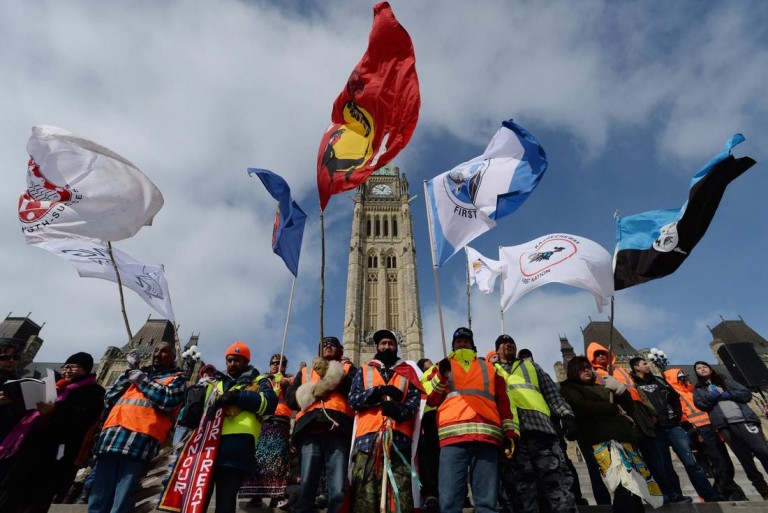

When Native leaders meet to discuss problems, some understandable issues arise: treaty implementation, child welfare and policing are usually on the agenda. Depending on recent news, such as the ongoing housing crisis on Attawapiskat, the small isolated First Nation in northern Ontario, other topics will also pop up.
However, beyond these issues are hidden matters almost never addressed, including and especially by the Assembly of First Nations at its summits: the treatment of minorities on First Nations reserves, with its attendant link to individual rights. Problematically for such minorities, there is an ongoing, rarely acknowledged conflict between indigenous people of different faiths.
In January 2011, the small Quebec First Nation of Ouje-Bougoumou (north of Montreal), an overwhelmingly evangelical Christian community, voted to ban sweat lodges and all forms of indigenous spirituality. The issue arose when an individual built the sweat lodge on his property; some responded by initiating a petition drive to ban the practice in the community. The community’s elders, overwhelmingly Christian, supported the removal of any signs of Native spirituality. Eventually, a community meeting was held and the band council voted to remove the lodge.
The move divided the community but it would be a mistake to see that example as isolated, or as only having arisen from just Christian indigenous people. There are many Aboriginal traditionalists who would be happy to see Christians leave their community. To them, Christians are reminders of the residential school legacy, where many felt Christianity was forced on indigenous peoples and traditional ways were punished.
For instance, I once heard a First Nations man in Winnipeg (a very good man by any measure) who was committed to Midewin, an indigenous traditional belief system. He talked about “wiping churches off the maps of First Nation communities.” He was speaking metaphorically but the rhetoric was still unsettling.
Life for First Nation Christians is not easy when indigenous activists use bellicose anti-Christian rhetoric, or seek as their end goal a restoration of indigenous spirituality, this when many Native people have freely chosen other religious faiths. In an ongoing example of a government-introduced double-standard, when provincial education ministries attempt to inject Native culture into school curricula, ostensibly to make Native children perform better, they almost always include a spiritual component. However, it is one which ignores the many Native Christians who are proud of their identity but who obviously choose not to practice “traditional” Aboriginal spirituality.
The divide is obvious at the highest levels of indigenous leadership. When the first session of the Truth and Reconciliation Commission was held in Winnipeg a few years back, Elijah Harper, a Cree leader and the first treaty Indian to be elected to a provincial legislature (in Manitoba in 1981), addressed the need for forgiveness, which he stated publicly was rooted in his Christian faith. The next speaker was a Native traditional revivalist and made a great effort to explain why she felt she was not “going to hell,” clearly an attempt to counter Harper’s words.
Faith is a divisive issue on many reserves. Often, religion enters into public life in a way that would make many non-Aboriginals, more used to secularism, uncomfortable. In some southern Alberta Blackfoot communities (where tribal functions involve specific rituals) traditional religious societies still play a role politically within modern band politics. That means that belonging to the ‘right’ society (i.e., that of the chief’s) can bring benefits to you and your family.
This religious-based favouritism is why, in one meeting I attended, a young First Nations man commented on the need to “separate religion from politics.”
As with the other problems that stem from concentrated power on Canada’s reserves, such power in the hands of chief and band council exacerbates the religious tension between practitioners of “old” religions and the “new”. But, as most other Canadians long ago concluded, including Europeans who after the religious wars of centuries past signed the treaty of Westphalia in 1648 to end battles over religion, it is inappropriate to use the machinery of local politics to impose beliefs on everyone.
The revisions to the Canadian Human Rights Act last June as applicable to band governments might help protect minority and individual rights on many reserves. Still, it is clear that on many reserves, checks on government power still must be implemented to allow differing faiths to be practiced.
Many indigenous people are fully committed to this reality. But the AFN has never pronounced on this critical need for diverse faiths, be they traditional Aboriginal varieties or Christian expressions, to be respected on reserve. Maybe it is time to start.
~
Joseph Quesnel is a policy analyst with the Frontier Centre for Public Policy and editorial board member of Canada’s Journal of Ideas, C2C Journal.ca, where this article first appeared.