
What was Canada’s biggest business news story of 2018? According to a nationwide poll of reporters and editors by the Canadian Press, it wasn’t the virtual giveaway of Canadian oil to Americans for tens of billions of dollars below world prices, caused by a lack of pipelines from Alberta. It wasn’t the loss of tens of billions more in oil and gas investment to the U.S. because Canada is too hostile to building new projects. It wasn’t the Americanization of Encana, once the largest of all Canadian-headquartered companies. It wasn’t the federal Liberal government’s forced purchase of the Trans Mountain pipeline from Kinder Morgan because the expansion faced insurmountable opposition from the B.C. government and environmental and Indigenous groups. Nor was it the court decision blocking the federal government from completing that project. Instead, the Canadian media’s collective choice of business news story of the year was…the legalization of cannabis.
Given their confusion over what really matters to Canada, perhaps the nation’s newsrooms are run by potheads. According to BNN Bloomberg, annual cannabis revenues are only expected to be about $6 billion. Meanwhile, despite receiving far less than world market value for its product, the oil and gas industry still contributed some $117 billion to Canada’s GDP last year. That’s more than six times the economic contribution of the Ontario auto industry, where the closure of a single GM plant in Oshawa affecting 2,600 workers generated many more stories than the layoff of 100,000 Alberta oil workers since the late 2014 collapse of world oil prices.
The drastic decline of Canada’s most important industry wasn’t created by just one event or action, but rather a combination of ideological antagonism to fossil fuels and tunnel vision. Below are my choices for the truly big Canadian business news headlines from 2018. Given how bad the news was, maybe using these to shed some light in that tunnel might help make 2019 better. It could hardly be worse.
Our fractured federation
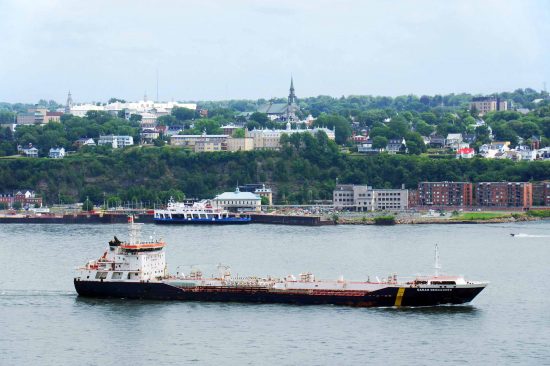
Every year, hundreds of tankers churn up the St. Lawrence River carrying oil from Saudi Arabia, Russia, Iran, Venezuela, Iraq, Nigeria, Angola and Algeria. They’re delivering oil to Eastern Canadians because Alberta oil can’t get there. These are all countries with human rights records ranking vastly below those of Canada. And none of those countries care a whit about carbon emissions. The proposed Energy East pipeline, running from Alberta to the Atlantic, would have replaced those imports plus create a new outlet to international markets, while creating jobs and economic benefits across the country. Economically beleaguered New Brunswick is an avid supporter of that nation-building project. But Quebec Premier François Legault insists there will be “no social acceptance for a pipeline that would pass through Quebec territory” carrying Alberta’s “dirty energy.”
When asked about reviving Energy East in year-end interviews, Prime Minister Justin Trudeau could have pointed out that it’s also Canada’s “territory” and that the federal government, not Quebec, has jurisdiction over pipelines. Instead, speaking to CTV, he tacitly supported Legault’s assertion by repeating “there’s no support for a pipeline through Quebec.” Along with the British Columbia government’s obstruction of oil pipelines, that makes two provinces that are getting away with opting into Confederation when it suits them, and opting out when it doesn’t.
Soon after the new premier of Quebec labelled Alberta oil “dirty energy” came news that Ottawa had boosted Quebec’s annual “equalization” transfer by $1.4 billion, to $13.1 billion. It’s inexplicable that, despite Quebec’s projected $3 billion budget surplus this year, it’s still considered a “have not” province. Meanwhile, Albertans, who face a $6 billion deficit, continue to bleed a net tax transfer to Canada of about $20 billion a year, which includes a $3 billion contribution to equalization, because Alberta is still considered a “have” province. Painfully aware that their federal taxes are the primary funder of the billions that go to Quebec every year, Albertans are starting to wonder if they’re the ones who should be talking about separation.
Making a virtue of hypocrisy
The Trudeau government was swift to condemn the murder in Turkey of journalist Jamal Khashoggi by Saudi agents. This, after Foreign Affairs Minister Chrystia Freeland had already created a diplomatic rift with the kingdom over human rights abuses committed against female Saudi activists. After Khashoggi’s murder, Trudeau said that he would “look for ways” to cancel arms sales to Saudi Arabia, despite contracts having already been signed. That would result in job losses and billions of dollars in cancellation fees, and the Saudis could simply buy arms instead from Russia. They could even pay for those Russian arms using cash Canadians send to buy Saudi oil being delivered to eastern provinces. The real way Canada could send a strong message to the Saudis would be to halt all Saudi oil imports, which have totalled over $20 billion in the past decade.
Despite strong resistance from the resource sector, the Trudeau government continued to push its Bill C-69, which will create a new approval process for resource projects, adding bizarre new criteria including “gender impacts.” Many in the industry say a pipeline will never be approved in Canada again. Of course, no investor might ever propose one again: when even the Canadian government can’t get its own, fully approved Trans Mountain pipeline expansion built, who else would dare try?
Whistler, B.C. Mayor Jack Crompton sent a letter to Alberta oil companies in November, calling for them to take “financial responsibility for your fair share of climate change being experienced by Whistler.” Critics responded that the resort’s three million annual visitors burn fuel driving from Vancouver or jetting in from around the world. Crompton could have learned from Environment Canada data showing that three-quarters of greenhouse gas emissions come from energy users, not producers. I wonder how much happier he would be if the oil industry didn’t supply fuel to deliver the tourists that make up his town’s entire economy.
Canada poses as the world burns
A press release following the UN’s climate conference in Poland trumpeted news that 190 countries had agreed upon a “rule book for putting emission reduction commitments into practice.”
Coal is the most emissions-intensive fossil fuel. China, which burns over half of the world’s coal, committed to a substantial reduction at the 2015 climate meeting in Paris. But recent research utilizing satellite photography found construction underway on hundreds of Chinese coal-fired power plants. Meanwhile, India, the world’s second-largest coal consumer, continues to escalate its coal burning at an annual rate of rate of six percent.
Elsewhere in Asia, a veritable frenzy of coal-fired power plant construction is underway. Plants under construction in Vietnam alone will produce far more carbon emissions than all of Canada’s oil and gas industry. In other news: many Canadians apparently still believe we can save the planet from global warming by shutting down our own oil and gas sector.
Canada’s oil and gas industry isn’t important only to Alberta. It’s the country’s single largest economic contributor. That’s not news. What is news is that the events of the past year further demoralized this vital, once-proud industry and its people, whose knowledge, hard work, and dedication made it one of the world’s best. And that these events resulted in handing Americans billions of dollars in price discounts due to Alberta’s lack of pipeline capacity, while sending billions more in capital fleeing south to a more hospitable climate for energy investment. All while fomenting a new national unity crisis.
Putting an end to this appalling mess, reviving Canada’s energy industry, and restoring national unity will require wise and decisive national leadership. Sadly, our current federal government is a primary source of these problems. That makes it very hard to be optimistic about 2019, even though it’s an election year. Because if the Canadian media covers the campaign with the same myopia it used to judge the 2018 business story of the year, many voters won’t have a clue about the issues that really matter.
Gwyn Morgan is the retired founding CEO of Encana Corp. A version of this article first appeared in the Financial Post.