
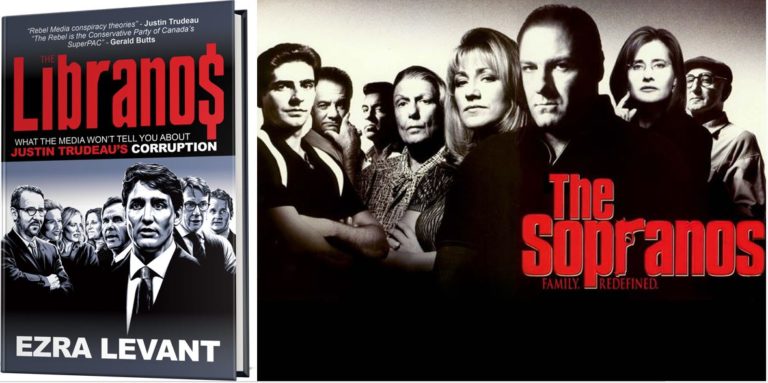
Levant in 2015 founded the Rebel News Network Ltd. and thanks his reportorial team for helping put together The Libranos: What the media won’t tell you about Justin Trudeau’s corruption, which officially launches next week. Often called Rebel Media or just The Rebel, the online multi-media venture is not to everyone’s taste. But what Levant and his team report is not about taste. It’s about facts and the narratives that make sense of them, often in ways far more persuasive than Canada’s mainstream media or the “Media Party” as Levant calls them. These are people who would prefer to snap a selfie with Justin over asking him a serious question. And although they (as well as the government and other elites) despise The Rebel, habitually describing it as “far right” and implying that it’s bigoted, that hasn’t stopped the little outfit from becoming hugely popular, with a reported 1.2 million YouTube subscribers.

The genesis of The Libranos came in the last election. Back then Justin Trudeau declared, “2015 will be the last election conducted under the first-past-the-post system.” What happened? The voting-reform committee didn’t get the message and failed to recommend what the Libranos wanted, a ranked-ballot system. For normal people, electoral systems are the most boring aspect of politics – but they’re critical to who forms governments, and how strong and stable (or entrenched, if you will) those governments tend to be. In this instance, changes to the electoral system were intended to ensure that Liberals would be in power forever because, so they thought, they were many people’s first choice and nearly everybody else’s second choice, making them eternal shoo-ins. The committee had other plans, however, recommending not the expected ranked or preferential ballot system but one of proportional representation, which would not do that. Trudeau was on record as favouring a preferential system, which is why, according to Levant, he rejected the alternative.

Trudeau promised many other things in 2015. For example, that there would be no more omnibus bills. These are bills so large and complex that they’re near-incomprehensible to anyone but the drafters, making them impossible to debate and very hard for the media and public to critique. And yet, in 2018 the Liberals used just such a bill to present a 582-page budget that on page 527 hid an amendment to the Criminal Code designed to favour one company, SNC-Lavalin. As we now know, this move involved far more than just the usual issue of the reliability accorded a politician’s promise.
In 2015 as well the Liberals vowed to govern with such transparency as had never before existed in Canada. Before the following winter was out, Trudeau had arranged to receive an illegal bribe from the Aga Khan in the form of a gift, namely a free visit to Bell Island (his 349-acre private getaway in the Bahamas) for Trudeau’s wife, Sophie Grégoire, and their kids. The family – this time with papa and a couple of Liberal MPs in tow – repeated the initiative over the 2016-2017 Christmas break. What turned these gifts into bribes was the fact that the Government of Canada, on behalf of Canadian taxpayers, had provided the Aga Khan Foundation with $55 million for its work in Afghanistan. The matter is still under federal investigation, although that process was interrupted in June so as not overtly to disrupt the coming election.

Trudeau’s Minister of Finance, Bill Morneau, followed the lead of his boss and neglected to disclose all his assets as the law required. Nor did he put his substantial stake in his dad’s company, Morneau Shepell, into a blind trust as also required by law. He did, however, introduce Bill C-27 that changed Canada’s public sector pension plan from a defined-benefit to a targeted-benefit structure. Morneau Shepell specializes in administering the latter sort.

Another Librano cabinet minister is Dominic Leblanc, who was once baby-sitter to a young Justin (he is son of Liberal warhorse and former Governor-General Romeo LeBlanc). LeBlanc reallocated about $24 million worth of Arctic surf clam quota from Clearwater Seafoods Inc. (itself the beneficiary of a federal monopoly) to something called Five Nations Clam Corporation. It sounds vaguely aboriginal and was touted as part of a “reconciliation” package, but had no First Nations involvement. A cousin of LeBlanc’s wife, however, was involved. This behaviour, along with Leblanc’s routine acceptance of gifts from the Irving family, was business as usual for the Libranos.

A reasonable conclusion, then, is that conflict-of-interest rules do not apply to Justin, Sophie, Bill and Dominic. Such rules, remember, do not refer to behaviour but to a situation, namely being in a position where individual and public interests conflict. You are required by law to avoid these altogether. Even if you don’t actual do anything that’s otherwise illegal, the situations themselves are against the law. As Levant noted, these people are shameless because they don’t believe such rules apply to them. Nor others, it seems.
For then there is SNC-Lavalin. So complex and extensive is this corrupt Quebec company that it takes Levant three chapters to unravel the story. SNC-Lavalin has an ecumenical reputation for bribery, with evidence of wrongdoing in Mozambique, Uganda, Bangladesh, Libya, and the McGill University Health Centre. Between 2004 and 2009, it ran an illegal donation scheme whereby its employees sent money to the Libranos and SNC-Lavalin reimbursed them along with a bonus equal to the original donation.
The federal Elections Commissioner informed the Liberals of what amounted to a continuation of the earlier, Chretien-era Adscam operation, but suppressed the information for three years. So did Elections Canada. The Elections Commissioner then said all would be forgiven if the Liberals gave back the money. “What a deal for SNC-Lavalin,” Levant observes. “They further entrenched the loyalty and affection of the Liberal Party, without it ultimately costing them a cent.” Nor does the episode say much for the Elections Commissioner or Elections Canada. It might also be worth noting that in the much smaller-scale (though more heavily publicized) scandal over former Conservative Senator Mike Duffy, attempts by Harper PMO staff to “give back the money” were portrayed as scandalous if not criminal.
In the recent French-language leaders’ debate, Yves-François Blanchet of the nominally separatist Bloc Québécois called SNC-Lavalin a “precious jewel” of the Quebec economy. What has the sparkling gemstone been up to lately? For starters, in exchange for a mere $160 million gift to the late Libyan dictator Muammar Gadhafi’s son, Saadi, SNC-Lavalin received several billion dollars’ worth of engineering contracts. Recall that the Colonel’s Libya was the scene of secret prison massacres, state-sanctioned rape- and sex-dungeons, torture, kidnapping, and extrajudicial execution of political opponents, to name just a few of its outrages, as well as instigating the terrorist bombing of Pan Am Flight 103 over Lockerbie, Scotland, which killed 270.

This was the kind of regime SNC-Lavalin was comfortable with. No wonder the company also gets on so well with the Libranos. “It wasn’t just about greasy cash,” Levant writes of the current scandal. “It was about undermining our hard-won system of law and order. It was a strike at democracy itself.” After SNC-Lavalin had been charged with corruption under Canadian law, its CEO, Neil Bruce, lobbied Bill Morneau (at Davos, of all places) to change the law. The Liberals agreed. That was the origin of the Deferred Prosecution Agreement hidden on page 527 of the 2018 budget. It would have allowed SNC-Lavalin to get off the hook with a fine and a promise to behave itself in the future.
Except for the (doubtless unexpected and probably shocking) integrity and stubbornness of the Justice Minister, Jody Wilson-Raybould, and her Director of Public Prosecutions, Kathleen Roussel, it would have worked. These two women held the quaint opinion that the Public Prosecution Service should be in fact independent of the government, as it is in law. The real problem, Levant notes, was that Wilson-Raybould “wasn’t part of the Laurentian consensus – she was a West Coast Aboriginal.” This made her an outsider to the prevailing Laurentian-Librano mentality.
And so, starting with the Prime Minister, the Liberals piled on Wilson-Raybould to get her to see the light. Trudeau’s Principal Secretary, Gerald Butts, the Clerk of the Privy Council, Michael Wernick and Bill Morneau all tried to get her to change her mind, while no fewer than three former Supreme Court justices were approached in the hope they’d do the same (details remain murky). Farther down the food chain, several other aides kept trying to “negotiate” with officials in the Justice Department. Kevin Lynch, a former Clerk and now Chairman of SNC-Lavalin, weighed in with other members of the Librano cabinet. What was the matter with that damned woman?
What neither Wilson-Raybould nor the rest of the country knew at the time was that, from the Prime Minister on down, they “were all running around in full freak-out mode…because SNC-Lavalin was making them.” Rather than pushing back, the Liberals were growing more subservient. Normal people might be forgiven if they thought that the behaviour of SNC-Lavalin was just the latest manifestation of what (mostly Anglophone) journalists (see Martin Patriquin’s Maclean’s column “Quebec: The Most Corrupt Province”) and scholars (see Ralph Heintzmann and David R. Cameron, “Of Patrons and Patronage,” Journal of Canadian Studies, 22/2 (1987), pages 212-14) have called a culture of corruption. Of course, some Quebecers see things differently (see Gilbert Larochelle, “Le Québec sous l’Emprise de la Corruption,” Cités, 53 (2013), pages 159-64).
Naturally enough, the whole sordid affair cast doubt on a couple of Trudeau’s much-ballyhooed escapades in virtue-signalling: his deep respect for Aboriginals along with a profound desire for reconciliation – that was the ostensible meaning behind the thunderbird tattoo on his shoulder – and his oft-displayed credentials as our first openly feminist and truly woke prime minister. Suddenly, he looked like a poseur. When Wilson-Raybould testified before a parliamentary committee last February, for the first time in three years what pollsters call the “right-track/wrong-track” numbers (reflecting whether poll respondents feel Canada is on the right track or the wrong track) started to move. More and more people had doubts about Trudeau’s feminism as well.
In fact, his track record on dealing with women was never very good. In May 2016, he lost his temper in the House of Commons and physically assaulted Ruth Ellen Brosseau, a 32-year old NDP member. Then the story surfaced of Rose Knight, aged 28, whom he’d groped at a beer party in Creston, B.C. years earlier. There were also the demotion and eventual expulsion from the Liberal caucus of Wilson-Raybould, the angry outburst at Celina Caesar-Chavannes when she said she was done with the Liberals and wouldn’t run again, and the statement by Jane Philpott that she could no longer be part of the Liberal government.

All these events, along with persistent rumours of equally “inappropriate” – which is to say, predatory – behaviour by the Prime Minister, pretty much shredded his reputation as an individual who cared much about women. Especially among those who still thought that public service actually meant public service. And, if the latest gossip swirling in the U.S. press is to be given any credence, there may be worse to come.
Discussions of character may mean nothing in the present election compared to regional interests and regional myths. So ask yourself some of the following questions: what has been the impact of Trudeau’s blackface caper? Or his $1.5 million family trip to India and its costuming buffoonery? How important is the jewel of the Quebec economy compared to the unrelenting attack on the Alberta economy under the spurious and deluded guise of enviro-alarmism? How long can even Laurentian-Canadians stomach an organization that claims to defend their interests while promoting only their own power and the material interests of the bosses? Albertans may well conclude that the Laurentians deserve Justin Trudeau, but we don’t. What comes next?
Barry Cooper is a Professor of political science at the University of Calgary.