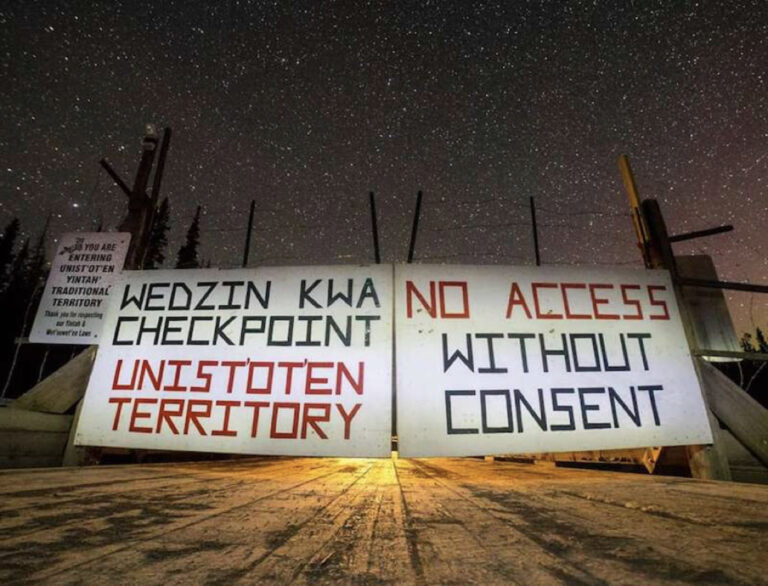
That no one should be punished for the sins of their father is an ageless concept of fundamental justice. But what about the wisdom of one’s father? Should anyone be obliged to acknowledge or honour that? It seems a particularly relevant question when considering Indigenous policy in Canada, given the respect traditionally due to – and often demanded by – native elders.
Yet over the past year, two significant opportunities for members of a younger generation to pay proper respect to the wisdom of their forebears have failed due to the narrow-minded and rigidly-enforced nature of contemporary Canadian politics. One example involves a blast of negative publicity given to the views of the late Robert Carney, a scholar and school administrator, regarding his thoughts on Canada’s Indian Residential Schools. This sudden interest was brought on by the fact his son Mark became prime minister this year.
The other case concerns the publication of a new book of essays meant to honour the work of distinguished native advocate William Wuttunee, a project overseen by his daughter Wanda Wuttunee, a Professor Emerita at the University of Manitoba. The elder Wuttunee is best remembered for his 1971 book Ruffled Feathers, which offered a stinging critique of contemporary Indigenous politics and argued persuasively for racial equality.
In both situations, the younger generation has proven itself unequal to the task; both son and daughter seem incapable of properly recognizing their fathers’ lifeworks. And the implications go beyond familial embarrassment. As a result of these slights and betrayals, modern Canada has been robbed of the crucial insights and deep knowledge embedded in the work of Robert Carney and William Wuttunee. Here, for the benefit of Wanda, Mark and every other Canadian, is the true wisdom of our elders.
Ruffled Feathers

In 1969, Prime Minister Pierre Trudeau’s Liberal government proposed the most comprehensive change in Canada’s relations with its Indigenous people since the creation of the Indian Act in 1876. A White Paper produced by then-Indian Affairs Minister Jean Chrétien proposed to abolish the nakedly racist Indian Act and dispense entirely with the paternalistic notion that Ottawa was responsible for overseeing the lives of native Canadians. “The Indian people should have the right to manage their own affairs to the same extent that their fellow Canadians manage theirs,” Chrétien’s report stated.
Among the White Paper’s recommendations was the conversion of Canada’s hundreds of Indian reserves from collective ownership to fee simple tenure. The distinction of Indian “status” would also be eliminated and Indigenous people given access to the same services enjoyed by all other Canadians. Antiquated treaty obligations would be replaced by substantial economic development funds provided by Ottawa, along with dedicated support for native culture. And tribal governance practices would shift to democratically responsive, municipal-style local government. The goal was to allow Indigenous Canadians to become fully-fledged citizens with access to the same legal, social and economic opportunities as everyone else in the country.
The response to this offer of genuine equality from the native rights lobby was a deafening “No!” The National Indian Brotherhood (later to become the Assembly of First Nations) and other Indigenous groups flatly refused to countenance any loss of their special treaty rights and privileges, regardless of the broader benefits on offer. The very concept of integration with the rest of the country was seen as an existential threat to native culture, which had to be defended at all costs.
One notable exception to this wave of indignation was William Wuttunee. Wuttunee was born in 1928 in a one-room log cabin on the Red Pheasant Cree Nation in Saskatchewan, where he endured a childhood of poverty and hardship. He attended a residential school as a child, but transferred to a public high school once his family moved off-reserve to Battleford.
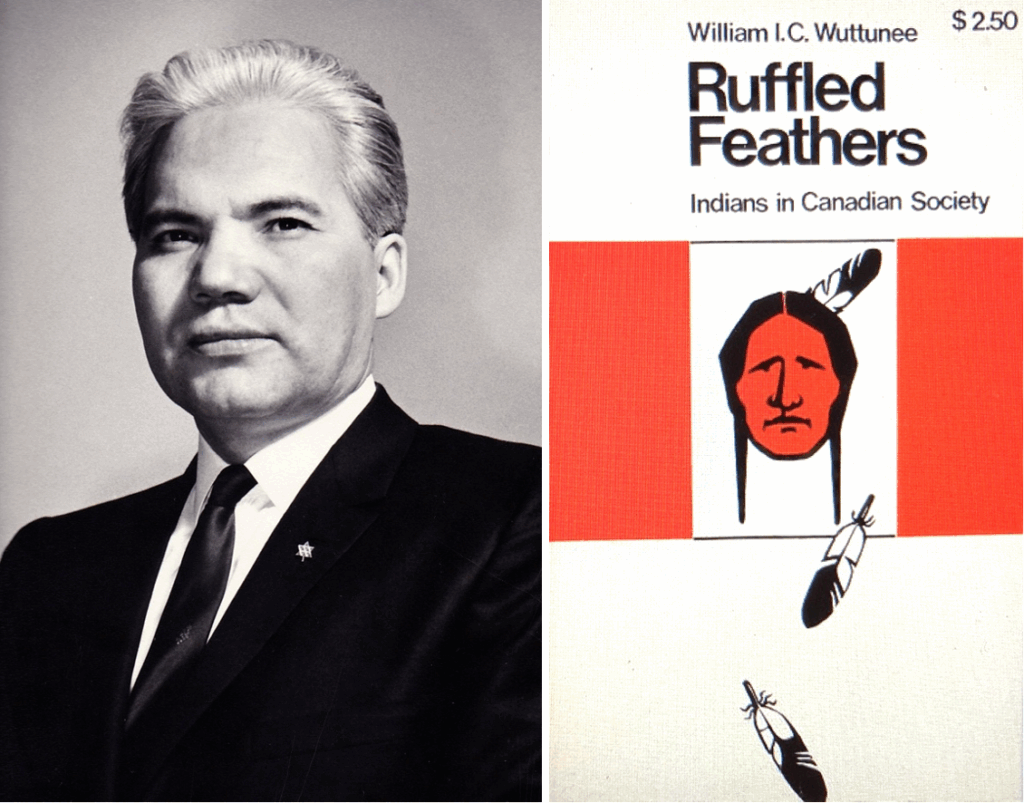 No more barriers: In his 1971 book Ruffled Feathers, William Wuttunee offered a stirring defence of the White Paper’s overarching goal of individual equality for Canadians of all races. (Source of photo: USask College of Law)
For his fearlessness and truth-telling, Wuttunee paid a heavy price. He was ostracized from the native political community and physically banned from numerous reserves, including his own. After the furor over Ruffled Feathers, he retreated into private life. He died in 2015.

A Daughter’s “Embrace”
This year, William’s daughter Wanda was given the opportunity to rectify the past mistreatment of her father. In the book of essays Still Ruffling Feathers – Let Us Put Our Minds Together, published by the University of Manitoba Press, she and the other contributors propose to “fearlessly engage” with William’s ideas. Unfortunately, the authors seek to bury, rather than praise, his bold vision of one Canada for native and non-native alike.
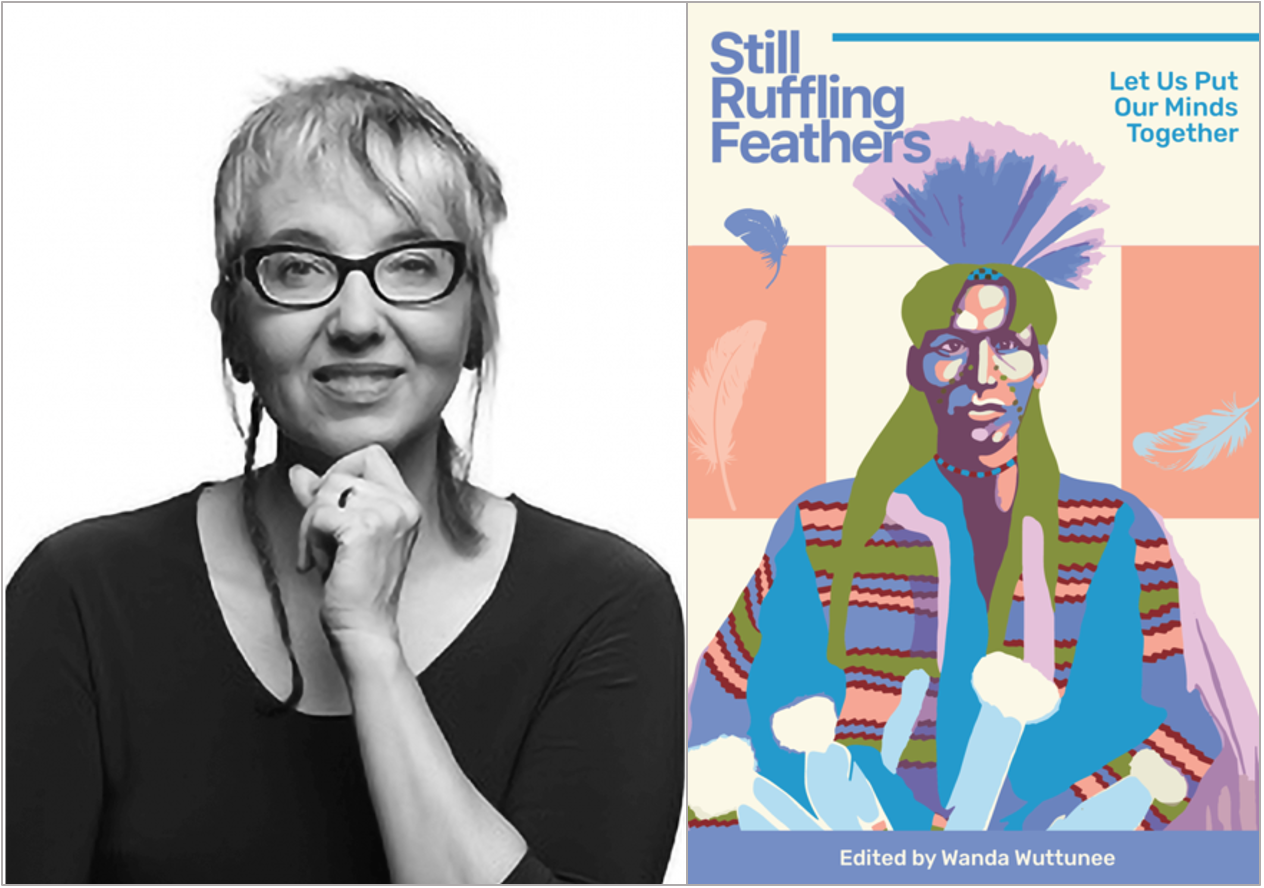 In the 2025 collection of essays Still Ruffling Feathers, William Wuttunee’s daughter, Wanda Wuttunee, purports to pay homage to her father’s legacy, but fails to appreciate his most important insights. (Source of photo: The University of Manitoba)
“If treaty obligations had been dissolved, as suggested by the White Paper policy that Bill endorsed, these funds would likely not have been secured,” Wanda claims. The same goes for numerous appellate-court rulings that have invented new aboriginal rights and thrown many aspects of conventional Canadian law and justice into chaos, including that the Charter of Rights might not apply on reserves, that private property rights can be superseded by aboriginal title, and that Canada’s national sovereignty is an illusion.
William Wuttunee’s dream of a treaty-free Canada is problematic today because it would have required giving up all the financial and legal goodies that have lately been delivered to Indigenous groups. To Wanda, this suggests that segregation was the optimal path all along. But there’s a counter-factual to consider. What if instead of hunkering down on their reserves in hopes of one day winning the federal spending lottery, Indigenous Canadians had, over the past half century or so, simply enjoyed the same incremental gains in income, health and other social indicators as the rest of the country?

Ample evidence on the massive and longstanding gap between native and non-native Canadians across a wide variety of socio-economic indicators, as well as the countless semi-permanent states of emergency declared on reserves, suggest that integration would have been the better bet, regardless of recent windfalls. To pick one grim statistic among many, the life expectancy for Indigenous men in Alberta is currently 60 years, similar to Third World countries such as Haiti and Bolivia and a shocking 19 years shorter than for a non-native male Albertan. Would anyone trade 19 years of their life for the chance at a Supreme Court ruling in their favour?
To be fair, Wanda does acknowledge the advantages enjoyed by Métis Canadians who have, until very recently, been closely integrated with mainstream Canadian society and have thus substantially outperformed other Indigenous groups on most socio-economic indicators. But the bigger point remains unspoken: the facts show her dad was right all along.
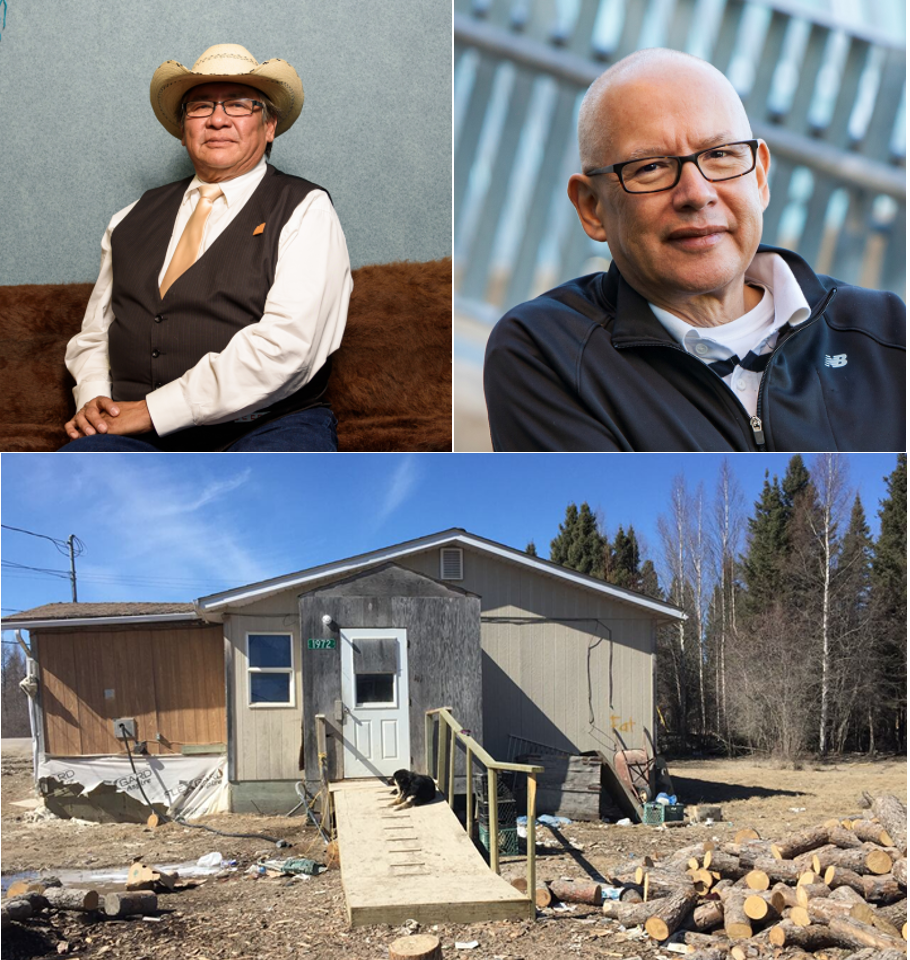 Wilful blindness: In Still Ruffling Feathers, contributors Lee Crowchild (top left), former chief of the Tsuut’ina Nation in Alberta, and David Newhouse (top right), a professor of Indigenous Studies at Trent University, Ontario, gloss over the enormous problems of poverty, substance abuse and despair associated with a segregated, reserve-based Indigenous culture. At bottom, the Kitchenuhmaykoosib Inninuwug reserve in northern Ontario. (Sources of photos: (top left) Forward Summit; (top right) Carleton University; (bottom) Jody Porter/CBC)
 Lone voice of reason: University of Ottawa professor Robert-Falcon Ouellette is Still Ruffling Feathers’ sole contributor acknowledging that Wuttunee was right about the damage done by a permanent reserve system. (Source of photo: robertfalconouellettemp/Instagram)
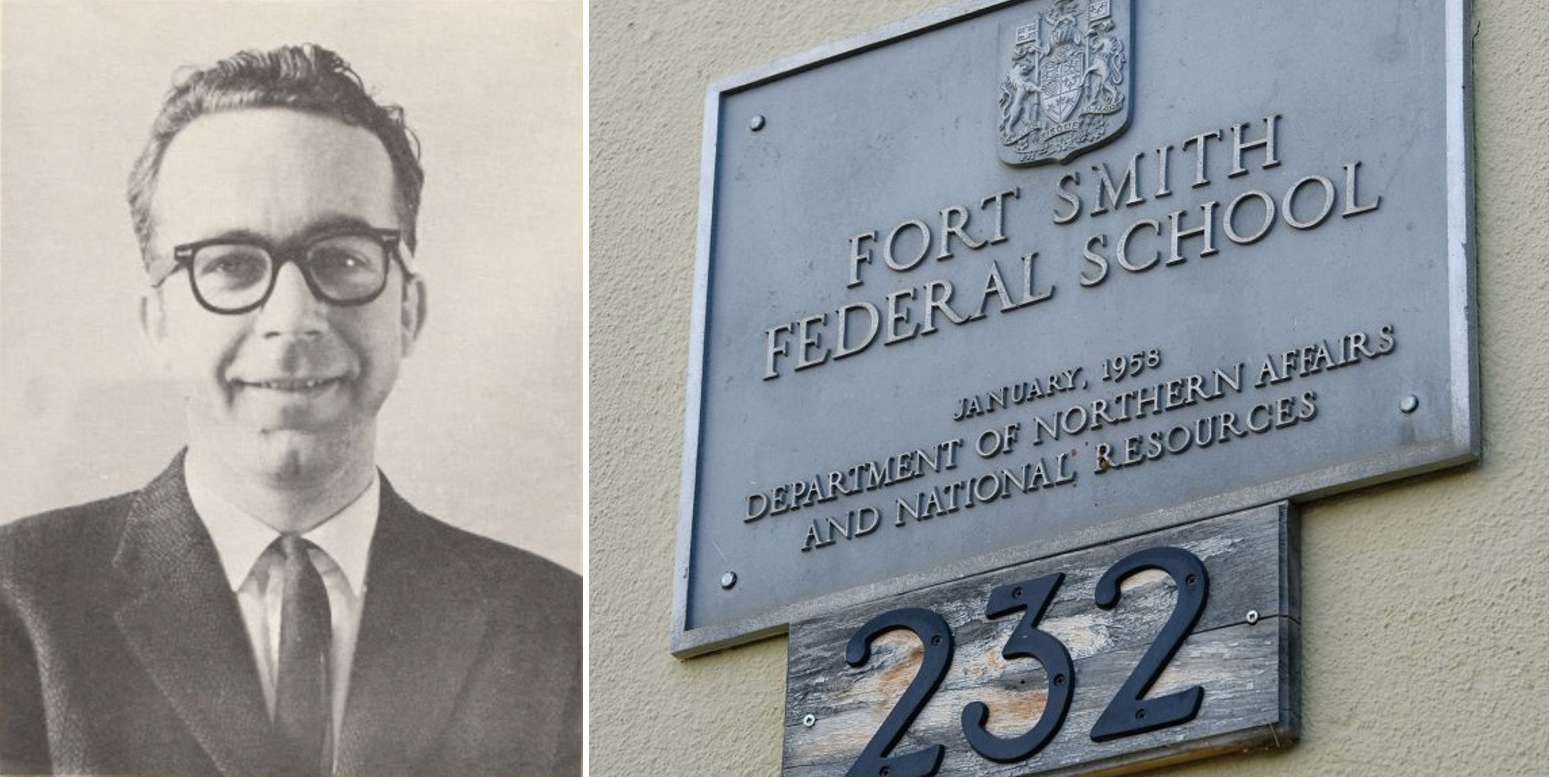 Lifetime of service: Robert Carney had a long career in aboriginal education, serving as principal of the Catholic day school in Fort Smith, NWT, government administrator throughout western and northern Canada, and professor of education at the University of Alberta, where he was on the editorial board of the Canadian Journal of Native Education. (Sources of photos: (left) Memories of Fort Smith NT/Facebook; (right) APTN)
In 1998 he wrote a scholarly review of a report on residential schools by the Royal Commission on Aboriginal Peoples (RCAP). Informed by his personal and professional knowledge, Carney strongly criticized the RCAP report for being one-sided and simplistic. He pointed out that the report, based largely on tales told by former students, made no effort to include important historical sources and lacked the sort of relevant comparisons and context that are “a necessary part of the historian’s trade.” Many of the flaws Carney identified in the RCAP report would be repeated, at a much higher volume, by the Truth and Reconciliation Commission in 2015.

Carney observed that the RCAP report “often repeated concerns [of] Aboriginal children being ‘removed from their homes and placed in the care of strangers,’ which would lead one to assume that parents had no say about their children attending residential schools.” As he well knew, for most native children to attend a residential school, their parents first needed to apply for a spot by signing an Application for Admission. Carney also found fault with the allegation that residential schools accommodated the bulk of Indigenous children; again, his own experience told him the vast majority attended day schools on reserves.
Of even greater concern to Carney, the report’s authors seemed unconcerned about digging up the whole truth. “Despite the resources available to them, the Commissioners did not come up with their own attendance count,” he wrote. Even today, Canadians lack accurate figures on the share of Indigenous children who attended various forms of schooling and for how long. Nonetheless, it has become commonplace for the mainstream media to report that “more than 150,000 Indigenous children were forced to attend residential schools.” All of which gives the impression the schools were run like prison camps rather than educational institutions.
The RCAP report’s refusal to say anything positive about residential schools similarly infuriated Carney. Again, he had first-hand knowledge of the important role these schools played in improving the lives of many students. And he pointed to the necessary social welfare function they performed in taking in “sick, dying, abandoned and orphaned children.” These facts are still being suppressed and denied in current debates.
Carney did not ignore the profoundly negative experiences of some students. In 1991 he investigated allegations of misconduct by staff at residential schools in the Western Arctic and reported several instances of “serious physical abuse”. He also understood the importance of preserving Indigenous culture. In a 1965 CBC radio interview, Carney explained, “We want [aboriginal students] to not forget their origins, or not to forget their backgrounds and to instill in them a sense of pride and a sense of belonging: that the culture from which they come is a good culture.” In all cases, he demanded that the schools be judged fairly and in proper historical context using accurate facts, rather than relying solely on the subjective recollections of a few jaded former students.

Backdated “Denialism”
In the midst of the 2025 federal election campaign, Mark Carney was asked if he agreed with his father’s views on residential schools. “I love my father, but I don’t share those views,” he answered. “To be absolutely clear…residential schools are a long and painful part of our history.” In a subsequent speech on National Truth and Reconciliation Day in September, the recently-elected Prime Minister again talked of “the devastating legacy of the residential school system…a painful part of our shared history,” and of the “pain of suppression and assimilation” suffered by the “survivors” of residential schools. And, of course, he made mention that “more than 150,000 First Nations, Inuit, and Métis children were separated from their families, communities, languages, and cultures.”

In both instances, Carney the younger repeats the same mistakes regarding a lack of context and missing facts his father warned about in the RCAP report. He also neglects to mention any of the educational or social benefits students might have enjoyed. The prime minister even used his later speech to promise more federal money for the pointless search for “unmarked graves” at former residential school sites that either don’t exist or were not unmarked in their time, something his meticulous and fact-focused father would have found absurd.
The objective of the prime minister’s dissembling seems obvious enough: to forestall any political unpleasantness that might arise from admitting the truth about residential schools. Indeed, once his father’s past views became public, some Indigenous activists leapt to accuse Robert Carney of residential school “denialism” (perhaps soon to be a criminal offence) and “complicity” in the associated horrors of Canada’s colonial education system. Yet, as a full and fair review of the facts reveal, these schools had a complicated history that includes both good and bad aspects. Despite undeniable instances of abuse and wrongdoing, they were generally run by decent, well-intentioned people like Robert Carney.
And so, like Wanda Wuttunee, Mark Carney has let his father down by seeking to distance himself from a now-toxic legacy for reasons of political expediency. It is a shameful performance that reminds one of the disciple Peter denying Jesus three times in the courtyard: “I do not know the man.”
William Wuttunee wanted all Canadians – native and non-native alike – to be recognized as true individuals, free to live their own peculiar lives free from political constraint or control. He rejected racial segregation, discrimination and identity politics in all forms. Such a lifelong commitment to equality ought to be celebrated as a great Canadian virtue. And yet in “honouring” his life’s work, his daughter and (all-but-one of) the contributors she enlisted for Still Ruffling Feathers reject this admirable legacy of truth-telling and courage by sidestepping the truth of his central belief. Unchangeable native orthodoxy puts the requirements of the group ahead of the rights of the individual, regardless of the merits and whatever the cost.

Mark Carney was similarly presented with an opportunity to offer Canadians a courageous and fact-based perspective on a subject of great current public interest by drawing upon his intimate connection with an expert in the field. Disappointingly, he chose to suppress whatever personal feelings and knowledge he might have on the matter and instead bowed to the requirements of political expediency and groupthink. In doing so, Canada’s new prime minister walked into the same trap his father warned about nearly 30 years ago. And so, Robert now stands accused of complicity in a phony genocide.
No one doubts that Wanda Wuttunee and Mark Carney each loved their dads, as any son or daughter should. And there is certainly no requirement that a younger generation accept without question whatever their parents thought. But in the case of the Wuttunees and the Carneys, both offspring have deliberately chosen to tarnish their fathers’ legacies in obedience to a poisonous ideology that promotes the entirely un-Canadian ideal of permanent racial segregation and inequity. That is wrong. And all of Canada is the poorer for it.
Peter Best is a retired lawyer living in Sudbury, Ontario. He is the author of the 2020 book There is no Difference: An Argument for the Abolition of the Indian Reserve System and Special Race-based Laws and Entitlements for Canada’s Indians, and a contributor to The 1867 Project: Why Canada Should be Cherished – Not Cancelled.
Source of main image: Freepik.