Canadian History

The Real Truthtellers: Canada’s Unsung Defenders of Historical Fact

Jerry Amernic
February 23, 2026
Canada, the old saying goes, suffers from too much geography and too little history. That ratio is getting even more out of whack. Since the election of Prime Minister Justin Trudeau in 2015 and gathering speed following allegations of mass graves in Kamloops in 2021, many of Canada’s most important historical figures have been erased in a tidal wave of cancellations and repudiations – all driven by a mob of woke activists uninterested in the true facts of Canada’s past. But as Jerry Amernic discovered while researching a book on historical revisionism, there are still those who believe Canadians can handle the truth. And they’re working hard to rescue our nation from the history hijackers.
Canadian History

The Real Truthtellers: Canada’s Unsung Defenders of Historical Fact

Jerry Amernic
February 23, 2026
Canada, the old saying goes, suffers from too much geography and too little history. That ratio is getting even more out of whack. Since the election of Prime Minister Justin Trudeau in 2015 and gathering speed following allegations of mass graves in Kamloops in 2021, many of Canada’s most important historical figures have been erased in a tidal wave of cancellations and repudiations – all driven by a mob of woke activists uninterested in the true facts of Canada’s past. But as Jerry Amernic discovered while researching a book on historical revisionism, there are still those who believe Canadians can handle the truth. And they’re working hard to rescue our nation from the history hijackers.
Share on Facebook
Share on Twitter

Truth is central to any country’s history. Providing an accurate account of the past is crucial to understanding what makes a nation. But who are the truthtellers? And what are their motivations?

I have spent the last two years studying the past records and recent treatment of some of Canada’s most important historical figures. Their names will be familiar to regular readers of C2C Journal. At the top of the list is Sir John A. Macdonald, Canada’s first and arguably greatest prime minister. Today, he’s often depicted as a racist maniac who created the Indian Residential School system to wipe out Canada’s native population. A similar fate has befallen educational reformer Egerton Ryerson, Scottish parliamentarian Henry Dundas, Halifax-founder Edward Cornwallis and Judge Matthew Baillie Begbie, who almost single-handedly created British Columbia’s legal system.

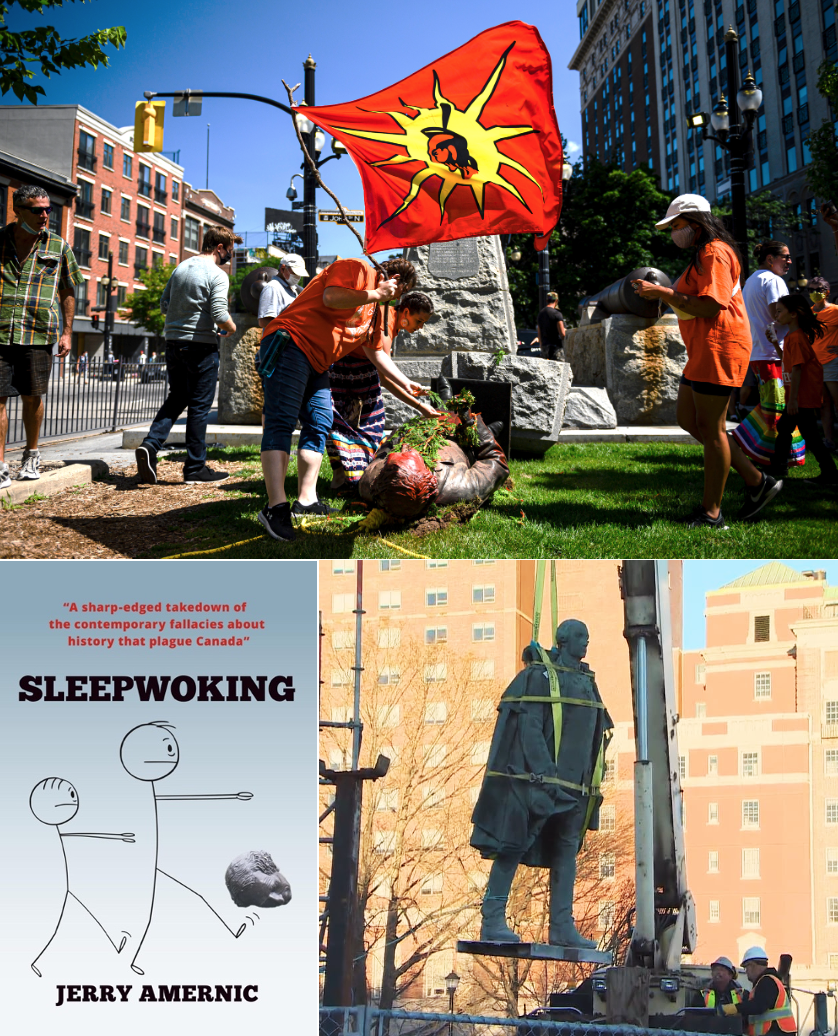
In his new book SLEEPWOKING, Jerry Amernic examines the cancellations and condemnations of Canada’s most famous historical figures. Shown, the statues of Canada’s first prime minister, Sir John A. Macdonald (top), and Halifax founder Edward Cornwallis (bottom) being removed from public view. In his new book SLEEPWOKING, Jerry Amernic examines the cancellations and condemnations of Canada’s most famous historical figures. Shown, the statues of Canada’s first prime minister, Sir John A. Macdonald (top), and Halifax founder Edward Cornwallis (bottom) being removed from public view. (Sources of photos: (top) The Canadian Press/Christopher Katsarov; (bottom) Craig Paisley/CBC)
Based on the claims of self-appointed “truthtellers” – a word that conjures images of Indigenous chiefs holding court around a smoky campfire – these and other historical figures have seen their statues torn down, historical accounts about them rewritten and their names purged from buildings, streets and other public landmarks that once celebrated their accomplishments.

My book SLEEPWOKING, published last October, examines the claims made against each of these men and the manner in which the mob has rendered its judgement. In every case, the full and honest story of their lives and accomplishments stands in sharp contrast to the historical fictions currently perpetrated against them. My research revealed the troubling degree to which woke politics has infiltrated the highest levels of Canadian governance and historical remembrance. Among the worst offenders, I discovered, is Parks Canada – the federal institution charged with preserving our precious historical legacy.

In the course of my research, however, I also stumbled upon a network of dedicated individuals with the common aim of rescuing our country’s history from its present-day hijackers. Some are working together to create new organizations devoted to historical accuracy. Others toil in solitude. Some have a very personal stake in their efforts as they try to rescue the reputation of a long-dead ancestor. Others are professional academics simply doing their job. As a group, they represent the widest possible range of political viewpoints and backgrounds. All persist because they believe strongly in one thing: that the truth should matter. They are Canada’s Real Truthtellers.

“Twenty people with chains is fascism”

Patrice Dutil – Toronto

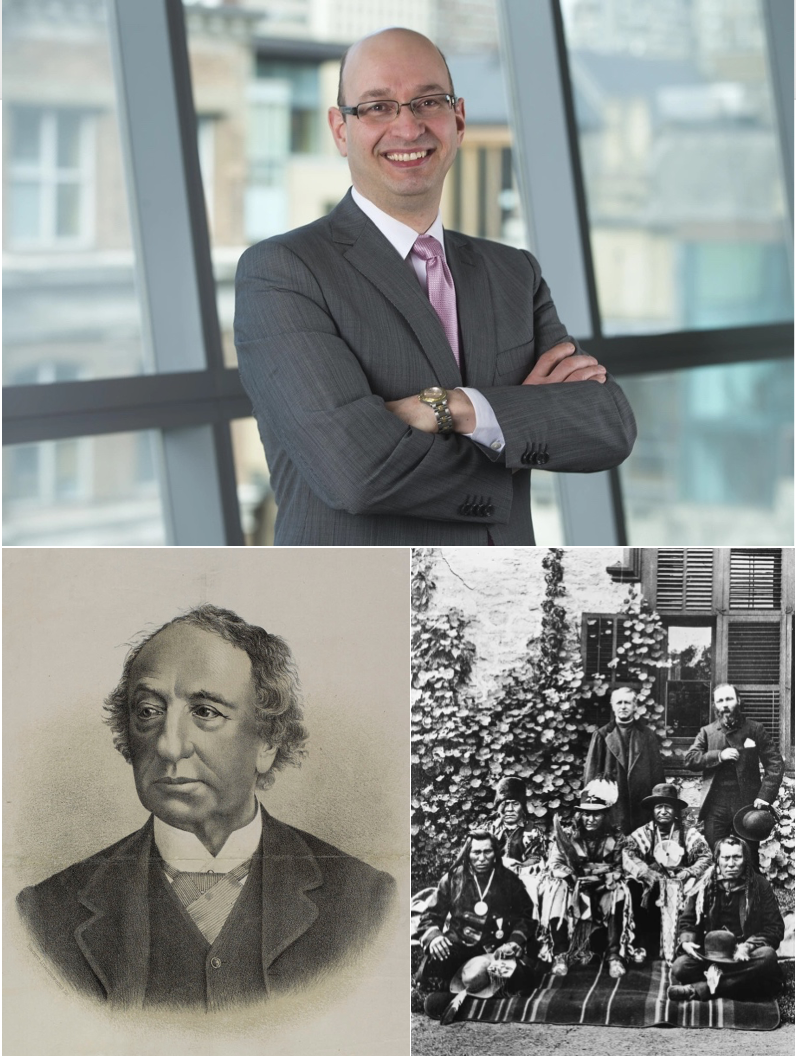
“I prefer the truth to what else is said”: Patrice Dutil (top), professor of politics and public administration at what was once Ryerson University and is now Toronto Metropolitan University, challenges claims that Macdonald (bottom left) was indifferent to the plight of Indigenous peoples. At bottom right, a Blackfoot delegation in front of Macdonald’s Ottawa home in October 1886.
x“I prefer the truth to what else is said”: Patrice Dutil (top), professor of politics and public administration at what was once Ryerson University and is now Toronto Metropolitan University, challenges claims that Macdonald (bottom left) was indifferent to the plight of Indigenous peoples. At bottom right, a Blackfoot delegation in front of Macdonald’s Ottawa home in October 1886. (Sources of photos: (top) Mark Blinch/Patrice Dutil; (bottom left) CIHE; (bottom right) Glenbow Archives/NA-13-2)

Patrice Dutil finds himself at the epicentre of the current mania for historical removal. He is a professor of politics and public administration at Toronto Metropolitan University (TMU), an institution once known as Ryerson University. His school was renamed because local activists claimed Ryerson was complicit in creating Canada’s Indian Residential School system. Dutil is also one of Canada’s foremost authorities on Macdonald, the most frequently, and unjustly, attacked of all the heroes from our history. The most recent of Dutil’s 14 published books is Sir John A. Macdonald and the Apocalyptic Year 1885, published last year.

Dutil was born and raised in Montreal and his parents were pure laine Quebeckers. “I’m Québécois, a French-Canadian, but I often defend notable members of the British Empire,” he says. “I do it because I prefer the truth to what else is said.” His latest book counters claims that Macdonald was a dangerous racist and uncaring about Canada’s natives. Rather, Dutil’s research reveals the lengths to which Macdonald went in providing emergency aid to the Prairies during the famine of 1885. “There is no evidence that food was withheld to kill Indigenous people, as some would charge 150 years later,” Dutil concludes. “Even with…the economy in deep depression, Macdonald spent aggressively on food for the natives.”

The issue of historical cancellation arrived on Dutil’s doorstep in 2021 when a statue of Ryerson in front of his school was pulled down and destroyed by a mob; around the empty plinth were left 215 pairs of shoes representing the allegedly dead or murdered children buried in unmarked graves at the Kamloops Indian Residential School. Local native and Black Lives Matter activists charged that Ryerson, who wrote a short paper on native education in 1847, was the “architect” of Canada’s residential schools.

In his article “The Imbecile Attack on Egerton Ryerson” co-authored with Ron Stagg, former head of the history department at Ryerson/TMU, Dutil proves beyond doubt that Ryerson is innocent of the claims against him. In truth, Ryerson was a dedicated education reformer and largely responsible for creating Ontario’s public school system. Among Dutil and Stagg’s most convincing arguments exonerating Ryerson is that he was already dead by the time the federal residential school system was formally instituted in the 1880s, and further, that his short 1847 paper played no role whatsoever in that process. “The activist cabal agitating against this decent man is nothing but the product of an identity politics of destruction,” the duo concludes. “Canadian citizens and their timid leaders must recognize that Egerton Ryerson has been falsely accused and reverse the tendency to attack genuine heroes.”

Regarding the impromptu and unjust destruction of Ryerson’s physical presence on campus, Dutil asks, “How is it that twenty people armed with a cable and chains can pull down a statue that was paid for by donations 130 years ago?” He adds, “When they erected that statue 10,000 to 15,000 people were in attendance. That to me is democracy. Twenty people with chains is fascism.”
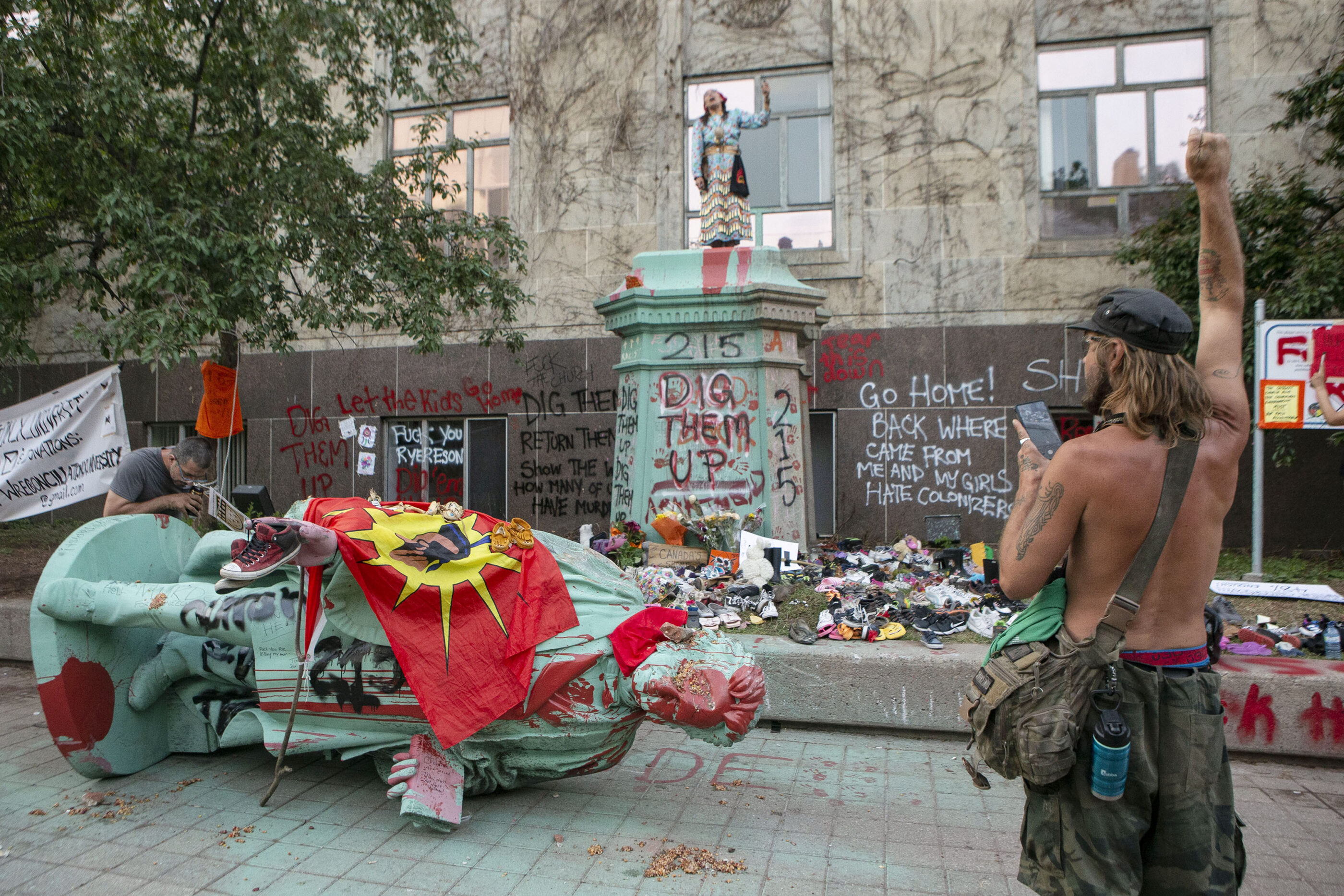
The imbeciles unleashed: Despite activists’ claims that Egerton Ryerson was the “architect” of Canada’s Indian Residential School system, Dutil explains Ryerson played no role in its creation and was dead decades before it was even established. Shown, Ryerson’s statue being vandalized during a June 2021 protest.
xThe imbeciles unleashed: Despite activists’ claims that Egerton Ryerson was the “architect” of Canada’s Indian Residential School system, Dutil explains Ryerson played no role in its creation and was dead decades before it was even established. Shown, Ryerson’s statue being vandalized during a June 2021 protest. (Source of photo: The Canadian Press/Chris Young)

Based on his experience in attempting to promote historical truth, Dutil says he has become deeply critical of the mainstream media. The Globe and Mail and Toronto Star used to publish his work, he says, but have since closed their doors to him. And the CBC is downright “hostile” to any views that seek to paint a fuller picture of Macdonald, Ryerson or others. “I don’t deny that terrible things were done to Indigenous persons,” Dutil admits. “But it wasn’t genocide.” And, in particular, it wasn’t by those two men.

Dutil’s greatest disappointment, however, lies with the actions of his own employer, and especially the school’s task force on Ryerson’s legacy. “The whole thing was railroaded,” he says of the final report that called for Ryerson to be removed from his school’s name. “If a university can’t teach its own students about history, where are we going? I talk to my colleagues across the country and I get the same thing. Wokism has paralyzed this. I’m very worried about the future.”

 “Squeaky clean”

Lynn McDonald – Toronto

Making common cause with Dutil is Lynn McDonald, professor emerita of the University of Guelph, fellow of the England-based Royal Historical Society and member of the Order of Canada. “TMU doesn’t have high standards,” McDonald says. “They abandoned standards for the bandwagon. It’s disgusting. As a taxpayer I think all the money that goes to universities should be for education. Not propaganda.”

In her 80s and physically slight, McDonald cannot be dismissed as a lightweight or angry right winger. Rather, she has a long track record of pushing back against the tide as a “feminist scholar and social activist”, as her Order of Canada award explains. This includes her past roles as president of the National Action Committee on the Status of Women, a climate activist (long before it was fashionable) and co-founder of the lobby group Campaign for the Abolition of Solitary Confinement. She also held elected office, serving as NDP MP for the Toronto riding of Broadview-Greenwood from 1982 to 1988. During this time, she introduced a private member’s bill that paved the way for the world’s first legislation requiring smoke-free work and public places.
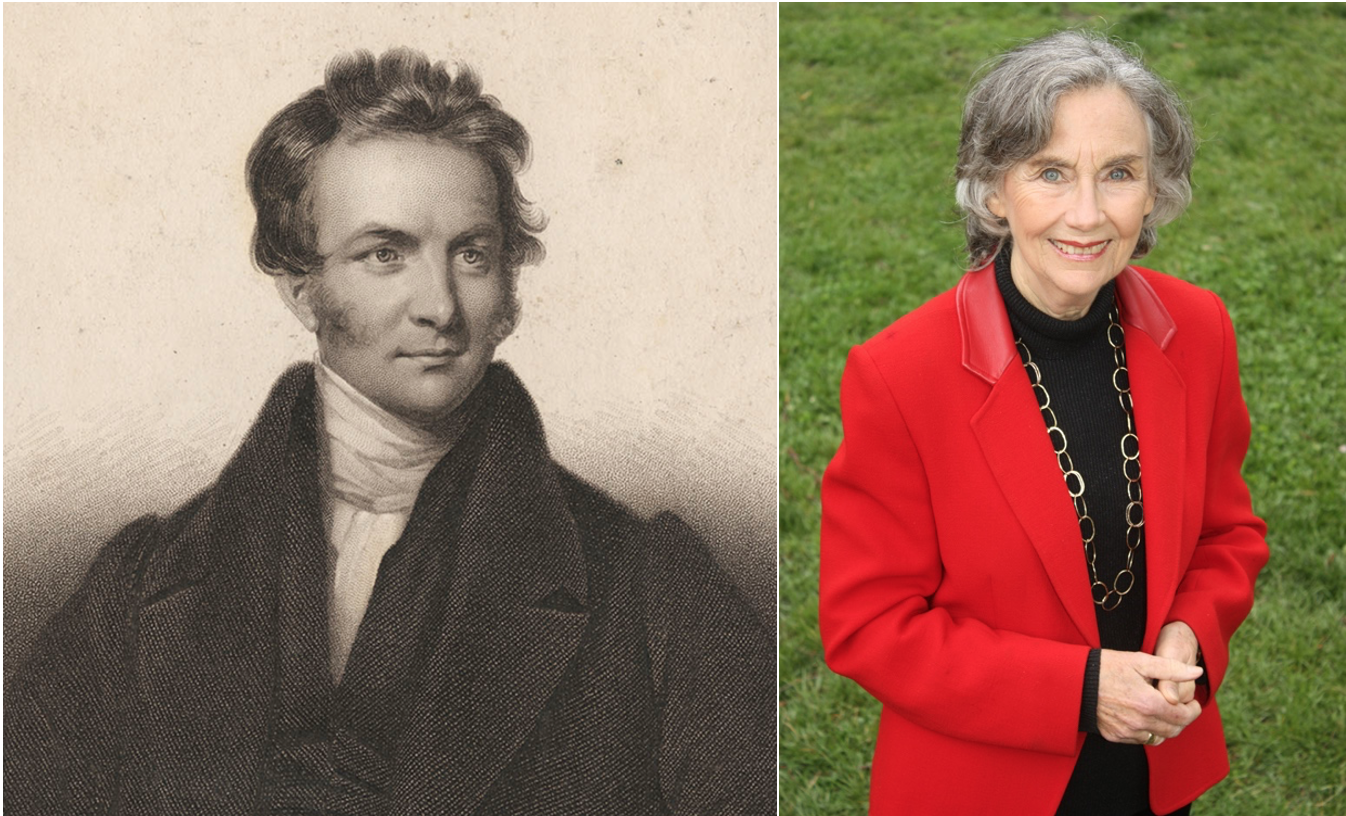
“Absolutely squeaky clean”: After thoroughly examining the historical record pertaining to Ryerson (left), University of Guelph professor emerita Lynn McDonald (right) created the lobby group Friends of Egerton Ryerson to defend his reputation.
x“Absolutely squeaky clean”: After thoroughly examining the historical record pertaining to Ryerson (left), University of Guelph professor emerita Lynn McDonald (right) created the lobby group Friends of Egerton Ryerson to defend his reputation. (Source of left image: CIHE)

Following the attacks on Ryerson, McDonald – who professes she initially knew little of the man beyond his nameplate on a university statue – began immersing herself in everything written about him. She couldn’t find a single piece of evidence implicating him as the architect of residential schools. “If you look at the facts of Egerton Ryerson…[he] was absolutely squeaky clean,” she says, adding that he was also demonstrably “pro-Indigenous.” Together with historian Stagg, McDonald co-founded the group Friends of Egerton Ryerson, which today has 300 members – including living members of the Ryerson family.

Like Dutil, she is blunt in her assessment of Canada’s current ahistorical affliction. “They tore down the statue of Ryerson and no one was prosecuted,” she says. “This kind of thing happens to dictators when they fall.” She adds that TMU has “an Aboriginal Education Committee and tries to please them. Fine, but not when it is factually wrong. Their task force was shameful. People appearing before them who were pro-Ryerson were ignored.”

Historical research proves that Sir John A. Macdonald was not responsible for the famine on the Prairies in the mid-1880s. Records from that period show that despite the Canadian economy being in a deep depression, Macdonald spent aggressively on food to provide emergency aid for starving native populations. His commitment to supporting all citizens aligns with the principles of Classical Liberalism, which values the preservation of the social contract.

Watch it – That’s My Family You’re Talking About

Jennifer Dundas – Port Rowan, Ontario

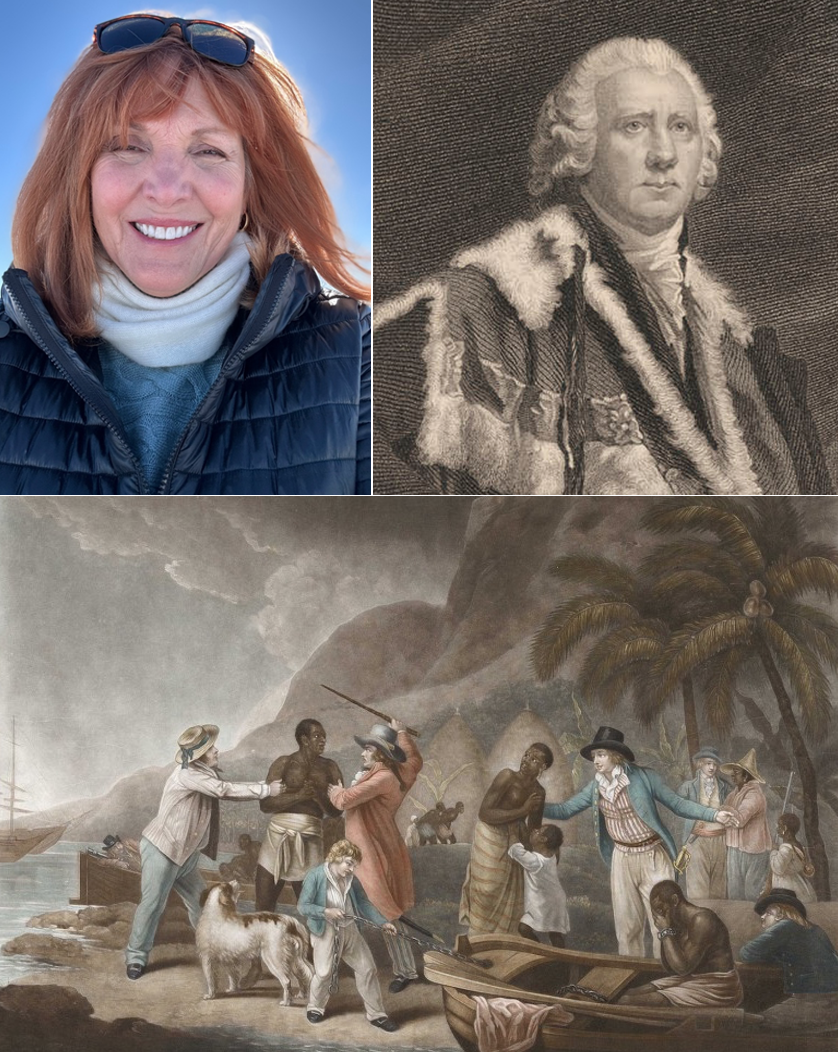
Jennifer Dundas is a distant relative of Henry Dundas, an 18th-century Scottish parliamentarian who has lately been accused of prolonging the slave trade and has thus become a controversial figure in Canadian history. She studied journalism at Ryerson University and spent two decades in the field, including as a late-night TV anchor for CBC News in Winnipeg. “I was a typical CBC journalist with a progressive left-wing outlook,” Dundas says in an interview. She later went to law school and worked as a Crown prosecutor in Manitoba and Alberta.

In 2020 she became aware of a movement to rename Dundas Street in Toronto as a result of allegations regarding her forebear’s connection to the transatlantic slave trade. “I was barely aware of Henry Dundas,” she says. “I just knew we had a famous ancestor and didn’t question the accusations against him.”

Her initial instinct was to try to raise money for an endowment fund to provide scholarships for students to study the slave trade, an attempt to undo whatever harm her long-dead relative might have caused. To this end, she got in touch with “Bobby Melville” of Edinburgh, Scotland, otherwise known as Robert Henry Kirkpatrick Dundas, the 10th Viscount Melville. As the current holder of Dundas’ hereditary title, Melville provided his Canadian relation with sources and information on the real facts about their ancestor – and his important role as an abolitionist.

In 1792 another British MP put forth a motion to abolish slavery; it was defeated, largely because many Scottish Lords were slaveowners themselves. As a committed abolitionist, Dundas then introduced an amendment to the original motion that stated, “it is the opinion of this Committee, that the Trade carried on by British Subjects for the purpose of obtaining Slaves on the Coast of Africa, ought to be gradually abolished.” This motion passed and became the first step in legally ending the slave trade throughout the British Empire. Modern-day critics of Dundas, however, dwell on the word gradually to accuse him of trying to prolong the slave trade. This is incorrect; he was trying to prevent a stinging defeat to the abolitionist movement and maintain its momentum in order to bring the trade to a close as expediently as possible.

There is plenty of other evidence proving Dundas was a committed abolitionist. Before going into politics, for example, Dundas was a lawyer and once defended an enslaved black man from Jamaica who had been brought to Scotland. His victory in that case created a precedent that ended up freeing all slaves in Scotland. Also, in 1791 Dundas, as the British Home Secretary, appointed abolitionist John Graves Simcoe as the first Lieutenant-Governor of Upper Canada. Two years later Simcoe introduced the Act to Limit Slavery in what is now Ontario; it was the first piece of legislation to limit slavery anywhere in the British Empire.

Skeletons in her closet? Former CBC presenter and Crown prosecutor Jennifer Dundas (top left) is a distant relative of Henry Dundas (top right), the 18th century Scottish parliamentarian today accused of prolonging the trans-Atlantic slave trade. At bottom, the 1814 oil painting Execrable Human Traffick by British painter George Morland, based on an earlier engraving by John Raphael Smith.Skeletons in her closet? Former CBC presenter and Crown prosecutor Jennifer Dundas (top left) is a distant relative of Henry Dundas (top right), the 18th century Scottish parliamentarian today accused of prolonging the trans-Atlantic slave trade. At bottom, the 1814 oil painting Execrable Human Traffick by British painter George Morland, based on an earlier engraving by John Raphael Smith. (Sources of images: (top right) CIHE; (bottom) National Maritime Museum)

Jennifer Dundas took the historical evidence Melville provided to her from the Scottish-based Henry Dundas Committee for Public Education on Historic Scotland, along with her own research, and sought to bring this to the attention of Toronto City Council. No one was interested in hearing it, she says. After becoming mayor, Olivia Chow endorsed the decision to rename Dundas Street and remove Dundas’ name from subway stations, a public library, parks, street signs, and the Yonge-Dundas Square – the biggest public square in Canada’s biggest city. Today it’s known as Sankofa Square – an absurd choice of a Ghanaian word used by a tribe that was itself infamous for owning and trading slaves. “They chose the narrative that fit their world view and treated it as if it was the truth,” Dundas says. “It’s dangerous that narratives are driving public policy instead of facts.”

Dundas describes the whole episode as “one of the most frustrating experiences I ever had.” Her whole career, she notes, has revolved around “truth-seeking”, first as a reporter and later as a Crown prosecutor. But, she says ruefully, “My best efforts at seeking the truth of Henry Dundas had absolutely no influence. It didn’t matter how solid the case was.” In hopes of gaining some longer-term personal satisfaction, she notes with pride that her new grandson is named Henry, in honour of his abolitionist relative.

Win some, lose some: Despite Jennifer Dundas’ dogged efforts to correct mistruths about Henry Dundas, Toronto went ahead and removed his name from several public spaces, including Yonge-Dundas Square, now labelled Sankofa Square. At right, Jennifer with her one-year-old grandson Henry, named after his famous (and provably abolitionist) ancestor.
xWin some, lose some: Despite Jennifer Dundas’ dogged efforts to correct mistruths about Henry Dundas, Toronto went ahead and removed his name from several public spaces, including Yonge-Dundas Square, now labelled Sankofa Square. At right, Jennifer with her one-year-old grandson Henry, named after his famous (and provably abolitionist) ancestor. (Source of left photo: Toronto City News)

The Canadian Institute for Historical Education

Don Cranston – Toronto

Dundas, McDonald and Dutil all participate in the Canadian Institute for Historical Education, a group formed in 2023 to push back against rampant historical revisionism across Canada. As chair Don Cranston explains, the CIHE is a “reactionary organization trying to stop the tearing down of statues and renaming of streets and schools.” The group has a 40-member advisory council and board, and more than 10,000 online followers, mostly in Ontario and Alberta. Its mission statement: “Promoting historical literacy through research, education and engagement in the public square.”

An investment portfolio manager during the day, Cranston is deeply influenced by his Loyalist roots: his mother’s family fought for the British with the Mohawk Indians during the American Revolution. (He says his maternal grandmother warned him never to trust “republicans”.) As a youth, Cranston spent six summers working as a uniformed re-enactor at the Fort York historical site in Toronto and later became a member of the Friends of Fort York lobby group, formed to oppose plans to move Fort York from its original location. More recently it has fought back against Toronto’s plan to scrap the Fort York Guard re-enactors as part of a larger plan to “decolonize” the city’s museums. “What’s wrong with modern society is we’ve destroyed a lot of the structures and other reminders of our history,” he says. “It’s no wonder Canadians don’t know their history.”
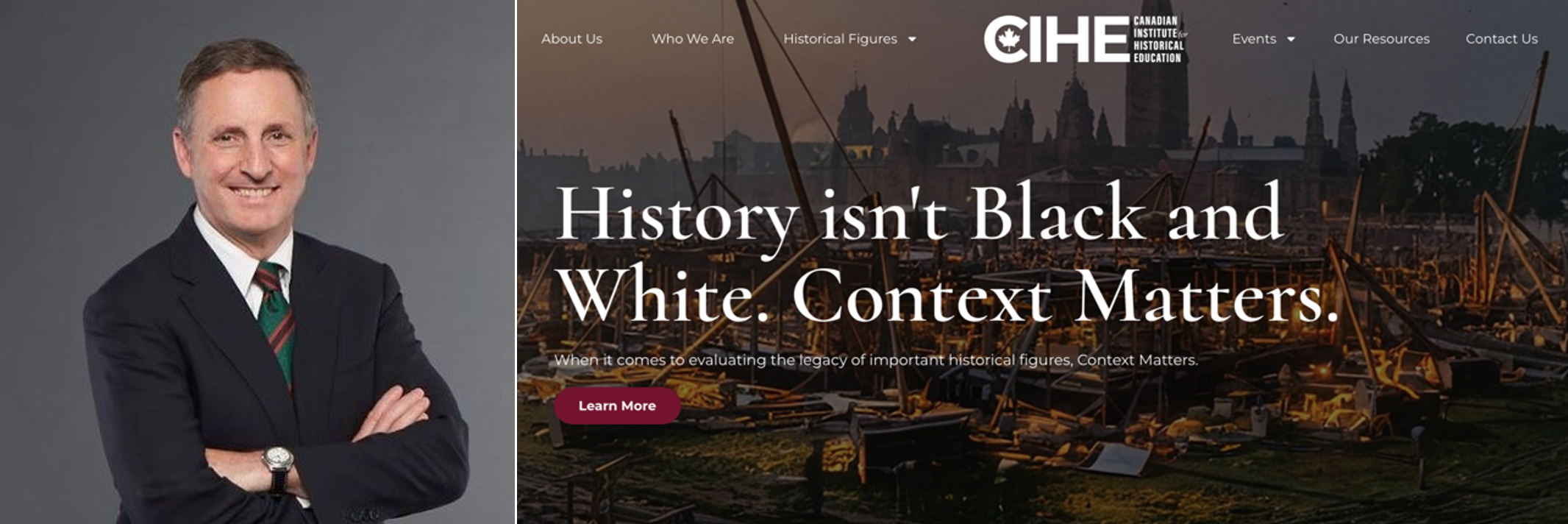
“We’ve been reactive but now we’re going proactive”: Don Cranston, chair of the Canadian Institute for Historical Education (CIHE), says the new organization is committed to challenging rampant historical revisionism and “promoting historical literacy through research, education and engagement in the public square.”
x“We’ve been reactive but now we’re going proactive”: Don Cranston, chair of the Canadian Institute for Historical Education (CIHE), says the new organization is committed to challenging rampant historical revisionism and “promoting historical literacy through research, education and engagement in the public square.”

One of the CIHE’s initial goals, Cranston explains, was to rescue a prominent Toronto statue of Sir John A. Macdonald from its plywood box. The statue in front of the Ontario Legislature had been placed behind boarding for protection following attacks on other Macdonald statues throughout 2021. The unboxing task was finally accomplished in June 2025 at the direction of Premier Doug Ford. This year – 2026 happens to be the 250th anniversary of the American Revolution – Cranston says the CIHE intends to focus on explaining to Canadians how their country was a counter-revolution to the U.S.

“We’ve been reactive but now we’re going proactive,” Cranston says. “We want to get Canadians engaged about their history and sit down with all the provincial governments to talk about the history curriculum in schools and how we can help. It’s sad what’s going on in schools. Parents are sick and tired of the BS.” Besides its successful lobbying campaigns, the CIHE also hosts in-person events with noted speakers as well as an online podcast series – all with the intent of promoting the truth behind Canada’s history.

East Coast Preservation

Leo Deveau – Summerside, PEI

Like his fellow truthtellers, Leo J. Deveau has a passion for history. He is a director of the Halifax Military Heritage Preservation Society and used to write a bi-weekly column on Nova Scotia history for the Halifax Chronicle-Herald; in 2017 he published the book 400 Years in 365 Days: A Day by Day Calendar of Nova Scotia History. Back in his teens, Deveau was a member of the Royal Canadian Air Cadets and later taught glider flying at Canadian Forces Base Greenwood in Nova Scotia’s Annapolis Valley. He recently moved from Halifax to Summerside, PEI.

At issue for Deveau today is the shabby treatment given to Halifax’s founder, Edward Cornwallis. In 1749 Cornwallis arrived from England with 2,500 settlers and a mandate to establish a settlement at the site that later became Halifax. He quickly found himself in the midst of a vicious proxy war with New France and its allies, the Mi’kmaq. After a series of horrifying massacres perpetrated by Mi’kmaq warriors on white settlers with French encouragement, Cornwallis issued a Bounty Proclamation that declared “a reward of ten Guineas be granted for every Indian Micmac taken or killed.” This proclamation has since become infamous as the current focus of charges against Cornwallis.
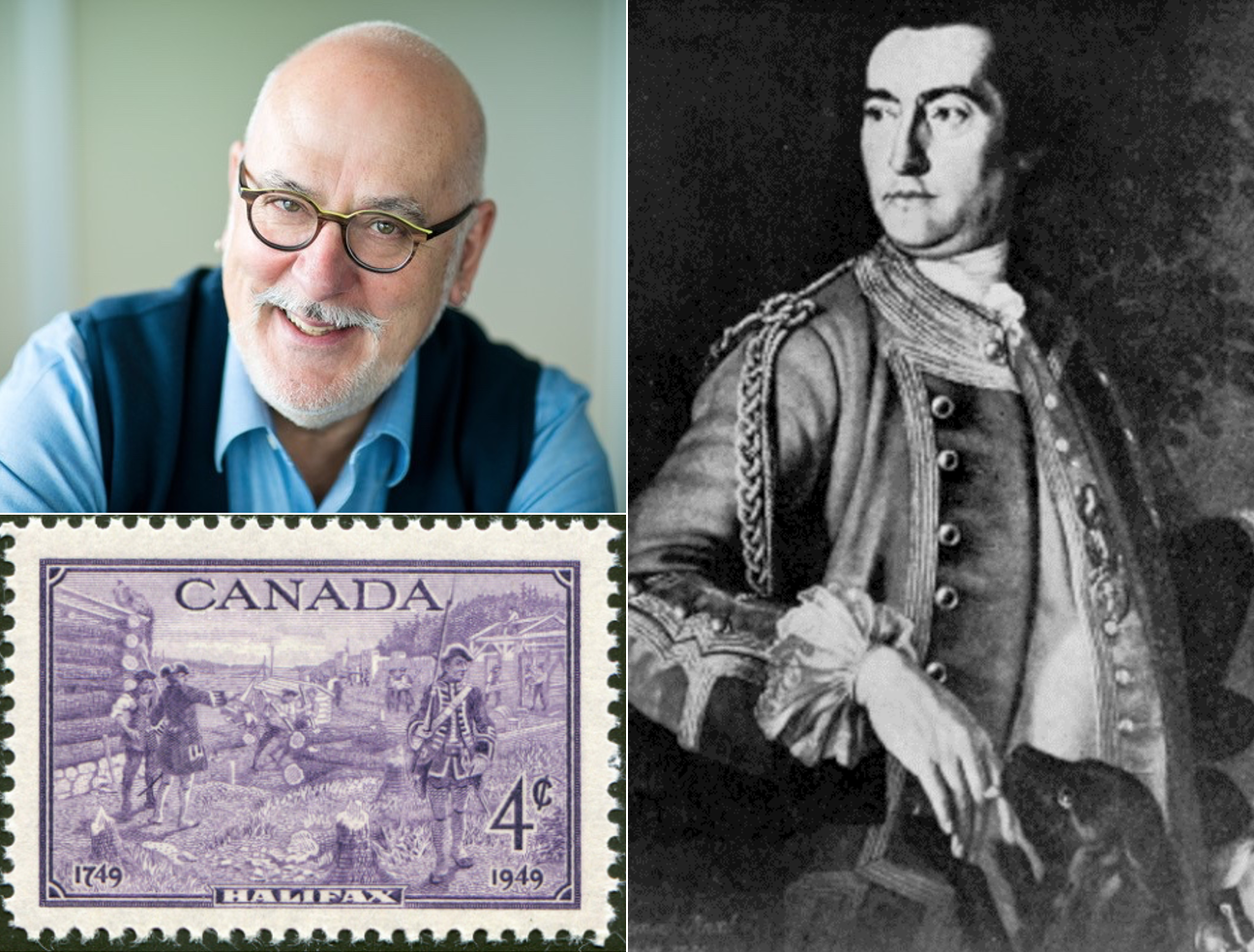
Leo J. Deveau (top left) is director of the Halifax Military Heritage Preservation Society, created to counter attacks on the reputation of Halifax’s founder Cornwallis (right). At bottom left, a 1949 stamp commemorating the 200th anniversary of the founding of Halifax.
xLeo J. Deveau (top left) is director of the Halifax Military Heritage Preservation Society, created to counter attacks on the reputation of Halifax’s founder Cornwallis (right). At bottom left, a 1949 stamp commemorating the 200th anniversary of the founding of Halifax.

In his book We Were Not the Savages: Collision Between European and Native American Civilizations, Mi’kmaq elder Daniel Paul claims that Cornwallis called for the “extermination” of native men, women and children via his scalp bounty. This heated accusation quickly lodged itself in the public consciousness. And, as has occurred with other historical figures, Cornwallis’ cancellation soon followed.

First to go was a statue of the former governor in Cornwallis Park in Halifax. Then the itself park was renamed, along with anything else bearing the Cornwallis name, including a school, street and ship. Curiously enough, neither Paul nor anyone of Cornwallis’ other attackers ever mention the earlier massacres of British settlers that prompted his bounty for Mi’kmaq warriors. The Fortress of Louisbourg national historic site in Nova Scotia, run by Parks Canada, is similarly mute on the Mi’kmaq raids, while indulging in frequent references to the evils of colonialism and racism.

Among the reasons the Halifax Military Heritage Preservation Society was created in 2019, Deveau explains, was to counter the narrative that Cornwallis planned a genocide against the Mi’kmaq. “We formed it during the Cornwallis debate and invited the Mi’kmaq to meet with us, but they wouldn’t,” he says.

“Daniel Paul broadened the perspective,” Deveau says of the book We Were Not Savages. “But he was so driven by a sense of grievance that I found his book hard to read. I was fed up with misinformation and the crowd mentality of those who have a simple view of what they think is history and then malign people like Cornwallis.” Of note, Paul’s book also calls Prime Minister Macdonald “an unrepentant white supremacist” and compares the plight of the Mi’kmaq in 18th-century Nova Scotia to Jews in the Holocaust. Paul, who passed away in 2023, received the Order of Canada in 2005.
Egerton Ryerson was dead by the time the federal school system was formally instituted in the 1880s. While in an 1847 paper he authored on native education is often cited by activists, this document played no role in the later development of the schools. The historical record demonstrates that Ryerson was a dedicated education reformer primarily responsible for creating the public school system in Ontario.

From “Legendary” to “Hanging” Judge

Suzanne Anton and Sam Sullivan – Vancouver

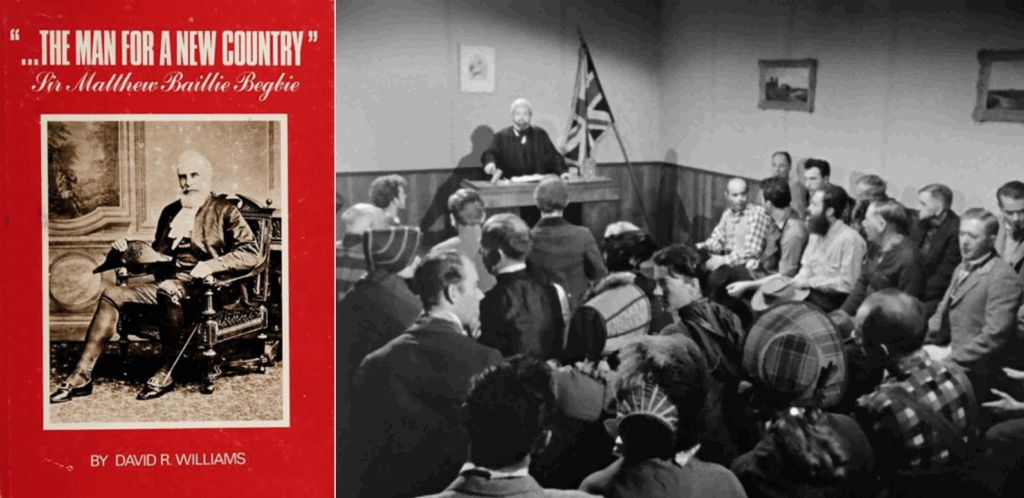
In 1977 prominent B.C. lawyer and legal historian David R. Williams published a biography of Sir Matthew Baillie Begbie entitled The Man for a New Country; it won the UBC Medal for Canadian biography. Williams begins his book by describing two statues that once flanked the main entrance to the Parliament Buildings in Victoria – James Douglas, the first governor of B.C., on one side, and Begbie, the province’s first Chief Justice, on the other. Wrote Williams: “The people of this province in this fashion acknowledged the obligation owed these men; without them Columbia might not have remained British Columbia.”

Begbie is truly a monumental historical figure. An English lawyer who stood six-foot-five, he arrived on the West Coast in 1858 as the appointed chief justice of the colony of British Columbia. For 12 years Begbie was the only judge in B.C.; he would go on to serve 36 years. He travelled extensively on horseback learning all he could about the new colony and its people. He studied Indigenous languages and was an early defender of the concept of aboriginal title. From the bench, he also opposed discrimination against Chinese immigrants. When gold was discovered in the Fraser Valley and tens of thousands of American miners flooded into the colony threatening chaos, Begbie was instrumental in taming them. A 1958 National Film Board documentary entitled The Legendary Judge declared that he was “the form and substance of British justice sent out from England to challenge the wild west.”

Monumental figure: David R. Williams’ 1977 biography, The Man for a New Country, explains how Chief Justice Sir Matthew Baillie Begbie brought the rule of law to the colony of British Columbia, including by defending the rights of Indigenous and Chinese people. At right, a screenshot from the 1958 National Film Board documentary The Legendary Judge. Monumental figure: David R. Williams’ 1977 biography, The Man for a New Country, explains how Chief Justice Sir Matthew Baillie Begbie brought the rule of law to the colony of British Columbia, including by defending the rights of Indigenous and Chinese people. At right, a screenshot from the 1958 National Film Board documentary The Legendary Judge.

Begbie’s present-day problems stem from a series of ghastly murders in B.C.’s remote Chilcotin territory. In 1864 white settlers started building an unauthorized road through Indian lands. Nursing a variety of grievances, local Tsilhqot’in natives led by war chief Klatsassin launched a series of surprise attacks on the road crew and others in the area, leaving 21 whites dead – some with their bodies horribly mutilated. A posse of colonial volunteers later set out in pursuit of Klatsassin and his band; once they were finally apprehended, some say by trickery, Begbie served as judge for the jury trial. The result was a guilty verdict for five of eight men charged with murder; a sixth would later be found guilty in a separate trial. In those days, murder carried a mandatory death sentence. Given the jury’s verdict and mandatory sentencing rules, Begbie himself bore little responsible for the executions.

In 1993 the Cariboo-Chilcotin Justice Inquiry, a provincial task force looking into the incarceration of Indigenous people in the region, included among its recommendations a posthumous pardon of those hanged in the Chilcotin War as an act of reconciliation. Strangely, this gesture later morphed into a campaign against Begbie, turning him into the villain of the story. If the natives who were hanged were actually innocent, the logic goes, then the presiding judge must be to blame. In 2001 the University of Victoria removed his name from the school’s law building. In 2017 a famous statue of Begbie on horseback was removed from the lobby of the Law Society of B.C.’s building. As usual, the media played a key role in focusing on activist claims against Begbie without any countervailing discussion.

In 1792, Henry Dundas introduced a successful motion in the British Parliament that called for the slave trade to be gradually abolished. This represented the first legal step to ending the slave trade throughout the British Empire. Furthermore, as British Home Secretary,  Dundas appointed John Graves Simcoe as the first Lieutenant-Governor of Upper Canada, who subsequently introduced the Act to Limit Slavery in 1793, the first legislation of its kind in the British Empire. Despite clear evidence of his abolitionist leanings, his name was recently removed from Toronto’s Yong-Dundas Square amid claims he intended to prolong the slave trade.

Throughout the province, anything with the Begbie name was renamed; Sir Matthew Begbie Elementary School in Vancouver got a new and unpronounceable Indigenous name. The premier of B.C. and prime minister of Canada each apologized for the outcome of the trial.

Suzanne Anton is the daughter of Begbie-biographer Williams and a former municipal councillor and MLA, serving as Attorney General and Minister of Justice in the cabinet of Liberal Premier Christy Clark. “My father spent six months in the U.K. researching Begbie’s early life and his family, and had great admiration for him,” Anton says. Faced with the current onslaught of anti-Begbie sentiment, she says she plans to republish her father’s book to bring some balance back to the conversation.

“History should consider Begbie’s entire record, which speaks for itself,” Anton says. “He was highly regarded by Indigenous and settlers alike. He kept the peace. And in spite of the large numbers of American miners, he was able to keep B.C. British. He was a remarkable man.”

Echoing this view is Sam Sullivan, a former mayor of Vancouver. He was so incensed with the slander against Begbie that he produced his own video about the gold rush, Indigenous inter-tribal conflicts, and Begbie. “With a legal system that owes so much to him in a province whose very existence depended on the force of his personality, one must wonder if the justice he worked so hard for was done,” Sullivan says in his video.
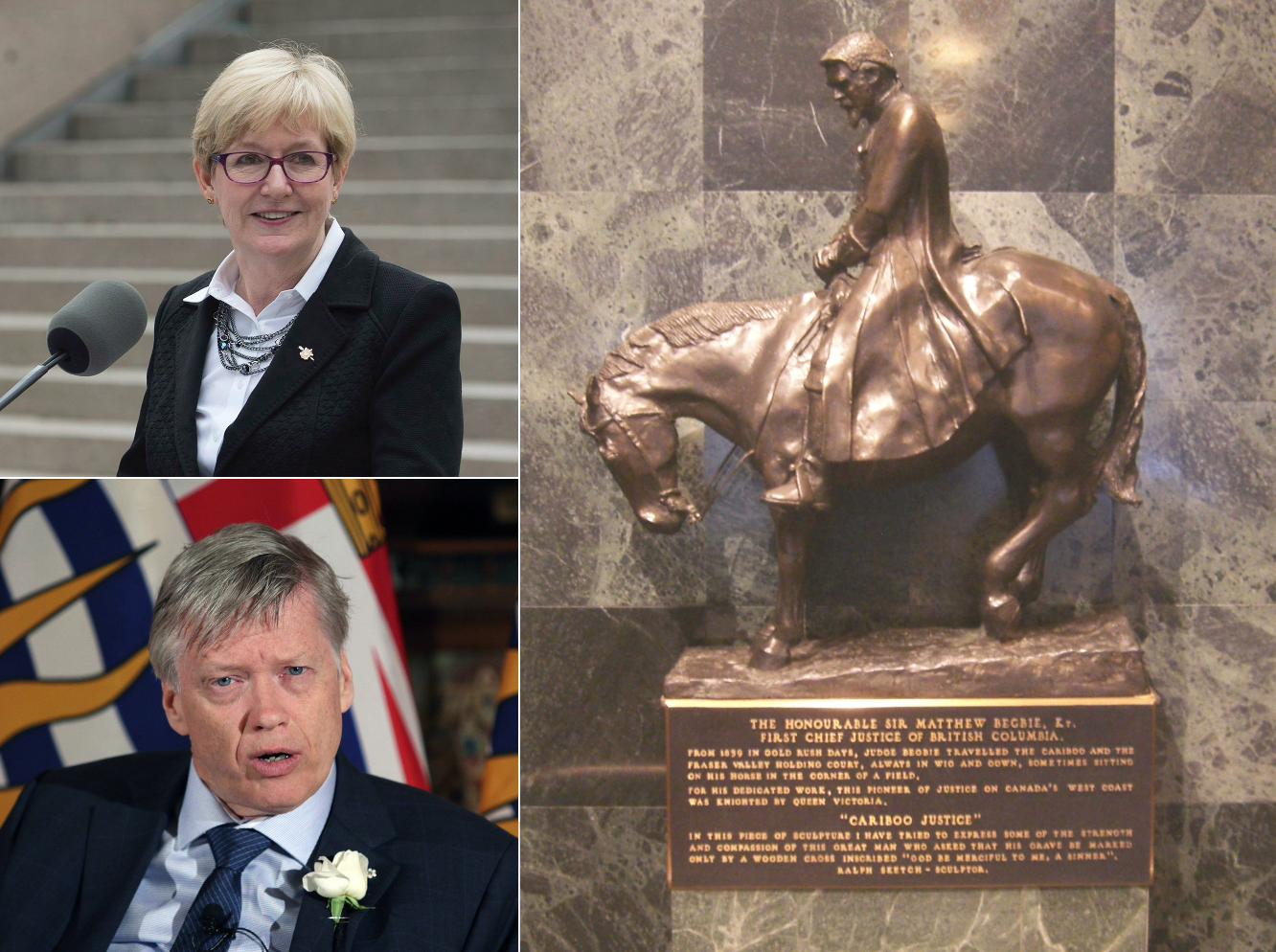
Following the provincewide repudiation of Begbie, former B.C. Attorney General Suzanne Anton (top left) and former Vancouver mayor Sam Sullivan (bottom left) came to his defence. At right, Begbie’s statue in the lobby of the B.C. Law Society’s building prior to its removal in 2017.
xFollowing the provincewide repudiation of Begbie, former B.C. Attorney General Suzanne Anton (top left) and former Vancouver mayor Sam Sullivan (bottom left) came to his defence. At right, Begbie’s statue in the lobby of the B.C. Law Society’s building prior to its removal in 2017. (Sources of photos: (top left) The Canadian Press/Jonathan Hayward; (bottom left) The Canadian Press/Chad Hipolito; (right) Ken Walker [email protected], Sculpture by Ralph Sketch, licensed under CC BY 2.5)

Confined to a wheelchair since a skiing accident when he was 19, Sullivan is founder of the Sam Sullivan Disability Foundation and a member of the Order of Canada. His mother and wife both attended Sir Matthew Begbie Elementary School as children. “I find that people who are trying to humiliate the country and tear it down always go after the first, whether it’s the first prime minister or first chief justice: the icons,” Sullivan says. “By removing respect for the ‘first’ they can destroy the rest. But I think Canadians are getting fed up with the denigration of our country.”

Sullivan is also worried about how wokism has infiltrated the legal profession, especially among young lawyers; the fact the B.C. law society removed its Begbie statue without consulting its members is evidence of this, he says. The root cause, he explains, is a fundamental lack of respect for and attention paid to our history.

Friends Forever

If there’s a bright spot to be found in the current deluge of historical cancellations and untruths, it’s that Canada’s greatest heroes now know who their friends really are. Amid the many illogical and unsupportable claims made against historical figures, new organizations are rapidly appearing to correct these rampant falsehoods. Lynn McDonald’s Friends of Egerton Ryerson, Deveau’s Halifax Military Heritage Preservation Society and Jennifer Dundas’s Henry Dundas Committee of Ontario are three such examples. In 2021, a collective of Canadian historians and other academics calling themselves the Friends of Sir John A. Macdonald took out a full-page ad in the National Post to defend our first prime minister’s reputation. The group Kingston Friends of the CIHE is another grassroots organization fighting back and trying to set the record straight.
You’ve got a friend: Organizations such as Friends of Egerton Ryerson and the Friends of Canadian History have sprung up in recent years to set the record straight about Canada’s historical figures.
xYou’ve got a friend: Organizations such as Friends of Egerton Ryerson and the Friends of Canadian History have sprung up in recent years to set the record straight about Canada’s historical figures.

These “friendly” groups are having a real impact. Consider, for example, the role of the CIHE in returning Macdonald’s statue at Queen’s Park to its rightful place in public view. Likewise, the offshoot organization Kingston Friends of the CIHE has argued that its city’s precipitous removal of a Macdonald statue in 2021 was in direct violation of provincial heritage laws and must be reversed since it was illegal. They have a strong case.

And while Henry Dundas’ name was indeed removed from Yonge-Dundas Square as well as from two Toronto subway stops, public pressure and mounting costs finally forced the City of Toronto to halt its larger anti-Dundas campaign. The city no longer plans to relabel every street sign that bears the name, meaning Dundas Street remains one of Toronto’s most significant thoroughfares. And as Jennifer Dundas points out, Torontonians have not exactly embraced their new Sankofa Square. In 2024 as Yonge-Dundas Square it hosted 71 public events; in 2025 as Sankofa, a mere 22.
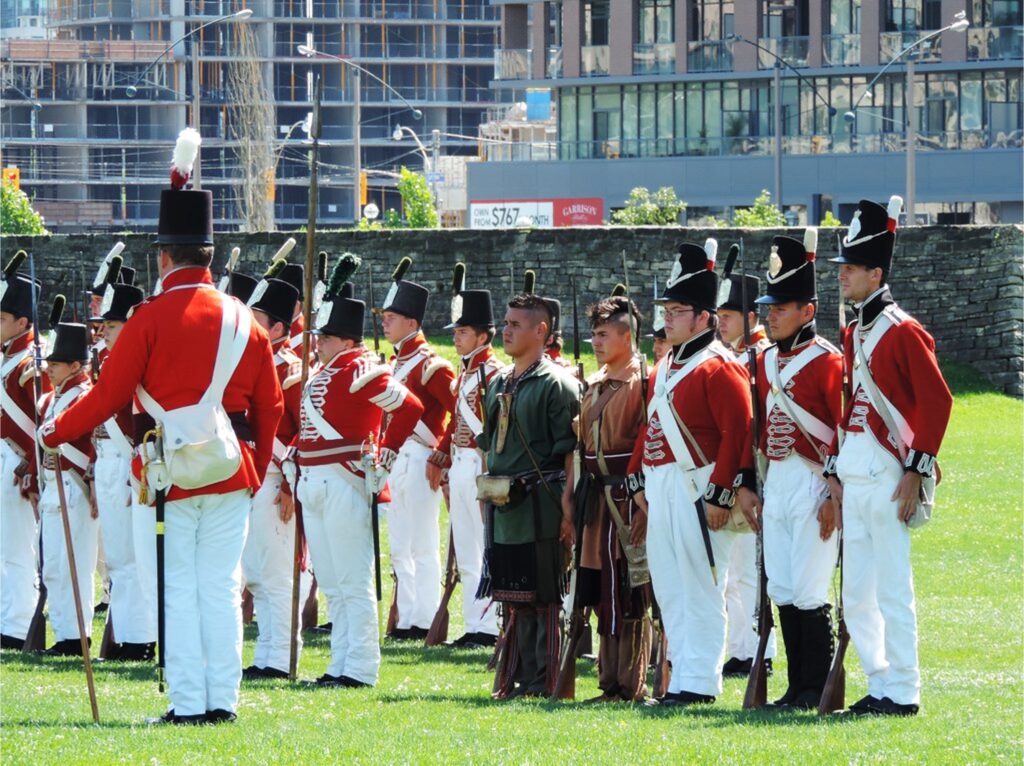
Reason for hope: Among the CIHE’s recent accomplishments is the promised return of the Fort York Guard re-enactors at Toronto’s Fort York National Historic Site this coming summer. The popular tourist attraction was cancelled in 2022 as part of the “decolonization” of the city’s museums.
xReason for hope: Among the CIHE’s recent accomplishments is the promised return of the Fort York Guard re-enactors at Toronto’s Fort York National Historic Site this coming summer. The popular tourist attraction was cancelled in 2022 as part of the “decolonization” of the city’s museums. (Source of photo: Alyx Dellamonica, licensed under CC BY-NC 2.0)

Also in Toronto, the cancellation of the much-loved Fort York Guard has finally been reversed. “The city wanted to decolonize Fort York and we fought them,” CIHE chair Cranston explains. “They shut down [the uniformed re-enactors program] and we got them back.” The colourful soldiers are expected to make their return this coming tourist season. While the original cancellation was steeped in wokism and petty politics, the return seems a clear victory for common sense. As for the CIHE, interest in its message is clearly growing. Its newsletter and online mailings received 4 million views in 2025. And new branches of CIHE, such as the Kingston franchise, are opening across the country.

Historical truth has clearly not gone out of fashion in Canada. It may be too soon to say the tide has turned for good, but there’s certainly reason for optimism. Thanks to a dedicated band of truthtellers, the real story of Canada and its historical heroes is being told once more. Our history, never mind our future, depends on them.

Jerry Amernic is a journalist and novelist based in Toronto. In addition to works of historical fiction, he has written books about Babe Ruth and former Toronto Chief of Police Julian Fantino. His latest book is SLEEPWOKING, published in October 2025, which became an Amazon #1 Bestseller in Canadian history.

Source of main image: ChatGPT.

Love C2C Journal? Here's how you can help us grow.

More for you

Hearts of Darkness: How the Left Uses Hate to Fuel its 21st Century Universal Imperium

For years now the Left has shown itself eager to claim hatred as the motive for anyone who opposes its worldview. This impulse has become a poisonous social force – elevating identity politics, quashing freedom, driving cancel culture and threatening the very foundation of Western liberal democracy. But where did it come from? Collin May, a former Chair of the Alberta Human Rights Commission who himself experienced cancellation, explores the deep origins in this thoughtful and wide-ranging essay. From Ancient philosophers and early theologians through Renaissance scholars and fashionable modern intellectuals, May traces this dark pathology’s evolution and explains why it’s so dangerous.

In Case of Emergency, Break Law? Why the Federal Court of Appeal Hammered Trudeau’s Use of the Emergencies Act

It’s a rare and beautiful thing to see Canada’s courts strike a blow for individual freedom, but that’s what happened in an Ottawa courthouse last month. In a ringing and powerfully-reasoned decision, the Federal Court of Appeal found the Justin Trudeau government’s invocation of the Emergencies Act during the 2022 Freedom Convoy protests violated the law and the Constitution. Civil rights lawyer Christine Van Geyn, who was in the thick of the nearly four years of litigation the event triggered, explains why the court agreed that Trudeau’s actions constituted a draconian abuse of power – and why its ruling could prove a historic victory for Canadian civil liberties.

Give This Idea an F: The Problematic Push to Eliminate Letter Grades

B.C.’s decision to abandon letter grades in favour of four vague “proficiency” categories is the latest example of the move to do away with objective standards throughout Canada’s public education system. Traditional grading methods are too hard on the tender egos of young students, the logic goes. And the possibility of failure is outdated, if not downright racist. Christina Park reveals how this new system is failing parents, who have a right to know how their child is doing, and harming students, who may be denied the help they need. She also uncovers some “gritty optimism” about the possible return of coherent educational standards.

More from this author