
European Affairs

The Price of Foolish Pride: What Germany’s Social and Economic Decline Can Teach Canada

Gwyn Morgan
January 26, 2026
Germany was postwar Europe’s most successful nation – until it was seized by an arrogant leftist ideology that led it down a ruinous path. Its government abandoned safe, zero-emission nuclear power for inefficient wind and solar plus natural gas from Vladmir Putin. It threw open its borders to millions of asylum-seekers with barely a thought to the enormous costs or the difficulties of social integration. Today, at the 11th hour, Germany is at last struggling to turn around its decade of economic decline and social disintegration. In this cautionary tale, Gwyn Morgan sees a profound warning for Canada.
European Affairs

The Price of Foolish Pride: What Germany’s Social and Economic Decline Can Teach Canada

Gwyn Morgan
January 26, 2026
Germany was postwar Europe’s most successful nation – until it was seized by an arrogant leftist ideology that led it down a ruinous path. Its government abandoned safe, zero-emission nuclear power for inefficient wind and solar plus natural gas from Vladmir Putin. It threw open its borders to millions of asylum-seekers with barely a thought to the enormous costs or the difficulties of social integration. Today, at the 11th hour, Germany is at last struggling to turn around its decade of economic decline and social disintegration. In this cautionary tale, Gwyn Morgan sees a profound warning for Canada.
Share on Facebook
Share on Twitter

Germany has long been Europe’s economic engine and the country’s GDP remains third-largest in the world, well behind the U.S. and China though still ahead of Japan and India. But because of serious policy failures in key areas Germany is now a nation in social, political and economic decline. It is a cautionary tale with powerful – and ominous – lessons for Canada.

Begin with economic policy, specifically energy policy. Reliable, affordable energy is key to any country’s economic well-being. In 2002, Germany’s 11 nuclear power plants generated more than one-quarter of its electricity, with coal and natural gas supplying most of the rest. “Renewables” were just getting going at the time. Since then, huge investments in solar and wind power have been made, with ugly wind turbines and solar farms blighting more and more of the pretty German countryside as well offshore zones in the North Sea. The original intention was to phase out fossil fuels and drive down greenhouse gas emissions to meet Germay’s international commitments. But driven by an irrational anti-nuclear-power campaign by environmental zealots and Green Party politicians, Germany’s plan then morphed into generating so much power from wind and solar so as to also allow the shutdown of all of Germany’s zero-emitting nuclear plants by 2036.
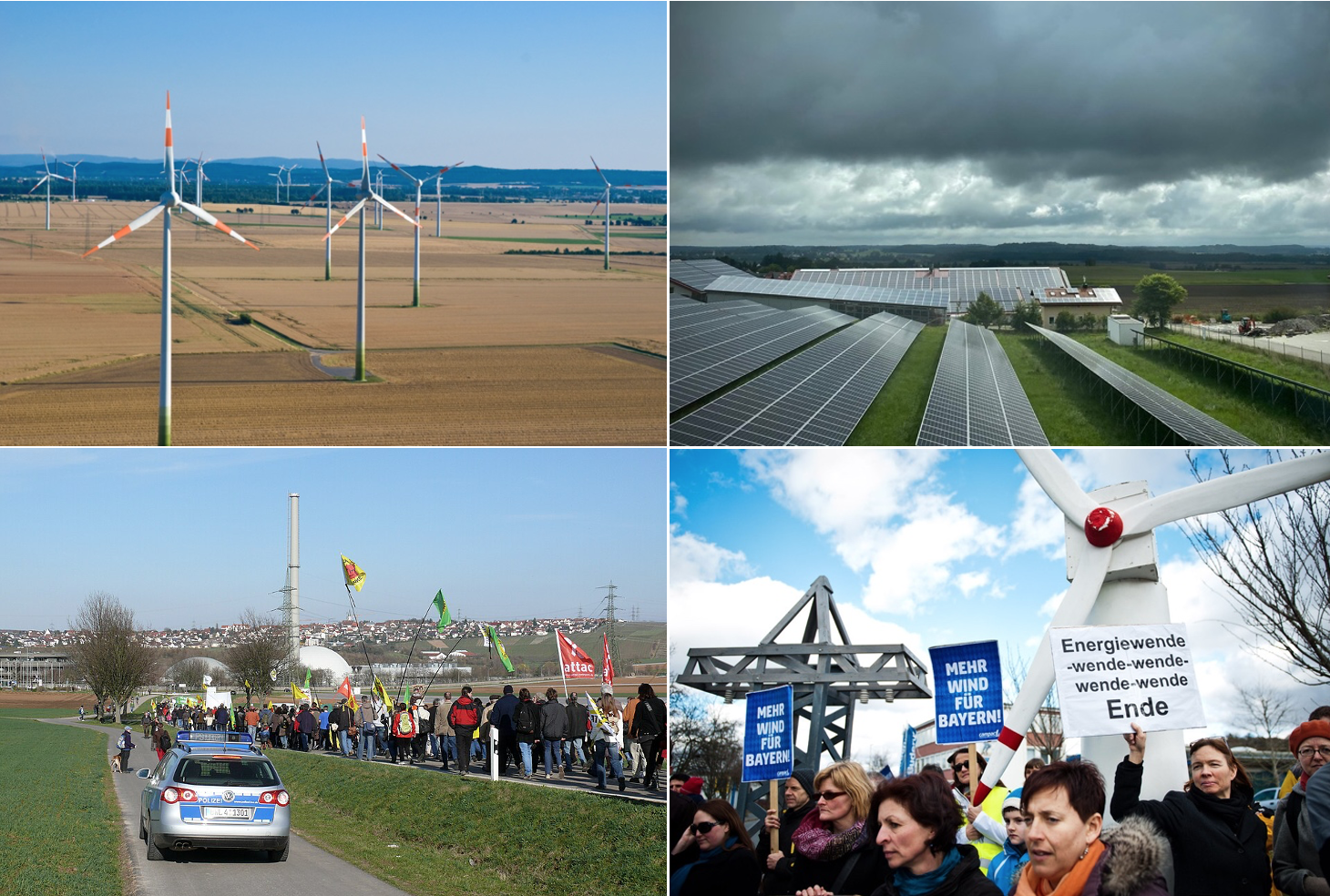
Ugly turbines, ruinous policy: Germany’s push to cut CO2 emissions by adding renewable power bizarrely coincided with an uncompromising anti-nuclear-power campaign. At bottom left, a 2011 anti-nuclear protest near the Neckarwestheim Nuclear Power Plant near Stuttgart; at bottom right, a 2014 pro-wind-power march in Bavaria.
xUgly turbines, ruinous policy: Germany’s push to cut CO2 emissions by adding renewable power bizarrely coincided with an uncompromising anti-nuclear-power campaign. At bottom left, a 2011 anti-nuclear protest near the Neckarwestheim Nuclear Power Plant near Stuttgart; at bottom right, a 2014 pro-wind-power march in Bavaria. (Sources of photos (clockwise starting top left): Philip May, licensed under CC BY-SA 3.0; Sharon Hahn Darlin, licensed under CC BY 2.0; campact, licensed under CC BY-NC-ND 2.0; Roman Eisele, licensed under CC BY-SA 3.0)

Then came the 2011 nuclear disaster in Fukushima, Japan. Although it was triggered not by a nuclear accident but by tidal waves from an offshore earthquake, the unwarranted fears the plant’s destruction aroused accelerated the shutdown of Germany’s safe and reliable nuclear plants. Within six months, eight of Germany’s nuclear plants were closed. Since then, ironically, Japan has worked to refurbish and restart 15 of the 54 units that it shut down nationwide, and plans to restart another 16. With Germany’s electricity consumption zooming as the government pressured consumers and businesses to transition away from fossil fuel use, even the country’s headlong wind and solar energy construction couldn’t keep pace.

Germany’s current energy policy has been a primary driver of its serious economic decline. The decision in the early 2000s to phase out nuclear power in favour of volatile renewables like wind and solar power – along with the government’s encouraging German consumers and businesses to use ever-more electricity – led to some of the highest electricity prices in the world.

This shift has been ruinous for the nation’s manufacturing core, particularly the chemicals and automotive sectors. Automobile production in Germany declined by 29 percent between 2017 and 2024, a sharp contrast to continued growth in China. Reports by credible economic consultancies conclude that had Germany maintained its nuclear power plants, electricity prices in 2025 would be 23 percent lower, while 94 percent of power generation would be emissions-free.

That left little choice but to import ever-greater volumes of natural gas from Russia for power generation, heating and industrial fuel. The enormous, twin-pipe Nord Stream natural gas pipeline running down the Baltic Sea, completed in 2012, in effect replaced Germany’s secure nuclear power with dependency on a fossil fuel supply controlled by Vladimir Putin. Had Germany kept its nuclear plants, a Price Waterhouse report concluded last year, fully 94 per cent of its power generation would now be emissions-free and the average price of its electricity would be 23 per cent lower. Instead, German ratepayers and businesses face some of the world’s highest electricity prices – plus scarcity of natural gas and declining reliability. Germans have coined a lamentable new term, “Dunkelflaute”, to describe all-too-numerous calm nights when the country’s entire vast array of wind and solar power facilities produce not one single watt of electricity.

The impact of Germany’s disastrous energy policy can hardly be overstated. High energy prices have been literally ruinous, rendering business after business and entire industries uncompetitive in the face of surging global competition. Germany’s world-leading chemicals industry – which, among its thousands of inventions, brought the world Bayer Aspirin – has been pummelled into a shadow of its former self. The country’s famously productive and reliable mid-sized manufacturers, most of them family-owned for generations, have been scaling back or shutting down by the hundreds.
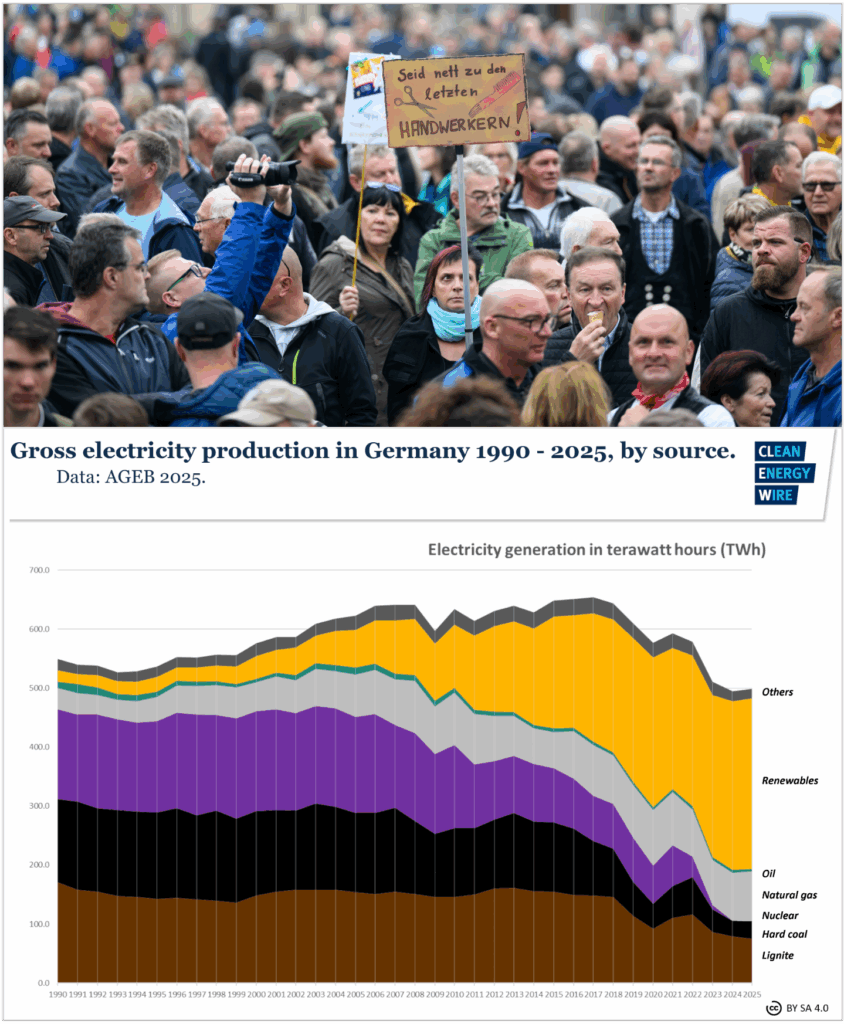
As power generation from inefficient wind and solar facilities zoomed but overall output fell, Germany’s electricity prices soared and are now 23 percent higher than had the country’s nuclear power plants remained open; high energy costs have devastated the country’s mid-sized manufacturers. At top, skilled tradesmen in Dresden protest in 2022 against rising energy prices, with a poster reading “Be nice to the last craftsmen!”
xAs power generation from inefficient wind and solar facilities zoomed but overall output fell, Germany’s electricity prices soared and are now 23 percent higher than had the country’s nuclear power plants remained open; high energy costs have devastated the country’s mid-sized manufacturers. At top, skilled tradesmen in Dresden protest in 2022 against rising energy prices, with a poster reading “Be nice to the last craftsmen!” (Sources: (photo) Robert Michael/dpa via ZUMA Press; (graph) AGEB, licensed under CC BY-SA 4.0)

And now the country’s single largest industrial category, biggest employer and foremost source of export earnings too is under threat. Germany’s automotive sector has been described as “an ecosystem that provides livelihoods for millions of people.” But now, Chinese automakers such as BYD and NIO have entered European markets with innovative, affordable products, eroding profitability and market share for Volkswagen, Audi, BMW and Mercedes-Benz and leading to the first mass layoffs in that industry since the Second World War over 80 years ago. Automobile production in Germany declined by an incredible 29 percent between 2017 and 2024, according to auto industry data, while China’s output continued to increase and the U.S. was down by a more manageable 10 percent. No wonder Germany’s economic growth has flatlined and its average per capita income is falling. Sound familiar?
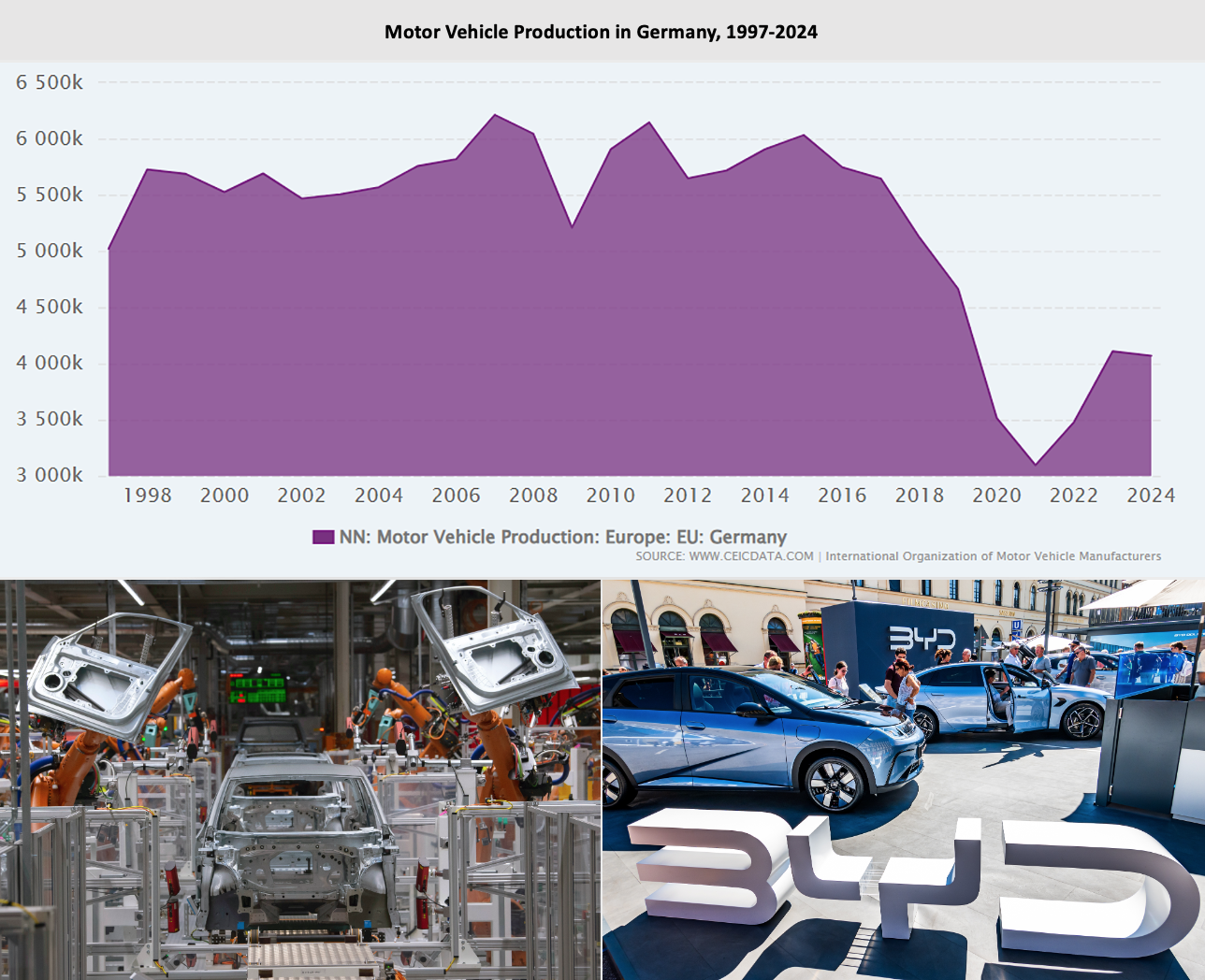
Fading ecosystem: Production in Germany’s critical automotive sector is down by nearly one-third from its past levels, as demand falls and Chinese brands such as BYD and NIO make major inroads. At bottom left, a Volkswagen AG assembly line in Zwickau, eastern Germany; at bottom right, BYD display at international auto show in Munich, September 2023.
xFading ecosystem: Production in Germany’s critical automotive sector is down by nearly one-third from its past levels, as demand falls and Chinese brands such as BYD and NIO make major inroads. At bottom left, a Volkswagen AG assembly line in Zwickau, eastern Germany; at bottom right, BYD display at international auto show in Munich, September 2023. (Sources: (chart) CEIC; (bottom left photo) AP Photo/Jens Meyer, file; (bottom right photo) FooTToo/Shutterstock)

Social Calamity Driven by the Same Ideologues

Germany’s socio-political picture is even more dismal. During the Syrian civil war that erupted in 2015, large numbers of displaced Muslim asylum-seekers made their way though the Balkans and into Europe. They came in huge, unruly waves, instilling fear in local citizens. Greece, Poland, Hungary and Belarus forcibly prevented entry, while other countries did all they could to usher them onward with tales of free housing and welfare cheques farther to the north. Germany became a favoured destination, taking in 76,000 Syrians in July 2015 and 170,000 in August.

That was only the start; Chancellor Angela Merkel then made her soon-to-be-infamous declaration “Wirschaffen das” – “We can do this.” That opened the floodgates and by the end of 2015 Germany had taken in 1.2 million Muslim refugees. Attempting to integrate the huge waves of migrants proved an enormous challenge. Immigration offices, schools, language instructors, social service providers and employment offices were overwhelmed. In 2024 alone Germany officially spent a staggering €29.7 billion – Cdn$48 billion – on refugees and asylum seekers, a figure that does not include damages from the associated criminality, and with rival estimates running as high as €50 billion.

The financial burden of this policy has accelerated Germany’s economic decline, with the government spending approximately 29.7 billion (Cdn$48 billion) on refugees and asylum seekers in 2024 alone. Beyond the fiscal strain, the country faces significant social challenges, including a constant threat of terrorism that has stoked widespread public fear and, among other measures, forced the scaling back of traditional German Christmas markets. Integration efforts have overwhelmed schools and social service providers, while certain radical groups, such as Muslim Interaktiv, have even called for German law to be replaced by Islamic law.

Even as problems became apparent, however, Germany continued to welcome migrants year after year. In 2023 alone, Germany accepted 300,000 asylum seekers, 80 percent of whom were Muslim, a large proportion of those unattached young men, bringing the total to 2 million. This was after an estimated 1,200 German women were sexually assaulted, including hundreds of them raped, by mostly migrant men on a single New Year’s Eve.
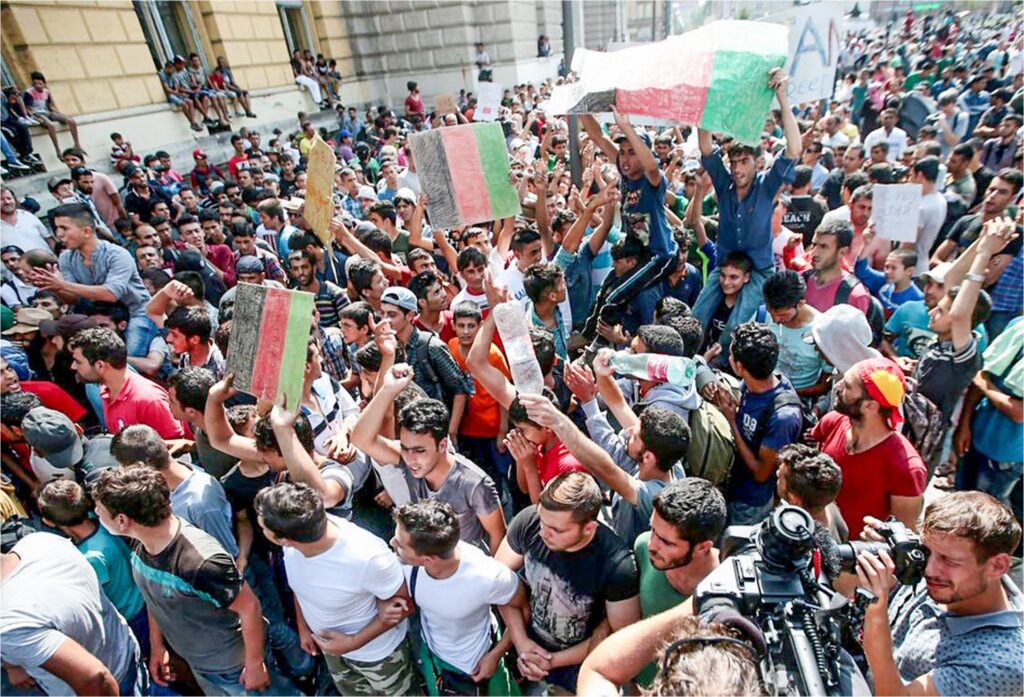
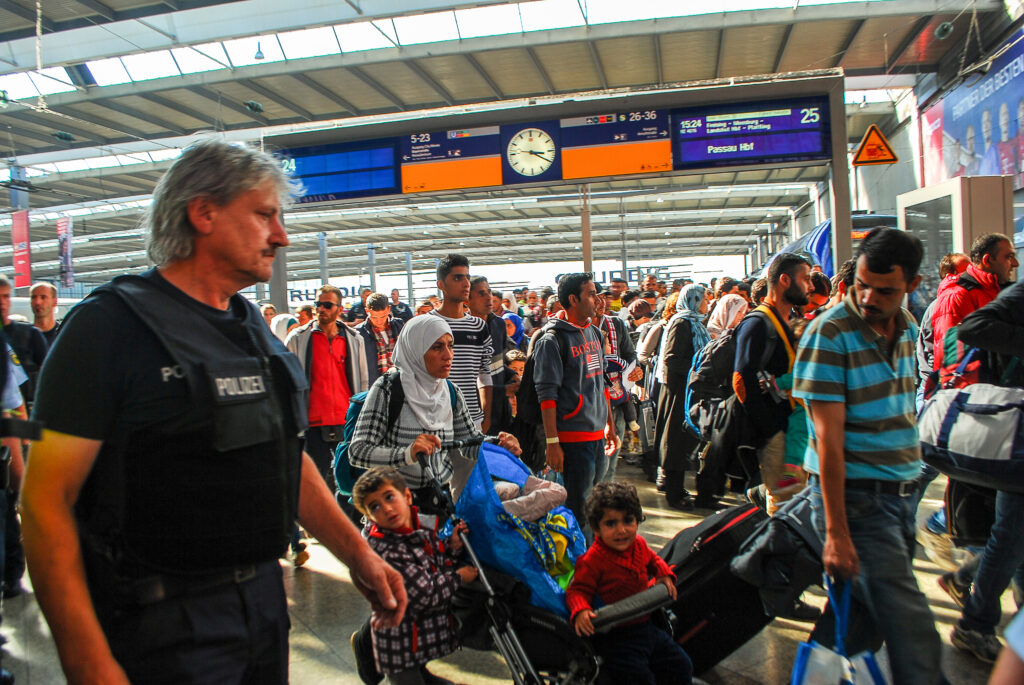
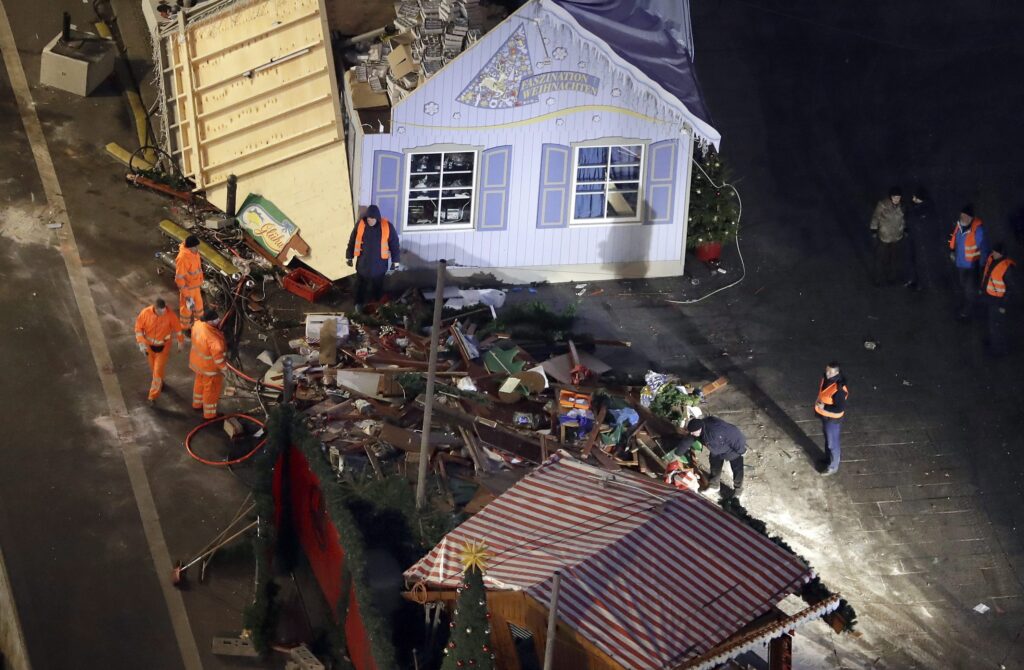
Open floodgates: Germany has taken in more than 2 million migrants from mainly Muslim countries, bringing ruinous costs, social disintegration and crime. At top, Syrian and Afghan refugees in Hungary demand travel to Germany. At middle, police escort migrants arriving by train at Munich Central Station, September 2015. At bottom, aftermath of 2016 Berlin attack in which a Tunisian murdered 12 and wounded 56 by driving a truck into a busy Christmas market.
xOpen floodgates: Germany has taken in more than 2 million migrants from mainly Muslim countries, bringing ruinous costs, social disintegration and crime. At top, Syrian and Afghan refugees in Hungary demand travel to Germany. At middle, police escort migrants arriving by train at Munich Central Station, September 2015. At bottom, aftermath of 2016 Berlin attack in which a Tunisian murdered 12 and wounded 56 by driving a truck into a busy Christmas market. (Sources of photos: (top) Public Domain; (middle) Jesus Fernandez/Shutterstock; (bottom) AP Photo/Michael Sohn)
Clearly, Germans have been paying a terrible price in more than just financial terms. Dozens of the country’s world-famous Christmas markets have been scaled back or shut down, while heavy security has sucked the life out of many others, due to the constant threat and, too often, reality of terrorism. Last February, among many examples, a 24-year-old Muslim man was arrested in Munich after a car-ramming attack that wounded 39 people, two very seriously. Casual sexual assaults have become so common that the government has launched campaigns to make swimming pools safe against “pinching” and other unwanted acts – although the associated propaganda posters ludicrously portray the perpetrators as white Germans.

The relentless attacks and the soaring popularity of the anti-migrant Alternative für Deutschland (AfD) Party in Germany’s eastern provinces and at the federal level have at last prompted the federal government – headed by the Christian Democrats under Chancellor Friedrich Merz, in coalition with the leftist Social Democrats – to take meaningful action. For the first time since the Second World War, Germany has begun deporting large numbers of migrants, last year sending some 60,000 illegal immigrants, rejected asylum-seekers or criminals back to their country of origin. Welfare payments and social supports have also been slashed. Germany’s measures to date are summarized (along with those of nine other European countries ranging from Latvia to Denmark to Poland) in this informative video.

The Merz government is also targeting extremism among legal immigrants and naturalized citizens. In November it banned a group called Muslim Interaktiv that has called for Germany to become an Islamic Caliphate in which, according to the German Ministry of the Interior, “Islamic law should take precedence over German law in regulating life in the Muslim community, including in areas such as the treatment of women.” Ahmad Mansour, an outspoken critic of Islamic extremism, calls Muslim Interaktiv “part of an Islamist network that has become significantly more aggressive and dangerous in recent months. They carry out intimidation campaigns, specifically mobilize young people and attempt to indoctrinate them with Islamist ideology.” Accordingly, Germany has also strengthened controls on funding by countries such as Saudi Arabia and Qatar of mosques that have encouraged radicalization.
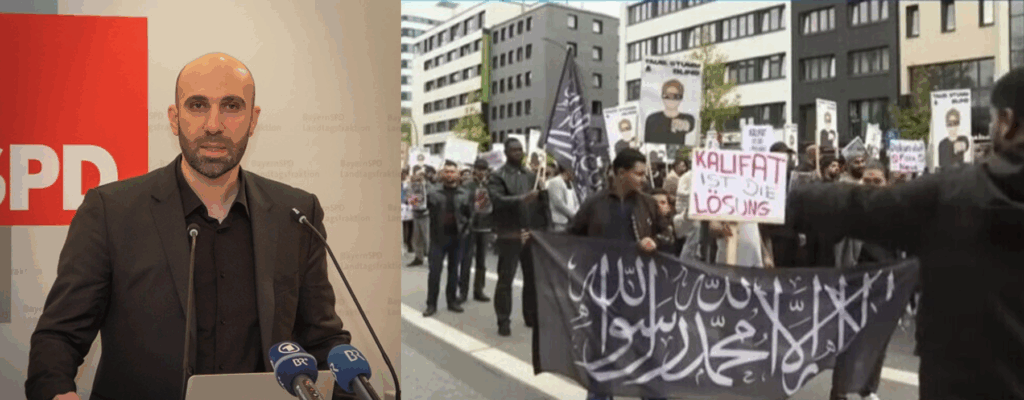

Faces of multiculturalism: Ahmad Mansour (left), an outspoken critic of radical Islam, warns that extremist groups like Muslim Interaktiv seek to turn Germany into part of an Islamic Caliphate. At right, a Muslim Interaktiv-sponsored march in Hamburg displaying a poster proclaiming “Caliphate is the solution”, April 2024.
xFaces of multiculturalism: Ahmad Mansour (left), an outspoken critic of radical Islam, warns that extremist groups like Muslim Interaktiv seek to turn Germany into part of an Islamic Caliphate. At right, a Muslim Interaktiv-sponsored march in Hamburg displaying a poster proclaiming “Caliphate is the solution”, April 2024. (Sources of photos: (left) SPDBayernLandtag, licensed under CC BY-ND 2.0; (right) YouTube/ZDFheute live)

Still, like other European countries, Germany continues to commit demographic suicide. The average fertility rate in the European Union fell to an all-time low of 1.38 in 2023, well under the bare replacement rate of 2.1. In Britain and France, which publish separate fertility rates for Muslim women, the estimated fertility rate is more than twice as high at 2.9, while Muslim fertility for Europe as a whole is estimated at 2.6.

Germany’s economic decline is exacerbated by a collapsing birthrate among its native population, which reached an all-time low of 1.38 in 2023. This is well below the replacement rate of 2.1 required for a stable society. In contrast, the fertility rate for Muslim women in Europe is estimated at 2.6. This demographic divergence, paired with the influx of over 1.2 million migrants into Germany since 2015, is fundamentally reshaping the nation’s social fabric and long-term stability.

This is the sad story of how energy supply decisions and ruinous immigration policies driven by the same collection of hard-left ideologues have brought to the brink of economic and social destruction a once-thriving society that had risen from the ashes of Nazism to become the most successful nation in postwar Europe. May the lessons Germany and other European nations finally seem to be learning help guard other nations from the same sad fate. Including our own.

 Gwyn Morgan is a retired business leader who has been a director of five global corporations.

Source of main image: Shutterstock.

Love C2C Journal? Here's how you can help us grow.

More for you

What’s Yours is Ours: Why Canada’s Charter Ignores Property Rights and What That Means for Everything You Own

“The whole meaning of life,” famed comedian George Carlin once observed, “is trying to find a place for all your stuff. That’s what your house is, it’s a place for your stuff with a cover on it.” If so, then Canadians should be very concerned about their stuff. Unlike nearly every other modern nation, Canada lacks constitutional affirmation of the right to own property and as protection against its unjust seizure. With a recent B.C. Supreme Court ruling putting the very notion of home ownership at risk, Peter Shawn Taylor seeks out legal opinions on Canada’s surprisingly lax attitude towards property rights, how it differs from other countries and what that means for everyone’s possessions. If Canadians really want to protect their homes, belongings and personal finances, Taylor concludes, now’s the time to get loud.

The Righteous Response: What Canada Can Learn from America’s Fight Against Antisemitism

Canadians frequently criticize U.S. President Donald Trump’s projection of American power. But in the fight against anti-Semitism, Canada could learn a thing or two from our neighbour to the south. In Part One of this series, Lynne Cohen revealed how Canada’s political and civic leaders have chosen to ignore or even abet the hate crimes and abuse Jews have suffered since October 7, 2023. In this second installment, she shows how the U.S. – from the President on down to local officials and law enforcement – has fought back. Where Canada has been cowering and cowardly, the U.S. has resolved to fight anti-Semitism, protect its Jewish citizens and defend Israel’s right to live freely as a Jewish state.

One Free Miracle: Towards a Theory of Everything

A new year has dawned and, as the light strengthens across the Northern Hemisphere, David Solway reminds us that how we choose to experience our world is at least as important as understanding how it came to be. In the first instalment of this two-part series, the writer illuminated the irreducible paradox at the heart of all theories concerning the universe’s creation, then scrutinized the seemingly unbridgeable gap between quantum physics and the physical world we live in. In Part II he considers an even tougher and, so far, unsolved scientific challenge: gravity. Some of the finest minds in science think it actually is insoluble without some kind of creative intelligence to oversee it. In other words, a miracle. To Solway, the true miracle is the fact of a marvellous world and our freedom to experience and wonder at it.

More from this author

Socialist Shakedown: It’s Finally Time to End Supply Management in Agriculture

U.S. President Donald Trump’s trade policy may be chaotic and punitive, but he’s right about one thing: Canada’s agricultural supply management system has to go. Not because it’s unfair to America, though it is, but because it punishes Canadians. The price-fixing scheme limits consumer choice, requires a huge bureaucracy and prevents farmers from producing more in the face of shortages, forcing them instead to dump excess production. Worst of all, writes Gwyn Morgan, it drives up prices for milk, cheese, chicken, eggs and other essential foods — all for the benefit of a few thousand farmers, largely in Quebec. For Canada’s trade negotiators, argues Morgan, ending this mad racket should be job one.

Climate Climbdown: Sacrificing the Canadian Economy for Net Zero Goals Others Are Abandoning

Climate-obsessed politicians – Justin Trudeau in the vanguard – nearly destroyed the Canadian economy chasing emissions targets that are both unrealistic and pointless. Ottawa and the four biggest provinces have squandered $158 billion to create just 68,000 “clean” jobs. Meanwhile, fossil fuels are supplying a bigger share of Canada’s energy needs than ever. And now, leading U.S. officials and even eco-zealots like Bill Gates are re-evaluating their net-zero ideology. But that hasn’t gotten through to Prime Minister Mark Carney who, warns Gwyn Morgan, intends to inflict further punishment on an ailing country in pursuit of a delusional cause.

What if October 7 Had Happened Not in Israel but in Canada?

It is probably beyond the imagination of most Canadians that they would ever face the kind of evil atrocity Israelis suffered on October 7, 2023. Or that we would find ourselves living next door to savage terrorists bent on our annihilation. But as Gwyn Morgan points out, it is critical to understand that reality as Israel’s struggle for existence carries on. The history of Israel is nothing short of miraculous. As Morgan personally observed on a tour of the world’s only Jewish state, Israelis have with determination and heart built a free, tolerant, prosperous and technologically-advanced democracy while surrounded by enemies. In the face of ruthless attacks by Hamas and the craven behaviour of supposed friends and allies who now lean in favour of the terrorists, Israel has reminded the rest of the world what real courage is.