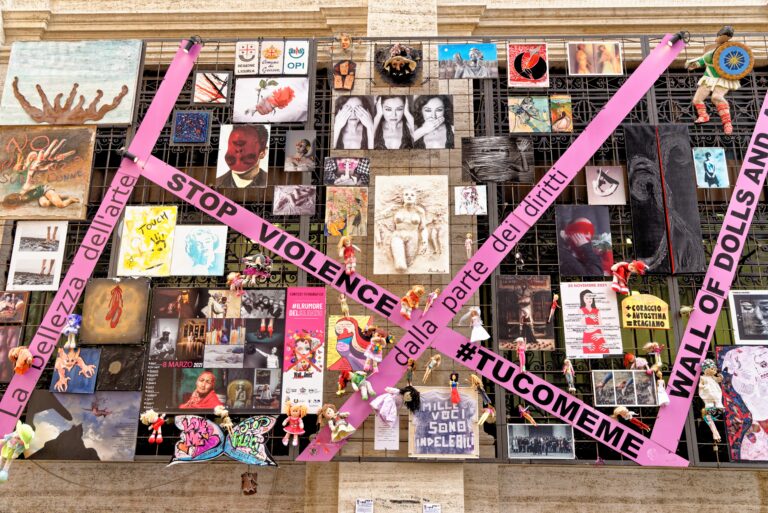
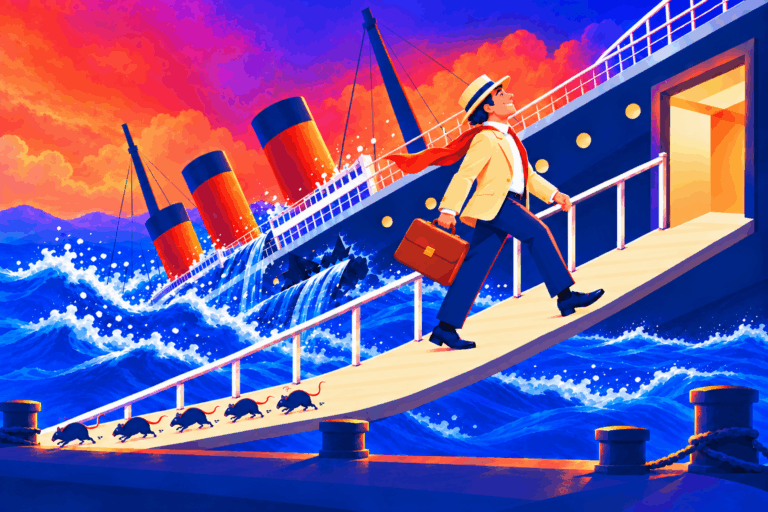
There is an obsession infecting our political speech that has become so prevalent it could be called the great narrative of our public life. On the one hand Western leaders, activists, bureaucrats and legacy news media – the entire “elite”, really – revel in hectoring their citizens on the inestimable value of inclusion, acceptance and empathy. At the same time, they spend an inordinate amount of time uncovering and condemning hatred. This dual-sermonizing has come to define much of the past 15 years.
As for what is hateful, the list is endless: patriotism, familial loyalty, religious dedication, merit, virtue, intrinsic beauty, condemnation of criminal malfeasance, intellect, scientific rigour, objectivity, moderation, fairness. All are targets in the great hate turkey-shoot. Even equality, the crown of our modern democratic dispensation, is now deemed heinous and finds itself crushed under a landslide of amorphous “equity”.
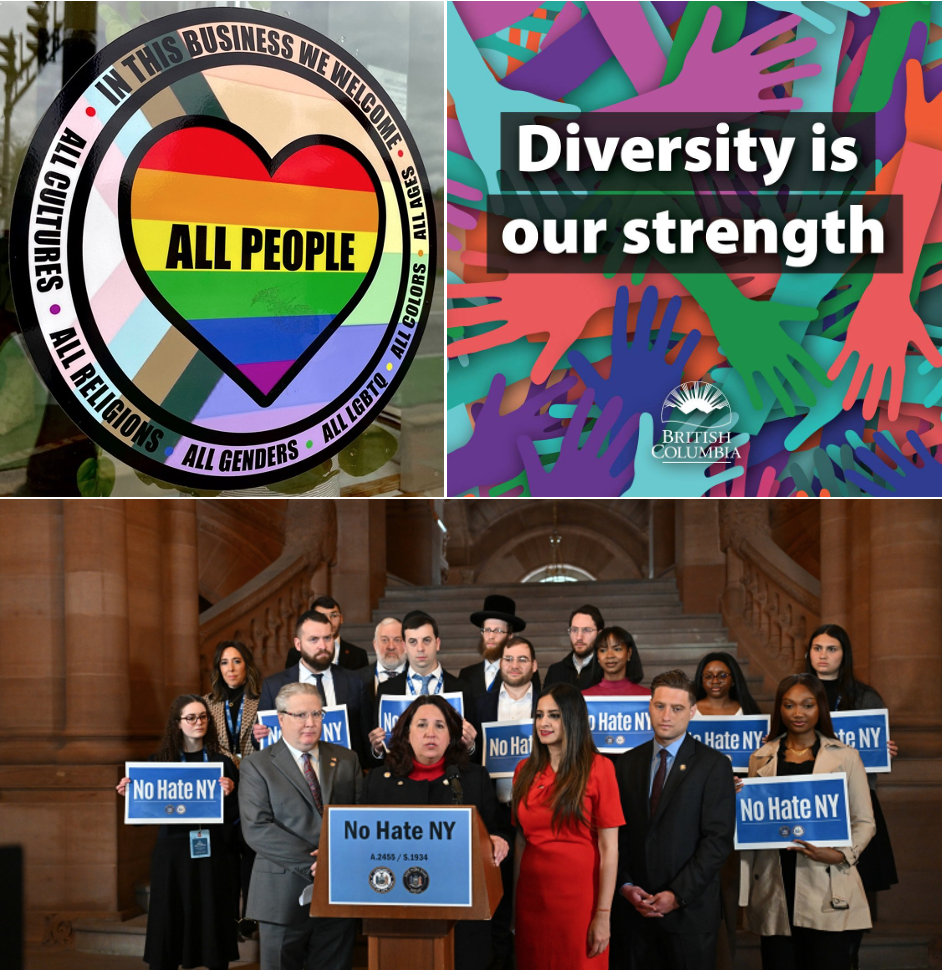
Those of us on the receiving end of this campaign have come to see that something is deeply amiss. After more than a decade of woke hectoring, we know in our minds and feel in our guts that this habit of tainting all manner of actions and thoughts with the toxic tincture of hate is itself a form of pathology. We hear the invocation of inclusion but see only the malice of obfuscation.
On top of it, we have come to recognize that most of this comprises duplicitous phrases without any connection to real actions, such phrases as virtue-signalling and sheer chicanery. What phrase is picked appears to depend in part on what Canadian theologian and philosopher Bernard Lonergan called scotosis – meaning intellectual blindness. So when faced with the tangible outcomes of actual hatred – the massacre at Bondi Beach, for instance – our self-appointed schoolmarms revert without missing a beat to their vacuous memes invoking humanity and unity along with their stock phrase: “There’s no room for hate in [insert jurisdiction here].” Having done their oracular duty, these false prophets slink off: words without meaning, speech without consequence.
The obsession with hatred and the flagging as hateful things that common sense and experience have deemed worthwhile suggest it is the accusers whose overriding motivation is hate. Their imputation of hatred in others, it would seem, is mass-projection, a reflection of something dark in their own passions. Given the enormous political force this phenomenon wields, it is incumbent on us to identify its source and who has signed onto it.
The Essence and Imperialism of Hate
A good place to start our journey into hatred is the Roman Catholic Church. My reasons are not to join the voices who over the centuries have condemned Christianity for acts of intolerance and historical injustice, or even those in the liberal camp who profess admiration for the now-commonplace separation of Church and State. Instead, I want to suggest that it is the Church which stands at the intellectual and historical fulcrum of much of our understanding of hate in the West. And that there are two relevant ideas associated with the Church in this regard: essence and empire.
First, though, I want to draw on a statement from the late head of the Roman Church, Pope Francis. Often considered a leading figure from the Church’s progressive wing, even Francis, in the annual speech delivered to diplomatic representatives to the Holy See on January 10, 2022, found himself lamenting a scourge of the left. A “divisive” mindset, he bluntly asserted, has taken hold in many institutions, driven by a movement “that rejects the natural foundations of humanity and the cultural roots that constitute the identity of many peoples.”
Coming to the nub of the matter, the late Pontiff went on to say, “I consider this a form of ideological colonization, one that leaves no room for freedom of expression and is now taking the form of the ‘cancel culture’ invading many circles and public institutions.” [Emphasis added] This is a remarkable statement because, not only does it condemn cancel culture, it provides an intellectual framework for thinking about it. While his speech went on to explore this problem’s implications, we need to unpack the phrases cited above.
Beginning with the notion of the “natural foundations of humanity,” we see two linked ideas at work. The first is what is true by nature. Francis evoked the long history of Catholic theology and its adoption of philosophical categories. To understand what is true by nature traditionally has meant to understand, or attempt to understand, what is universally true and accessible to human reason as opposed to defined by custom or law; in other words, to understand what is essential to each category of thing. What is natural is also universal, having the same essence everywhere regardless of differences of culture, politics and language. Universalism as essence is the second idea linked directly to nature.
In the same breath, Francis invoked the particularity of culture that differentiates the diverse peoples who constitute the universal that is humanity. Here again, Francis harkened back to the long intellectual tradition in which the Catholic Church sought to understand the relationship between what is universal and what is particular, between what is essential by nature and what exists concretely.
Over against this interplay of essential nature and particular cultures, the pope condemned cancel culture as a form of “ideological colonization” that, first and foremost, “leaves no room for freedom of expression.” Here again, there is a lot to think about. The phrase “ideological colonization” is highly evocative. We have come to recognize, following bitter experience during the 20th century, that ideology has a negative connotation implying force, destruction and exclusion. To mark something with the qualifier of “ideological” is not complimentary.
Similarly, “colonization” in current parlance has become the ultimate sin. To colonize is to dominate, to subjugate and to exploit – even to eliminate. Additionally, we often associate colonization with imperialism, including the imperialistic notion that we can subsume all peoples under one ruler. In the case of cancel culture, Francis seems to say that it involves precisely this sort of subjugation of difference – an imperialism that brooks no exception.
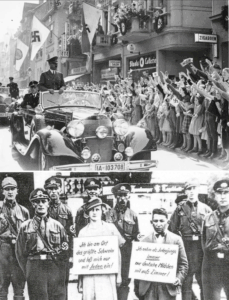
Helpfully, he also tells us what an exception to this ideological colonization might look like: a freedom, specifically the freedom of expression. This is interesting because the pope introduces something not explicitly part of the Church’s long intellectual tradition: freedom of expression. We generally think of freedom of expression as one of the original political rights, one often exercised against the Church’s authority.
Today the Catholic Church has, after a long battle against modernity, taken to championing this most modern of human rights. But according to Francis, it is exactly this one that cancel culture seeks to deny. We know we are in odd times when the Church, once the critic of many political rights, while also having been the font of broader human rights, must come to the rescue of those same political rights against the forces of the left and postmodern cancellation.
The late pope used a notably precise phrase when describing cancel culture’s attack against freedom of expression: it “leaves no room.” Cancellation as imperialist colonizer has the totalizing effect of eliminating dissent or disagreement. This is effectively to eviscerate and obliterate, to erase from existence. That it will do so in the name of “diversity” and call those who disagree “hateful” shows how far we have fallen from what the Church might call, somewhat ironically, grace.
The second point to consider is where we are today. Those who most willingly deploy cancellation as a tactic against what they see as the oppression of ancient authorities such as the Catholic Church routinely deplore any reference to what is true by nature, to what is essential. They view such terms as carriers of and justifications for the imposition of repressive formalism onto the fluidity of diversity, the curse of “essentialism”. Similarly, they vehemently decry imperial colonialism as an effort to erase cultural difference, as the ultimate expression of “hate”.
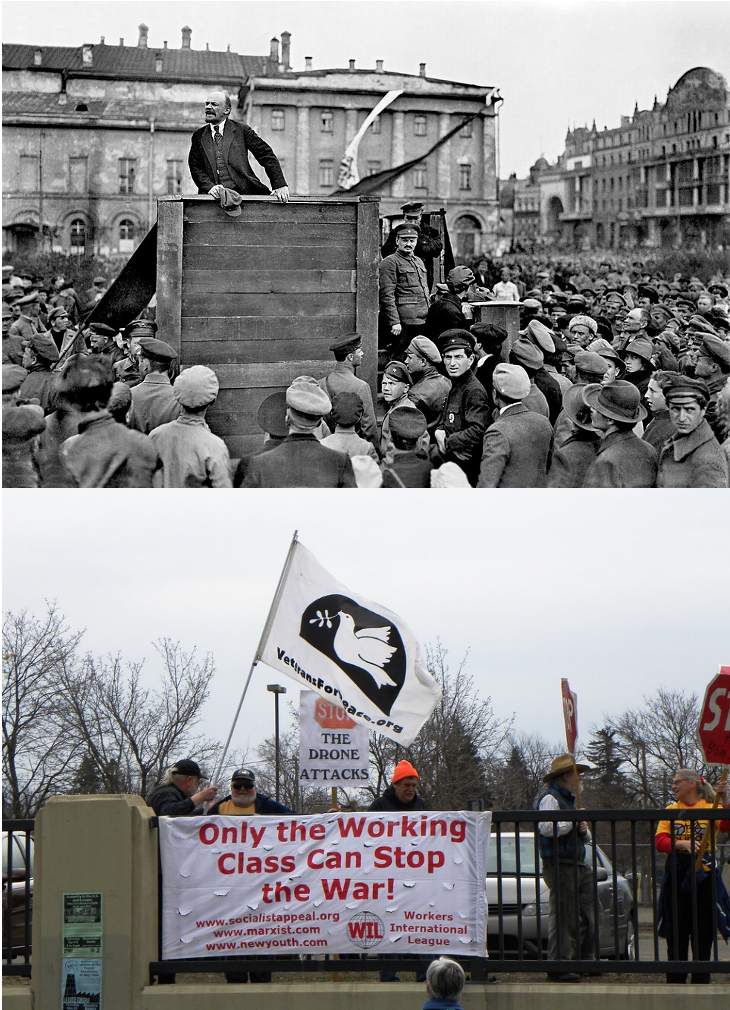
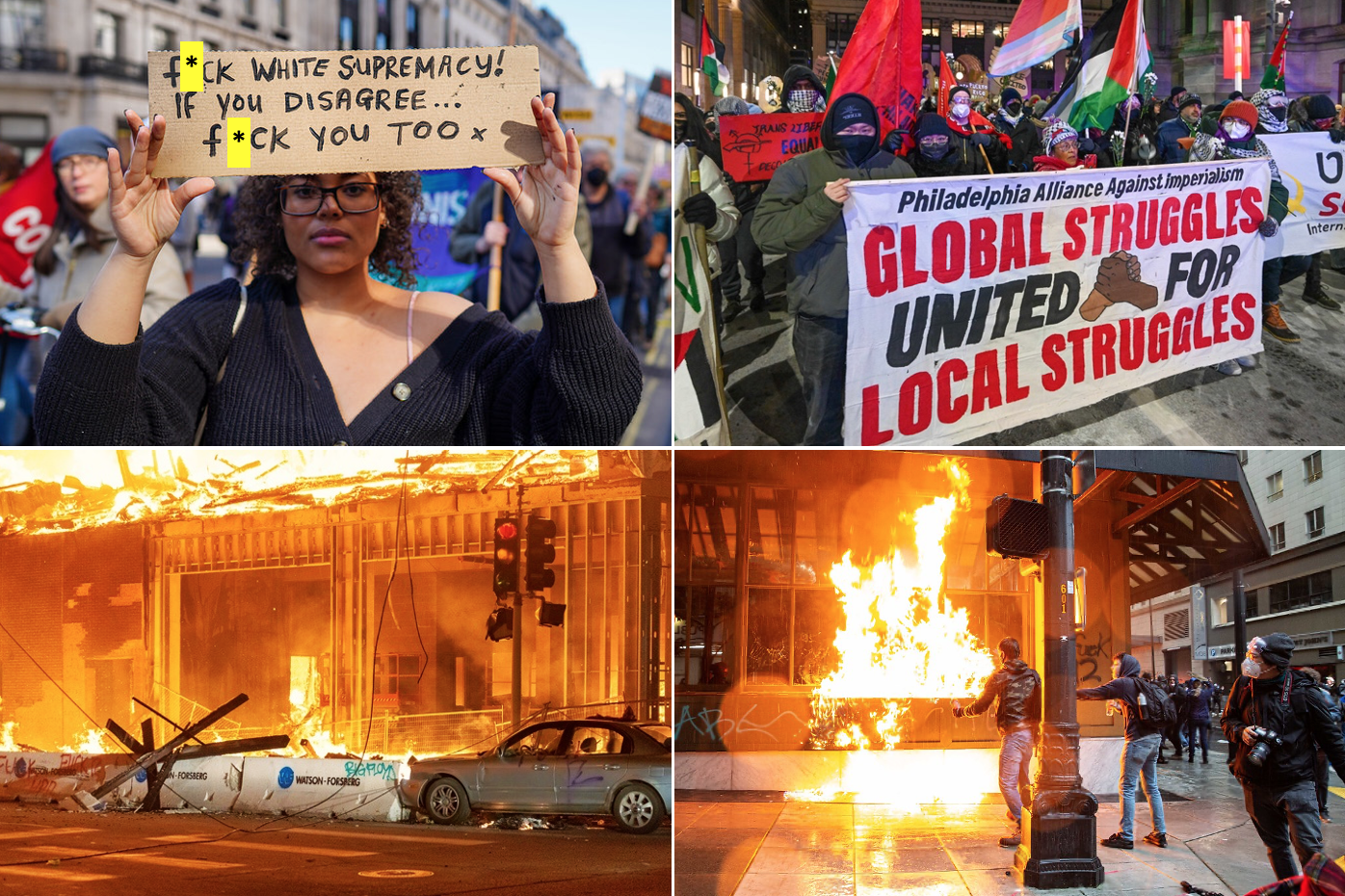
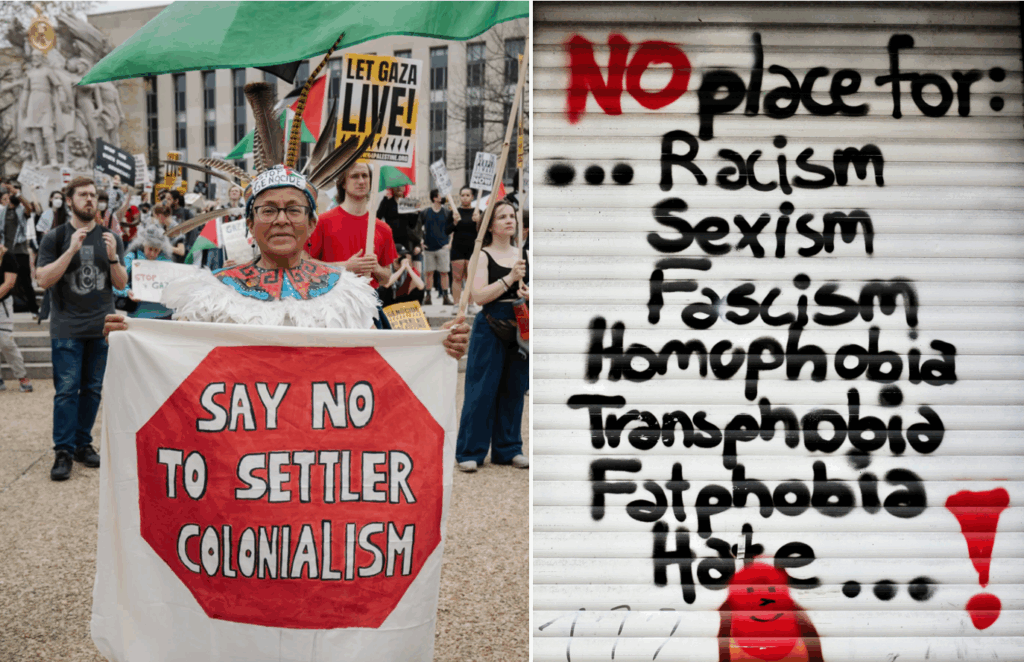 Essentialism on steroids: While decrying imperial colonialism and so-called “essentialism” – a snide term for the age-old philosophical and theological idea that every category of thing (including humans) shares an innate, universal essence – the postmodern left has adopted a reductive and all-consuming attitude that all historical events and political movements can be explained by the West’s hatreds. (Sources of photos: (left) Instagram/activistnyc; (right) Unsplash)
That has changed dramatically in the 21st century. In an inversion of past liberal indifference to identities, we now celebrate differences as the hallmark of each individual’s self-understanding. Moreover, these identities are apparently subject to change as they have come to be regarded as fluid and, for some, actually in flux. In this context, we no longer simply respect others as individuals but are obligated to recognize, accept and even praise their individual identity choices. And as if this relativist notion of recognition were not enough, we attach to it the affirmation that the basic Western identity of liberal free-market individualism has been the historical oppressor of all other identities.
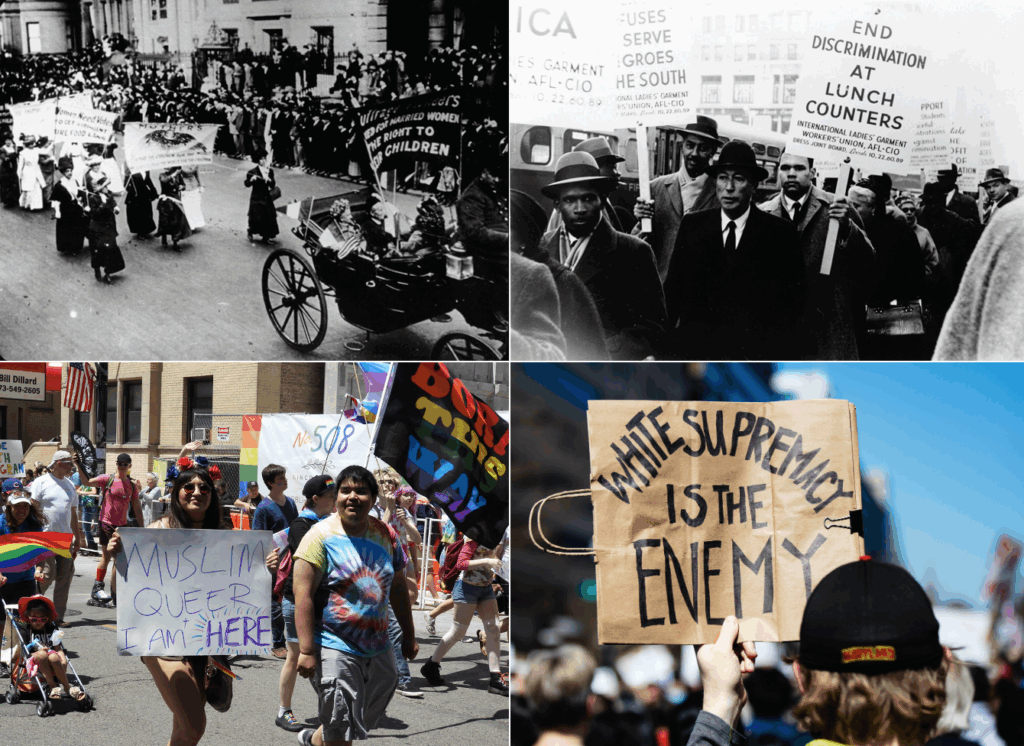
In a more philosophical vein, we might say we merge Friedrich Nietzsche’s dismantling of objective truth via Martin Heidegger with Karl Marx’s essentialist notion of the oppressor-oppressed binary. To hate in this context is to define and rank identities, especially if that ranking gives any priority to the vast array of affiliations that make up the complex history of the West. We celebrate the category of identity but we detest any authority that may arise in relation to particular identities, what Hegel referred to as Sittlichkeit, or the moral contents of life. This links us to the essentialism and imperialism of the contemporary rhetoric of hate as identified and deplored by Pope Francis.
Today’s left claims to despise both essentialism and imperialism in the name of recognition of identities. And in its own exclusive vehemence, it labels anyone who does not uniformly share its totalizing views as “hateful”. This is the ironic essence and imperialism of the left’s own uncompromising hate. And here we can point out that today’s left is collectively driven and consumed by hatred in a way very unlike the right, where hatred remains the province of individuals and smaller sub-groups – at least for now – and where political opinions and positions are formed for the most part by ideas, facts, evidence and emotions other than raw hatred.
A Brief History of the Good – Human and Divine
As I’ve mentioned, the idea of an essence – something that has universal applicability apart from particular entities – is commensurate with the search for the natural foundations of human existence and political life. What do I mean by this? Looking at the original Ancient Greek philosophers, they concerned themselves constantly with whether there was an unchanging truth and, if so, how it related to the particularity of existing things, be they humans, animals or inanimate objects.
Heraclitus thought there was only change and flux. Parmenides took the opposite position and argued that only universals were real while particular beings were illusory. Later thinkers such as Socrates, Plato and Aristotle, often in political debate with the materialistic Sophists, sought something of a middle way that took account of the aspiration for knowledge of universals while recognizing the sway of particularity. They took various approaches on this front, often replete with their own difficulties. It is, after all, virtually impossible to pin down Plato on his final view of universals as ideas (his theory of “forms”), if he even had one, given that he describes them differently depending on the interlocutors in his dialogues.
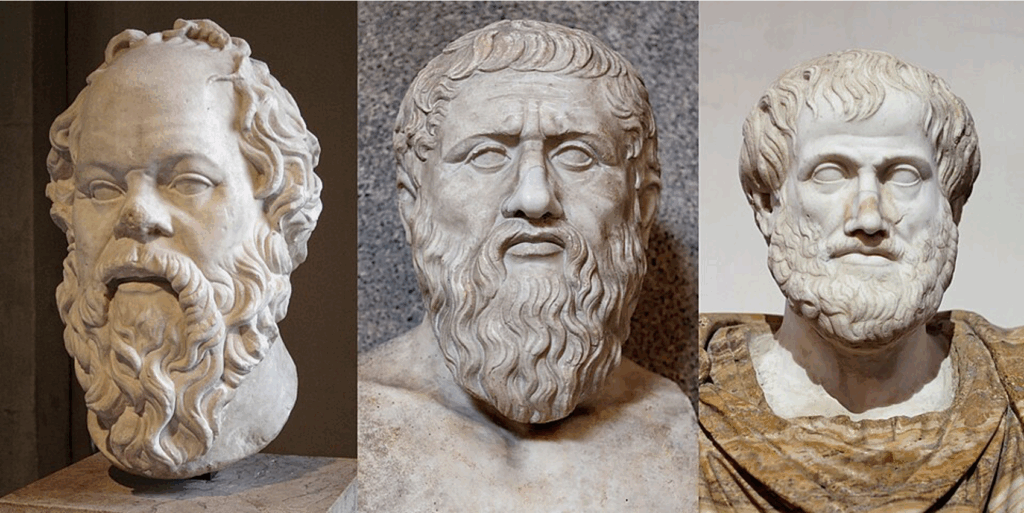
The key point is that philosophy, differentiating itself from particular political communities, came to see the universal as the goal of understanding. At the same time, while it often attributed impediments to understanding to the particularity of bodily and partisan passions, it did not simply disdain non-philosophic goals. In fact, it considered most human endeavours as goods in themselves that needed to be balanced.
A prime example of this is how Aristotle deals with the competing aspirations of aristocrats and democrats in Chapter Three of his Politics. Having attempted and failed to discuss these two classes according to their natures and according to their interests in the previous two chapters, in Chapter Three Aristotle follows a sort of mediation between them. Significantly, he treats both classes as seeking to rule according to the competing goods they espouse.
Aristocrats desire to rule based on the principle of virtue (though that has really degenerated into wealth by Aristotle’s time; his aristocrats are oligarchs). By contrast, democrats seek rule based on the idea of equality. Aristotle proceeds to point out to both parties that there are inconsistencies in their conceptions of the good, thereby seeking to moderate their differences, something that occurred every day in each of the various Greek cities. What remains important here is that, for Aristotle, these competing interests are not just interests but desirable goods in themselves; as such, they all have a legitimate though partial claim to rule within the human whole that (in the Ancient Greek mind) is the city-state.
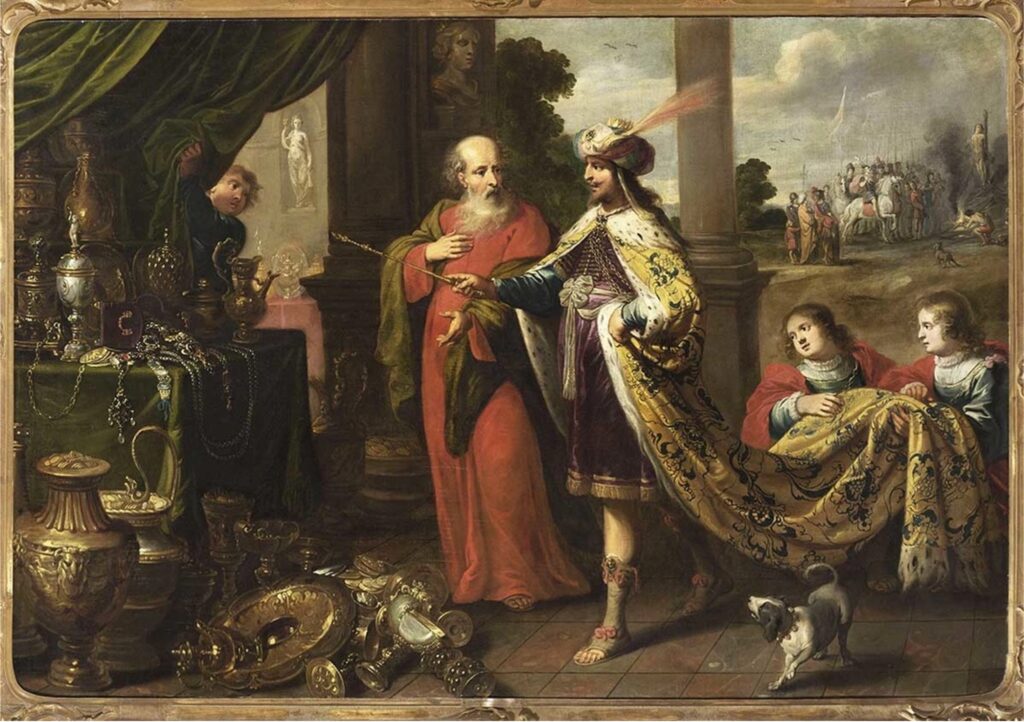 In his famous Politics, Aristotle described the different principles and competing aspirations of two societal classes, aristocrats and democrats, as desirable goods in themselves – which thus provided each with a legitimate though partial claim to governing their city-state. Pictured, Croesus Showing His Treasures to Solon, by Gaspar van den Hoecke, 1630s. (Source of image: Radio France)
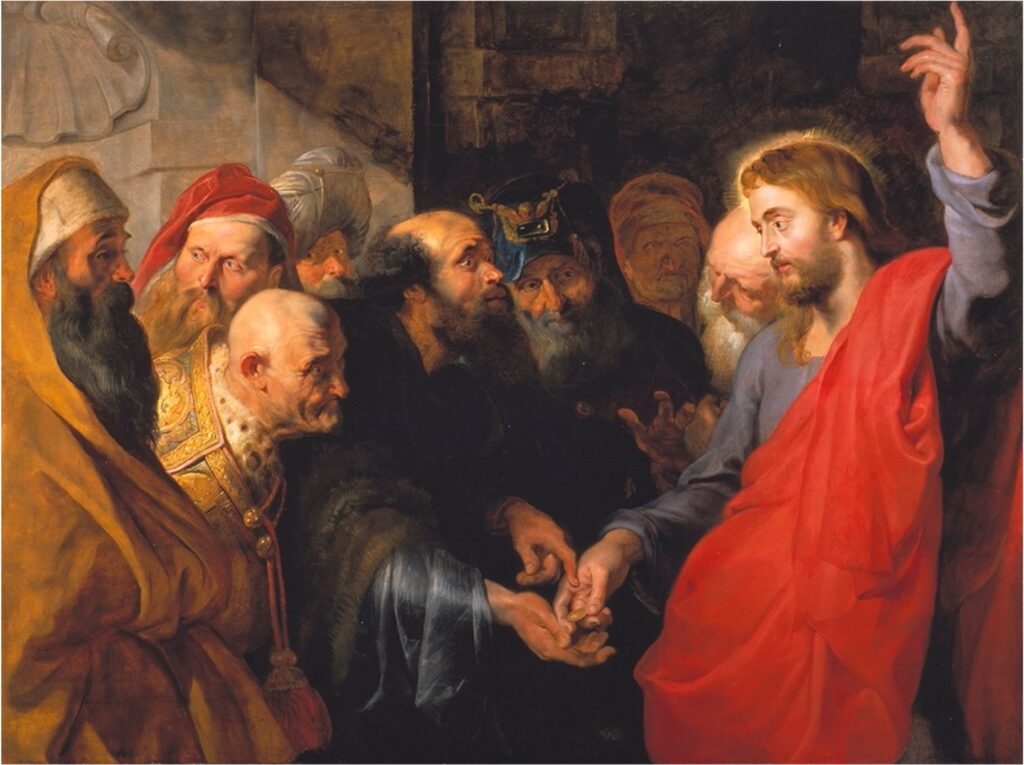 “Render unto Caesar the things that are Caesar’s, and unto God the things that are God’s”: Jesus Christ’s teaching in Matthew 22:21 laid the foundation for Christianity’s distinction between spiritual and secular political/legal authority, a critical concept for the eventual development of the modern liberal-democratic, pluralist and free political order. Pictured, The Tribute Money, by Peter Paul Rubens, 1610-1615.
These few lines contain in them a whole new world. As Machiavelli notes, the tradition in writing about political matters, including in the mirror-of-princes genre that our Florentine claims to employ, is to describe theoretical models of a well-governed polity rather than look to existing political institutions for guidance. Aristotle did write about some existing political structures and arrangements, but these reviews were intended to glean what would be the best form of polity – and that was too much for Machiavelli. He had little interest in the imagined republics and principalities of the Greeks or their Roman or Christian successors. So he declines to propound upon how one should live, preferring to study and learn from how one does live.
But Machiavelli isn’t just talking about politics here. He is also making a philosophical statement that, in those few words above, throws overboard the whole panoply of Classical philosophy and Medieval theology built around the notion of a universal essence as comprehended by the imagination. In doing so, he also casts aside the concern with the relationship between universal essences and existing particulars. For Machiavelli, general intimations of immediate applicability drawn from how politics actually works replaces pontificating about idealized realms. In this, he sets the groundwork for the following centuries’ emphasis on science as the practical application of natural laws.
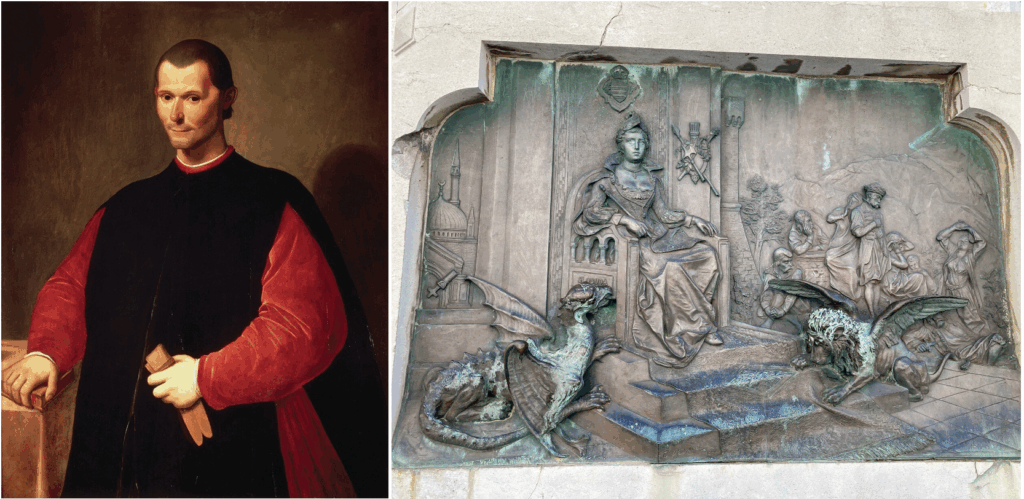
Machiavelli’s revolution will carry through all of modern philosophy to our own time. John Locke in An Essay Concerning Human Understanding will claim that we have no access to universals, including any essential answer to the age-old question: What is man? He instead invokes the functions of the state of nature as a framework to establish the sovereign power as well as limit it according to the right to own property. Locke’s empiricist critic, David Hume, will even discard the right to property ownership as an over-complex idea beyond human certainty.
Immanuel Kant will then attempt to reintroduce moral norms into human affairs, but not by returning to human nature. Instead, Kant limits the newfound science of the laws of nature in order to preserve room for a new human freedom to legislate. This will spawn a series of reactions leading to the rejection of Kant’s project by Friedrich Nietzsche, Martin Heidegger and the last great movement of modern philosophy: existentialism.
For Nietzsche and his acolytes, even Kant failed to eliminate the spectre of essences. So they attempt to overthrow, once and for all, the decayed remnants of Plato’s essentialism and its popularized Christian manifestation that they believe have led Europe to the contemporary nihilism (abstract detachment) of Kantian moralism. They engage in an endless form of resistance, invoking the particular as a manifestation of will to power (Nietzsche) or as a rather unfathomable revelation of Being (Heidegger).
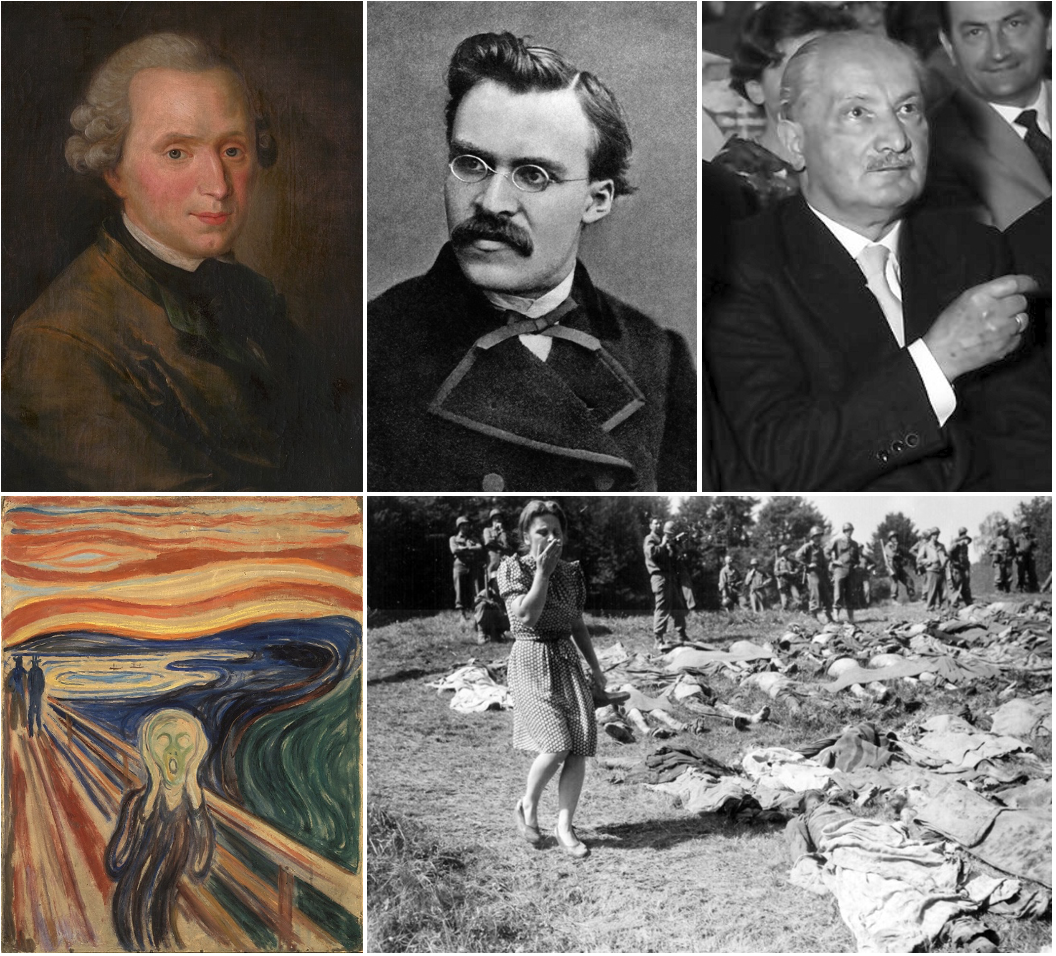 Continuing Machiavelli’s revolution, modern German philosophers (top left to right) Immanuel Kant, Friedrich Nietzsche and Martin Heidegger moved ever-further from Platonic and Christian notions of universals and focused on human particularities such as the “will to power” and “higher man”, all-but completing the West’s march into nihilism and totalizing ideology. Shown: (bottom left) The Scream, by Edvard Munch, 1893, often associated with nihilism due to its theme of existential terror; (bottom right) exhumed bodies of some of the 800 slave labourers murdered by Nazi SS guards near Namering, Germany, May 1945. (Sources of photos: (top right) Willy Pragher, licensed under CC BY-SA 3.0; (bottom right) Marion Doss, licensed under CC BY-SA 2.0)
The aristocrats’ sole desire is to dominate and oppress the popular classes – not merely rule the state. The democrats’ program is encapsulated as an effort to escape the aristocrats’ tyranny and oppression. They no longer have their own notion of the good but exist solely as negation, repudiation of the powers that be. In Machiavelli’s world, it falls to the prince (later elevated by Thomas Hobbes to the infamous “Leviathan”) to manage and exploit this conflict.
Whether we consider the Greek philosophers, the Romans or the Medieval Christian thinkers, regardless of their differences in emphasis on the essential nature of the good and how it relates to other lesser goods, we see none attempting to build hate and conflict into their thought, let alone activate it for political effect.
In doing so, Machiavelli introduces discord into our modern thought and the political arrangements built on it. Many of his followers have attempted to moderate this influence. But in our contemporary world, what liberalism once moderated has been turned into a hammer to attack the West and all the structures it has come to value, from family and religion to freedom, merit and science. As well as the nation-state, the carrier of our liberal-democratic adventure for at least four centuries.
The Left’s Imperial Contempt for the Nation
The nation-state is not an obvious political entity. For most of history, most humans have lived in empires of various types, from the more national empires of the ancient world (Egypt, Babylon, Assyria, China, Maya, etc.) to the multi-civilizational empires beginning with Persia and followed by Alexander’s and then the Roman. Apart from prehistoric small bands and then tribal formations which are partly political, the only other political entity of note is the city-state, which has had some moments of greatness, especially among the Greeks and in Italy and northern Europe, but has generally been limited in scope and duration.
The nation-state only came into its own in 17th-century Western Europe. It is a particularly complex entity. Partly natural and partly invented, it arose in the context of Western Christianity. According to Hegel and some rabbinical thinkers, the nation concept allowed Europe to subjectively appropriate Christianity, meaning the objective requirements of the imperial Christian Church were appropriated by various free peoples within a national structure. The results were, first, a welcome settling-down of the chaotic barbarian wanderings during the disintegration of the Western Roman Empire, second, a lot of religious conflict as various nations each claimed to represent the “one true Church” and, more happily, the development of our modern nation-states as liberal, democratic, economically inclusive and pluralist (non-sectarian).
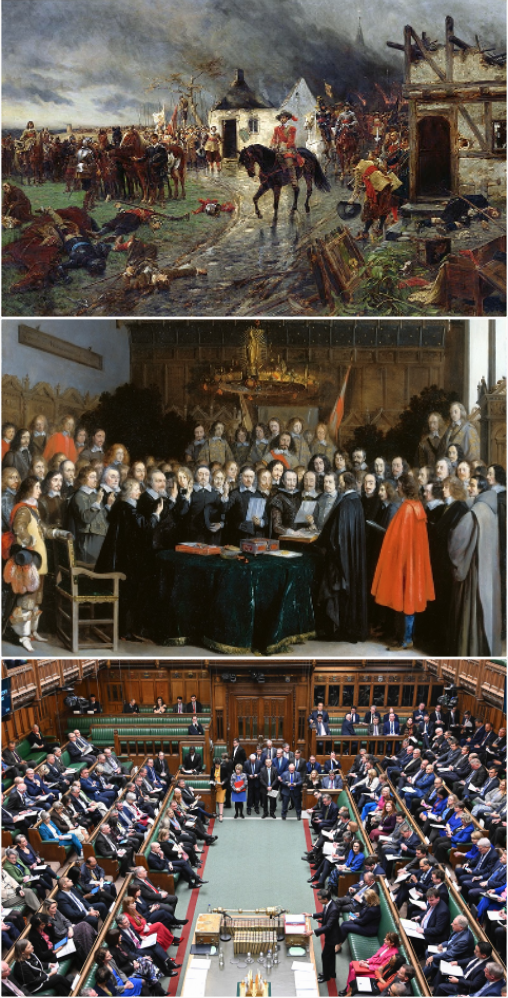 The nation-state developed within the framework of Western Christianity in the 1600s; though intense religious conflicts ensued as various nations claimed to represent the “true” Church, these were eventually superseded by modern states defined increasingly by liberalism, democracy, economic inclusivity and pluralism. Pictured: (top) Wallenstein: A Scene of the Thirty Years War, by Ernest Crofts (1847–1911); (middle) ratification of the Treaty of Münster, part of the Peace of Westphalia ending the Thirty Years’ War in 1648, by Gerard ter Borch; (bottom) the UK House of Commons Chamber, February 2024. (Source of bottom photo: UK Parliament/Maria Unger, licensed under CC BY 3.0)
This imperial impulse, combined with the essentialism of hate we’ve discussed, allies with another actor on the contemporary world stage, though as I’ve learned personally, to speak about it can result in nasty consequences. This is the violent imperialism of politicized Islamism. As noted earlier, Islam took on the imperial political form as it broke out of the Arabian Peninsula. Finding itself fighting weakened versions of the Byzantine Eastern Roman Empire and the much-reduced heirs to the Persian, it conquered spectacularly, carrying the Arabic tongue with it. The political form it relied on was the caliphate, which combines political and religious rule under one supreme leader.
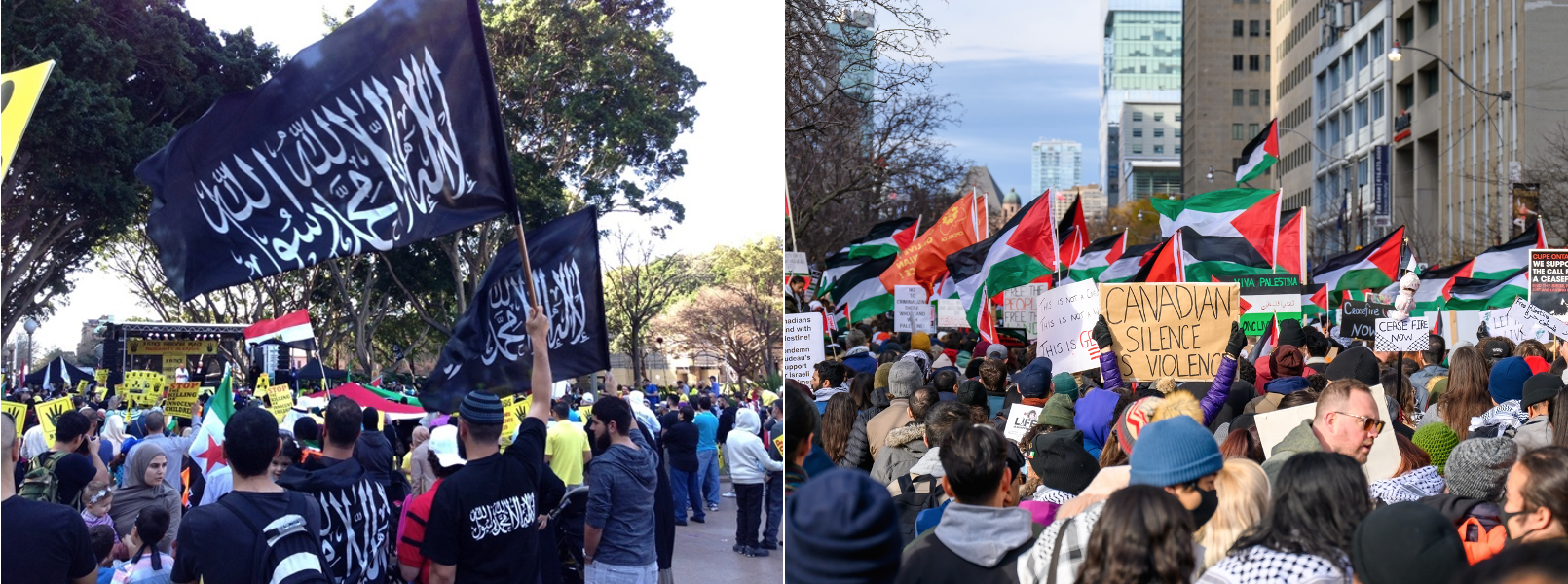
The history of Islamic expansion – often by the sword but sometimes by conversion and trade – is too complex to go into here. What we can say is that the last caliphate in the form of the Ottoman Empire was purposely replaced in 1924 by Mustafa Kamal (the later Atatürk) in favour of the modern Turkish nation. Since then, traditionalist Muslim forces, influenced ironically by the Western philosophy of repudiation, have sought to rebuild a stricter and more violent version of the imperial caliphate than any known to history. This effort began with the Muslim Brotherhood in 1928 and continues today in the Islamic world and via the phenomenon of “entryism” in the West. That so many Middle Eastern and Muslim nations, from Jordan and Egypt to Bahrain and the UAE, condemn these efforts should alone tell us they are a danger to freedom and peace around the globe.
This goes a long way to explaining why the contemporary left, enamored of its own imperial and essentialist hatreds, has such an affinity for Islamism’s imperial ambitions as professed by the Islamic Regime in Iran and its proxies in Lebanon and Gaza. It also accounts for the fact that the radical left has no interest in freeing the Iranian people from the dictatorial theocracy. This regime was itself inspired by Ari Shariarti, an intellectual follower of Heideggerian thought, and Michel Foucault, who made pilgrimage to Iran in 1978 to praise the Islamic revolution that gave the world this current thugocracy.
What about Canada?
Canadian readers should have little trouble applying the foregoing discussion’s philosophical and, at times, perhaps somewhat abstract framework to the all-too-real, hateful imperialist essentialism of Canada’s left. “Progressives” throughout Canadian society have proved highly susceptible to the pathology of hate and, once in its grip, enthusiastic and disturbingly successful practitioners of its precepts.