Free Expression

We Have Ways of Making You Talk: The Tyranny of Land Acknowledgements and Other Compelled Speech

George Ramsay
March 23, 2026
Indigenous land acknowledgements have become so common that many Canadians no longer give them a second thought – simply accepting a kind of tuneless new national anthem before events of all sorts. And that’s why they’re so dangerous. The enforced conformity and compelled speech they depend on are not just threats to individual freedom, writes George Ramsay, they also create a divisive moral hierarchy based on race. In this originally reported story, Ramsay delves into the dangers posed by Canada’s broader shift to enforced verbal compliance, reveals the inspiring stories of a few brave souls who have dared to challenge this social tyranny and offers practical tips on how the rest of us can fight back too.
Free Expression

We Have Ways of Making You Talk: The Tyranny of Land Acknowledgements and Other Compelled Speech

George Ramsay
March 23, 2026
Indigenous land acknowledgements have become so common that many Canadians no longer give them a second thought – simply accepting a kind of tuneless new national anthem before events of all sorts. And that’s why they’re so dangerous. The enforced conformity and compelled speech they depend on are not just threats to individual freedom, writes George Ramsay, they also create a divisive moral hierarchy based on race. In this originally reported story, Ramsay delves into the dangers posed by Canada’s broader shift to enforced verbal compliance, reveals the inspiring stories of a few brave souls who have dared to challenge this social tyranny and offers practical tips on how the rest of us can fight back too.
Share on Facebook
Share on Twitter

While censorship is often the focus of discussions about free speech, there’s a related phenomenon that can do just as much damage to a free society. Not in preventing people from saying things they believe in, but in forcing them to say things they do not. Compelled speech requires people to use certain words or phrases, or to partake in upholding certain ideological beliefs. It is just as dangerous to free expression as overt censorship.

When someone is told what to say, how to say it and when to say it, not only is personal autonomy contradicted, but a false group consensus is manufactured. The famous Asch conformity experiments of the early 1950s demonstrated this phenomenon, revealing that many people will knowingly answer a simple question incorrectly if they see other people doing likewise. If everyone says 2 + 2 = 5, it takes psychological fortitude to stand by your own judgement and state the truth, that 2 + 2 = 4.

Sadly, Canadians have grown accustomed to changing how they speak on many controversial topics to fit societal expectations. What then occurs is not free discourse, but enforced obedience. Something needs to be done.

Indigenous Land Acknowledgements

The constant recitation of Indigenous “land acknowledgements” embodies and illustrates Canada’s shift towards enforced mass-compliance. These statements have become ubiquitous in Canadian public life: at schools, workplaces, government functions, ceremonies and sporting events. Institutions display them in written formats on websites, documents, email signatures and on social media. A busy person in Canada may come across dozens of land acknowledgements per day in various contexts.

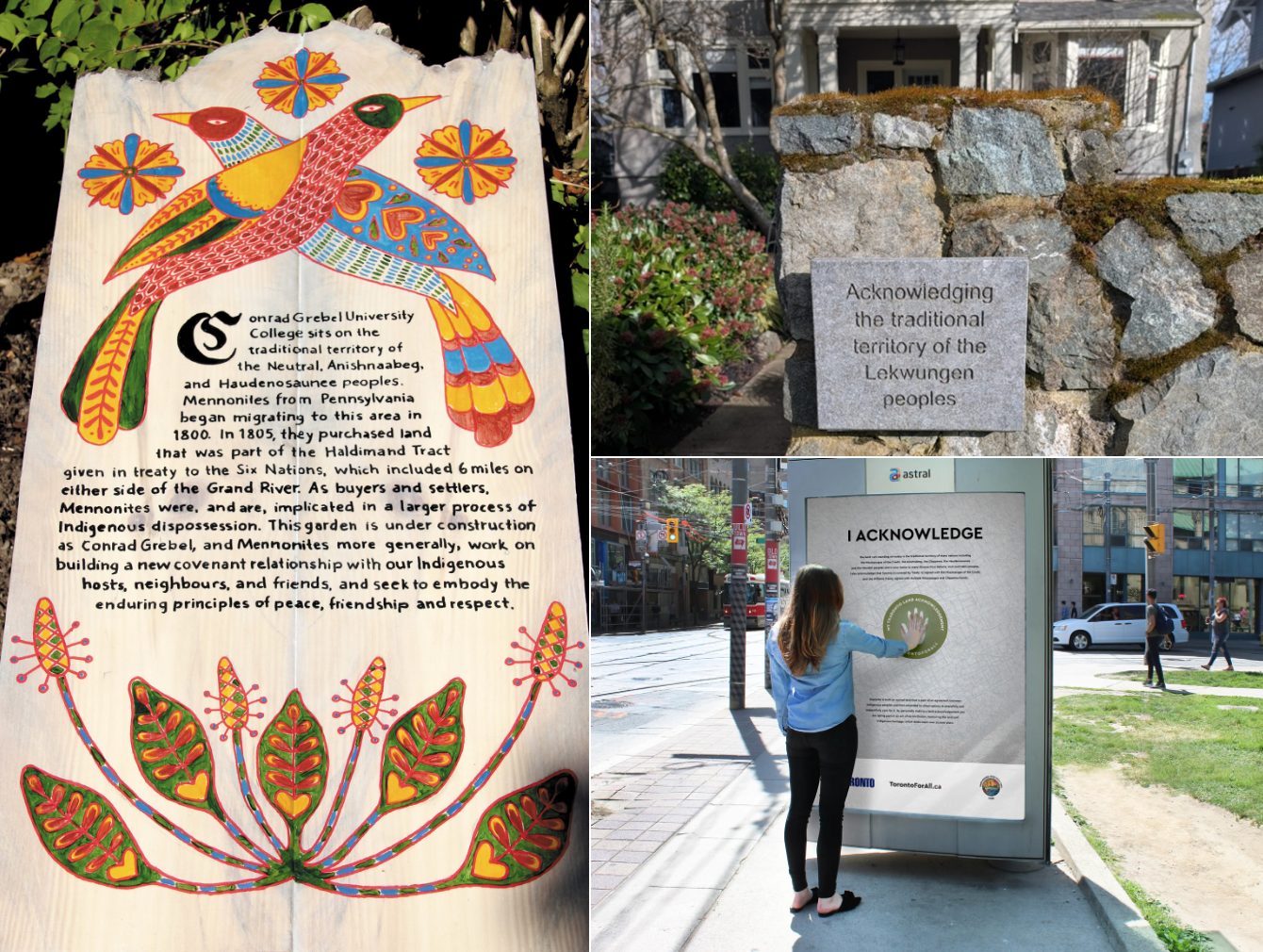
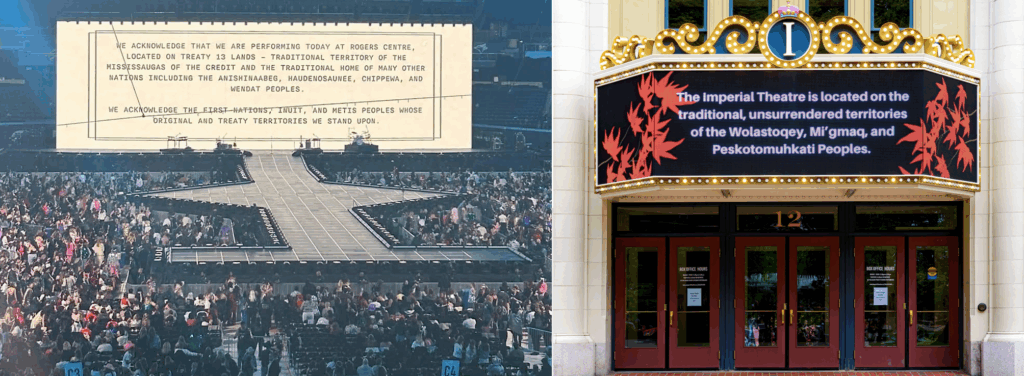
Everywhere you go, there they are: Over the past decade, Indigenous land acknowledgements have become an unmissable fixture of Canadian public life. Shown, public land acknowledgements displayed (clockwise starting top left) at the Conrad Grebel University College in Waterloo, Ontario; on a front yard in Vancouver; at a Toronto bus stop; on the Imperial Theatre marquee in Saint John, New Brunswick; at a 2024 Taylor Swift concert in Toronto.
xEverywhere you go, there they are: Over the past decade, Indigenous land acknowledgements have become an unmissable fixture of Canadian public life. Shown, public land acknowledgements displayed (clockwise starting top left) at the Conrad Grebel University College in Waterloo, Ontario; on a front yard in Vancouver; at a Toronto bus stop; on the Imperial Theatre marquee in Saint John, New Brunswick; at a 2024 Taylor Swift concert in Toronto. (Sources of photos (clockwise starting top left): Canadian Mennonite; George Ramsey; Global News; Doug McLean/Shutterstock; Consequence/Facebook)

Although originally framed as optional gestures of respect, many organizations have policies mandating land acknowledgements. In other circumstances social pressure can make them seem mandatory even if they are not. In British Columbia, some people are so devoted to the idea that they’ve posted land acknowledgements in their front windows or engraved them in stone on their front yards.

As an idea, land acknowledgements were first mooted in Australia in the 1970s. In Canada land acknowledgements were popularized following the 2015 Truth and Reconciliation Commission’s report. Although the report did not specifically demand them, they were widely promoted as a tool of “Indigenous reconciliation”. But this seemingly laudable concept has since degenerated into shorthand for a symbolic and indefinitely-ongoing statement of regret for Canada’s historical treatment of Indigenous people. In this way, “land acknowledgements” gained the air of a public apology.
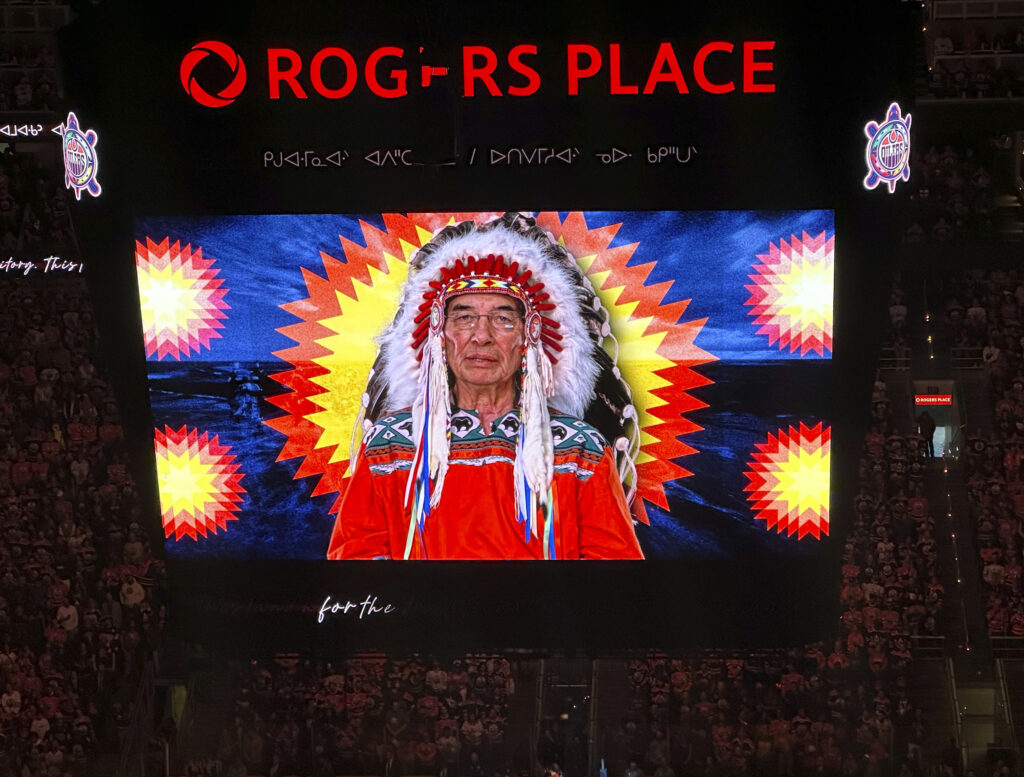
Get on with the game: Cree chief Wilton Littlechild delivers a video land acknowledgment prior to every Edmonton Oilers home game, informing hockey fans that their seats are on “Turtle Island”.
xGet on with the game: Cree chief Wilton Littlechild delivers a video land acknowledgment prior to every Edmonton Oilers home game, informing hockey fans that their seats are on “Turtle Island”. (Source of photo: AP Photo/Stephen Whyno)

These proclamations have evolved far beyond the simple sharing of history and morphed into a reinforcement of racialized identity politics. Among innumerable current examples, any customer of Telus checking their bill online will find a cloying land acknowledgement at the bottom of the page that’s longer and more detailed than many of the explanations for the firm’s actual products and services. The company falls all over itself thanking “Knowledge Keepers and Elders” and to “express gratitude to those whose territory we reside on, work on or are visiting.”

NHL fans in Edmonton, meanwhile, are bombarded by an unctuous land acknowledgement – or, in this case, a land assertion – by Cree chief Wilton Littlechild dressed in full traditional regalia projected over an enormous screen proclaiming that all of us are inhabitants of “Turtle Island”. A lawyer, former MP and Senator, Littlechild obviously knows that North America doesn’t literally float atop an enormous reptile, but the point is made: shut up and take it, no matter how ludicrous it sounds. The “Turtle Island” myth, incidentally, isn’t even a Cree belief but stems from eastern Indian tribes. Which in turn points to the fact that the lands which later became Canada have shifted countless times between the various migrating and warring native tribes.

The “Turtle Island” example illustrates how land acknowledgements, whether intentionally or not, often imply a sort of spiritual ownership that people with Indigenous heritage hold over the land. Once this position becomes the dominant viewpoint, discussion moves away from facts and verifiable history into the realm of philosophy, theology, claimed collective memory or sheer mysticism. Indeed, lawyers representing some Indigenous groups advancing claims cheerfully put “evidence” comprised of mystical claims before the courts – and the courts sometimes accept these arguments at face value.

For many practitioners, land acknowledgements appear to have become a form of “performative activism”, i.e., inauthentic and/or self-serving superficial support for a popular cause. And those subjected to the mandate engage in the more familiar concept of virtue-signalling, outwardly displaying their allegiance to a required position on the issue. For all but the most committed zealots, land acknowledgements are probably just another box-checking ritual. Such thinking extends into the strangest corners; magazine articles about skiing now describe various B.C. resorts as sitting on the “unceded” territory of local First Nations.

More sinister is that these practices increasingly presume inherited moral responsibilities based on race, dividing Canadians between “settlers/colonizers” and those with Indigenous lineage as the rightful inhabitants, often deemed “stewards” or “caretakers” of the land. The more extreme practitioners now accuse Canada – and all Canadians – of occupying “stolen land”.

Indigenous land acknowledgements are compelled speech because many organizations have implemented policies that mandate their proclamation, reading or recitation, have created social pressures that make them feel mandatory, or harshly punish anyone who questions their need or value. While they became popular in the wake of Canada’s 2015 Truth and Reconciliation Commission as a recognition of the need for reconciliation between Canada’s aboriginal and non-aboriginal peoples, these statements have morphed into a form of a public apology with the requirement that individuals use ideologically loaded terms such as “unceded land” or “stolen land”, or accept Indigenous spirituality or mysticism as verified facts. When an individual is required to recite a specific political narrative, it violates personal autonomy and falsely contrives a group consensus.

As a result, many people now feel compelled to signal that they occupy the correct side of this collective conscience. Refusing to participate – or worse, asking critical questions – can invite accusations of insensitivity, moral failure or racism. But if one is compelled to participate in something, it no longer exists as a genuine expression of interest or concern. This is a paradox of respect: how can words be respectful if they’re required?

Higher Education Succumbs to Compelled Speech

While land acknowledgements do not all read the same, they follow a general lexicon and theme. They rely on terms like “unceded,” “stolen,” “traditional,” “colonized,” “uninvited,” “settler” and similar ideologically loaded, sometimes outright hostile and generally inaccurate expressions. Often they reverse or redefine key concepts to accentuate narratives of victimization and entitlement. For example, the numbered treaties of the late 1800s that enabled the peaceful settlement of the Prairies and much of the Far North are increasingly described as vague “land sharing” arrangements, which facilitates open-ended modern-day Indigenous claims extending far beyond the specific wording and intent of the treaties themselves. This is false.

The University of British Columbia goes even further. The school’s Department of English Language and Literatures (sic), for example, claims to be located on “unsurrendered traditional and ancestral territories”. This seems to imply some ongoing conflict. (Ukraine’s claim to the Donbas, perhaps?). The statement also describes the entire discipline of English as being informed by “colonizing violence”. The department concludes by asserting a commitment to “do better” and “think better”. Jargon like this does not merely acknowledge history; it advances moral judgments and prescribes approved modes of thought.
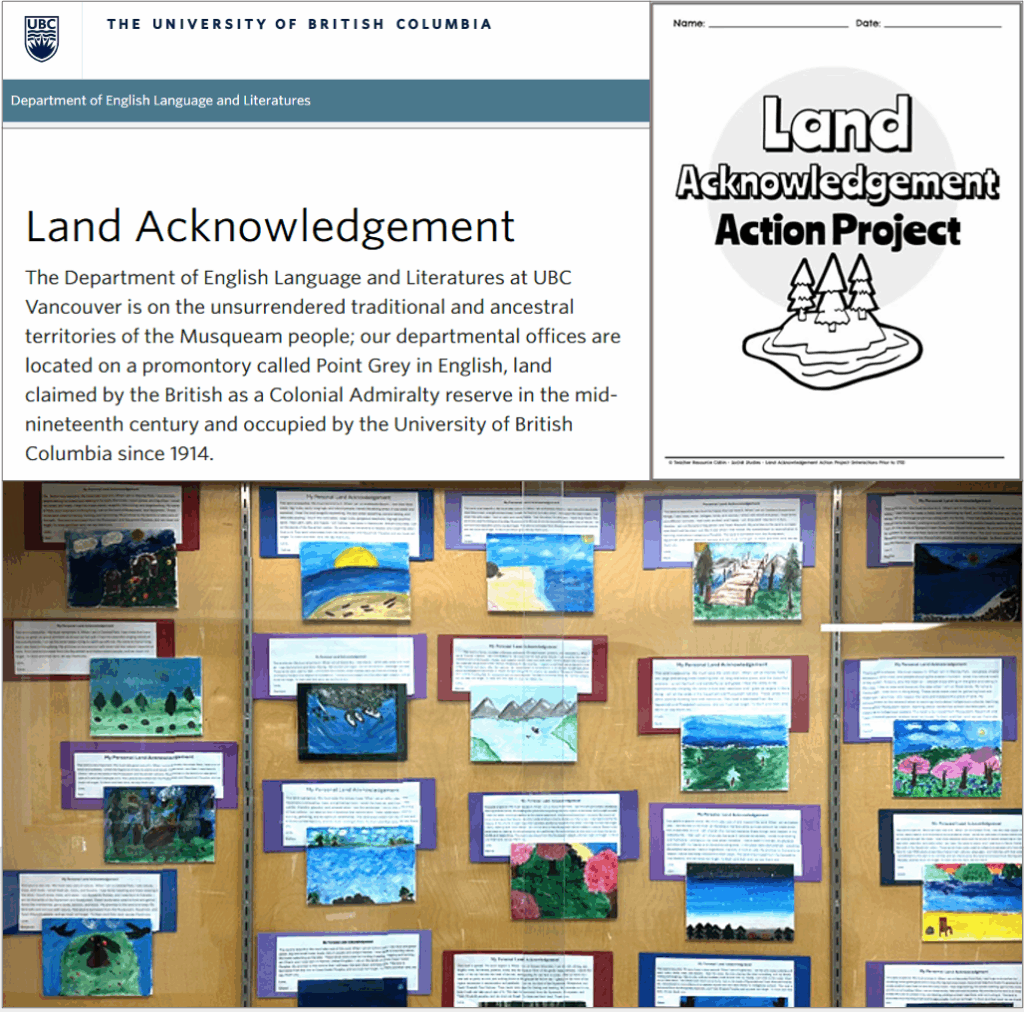
Under the influence: Land acknowledgements are now deeply embedded in Canada’s education system. At top right, the first paragraph of a lengthy and grovelling land acknowledgement from the University of British Columbia’s Department of English Language and Literatures. At top right, the cover page of a Grade 5 land acknowledgement school project from the Ontario Social Studies curriculum. At bottom, land acknowledgement artwork by Grade 6 and 7 students from Maywood Community School in Burnaby, B.C.
xUnder the influence: Land acknowledgements are now deeply embedded in Canada’s education system. At top right, the first paragraph of a lengthy and grovelling land acknowledgement from the University of British Columbia’s Department of English Language and Literatures. At top right, the cover page of a Grade 5 land acknowledgement school project from the Ontario Social Studies curriculum. At bottom, land acknowledgement artwork by Grade 6 and 7 students from Maywood Community School in Burnaby, B.C. (Source of bottom photo: Burnaby Schools)

And yet there’s no need to pick on UBC. The entire national education establishment is perhaps Canada’s strongest enforcer and promoter of land acknowledgement rituals. Students of all ages encounter them at the beginning of classes, during assemblies and on course materials, and hear them read aloud as school announcements. Students are regularly asked to make or reflect on land acknowledgements as graded homework assignments. They know exactly what their teachers want to hear and what will get them a good grade; I certainly did. Conforming to expectations in this case becomes a basic tactic of survival and advancement.

The next generation of young teachers currently attending undergraduate education programs are also being flooded with messaging about the necessity of land acknowledgements and how to integrate them into future curricula. If change is going to come, it won’t be from this quarter.

 No Questions Allowed

 The consequences of resisting this type of compelled political speech can go much further than a poor mark on an essay or a strained relationship with a teacher. Some adult Canadians have faced serious disciplinary and social repercussions. Two recent cases from Ontario – those of Geoff Horsman and Catherine Kronas – each involve land acknowledgements and ruthlessly dogmatic school boards.
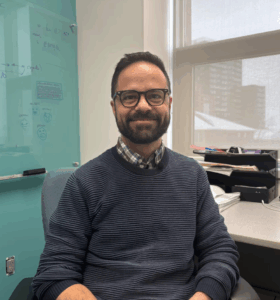
We will not be taking questions: Geoff Horsman, a biochemistry professor at Wilfrid Laurier University in Waterloo, Ontario, questioned the need to include land acknowledgements at his local school’s parent council meetings; the school board immediately declared Horsman’s inquiry out of line.
xWe will not be taking questions: Geoff Horsman, a biochemistry professor at Wilfrid Laurier University in Waterloo, Ontario, questioned the need to include land acknowledgements at his local school’s parent council meetings; the school board immediately declared Horsman’s inquiry out of line. (Source of photo: CTV News)

Horsman is a biochemistry professor at Wilfrid Laurier University in Waterloo, Ontario. As a parent of three children in the local school system and as a member of his local school’s parent council, he had noted the growing politicization of the regional school system. Of particular concern was the practice of opening every meeting with a land acknowledgement, which took up valuable time and reinforced what he considers a divisive premise. “I don’t think there is anything good that can come out of the idea that a certain ethnic group are the true inheritors of this land,” Horsman says in an interview.

Such a constant fixation on moral hierarchies based on race is more disruptive than liberating, he asserts. And it becomes hard to break free from such a mindset. “There’s a sacred air to it – it’s an aura,” Horsman says. “You’re not supposed to question it. You can feel a repressive weight around these topics.”

Horsman was moved to take action against what he saw as a “a culture of speech restrictions and politeness” that caused people to “fall in line surprisingly quickly.” When he raised objections in the spring of 2025, he encountered immediate resistance. In a subsequent series of private meetings with Waterloo Region District School Board staffers, he was told that even discussing the issue was off the table. The board’s commitment to “reconciliation”, “equity” and “human rights” made land acknowledgements necessary and unquestionable, he was told. There was no further elaboration.

Smarting over the board’s heavy-handed behaviour, Horsman decided his next step had to be through the courts. Since late 2025 he has been working with the Justice Centre for Constitutional Freedoms (JCCF) to bring the issue before the Ontario Superior Court of Justice. Their application for a judicial review was filed on November 27, 2025; no hearing has yet been scheduled. At play is a concept with consequences far beyond Waterloo Region: may any school board compel political speech and ban debate on any topic?

Other Canadians have faced serious consequences for questioning mandatory land acknowledgements. Catherine Kronas, a mother of a student attending Ancaster High Secondary School in Hamilton, lost her position as an elected member of her school council last year after she politely disagreed with land statements being read out loud before meetings. Similar to Horsman’s dispute, Kronas explains in an interview that, “I felt that the board was encroaching on our council space. School councils should decide what gets said in their meetings, and we shouldn’t have to recite something mandated by the government.”
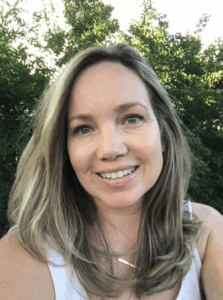
“We shouldn’t have to recite something mandated by the government”: Catherine Kronas of Hamilton, Ontario, was stripped of her elected position on a school council after objecting to land acknowledgements prior to every meeting. She was reinstated only after threatening legal action.
x“We shouldn’t have to recite something mandated by the government”: Catherine Kronas of Hamilton, Ontario, was stripped of her elected position on a school council after objecting to land acknowledgements prior to every meeting. She was reinstated only after threatening legal action. (Source of photo: Catherine Kronas)

Having done nothing apart from speaking for a few seconds, Kronas was suspended from her position by Hamilton-Wentworth District School Board officials. They claimed her words had “caused harm” and were in violation of board “policy”. Neither accusation was substantiated in any way. In disbelief at her treatment, Kronas sought legal assistance from the JCCF in similar fashion to Horsman. Her lawyer Hatim Kheir sent the school board a letter asserting that her suspension was illegitimate. “We are writing to warn you that the Board’s decision to suspend Ms. Kronas from the Ancaster Secondary School Council…is unconstitutional and contrary to administrative law principles of procedural fairness,” the letter states. The Hamilton-Wentworth School Board quickly reversed its decision and reinstated her to the council.

Two months later, the school board banned all forms of recording during public council meetings. Presumably this was meant to prevent Kronas from collecting any evidence about school council behaviour or practices. Kheir has since responded with a second warning letter, arguing that the recording ban constitutes a further violation of members’ rights to free expression under Section 2(b) of the Canadian Charter of Rights and Freedoms. 

Horsman’s and Kronas’ cases are both about Indigenous land acknowledgements, but the issues they raise run much deeper. They could have been challenging any form of imposed ideological speech. In fact, many Canadian governments and institutions are developing a worrying track record of legally enforcing ideological language. Back in 2017, clinical psychologist Jordan Peterson began his ascent to becoming one of the world’s most famous public intellectuals with his testimony at a Senate hearing where he warned legislators of the dangers of criminalizing the use of sex-accurate pronouns (or, to use the doublespeak of transgender advocates, “misgendering”).

Peterson’s book 12 Rules for Life: An Antidote to Chaos was published the following year, rocketing to international fame and going on to sell over 10 million copies. But Peterson’s arguments, though rigorous and detailed, failed to persuade. The legislation he was scrutinizing has since become a moralistic doctrine that can only be questioned at great personal peril.
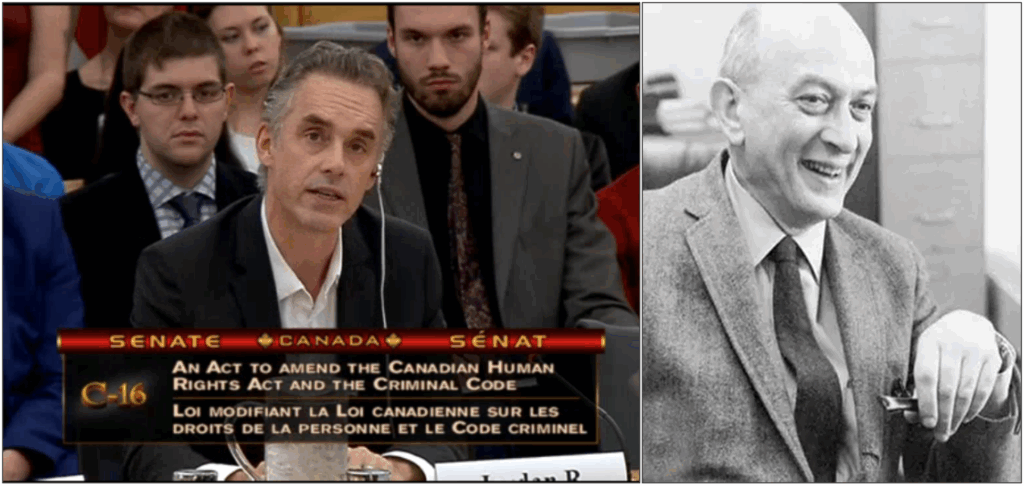
Think for yourself: In 2017, Canadian psychologist Jordan Peterson (left) warned a Senate committee about the dangers of compelled speech. At right, Polish-American psychologist Solomon Asch, renowned for his landmark experiments in the 1950s that demonstrated how easily people will acquiesce to majority opinion even when it is clearly wrong.
xThink for yourself: In 2017, Canadian psychologist Jordan Peterson (left) warned a Senate committee about the dangers of compelled speech. At right, Polish-American psychologist Solomon Asch, renowned for his landmark experiments in the 1950s that demonstrated how easily people will acquiesce to majority opinion even when it is clearly wrong. (Source of right photo: Akademia)

This was reinforced recently with the astonishing $750,000 fine levied by the B.C. Human Rights Tribunal against Barry Neufeld, a former school board trustee who was found guilty of being bluntly critical of the integration and facilitation of transgenderism within public education. Neufeld says he will appeal the fine, which clearly aims to punish him financially for expressing his lack of belief in what the tribunal seems to think is an unquestionable truth. Luckily for those who continue to regard fundamental freedoms as paramount, there are stubborn dissidents like Horsman, Kronas and Neufeld prepared to fight the system.

Individuals who question mandatory Indigenous land acknowledgements have faced significant hostility and even disciplinary action. In 2025, Wilfrid Laurier University biochemistry professor Geoff Horsman was told by the Waterloo Region District School Board that he could not discuss the issue of land acknowledgements before a parents’ council meeting because it was “policy”. He is now pursuing a judicial review. Similarly, parent Catherine Kronas was suspended from her elected position as a school councillor in Hamilton after disagreeing with the practice. Resisting enforced ideological language can often result in accusations of “causing harm”, violating specific policies or being racist. Anyone protesting this type of compelled speech may also be socially ostracized.

Pathways to Change

 Most Canadians consider themselves polite, kind and caring, a usually laudable set of characteristics that has lately been weaponized. Reinforcing different rights for certain racial groups or creating a new version of the caste system ought to be at sharp odds with a “progressive” or compassionate position. But that battle, sadly, has been lost – at least for the moment. Among entrenched leftists these days, it is considered unseemly if not foolish to quote the Rev. Martin Luther King, Jr.’s famous dictum about being judged by the content of one’s character rather than the colour of one’s skin.

Still, many Canadians surely are bothered by land acknowledgements and other forms of compelled speech. It is worth noting that Solomon Asch, architect of the Asch conformity experiments mentioned earlier, found that more than one-quarter of his subjects stuck to their own perception of the truth – that is, recognized the correct answer and refused to knuckle under to external pressure – even if that meant going it alone against the group.

If someone does not feel genuinely aligned with a land acknowledgement or other ideological speech, how should they push back? Brian Giesbrecht, a retired Manitoba judge who is still heavily involved with Indigenous issues, offers some learned suggestions. Giesbrecht is a lifelong advocate for individual rights and favours abolishing the federal Indian Act, which defines the relationship between Ottawa and Canada’s Indigenous in race-based terms. In an interview, Giesbrecht agrees that today’s land acknowledgments “create a divisive form of belief in which some people only have rights as ‘settlers’.” He offers some practical options for Canadians who want to resist the pressure of land acknowledgements:

  1. Send written complaints to local governments or other authorities that prescribe and enforce land acknowledgements. “Most Canadians don’t want to be rude and interrupt an event to verbally say something,” explains Giesbrecht. Written complaints are a safer and more convenient option.
  2. If contemplating making a public, in-person stand against land acknowledgements, prepare your case carefully, preferably backed by a formal presentation.
  3. If willing to adopt a bolder form to showcase one’s discontent, be prepared to walk out during a land acknowledgement.
  4. Use formal legal channels such as the JCCF to challenge an organization’s oppressive/coercive use of land acknowledgements.
  5. Become politically engaged and encourage local political candidates to focus on freedom and free choice with regard to land acknowledgements.
Start pushing back: Retired Manitoba judge Brian Giesbrecht, now a senior fellow with the Frontier Centre for Public Policy, suggests several ways to fight oppressive land acknowledgement demands, ranging from politely declining to participate to launching a legal challenge.
xStart pushing back: Retired Manitoba judge Brian Giesbrecht, now a senior fellow with the Frontier Centre for Public Policy, suggests several ways to fight oppressive land acknowledgement demands, ranging from politely declining to participate to launching a legal challenge. (Source of screenshot: YouTube/Leaders on the Frontier)

For those with a thicker skin and a flair for the dramatic, satire can also be an effective tool to expose the absurdity of land acknowledgements. At a public meeting of the City of Toronto’s budget subcommittee in January, Daniel Tate from the civic watchdog group IntegrityTO delivered a wry “Taxpayer’s Acknowledgement” that both lampooned land acknowledgements and skewered the fiscal profligacy and failed ideological policies of his city’s council and bureaucracy. His entire performance took only 70 seconds.

“We pay respect to those taxpayers, because without them this institution could not indulge in ideological excesses like renaming streets and public squares, painting roads with inferior and environmentally damaging red paint, nor fund harm-reduction programs that result in a steady stream of drug paraphernalia littering our streets, sidewalks, parks and playgrounds,” Tate read into the official record as councillors sat glumly or quietly seethed. Like all great satire, Tate’s deputation was barely separated from the literal truth. The video of his statement was viewed over 1 million times within just a few days. History has shown that, once a dogma becomes the object of widespread ridicule, its surrounding aura of fear and inevitability often deflates like a punctured balloon.
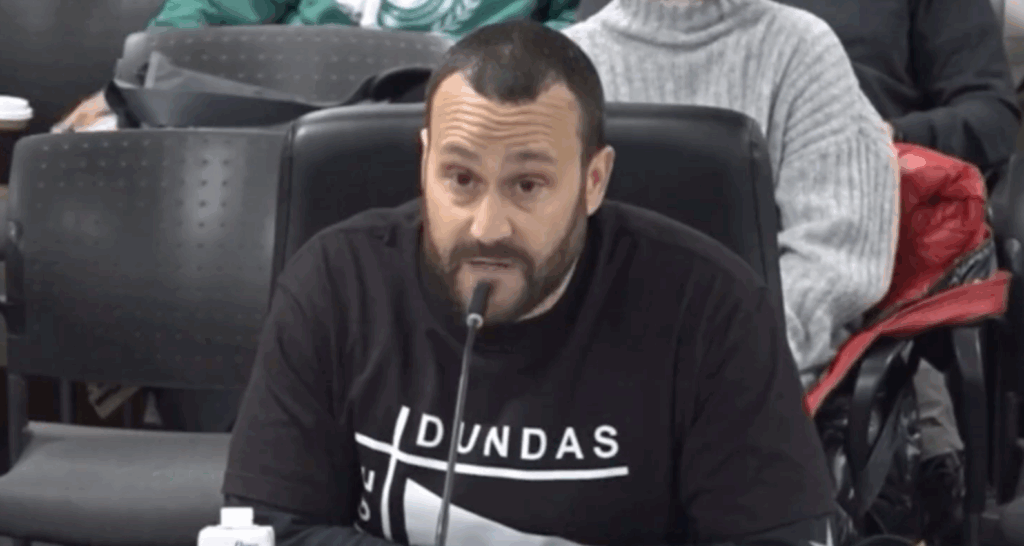
Sometimes you just gotta’ laugh: Daniel Tate of IntegrityTO skewered land acknowledgements with his satirical “Taxpayer Acknowledgement” before Toronto City Council. The video of his 70-second address in January 2026 went viral.
xSometimes you just gotta’ laugh: Daniel Tate of IntegrityTO skewered land acknowledgements with his satirical “Taxpayer Acknowledgement” before Toronto City Council. The video of his 70-second address in January 2026 went viral. (Source of screenshot: YouTube/integrity_to)

Another potential trigger for pushback may come from ordinary people getting mugged by reality. One such example arises from the controversial Cowichan ruling in B.C., which asserts that aboriginal title supersedes private land titles in a large portion of Richmond and, by implication, possibly all of B.C. At a raucous town hall meeting held to discuss the court case, reports indicate no land acknowledgement was given or requested. In fact, Richmond mayor Malcolm Brodie has long resisted making land acknowledgements because of legal threats made against Richmond residents by various native groups. The idea may finally be dawning on the public in B.C. that if something is repeated often enough, it will eventually become true – and that includes claims that we are living on someone else’s land.

These methods focus on the individual pushing back in a gentle and reasoned way. For the time being, this may be the only course of action Canadians have, considering the enthusiasm the current federal and most provincial governments demonstrate for the notion of enforced ideological conformity.
Tough skin required: Last year B.C. MLA Dallas Brodie presented a bill to prohibit land acknowledgements in publicly-funded provincial institutions. It failed on first reading and led to leftists vilifying Brodie as being motivated by “hate, pure and simple.”
xTough skin required: Last year B.C. MLA Dallas Brodie presented a bill to prohibit land acknowledgements in publicly-funded provincial institutions. It failed on first reading and led to leftists vilifying Brodie as being motivated by “hate, pure and simple.” (Source of photo: UBCM)

There is one further option: legally mandating an end to land acknowledgements in certain situations. Last fall B.C. MLA Dallas Brodie of the One BC Party (an offshoot of the provincial Conservative caucus) tabled a private member’s bill to prohibit land acknowledgements from being made by any publicly funded employee, a move that would effectively ban them throughout the school system. (Notably, the Bill left room for land acknowledgements if they accurately described history without upholding narratives of race-based guilt or denying the Crown’s sovereignty.) Brodie’s Bill failed on first reading, with only four other MLAs supporting her. And she was roundly condemned in the mainstream media for her efforts. The NDP government’s Indigenous Relations Minister, Spencer Chandra Herbert, called it “hate, pure and simple”. Brodie previously called land acknowledgements the “anthem of a suicidal nation.”

While Brodie’s initial effort failed decisively, that doesn’t signal the end of the line for such a strategy. Canadian legislative history is full of examples of lonely backbench MPs or MLAs, from either the government or opposition benches, advancing unpopular or seemingly unachievable ideas only to have them later become mainstream policy. The federal Clarity Act, much talked about today in regards to Alberta separatism, is one such example. This Liberal legislation actually began as an effort by the opposition Reform Party in the late 1990s to pressure Ottawa to get tougher with Quebec; the idea took more than five years to become law, but is now an accepted component of Canadian federalism.
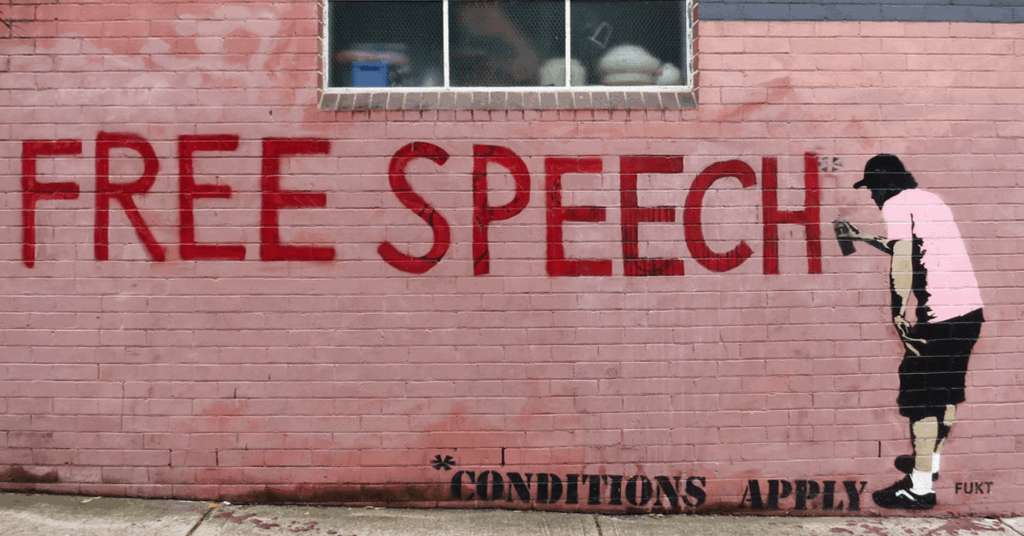
Resistance to Indigenous land acknowledgements and other types of compelled speech can take several forms, ranging from quiet administrative objections to public legal challenges through organizations like the Justice Centre for Constitutional Freedoms. According to retired judge Brian Giesbrecht, options include walking out during a land acknowledgement, raising an objection during a meeting or sending a written complaint to local officials. Among other possibilities is the use of satire to highlight the absurdity of speech mandates. A notable example of this occurred in January 2025, when a government watchdog representative delivered a “Taxpayer’s Acknowledgement” before a City of Toronto budget meeting. The video of this presentation went viral, demonstrating that ridicule can effectively puncture the mystique of forced dogma.

The Window Opens

Any topic which comes with a requirement for what Yale University psychologist Irving Janis in the 1970s labelled “groupthink” merits concern on principle alone. The state and its institutions should always avoid compelling participation in moralistic and contentious rituals or speech practices. In fact, Canada’s Charter of Rights and Freedoms expressly guarantees all citizens the freedom of thought, belief, opinion and expression under Section 2(b), freedom of conscience in Section 2(a) and freedom of association in Section 2(d). But these rights must be continually re-asserted to be realized. As criticism grows and more brave people like Horsman and Kronas step up, the possibility of systemic change also grows.

Canadians should not feel that they need to tiptoe on eggshells when discussing controversial topics. Being compelled to proclaim certain beliefs constitutes a moral injury. It also makes navigating the current social environment needlessly stressful. Even if something is seen to be “good” in itself, compulsion in its promotion should be unacceptable to a free society.

The right to say what you believe, as well as the right not to say things you do not believe, are fundamental components of free speech and protected by the Canadian Charter of Rights and Freedoms. The right to say what you believe, as well as the right not to say things you do not believe, are fundamental components of free speech and protected by the Canadian Charter of Rights and Freedoms. (Source of photo: wiredforlego, licensed under CC BY-NC 2.0)
The future of a prosperous, functional, united Canada that is genuinely “inclusive” – in which every citizen regardless of race or origin feels secure in their basic equality – depends on being able to say what you believe and having the freedom to remain silent when you do not. This Canada can be restored. Each time someone criticizes the status quo regarding compelled speech, it becomes easier for the next person to speak up.

Over time, the so-called “Overton Window” – the range of socially acceptable discourse – will widen. One day it will not be an act of bravery to say, “No thanks, I don’t do that,” in response to a request to make a land acknowledgement or some other contested cultural ritual. That day could come sooner than you think. It could happen the next time you encounter one.

George Ramsay is a recent kinesiology graduate from Victoria, British Columbia who became interested in groupthink as it is currently imposed at universities. This is an edited and expanded version of his grand-prize-winning entry in the 3rd Annual Patricia Trottier and Gwyn Morgan Student Essay Contest.

Source of main image: Shutterstock.

Love C2C Journal? Here's how you can help us grow.

More for you

Take This Algorithm and Shove It: Gen Z Wrestles with Digital Privacy

Generation Z should know better than anyone the risk that technology poses to personal privacy. They are after all the first generation to grow up entirely in the digital age. Jessica Nwaefidoh knows from personal experience how vulnerable your most intimate information can be. With companies anxious to profit from everyone’s personal data, politicians happy to play along for their own selfish reasons and most people willing to sacrifice their own privacy for convenience, amusement or just to get by, Nwaefidoh argues that it’s time to fight back. The right to be left alone, she finds, requires constant vigilance – and she offers some practical tactics to reclaim that right.

Future Tense: Why Gen Z is Right to Feel Betrayed

Older generations often roll their eyes when young people seek to blame them for their woes. But if Canada’s Gen Zers feel betrayed by the Boomers, they are right to do so, argues Gwyn Morgan. Years of irresponsible fiscal and regulatory policies have hamstrung the Canadian economy and left younger generations facing a bleak future of stagnant wages, rising taxes and shrinking opportunities. A former business leader who created more than his share of jobs and prosperity during his long corporate career, Morgan casts a worried eye over the next generation – and offers sympathy for the situation they’re inheriting.

Unfriendly Skies: Why Canada Needs Real Airline Competition

Ireland’s Ryanair will fly you from London to Geneva for $49. Flying from Calgary to Vancouver – a shorter trip – likely will set you back four times as much. Canadians suffer some of the highest-priced, least-convenient and most unpleasant airline service in the world, and mainly for one reason: forestalled competition. In fact, creating barriers to prevent any meaningful competition has been the main goal of Canadian airline policy since the formation of Trans-Canada Air Lines in 1937. Simon Michell explains how this sorry situation came to be and reveals how opening up our skies – as so many other countries have already done – would make things much better for us all.

More from this author