

In Canadian defence circles the 1990s have long been known as the “decade of darkness”. The Chretien administration, committed to erasing the country’s deficits, slashed the defence budget by 25 percent, from $12 billion in 1993 to $9.4B in 1998, plunging troop numbers from 74,000 to below 60,000. During and after these cuts, the government deployed the Canadian Forces (CF) on practically every United Nations mission. Some – like the 2000-01 deployment to Ethiopia and Eritrea – were of dubious worth, and together they greatly exacerbated equipment and personnel problems as both wear and tear and retention issues took their toll. By the early 2000s the CF was facing a $15B equipment shortfall and people began wondering aloud whether Canada would have a functional armed forces at all.
Thus, for many military supporters, the 2006 Conservative election pledge to “Stand Up for Canada”, and provide “our brave men and women in uniform with the tools and resources they need to keep our True North strong and free”, came as a relief. The military would get more money, more troops, and new equipment. The new government also vowed to move beyond the operational tokenism so characteristic of 1990s’ peacekeeping missions to actually making substantial contributions to international security. Luckily for the Conservatives, their plans were buoyed by fortuitous political circumstances, including broad public support for the military owing to its outstanding performance in the Afghanistan war, a reasonably full federal treasury, and decent economic growth.
Now, nearly a decade later, it’s time to assess how well the Conservatives have delivered on rearmament. The period from 2006 to 2009 were the golden years. Shortly into their first mandate, in June 2006, the new government unveiled $17B worth of procurement projects. Billed as the “largest concentration of planned defence procurement projects in Canadian history”, the shopping list included three Joint Support Ships, six to eight Arctic Patrol Ships, four C-17 strategic airlift aircraft, and 17 C-130Js tactical transports. To put this announcement in perspective, the Department of National Defence’s (DND) capital budget for 2004-05 was only $3B. The entire military budget was just $14.5B.
In order to make these acquisitions a reality, the government delivered a sustained funding plan in 2008 called the Canada First Defence Strategy. At the heart of the CFDS was a 20-year funding formula that would increase by two percent per year from 2008 to 2028. In real terms, DND’s budget would increase from $18B in 2008 to $30B in 2028, totalling $490B over the two decades, with $45B to $50B for major acquisitions. Personnel levels would grow to 70,000 regulars and 30,000 reserves and further recapitalization would occur: 65 “next-generation fighters”, 100 Leopard II tanks, 17 Fixed-Wing Search and Rescue (FWSAR) aircraft, 15 Canadian Surface Combatants (CSC) warships, 10-12 Maritime Patrol Aircraft, and a new fleet of armoured vehicles.

Until 2010-11, the government largely kept to the CFDS spending increases. The defence budget rose by 24 percent, with the CF receiving C-17s, C-130Js, tanks, M-777 howitzers, and Chinook helicopters. Yet the government’s remaining procurement plans – particularly the replacement of almost all of the naval fleet – have become mired in delays and financial controversies. Some of this can be attributed to bureaucratic processes; the number of personnel in DND’s Material branch grew by only four percent between 2003 and 2010 while contending with a 68 percent increase in overall defence spending during the same period. Nevertheless, it was the Afghanistan mission and the 2008 global recession that had the biggest impact.
With Afghanistan, the army, quite rightly, became the priority. This meant that procurement funds had to be reallocated away from longstanding naval and air force projects to cover mission-specific equipment, such as $1.3B for Leopard II tanks. While it is challenging to pin down the exact cost of the Afghanistan operation a 2008 Parliamentary Budget Office report estimated expenses at $13B to $18B over the 2001-2011 period. In short, budgetary increases made under the Martin and Harper governments were largely absorbed by Afghanistan.
In response to the 2008 recession, the government adopted a two-year, $47B stimulus plan in Budget 2009. The federal deficit ballooned to a record high of more than $50B. Job creating infrastructure investments, financial system liquidity injections, multi-billion-dollar supports for automakers and other measures designed to protect jobs and goose economic activity became the top priority. By and large these efforts succeeded in sheltering Canada’s economy from the worst effects of the Great Recession, but they added well over $100B to the federal debt and set the stage for an austerity drive. Defence, representing 20 percent of all federal program spending, was an inevitable target.
To no surprise Budget 2012 projected a fifth of all federal spending reductions coming from defence. Budget 2014 defence cuts went even deeper, accounting for a quarter of all spending reductions. These measures effectively made the CFDS unsustainable, its 20-year budget reduced from $490B to $453B. From a high of $22B in 2011 the defence budget in 2013 stood at $19B. Adjusted for inflation, the 2013 sum is actually $16B, the same as it was in 2005 before the Conservatives took power. As a proportion of GDP, defence spending is now where it was during the depths of the decade of darkness, at 1.1 percent, down from 1.4 percent in 2009.
These reductions, in combination with CFDS budget caps put in place in 2008, mean that many projects are underfunded. The CSC warships project, for example, is at least $14B short. As a stop-gap measure the government has launched a number of expensive refit schemes to keep core fleets operating into the 2020s: $4.2B on modifying the Halifax-Class frigates, $1.2B on updating 600 Light Armoured Vehicle IIIs, and an estimated $100M on keeping 77 CF-18s up in the air. Meanwhile, two of the three Iroquois class destroyers and the entire complement of Auxiliary Oil Replenishment ships are being sold off as a cost saving measure. Even with these actions the government still faces a capability-cost dilemma: either increase the defence budget to meet the planned procurement needs, or reduce the capabilities by cutting equipment numbers, personnel levels, or both.
Increasing defence spending in the next budget seems a non-starter in an election year. Conventional political wisdom holds that voters prefer promises of direct benefits like tax cuts and childcare support over expensive military hardware. On the other hand, Canadians have been bombarded for months with headlines about rising national and international security threats. The powerful emotional response to October’s domestic terror attacks indicates that public affection for the Canadian Forces has not waned post-Afghanistan. Most polling has indicated strong public support for air strikes against the Islamic State. And if military and foreign policy issues do figure prominently in the 2015 election campaign, no party or leader will be able to credibly position as a defender of Canada’s security without making commitments to rearmament.
Whatever commitments are made, before or after the election, should reflect changes in the global security environment and current priorities of the CF. As the army has done relatively well on procurement in recent years, in large part because of the Afghanistan mission, the government should focus on re-equipping the navy and air force. In Canada and much of the western world, there currently seems little public appetite for more “boots on the ground” missions to the world’s hotspots anyway, and the emerging western defence consensus is that local armies should fight their own battles, supported by western trainers and technologies. Operations in Libya, Mali, and now Iraq, stand out in this regard.
Despite the rust out, Canada’s navy and air force still have the high-tech, integrated systems our allies look for in operations. Witness the HMCS Charlottetown’s pivotal role in coordinating NATO airstrikes against Qaddafi’s forces in Misrata in 2011. Both services are directly tied to fulfilling our continental duties under NORAD, and our alliance responsibilities under NATO.
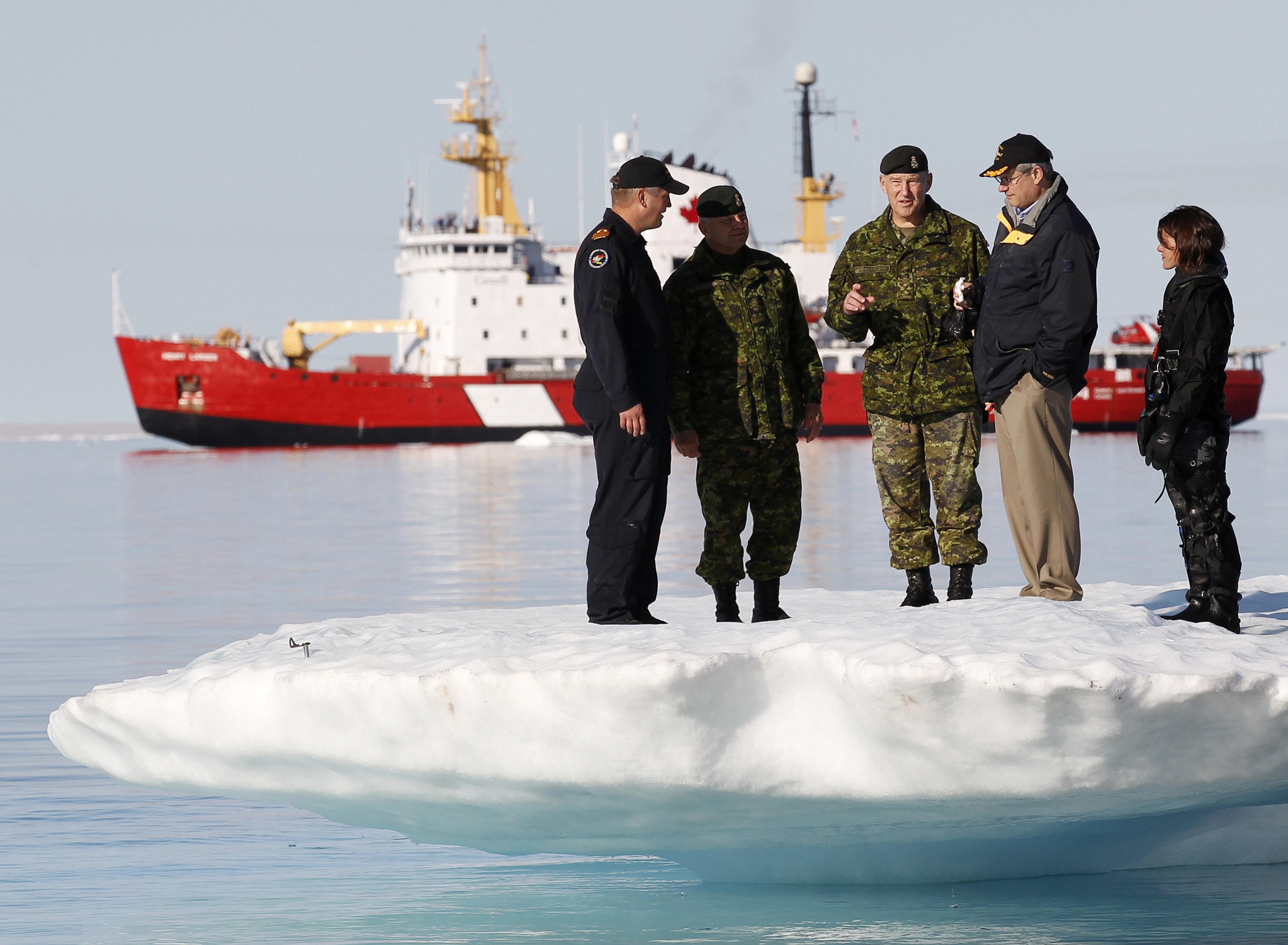
But without significant hardware upgrades Canada risks becoming a bit player in our western alliances. At a minimum the air force has to replace the F-18s with fighters that can interoperate with our great power allies, and despite its design setbacks and controversies, the F-35 remains the optimal choice to do that as it is adopted by more countries over the next decade. And strengthening the navy offers a political upside in the expansion of jobs at domestic shipyards – as well as satisfying the government’s promise to enforce Arctic sovereignty as melting polar ice opens up the North to challenges from Russia and China.
There are indications that Canada’s shift towards the new western defence doctrine, focussing on the navy and air force, is already happening. The army’s readiness budget has been reduced, troop numbers frozen, and certain projects, like the $2.2B Close Combat Vehicle, have been cancelled. This is likely to continue, whether military and foreign policy becomes a 2015 campaign issue or not, and regardless who wins the election. The proliferation of security threats over the last year has likely ended the latest round of hollowing out the defence budget to pay for other priorities, and the main elements of the CFDS will be resumed, albeit with significant revisions to reflect the new challenges and priorities facing Canada in the present and future global security environment.

~
Jeffrey F. Collins is a Research Associate with the Atlantic Institute for Market Studies. A former policy advisor for Canada’s Minister of Veterans Affairs, he is currently pursuing a PhD thesis in Canadian defence procurement at Carleton University.