Stories

Darkness descends on “sunny ways”

Paul Bunner
November 19, 2015
What if the horrific Islamist assault on Paris last Friday had occurred just a few weeks earlier, before the October 19 Canadian federal election? Would voters have felt differently about Bill C-51, bombing ISIS, opening the door to refugees, stripping citizenship from terrorists, and banning the niqab? Probably, but it doesn’t matter. What matters is how the young Trudeau government handles refugee and security policy in the aftermath of the Paris attacks. Our western allies are tightening their borders and escalating the war against ISIS. But the Liberals, writes Paul Bunner, are stubbornly sticking to their election script.
Stories

Darkness descends on “sunny ways”

Paul Bunner
November 19, 2015
What if the horrific Islamist assault on Paris last Friday had occurred just a few weeks earlier, before the October 19 Canadian federal election? Would voters have felt differently about Bill C-51, bombing ISIS, opening the door to refugees, stripping citizenship from terrorists, and banning the niqab? Probably, but it doesn’t matter. What matters is how the young Trudeau government handles refugee and security policy in the aftermath of the Paris attacks. Our western allies are tightening their borders and escalating the war against ISIS. But the Liberals, writes Paul Bunner, are stubbornly sticking to their election script.
Share on Facebook
Share on Twitter

C2C Bunner 19Nov

The Conservative party under Stephen Harper tried to frame the ballot in the October 19 election around three main issues: the economy, leadership and national security. By the end of the long campaign, the economy was almost irrelevant, Harper’s leadership was a liability, and national security had morphed into a debate about compassion for refugees and Conservative intolerance towards Canada’s Muslim minority.

Harper’s leadership became a lightning rod largely because of his insistence on expanding the security state through Bill C-51, revoking the citizenship of dual nationals convicted of terrorism, continuing the bombing campaign against ISIS in Syria and Iraq, limiting and carefully screening refugees, and pressuring Muslim Canadians to adopt Canadian cultural values (such as showing your face at citizenship ceremonies). The barbaric cultural practices snitch line was the last straw for many voters, including some conservatives. So the choice between the fearmongering Harper and the fun-loving Justin Trudeau was really no contest, the Conservative clouds parted, and the land was bathed in “sunny ways”.

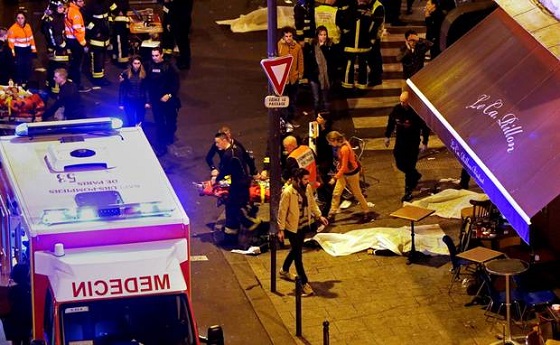
Darkness returned with a vengeance on November 13 as the perverted sword of Islam butchered 129 innocents in Paris. The slaughter has prompted a massive reconsideration of western refugee and security policies. Borders are tightening and the war against ISIS is escalating. And amid evidence that the perpetrators were either home-grown Islamists or part of the great refugee tsunami, inevitably there are questions about how many barbarians are inside the gates.

Under the circumstances, it’s hard not to wonder if the Canadian election would have turned out differently if the Paris attacks had occurred in the days before the vote. Obviously the answer is unknowable, but it’s reasonable to assume that if Canadians had walked into their polling booths with the carnage from the Bataclan concert hall fresh in their minds, at least some might have voted for the tough devil they knew instead of untested angel of hope and change.

Pointless speculation? Maybe. But as the new Trudeau government grimly clings to its election promises to stop bombing ISIS and meet its impossible target of 25,000 Syrian refugees by Christmas, one gets the feeling that this political honeymoon is going to be shorter than most. While our allies are ratcheting up the war and security rhetoric at the string of fall international summits, our pacifist young PM is heading the other direction and looks decidedly unready for battle.

Maybe he’ll get through it somehow. It is amazing how quickly terrorist events disappear down the memory hole. The Conservative election plan rested on the notion that Canadians were still traumatized by the crazy Islamist rampage on Parliament Hill a year earlier, were at least vaguely aware of numerous domestic terrorist plots that had been thwarted in recent years, were spooked by regular videos of ISIS beheadings and other atrocities, and had some recollection of major international Islamo-terrorist actions like the Nairobi shopping mall massacre and the Charlie Hebdo bloodbath. Silly boys and girls in short pants: they should have known that Canadians are widely afflicted with short-term memory deficits, even before Trudeau legalizes marijuana.

Still, at some point you have to think the sheer frequency and scale of Islamist attacks will achieve critical mass in the frontal lobes of its targets. This phenomenon is already well advanced in Europe, where dangerously xenophobic political parties are on the rise. In Canada it is most advanced in Quebec, where the province has banned wearing the niqab in the delivery or receipt of public services.

But the Trudeau government seems determined to swim against the tide. The new Justice minister phoned the celebrated victim of Harper’s niqab-citizenship ban the other day to tell her Ottawa was abandoning the policy. The Liberals are also committed to repealing the Conservative law that stripped Canadian citizenship from dual nationals convicted of terrorism.

If you really believe the best way to defeat Islamo fascism is to stop inciting it with bombs and military occupations and by accommodating fundamentalist Muslim cultural practices within the multicultural mainstream, then you probably still would have voted Liberal on October 19, even if the Paris attacks had occurred on the 18th.

Lots of people do believe this, even in Paris today. This week the CBC aired an interview with a father and his roughly four year old son at a shrine to the victims in the 10th arrondissement. Asked if he was scared, the boy said he feared they would have to leave their home. His father said that it would not be necessary but the boy still expressed worry about the “bad people”. There are bad people everywhere, his father replied. Then he pointed to the shrine. “The flowers will keep us safe,” he said. The boy appeared confused and skeptical but asked, “And the candles too?” Yes, insisted his father.

The boy looked to be about the same age as the Syrian child who washed up on the beach in Turkey and turned the Conservative election strategy inside out. The latter will never know if flowers, candles and pacifism will placate Islamist totalitarianism. The former may live long enough to find out. Canadians, meanwhile, have apparently elected a four year experiment with that strategy.

~

Paul Bunner is the editor of C2C Journal.

Love C2C Journal? Here's how you can help us grow.

More for you

Give This Idea an F: The Problematic Push to Eliminate Letter Grades

B.C.’s decision to abandon letter grades in favour of four vague “proficiency” categories is the latest example of the move to do away with objective standards throughout Canada’s public education system. Traditional grading methods are too hard on the tender egos of young students, the logic goes. And the possibility of failure is outdated, if not downright racist. Christina Park reveals how this new system is failing parents, who have a right to know how their child is doing, and harming students, who may be denied the help they need. She also uncovers some “gritty optimism” about the possible return of coherent educational standards.

The Price of Foolish Pride: What Germany’s Social and Economic Decline Can Teach Canada

Germany was postwar Europe’s most successful nation – until it was seized by an arrogant leftist ideology that led it down a ruinous path. Its government abandoned safe, zero-emission nuclear power for inefficient wind and solar plus natural gas from Vladmir Putin. It threw open its borders to millions of asylum-seekers with barely a thought to the enormous costs or the difficulties of social integration. Today, at the 11th hour, Germany is at last struggling to turn around its decade of economic decline and social disintegration. In this cautionary tale, Gwyn Morgan sees a profound warning for Canada.

What’s Yours is Ours: Why Canada’s Charter Ignores Property Rights and What That Means for Everything You Own

“The whole meaning of life,” famed comedian George Carlin once observed, “is trying to find a place for all your stuff. That’s what your house is, it’s a place for your stuff with a cover on it.” If so, then Canadians should be very concerned about their stuff. Unlike nearly every other modern nation, Canada lacks constitutional affirmation of the right to own property and as protection against its unjust seizure. With a recent B.C. Supreme Court ruling putting the very notion of home ownership at risk, Peter Shawn Taylor seeks out legal opinions on Canada’s surprisingly lax attitude towards property rights, how it differs from other countries and what that means for everyone’s possessions. If Canadians really want to protect their homes, belongings and personal finances, Taylor concludes, now’s the time to get loud.

More from this author

Good News From C2C Journal

C2C Journal is pleased to announce that thanks to the loyal and generous support of our readers, contributors and donors, the Journal is immediately increasing volume and frequency of original stories and essays, expanding staff, unveiling a redesigned website, and launching a sustained social media marketing push on multi-media platforms. Editor Paul Bunner has the details.

One step forward, two steps back for freedom

When he wasn’t kayaking on or swimming in the North Saskatchewan River near his home in Edmonton, C2C Journal editor Paul Bunner spent some of his summer fighting two battles for little freedoms in his local community. He won one and lost one. Although he’s a veteran political activist at the federal and provincial level, Bunner contends that the lifeblood of democracy must be nurtured at the foundations of society if it is to flourish at the top.

The Last Front Page

The rapidly shrinking newspaper business raises all kinds of questions. What will we wrap fish guts in? How will we light backyard fires? And where will we get reasonably accurate and important stories about what’s going on in our community, our country, and the world? The internet? Where global editor-bots decide what’s news? Where politicians can lie with impunity? Where fake news outsells real news? The short answer is yes. The longer and more encouraging answer is in the Spring edition of C2C Journal, which launches today with editor Paul Bunner’s lead editorial and career newspaperman Paul Stanway’s lament for the ink-stained wretches of yesterday’s news.