
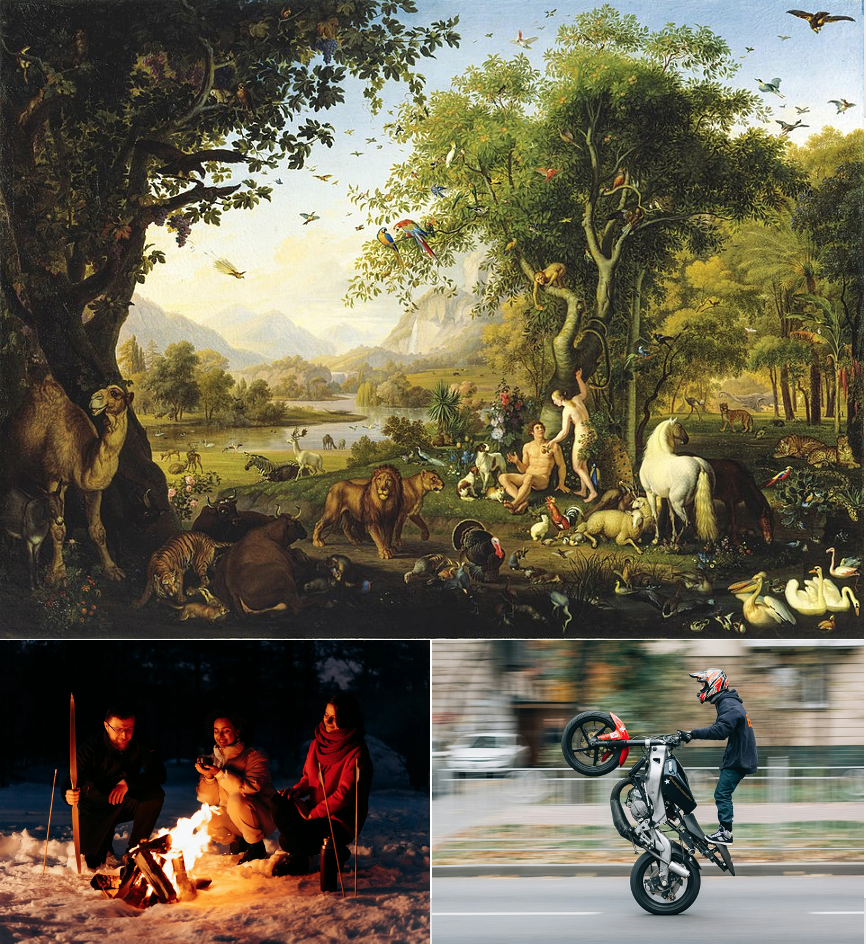
 Conservation above all: The universe (or Creation) is established on intractable laws that demand obedience for life to be preserved; these laws are both metaphysical, expressed in religious teachings, and physical, like the four laws of thermodynamics. Depicted at top, Adam and Eve in the Garden of Eden, by Wenzel Peter, circa 1800-1829. (Sources of photos: (bottom left) Pexels; (bottom right) Unsplash)
Science, like theology, has its own mysterious interconnections that are also aspects of arcane realities, often entailing jarring incompatibles. It addresses its own transcendent imponderables and material necessities, its sacred and mundane, its tangibles and incorporeals, its conviction of the existence of at least two orders of reality involving an apparatus of empirical investigation and a set of mathematical concepts that appear mystifying to the uninitiated. Experimental procedures are the link between abstruse theory and practical fact.
Scientists are also wedded to a set of personal beliefs that connect scientific pursuits to human endeavour. Their efforts to impose scientific clarity upon the hidden processes of nature and the narrow borders of the human intellect continue to animate them, though not always amiably. Emotional investments sometimes go too deep.
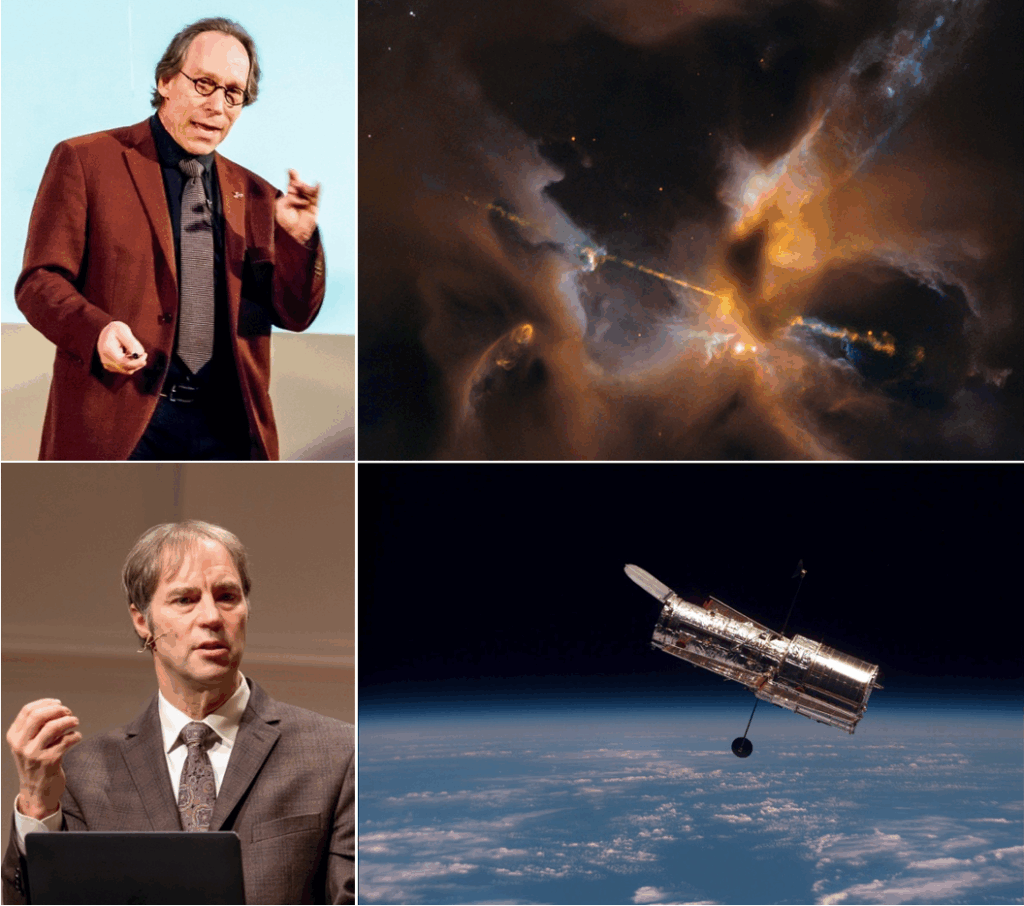
For example, theoretical physicist Lawrence Krauss in A Universe from Nothing suggests that a universe can arise from “a boiling brew of virtual particles that pop in and out of existence” in the perfect vacuum of empty space, which is effectively Nothing. This implies the prior existence of empty space (or something called Nothing), whose origin is taken for granted within the continuum of time. The whack-a-mole particles it somehow contains just come and go in ways that cannot be predicted, which is the basis of what is called quantum reality, the micro-event horizon where objective reality ceases to exist. (These particles are “virtual” because they are essentially fleeting perturbations in a “field”.)
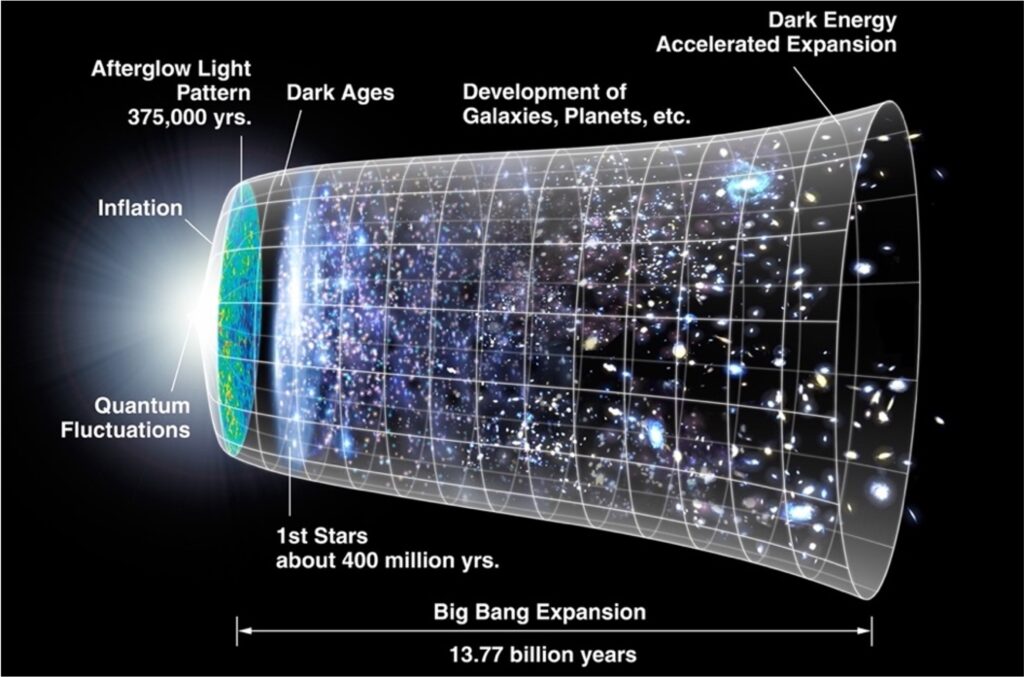 Unanswered question of cosmology: Under the prevailing scientific view, the Big Bang created the universe, its laws, forces, matter, energy, and even space and time; the theory leaves dangling the key issue of what existed prior to the Creative moment – and how causation could operate outside time and space. Shown, graphical representation of the universe’s expansion from the Big Bang to the present day.
Eighteenth-century Swiss polymath Leonhard Euler believed existence and nonexistence could be mathematically correlated and devised an identity formula for nothing (i.e., nonexistence), considered the most beautiful of mathematical equations. It has the identities 1 and 0, it has the two most important transcendental numbers e and pi, and it has i for irrationals. It is: eiΠ=0. This is said to connect the realms of real numbers and imaginary numbers, bridging worlds. It’s a beguiling equation but baffling to those without mathematics, and it is experimentally unrealizable. Beauty is not always useful in the hunt for the evanescent.
In any “event”, whether the universe came into being during time, which as we will see makes no sense, or before time, which also makes no sense, the question continues to be asked in various and unsatisfactory ways.
Did the universe spring from a vacuum? Or did God put his supersensual artistry to work from some aesthetic proclivity? Was the universe the progeny of the Quantum Observer in whose image or “signal field” it is ostensibly disposed? Is the universe, as some believe, merely a hologram, a playful simulation whose deep structure is based on the sort of physics one would program into a computer, perhaps a prank cooked up by an interstellar super-race that obviously cannot be self-generated?
Even a prior event like quantum tunnelling that some cosmologists believe caused the Big Bang merely begs the question. The theory that the universe began on the other side of a black hole in another universe, or ignited in a collision between higher-dimension structures called branes as m-theory asserts, are similarly null. Note that each of these theories requires something; in none is the universe truly self-creating.
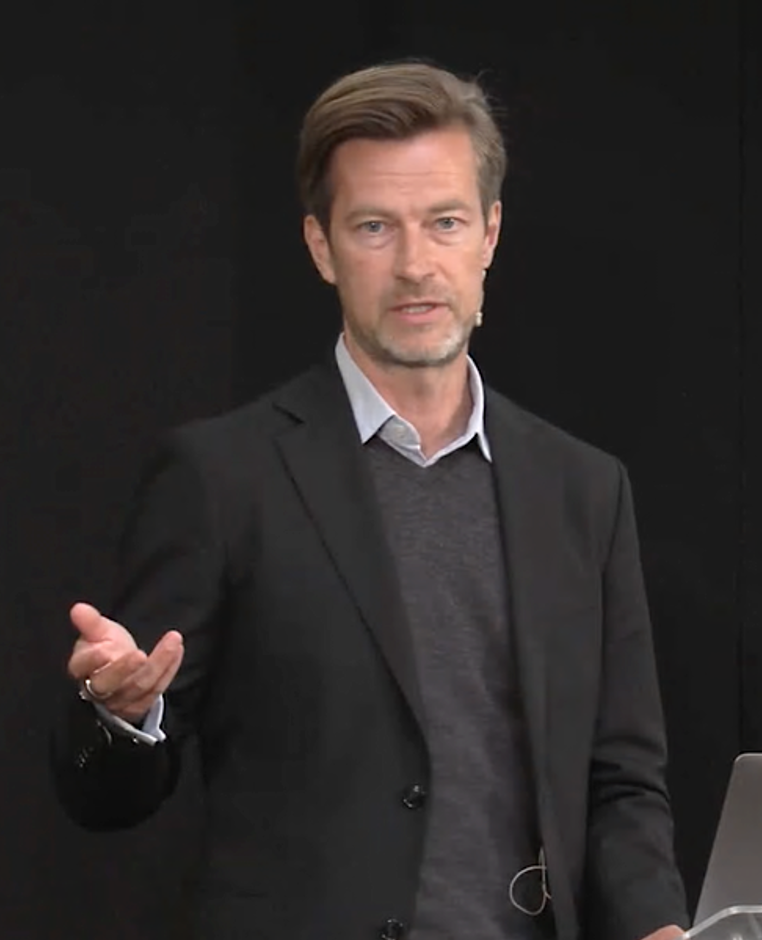
There is also the question of whether even the Big Bang is a convincing scientific theory. As Bjørn Ekeberg contended on the Scientific American’s blog some years ago, today’s multilayered theoretical edifice of the Big Bang may turn out to be inherently flawed, a confusing mix of fictional beasts invented to uphold the model. In his book Metaphysical Experiments, Ekeberg suggests that “scientific cosmology actually operates in a twilight zone between the physical and metaphysical,” a kind of theoretical squat. The Big Bang paradigm, he insists, does not describe known empirical phenomena but only maintains the mathematical coherence of the current explanatory framework, making it not a theory of Creation but merely an elaborate theory of itself. Many contemporary physicists agree.
Whatever our beliefs may be, the major issue stays in place, which leads to what we might call the paradox of the knot. Religious philosopher Søren Kierkegaard once wrote in his Journals, “To philosophize without dogma is like sewing without a knot at the end of the thread.” We have to start somewhere, with a new or accepted perspective or standpoint, some sort of “dogma”, where all that comes before the analysis we have embarked upon lingers in a state of obscurity. Everyone uses the knot but, as we’ve already seen, some would rather not acknowledge it.
 Reason for shared humility: The stories of Genesis and of the Big Bang both evade the ultimate question of origin, the one event which is impossible to revisit and which therefore remains fundamentally unexplained. Depicted: at top, God Creating the Earth, by Raffaello Sanzio Raphael, 1483-1520; at bottom, Astronomer Copernicus, or Conversations with God, by Jan Matejko, 1873.
Scientists can merge electromagnetism and the weak nuclear force owing to the energies available in particle colliders. They are two aspects of a single, unified electroweak force, which existed “in the beginning” as one force, now evinced at different energy scales. There are also theoretical calculations to fold in the strong nuclear force at even higher energies. And all four forces are believed to be governed by “gauge symmetries” that allow for invariance of mathematical systems under conditions of change, and permit a descriptive reunification of the forces into the single larger group. But gravity relates to the structure of spacetime itself rather than “living” in spacetime and, thus far, gravity refuses to join the party that speaks to the organization of the grand structure.
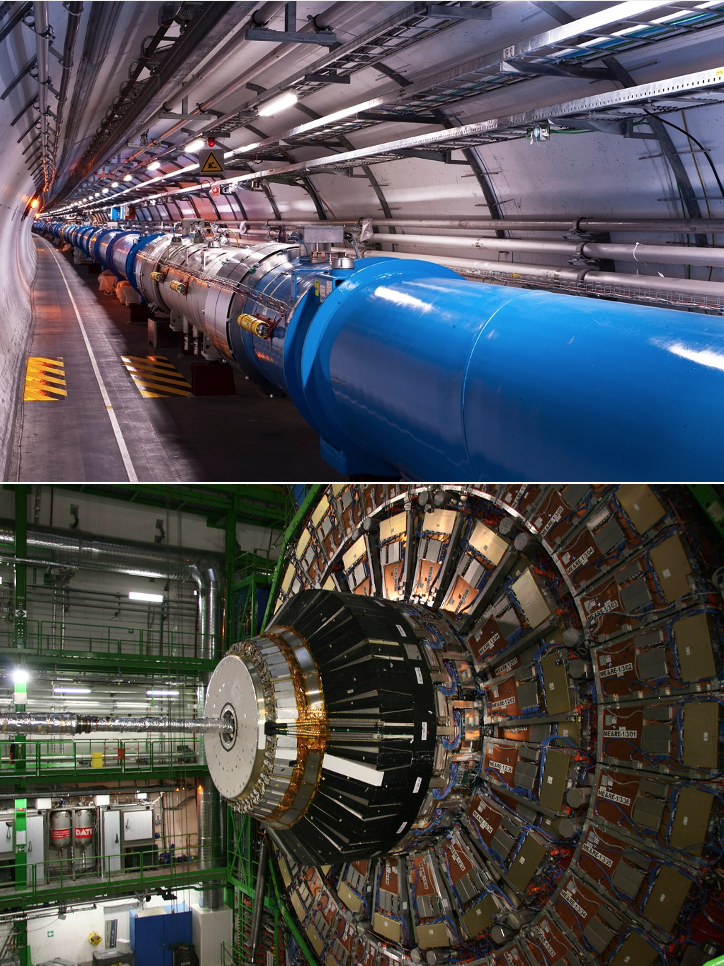
As if this were not enough to unsettle the mind, at the quantum level new issues intervene. What is referred to as Laplace’s Demon, asserting the deterministic mechanism of the classical manifold, has been banished in favour of probability, the basic feature of complex, infinitesimal structures. There may be no final word on the Big Bang commanding 100 percent agreement, but few doubt that quantum physics obeys a wholly new and different set of rules from those in the large-scale world of everyday human experience.
Few doubt any longer what Werner Heisenberg called “incommensurable quantities” and Stephen J. Gould termed “non-overlapping magisterials”. These are now the order of the scientific day, describing two differing worlds, the latent and the manifest, that are clearly reciprocal but at the same time belong to different referential frames. Though lawfully dissimilar, these two conflicting architectures account for the world as a whole. The objective forms at the periphery where we live are merely the outward expressions of the phantom-like hidden forms at the centre that we know only indirectly. Our home is the product of mismatched sets of physical law, a fact which is both theoretically and empirically incredible.
How does this contradiction play itself out? Local realism is what ensures that objects must possess pre-existing values abiding by the laws of classical physics prior to any measurement, that is, laws which scaffold the world of our ordinary, technically predictable reality all the way from the atom to the galaxy. Thus, in the classical milieu, the object is there at a discernible position and at a given, specifiable time. That is why we can confidently book a reservation at a restaurant that remains at a fixed address at any given time instead of it migrating from one street to another at any other hour of the day.
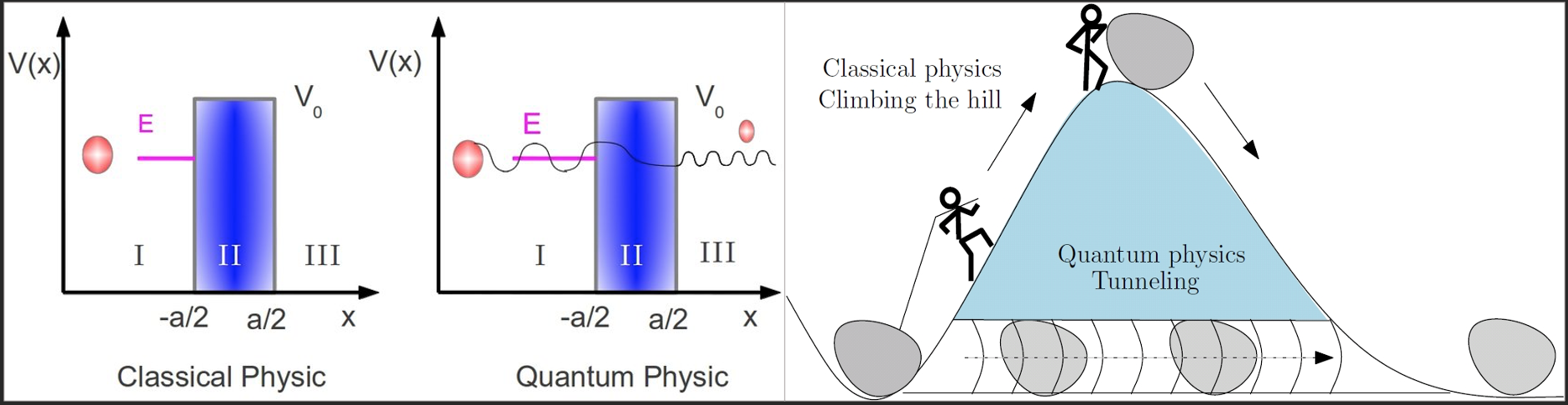
Non-local events, however, are categorically different. In the quantum milieu, the object fluctuates in a cloud of probabilities called a wave function which collapses only with observation, allowing the “particle”, which did not exist in a particular time or position prior to the observation or measurement, to suddenly appear. Were we living in the quantum field, we might as well give up planning for a meal out since we could neither pre-arrange for a time nor have any idea where the restaurant would be when we left the house. It would not appear at all unless we correctly guessed its location and went there to “make a measurement”, as the physicists like to say.
The statistical equation for the wave function of the probability of finding a particle in a specific region, also known as the Born Rule, looks like this in its compressed variant: |Ψ(x,t)|2. The wave function is not directly observable but its magnitude squared gives a real, positive number, another way of saying that it is both problematic and real. In the quantum state, then, the “particle” is the probability wave we cannot surf with confidence. But in the scale of our existence it is a phone number, a restaurant and an exquisite fettuccine alfredo at La Piazza Dario.
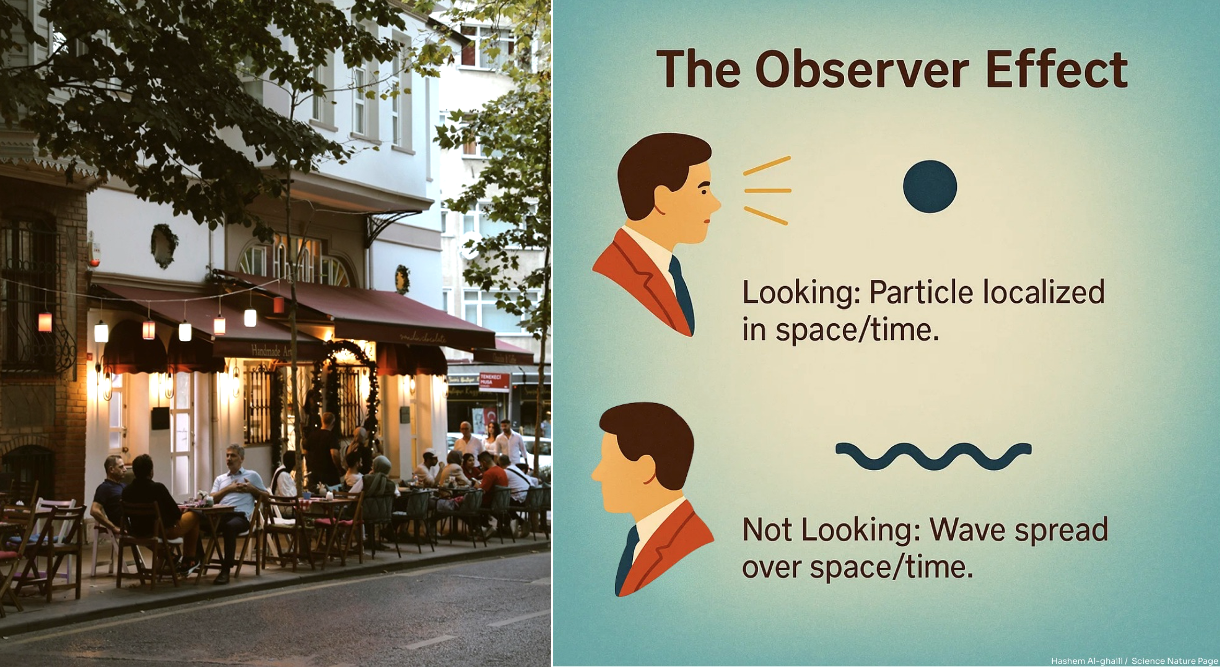
A famous thought-experiment tackles the subject. Erwin Schrödinger’s cat is neither alive nor dead, or is both, until the intermittently radioactive box in which it lies is opened and the feline is either mourned or fed. (The joke among physicists is that the experiment was proposed by Schrödinger’s dog.) One interpretation of the groundbreaking Austrian physicist’s thought-experiment states that the instant at which the radioactive atom in the box decays, presuming it does, occurs only after the event has been monitored. In quantum physics, a measurement’s results can send information back in time, that is, a present measurement setting in “delayed choice” experiments can retrocausally influence an earlier, unobserved measurement. Strange, but so.
Another reading proposes that since radioactive decay is a quantum event, the radioactive atom exists in wave-superposition and is both decayed and not decayed simultaneously, so the cat winds up both alive and dead until the box is opened, the wave function collapses, and one or the other result occurs. Mutatis mutandis, it’s a bit like proposing that Lazarus in the cave is both alive and dead until Christ bids him come forth and thus collapses the wave function. Thankfully, this was not a quantum experiment using photomultiplier detectors.
Incidentally, the thought-experiment expressed Schrödinger’s view that wave mechanics were being ridiculously misinterpreted. Yet it proved immensely fruitful. One of Schrödinger’s kittens was the “many-worlds” theory, inasmuch as the quantum solution suggested the existence of parallel worlds to account for each possibility. Yogi Berra also knew his quantum: “When you come to a fork in the road, take it.”
 Two worlds, two outcomes? Erwin Schrödinger’s (left) cat, a famous thought experiment, illuminated the apparent absurdity of quantum physics by applying it to the regular world. A hypothetical cat in Schrödinger’s box exists in two states, being neither alive nor dead, along with a vial of poison that might be shattered by a radioactive substance that is both decayed and not decayed – until the box is opened and the outcome is observed. (Sources: (left photo) American Institute of Physics; (right image) Dhatfield, licensed under CC BY-SA 3.0)
The quantum world is pretty funky, reminiscent in a way of the gothic horror comedy Beetlejuice, as if quantum emanated either from the film or the film’s name-origin, the star Betelgeuse in the Orion Constellation. On the contrary, from the perspective of experience, our world is comparatively rudimentary. Decoherence is unexplainable; the “operation” should not be possible, and many physicists think it is not. But the impossible seems to be a basic law of subatomic physics. Zero-point energy, which is the latent or underlying sea of energy due to quantum oscillations that presumably generate reality from indiscernible probabilities, is presumably the Tao – the fundamental principle – or maybe the quick of the routine and calculable billiard-ball world we live in.
To return. If the first puzzle is how something can actually begin when there is no space or time for it to begin in or no earlier space and time which itself would have had to begin, the second conundrum is how two dissimilar and even clashing palettes of law can paint an integrated and orderly field of predictable activity and coalesce into what amounts to a habitable world via the principle of decoherence.
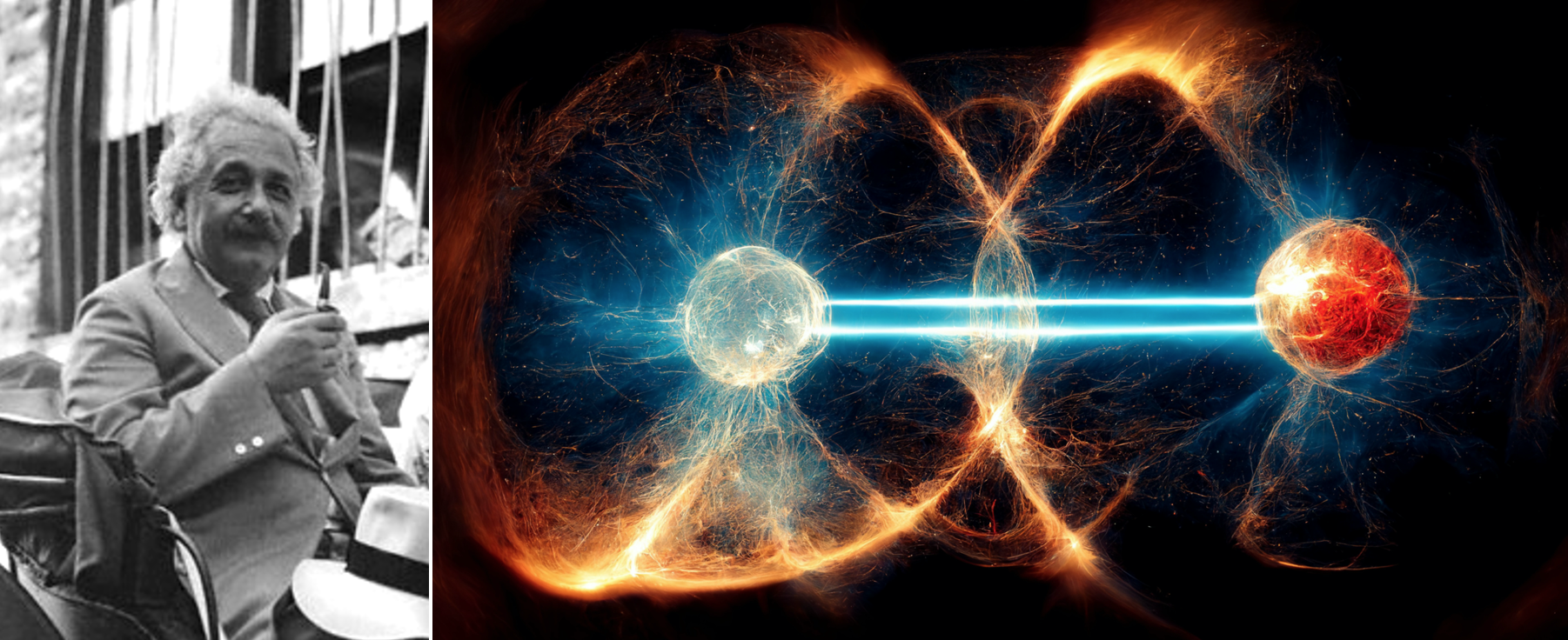
Add to these two a third, what Einstein called “spooky action at a distance”, or quantum entanglement. He was referring to the building-block particles with no internal structure called quarks and leptons that are linked or correlated in a way that is faster than the boundary speed of light. When a quark/lepton “spins”, its fellow quark/lepton will reverse “spin” even if it’s at the opposite end of the universe, the required information transmitted instantly.
I believe it is licit to define these transformations as involving a spiritual level of reality. It’s what Brian Clegg has concisely called The God Effect in a book I consider indispensable. A universal intelligence appears to interact with humanity in a range of contact previously unanticipated. One might even say that the universe comes into existence because God observes it. But there is another problem here: observes what? Where is the cloud of probabilities that exists apart from the Supreme Being? There can be no probability, no hierarchy of ancillary realities that boasts an independent existence, zooming in at a tangent. Some cosmologists throw up their hands and believe that the universe is God’s dream and we are stuck in its quicksand until the great awakening releases us.
We now have the three major physical challenges that baffle the human imagination, the trinity of subliminal but absolutely central scientific problems: origins, decoherence and entanglement. No descriptive equation, no array of calculations, can account for the three aspects of our cosmological cliffhanger. They point to the inscrutable or occult mystery of existence as well as to the noble pixilation of the hunt for knowledge.
As I have argued as an underpinning premise throughout, the problem is not only scientific but theological. Physicist Menas Kafatos, author of The Non-local Universe: The New Physics and Matters of the Mind, proposes the “triadic system”, a model integrating the relationships between epistemic consciousness, the objective universe and the subjective individual. Kafatos’ system functions in the quantum area and migrates up to biological processes and the nature of the cosmos. The model applies across the board and influences the exploration of reality, that is, of ultimate things, in both the physical and spiritual realms. Kafatos makes a strong case that the poles of science and religion are not opposites but complementary.
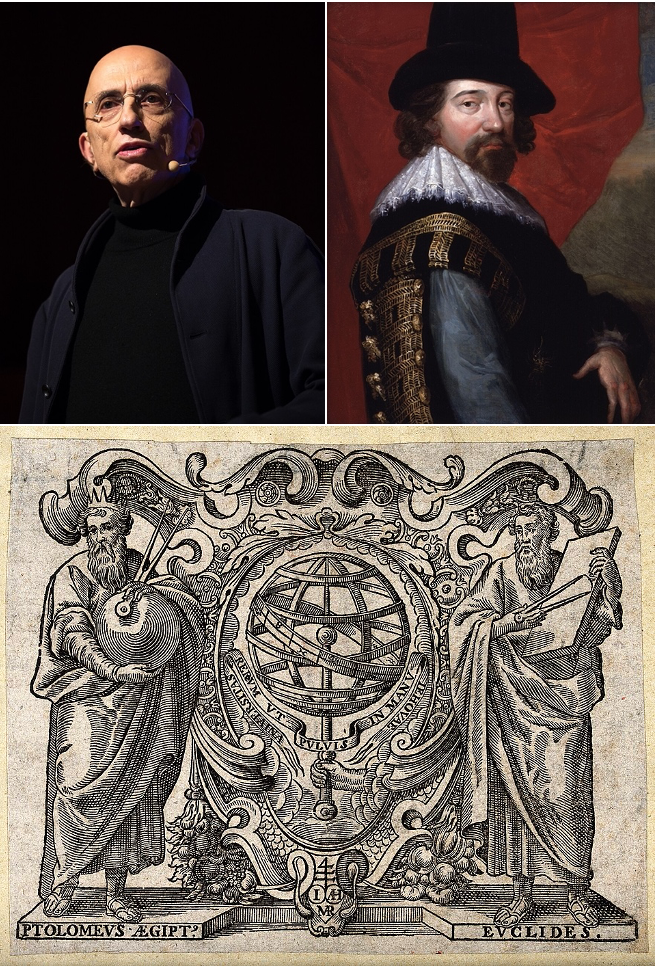
This is not a new proposition. In 1620 Francis Bacon’s Novum Organon stressed that humans’ rights over nature were “assigned to them by the gift of God,” enabling our investigations and discoveries. There was no radical lesion between reason and faith. God belonged to no official communion, logical systems were not subject to theological warrant, skeptical reason and the inductive method were essential to learning, and wisdom regarded final things. Authentic faith and rigid orthodoxy, however, were two different qualities. Bacon insisted that the intellectual faculty must be “governed by right reason and true religion” acting together. And that what cannot be known is common to both.
Recognizing the immanence of spirit in the world of mass and energy is not a pathology of reason, but a sign of the open mind a scientist must bring to the world of his professional interest, signifying the innate human desire to know the truth of the transcendent, so far as this is possible. A passage from the Second Vatican Council’s Dignitatis Humanae of 1965 makes the quest for knowledge a human, almost a religious responsibility: humans possess reason and free will which obligates them to seek the truth about the final causes of the universe.
All this reminds me of early Christian theologian Tertullian’s pivotal question, “What has Athens to do with Jerusalem?” The question is with us still, and may be answered insightfully and without hesitation: Everything. I would submit that God is not virtual. God is not a mere probability. God does not need to file a patent for an invention no one really understands. God is no more improbable than the neutrino, also known as the “ghost particle ghost”, so small it can pass through everything and whose signature typically manifests as deviations in the outgoing lepton flux or energy spectrum.
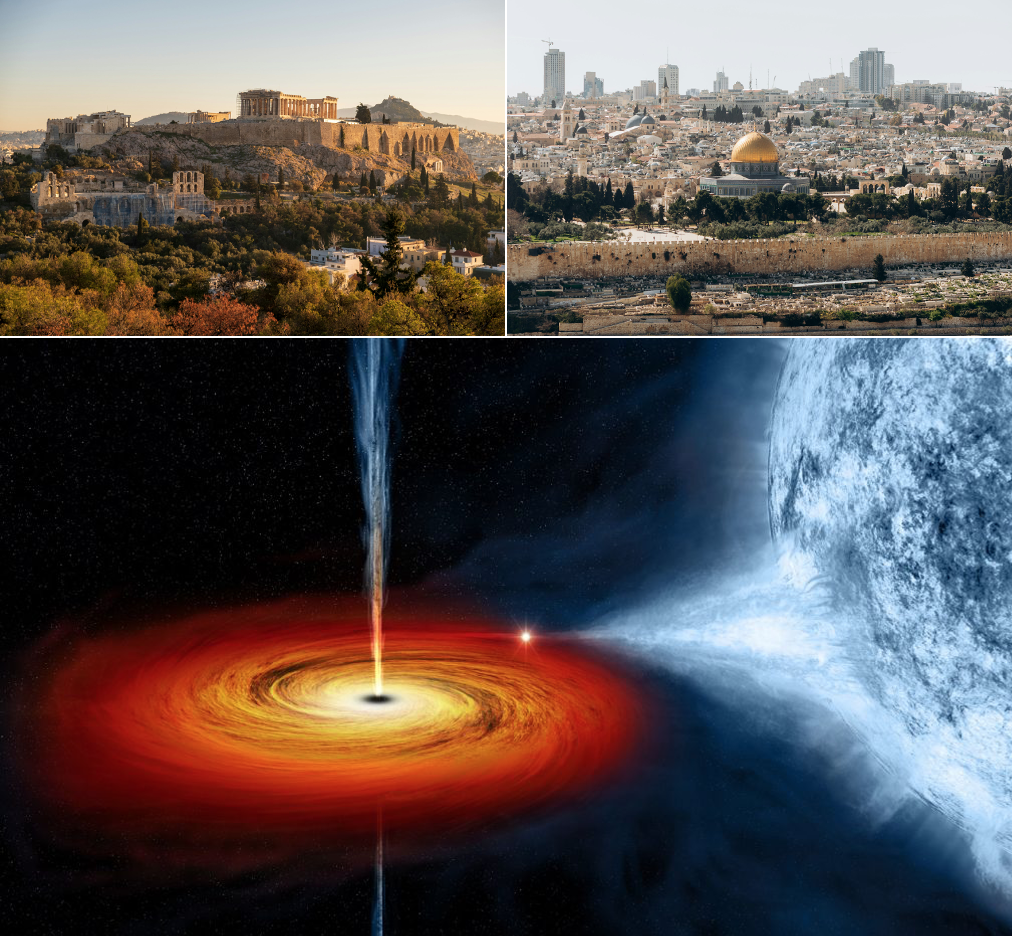
Even so, what comes before God is the waking child’s unanswerable question. What could have existed beyond the mind-numbing veil? So we are back where we both started and ended. But the mystery is here and we have been put to the test. The pilgrimage of the human mind will continue despite the inevitability of ultimate failure, as seems to be ordained, certainly on this side of the zodiac. It’s part of the business of living and thinking, part of the larger game. Consider Victorian poet Robert Browning’s lines in “Andrea del Sarto”: