Stories

Quick Read

Climate Climbdown: Sacrificing the Canadian Economy for Net Zero Goals Others Are Abandoning

Gwyn Morgan
November 13, 2025
Climate-obsessed politicians – Justin Trudeau in the vanguard – nearly destroyed the Canadian economy chasing emissions targets that are both unrealistic and pointless. Ottawa and the four biggest provinces have squandered $158 billion to create just 68,000 “clean” jobs. Meanwhile, fossil fuels are supplying a bigger share of Canada’s energy needs than ever. And now, leading U.S. officials and even eco-zealots like Bill Gates are re-evaluating their net-zero ideology. But that hasn’t gotten through to Prime Minister Mark Carney who, warns Gwyn Morgan, intends to inflict further punishment on an ailing country in pursuit of a delusional cause.
Stories

Quick Read

Climate Climbdown: Sacrificing the Canadian Economy for Net Zero Goals Others Are Abandoning

Gwyn Morgan
November 13, 2025
Climate-obsessed politicians – Justin Trudeau in the vanguard – nearly destroyed the Canadian economy chasing emissions targets that are both unrealistic and pointless. Ottawa and the four biggest provinces have squandered $158 billion to create just 68,000 “clean” jobs. Meanwhile, fossil fuels are supplying a bigger share of Canada’s energy needs than ever. And now, leading U.S. officials and even eco-zealots like Bill Gates are re-evaluating their net-zero ideology. But that hasn’t gotten through to Prime Minister Mark Carney who, warns Gwyn Morgan, intends to inflict further punishment on an ailing country in pursuit of a delusional cause.
Share on Facebook
Share on Twitter

In 2015 the newly elected Justin Trudeau government signed the Paris Climate Agreement, which commits signatory countries to “increasingly ambitious climate action” aimed at limiting the forecast increase in global average temperature to 1.5°C by the end of the century. The following year Trudeau’s Liberal government imposed the Pan-Canadian Framework on Clean Growth and Climate Change, which included more than 50 measures aimed at “reducing carbon emissions and fostering clean technology solutions.” Key among them was economy-wide carbon “pricing” – Liberal-speak for taxes on Canada’s industries and every citizen.

Many further measures followed, culminating in the announcement in 2022 of the 2030 Emissions Reduction Plan, which commits Canada to slashing greenhouse gas (GHG) emissions to 40 percent below 2005 levels by 2030 and to achieve net-zero emissions by 2050. The plan included $9.1 billion for retrofitting structures, subsidizing zero-emission vehicles, building battery-charging stations and subsidizing solar panels and wind turbines. It also mandates the phase-out of Canada’s last remaining coal-fired power generation, and stringent emissions and energy-efficiency standards for vehicles and buildings.
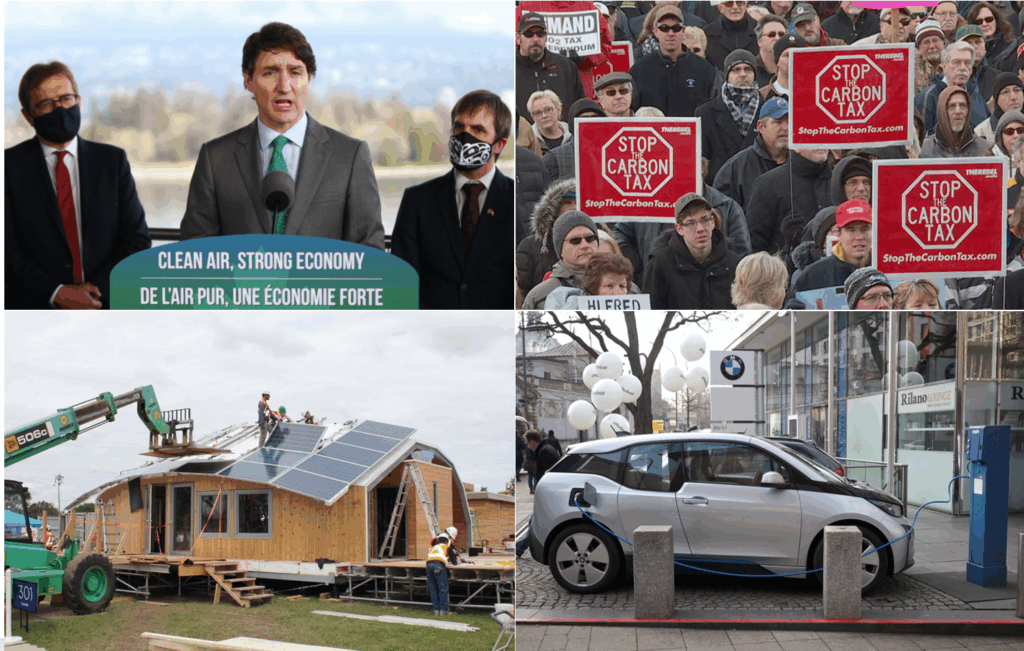
In the name of combating climate change, the Liberal government of Justin Trudeau introduced numerous subsidies, taxes and restrictions – a nation-impoverishing burden on Canada’s industries and every citizen.
xIn the name of combating climate change, the Liberal government of Justin Trudeau introduced numerous subsidies, taxes and restrictions – a nation-impoverishing burden on Canada’s industries and every citizen. (Sources of photos (clockwise from top left): The Canadian Press/Chad Hipolito; Encyclopédie de l’énergie; Janitors, licensed under CC BY 2.0; Dept of Energy Solar Decathlon, licensed under CC BY-ND 2.0)

Other “green” initiatives have included the “On-Farm Climate Action Fund,” a nationwide reforestation initiative to plant 2 billion trees (almost none of which were actually planted), the “Green and Inclusive Community Buildings Program” to promote net-zero standards in new construction, and the Federation of Canadian Municipalities’ federally-funded “Green Municipal Fund” to support decarbonization actions.

That’s a staggering list of nation-impoverishing subsidies, taxes and restrictions. What about the damage to the industry that contributes most to the Canadian economy – and whose economic vitality and continued growth would at least have helped enable the Canadia economy to support the above-listed government spending?

Federal regulatory decisions have systematically blocked major export projects that would have allowed Canadian resources to reach global markets. The cancellation of the Northern Gateway oil export pipeline by the Justin Trudeau government in 2016 occurred even after the project had secured a permit from the previous Conservative government, resulting in over $1 billion in lost pre-construction expenditures. Similarly, the Energy East project, designed to transport Western oil to New Brunswick and European markets, was abandoned following political opposition from the Quebec government. In the natural gas sector, a complex regulatory environment led to the cancellation of 11 out of 12 major liquefied natural gas (LNG) proposals, preventing Canada from becoming a world-class LNG exporter.

Opting for ideology over good sense, the Trudeau government cancelled the Northern Gateway oil export pipeline to B.C.’s northern coast – even after exhaustive study and being granted a permit by the previous Conservative government. That cost the project’s proponents more than $1 billion in pre-construction expenditures and stranded hundreds of billions of dollars worth of crude oil in the ground. Ottawa also stood by as the Quebec government’s politically motivated posturing killed off the Energy East project to carry Western-produced oil, via Central Canada’s refineries, to New Brunswick – and onward to European markets. Meanwhile on the natural gas side, the political and regulatory morass the Liberals created all-but crushed hopes to make Canada a world-class exporter of liquefied natural gas (LNG), leading to cancellation of all but one of 12 major LNG proposals.

But have all those taxes, all that deficit spending and all those project-killing regulatory measures even reduced Canada’s fossil-fuel consumption? As internationally respected environmental statistician and author Bjorn Lomborg has reported, between Trudeau’s election and 2023, fossil fuels’ share of Canada’s energy supply actually increased from 75 to 77 percent. But that wasn’t due to any sort of economic boom; energy consumption rose entirely due to Canada’s immigration-fuelled population boom.
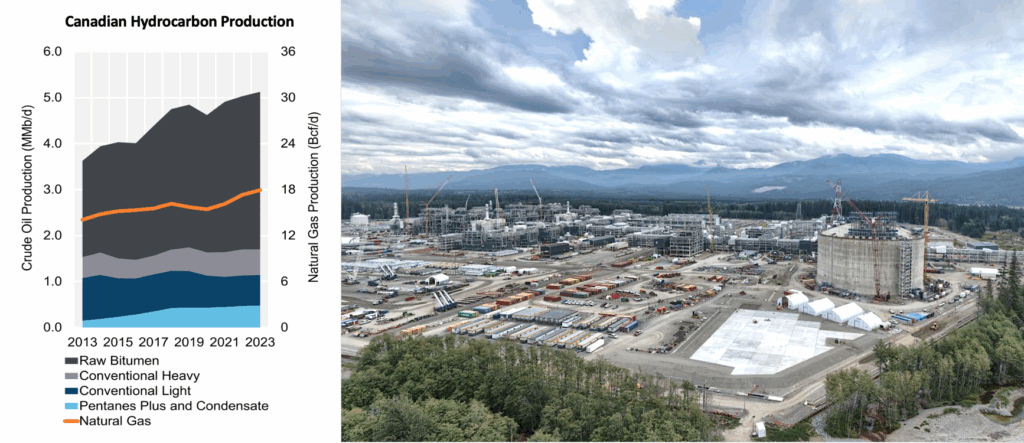
Ideology over sense: Even as Trudeau’s regulatory measures killed off hundreds of billions of dollars worth of projects, fossil fuels’ share of the national energy supply actually increased to 77 percent from 2015 to 2023. At right, Canada’s only major liquefied natural gas export facility under construction in Kitimat, B.C.
xIdeology over sense: Even as Trudeau’s regulatory measures killed off hundreds of billions of dollars worth of projects, fossil fuels’ share of the national energy supply actually increased to 77 percent from 2015 to 2023. At right, Canada’s only major liquefied natural gas export facility under construction in Kitimat, B.C. (Sources: (graph) Canada Energy Regulator; (photo) LNG Canada)

The dismal results weren’t for lack of trying. Two newly released studies by the Fraser Institute have found that Ottawa and the four biggest provinces have either spent or foregone a mind-numbing $158 billion to create just 68,000 “clean” jobs, increasing Canada’s “green economy” by a minuscule 0.3 percentage points to 3.6 percent of GDP – an eye-watering cost of over $2.3 million per job “created”. As for saving the world, or even making a real contribution towards doing so, Canada contributes just 1.5 percent of global GHG emissions. As I’ve mentioned in the past, if Canada disappeared from the face of the Earth tomorrow, the emissions growth from China and India would make that up in just a few weeks.

That is Canada’s emissions-reduction debacle. What’s the global picture? A decade after the Paris Climate Agreement, over 81 percent of the world’s energy still comes from fossil fuels. And world energy demand is up by an estimated 15 percent, from 564 “exajoules” (one million million megajoules) to an estimated 650 exajoules last year. As Lomborg also wrote in the above-mentioned article, “In order to achieve global net zero by 2050, we would have to remove the equivalent of the combined emissions of China and the United States in each of the next five years. This puts us in the realm of science fiction.”

Despite the ambitions of the Liberal government’s Pan-Canadian Framework on Clean Growth and Climate Change introduced in 2016, the return for the Canadian economy has been minimal if not negative. Studies by the Fraser Institute covering the period between the 2015 election of the Justin Trudeau government and 2023 found that the federal government and the four largest provinces spent or forewent $158 billion to create only 68,000 “clean” jobs. This equates to a cost of over $2.3 million per job created and increased the size of the “green economy” by just 0.3 percent of Canada’s GDP. Furthermore, fossil fuels’ share of Canada’s energy supply actually increased from 75 percent to 77 percent during this same period, largely driven by population growth rather than industrial expansion.

Thankfully, a measure of rationality appears to be returning south of the border. In late July, the U.S. Department of Energy issued a report assembled by a team of highly credible climate scientists which asserted that, “CO2-induced warming appears to be less damaging economically than commonly believed and aggressive mitigation policies could be more detrimental than beneficial.” Backed by copious amounts of scientific data, it noted that “claims of increased frequency or intensity of hurricanes, tornadoes, floods and droughts are not supported by U.S. historical data.” The report also concluded that, to the extent climate change is occurring, U.S. policy actions are expected to have “undetectably small impacts on the global climate.”

This was music to the ears of U.S. Secretary of Energy Chris Wright, who responded to the report by commenting, “Climate change is real…but it is not the greatest threat facing humanity …(I)mproving the human condition depends on access to reliable, affordable energy.” Responsibly produced Canadian oil and natural gas clearly should be part of that solution. The same day as the aforementioned report was issued, the Environmental Protection Agency released a proposal to rescind the “endangerment finding” that in 2009 had designated CO2 and other GHGs as pollutants. The endangerment finding provided the rationale for blocking oil and natural gas development while imposing a succession of green policies and regulations (like EV mandates) that, the current Administration calculates, cost the U.S. economy at least US$1 trillion in foregone growth.
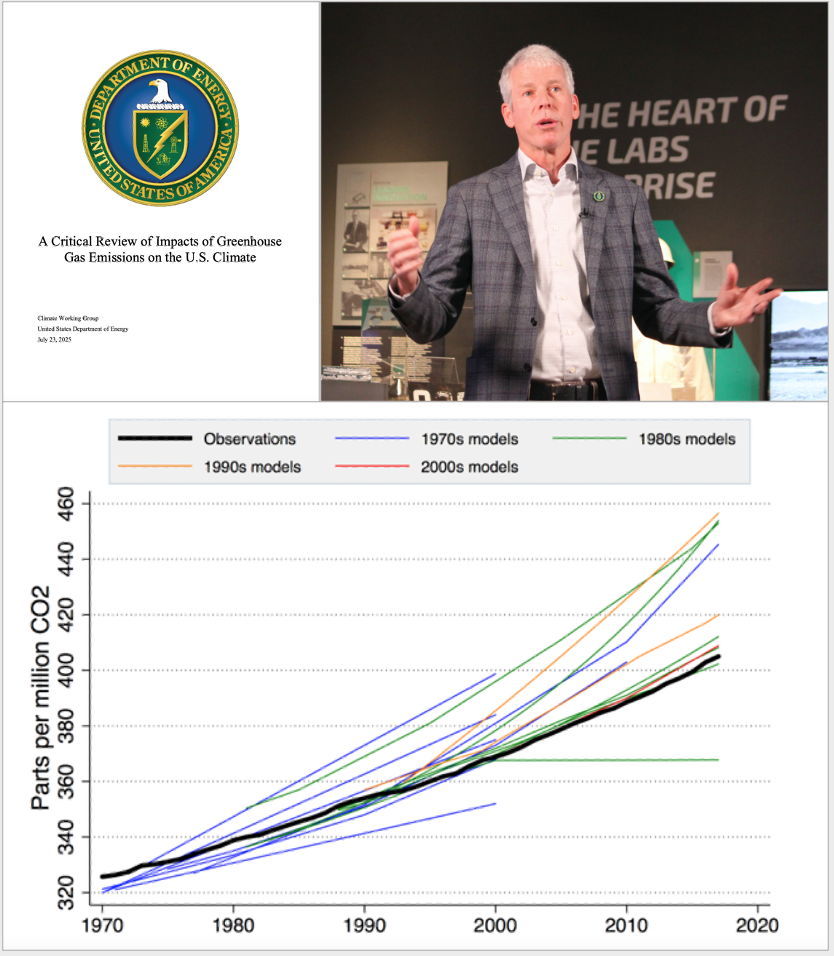
Reason returns: “CO2-induced warming appears to be less damaging economically than commonly believed and aggressive mitigation policies could be more detrimental than beneficial,” a recent U.S. Department of Energy report concludes. Shown: at top right, U.S. Energy Secretary Chris Wright; at bottom, nearly all climate models have over-estimated the growth in atmospheric carbon dioxide concentration, which allegedly drives global temperature.
xReason returns: “CO2-induced warming appears to be less damaging economically than commonly believed and aggressive mitigation policies could be more detrimental than beneficial,” a recent U.S. Department of Energy report concludes. Shown: at top right, U.S. Energy Secretary Chris Wright; at bottom, nearly all climate models have over-estimated the growth in atmospheric carbon dioxide concentration, which allegedly drives global temperature. (Sources: (right photo) AP Photo/Susan Montoya Bryan; (graph) energy.gov)

This leaves little doubt as to where our largest trading partner stands on GHG emissions. But does the U.S.’s backing away from net zero ideology mean our planet will become unlivable? Concurrently with the Trump Administration’s hard-headed economic focus comes news that even some eco-zealots are re-evaluating the situation.

Last month Ted Nordhaus, a prominent American climate catastrophist, published an essay admitting that he now realizes that the Intergovernmental Panel on Climate Change’s forecast for global warming through 2100 is based on an impossible presumption: that the world will experience decades of simultaneously soaring population, robust economic growth and low technological change. But, noted Nordhaus, the three of those do not occur together. Increasing prosperity, for example, tends to dampen a country’s population growth, in turn holding down GHG emissions increases. Economic growth also typically coincides with technological improvement, which enables improvements to energy efficiency. Nordhaus is, in other words, telling us to expect a lot less global warming than the official predictions.
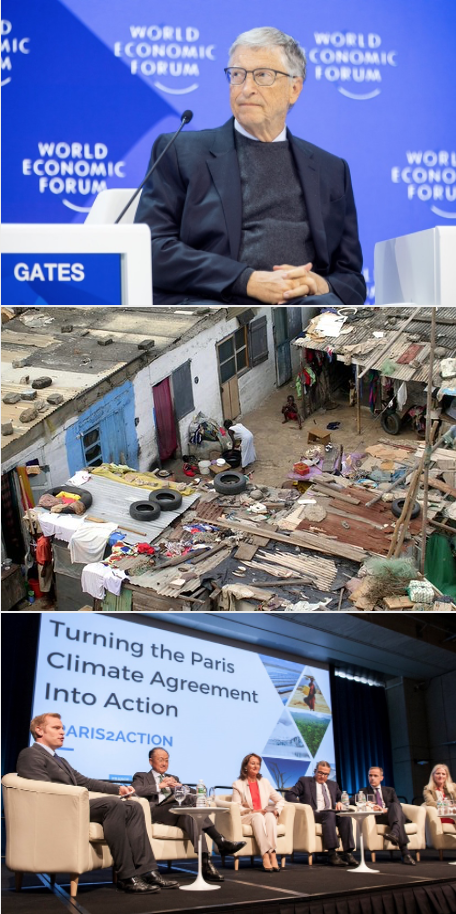
Recovering eco-holic? Bill Gates now says humanity should “focus our limited resources on interventions that will have the greatest impact for the most vulnerable people,” i.e., alleviating poverty and disease. But is Canada listening? At bottom, a 2016 panel commits to turning the Paris Climate Agreement into action, with future Prime Minister Mark Carney (second from right) presiding.
xRecovering eco-holic? Bill Gates now says humanity should “focus our limited resources on interventions that will have the greatest impact for the most vulnerable people,” i.e., alleviating poverty and disease. But is Canada listening? At bottom, a 2016 panel commits to turning the Paris Climate Agreement into action, with future Prime Minister Mark Carney (second from right) presiding. (Sources of photos: (top) World Economic Forum, licensed under CC BY-NC-SA 2.0; (middle) spinning jenny, licensed under CC BY-NC-SA 2.0; (bottom) World Bank Photo Collection, licensed under CC BY-NC-ND 2.0)

Even more dramatically, two weeks ago Bill Gates published a personal essay that, while not challenging global warming forecasts, says the effects won’t be “cataclysmic”. Accordingly, Gates writes, humanity should focus not on preventing disasters that won’t even occur but on alleviating the poverty and disease that are before our eyes right now. “Although climate change will hurt poor people more than anyone else, for the vast majority of them it will not be the only or even the biggest threat to their lives and welfare,” Gates writes. “The biggest problems are poverty and disease, just as they always have been. Understanding this will let us focus our limited resources on interventions that will have the greatest impact for the most vulnerable people.”

Gates’s and Nordhaus’s changes in tune are late-in-the-day conversions, to be sure; the enormous economic damage wrought by three decades of doom-mongering won’t be undone overnight. Still, better late than never.

Despite all of this, however, don’t expect the man who helped launch the Glasgow Financial Alliance for Net Zero at 2021’s giant global climate change conference in that city, and co-chaired the organization until Trudeau’s resignation in January, to soften his stance on his favourite futile climate change measures: carbon taxes. Prime Minister Mark Carney’s just-released budget saddles our already-struggling industries with carbon tax increases of $80-$170/tonne of CO2-equivalent emissions by 2030. Doing so increases Canadian businesses’ competitive disadvantage against our most important trading partner and does nothing to help the environment. It only puts Canada further offside global energy policy trends – and extends our country’s sad decline.

Gwyn Morgan is a retired business leader who has been a director of five global corporations.

Source of main image: Shutterstock.

Love C2C Journal? Here's how you can help us grow.

More for you

The Price of Foolish Pride: What Germany’s Social and Economic Decline Can Teach Canada

Germany was postwar Europe’s most successful nation – until it was seized by an arrogant leftist ideology that led it down a ruinous path. Its government abandoned safe, zero-emission nuclear power for inefficient wind and solar plus natural gas from Vladmir Putin. It threw open its borders to millions of asylum-seekers with barely a thought to the enormous costs or the difficulties of social integration. Today, at the 11th hour, Germany is at last struggling to turn around its decade of economic decline and social disintegration. In this cautionary tale, Gwyn Morgan sees a profound warning for Canada.

What’s Yours is Ours: Why Canada’s Charter Ignores Property Rights and What That Means for Everything You Own

“The whole meaning of life,” famed comedian George Carlin once observed, “is trying to find a place for all your stuff. That’s what your house is, it’s a place for your stuff with a cover on it.” If so, then Canadians should be very concerned about their stuff. Unlike nearly every other modern nation, Canada lacks constitutional affirmation of the right to own property and as protection against its unjust seizure. With a recent B.C. Supreme Court ruling putting the very notion of home ownership at risk, Peter Shawn Taylor seeks out legal opinions on Canada’s surprisingly lax attitude towards property rights, how it differs from other countries and what that means for everyone’s possessions. If Canadians really want to protect their homes, belongings and personal finances, Taylor concludes, now’s the time to get loud.

The Righteous Response: What Canada Can Learn from America’s Fight Against Antisemitism

Canadians frequently criticize U.S. President Donald Trump’s projection of American power. But in the fight against anti-Semitism, Canada could learn a thing or two from our neighbour to the south. In Part One of this series, Lynne Cohen revealed how Canada’s political and civic leaders have chosen to ignore or even abet the hate crimes and abuse Jews have suffered since October 7, 2023. In this second installment, she shows how the U.S. – from the President on down to local officials and law enforcement – has fought back. Where Canada has been cowering and cowardly, the U.S. has resolved to fight anti-Semitism, protect its Jewish citizens and defend Israel’s right to live freely as a Jewish state.

More from this author

The Price of Foolish Pride: What Germany’s Social and Economic Decline Can Teach Canada

Germany was postwar Europe’s most successful nation – until it was seized by an arrogant leftist ideology that led it down a ruinous path. Its government abandoned safe, zero-emission nuclear power for inefficient wind and solar plus natural gas from Vladmir Putin. It threw open its borders to millions of asylum-seekers with barely a thought to the enormous costs or the difficulties of social integration. Today, at the 11th hour, Germany is at last struggling to turn around its decade of economic decline and social disintegration. In this cautionary tale, Gwyn Morgan sees a profound warning for Canada.

Socialist Shakedown: It’s Finally Time to End Supply Management in Agriculture

U.S. President Donald Trump’s trade policy may be chaotic and punitive, but he’s right about one thing: Canada’s agricultural supply management system has to go. Not because it’s unfair to America, though it is, but because it punishes Canadians. The price-fixing scheme limits consumer choice, requires a huge bureaucracy and prevents farmers from producing more in the face of shortages, forcing them instead to dump excess production. Worst of all, writes Gwyn Morgan, it drives up prices for milk, cheese, chicken, eggs and other essential foods — all for the benefit of a few thousand farmers, largely in Quebec. For Canada’s trade negotiators, argues Morgan, ending this mad racket should be job one.

What if October 7 Had Happened Not in Israel but in Canada?

It is probably beyond the imagination of most Canadians that they would ever face the kind of evil atrocity Israelis suffered on October 7, 2023. Or that we would find ourselves living next door to savage terrorists bent on our annihilation. But as Gwyn Morgan points out, it is critical to understand that reality as Israel’s struggle for existence carries on. The history of Israel is nothing short of miraculous. As Morgan personally observed on a tour of the world’s only Jewish state, Israelis have with determination and heart built a free, tolerant, prosperous and technologically-advanced democracy while surrounded by enemies. In the face of ruthless attacks by Hamas and the craven behaviour of supposed friends and allies who now lean in favour of the terrorists, Israel has reminded the rest of the world what real courage is.