Two weeks ago Carlos Portugal Gouvea, a visiting professor at Harvard Law School, was arrested by U.S. Immigration and Customs Enforcement (ICE) officers. The event went unnoticed in Canada and left barely a ripple in U.S. media. But two months prior Gouvea, a noted Brazilian gun-control activist and head of the University of São Paulo’s “diversity and inclusion committee”, had been observed wielding what looked like a rifle close by Temple Beth Zion, a synagogue in the Boston suburb of Brookline, during Yom Kippur, the holiest day in the Jewish calendar.
After fleeing security guards, Gouvea was arrested with what turned out to be a pellet gun. He told local police he had been out “hunting rats”; one of his shots had shattered a car window. Within days, Gouvea was charged with four offences, his visa was revoked and a U.S. Department of Homeland Security official denounced “brazen, violent acts of anti-Semitism like this.” In November Gouvea struck a plea deal over his illegal use of the air rifle. Early this month he was re-arrested by ICE and, to avoid the humiliation of deportation, agreed to leave the U.S. “voluntarily”.

This obscure event offers a window into the accelerating U.S. campaign to confront and roll back anti-Semitism – and the contrast to Canada. By coincidence, also two weeks ago Mohammed Hashim, CEO of the taxpayer-funded Canadian Race Relations Foundation, told the Standing Senate Committee on Human Rights that any current promises to keep Canada’s Jewish population safe are based on “hope”. As first recounted by Blacklock’s Reporter, Hashim did denounce Canada’s escalating anti-Semitism. Yet he then framed ensuring that Canada remains “a place of safety” for the nation’s approximately 400,000 Jews as a “difficult aspiration” – rather than, say, as a solemn duty to be carried out at all costs. Canada’s top race-relations official seemed to be telling Canada’s Jews no longer to count on their own government.
Jewish citizens of both countries have increasing reasons for fear. Anti-Semitism, its clouds gathering throughout the Western world for the past 20 or so years, burst forth into an unending storm after the Hamas massacre of more than 1,200 Jews on October 7, 2023. Today, cataloguing all of the anti-Semitic words and deeds racked up in Canada in the last two-plus years would fill books; Statistics Canada confirms that hate crimes against Jews have proliferated. Merely describing the various types almost exceeds the scope of an article such as this one. A few examples illustrate.
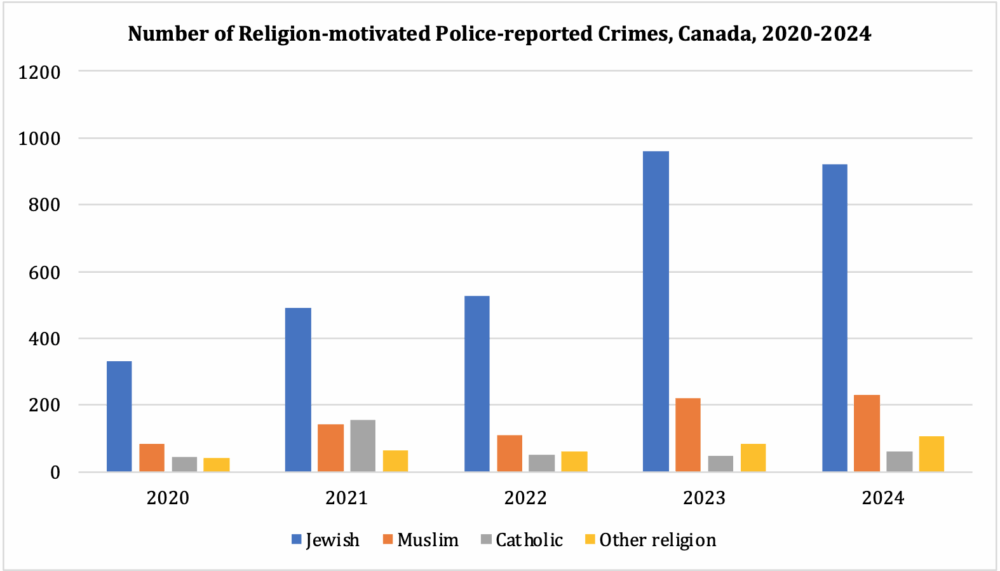
In Toronto, which has become Canada’s main hotbed of anti-Semitism, the Bais Chaya Mushka day school has been shot at – three times. The Kehillat Shaarei Torah Synagogue has been vandalized 10 times. Jews have had their luggage thrown out of Ubers for speaking Hebrew, have been falsely told by federal passport officials that they can’t list locations in Israel as their birthplace, and have had mezuzahs (small boxes containing a scroll with Torah verses) ripped from their front doors. Jewish or “Zionist” medical students and doctors across Canada are singled out for shaming and hatred. Jewish-themed theatre productions are cancelled and pro-Israel films are barred from festivals. Vocal demonstrations for “Free Palestine” – virulently anti-Israel, often including calls for death to Jews – are staged every Sunday in a predominantly Jewish Toronto neighbourhood. “Gas the Jews” and “Kill the Jews” is spray-painted on a Jewish community centre in Victoria.

“Across Canada, this tolerance of public violence and hatred targeting Jews has been normalized,” writes columnist Vivian Bercovici. “Law enforcement? They mostly look away. Or, as occurs frequently in Toronto, Jewish people are told that their presence is ‘provocative’.” In March 2024, reporter David Menzies of Rebel News was arrested while attempting to cover a pro-Hamas protest outside Toronto’s King Edward Hotel. Meanwhile, municipal governments are coming under secret pressure to boycott companies doing business with Israel. In Montreal, for centuries Canada’s centre of Jewish culture and life, pro-Hamas protesters recently showed up at federal Industry Minister Melanie Joly’s home, calling her a “war criminal” and threatening “consequences” for not being tough enough on Israel.
While Canada has a worrying enough track record, Jew-hatred has grown even more intense in the U.S. According to the Anti-Defamation League, just one year after October 7, there had been over 10,000 anti-Semitic incidents, the highest number ever recorded. No Jew has yet been murdered in Canada merely for being Jewish. But in addition to innumerable “minor” acts of anti-Jewish violence and threats – such as physically barring Jews from the campuses where they study or work – Jews in the U.S. had fallen victim to several mass murders before October 7, 2023 plus at least three serious physical attacks since. In May, Israeli embassy employees Yaron Lischinsky and Sarah Lynn Milgrim were shot and killed outside a Jewish museum in Washington, D.C., by a man who shouted “Free, free Palestine” as he was arrested.
But while the U.S. is farther down the dark road of anti-Jewish violence, it is also much farther along in countering it. “Contrast” doesn’t describe the difference between the two countries; it is more like a yawning chasm. Through unambiguously worded Executive Orders that drive the entire federal apparatus, appointments of like-minded Cabinet officials, constant public statements in support of Jews and powerful acts such as the bombing of Iran’s nuclear weapons sites, U.S. President Donald Trump is signalling that Jews should still feel safe in America – but that anti-Semites should not. Federal prosecutors, for example, are seeking the death penalty for the murder of Lischinsky and Milgrim. While anti-Semitism is deeply nested in many U.S. campuses and in cities and states run by Democrats, there are growing efforts across multiple states, cities, voluntary organizations and even some universities to counter it.
Canada can boast few analogous efforts. Where in the one country there is determination, energy, imagination, relentlessness, a steely willingness to meet violence and terror with force – and growing success – in the other there is passivity, defeatism, pandering, refusal to name much less confront the source of the problem – and ever-more worrying incidents. Canada is failing its Jewish population. Worse, Canada seems to be choosing to do so.
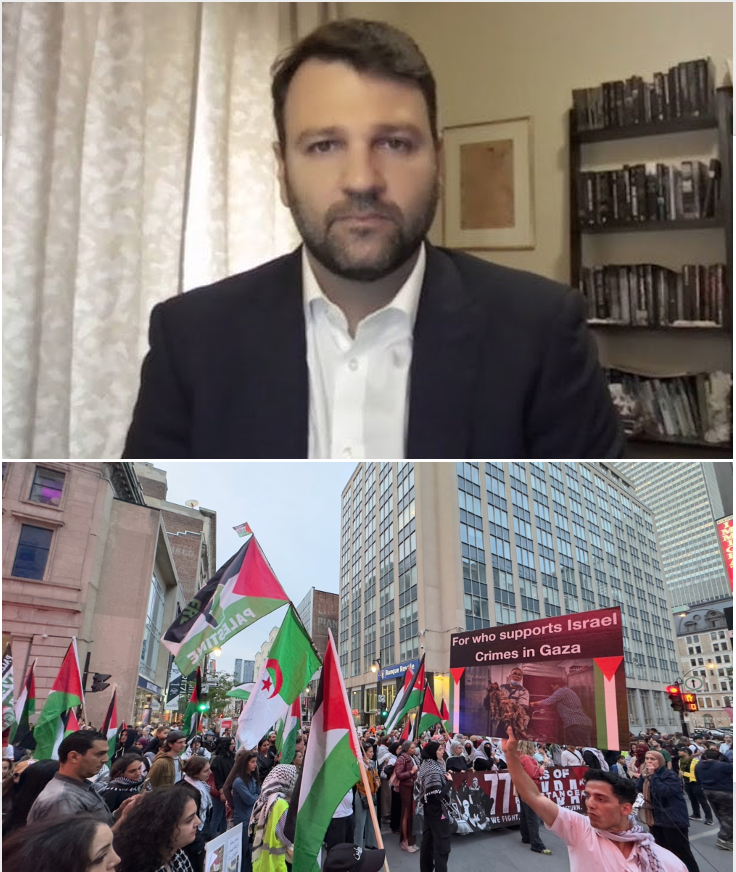
“Jews in both Canada and the United States want reassurance from their governments that they care about them and will protect them, like they will any other citizens,” says Rabbi Chaim Mendelsohn, spiritual leader of Chabad of Centrepointe, an Ottawa synagogue and cultural centre, in an interview. Noah Shack, president of the Centre for Israel and Jewish Affairs, agrees. “It is a failure of public policy to have a law that bans a $10 donation to Hamas but permits organizing a pro-Hamas rally for 10,000 people,” Shack wrote recently. From the highest levels – the president or prime minister and their cabinets – to state or provincial authorities, to municipal administrations, local police and school officials, authorities owe it to Jewish residents to defend them and keep them safe.
Yet today, Canadian Jews are being told that feeling safe in their own country is just a “hope”.
The Carney Government Revives “Triangulation”
Canada’s anti-Semitic rot is broad and deep, mitigated by only a few bright spots. And if the rot doesn’t exactly start at the top, it has certainly spread there. “Jews are no longer safe in our country,” said Leo Housakos, Conservative Leader in the Senate, in a speech earlier this year. “It’s not that they feel unsafe; they are unsafe, and we, as politicians, are in no small part to blame. Antisemitism and Jew-hatred are now expressed openly, shamelessly and without restraint in Canada.”
South of the border, the U.S. President has sided decisively with Israel, bombed Iran, is proud to have close Jewish relatives who are also key advisers and has “earned” a US$40 million bounty on his head from Iranian terrorist groups. Prime Minister Mark Carney, by contrast, has offered conditional recognition for a Palestinian state – on the eve of Rosh Hashanah, the Jewish New Year, no less – contributed nothing whatsoever to freeing the remaining Hamas hostages and refused to reverse his predecessor’s acquiescence to an illegitimate international arrest warrant targeting Israel’s democratically elected prime minister. Hamas, an organization dedicated to Israel’s erasure, whose members gleefully rape and torture Jews, then boast about it – has twice praised the Carney government.
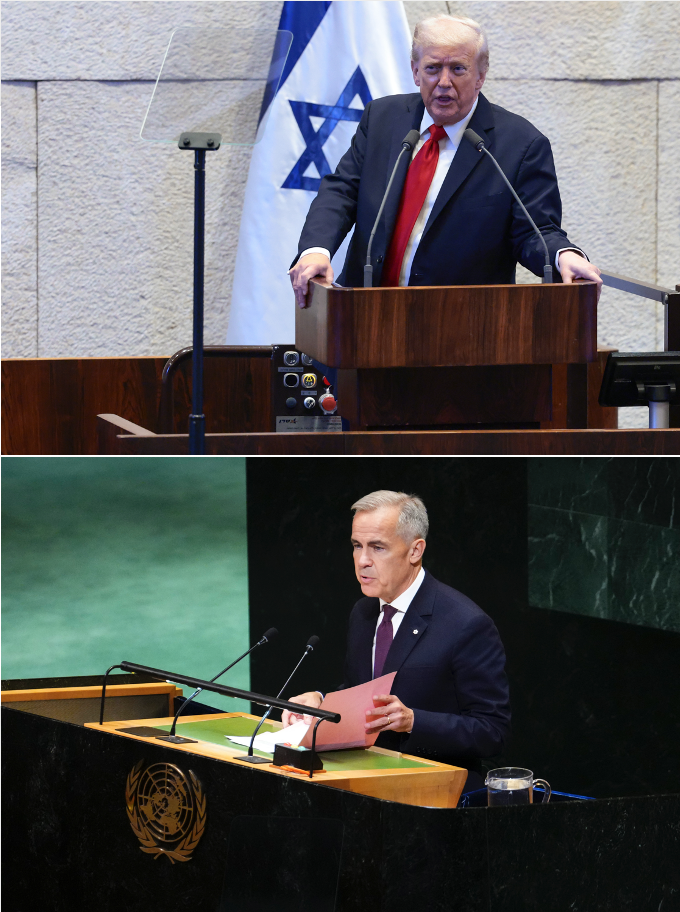
In approaching the issue Carney’s Liberal government appears to have revived a version of “triangulation”, a political tactic made famous by U.S. President Bill Clinton in the 1990s. One variant of triangulation consists of crafting essentially empty messages aimed at holding onto a traditional voting bloc or coalition member, while implementing conflicting and often more substantive policies aimed at gaining the support of an opposing and often larger voting bloc that either supports or might otherwise shift to an opposing party. Saying what one group wants to hear, while doing what an opposing group wants to see done.
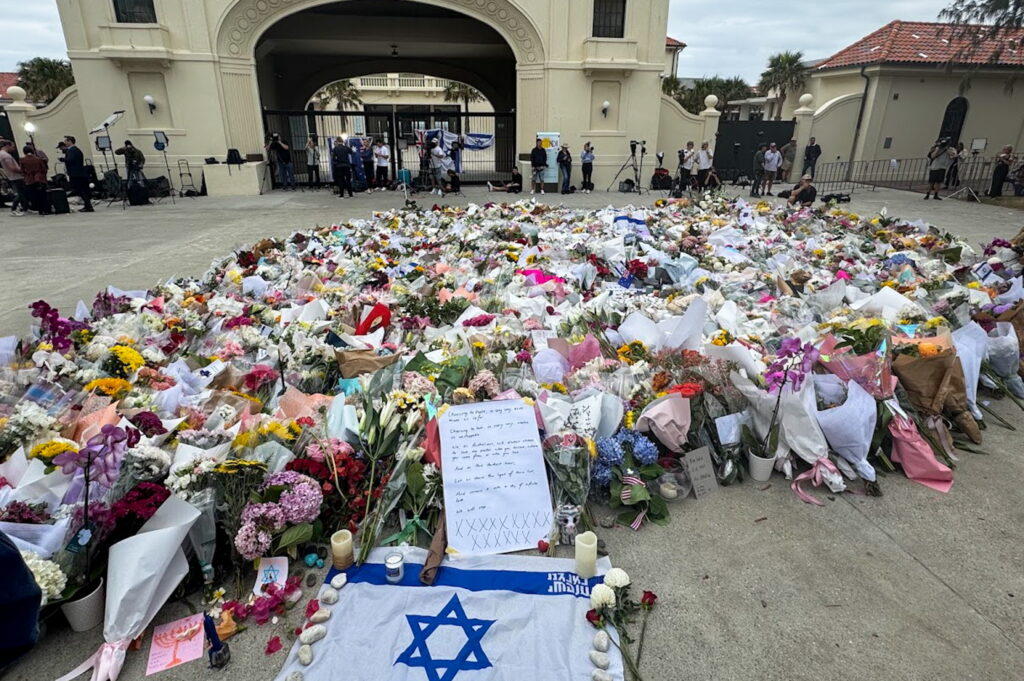
The Liberal government’s actions under both Justin Trudeau and Carney reek of triangulation. Rhetorically, the Liberal government has repeatedly professed to be pro-Jewish and determined to counter anti-Semitism. Foreign Affairs Minister Anita Anand dutifully denounced the recent murder of the Israeli embassy staffers as “appalling and horrifying.” After last weekend’s horrific massacre of Jews celebrating Hannukah at Bondi Beach in Sydney, Australia, Carney promised, “The government will always stand with you…Canada is not Canada unless all members of the Jewish community can participate fully in Canadian life.”
Promising words but, when it counts, the Liberal government often dissembles, fails to act or adopts half-measures that also appear oddly like triangulation. The case of Samidoun (aka the Palestinian Prisoner Solidarity Network) is instructive. Well before October 7, 2023 this organization, an accredited Canadian non-profit, was glorifying terror and openly supporting the Popular Front for the Liberation of Palestine (PFLP) which, like Hamas, is dedicated to the elimination of Israel. After October 7, Samidoun members attended protests and threatened Jews, burned the Canadian flag and chanted “Death to Canada”. Stunningly, the Trudeau government continued to rebuff calls to designate Samidoun a terrorist organization, finally relenting under U.S. pressure late last year.

The terrorist designation makes it illegal to support or donate funds to the organization and subjects its members to investigation, potential charges and/or deportation. Samidoun’s key Canadian officials – the U.S.-born Charlotte Kates who is Samidoun’s “International Coordinator”, and her husband, Khaled Barakat, Samidoun’s “Network Coordinator” as well as an actual member of the PFLP – were previously deported from Europe and have been barred re-entry to the EU. Yet both continue to reside unmolested in Canada, despite Kates’ continued anti-Israel rhetoric after Samidoun’s terrorist designation. Earlier this year, in an apparently since-deleted Instagram post, Kates reportedly praised the murderer of the two young Israeli embassy employees, implicitly praised the act itself – and even appeared to imply that further such acts should take place.
Meanwhile, relations between Israel and Canada have fallen (or been pushed off) the rails. The Liberal government’s official Canadian policy on key issues in the Israeli-Palestinian conflict reads on its face like a blandly uncontroversial affirmation of Israel’s right to exist. But it is full of coded language signalling a distinct tilt towards the other side. For example, it uses the term “occupied territories” to describe lands that in one case – the Golan Heights – have been annexed by Israel with full U.S. support, and in another – the Gaza Strip – Israel willingly vacated 20 years ago. This piece of land has served as Hamas’s base to terrorize Israel ever since.
The document incessantly asserts the need for a Palestinian state but omits mention that Palestinian leaders have rejected at least five offers of land for peace since 1948, including the most recent offer in 2019. Israelis, by contrast, have experienced up close and personal the folly of Western countries’ two-state fixation. “What is ignored is how this two-country goal has been badly undermined by the Palestinians themselves,” says Rabbi Reuven Tradburks, the Ottawa-born Israeli Director of the Rabbinical Council of America. Now living in Jerusalem, he agreed to be interviewed by C2C. “[Gaza] was supposed to be the first attempt at an independent Palestinian entity. And look what it became. Controlled by terrorists and saturated with terrorism. Why would we think a Palestinian state of any kind could not turn out similarly?”
While Canada’s policy does condemn terrorism, the Liberal government continues to place inordinate faith in the United Nations, which has a long track record of anti-Israel resolutions, and in key UN agencies, some of which tacitly or even openly support terrorist groups. One of these is the United Nations Relief and Works Agency (UNRWA), set up to fund and deliver education, health care and other social services to Palestinians. The U.S. stopped funding UNRWA after it was revealed that the agency is not only deeply corrupt, crime-ridden and anti-Semitic, but had actual Hamas terrorists on its staff, some of whom took part in the October 7 massacre. After the news broke, Canada and the U.S. interrupted funding of UNRWA; Canada, though, then resumed funding. Also at the UN, Trudeau had Canada support a resolution sponsored by North Korea that singled out Israel for condemnation.

Outside the UN’s halls, a similar bias is increasingly evident in Canada’s foreign policy conduct. A joint statement in May from the leaders of the UK, France and Canada, for example, called weakly upon Hamas to release the remaining living hostages and bodies of deceased hostages – while demanding that Israel halt all military operations to free them. It also repeated, like a mantra, that peace in the region can only come through a “two-state solution” – even though Hamas remains officially committed to Israel’s destruction and the Palestinian Authority, which governs the West Bank, unofficially so.
The joint statement was praised by Hamas – the second time the terrorist organization had thus singled out the Carney government – prompting Israeli Prime Minister Benjamin Netanyahu to note angrily that, when baby-killers praise you, “You are on the wrong side of justice.” “Every citizen of all three countries should be profoundly ashamed,” author and columnist Conrad Black wrote of the joint statement. Such open bias concerning a foreign conflict, Black noted, can be profoundly damaging at home, signalling to domestic audiences which sort of people matter to Canada’s government – and who is on the outs. More triangulation, and more danger to Canada’s Jews.
Beyond showing mere naïveté and bias, however, the Liberal government is teetering close to actually joining the movement to delegitimize Israel. In November 2024 Trudeau unmistakeably implied that Canada would apply any ruling of the International Criminal Court in “carrying out a pair of arrest warrants for Israeli Prime Minister Benjamin Netanyahu, and the country’s former defence minister, Yoav Gallant.” Both have been accused with no legitimate legal basis of war crimes, and the U.S. has pushed back strongly. Yet stunningly, just two months ago Carney affirmed that Canada would arrest either man if he set foot in Canada.
“It can be difficult to listen to our leaders support Canadians whom we feel may have an attachment to terrorism, and who support the Palestinians in Gaza as if they are just as much victims of the October 7 massacre as Jewish victims,” says the abovementioned Rabbi Mendelsohn. “Hamas cannot be forgiven for what they did, nor for taking and holding the hostages. It is quite unbelievable that Carney and his cabinet seem to be supporting this group more than the Israelis.” Delegitimizing Israel, Zionism and its supporters promotes anti-Semitism generally. And when Canada’s government signals it is siding increasingly with one side in a bitter international dispute, it emboldens that side’s supporters inside Canada.

Even rhetorically, the Liberal government seems increasingly ambivalent between protecting Canada’s Jews under threat and pandering to the country’s growing Muslim population. The National Forum on Combatting Antisemitism, formed one year ago, is one such example. Though a seemingly stout move on behalf of Canada’s Jews, the organization’s opening meeting last March was not promising. Rather than focusing intently on anti-Semitism as the organization’s name implied, its associated documents and statements made incessant references to “hate crimes in all its (sic) forms” and similar phrasing.
Attendees to that first meeting were an eclectic mix that included not only the Alliance of Canadians Combating Antisemitism (ALCCA) but also doctors’ organizations, Muslims, police officers and Crown Prosecutor Moiz Karimjee, perhaps best-known for pushing to jail Freedom Convoy co-organizer Tamara Lich for 10 years for mischief. And while several attendees spoke movingly of anti-Semitism and others expressed clear determination to counter it, ALCCA Chair Mark Sandler walked away concluding that the event had devolved into an exercise in “mixed messages”.
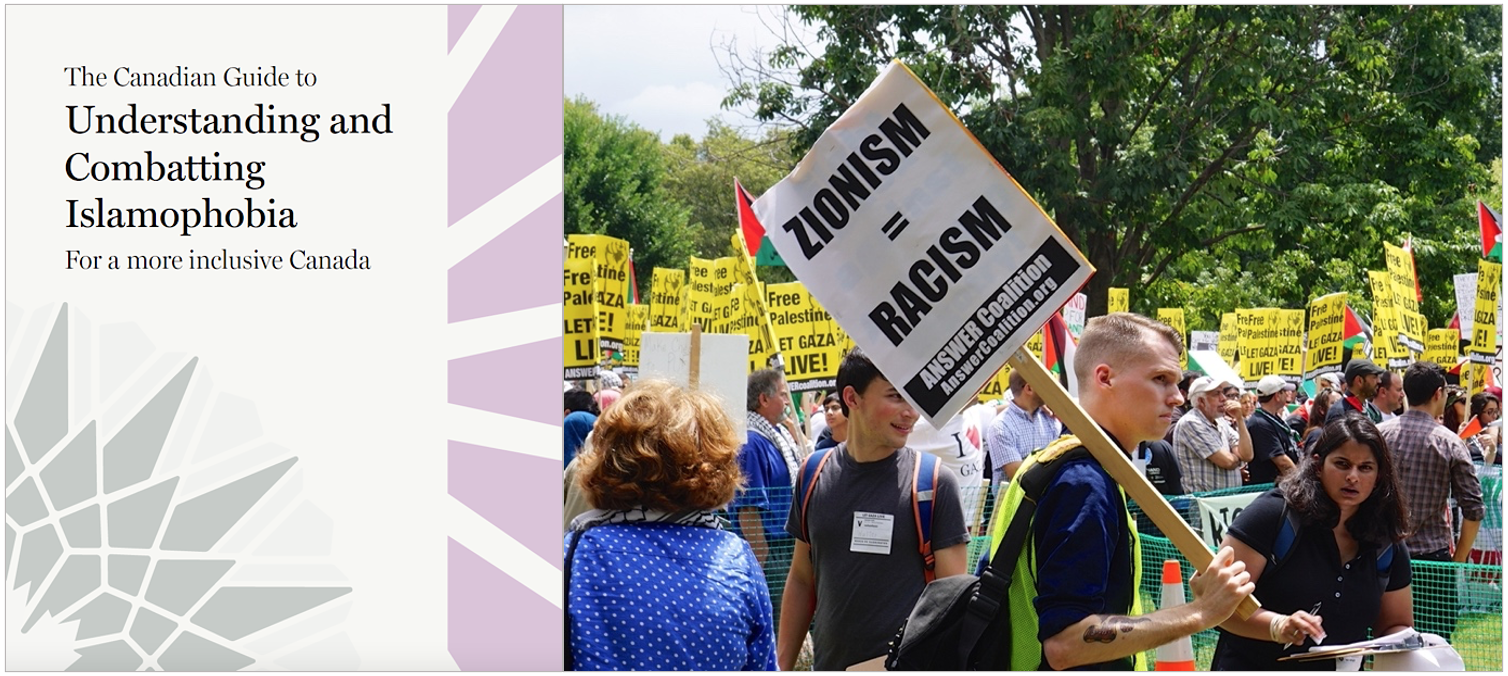
That is because before the March meeting, the Carney government had thrown into the mix a longer and much more pointed document, The Canadian Guide to Understanding and Combatting Islamophobia: For a More Inclusive Canada. It was reportedly created in part by Amira Elghawaby, the federal government’s Special Representative on Combatting Islamophobia, who last year gained notoriety for Tweets blaming Israel for all of the violence in the war with Hamas and for mentioning only Palestinian victims. The fact that neither Trudeau nor Carney fired her is itself instructive.
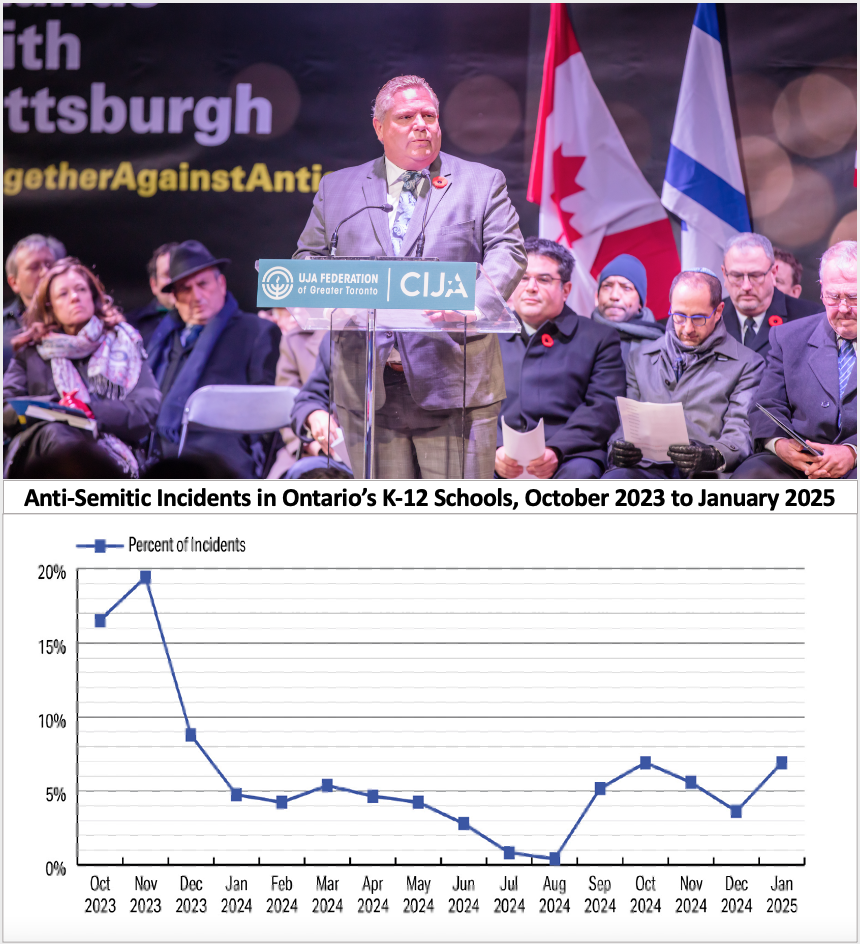
Finally, as the 2024-2025 school year ended, Ontario Education Minister Paul Calandra announced the province was assuming control of four school boards, including the TDSB and the Ottawa-Carleton District School Board. The stated reasons were “financial instability and mismanagement,” but Canadian Jewish News reported that the intervention’s motives include “escalating concerns about antisemitism and student safety.” Calandra has his work cut out for him; the above report found that some of the bigotry came from teachers.
As for other provinces, B.C.’s NDP government is deeply problematic in this area. The province refused, for example, to prosecute Samidoun’s Charlotte Kates despite Vancouver police recommending charges of willful promotion and incitement of hatred. An opposition MLA is now attempting to bring a private prosecution against Kates. Alberta Premier Danielle Smith is unequivocally pro-Jewish, but highly controversial for other reasons and thus not a credible national leader in this area.
But also encouraging to Jewish Canadians should be recent declarations by Ford that law-abiding Canadians ought to be able to defend themselves against criminals who invade their homes, and even stronger recent statements by Smith that her government is directing Alberta police and Crown prosecutors not to charge or prosecute such cases of self-defence. While not directly linked to defending against and deterring acts of Jew-hatred, such policies should bolster the confidence of law-abiding Jewish Canadians.
Recurring Battlegrounds – Canada’s Cities
What probably has an outsized impact on the dynamics of anti-Semitism, at least at street level, are the attitudes of Canada’s mayors and other local leaders. When people see them supporting Jews, they feel inspired to do the same. And vice-versa, of course. Here too, the record is decidedly mixed.
At one end of the spectrum stand mayors like Ottawa’s Mark Sutcliffe, who has distinguished himself. He not only shows up at the traditional lighting of the Menorah at the start of Hanukkah each year, including this week’s lighting, he expressed disappointment when the annual flag-raising ceremony for Israeli Independence Day had to be cancelled for security reasons. And he openly criticized and boycotted last year’s “Capital Pride” parade for its refusal to stand aside the political fray and instead accuse Israel of “genocide”, pledge to join a boycott against Israel and demand that Israel stop fighting to free its hostages. Elsewhere, a number of mayors have declined to raise the Palestinian flag at their city hall, having concluded it has become a symbol of Hamas intimidation and violence against Israel and Jews.
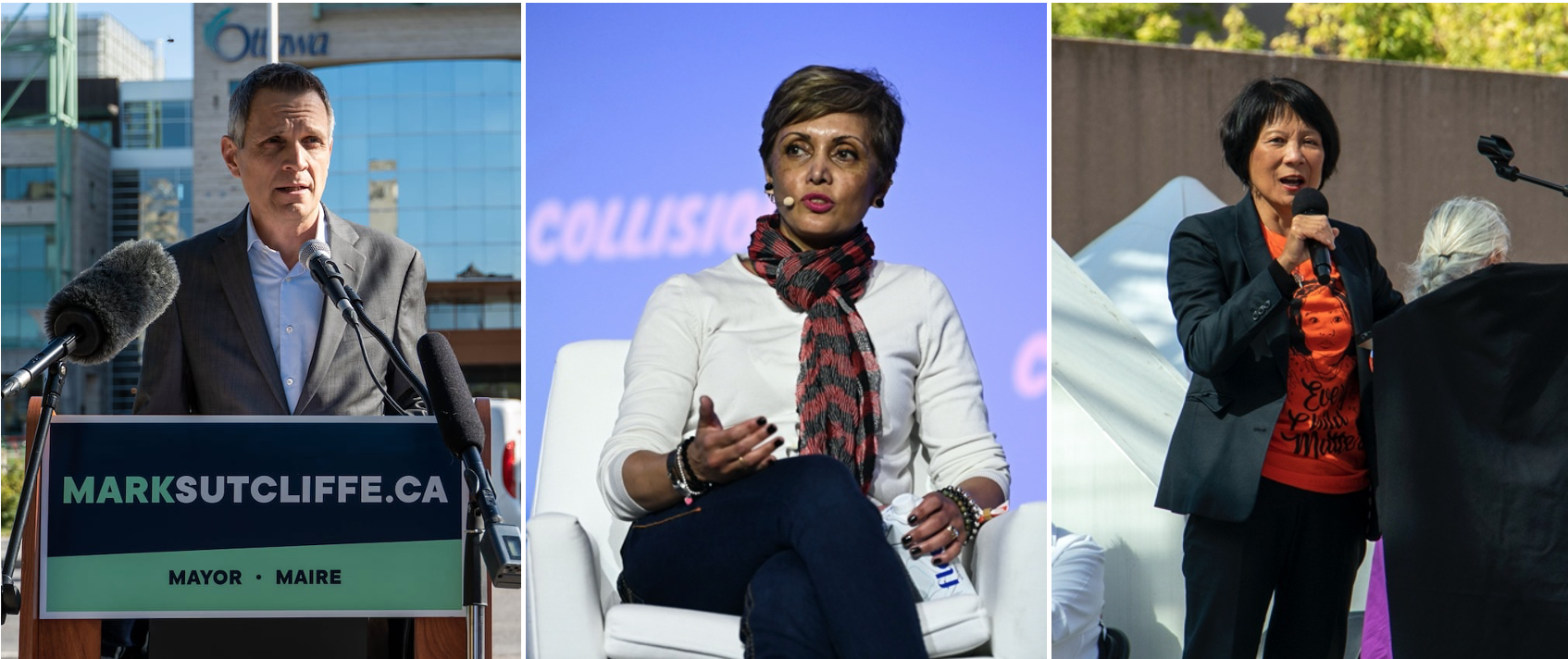
Other mayors, however, have brought shame upon their cities. Calgary’s left-wing Jyoti Gondek spurned the annual Menorah lighting in 2023, the first one following October 7, then ludicrously claimed a scheduling conflict. One can hope this contributed in some small way to Gondek’s crushing defeat in this year’s mayoral election. Gondek’s successor, Jeromy Farkas, attended this week’s Menorah lighting, although his statements there included an entirely off-point denunciation of “Islamophobia”.
Toronto’s even harder-left Olivia Chow has been worse still. She expresses constant support for all things pro-Palestinian – and thus, directly or indirectly, anti-Israel – and last year snubbed a one-year October 7 memorial vigil, then issued a lame non-apology. More recently, Chow referred to “the genocide in Gaza” in her talk at an event hosted by the National Council of Canadian Muslims, prompting Canadian Jewish advocacy groups to ask the Toronto Integrity Commissioner to investigate. As Michael Higgins wrote last week following yet another instance of vandalism against Jewish homes, “It is monumental hypocrisy on Chow’s part to drape herself in the Palestinian flag, kneel to the anti-Israel activists, permit protest and pandemonium on behalf of those committed to an anti-Israel/antisemitic agenda and then innocently wonder where all this Jew hatred comes from.”
Ground Zero – Canada’s Universities
Canada’s institutions of higher learning are not only hotbeds of anti-Semitic activity. Indeed, the warmed-over Marxism that structures the working doctrine that Palestinians or Muslims generally are always the victims in any dispute and Jews always their oppressors comes straight out of our universities. This makes them the ideological ground zero of 21st century anti-Semitism.
Illegal pro-Hamas encampments sprang up on university grounds around the world and across Canada after October 7. They were rife with hatred and calls for violence against Jews. In some cases, masked individuals followed and harassed senior administrators at their homes and offices. The encampment at McGill featured a hanging effigy of Netanyahu clad in a Holocaust-style prisoner’s uniform. Students and their supporters dug in and demanded everything from divestment of Israel to a “one-state solution” (i.e., the destruction of Israel) to outright genocide. Except in Alberta, which moved decisively against the illegal camps, it took most of a year for these usually filthy, always chaotic bivouacs to start coming down.

In the face of this genuine crisis – a challenge not only to campus order but the principles of equality, freedom and peaceful discourse that have animated Western universities since the Middle Ages – administrators failed to uphold their own codes of conduct. Such codes include prohibiting disruption of university activities, intimidating or threatening others, occupying campus property and vandalism. Instead officials looked on indulgently (or perhaps quivered fearfully) as students – and according to some reports, paid activists from off-campus – blocked access to buildings, defaced property with hateful symbols and targeted Jewish students and faculty. Perpetrators faced little or no disciplinary action; in many cases, campus authorities and local police shrugged it off as “protected free speech”, leaving anti-Semitism to grow unchecked.
Quite a number of university faculty proved little better than their students, hardly containing their “drooling hostility to Israel,” as Conrad Black put it. U of T staff voted to pressure the university’s pension plans to divest from Israel and companies doing business with Israel. “When [the faculty association] rams through discriminatory measures with less decorum than a meeting of a chapter of the Ku Klux Klan, and in approximately the same racist spirit, it is not only time to worry, but time to take counter-measures as is happening in the United States,” Black wrote.
Even long after the illegal camps were demolished or abandoned, anti-Semitism has hardly been stemmed. “Anti-Jewish hate continues to flourish in Canada thanks to lax enforcement of hate speech and anti-discrimination laws – and a lack of political will to stand up for Canada’s Jewish community,” writes Ontario-based immigration lawyer Sergio Karas. As in the U.S., Karas notes, “Many of the ringleaders of antisemitic ‘pro-Palestine’ protests and campus disruptions in Canada are foreign students.”
Some Jew-hating students appear willing to go beyond even the nastiest of those “protests.” In September 2024, Canadian authorities arrested Muhammad Shahzeb Khan, a Pakistani studying in Canada, for planning to “slaughter as many Jews as possible” at a Brooklyn Jewish centre. In other cases, similarly radical youths were allowed to study in Canada for years, only being arrested at the last minute in the U.S. Who knows when another such aspiring terrorist might make it through? While Canada’s bureaucracy has provisions to register, monitor and if necessary deport foreign students who overstay or violate laws, it is an unwieldy and unreliable mechanism. “Canadian authorities have long recognized the need to strengthen security screening in the international student program, yet they have failed to do so,” Karas notes.

It is clear that dozens if not hundreds and perhaps thousands of foreign students in Canada have taken part in pro-Hamas protests. The University of Toronto’s encampments included many international students. “Assistant Professor Chandni Desai confirmed their involvement,” Karas wrote. “University Affairs also mentioned that many international students, especially those with personal or familial ties to the Middle East, participated in the protests.”
The Human Effects on Canada’s Jews
For Jewish Canadians, such passivity and indifference in the face of sustained hatred and aggression have real consequences. My daughter, her husband and three children, who live in Vaughan, Ontario, had a very rough time, experiencing tremendous fear after October 7, 2023. As the months passed and Canadian governments – including the City of Toronto – did virtually nothing to quell that fear, she and her husband instituted profound changes.
“My husband and I are much more careful about where we let our children go alone in the city,” she says. Previously the kids rode public buses and subways together to many places without their parents worrying. Now, the boys can only bus together to their yeshiva and her little girl can only take the school bus to her cheder. “I am much more alert and aware of what is around us when we are out,” my daughter says. After instituting these changes, and strengthening their home’s security measures, she explains that, two years after October 7, “I wouldn’t say I’m fearful anymore. Rather, I have an undercurrent of anxiety which rises or falls, depending on my surroundings.”

It is the bigger picture that now worries her far more. “Canada is changing so much that the Jewish Zionist identity will soon not be welcome here,” she says. “We will increasingly become social pariahs.” She blames the Liberal government which, she says, had taken a worrying and sinister turn in its response to the 2022 Freedom Convoy protests. “Since October 7th, I feel my government is in complete opposition to me, my family and my community,” she says. That has not changed under Carney.
Accordingly, much of the family talk currently revolves around whether even to remain in Canada. My daughter’s middle child would like to study art after high school. “His art teacher’s guidance included advice on which Toronto schools are the least anti-Semitic,” she relates. “I told him he can be a proud Jew and study where he wants and not let haters dictate his life choices. But then he told me, ‘Sure, but I don’t want to spend all my time with unpleasant people. I would like to be nice to everyone and I want to be around nice people.’” In response, my daughter concluded, “He might as well go to Israel to study.” He answered: “I would live in Israel, but it’s a shame. I love Canada, it’s such a great place.” My daughter was heartbroken. This is some of the human toll of anti-Semitism.
Concerned Jews everywhere are naturally turning to their spiritual leaders to get through. Rabbi Zischa Shaps of Congregation Beit Tikvah of Ottawa, a small west-end Orthodox synagogue, explains in an interview that he reminds his congregants who come to him in fear that “Jew-hatred is not new. It has been with us since Eisav hated Yaakov. For the most part, those of us who grew up in North America in the last 50 years have been spared, but, as everyone can see, it has recently risen its ugly head here in Canada and the United States.” What can they do to improve their frantic circumstances? “Follow G-d’s commandments,” he invariably counsels. “When non-Jews see you following your religion, they often respect you.” Not at Bondi Beach, of course.
The critical lessons from Cohn and the vastly larger number of innocents who did not survive are that distant events can come to one’s own shores and that repeated threats of violence eventually become actual violence. Canada, sadly and sickeningly, may not be exempt. Columnist Terry Newman recently pointed out that the wave of terrorist bombings and murders that gripped Quebec in the 1960s started off similarly. “Today, anti-Israel groups are emulating many of the tactics used by the FLQ, and the relationship between Quebec activists and the Palestinian Liberation Organization’s goals seems like it’s been revived,” she writes. “Will people have to die before Canadian governments, police forces and the general public start taking the threat posed by these protesters seriously?”
Newman’s hopefully rhetorical question crystallizes an essential point: where anti-Semitism stands now in Canada is due to a series of choices, choices by the many individuals who have succumbed to anti-Semitism and now spew its evil thoughts, and choices by the many people in leadership positions who have done little or nothing about it. It didn’t have to be this way. And now, how much farther Canada travels down the dark road of Jew-hatred will depend on additional choices. Anti-Semitism can still be confronted, halted and rolled back – if enough Canadians muster the will to do so.
First and foremost, the Carney government must stop the continuous political signalling that Palestinians and Muslims are almost always the victims, that Israel is borderline illegitimate, that Jews are at fault in nearly any dispute, and that hostility and aggression against Jews are somehow understandable responses to Muslim grievances. And then substantively, the nation’s political leaders at all levels must consider the numerous steps being taken in the U.S. right now to counter anti-Semitism, many of which could be readily copied and pasted into Canada virtually without modification. The measures range across legislation, education, organization, leadership, financing, peaceful protests, media campaigns and enforcement/punishment.
The inspiring and instructive U.S. campaign to combat Jew-hatred will be the focus of Part II, coming in early January.
Lynne Cohen is a non-practising lawyer and journalist. She has written six books, four of them published, including the ghost-written Holocaust memoir The Life of Moshele Der Zinger: How My Singing Saved My Life.
Source of main image: Yan Parisien/Shutterstock.