Cosmology

One Free Miracle: Towards a Theory of Everything

David Solway
January 4, 2026
A new year has dawned and, as the light strengthens across the Northern Hemisphere, David Solway reminds us that how we choose to experience our world is at least as important as understanding how it came to be. In the first instalment of this two-part series, the writer illuminated the irreducible paradox at the heart of all theories concerning the universe’s creation, then scrutinized the seemingly unbridgeable gap between quantum physics and the physical world we live in. In Part II he considers an even tougher and, so far, unsolved scientific challenge: gravity. Some of the finest minds in science think it actually is insoluble without some kind of creative intelligence to oversee it. In other words, a miracle. To Solway, the true miracle is the fact of a marvellous world and our freedom to experience and wonder at it.
Cosmology

One Free Miracle: Towards a Theory of Everything

David Solway
January 4, 2026
A new year has dawned and, as the light strengthens across the Northern Hemisphere, David Solway reminds us that how we choose to experience our world is at least as important as understanding how it came to be. In the first instalment of this two-part series, the writer illuminated the irreducible paradox at the heart of all theories concerning the universe’s creation, then scrutinized the seemingly unbridgeable gap between quantum physics and the physical world we live in. In Part II he considers an even tougher and, so far, unsolved scientific challenge: gravity. Some of the finest minds in science think it actually is insoluble without some kind of creative intelligence to oversee it. In other words, a miracle. To Solway, the true miracle is the fact of a marvellous world and our freedom to experience and wonder at it.
Share on Facebook
Share on Twitter

I strongly believe in the existence of God, based on intuition, observation, logic, and also scientific knowledge.

—Charles Townes, Nobel Prize-winning astrophysicist and inventor of the laser

Perhaps there is a reason for the existence of incongruities. Maybe Tertullian was on to something back in AD 200 when he allegedly uttered those fateful words Credo quia absurdum – I believe because it is absurd. It’s a test. Or maybe one has to infer an element of mischief behind the Creation. I sometimes believe God has a sense of humour. Perhaps the Eyn Sof – God before He manifested Himself – likes to tweak or troll the vaulting and self-congratulatory human tendency to cognitive ascent. But this belongs to another field of inquiry, Kabbalah or Talmud or a chapter in Surely You’re Joking, Mister Feynman! Regrettably, I have no solution, scientific or otherwise, to the central enigmas we are dealing with and explored in Part I. I accept Kierkegaard’s knot.

Thinking back to the Greek island I told of in that instalment, I recall a conversation with a friendly restaurateur whose establishment I would regularly visit. His name is a common variation of Evangelos, deriving from the Greek word euángelos meaning “bringing good news” or “messenger of good news”, from which we also get “angel”. Vangelis was not a particularly prepossessing man, his two major objects of interest being food and profit. One evening after the diners had gone and we sat together idly trading stories, he said, “I have something I’d like to show you.” He led me into the kitchen and extracted a black-bound tome from the till. The book was a Greek translation of The Dark Night of the Soul by St. John of the Cross. “I not only own a restaurant,” Vangelis confided, “I teach theology on the side.” The revelation was totally unanticipated. Here in a shabby little restaurant on the outskirts of town, another pneme – a “spiritual particle” as I have named phenomena like this one – had manifested itself. I sometimes believe certain experiences that happen by serendipity are somehow intended.

A cause for incongruities? With life full of serendipitous experiences and a world of scientifically implausible possibilities, the author ponders what makes the universe’s two contrasting and seemingly unbridgeable orders of reality – quantum and observable – coexist and function in harmony.
xA cause for incongruities? With life full of serendipitous experiences and a world of scientifically implausible possibilities, the author ponders what makes the universe’s two contrasting and seemingly unbridgeable orders of reality – quantum and observable – coexist and function in harmony. (Source of photos: Unsplash)

Later that evening I found myself thinking of the unexpected, of small everyday omens and anecdotal vectors reminding us that we live in an unlikely world. It felt like quantum or spirit was everywhere, which it was. It made me suspect that the most profound framework underlying and embracing quantum phenomena, or discontinuities, is caused by a God who really does play dice (as Einstein denied), who enjoys bringing odd things spontaneously together. Maybe the Supreme Being is like a hyper-strong gravitational field that can cause deviations in, say, the inverse square law of gravity, a grand designer who generates asymmetries like two people who have little in common sharing an unanticipated moment, or two orders of reality – quantum physics and the observable world around us – that do not correspond, are not readily explicable and are so different they should not even be able to co-exist (as I explored in Part I).

Now, I simply want to postulate a number of implausible possibilities to explain such a world: a Creative Intelligence (a) who exists beyond time and space behind the problematic Big Bang, which is rationally impossible; (b) who exists within time and space that provides us with no absolute point of origin for the act of Creation, which is chronologically anomalous; and (c) who reconciles incompatibles according to a quarrelsome bundle of laws somehow terminating in unity, which is logically futile. In each of these cases, it is as if we are beholding a Menger Cube whose volume approaches zero while its surface area increases without limit.

In addressing the “central enigmas” of existence, poet, songwriter and author David Solway outlines three conceptual possibilities for a Creative Intelligence, all of which present difficulties. The first is that it exists beyond time and space, effectively behind the Big Bang, which he finds “rationally impossible”. The second is that it exists within time and space, which offers no absolute point of origin for the universe and thus is “chronologically anomalous”. The third is that it reconciles and unifies the seemingly incompatible laws of the universe – quantum physics, classical physics and gravity – a task Solway finds “logically futile”.

A Problem of Gravity

The unruly fourth force: Isaac Newton (top left) defined gravity in terms of absolute values for space and time, while Albert Einstein’s (top right) theory of general relativity describes the phenomenon as the curvature of spacetime. Even after Einstein’s great leap, however, scientists continue to be confounded in trying to “quantize” gravity and thus bring it under a Theory of Everything.
xThe unruly fourth force: Isaac Newton (top left) defined gravity in terms of absolute values for space and time, while Albert Einstein’s (top right) theory of general relativity describes the phenomenon as the curvature of spacetime. Even after Einstein’s great leap, however, scientists continue to be confounded in trying to “quantize” gravity and thus bring it under a Theory of Everything.

Admittedly, I am leaving gravity out of my discussion. (If I were writing a political dissertation, gravity would be the conservative who went left.) The Grand Unified Theory, first proposed by Howard Georgi and Sheldon Glashow, in its several variants focuses on the three fundamental physical forces described by the standard model of particle physics: the strong atomic force, the weak atomic force and electromagnetism. Should the fourth force, gravity, one fine day be reunified, we would have the Theory of Everything, which Stephen Hawking famously worked on. But this is an enormously distant goal – if ever reachable.

Gravity is a major problem in fundamental physics: how to quantize gravity and thereby bring all the forces of nature under one theoretical umbrella. To quantize gravity means to come up with an equation that unifies quantum physics with Einstein’s theory of general relativity, which describes gravity not only as a Newtonian force but in macro-regions as the curvature of spacetime (it was Einstein, remember, who demonstrated that time was a dimension, unifying it with space). As cosmologist Paul M. Sutter of Johns Hopkins University explains, for quantum mechanics, spacetime is just a background; physics happens “on top” of that background. For general relativity, however, spacetime isn’t a proscenium for the actors; it is the actor, having been created, as noted, at or by the Big Bang.

Richard Panek in The Trouble With Gravity: Solving the Mystery Beneath Our Feet depicts gravity rather creepily as the “greatest ghost in the machine.” It is evident in “the elisions of religion” and in “the subtlest recesses of our civilizations and psyche.” But Panek confesses he doesn’t know what gravity is or what component of the universe causes it. It has wafted here without a known address; indeed, many are convinced it is an interloper from another universe.

One can see the difficulty. Indeed, the graviton or gravitational “particle”, a massless vibration of a closed string as string theory prescribes, is an unruly character. Obviously, to seek a quantum theory of gravity, we really need to seek a quantum theory of spacetime to accommodate general relativity. Not so easy. In any scenario, gravitational fields would have to be quantized before unifying progress could be attained, but candidate theories are experimentally inaccessible and mathematically elusive.

Even if gravity were to yield to the physicists’ reckoning, it is evident that a Theory of Everything will not acquire a final mathematical form until the reciprocity of the two incompatible sets of laws governing the working of the universe on both the local and non-local, the deterministic (physical or Newtonian) and the probabilistic (quantum) levels, is ultimately arrived at. It does look like the ETA may be “Never”. They do not go together.

For this fusion to happen, one might have to posit a divine will that decides to bridge the gap between the two disparate and irreconcilable branches of physics and physicality. They cannot, it seems, be reconciled in any other manner and still continue to function so that both the “sub” and the “super” reality-fields continue to operate despite their intrinsic lack of fit.
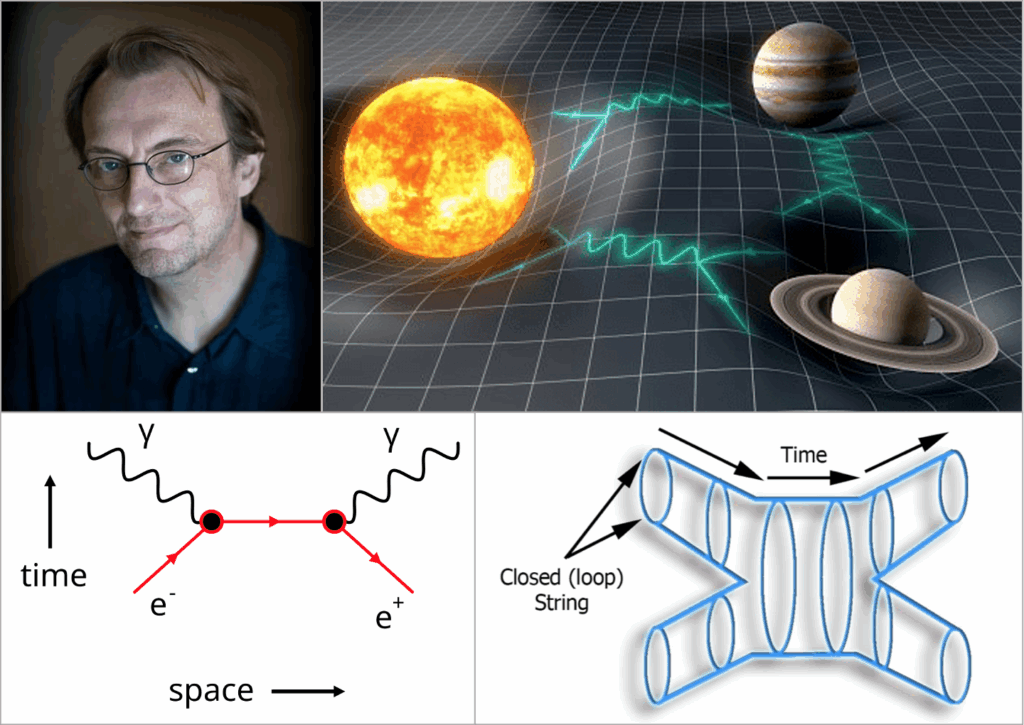
The “greatest ghost in the machine”: Popular science writer Richard Panek admits the difficulty of grasping what gravity even is; among the possibilities, string theory suggests gravity is a massless vibration of a closed string. At bottom, two particles in a point-like interaction in the original Feynman diagram (left) are replaced by interacting closed strings (right).
xThe “greatest ghost in the machine”: Popular science writer Richard Panek admits the difficulty of grasping what gravity even is; among the possibilities, string theory suggests gravity is a massless vibration of a closed string. At bottom, two particles in a point-like interaction in the original Feynman diagram (left) are replaced by interacting closed strings (right). (Source of top right image: Y Gominet IMCCE/Observatoire de Paris/NASA)

We are dealing with the existence of a “double truth” that is anathema to reasoned inquiry, a split that may undermine the philosophical idea that all truth is one. Occam would be unhappy. But the overall truth is that these two primal foundations of reality – quantum and classical – are somehow folded into a single truth in that they have formed a kind of cosmological “society” of separate classes that actually work together under a permanent “constitution”. It would be a truth, however, that is not founded on a law of nature as we understand it but on a consensus of conservation, a workable agreement that blends the best of both worlds. It is almost as if the alignment were political, a coalition government at the cosmic level.

It is even more important to remember that none of these solutions will answer the question of origins, of the existence of time and space at a recessive beginning, or of the absence of a temporal field altogether. This is not a leisurely or abstract speculation. However it came to be, the initial singularity – which common theory holds gave rise to the universe – appears to be there, an infinitely small point of infinite density and temperature where our known laws of physics degrade and cease to be effective.

Quantum mechanics tells us that what we experience as the forces of nature really come in discrete, dense, tiny chunks or quanta, whereas the conditions of the Big Bang are whirligig-like, impenetrable to reason. So some scientists have pursued another track, suggesting that the universe did not begin as is normally understood but as what is called loop quantum gravity, which attempts to unify the laws of quantum physics with gravity under a different set of equations.
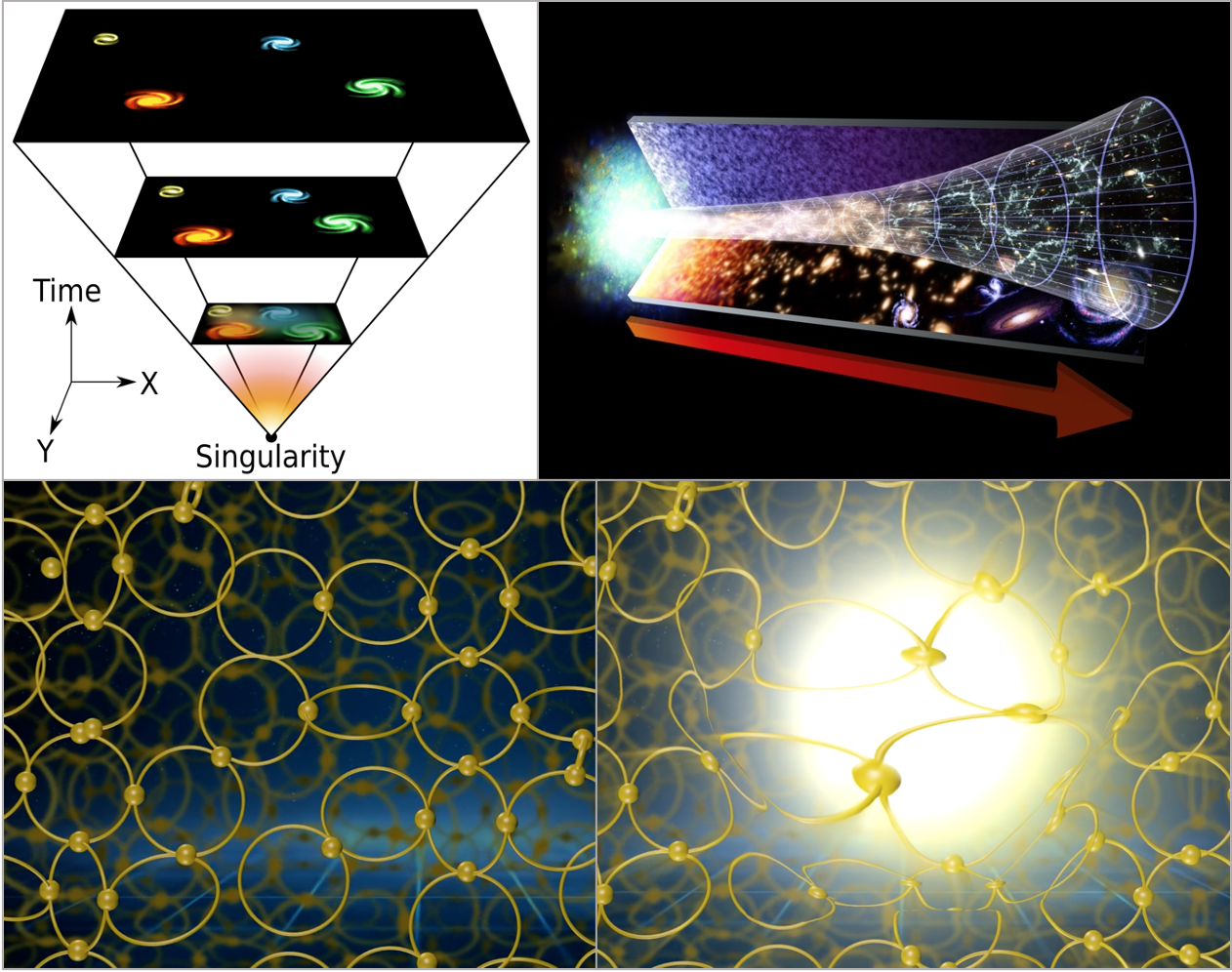
What is space? Under the Big Bang theory, the expansion of the universe began from the initial singularity, an infinitely small point of unlimited density and temperature (top). Loop quantum theory replaces the infinite singularity with closed loops capable of bending and stretching, called quanta of space.
xWhat is space? Under the Big Bang theory, the expansion of the universe began from the initial singularity, an infinitely small point of unlimited density and temperature (top). Loop quantum theory replaces the infinite singularity with closed loops capable of bending and stretching, called quanta of space. (Sources of images: (top left) Fredrik/Waterced, licensed under CC BY-SA 4.0; (top right) NASA; (bottom) YouTube/Arvin Ash)

A spacetime singularity is a location where the quantities that are used to measure the gravitational field become infinite. That is, a point where physical laws are indistinguishable from one another and space and time merge, ceasing to have any independent meaning. Loop theory transforms these infinite curves into closed loops, replacing the infinite singularity of the Big Bang with these pixel-like bits. Plainly, there must be distances between these loops or “chunks”, which might lead to infinities which in themselves cannot be quantized, but perhaps the issue has been mathematically elucidated to some extent. Even so, the problem seems incorrigibly theoretical, shifting up, down and sideways.

Carlo Rovelli is the master in the field, wrestling with a force he cannot yet vanquish. His Covariant Loop Quantum Gravity is the reader-friendly go-to book, and is worth consulting even for the amateur and non-specialist, though the boogeymen still go bump under the bed. Dear Carlo, may the Force be with you. (I confess that although one of my university majors was mathematics, the relevant equations are infinitely beyond my capacity.) Still, the issue grows more involuted if Rovelli is correct, if the quantum gravitational field is the force from which space is woven from its closed-loop threads of three-dimensional rings.

Standard Big Bang theory posits an “initial singularity”, a point of infinite density where physical laws degrade and space and time lose independent meaning. Loop quantum gravity theory challenges this by proposing that the universe did not begin with such a singularity but is instead composed of discrete, tiny chunks or “quanta”. This theory replaces the smooth, infinite curves of the Big Bang model with closed loops (similar to concepts found in string theory), effectively transforming the “whirligig-like” nature of the origin into a structure of pixel-like bits, though it still presents theoretical challenges regarding the distances between these loops.

The Tertium Quid

I have taken another fork in the road. Physicist Paul Davies concludes that the universe is “no mean byproduct of mindless, purposeless forces.” It is something made, it posits intent, it is an artifact, and it has come from the mind of a supreme intelligence in a way no one can specify and of which no one can give any semblance of coordinates. The search for the initial singularity ceases to be purely scientific. The universe did not come to be in time and space and it did not come to be outside of time and space, which is the conclusion we are left with. Where is the tertium quid?

There is no logical or scientific account of the issue – but the universe exists and it got here somehow. Again, we have the knot, but are we brave and humble enough to accept it, to acknowledge at least in theory some power of which we cannot speak intelligibly, neither in science nor religion, neither in genesis nor Genesis, and which is neither in nor out of spacetime? There is always a limit to our probes and inquiries. We can take it to the limit as often as we wish, to paraphrase the Eagles’ great song, but there is no way to leapfrog it into the dragon-brimmed territory beyond.

The real problem is that nothing evidential can be articulated about a primal origin. It is beyond the conceptual scope of the human mind. Aristotle’s ὃ οὐ κινούμενον κινεῖ (“the prime mover which moves without being moved”) would include the properties of a formative intelligence as well, about whom nothing analytic can be said. The element of mystery, however, is so vast and inescapable that it is hard not to suspect something supernatural or spiritually transcendent, something in the vicinity of theistic evolution, something in the order of the Divine.
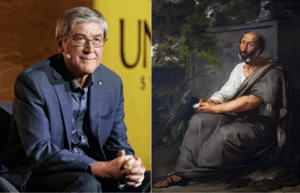
English Physicist Paul Davies (left) cannot accept the universe as just a “byproduct of mindless, purposeless forces” but regards it as something like an artifact intentionally created by the one whom the ancient Greek philosopher Aristotle (depicted at right in an 1811 painting by Francesco Hayez) called “the prime mover which moves without being moved.”
xEnglish Physicist Paul Davies (left) cannot accept the universe as just a “byproduct of mindless, purposeless forces” but regards it as something like an artifact intentionally created by the one whom the ancient Greek philosopher Aristotle (depicted at right in an 1811 painting by Francesco Hayez) called “the prime mover which moves without being moved.” (Source of left photo: UNSW Sydney)

It seems we must accept that there is no way of quantifying the esoteric parameters of the suspension bridge connecting our two shores, the here and the there, the quantum and the classical, existence and origin, the before and the after, time and non-time, the Creation and the Nothing. We don’t have the requisite information. All we can say is that something happened, but how or why is a domain that cannot be plumbed. We can only chart its immediate after-effects and its evolution. In this context, El Shaddai, as James A. Michener salutes Him, or It, in his exceptional novel The Source, has as much to tell us in this regard as the physicists’ bristling equations, which is not much.

Thus, in whatever way we confront these issues, we may have no end-choice but to rely on a celestial consciousness that creates an infinite singularity or a gravitational loop and seals inconsistencies and lacunae by will, as overpriced as this may sound. I’m not sure I’m willing to go for this hypothesis, but I can think of no other option. The source will always remain inscrutable and the quantum disconnect that governs our life may well remain indiscernible, parts of the world that will always trouble the spirit of faith or the mathematics of unity, and which reflects in little the overwhelming partition between Heaven and Earth.

Still, as the rich collaboration between theologian Matthew Fox and biologist Rupert Sheldrake in The Physics of Angels: Exploring the Realm Where Science and Spirit Meet makes amply clear, it is possible to begin healing the separation between reason and faith by admitting both our hybris and our limitations. The gulf is ours to negotiate. Sheldrake observes in a separate work that quantum mechanics can describe in detail the electronic orbitals and the energy states of, say, the hydrogen atom. But this is very different from providing a fundamental explanation of complex molecules and chemical structures necessary for life.
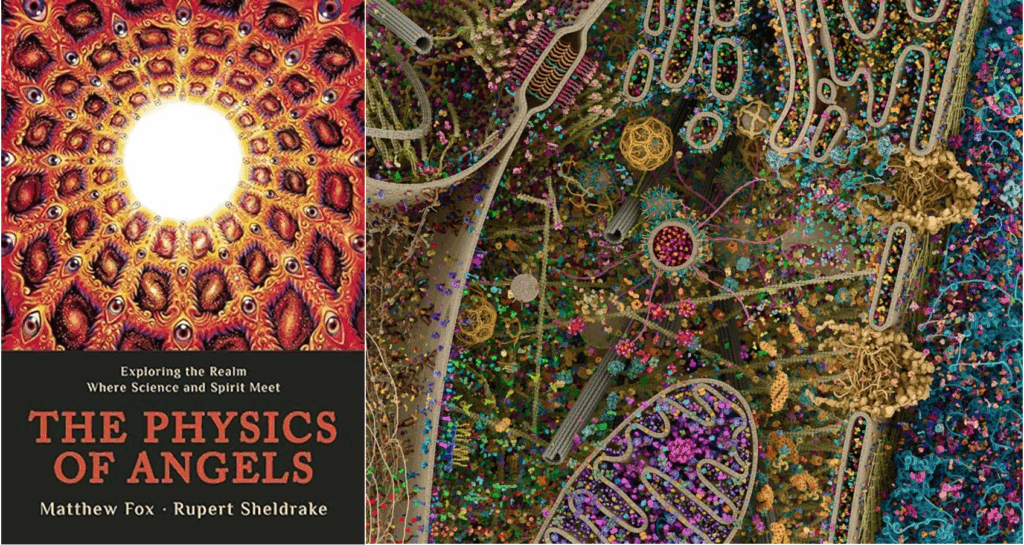
In their collaboration, theologian Matthew Fox and biologist Rupert Sheldrake offer a unifying view on reason and faith, highlighting the common deficiencies each branch of inquiry labours under in seeking to understand life with its immensely complex, highly functional molecules and structures. Depicted at right, the most detailed 3D rendering of an animal cell obtained to date.
xIn their collaboration, theologian Matthew Fox and biologist Rupert Sheldrake offer a unifying view on reason and faith, highlighting the common deficiencies each branch of inquiry labours under in seeking to understand life with its immensely complex, highly functional molecules and structures. Depicted at right, the most detailed 3D rendering of an animal cell obtained to date. (Source of right image: Evan Ingersoll and Gael McGill)

To put it simply, something else is involved, something that transcends material happenstance. The eminent astrophysicist Bernard Haisch remarks, “An integration of scientific and spiritual concepts will of necessity come about eventually.” Amen.

A World of Miracle and Wonder

I can no more fathom these mysteries than I can explain the existence of a complex, marvellous, incredibly vital, infinitely various world I wonder at every single day. It is the greatest of all prodigies, of all unsolved problems, the thing itself, the world we live in, the universe whose very being defies comprehension. It is inconceivably multifarious – far more detailed than even Charles Darwin could have imagined. Its creatures are indescribably heterogeneous and singular. It is both terrifying and teasingly beautiful. It is governed by laws and properties and constants which have created a totally improbable Goldilocks planet whose fine-tuning enables us to survive and even flourish. It is spirit in a twin symmetry. It turns out there is indeed a there here and a here there. The commonplace is thick with pnemes, like manna in the desert. Spiritual particles are everywhere.
Though I am not a scientist, I am enchanted by the various aspects of cosmology. I have only “chauffeur’s knowledge”, a well-known jape about theoretical physicist Max Planck’s chauffeur having impersonated his master during a lecture in Munich. It is obvious to the reader that I have accepted cosmology’s standard model as largely viable though inordinately far from completion. In the same way, I regard the “Kingdom” of the Divine as a mystery that exceeds by orders of magnitude my ability to absorb it. The fundamental question I am addressing not only on the physical but the human level remains.

And this is the question: how is it possible to assimilate this amazing dimension of the universe without being rendered dumb and almost insensible with wonderment? How do we become able to think of the fugitive nature of time or speculate on the nature of non-time? After all, we come into the world without memories; we “emerge” from a time that did not exist for us. Non-time is conceptual in argument even if not conceivable in reality. What we have learned from theorizing about the universe is that what is not possible is indeed possible. Spiritual thinkers have always known this about the Creation, not only of man but of the inexplicable tapestry of the universe which enfolds him.

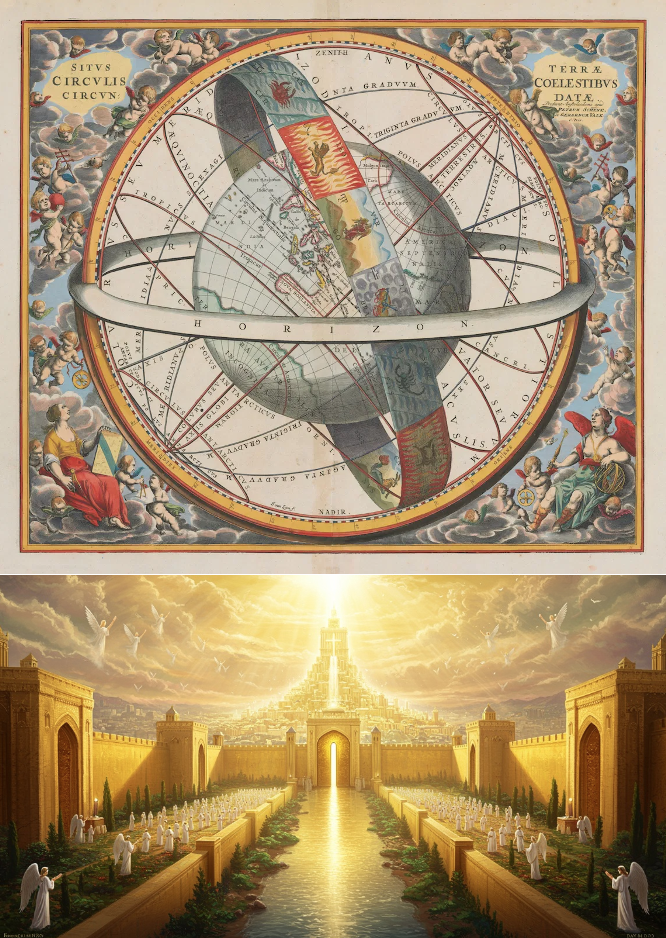
Fundamentals unanswered: For the author, scientific cosmology offers a largely viable yet still critically incomplete paradigm of reality, whereas the “Kingdom” of the Divine is an inaccessible mystery. At top, Harmonia Macrocosmica Plate 11, an engraving in Andreas Cellarius’s 1660 atlas of Earth-centred cosmology. At bottom, an AI depiction of the New Jerusalem from the Book of Revelation. Fundamentals unanswered: For the author, scientific cosmology offers a largely viable yet still critically incomplete paradigm of reality, whereas the “Kingdom” of the Divine is an inaccessible mystery. At top, Harmonia Macrocosmica Plate 11, an engraving in Andreas Cellarius’s 1660 atlas of Earth-centred cosmology. At bottom, an AI depiction of the New Jerusalem from the Book of Revelation. (Sources of images: (top) Public Domain Review; (bottom) AI/Shutterstock)

We forget this in the course of our daily lives: the way that the fact of the universe, or the Creation, however it manifested, is a miracle that is almost incommunicable in its nature. A miracle is regarded as a violation of the laws that govern the universe. The emergence of the classical apparatus of laws from a vastly different and unconnected quantum base is precisely a miracle as the common usage has it. It is a theoretical and mathematical violation of reason. It cannot be pictured or represented, not even in a Feynman diagram.

“The world,” as the philosopher Ludwig Wittgenstein opens his Tractatus, “is everything that is the case,” a view implying that anything that is not a fact, or cannot be logically pictured by a proposition or representation, is beyond the limits of meaningful language. Wittgenstein concludes by counselling that “whereof we cannot speak, thereof we must be silent.” But this would reduce much science, theology and philosophical speculation to proctorial speech and render the human mind as little of consuming importance. It would also deprive us of miracle.

But however we define it, miracle exists, it is part of “the case”, whether a contravention or a presence. It is the driving force behind the passion for discovery, the need to invent, the urge to ask what may well turn out to be insoluble or preposterous questions, the desire to explore what lies temptingly and provocatively before us in the terrestrial, physical, mental and spiritual compass of the very miracle of being.

The world as a whole is what I call a true miracle of simple existence without internal contradiction irrespective of our inability to resolve it. In other words, the miracle is the universe. Its entire existence is, to put it awkwardly, unprecedented, at bottom more unthinkable than anything science can offer in its most exotic and ethereal equations. The miracle is not only a violation or a presence; it is also the unprecedented. It is a violation of the nothing.

Ethnobotanist Terence McKenna observed, “Modern science is based on the principle: ‘Give us one free miracle and we’ll explain the rest.’ The one free miracle is the appearance of all the mass and energy in the universe and all the laws that govern it in a single instant from nothing.” In other words, the Big Bang and the created universe. God’s work.

God’s work? Ethnobotanist Terence McKenna describes the monumental assumption buried deep within all modern science as, “Give us one free miracle and we’ll explain the rest.” At right, Dome Cappella Chigi with a mosaic composition titled Creation of the World, by Raphael, 1516, in Santa Maria del Popolo, Rome, Italy. God’s work? Ethnobotanist Terence McKenna describes the monumental assumption buried deep within all modern science as, “Give us one free miracle and we’ll explain the rest.” At right, Dome Cappella Chigi with a mosaic composition titled Creation of the World, by Raphael, 1516, in Santa Maria del Popolo, Rome, Italy. (Source of left photo: Jon Hanna, licensed under CC BY-SA 3.0)

As frequently reported, famously earthy commentator Joe Rogan appears to have become “religious”. His formulation during a May 2025 podcast was both succinct and memorable, similar to McKenna’s: “There couldn’t be nothing and then all of a sudden everything.” Master inventor and technical wizard Elon Musk, who once claimed “our reality might be a computer simulation being played like a video game,” replied to a podcast question about whom he “look[s] up to the most” in two words: “The Creator.”

I am not a “believer” in any organized religion but I find that religious documents, like scientific studies, are often fruitful to free speculation. For example, the Dei Filius decree of the First Vatican Council in 1869 affirmed that God can be “known” not only by revelation but also by reason alone “in the things that have been made.” This is a way of recognizing the very miracle of Creation, or the Big Bang, or whatever brought the world into being, whether we are believers or skeptics or agnostics. The “light of reason” is sufficient.

Everyday miracles: Christian teachings assert that God can be “known” through “the things that have been made,” including celestial phenomena and the diversity of nature.
xEveryday miracles: Christian teachings assert that God can be “known” through “the things that have been made,” including celestial phenomena and the diversity of nature. (Source of photos: Unsplash)

Making Believers of us All

The Israeli poet Dov Ben Zamir made the point in a verse about the creation of light on the first day of the world which the Lord conjured out of darkness, a poem which technically amalgamates science and religion in its re-configuration of Genesis Chapter 1.
“Genesis”

The earth was without form, and void

and darkness was on the face of the deep

and the Spirit of God hovered over the face of Nothing.

Then God said

Let there be a zero-point field

and there was a zero-point field.

And God saw the zero-point field

that it was good.

And God said

Let there be a quantum vacuum.

Let it fluctuate in ceaseless waves

in a rippling sea of quantum radiation.

And it was so.

Then God said

Let there be a Higgs particle.

Let matter come and let it be

given mass and sustained

by the Higgs particle

and by the underlying sea of quantum oscillations

for it is a force that opposes acceleration

and gives a body to things.

And it was so.

Then God said

Let stochastic electrodynamics be the order of the day.

Let there be inertia.

And it was so.

Then God commanded the gauge symmetries to come forth

and the gauge symmetries arose.

And when this had come to pass

God took a portion of dark matter in his hand

and created an electromagnetic spectrum

and called it light

which was not the light of the sun, moon and stars

but the light of Creation.

And indeed it was very good.

Then God said

Let all living creatures come forth

and thus it happened.

It has all been downhill since then.

The “triadic system” is a model that integrates epistemic consciousness, the objective universe and the subjective individual. Applying across biological processes and the Cosmos, his model supports the view that science and religion are complementary rather than opposed. This aligns with the perspective of historical figures like Sir Francis Bacon, who in the 17th century argued that the intellectual faculty must be governed by “right reason and true religion” acting together. The First Vatican Council in 1869 similarly affirmed that the “light of reason” alone is sufficient to know God through the “things that have been made,” i.e., the world around us, suggesting there’s no unbridgeable gap between authentic faith and rational inquiry.

Darwin ended his life as an unsure materialist, writing in his Autobiographies of “the extreme difficulty or rather impossibility of conceiving this immense and vast universe…as the result of blind chance nor necessity. When thus reflecting I feel compelled to look to a First Cause having an intelligent mind.” In The World As I See It, Einstein was even more convinced that the laws of nature display “an intelligence of such superiority that, compared with it, all the systematic thinking and acting of human beings is an utterly insignificant reflection.” Something incomprehensible to us is nevertheless in some way intelligible to the mind as a miracle. The person who cannot see this, said Einstein, in the harshest of judgments, “is almost unqualified for life.”

A true miracle, then, is the pre-existent Logos that made and sustains the space and time we live in, however it may have occurred. The fact that the world is here and we live in it, and that there is, we might like to fancy, a bale of turtles way down beneath the quantum underworld and a hierarchy of Principalities way above the objective realm – this is another way of describing the miracle. Just as the wave function requires a conscious observer to result in an object, so the Creation requires a sentient and aware observer if it is to be recognized for the miracle that it is. If one does not sense it, one is diminished and has lost the fact of the unprecedented, of miracle. One has turned down an invitation to the party.

To be able to view the world mindfully, to recognize the astounding vitality and visionary nuances, or pnemes, of the everyday, or to strenuously try to do so indifferent to the walls and buffets that obstruct us, is perhaps as empirically close to the human edition of the Grand Unification as we can get, unifying it with ourselves, bringing the world into the soul. As Henri Bergson wrote in An Introduction to Metaphysics, “True empiricism is that which proposes to get as near to the original itself as possible,” even if the effort is always asymptotic.

Quantum fluctuations and virtual particles. The Big Bang. Intelligent Design. Unsymmetrical realities. Gauge symmetries. A simultaneously living and dead cat in a box. Quantized gravity. Time that begins out of time. Time that is infinitely recessive. Information that does not arise by itself but from an intelligence. |Ψ(x,t)|2. The Quantum Observer. The infinitely infinitesimal. Decoherence. Spooky action. The advent of miracle. Religion and science equally unenlightening and helpless before origins. The utterly magnificent world around us. How is any of this even possible?

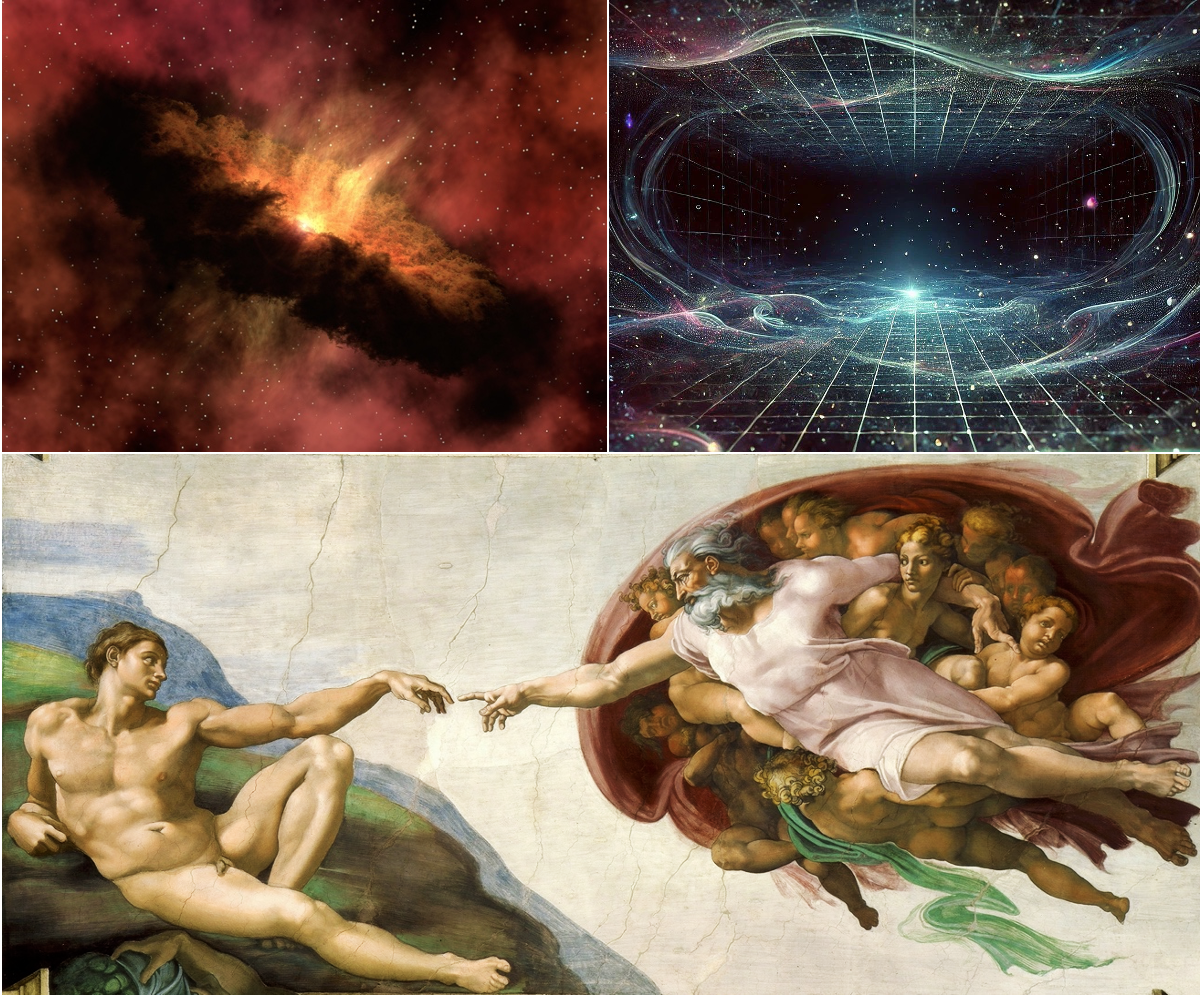
Bringing the world into the soul: Meditations over cosmology and the principles of quantum physics have left the author deeply in awe of the world and its origins; he urges everyone to recognize and appreciate life’s miraculous experiences. At top left, a NASA image of a protoplanetary disk around a newly formed star; at top right, a rendering of zero-point energy space filled with quantum fluctuations; at bottom, the iconic Creation of Adam by Michelangelo, 1511, Sistine Chapel, Vatican.Bringing the world into the soul: Meditations over cosmology and the principles of quantum physics have left the author deeply in awe of the world and its origins; he urges everyone to recognize and appreciate life’s miraculous experiences. At top left, a NASA image of a protoplanetary disk around a newly formed star; at top right, a rendering of zero-point energy space filled with quantum fluctuations; at bottom, the iconic Creation of Adam by Michelangelo, 1511, Sistine Chapel, Vatican.


The question of response is crucial. How can one truly and successfully unify, or reunify, Man and Creation? Ultimately, we seem to come back to Michelangelo’s gorgeous vision limned on the ceiling of the Sistine Chapel and the tiny aperture between the finger of God and the finger of Adam – a gap as large as the universe. The questions persist. How does one narrow the gap? How does one achieve reunification? How does one commute the real Grand Unified Theory into prayer? How does one arrive at a Theory of Everything and make it beat on the pulses? How does one quantize an act of adoration?

Perhaps only the Lord, who is greater than infinity and less than zero, knows.

David Solway’s latest prose book is Profoundly Superficial (New English Review Press, 2025)His translation of Dov Ben Zamir’s collected poetry New Bottles, Old Wine (Little Nightingale Press) will be released in the new year. Solway has produced two CDs of original songs: Blood Guitar and Other Tales (2014) and Partial to Cain (2019) on which he is accompanied by his pianist wife Janice Fiamengo. A third CD, The Dark, is in planning.

Love C2C Journal? Here's how you can help us grow.

More for you

The Impossible Equation: Seeking a Unified Theory for a Miraculous Universe

We’ve long been told that science and religion occupy two incompatible poles – one of reason and fact, the other of faith, superstition and even irrationality. But what if it isn’t so? In this two-part series, David Solway proposes a new Grand Unified Theory of cosmology aimed at bringing science and religion back together. In the opening instalment, Solway illuminates the irreducible paradoxes at the heart of all theories concerning the universe’s creation, then scrutinizes the seemingly unbridgeable gap between quantum physics and the physical world we live in – a gap that nevertheless is bridged into an integrated and orderly reality. What, then, might this say about the apparently irreconcilable differences between 21st century science and theology? Perhaps, Solway ventures, they’re more like two peas in a pod – and should consider forging a new entente to support humanity’s eternal search for Truth.

Triangulation of Hate: Why Canada Is Choosing to Let Antisemitism Grow

Canada has seen a troubling rise in anti-Semitism in the last two years. Hatred of Jews is now expressed openly, shamelessly, without restraint – and without consequence for those engaged in it. In part one of a two-part series, Lynne Cohen explains why Canada’s political and civic leaders seem unwilling to call out anti-Semitism or take any meaningful action to stop it. Whether driven by bias, cowardice or cold political calculation, the country’s political class is not just failing Canada’s Jewish population. It is choosing to do so. If the brutal massacre of innocent Jews by Muslim terrorists at Bondi Beach in Australia teaches anything, it’s that allowing anti-Semitism to spread has murderous consequences. Canada should take heed.

Socialist Shakedown: It’s Finally Time to End Supply Management in Agriculture

U.S. President Donald Trump’s trade policy may be chaotic and punitive, but he’s right about one thing: Canada’s agricultural supply management system has to go. Not because it’s unfair to America, though it is, but because it punishes Canadians. The price-fixing scheme limits consumer choice, requires a huge bureaucracy and prevents farmers from producing more in the face of shortages, forcing them instead to dump excess production. Worst of all, writes Gwyn Morgan, it drives up prices for milk, cheese, chicken, eggs and other essential foods — all for the benefit of a few thousand farmers, largely in Quebec. For Canada’s trade negotiators, argues Morgan, ending this mad racket should be job one.

More from this author

The Impossible Equation: Seeking a Unified Theory for a Miraculous Universe

We’ve long been told that science and religion occupy two incompatible poles – one of reason and fact, the other of faith, superstition and even irrationality. But what if it isn’t so? In this two-part series, David Solway proposes a new Grand Unified Theory of cosmology aimed at bringing science and religion back together. In the opening instalment, Solway illuminates the irreducible paradoxes at the heart of all theories concerning the universe’s creation, then scrutinizes the seemingly unbridgeable gap between quantum physics and the physical world we live in – a gap that nevertheless is bridged into an integrated and orderly reality. What, then, might this say about the apparently irreconcilable differences between 21st century science and theology? Perhaps, Solway ventures, they’re more like two peas in a pod – and should consider forging a new entente to support humanity’s eternal search for Truth.

Sing Creation: The Miracle of Melody

All of us have a favourite tune – perhaps a whole list of them. But when was the last time any of us asked ourselves what melody actually is, where it came from or how it differs from other pleasing sounds? The animating spirit of music, melody travels deep into the human soul, moves the heart like no other sound and can be traced to the dawn of humanity. But what is it? Probing the evanescent force that is melody, David Solway finds that while the metaphysics may remain forever enigmatic, posing the question is more than half the fun. In this most magical, joyful and musical of seasons, Solway provides a taste of honey that might just cause your heart to skip a beat as you look to the stars, sense the transcendent and hear the sounds of the heavens.

Resistance Theory: The Freedom Convoy’s Place in our Divided History

If there is a politico-historical thread running from Louis Riel and the buffalo-hunting Métis rebels in Confederation-era Manitoba, via Ottawa’s creation of three second-class Prairie provinces, followed by decades of friction over resource ownership and taxation, all the way to the convoys of diesel-powered trucks that rumbled into Ottawa to protest federal vaccine mandates in the winter of 2022, few have taken note. David Solway is one. As the main convoy leaders await a court verdict, Solway is taking the long view. He asserts that the truckers’ protest is a powerful contemporary manifestation of a recurring theme – perhaps the defining theme – of how Canada is governed, and to whose benefit. But while Canada’s late-19th century leaders were flawed men who made mistakes, Solway finds, the country’s current federal leadership appears outright bent on destruction.