
On Valentine’s Day 2022 Prime Minister Justin Trudeau held a news conference flanked by four masked senior Cabinet members in front of a row of Canadian flags. Displaying his trademark dramatic flair, Trudeau announced that for the first time in Canadian history the federal government would invoke the most extraordinary power available in Canadian law: the Emergencies Act.
They say that while history doesn’t repeat itself, it often rhymes, and in this case it rhymed with “Trudeau”. There is an odd symmetry in that the War Measures Act, used (and, many say, abused) by Prime Minister Pierre Elliott Trudeau in 1970, was replaced by the far more tightly constrained Emergencies Act, only for it to be used by his son, Justin Trudeau. And now, two levels of courts have both affirmed that Trudeau Junior also abused Canada’s emergency powers. On January 16 the Federal Court of Appeal (FCA) upheld the Federal Court of Canada’s 2024 judgment that Trudeau’s declaration of a public order emergency under the Emergencies Act was illegal and unconstitutional.
The court’s appeal judgment is a great step towards re-establishing the rule of law in Canada as it concerns emergencies legislation. It restores the Emergencies Act to what Parliament intended – a narrow, exceptional tool – rather than a blunt instrument to be used against dissent or political turmoil. The FCA’s judgment is so well-reasoned and decisive that, in my opinion, it leaves few avenues for reversal upon appeal, should the Government of Canada seek leave from the Supreme Court of Canada.
Draconian: The Justin Trudeau government’s February 14, 2022 invocation of the Emergencies Act against the Freedom Convoy protesters – whom then-private citizen and now Prime Minister Mark Carney condemned as “seditionists” – has been unanimously ruled illegal and unconstitutional by the Federal Court of Appeal. (Source of bottom left photo: Maksim Sokolov, licensed under CC BY-SA 4.0)Trudeau’s unprecedented decision was made in response to the weeks-long Freedom Convoy protests that had tied up Ottawa and several border crossings in opposition to Ottawa’s and some provincial governments’ brusque and uncompromising extension of Covid-19 restrictions and mandates. The Emergencies Act was invoked seven days after an inflammatory Globe and Mail column by Mark Carney, then a private citizen, who denounced the protesters as “seditionists” whose goal was to remove the government from power, and who were engaged in “blatant treachery.” Carney – the former central banker – pointedly called for “choking off the money that financed this occupation.”
Trudeau had often been at least as hostile towards the protesters as Carney, infamously denouncing them as a “small fringe minority” with “unacceptable views”, words he later claimed, not entirely convincingly, to regret. But in his February 14 announcement the prime minister chose to frame things a bit more gently. “This is about keeping Canadians safe, protecting jobs, and restoring faith in our institutions,” he declared to the cameras and the thousands of Canadians watching at home. It is worth noting that resorting to “safety” to justify limiting the rights of citizens is a perennial temptation for politicians. As the Austrian philosopher Friedrich Hayek warned us back in 1979, “Emergencies have always been the pretext on which the safeguards of liberty have been eroded.”
The risk that a government might be tempted to abuse emergency powers isn’t an esoteric notion. Among Canadian politicians such a risk was considered so high that when the Emergencies Act was being crafted and debated in 1987-1988 to replace the War Measures Act, it was deliberately designed with a very high and quite specific threshold before it could be used. This is crucial, because the Emergencies Act is not just another statute. It is a law designed for extraordinary times. War. Terrorist attacks. Armed insurrection. Or massive natural disasters, which heretofore had always been handled without recourse to such powers.
Once the built-in criteria are met, however, the Emergencies Act provides stupendous powers. It suspends the ordinary constitutional division of powers, handing the federal Cabinet sweeping and expansive powers to, among other things, do something that only Parliament normally can do: create new criminal law by executive decree, without prior notice, and without parliamentary debate. Under the Act Cabinet can restrict public assembly and travel and create new criminal offences for any contravention of an order or regulation made under the Act. These powers are intrusive and result in dramatic consequences for anyone caught within their ambit.
Canada’s federal Emergencies Act was specifically designed to prevent the kind of abuse of emergency powers seen during the 1970 October Crisis in Quebec. Shown: (top) Prime Minister Pierre Trudeau walks to the House of Commons before declaring his government’s use of the Emergencies Act’s predecessor, the War Measures Act, October 16, 1970; (middle) a newsboy hawks papers reporting the event; bottom, Canadian soldiers patrolling the streets of Montreal, 1970. (Sources of photos: (top) The Canadian Press/Chuck Mitchell; (middle) CP Photo/Peter Bregg; (bottom) Toronto Star Archives)In this case, once the public order emergency was proclaimed, Cabinet issued two categories of regulations. The first category can be called the “assembly measures”. These comprised sweeping prohibitions on assembly that criminalized ordinary protest activity nationwide. They outlawed assemblies that could “reasonably be expected to lead to a breach of the peace,” as well as travelling to such assemblies and providing material support to them. Violations carried penalties of up to five years in prison. The regulations did not distinguish people engaged in blockades from people protesting peacefully. This meant that people could face serious criminal consequences not because of what they were doing, but because of what someone else nearby might do.
Financial institutions were effectively deputized as agents of the state. Once a financial institution shared a suspect’s information with police, the police could rely on that information to charge those individuals with offences carrying penalties of up to five years in prison. These are extraordinary things to do in a liberal democracy.
A person could be subject to charges for blockading a road. But under the Act you could be subject to the same penalty for standing silently on the grass holding a sign while others nearby might block a road or other site. You could be subject to the same penalty for giving a coffee to someone who might participate in a blockade. You could be subject to these penalties even if you disagreed with any such blockades themselves but were protesting silently, peacefully and without threatening or disrupting anything.

The second category of regulations were the “financial measures”. These required banks and other financial institutions to disclose personal financial information to authorities and to freeze a customer’s accounts if the institution had “reason to believe” that an account belonged to a “designated person.” A “designated person” was defined broadly to include anyone engaged directly or indirectly in prohibited protest activity. This was all done without warrants, court orders or notification of the affected parties, and without any meaningful way for anyone so targeted to challenge their status as a designated person.
Police directed banks which accounts to freeze, and some 290 accounts were frozen. To meet their ongoing obligation to provide police with the account information of “designated persons”, banks were told to scour news and social media to identify potential targets. This was also done without a warrant, without notifying the bank client, and without providing them any recourse. Financial institutions were thus effectively deputized as agents of the state. Once a financial institution shared a suspect’s information with police, the police could rely on that information to charge those individuals with offences carrying penalties of up to five years in prison.
These are all extraordinary things to do in a liberal democracy. They became among the most egregious instances of the growing worldwide phenomenon of politicized “debanking”.
The Real People Harmed by the Emergencies Act
It is important to give some colour to the experiences of individual Freedom Convoy protesters. It’s easy to talk about thresholds and statutory language in the abstract, and remain there. But emergency powers are, when used, best understood through their human consequences.
Edward Cornell and Vincent Gircys were two of the individuals whose accounts were frozen – and who would challenge this government conduct in court. They were dramatically impacted by the financial measures, and their stories are compelling.

Cornell is a now-66-year-old retired Canadian Armed Forces Warrant Officer who was decorated for bravery, later serving as an Ontario Provincial Police auxiliary officer, who now lives in Shediac Cape, New Brunswick. Cornell’s involvement in the protest – like that of hundreds of others – was entirely peaceful. He and his wife travelled to the protest to support the truckers and help liaise between police and protesters.
But following the Emergencies Act’s invocation and creation of the financial measures, his bank accounts were frozen with no notice, leaving him with no access to his own money to travel the more than 1,200 km home in winter. Thankfully, he had just enough cash on hand to get there. Still, he missed bill payments. Cornell’s accounts were not reactivated until well after he had returned to New Brunswick.
As for Gircys, the now-64-year-old from St. Catharines, Ontario had a 32-year career as a forensic investigator with the Ontario Provincial Police, earning accolades such as the Exemplary Service Medal, before retiring in 2014. Like Cornell, Gircys’ participation in the protests was peaceful. He travelled to Ottawa on January 29, where he helped see to the truckers’ day-to-day needs and liaised between the protesters and police, providing security at various press conferences, and even being quoted in the New York Times.

Gircys remained in Ottawa until the protests were crushed on February 18-20. Like Cornell’s, his bank accounts were frozen without warning, and when they were, he had just $20 cash on hand. Gircys had to rely on the generosity of strangers for shelter and transportation home. His accounts remained frozen for some time after he left Ottawa.
Freezing a person’s bank account in our electronic age does not merely inconvenience them. It severely disrupts their ability to manage key affairs such as mortgage and utility payments, purchase of groceries or even child support payments. It virtually immobilizes them. It can bring them into severe disrepute with service providers, customers, business associates, acquaintances and even relatives. It can create daunting legal problems. For all but the steeliest, it is traumatizing.
The evidence before the Public Order Emergency Commission, a separate non-judicial inquiry into the Act’s invocation, also revealed details of the harm caused by such financial measures. Even some joint accounts were frozen, meaning spouses who had nothing to do with the protests (and, potentially, even disagreed with them) were unable to buy groceries or pay for medication. Some people missed business loan payments. Others missed child support payments. There were potential long-term credit consequences, adding a further level of “process” punishment to a person who had not been charged, tried or convicted of anything at all.
It doesn’t matter whether you agree or disagree with the protesters’ political views: punishing their peaceful protest activity by freezing their bank accounts was cruel, petty, vindictive, unnecessary and plain unconscionable. And, as it would turn out, illegal and unconstitutional. Plus, it created a wider, chilling effect. At the Canadian Constitution Foundation, we received emails and phone calls from donors worried their own accounts could be frozen if they donated to support our legal challenge. Such a thing previously would have been unthinkable. That fact alone should trouble anyone who cares about democratic accountability.
A number of things about the factual background to this case do not matter. It does not matter whether you liked or disliked the protest or the protesters – though millions of Canadians seem to have a hard time making this distinction. It does not matter whether you agreed or disagreed with the Freedom Convoy’s goals.
In the end, the special regulations were wholly unnecessary. If we look at what happened on the ground, none of their measures were relied upon to end the protests. By the time the emergency proclamation was made, the border blockades were already being dismantled using ordinary criminal law powers. The Ottawa protests also ended up being resolved using ordinary policing.
The Legal Challenge
On February 22, 2022, the Canadian Constitution Foundation, the legal charity I direct, filed an application in the Federal Court of Canada for judicial review of the Emergencies Act invocation and a constitutional challenge of the regulations. That challenge was joined with a separate legal challenge filed by the Canadian Civil Liberties Association as well as some individuals directly affected by the regulations, including Cornell and Gircys.
A number of things about the factual background to this case do not matter. It does not matter whether you liked or disliked the protest or the sometimes scruffy or rough-edged protesters – though millions of Canadians seem to have a hard time making this distinction. It does not matter whether you agreed or disagreed with the Freedom Convoy’s goals – even if those goals for some protesters included pressuring Trudeau to resign. It does not matter whether you found the more than two-week-long event annoying, obnoxious or embarrassing, or even agreed with the mainstream media’s characterization of it as a “menacing blockade” that threatened peaceful Ottawans. It does not matter whether you saw in it an entirely peaceful exercise in “love” – as one of the main protest organizers often describes it – and/or as an expression of genuine Canadian patriotism, as millions of flag-waving Canadians seemed to believe.
As difficult as it may be to set all of this aside, none of this matters because none of it is germane to the case at hand. What matters is whether the legal thresholds to use the Emergencies Act were met and whether the regulations subsequently enacted under it were constitutional. And in what I believe will probably go down as the most important civil liberties case in a generation, the appellants twice won decisively.
The Federal Court Decision
On January 29, 2024, Federal Court of Canada Justice Richard Mosley held that the Trudeau government’s use of the Emergencies Act was unreasonable: it was unreasonable for Cabinet to have concluded that the threshold to use the Act was met. Mosley held that the government had not satisfied the Act’s strict embedded criteria and that the government’s actions under the Act violated the Canadian Charter of Rights and Freedoms, being unjustified violations of the right to freedom of expression and freedom from an unreasonable search and seizure. In other words, Trudeau had acted both illegally and unconstitutionally.
Mosley found that there was no national emergency and no threat to the security of Canada, both of which are built-in legal requirements to prevent the Act from being abused. He also found that the orders freezing bank accounts violated the constitutional right to be secure against unreasonable searches and seizures, and that the restrictions on protests violated the right to freedom of expression.

The Government of Canada’s lawyers had conceded that the banks’ sharing of financial information with authorities constituted a “search”, although they argued it was a reasonable search. Justice Mosley rejected this argument and found instead that the financial measures engaged the Charter right to be free from an unreasonable search. The government also took the position that freezing bank accounts was not a “seizure”. Mosley wrote that he had “considerable difficulty” accepting this, noting that “governmental action that results in the content of a bank account being unavailable to the owner of the said account would be understood by most members of the public to be a ‘seizure’ of that account” (para 334). He concluded that the searches and seizures permitted and conducted under the financial measures were not minimally impairing of the rights to be free of such actions guaranteed by section 8 of the Charter.
Paragraphs 370-371 of Mosley’s ruling are noteworthy for their influence on what came next. “At the outset of these proceedings,” he wrote, “while I had not reached a decision on any of the four applications, I was leaning to the view that the decision to invoke the [Act] was reasonable.” Following the submissions of the Canadian Constitution Foundation and Canadian Civil Liberties Association, however, he became convinced the invocation was not reasonable: “Their participation in these proceedings has demonstrated again the value of public interest litigants. Especially in presenting informed legal argument. This case may not have turned out the way it has without their involvement, as the private interest litigants were not as capable of marshalling the evidence and argument in support of their applications.”
This paragraph is a laudable example of judicial candour. But to bring its appeal – which it announced within mere minutes of Mosley’s judgment being issued – the Government of Canada relied on it as evidence of what it claimed was Mosley misapplying the reasonableness standard.
How did the emergency measures enacted by the Justin Trudeau government in February 2022 harm the constitutional rights of Canadians in areas such as freedom of expression and assembly and security against unreasonable search and seizure (such as freezing of bank accounts)?
The emergency regulations enacted after the February 14, 2022 invocation of the Emergencies Act to crush the Freedom Convoy protests created sweeping prohibitions on public assembly that criminalized mere attendance at protests, even if the activity was peaceful. The Federal Court of Appeal on January 16, 2026 ruled that these measures violated the right to freedom of expression under paragraph 2(b) of the Canadian Charter of Rights and Freedoms because they were overbroad and did not distinguish between lawbreakers and peaceful bystanders. The emergency regulations also included financial orders requiring banks to disclose customers’ personal information and freeze the accounts of designated persons without a warrant, judicial authorization or other due process. The Federal Court of Appeal has ruled that this process constituted an unjustified violation of the Charter’s section 8 right to be free from unreasonable search.
The Federal Court of Appeal Decision
The FCA decision followed two days of argument by both sides in February 2025. It is meticulous, unanimous and devastating to the Government of Canada’s position.
The appeal court rejected the government’s claim that Mosley had misapplied the reasonableness standard. “[I]t may indeed appear curious to find such a candid admission at the very end of the Federal Court’s reasons,” it found. “It is not for us, however, to speculate as to what exactly the Federal Court had in mind and why it felt compelled to express sympathy for those who had to decide whether or not to issue the Proclamation” (para 183). It held that this paragraph did not taint the Federal Court’s reasoning or undermine its findings.
The FCA’s 508-paragraph decision, authored by Chief Justice Yves de Montigny, can be understood as dealing with three main issues. First was whether the threshold to use the Emergencies Act was met. Second was whether the assembly prohibitions were an unjustified violation of the Charter’s section 2(b) right to free expression. Third was whether the freezing of accounts and sharing of financial account information without a warrant was an unjustified violation of the Charter’s section 8 right to be free from unreasonable search.
The Three Thresholds to Use the Emergencies Act
In invoking the Emergencies Act on February 14, 2022 the Trudeau Cabinet declared a “public order emergency”. For there to be “reasonable grounds” to do so (wording built into the Act) requires passing three important thresholds built into the statute and based on defined terms.
Tripwires were built into the Emergencies Act to prevent it from being abused. The legal thresholds are vital; it is no exaggeration to say that this is where the rule of law lives or dies. The Act’s architecture and the critical content within that architecture were deliberate.
First, there must be a threat to the security of Canada. This is defined by reference to the Canadian Security Intelligence Service (CSIS) Act and, importantly, requires an element of serious physical violence. Second is what we call the “last resort” clause. The Emergencies Act is a tool of last resort, meaning that existing federal laws must be exhausted before a public order emergency can be proclaimed. Third is that the emergency must exceed the capacity of provincial authorities to deal with it; there must be a “national emergency” of such a threatening nature or large proportion as to overwhelm the policing, legal, security, disaster relief or organizational capacities of the affected provinces.
These tripwires were built into the Act to prevent it from being abused. The legal thresholds are vital; it is no exaggeration to say that this is where the rule of law lives or dies. The Act’s architecture and the critical content within that architecture were deliberate, because of the history preceding the Emergencies Act. Its built-in constraints are not technicalities but represent what could be called the “democratic bargain”.
Parliament drafted the Emergencies Act as a response to the widely acknowledged abuses of the War Measures Act – the same Act that enabled internment of Japanese-Canadians during the Second World War and mass arrests during the 1970 October Crisis in Quebec. The FCA emphasized: “One must not lose sight…of the history of the Act and of the context in which it was adopted” (para 176). Parliament, the court noted, “precisely circumscribed Cabinet’s discretion” to prevent the casual or political use of emergency powers.
The First Threshold – On the question of whether there was a “threat to the security of Canada”, the FCA held it was not reasonable for Cabinet to conclude that there was. CSIS had informed the government that it did not believe such a threat existed. The Government of Canada has the authority to depart from the CSIS assessment, but it must have a reason for doing so. The Privy Council Office had promised to supply Cabinet with an alternative threat assessment, but never did. Yet lacking any separate formal rationale, Cabinet proclaimed an emergency anyway.
The FCA noted that the Trudeau Cabinet viewed the threshold of “threats to the security of Canada” as lower in the Emergencies Act than in the CSIS Act. The court held that this makes no sense. If anything, it should be the reverse. The powers in the Emergencies Act are much more sweeping and – to use the court’s own words – “draconian” than the ordinary surveillance powers in the CSIS Act. Emergency powers therefore require more justification, not less, especially when they authorize a vast array of coercive measures without prior authorization. On the evidence, the court was blunt: it was not reasonable for Cabinet to believe there was a threat to the security of Canada.
The Emergencies Act was carefully crafted to prevent the abuses under its predecessor, the War Measures Act, which included internment of Japanese-Canadians in the Second World War and mass arrests without clear evidence during the October Crisis. Pictured: (top) Japanese-Canadians being relocated to camps in the interior of British Columbia, 1942-1946; (middle) Progressive Conservative Prime Minister Brian Mulroney signs the agreement to compensate Japanese-Canadians for their internment and expropriation of their property, September 1988; (bottom) demonstrators in Ottawa opposing the 1970 use of the War Measures Act. (Sources of photos: (top) CP Photo/National Archives of Canada; (middle) Tony Seed’s Weblog; (bottom)Violence, as noted, is a key element of the first threshold to establish the existence of a “threat to the security of Canada”. And, the court found, it was lacking. “While undoubtedly disruptive and very annoying to residents of downtown Ottawa,” the FCA noted, “[the Freedom Convoy protest] was non-violent expressive activity that manifestly attempted to convey protesters’ dissatisfaction with the federal government’s Covid policies” (para 343).
Aside from the situation at the border-crossing in Coutts, Alberta – where a small weapons cache was discovered but the situation resolved through dogged police work and orderly arrests under ordinary law before the Emergencies Act was invoked – there was no credible evidence of actual or imminent violence. “When properly understood as requiring bodily harm,” the court said, “the evidence is quite simply lacking” (para 231).
To get around this lack of actual violence, the government’s lawyers had attempted at both levels of court to water down the meaning of “serious violence” to include “economic harm”. No doubt there was economic harm caused by the Freedom Convoy. There is some degree of economic harm caused by most protests. For some protests, such as labour strikes, economic harm is the point. (There is also, of course, economic harm caused by any number of government policies.)
“The evidence is quite simply lacking”: The authorization of the Emergencies Act requires evidence of “serious violence” constituting a “threat to the security of Canada”, which the courts have found was entirely absent during the Freedom Convoy protest. (Source of photos: Maksim Sokolov, licensed under CC BY-SA 4.0)The FCA flatly refused to accept the government’s attempt to define-down the meaning of violence. It held that economic harm is not part of the legal threshold to declare a public order emergency, and that expanding the definition to include economic harm would suppress democratic activities. The government’s “expansive interpretation of ‘serious violence’ to property is unwarranted and unreasonable,” it held. “It could stifle all kinds of protests and demonstrations […]” (para 208). The court did not separately comment on the violence inflicted upon the English language by the federal government’s Orwellian twists.
Crucially, the court recognized the catastrophic implications to the Act itself of redefining violence. Here it is worth quoting at some length:
“The adoption of the Act was clearly meant to curb the excesses and prevent the abuses that occurred under the War Measures Act. The reference to the definition of ‘threats to the security of Canada’ in the CSIS Act, which itself requires threat or use of acts of ‘serious violence’, was meant to assuage the concerns that pure economic considerations, especially those of a speculative or tentative nature, would not prevail over democratic values and fundamental freedoms of assembly and expression.” (para 208)
The Government of Canada was thus caught out attempting to do violence not merely to our language but to the meaning and intent of the Emergencies Act – and, hence, the rule of law itself.
While the federal government’s lawyers argued that provincial consent is unnecessary to invoke the Emergencies Act, the Federal Court of Appeal called the government’s failure to grapple with the provinces’ input a ‘serious deficiency’.
The Second Threshold – The “last resort clause”, as the term implies, first requires exhaustion of the powers and resources conferred by existing federal laws. The FCA found that the government failed also in this regard. The protests were ultimately resolved using the authority and provisions of the Criminal Code of Canada – the very tool that was always available and which the RCMP Commissioner at the time, Brenda Lucki, had told the government was still available. And protesters were charged with ordinary Criminal Code offences like mischief. What was lacking in Ottawa was never legal authority. It was always leadership, inter-agency coordination and, arguably, policing resources.
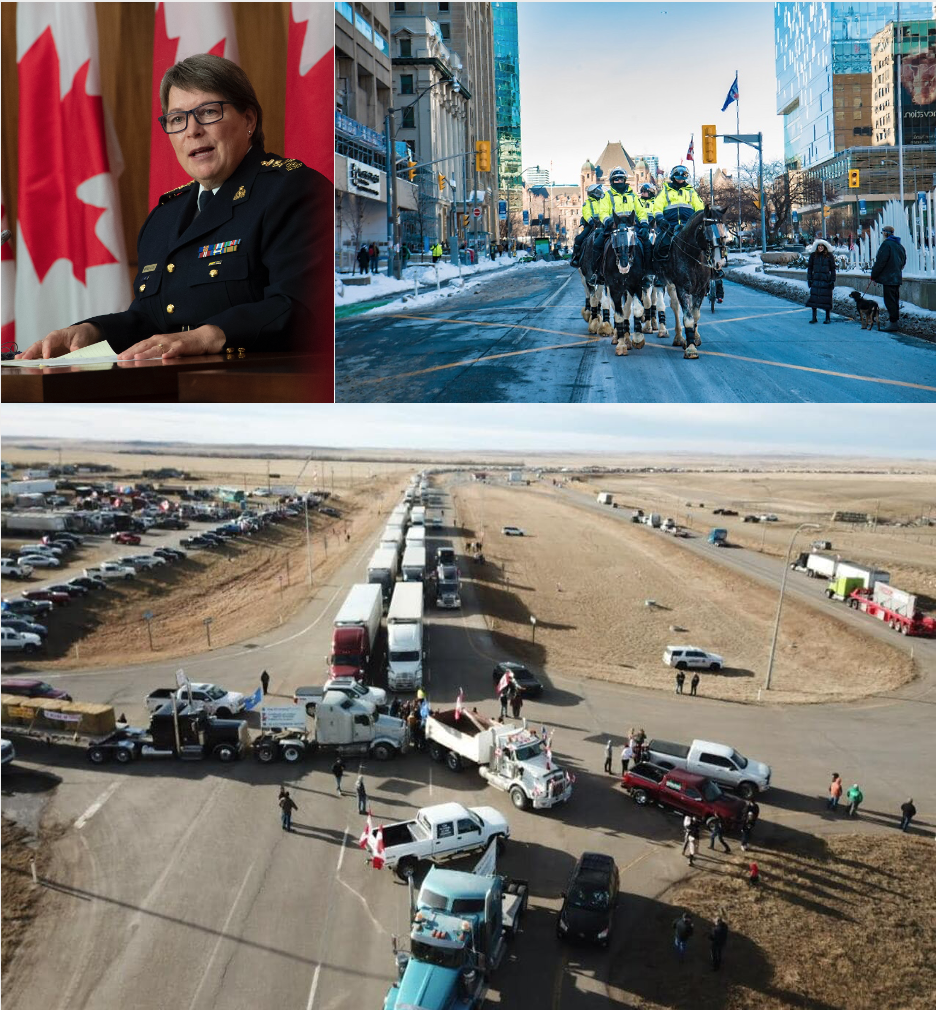
The “last resort” represented by the Emergencies Act was unnecessary since existing laws like the Criminal Code were sufficient to end the Freedom Convoy protests, as confirmed by then-RCMP Commissioner Brenda Lucki (top left). Nor was the third built-in threshold – exhaustion of all provincial powers – met, as indicated by the fact that the blockade of trucks and tractors at Coutts, Alberta (shown at bottom in January 2022) was dismantled before the Emergencies Act was invoked. (Sources of photos: (top left) The Canadian Press/Adrian Wyld; (top right) michael_swan, licensed under CC BY-ND 2.0; (bottom) Jake Zacharias)The Third Threshold – In examining whether provincial capacity had been exceeded, thereby necessitating and justifying federal emergency intervention, the FCA noted that the Trudeau Cabinet had failed entirely to engage with objections by multiple provinces to the Act’s use. When consulted a few hours before the Act was invoked, most provinces expressed the view that provincial capacity and authority were not exceeded and that the Act’s invocation would be divisive, unconstructive and unnecessary. Only Ontario, British Columbia and Newfoundland & Labrador appear to have supported the Act’s use, and then only on a time-limited basis.
While the federal government’s lawyers argued that provincial consent is unnecessary to invoke the Act, the FCA called the government’s failure to grapple with the provinces’ input a “serious deficiency”. Its words on this topic will be welcomed by all those who are concerned about preserving provincial constitutional jurisdictions and autonomy from unwarranted federal intrusion:
“In a federation, provinces should be left to determine for themselves how best to deal with a critical situation, especially when it largely calls for the application of the Criminal Code by police forces. The emergency power (and, with it, the suspension of the constitutional division of powers) cannot be employed to override a provincial government’s decision not to exercise its powers, or to exercise them in a manner that does not conform with the preferences of the federal government. To the extent that a situation is not of such proportions or nature as to exceed the capacity or authority of the provinces, they should be left to their own devices.” (para 286)
What specific legal thresholds must be met before the Government of Canada can lawfully declare a public order emergency under the Emergencies Act?
To lawfully declare a public order emergency, the federal Cabinet must have reasonable grounds to believe that a national emergency exists which exceeds the capacity or authority of provincial governments to handle. Under section 17(1) of the Emergencies Act, there must also be a “threat to the security of Canada”, a term in turn defined under the Canadian Security Intelligence Service Act as requiring an element of serious physical violence. The Emergencies Act also has a “last resort” requirement, meaning it can only be invoked if the situation cannot be effectively dealt with under existing Canadia law. In its January 16, 2026 decision, the Federal Court of Appeal confirmed that the February 14, 2022 invocation was illegal because none of these three thresholds was met: most provincial governments insisted they could handle the situation, the federal government failed to establish a threat of serious physical violence, and it did not exhaust existing legal tools such as the Criminal Code of Canada.
The Assembly Prohibitions and Financial Measures
The regulations enacted after the declaration – the assembly measures and the financial measures – fared no better under constitutional scrutiny. The FCA ruled that the sweeping ban on assemblies violated Charter-protected freedom of expression by criminalizing mere attendance at protests, including peaceful expression on Parliament Hill. The court found that the provision making anyone criminally liable merely for being near someone else who might breach the peace or commit a similar offence was overbroad and unconstitutional, that it too violated the Charter-protected right to freedom of expression, and that this violation could not be justified in a free and democratic society.
The FCA decried the “ad hoc” nature of the government’s effectively deputizing financial institutions as investigatory agents of the federal state by instructing them to “leverage the news” and social media to identify suspects – and then carry out the sentence. The court found that the system lacked procedural safeguards, allowing privacy to be invaded based on “potentially unfounded, subjective beliefs” (para 453). This approach unjustifiably violated the Charter’s protection against unreasonable search guaranteed in section 8. But in a departure from the Mosley decision, the FCA held that the freezing of accounts did not constitute a seizure under section 8 of the Charter.
What role did the Canadian Security Intelligence Service play in the recent legal determination that the 2022 invocation of the Emergencies Act was unreasonable?
The Canadian Security Intelligence Service informed the federal government in February 2022 that it did not believe the Freedom Convoy protests constituted a “threat to the security of Canada” as defined by law. Despite this, the Justin Trudeau Cabinet declared a public order emergency under the Emergencies Act on February 14, 2022 without providing an alternative formal threat assessment. In its unanimous decision issued on January 16, 2026, the Federal Court of Canada cited this as one of several reasons that the invocation was not reasonable under law and was, therefore, illegal. This in turn meant that the subsequent regulations infringing on individual rights were unconstitutional.
A History-Making Decision
The federal Emergencies Act exists because Canada learned the hard way that emergency powers can be abused. The War Measures Act had allowed Cabinet to suspend ordinary legal constraints. It was abused for the first time during the Second World War to justify the internment of Japanese-Canadians, to send them to labour camps, to force the sale of their property and to use the proceeds to fund their internment. It was abused again during the October Crisis in 1970 to justify warrantless searches, the seizure of reading material and the unnecessary mass arrests of many innocent people, including intellectuals, journalists and artists.
The Federal Court of Appeal’s Emergencies Act decision now stands as binding precedent. It restores the Emergencies Act to what Parliament intended it to be: not a blunt instrument against dissent or political turmoil, but a narrow, exceptional tool to be used only against the gravest of national threats.
The Emergencies Act was meant to prevent such abuses from happening again. Yet we saw the same mindset applied in the abuse of the Emergencies Act as we saw in its predecessor: the belief that when it comes to public safety, the ordinary law is too slow or inconvenient. That civil liberties and the rule of law can be brushed aside. It can’t.
Victory of our times: Whereas the War Measures Act was never formally and directly challenged in court, the misuse of the Emergencies Act triggered immediate legal opposition, four years later delivering a decisive rebuke of government overreach and a landmark win for Canadian civil liberties and the rule of law. At right, Christine Van Geyn, Director of the Canadian Constitution Foundation, which along with the Canadian Civil Liberties Association and several individuals, drove the legal challenge. (Source of right photo: christinevangeyn.ca)In response to the shocking use of this powerful law, a small group of brave litigants took up the cause, sued the Government of Canada and won at both the lower court and appeal court levels. Both courts have now rendered comprehensive, end-to-end and – assuming our former and current prime minister are capable of feeling shame – humiliating drubbings to the rationalizations for invoking the Emergencies Act and the measures taken under its authority.

The Federal Court of Appeal’s Emergencies Act decision – confirming the Federal Court of Canada’s hearing decision – now stands as binding precedent. It restores the Emergencies Act to what Parliament intended it to be: not a blunt instrument against dissent or political turmoil, but a narrow, exceptional tool to be used only against the gravest of national threats. For this reason this judgment is, in my opinion, one of the most important civil liberties decisions in a generation. I believe it will be very difficult to appeal. And I predict it will be taught in law schools – not just as a case about emergency powers, but as a case about the rule of law itself.
Christine Van Geyn is litigation director of the Canadian Constitution Foundation.
Source of main image: Gary A Corcoran Arts/Shutterstock.