
Economics of Air Travel

Unfriendly Skies: Why Canada Needs Real Airline Competition

Simon Michell
March 2, 2026
Ireland’s Ryanair will fly you from London to Geneva for $49. Flying from Calgary to Vancouver – a shorter trip – likely will set you back four times as much. Canadians suffer some of the highest-priced, least-convenient and most unpleasant airline service in the world, and mainly for one reason: forestalled competition. In fact, creating barriers to prevent any meaningful competition has been the main goal of Canadian airline policy since the formation of Trans-Canada Air Lines in 1937. Simon Michell explains how this sorry situation came to be and reveals how opening up our skies – as so many other countries have already done – would make things much better for us all.
Economics of Air Travel

Unfriendly Skies: Why Canada Needs Real Airline Competition

Simon Michell
March 2, 2026
Ireland’s Ryanair will fly you from London to Geneva for $49. Flying from Calgary to Vancouver – a shorter trip – likely will set you back four times as much. Canadians suffer some of the highest-priced, least-convenient and most unpleasant airline service in the world, and mainly for one reason: forestalled competition. In fact, creating barriers to prevent any meaningful competition has been the main goal of Canadian airline policy since the formation of Trans-Canada Air Lines in 1937. Simon Michell explains how this sorry situation came to be and reveals how opening up our skies – as so many other countries have already done – would make things much better for us all.
Share on Facebook
Share on Twitter

By all measures, Canada ought to be a country with a thriving airline industry. We boast a modern, wealthy economy heavily dependent on trade and with a long and proud history of aircraft design and manufacture. Our vast distances from coast to coast to coast make car travel unrealistic for many trips, while a decrepit passenger rail service means travel by train can be even slower. And there is no practical way to get from Toronto to Vancouver by boat. Flying is the quickest and most efficient way of moving around the country – and yet the skies of Canada are decidedly unfriendly for flyers.

The gradual deregulation of the airline industry in the 1980s, culminating in the privatization of Air Canada in 1989, was supposed to set off a boom in competition. It never happened. By the 1990s, just two major airlines dominated the skies: Air Canada and Canadian Airlines International Ltd., what was once Canadian Pacific Airlines. In the mid-1990s upstart WestJet Airlines Ltd. began serving Western Canada, offering a small but credible alternative. Around the same time, however, Canadian Airlines began to suffer serious financial difficulties; it was eventually taken over by Air Canada in 2001.
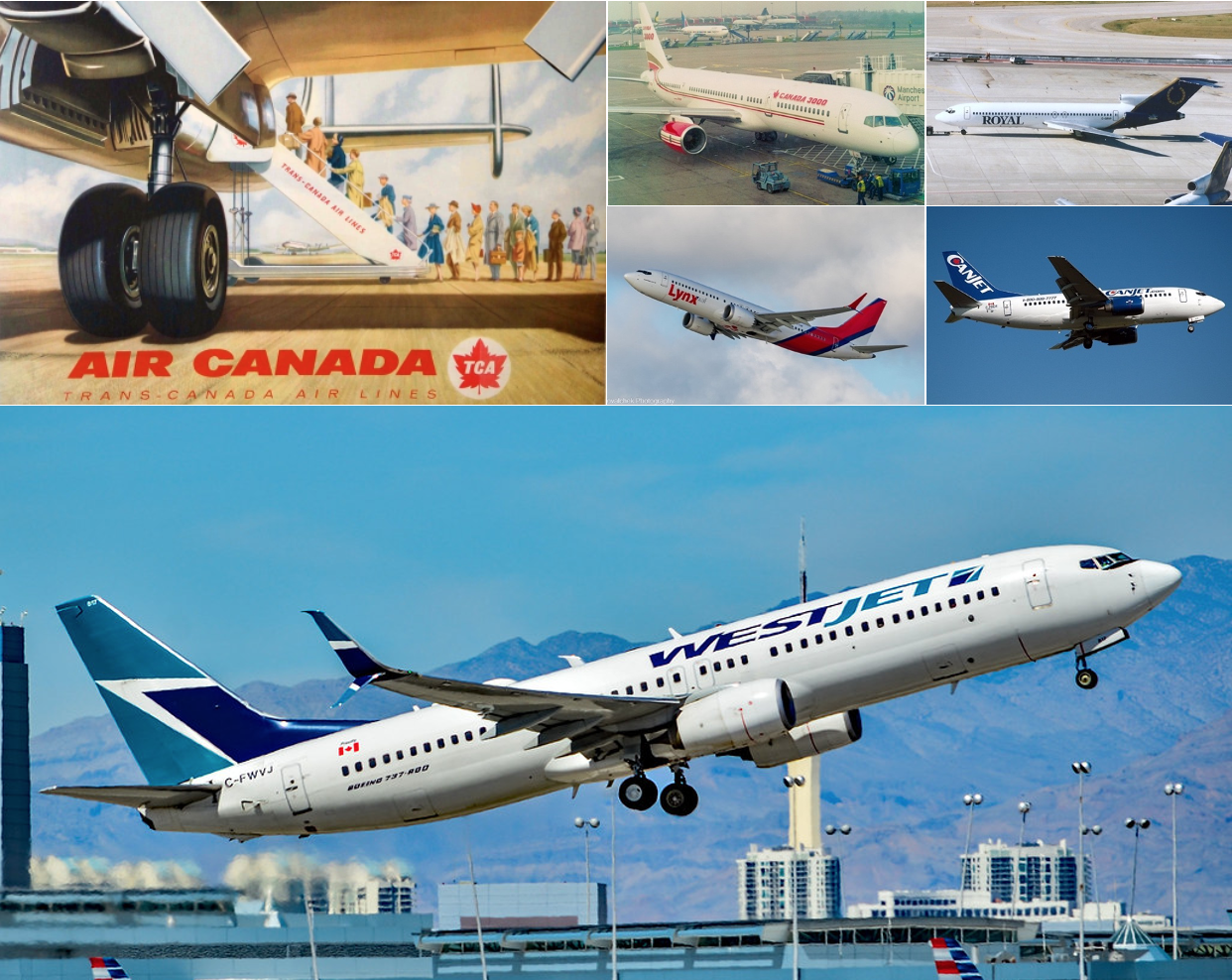

Deregulation of Canada’s airline industry was supposed to unleash a stampede of competitors; it never happened. Pictured: (top) a 1969 poster for Air Canada, long the country’s dominant carrier; (middle) four of Canada’s many failed budget airlines: Canada 3000, Royal Airlines, LynxJet and CanJet; (bottom) WestJet, currently Air Canada’s only substantive competitor.
xDeregulation of Canada’s airline industry was supposed to unleash a stampede of competitors; it never happened. Pictured: (top left) a 1969 poster for Air Canada, long the country’s dominant carrier; (top right) four of Canada’s many failed budget airlines: Canada 3000, Royal Airlines, LynxJet and CanJet; (bottom) WestJet, currently Air Canada’s only substantive competitor. (Sources of photos: (top row middle) ATom.UK, licensed under CC BY-SA 2.0; (top row right) simon butler, licensed under CC BY 2.0; (second row middle) Alaskan Dude, licensed under CC BY-NC 2.0; (second row right) caribb, licensed under CC BY-NC-ND 2.0; (bottom) TDelCoro, licensed under CC BY-SA 2.0)

While WestJet has since become a national carrier in its own right, it has merely stepped into the shoes once filled by Canadian Airlines as Air Canada’s smaller, main competitor. Full-throated airline competition remains an elusive dream. Numerous discount-focused carriers have tried and failed to break up Canada’s cozy airline partnership. Among the departed: Canada 3000, Royal Airlines, CanJet, Swoop, Lynx Airlines, Canada Jetlines and JetsGo. Flair, the current “value priced” competitor, has long struggled to define itself and establish a solid financial footing. Porter Airlines, based at Toronto’s tiny downtown Billy Bishop Airport, offers travelers limited options at a higher price. Meanwhile, basic service metrics for Canada’s domestic airline industry such as customer satisfaction, frequency of flight delays and overall cost of travel, are among the worst in the world. 

Why can’t Canada maintain a healthy and competitive airline industry? Perhaps a 19th-century French mathematician has the answer.

Cournot in the Skies

While strict government control of Canada’s air passenger industry was eliminated under the Progressive Conservative government of Prime Minister Brian Mulroney in the 1980s, several key federal regulations still remain. In particular, foreign airlines are not permitted to operate domestic services between Canadian destinations, what is called “cabotage”. Obviously, such restrictions do not apply on routes between Canada and other countries. Further, foreign ownership of any Canadian air carrier is capped at 49 percent, and no single non-Canadian investor can own more than 25 per cent of a domestic airline.

These foreign-ownership and cabotage restrictions have significant implications. According to a 2025 report by the Competition Bureau of Canada, Air Canada and WestJet together account for as much as 78 percent of domestic airline traffic on key routes. This means, in economic terminology, that Canada’s airline industry is effectively a duopoly. Which brings us to French mathematician Antoine Augustin Cournot.

French mathematician Antoine Augustin Cournot first proposed a theory of oligopolies in 1838. When a market is dominated by a small number of firms, Cournot argued that each provider will realize that their decisions affect the market price as well as the behaviour of their rivals, and act accordingly. This leads firms to reduce the quantity of goods provided and to raise the price. In the airline industry, this means higher air fares and healthy profits for the airlines. The Cournot model is a reasonable approximation of Canada’s airline industry, in which Air Canada and WestJet account for a large majority of seats on most major routes.

In 1838, Cournot published Researches into the Mathematical Principles of the Theory of Wealth, an early attempt to apply formal mathematical reasoning to economic behaviour. Cournot introduced equations to describe supply, demand and strategic interaction; he also broke new ground on topics such as tax incidence and price elasticity. His most enduring contribution was a simple but powerful insight: when only a few firms dominate a market, each must consider how its own output decisions affect prices and how its rivals are likely to respond. By rigorously applying math to observed economic phenomena, Cournot differentiated himself from other early “political economists” such as Adam Smith and John Stuart Mill who relied on a more philosophical approach.

Wisdom for the ages: Antoine Augustin Cournot (left), a 19th century French mathematician, originated many aspects of modern economic theory, including his famous Cournot model of how firms behave in a duopoly. His work was later refined and expanded by Nobel laureate John Nash. Shown at right, a poster for the 2001 Oscar-winning movie A Beautiful Mind with Russell Crowe as Nash. Wisdom for the ages: Antoine Augustin Cournot (left), a 19th century French mathematician, originated many aspects of modern economic theory, including his famous Cournot model of how firms behave in a duopoly. His work was later refined and expanded by Nobel laureate John Nash. Shown at right, a poster for the 2001 Oscar-winning movie A Beautiful Mind with Russell Crowe as Nash. (Source of right image: jdxyw, licensed under CC BY-SA 2.0)

Cournot’s innovations were largely ignored by his contemporaries. In the foreword to his third and final treatise, he groused that, “I am the only French economist who has not been cited by the others. I’ll be [damned] if I cite them.” Today, he has had his revenge. The Cournot model of oligopoly is a standard part of any undergraduate instruction in economics and business programs and has influenced modern game theory. The famous Nash equilibrium developed by Nobel Laureate John Nash, depicted in the 2001 movie A Beautiful Mind, generalized Cournot’s price setting as a special case. As Cournot was clearly ahead of his time in anticipating modern economic theory, he thus has much to say about the problems plaguing Canada’s maddeningly uncompetitive airline industry.

The Damage Duopolies Do

While Cournot used examples of mineral-water bottlers and coal miners to illustrate his work, his observations on the implications of a market dominated by a small number of companies can be universally applied. Consider, for example, a market in which two airlines offer essentially the same service on a series of routes. Each airline decides how much capacity to provide, meaning how many seats to make available, at what intervals, etc. Total market capacity is the sum of both airlines’ capacities and ticket prices are determined by overall supply, other things being equal.

We can assume each airline faces the same general expense in flying one extra passenger from one point to another – what economists call “marginal cost”. Further, each firm aims to maximize its profit, which is the difference between total revenue from ticket sales and the airline’s total costs across all seats it supplies. When an airline considers adding another seat, or a plane-full of seats, for sale, it must weigh two effects. On the one hand, selling that extra seat will bring in more revenue at the current market price. On the other, increasing the overall capacity of the market will lower the price per seat, thereby reducing revenue across all seats. The airline will thus set output at the point where these two forces balance.

As Cournot pointed out, in an industry or market with only two providers, each firm recognizes that expanding output will lower the market price and therefore chooses a quantity smaller than it would under normal competitive circumstances. This means duopolies will typically settle on a price above the marginal cost of adding more units of production, which obviously boosts its profits. In a situation of perfect competition – where many firms compete with one another and none can influence the market individually – the price is set at marginal cost, with no room for this sort of excess profit.
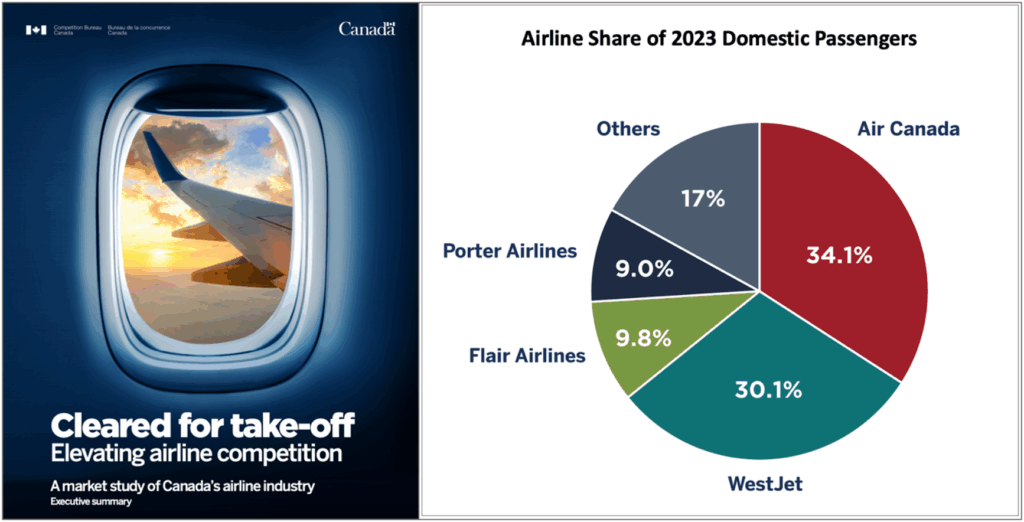
The Competition Bureau of Canada notes that Air Canada and WestJet dominate domestic air travel and account for an astonishing 78 percent of all seats sold on certain routes.
xThe Competition Bureau of Canada notes that Air Canada and WestJet dominate domestic air travel and account for an astonishing 78 percent of all seats sold on certain routes. (Source of chart: Competition Bureau of Canada)

As we can see, Cournot’s theory provides a reasonably accurate summary of the situation in Canada’s airline industry. Due to restrictions on cabotage that block foreign airlines from competing on domestic Canadian routes, the result is the same as with the poorly-capitalized domestic discount brands such as JetsGo or Canada 3000. On many major domestic routes, the two large carriers account for a majority of capacity. Air Canada and WestJet thus both realize that their capacity decisions can have a noticeable effect on the market as a whole. If one decides to increase the number of seats it offers on a particular route, total capacity will rise and seat prices will fall.

This theory is readily translated into real-world evidence. As a June 2025 market summary by the Competition Bureau of Canada reports, “Canada’s domestic aviation sector is highly concentrated, with two leading carriers. At Canada’s eight busiest airports, in 2023 Air Canada and WestJet accounted for half to three quarters of all domestic passengers combined (56% to 78%).” As mentioned above, the only partial threats to this pair are the bespoke Porter Airlines and unsteady discounter Flair, which has just 20 aircraft.

As the bureau’s report reveals, the vast majority of routes in Canada are served by only one or two airlines. While conclusions regarding prices can be tough to tease out because of dynamic pricing models, in which the price of a ticket for a particular flight fluctuates constantly, the Competition Bureau says its research shows prices are 9 percent lower when there was one additional competitor, such as Flair, flying a particular route, dropping the average ticket price by $27.80. “This shows that competition drives airlines to improve, and passengers benefit,” the report states. Other evidence has similarly revealed that Canadians pay some of the highest prices in the world for airline tickets. In 2017, online travel agency Kiwi.com calculated that Canadians paid nearly double the price as Americans for similar distance domestic flights.
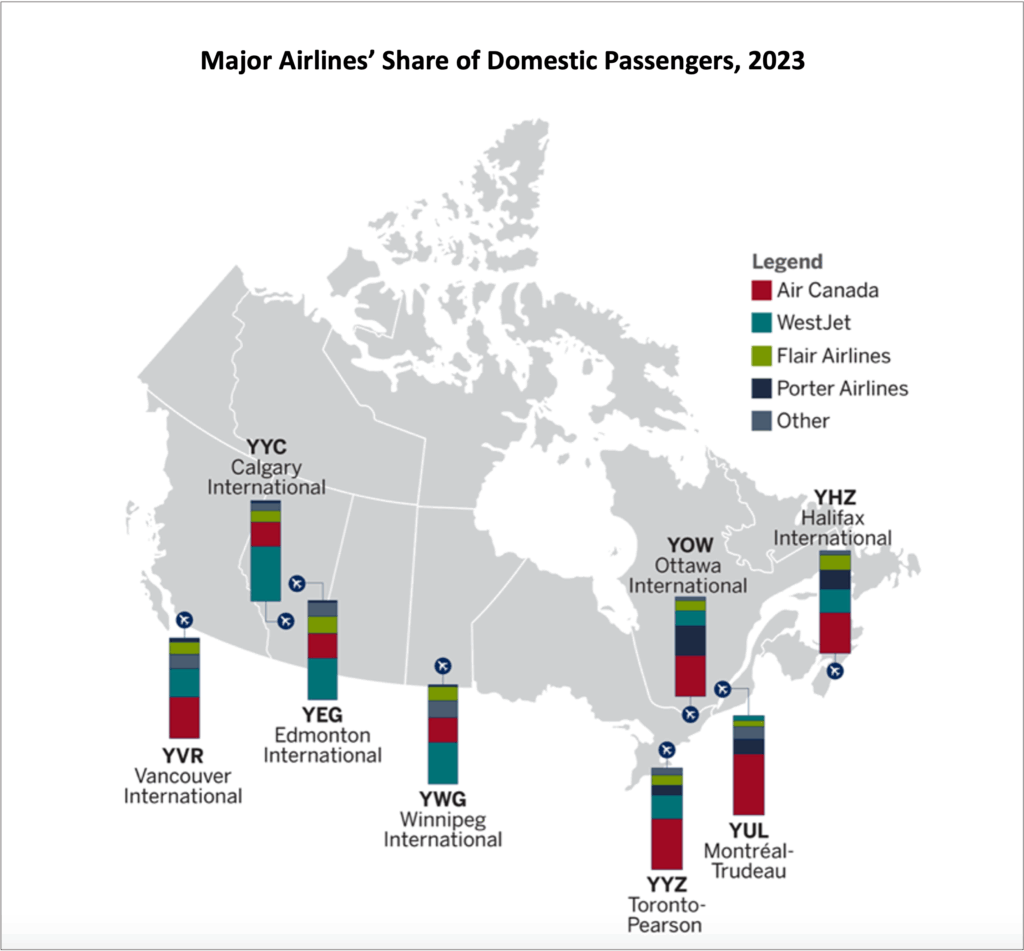
Half for you, half for me: Air Canada and WestJet’s duopolistic dominance has allowed the two companies to informally divide the country between them, with Air Canada dominating eastern Canada and WestJet stronger in western Canada.
xHalf for you, half for me: Air Canada and WestJet’s duopolistic dominance has allowed the two companies to informally divide the country between them, with Air Canada dominating eastern Canada and WestJet stronger in western Canada. (Source of graphic: Competition Bureau of Canada)

Of further concern, the Competition Bureau found that starting in 2022, Air Canada and WestJet took steps to divide the country’s air travel market between them, with WestJet retreating to Western Canada and Air Canada focusing more on Eastern Canada. Air Canada, for example, dropped a number of direct non-stop international flights out of Western Canadian cities. This is a classic duopoly move: two competitors recognize their interdependence and take steps to mitigate it. As the bureau’s 2025 report states:  

“Air Canada and WestJet are competing head-to-head on fewer routes now compared to 2019. Air Canada and WestJet have both reduced their routes. From 2019 to 2023, Air Canada reduced its routes between top-35 Canadian cities by more than one tenth (12%) and WestJet by one fifth (20%)…There is also less overlap between these carriers: Air Canada now competes with WestJet on roughly six in 10 of its routes (61%), down from seven in 10 in 2019 (72%). Similarly, WestJet now competes with Air Canada on less than eight in 10 of its routes (77%), compared to more than eight in 10 in 2019 (83%).”

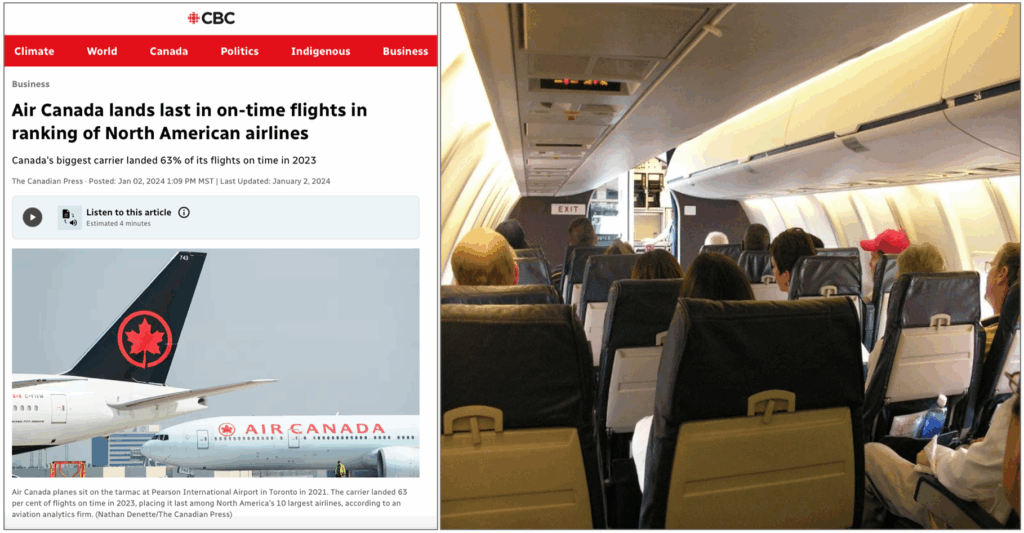
Tell me something new: Canadians have learned from bitter experience what a lack of competition does to service quality. According to aerospace analytics firm Cirium, in 2023 more than one-third of Air Canada flights failed to arrive or depart on time – the worst record among major North American airlines.
xTell me something new: Canadians have learned from bitter experience what a lack of competition does to service quality. According to aerospace analytics firm Cirium, in 2023 more than one-third of Air Canada flights failed to arrive or depart on time – the worst record among major North American airlines. (Source of right photo: Old Shoe Woman, licensed under CC BY-NC-SA 2.0)

Beyond affecting pricing and capacity, duopolistic behaviour can also be expected to degrade quality. While Cournot did not directly address this issue, it stands to reason that with fewer competitors, there will be less of an urge to provide top-notch service. Again, real world evidence supports the theory. In 2022, Air Canada and WestJet were ranked worst in North America for flight delays. In 2023, Air Canada had the worst on-time metrics among all major North American airlines, according to the aviation analytics firm Cirium. Stories of ever-smaller and less appetizing meals – and eventually, no food at all – are too numerous to count. More recently, WestJet outraged thousands of customers in announcing it was eliminating reclining seatbacks in economy class; it only relented after furious pushback.

Federal regulations in Canada prohibit foreign airlines from operating domestic services between Canadian destinations, a practice known as cabotage. Additionally, foreign ownership of any Canadian air carrier is capped at 49 percent, and no single non-Canadian investor is permitted to own more than 25 percent of a domestic airline. These restrictions have resulted in a highly concentrated domestic aviation sector. In 2023, Air Canada and WestJet accounted for between 56 percent and 78 percent of all domestic passengers at the eight busiest Canadian airports, according to data from the Competition Bureau of Canada. The bureau further found that starting in 2022, the two carriers began to divide the Canadian market amongst themselves, with WestJet retreating to Western Canada and Air Canada focusing on Eastern Canada.

Who Wants Bad Service?

Given the significant impact on travellers from higher prices and lower-quality service arising from Canada’s airline duopoly, the question arises: who would defend such a situation? Proponents of the status quo frequently mention national security as their prime concern. Domestic air travel is so crucial to Canada’s security, the argument goes, that any airline plying our skies must be reliably loyal to the concept of Canada itself. To some, this means every airline must be headquartered in Canada. While national security is a legitimate issue, such claims are often used as cover for other, more political efforts.

Forget cheap airfares, we want union jobs: Canadian Union of Public Employees national president Mark Hancock loudly opposes foreign competition in Canada’s skies, largely because new entrants would threaten his members’ stranglehold on the domestic air travel industry.
xForget cheap airfares, we want union jobs: Canadian Union of Public Employees national president Mark Hancock loudly opposes foreign competition in Canada’s skies, largely because new entrants would threaten his members’ stranglehold on the domestic air travel industry. (Source of photo: The Canadian Press/Sammy Kogan)

The Canadian Union of Public Employees (CUPE) sums up the prevailing nationalistic attitude. In a response to the Competition Bureau’s report on domestic airline competition, CUPE National President Mark Hancock took rhetorical flight. Any plan to allow greater competition, he insisted, “is not about giving Canadians more affordable air travel – it’s about handing control of our skies to Wall Street and foreign corporations…Canadians want safe, reliable and affordable service, not a race to the bottom.” Hancock’s statement implicitly acknowledges that if Canadians were offered foreign alternatives, they might find them preferable to what is currently on offer. If Canadians actually had access to “reliable and affordable service” on domestic routes, in other words, there’d be no need to worry about the entry of foreign firms. But of course, we don’t have a competitive market.

With regard to national security, evidence from other parts of the world suggests that greater competition can occur without putting it at risk. Since market liberalization in 1993, airlines based in the European Union are allowed to pick and choose what routes they serve without regards to their home country. All airlines flying from point to point in the EU are headquartered in EU countries and subject to the same security and legal protocols; as such, the home country of each airline is irrelevant. This makes national security a non-issue. Of greater interest is what liberalization or deregulation can do for prices and service.
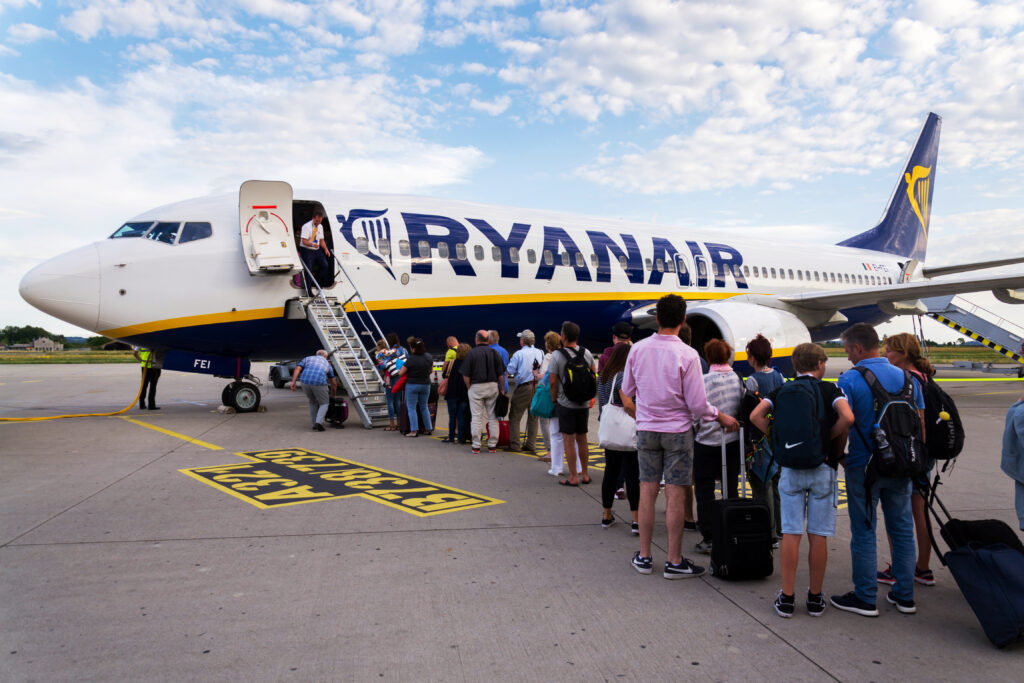
May the wind always be at your back: Following the European Union’s liberalization of air travel in 1993, budget airlines such as Ireland’s Ryanair became hugely successful by offering flyers ultra-low airfares throughout Europe.
xMay the wind always be at your back: Following the European Union’s liberalization of air travel in 1993, budget airlines such as Ireland’s Ryanair became hugely successful by offering flyers ultra-low airfares throughout Europe. (Source of photo: josefkubes/Shutterstock)

After deregulation in 1993, European airlines experienced a dramatic growth in their “hub-and-spoke” networks. This refers to an airline route system wherein a central hub airport connects to multiple smaller airports via shorter spoke flights, allowing airlines to serve many cities efficiently without operating direct flights between all locations. This is how low-cost carriers such as Ireland’s wildly successful Ryanair have been able to flood the European market with cheap fares across numerous destinations. To take a recent price example, a person can currently fly Ryanair from London’s Stanstead Airport to Geneva, Switzerland for $49. Flying the slightly shorter distance from Calgary to Vancouver, by contrast, typically costs $150 to $200.

A report by the International Transport Forum of the Organization for Economic Co-operation and Development (OECD) offers clear empirical evidence of this competitive effect. Revenue passenger kilometre (RPK) is a standard measure of airline service, capturing how much passenger transportation an airline sells by combining passenger volume and flight distance in a single indicator. One RPK corresponds to one paying passenger flown one kilometre; total RPK is the number of paying passengers multiplied by distance travelled. Airline yield is another key indicator which measures the revenue earned per unit of passenger transportation; it can be calculated by dividing total passenger revenue by total RPK. Yield is widely used in airline economics because it allows for meaningful comparisons across routes, airlines and markets with different flight lengths.
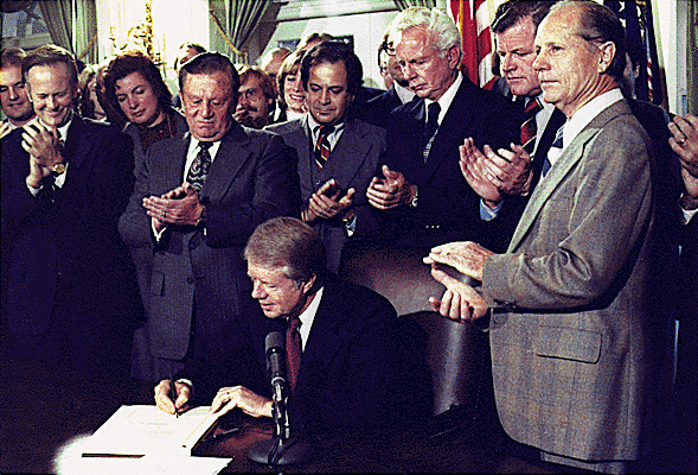
U.S. president Jimmy Carter’s 1978 deregulation of the American airline industry paved the way for greater airline competition around the world, and led to the mass democratization of air travel. Between 1978 and 2006 the annual number of air passengers in the U.S. nearly tripled.
xU.S. president Jimmy Carter’s 1978 deregulation of the American airline industry paved the way for greater airline competition around the world, and led to the mass democratization of air travel. Between 1978 and 2006 the annual number of air passengers in the U.S. nearly tripled. (Source of photo: Jimmy Carter Presidential Library & Museum/White House Staff Photographers)

The OECD research shows that after the EU’s 1993 liberalization, yield among participating airlines decreased in real, inflation-adjusted terms from US21¢/RPK in 1990 to US9¢/RPK in 2013. This stunning 57 per cent drop can be credited to increased competition, the erosion of the “national carrier” concept through cabotage and the rise of low-cost carriers. With more airlines flying on more routes from point to point throughout Europe, legacy air carriers lost their ability to constrain supply in order to raise prices.

European results mirror the earlier deregulation of the U.S. airline industry, which began in 1978 under President Jimmy Carter. Once rigid federal control of air travel was abolished, American airlines began innovating with the hub and spoke system that has since become standard for global air travel. And the impact on fares was swift and certain. A 1997 report by the Brookings Institution estimated that liberalization had lowered fares by 20 per cent.  Another report in 2009 in the Journal of Transport Geography found a much wider swath of advantages. “After experiencing 30 years of deregulation in the US airline industry, most observers agree that it has been a success, particularly in lowering average fares, providing more flights and increasing carrier efficiency, while maintaining a good safety record.” Between 1978 and 2006, the annual number of air passengers in the U.S. nearly tripled from 275 million to 750 million, a mass democratization of air travel driven by lower fares and better service, all made possible by the unleashing of new competitive forces.  

How to Get from Here to There

Having established the theoretical and empirical problems with Canada’s airline industry, the next step is fixing the situation. The most obvious solution lies in emulating competitive reforms that have proved highly effective in other markets. For Canada, this means letting more airlines fly by lifting cabotage restrictions and removing foreign ownership limits. There are several ways this could be done.

In its aforementioned 2025 report, the Competition Bureau recommends creating a special class of “domestic-only” foreign-owned airlines. This, the bureau claims, will attract greater capital investment and unleash more competition, leading to lower fares; Australia, a country with similar geography and airline concentration as Canada, has pioneered this approach. The bureau also promotes a “stepwise” approach to lowering foreign ownership limits on all airlines operating in Canada through international agreements. Incorporating cabotage into air treaties with other countries means Canada could permit airlines from friendly or allied countries to serve domestic airports while blocking access by others.

Evidence from the 1993 liberalization of the airline market in the European Union shows that allowing airlines from one country to fly passengers from point to point in another country, what is known as cabotage, resulted in the creation of numerous low-cost airlines offering cheap air fares. The 1978 deregulation of the United States’ airline industry also resulted in lower fares and better service. In Canada, where cabotage is not allowed, research on domestic flights reveals that the presence of one additional competitor on a specific route pushes prices down by 9 percent, for an average ticket price reduction of $27.80. In 2017, online travel agency Kiwi.com reported that Canadian air fares were twice as expensive as U.S. air fares on flights of a similar length.

In a paper published last year for the Centre for Civic Engagement, Vincent Geloso, a professor at George Mason University and senior economist at the Montreal Economic Institute (MEI) considers a variety of other possible solutions to air travel liberalization. Among them, “consecutive” cabotage rights. Here, regulators could allow foreign airlines to move Canadians between Canadian destinations, but only if those passengers were then flying on to another country. Consecutive cabotage would allow Air France, for example, to fly passengers from Edmonton to Montreal in order to connect with another flight to Paris; but Air France would not be allowed to simply fly passengers between Edmonton and Montreal.

xShock therapy is the best medicine: Vincent Geloso, senior economist with the Montreal Economic Institute and a professor at George Mason University, argues that Canada’s best path forward lies in rapidly removing all barriers to entry in the air travel industry and letting foreign carriers compete head-to-head with Air Canada and WestJet. (Source of right photo: ValeStock/Shutterstock)

Preferable to any limited type of reform, Geloso argues, is what he calls “shock therapy”. This would involve the “total elimination of all cabotage prohibitions except where they clearly clash with national security considerations…No gradualism, no incrementalism, just a straight-up overnight opening of the market.” Doing so, Geloso predicts, would create an onrush of new providers – most likely well-capitalized foreign airlines better able to weather the competitive storm than the long list of failed Canadian efforts. “A larger number of providers, a larger number of service points and, most importantly, lower fares,” Geloso predicts. This would be very different from the Competition Bureau’s “stepwise” approach.

A report by the Fraser Institute also from last year similarly promotes the benefits of erasing cabotage and foreign ownership restrictions quickly. In addition to citing the recent Competition Bureau analysis, authors Jack Fuss and Alex Whalen recap how liberalizing Canada’s airline industry has been a decades-long crusade. This includes a 2006 report by the MEI as well as the 2015 multi-volume federal review of the Canada Transportation Act, colloquially known as the Emerson Report. The Emerson Report, which called for large-scale deregulation across numerous transportation sectors, was originally commissioned by the Conservative government of Prime Minister Stephen Harper but delivered to – and utterly ignored by – the incoming Justin Trudeau Liberal government.

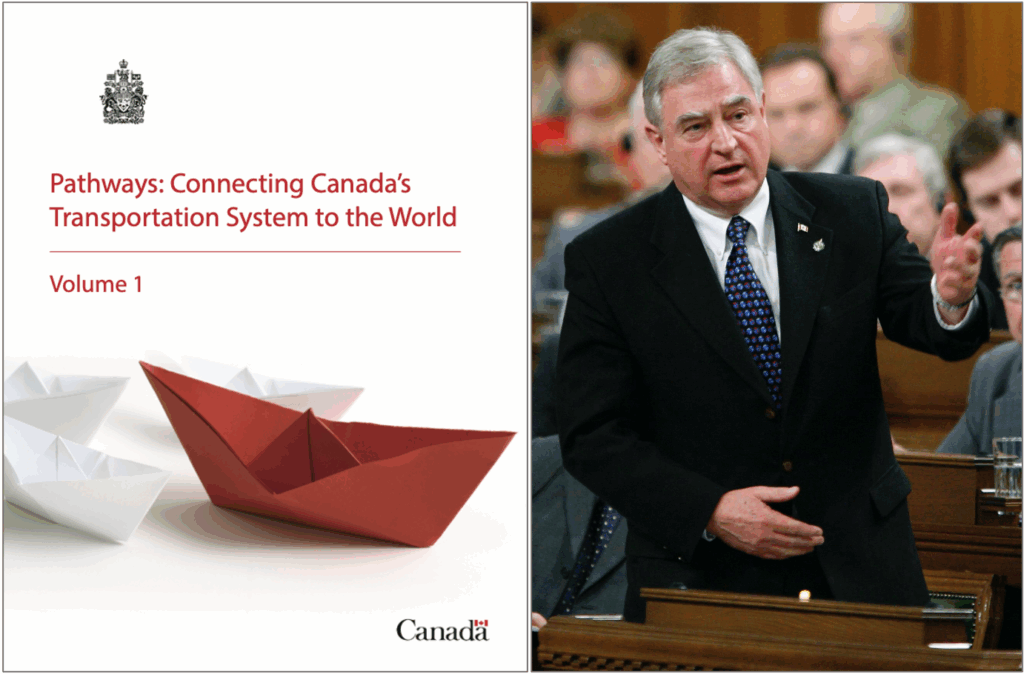
Repeat as necessary: Recent calls for greater competition in Canada’s domestic airline industry echo the findings of many earlier studies, including the 2015 federal review of the Canada Transportation Act by former federal Transport Minister David Emerson (right).Repeat as necessary: Recent calls for greater competition in Canada’s domestic airline industry echo the findings of many earlier studies, including the 2015 federal review of the Canada Transportation Act by former federal Transport Minister David Emerson (right). (Source of photo: The Canadian Press/Sean Kilpatrick)

After demonstrating how “air travel in Canada is currently rife with customer service dissatisfaction, questionable service quality, high ticket prices and a lack of consumer choice,” the Fraser study – which also examines other aspects of Canada’s hidebound air travel regime including airport ownership as well as the exorbitant taxes and fees paid by airport travellers – offers a single, succinct policy recommendation:  

“Ottawa should adopt a fully-privatized for-profit airport ownership structure, remove cabotage restrictions, make taxes and fees more competitive and actively pursue deregulation in Canada’s air travel industry.”

Crucially, what the Fraser Institute has to say about the airline industry applies equally well to the rest of Canada’s economy. The problematic barriers to open markets that define Canadian air travel are not unique to that one industry. The same lack of dynamism, innovation and competitive spirit embedded in the cozy Air Canada/WestJet duopoly can also be found in a troubling number of other Canadian industries, including banking, broadcasting, telecommunications, insurance and supply-managed agriculture, among others. All these oligopolies are protected by various federal regulations and laws from domestic and/or foreign competition and from foreign ownership. The addition of new entrants would almost certainly improve pricing, product/service choice and quality in all these industries – in many cases, radically so. By embracing the spirit of competition in air travel and beyond, Canadians could soon find that the sky’s the limit.

Simon Michell is a second-year student in McGill University’s joint Economics/Mathematics honours undergraduate program. This is an edited and expanded version of his third-place-winning entry in the 3rd Annual Patricia Trottier and Gwyn Morgan Student Essay Contest.  

Source of main image: Canva AI.

Love C2C Journal? Here's how you can help us grow.

More for you

Take This Algorithm and Shove It: Gen Z Wrestles with Digital Privacy

Generation Z should know better than anyone the risk that technology poses to personal privacy. They are after all the first generation to grow up entirely in the digital age. Jessica Nwaefidoh knows from personal experience how vulnerable your most intimate information can be. With companies anxious to profit from everyone’s personal data, politicians happy to play along for their own selfish reasons and most people willing to sacrifice their own privacy for convenience, amusement or just to get by, Nwaefidoh argues that it’s time to fight back. The right to be left alone, she finds, requires constant vigilance – and she offers some practical tactics to reclaim that right.

Future Tense: Why Gen Z is Right to Feel Betrayed

Older generations often roll their eyes when young people seek to blame them for their woes. But if Canada’s Gen Zers feel betrayed by the Boomers, they are right to do so, argues Gwyn Morgan. Years of irresponsible fiscal and regulatory policies have hamstrung the Canadian economy and left younger generations facing a bleak future of stagnant wages, rising taxes and shrinking opportunities. A former business leader who created more than his share of jobs and prosperity during his long corporate career, Morgan casts a worried eye over the next generation – and offers sympathy for the situation they’re inheriting.

The Real Truthtellers: Canada’s Unsung Defenders of Historical Fact

Canada, the old saying goes, suffers from too much geography and too little history. That ratio is getting even more out of whack. Since the election of Prime Minister Justin Trudeau in 2015 and gathering speed following allegations of mass graves in Kamloops in 2021, many of Canada’s most important historical figures have been erased in a tidal wave of cancellations and repudiations – all driven by a mob of woke activists uninterested in the true facts of Canada’s past. But as Jerry Amernic discovered while researching a book on historical revisionism, there are still those who believe Canadians can handle the truth. And they’re working hard to rescue our nation from the history hijackers.

More from this author