In 2022 I ran for school board trustee in Ward 15 of the Hamilton-Wentworth District School Board (HWDSB). With my son entering high school, my motivation was personal. I had serious concerns about how our local schools were operating and what our children were learning. My platform was based on protecting free speech, keeping parents informed and promoting merit-based education. During the campaign, I spoke to many parents who shared my concerns. And while I didn’t win, I felt my efforts struck a chord, given that I received 41 percent of the vote.
The experience energized my interest in participating in the school system. And so the following year when my son’s school asked for parent volunteers to serve on school council, I put my hand up. The council was promoted as a place where parents could raise concerns and offer suggestions to school administrators; the positions are elected, but unpaid. At the time, major changes were occurring in the Ontario school system, including the de-streaming of Grade 9 math which appeared to be having an impact on Grade 10 math results. I thought the school needed to be more transparent with parents, and that the council was the place to push for that.
What I found was the opposite.
It didn’t take long for me to realize that the principal and the school board had little interest in what parents thought. Worse, the administrators seemed determined to push their own views on parents – whether that was allowed by provincial legislation or not. It wasn’t until I put the law in front of them, in writing, and refused to back down that the school board finally admitted the truth about how school councils are supposed to operate. And that was only after I was investigated – twice! – for bogus human rights violations and suspended from my elected position.
What I learned in my two-year battle with a publicly funded school board should matter to every parent in the country: the law may give parents a voice, but the system treats using that voice as an offence.
Who Wants to Be Chair?
By law, every school in Ontario must have a school council. Parents are supposed to make up a majority of the council, which can include several dozen members. In addition to parents, the principal is also a member, as are representatives of students, teachers, non-teaching staff and the community-at-large. Meetings are open to the public. According to the published rules, “the purpose of school councils is, through the active participation of parents, to improve pupil achievement and to enhance the accountability of the education system to parents.”
Ontario regulation 612/00 makes it clear the councils are self-governing bodies, with the power to create their own bylaws, set their own agendas, keep their own minutes and produce their own reports. Parents are allowed to serve for as long as their children attend the school. Every member except the principal has a vote. To be clear, a council is not an arm of the local school board, and nothing in the legislation says it should act as such. On paper, a school council appears to be a powerful tool for parents who want to make themselves heard. But to be heard, you have to participate.
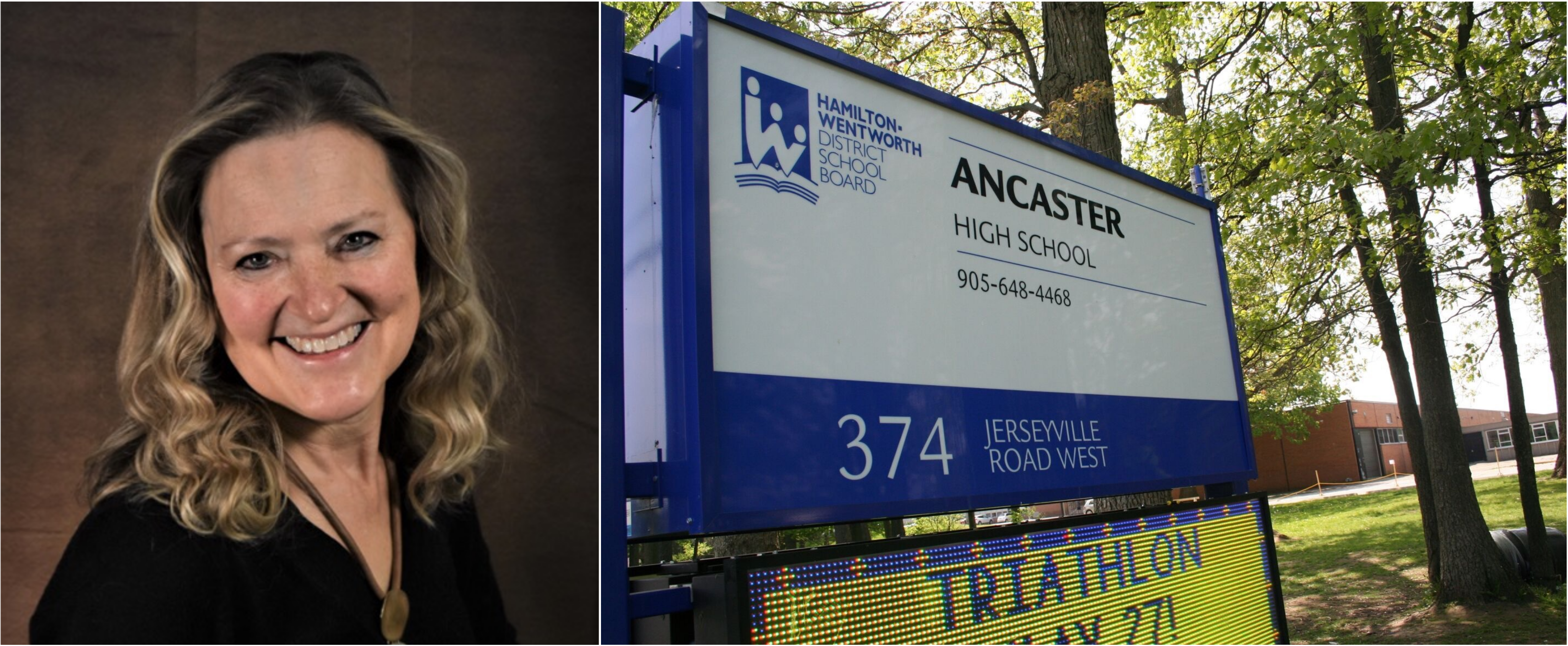
When I answered Ancaster High School principal Beth Woof’s call for candidates in October 2023, only five other parents volunteered alongside me. And even though I was a first-timer, I became chair by acclamation because no one else wanted the job. I agreed to fill the role because I had a vision for how to boost parental involvement. But other than one instance regarding a problem with the parking lot, school representatives seemed to care little about parents’ advice or concerns. What the board called parental engagement was entirely performative; I quickly learned that parents were meant to be an audience, not participants.
We listened to the principal and teachers report on renovation plans, clubs and school events, vaping concerns, course selection and whatever else they thought was interesting. This one-way flow of information seemed to me the opposite of the legislation’s intent. To achieve some balance, I proposed to bring in a speaker from the Ontario Institute for Studies in Education to discuss the link between ministry policies and our school’s disappointing math scores. The principal cancelled the talk, claiming it didn’t align with the board’s “strategic direction”.
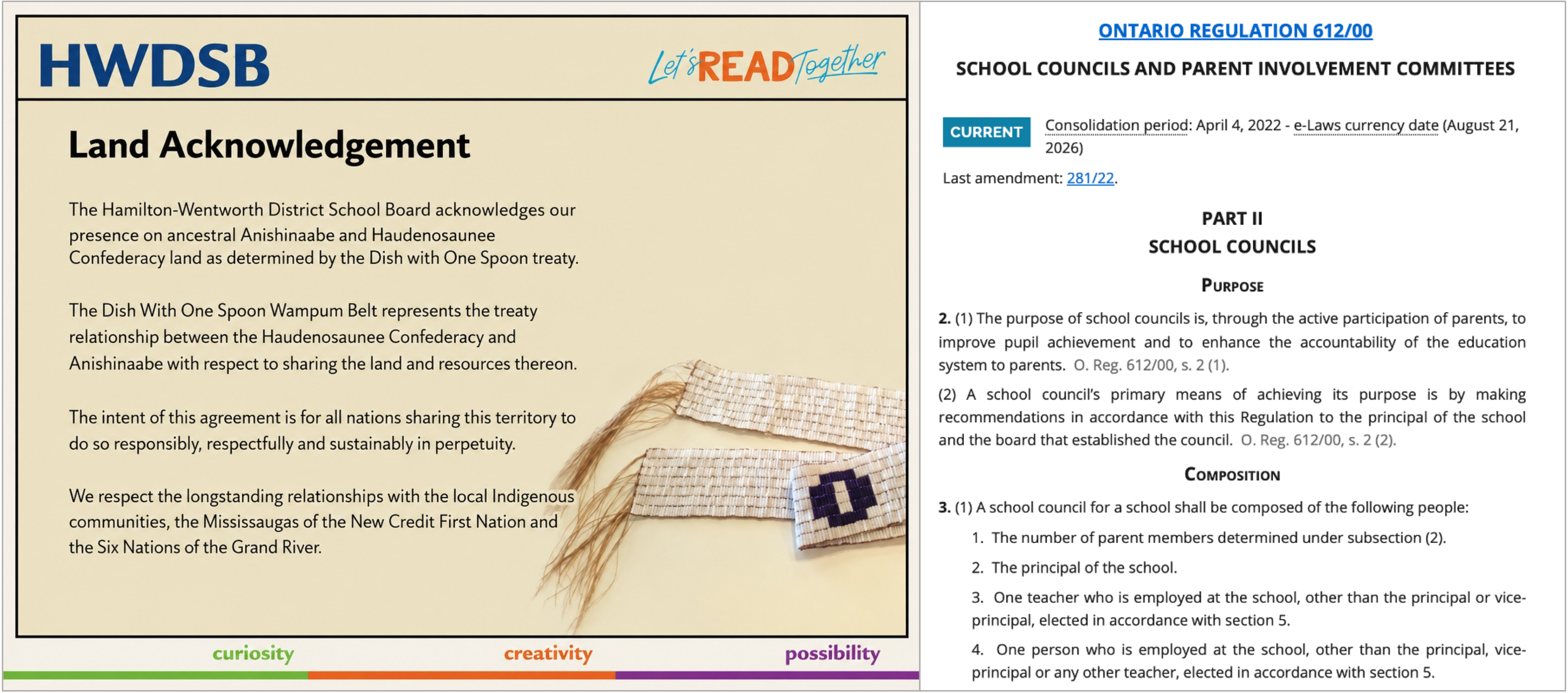
For me, the most grating and obvious way in which the school ignored our council’s independence concerned Indigenous land acknowledgements. These were delivered at the beginning of every meeting; and while no one said they were mandatory, everyone treated them as such. Several council members, however, told me privately that they disliked the concept. As a self-governing body, I figured we needed some clarity on the matter.
Mandatory Advice
The issue first arose at a meeting on April 29, 2024. As chair, I drew up an agenda without a land acknowledgement. As the meeting progressed, one member asked why we hadn’t done one. I replied that nothing in our governing legislation required us to do so. There was a brief discussion. I offered to put the matter to a vote, but Jason Monteith, the school’s new principal, intervened. From the school board’s perspective, he said “that[’s] typically how we proceed.” I replied, “It’s not a rule,” to which Monteith agreed. (These quotations are verbatim from audio recordings I kept of all school council meetings.) The meeting moved on without an Indigenous land acknowledgement.
Two weeks later, I met with school board trustee Amanda Fehrman at a local Tim Horton’s. She told me it was the HWDSB’s position that land acknowledgements are mandatory at all school meetings. When I asked for proof that the board could impose such a thing on an independent school council, she later sent me a section of the board’s 2022/23 School Council Handbook, entitled “Tips to consider when creating an Agenda.” It stated, “Always include a Land Acknowledgement/Welcome Address at the start of a meeting.” There is, of course, a huge difference between a “law” or “policy”, and a “tip to consider.” Did school board officials not understand this distinction? Or did they think I was stupid?
Having initially gotten involved in school council to improve communications between parents and the school, I knew it was wrong for the school to insist we open our meetings with an Indigenous land acknowledgement. And so I refused to drop the matter. These rituals are, after all, compelled speech, which I consider outrageous in principle.
Then there’s the matter of authority – both legal and moral. If the board could impose a land acknowledgement on an independent council, it could impose literally anything. I wrote back to Fehrman on May 16, 2024, copying all council members and school staff. School councils, I said, are “an important check and balance to uphold the accountability of the education system.” I noted that the board has “no authority over an apparatus that was designed to check its power.” In conclusion, I added, “We appreciate the advice [on land acknowledgements] but this is solely a matter for the council to decide.”
Not every member of the council felt as I did. Joanne Thompson, who had initially spoken up about the missing statement at the April meeting, contacted the school board’s director of education, Sheryl Robinson Petrazzini, and called my actions “disrespectful” and “disruptive”. Another member threatened “to leave council if, going forward, our school council decides not to acknowledge the land we are using.” Democracy exists to deal with differences of opinion like this.
The next day, with Monteith on parental leave, I got a call from the new acting principal, none other than former principal Woof. She informed me that two parents “perceive some harm done” from my stance on land acknowledgements. I took this as a warning. I could not let such an absurd escalation stand unchallenged. There were other parents, I replied, who told me they felt unable to speak out about certain topics precisely because of attitudes like this. “We need to be able to discuss things without charging that each other is being harmed by this,” I said.
Woof cited HWDSB’s human rights and equity advisor, Yohana Otite, and superintendent Paul Denomme as her authorities in arguing in favour of the land statements. She used the phrase “Thou shalt” twice in our conversation, which I also recorded. The board’s position, she opined, was “rooted in the Ontario Human Rights” framework.
Three weeks earlier, I had been told at a council meeting that no rule required a land acknowledgement. Now I was being warned that to even question the necessity of such a thing could be treated as a human rights infraction. Still, as council members had already agreed to skip the school year’s final meeting, I thought the matter was over. Not exactly.
“Harm” Is Alleged
When the 2024-25 school year began, I was told I was under investigation by the board. A letter signed by HWDSB superintendent Lindsay Snell and Otite explained that three students had submitted a complaint the previous Spring alleging I had committed a human rights violation. The letter admitted these students had not actually attended the meeting, but had “received reports from school council members” that I had caused harm to Indigenous and/or black students when, as chair, I “refused the reading of the Land Acknowledgment.” The students were thus claiming others had been harmed after hearing second-hand about something I didn’t say. The letter recommended I recuse myself from all further school council meetings until the investigation was complete. The board was essentially asking me to suspend myself from an elected position and remain silent about why I had disappeared. That seemed farcical. It was time to lawyer-up.
I immediately reached out to the Justice Centre for Constitutional Freedoms (JCCF), whose work I knew from the case of Carolyn Burjoski, a Waterloo Region District School Board teacher who had been unjustly censured for merely asking questions about the content of some controversial library books during a board meeting. (She later reached a settlement with the board.) Thankfully, the JCCF agreed to represent me.
As the first council meeting of the 2024-25 school year approached, I refused to let the investigation impede my duties as chair. I was still responsible for setting the date for the new council elections and managing the meeting agenda, both in consultation with the principal. Plus, there was unfinished business left over from the previous term, including the approval of the minutes from our newly-contentious April 29, 2024 meeting. Those draft minutes had been circulated to council members and no one had objected; even Thompson – who originally raised the issue of the missing land acknowledgement and would go on to become co-chair after me – said the minutes “look fine.”
Prior to that first meeting, Monteith, now back from his parental leave, phoned to ask if I intended to deliver an Indigenous land acknowledgement. I told him that was for council to decide by a majority vote, and that I would defer to whatever council decided. The principal – who it bears repeating is a non-voting member of the council – said such a democratic solution constituted a problem for him. As “an agent of the board” he said he would read a statement himself if no one else did. He later sent his own agenda to all parents without my agreement, usurping my role as chair. When I asked under what authority he’d done so, his reply was, “I’ve been directed to…[by] my senior team.”
Monteith acknowledged that I was still chair and said I could offer a welcome to open the meeting. But after that he intended to take over the meeting. Further, he said the April minutes would not be approved and the land acknowledgement “will have to be read.” He added, “if there’s harm in the space then I’ll have to stop whatever that is.”
Minutes to Memories
The meeting was eventually held on October 16, 2024. HWDSB superintendent Simon Goodacre, who supported all school councils across the board, attended in person. Prior to the election of new members, I explained that the required notice had not been given and that the agenda had been imposed without the input of the chair. Under such circumstances, it was unclear whether the elections could be considered valid. Goodacre didn’t answer my legal objection and instead announced that the meeting had “the knowledge and support of the board in moving ahead.” Monteith then read the Indigenous land acknowledgement and the election proceeded. The board did not formally remove me from council; it simply prevented me from acting as chair by taking over the meeting.
When I raised the issue of the unapproved minutes from last April, Goodacre said they would not be approved due to “the harmful nature of that meeting.” (Quotations from this meeting are taken from the official record.) His attempt to make these minutes disappear, presumably because they were contrary to the board’s current position, struck me as another egregious example of how the original intent of school councils had been perverted. I kept pressing.
At the next meeting in November, I again raised the issue of the missing minutes. After saying he’d “choose [his] words carefully,” Monteith declared once more that the minutes would not be approved because of “the impact that they may have.” Not only was the school board withholding approval of the minutes, it was preventing council members from even discussing them. For the record, Section 16. (1) of On Reg. 612/00 states unequivocally that, “A school council shall keep minutes of all of its meetings and records of all of its financial transactions.”
When I refused to back down, another council member turned to me and said: “We’re 25 minutes into the meeting and all you’ve done is talk about the April minutes, which quite honestly do not paint you in a good light. So I would move on if I were you.” As the council’s secretary, Roxane Dunmore, later put it, my pursuit of the April minutes “did not provide a good look for Catherine.” Those minutes were later reviewed and fully approved.
Cleared, But Still Kinda Guilty
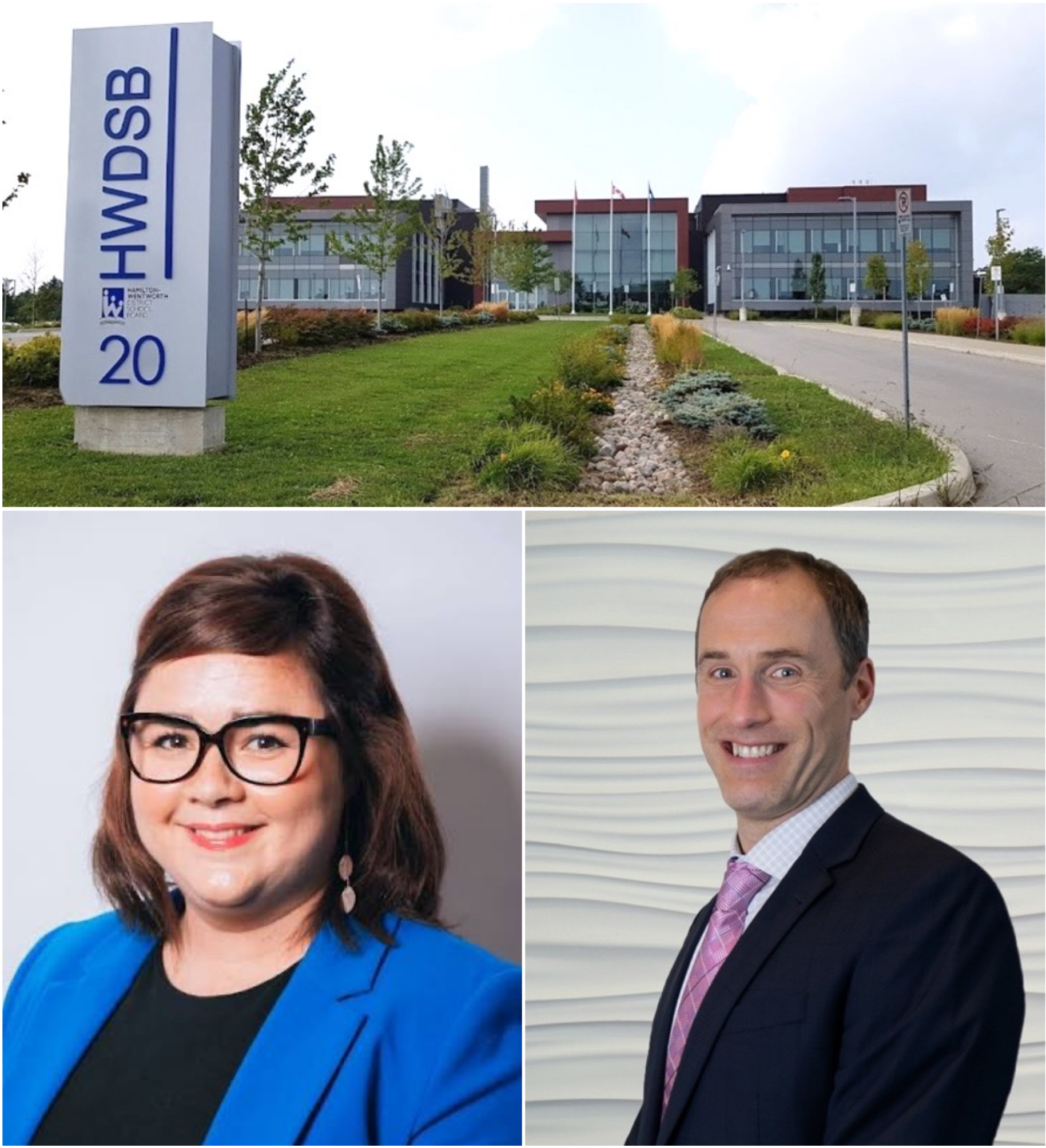
In an effort to get to the bottom of the ongoing impasse between council and the board, in February 2025 I met with HWDSB superintendents Snell and Goodacre via MS Teams. Snell had signed the original investigation letter about the “harm” I’d allegedly caused, while Goodacre had orchestrated the coup at the council meeting and was instrumental in blocking the missing minutes. I repeatedly made my point that nothing in Ontario’s Education Act or its related regulations gave either of them the authority to act as they had. In response, Goodacre claimed there were “two competing priorities” at play. (By then I was recording all our meetings.) In cases where the regulations lack specificity, he said, it was up to the superintendent “to look at those regulations and make a decision.” For her part, Snell claimed to be acting on behalf of “the spirit of what we’re trying to achieve with school council beyond legislation.”
While Snell refused to answer my direct question about whether this “spirit” superseded written legislation, the significance of her phrase suddenly hit me. I had been given a glimpse into the animating concept behind the board’s entire campaign against me. The same unwritten spirit that required Indigenous land acknowledgements before every school council meeting also governed the board’s other woke crusades regarding equity, race and social justice. Any parent who insisted on a contrary – or, shall we say, “legal” – interpretation of the board’s duties and obligations was thus working against this motivating spirit. And the board had ways of making life difficult for people like that.
Still under a confidential human-rights investigation, I entered the council’s February 2025 meeting determined to say as little as possible. When I explained that it had become impossible to talk freely on important matters before council, neither Monteith nor Vice-Principal Cherie Mills showed any concern. Instead, Monteith seemed to raise the stakes in ominous fashion, warning the members that stepping outside HWDSB’s Code of Conduct allegedly meant “the HWDSB cannot support indemnification” in any legal matters that might arise. I considered it another warning.
On March 18, 2025 I finally received an official “Outcome Letter” from the HWDSB’s Human Rights Office regarding the harm I’d supposedly caused. The conclusion: there was insufficient evidence to conclude I had violated the school board’s human rights policy. Despite the exoneration, however, the letter went on to say that my conduct had created “significant tension and conflict” and that I had used my position as chair to “impose my own opinion and stance on land acknowledgments.” The recommendation was that all council members receive lessons on “meaningful land acknowledgements.” The board, by the way, never followed up on this insulting recommendation.
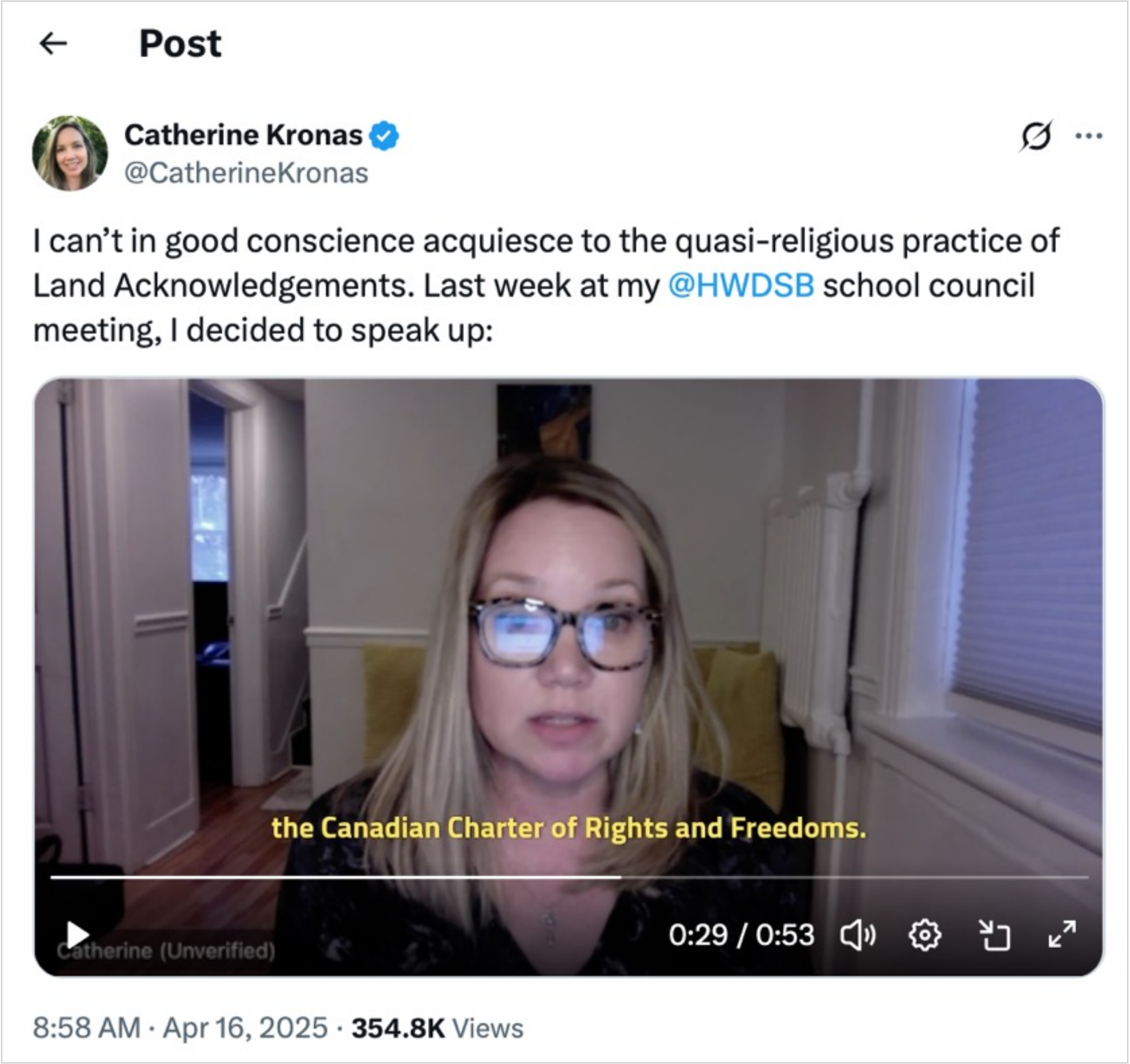
Three weeks after the investigation closed, council met and Monteith opened with an Indigenous land acknowledgement. I sat quietly but asked that my objection to it be recorded in the minutes. No one reacted while Monteith agreed to make a note of it. The meeting moved on. A week later, on April 16 I posted a video about my objection on X, along with my views on the quasi-religious nature of such statements.
In speaking my mind publicly in this way, I apparently violated the HWDSB’s animating spirit once more. Five weeks after my X post, the board informed me that I had been suspended from council because I had “allegedly engaged in conduct that has caused harm and is not in compliance” with board policy. Nothing in provincial legislation permits such a suspension. The JCCF immediately launched corrective legal action. Barred from the last meeting of the year, I asked Juno News to attend and see whether my objection made it into the minutes. The new co-chair Thompson instead deferred the minutes to next year’s council – a council that did not yet exist.
Surprisingly, while I was suspended, the long-lost minutes of the April 29, 2024 meeting mysteriously appeared on the school council’s website. Curiouser still, the version posted had never been approved by council and did not match the original draft that had been circulated. The entire exchange about Indigenous land acknowledgements was gone. So too was the opening line of the original draft: “No agenda was sent prior to the meeting due to a breakdown in communication between Mr. Monteith and Catherine.” The board had spent eight months refusing to let council approve these minutes because the meeting was “harmful”. And then it posted a sanitized version in my absence.
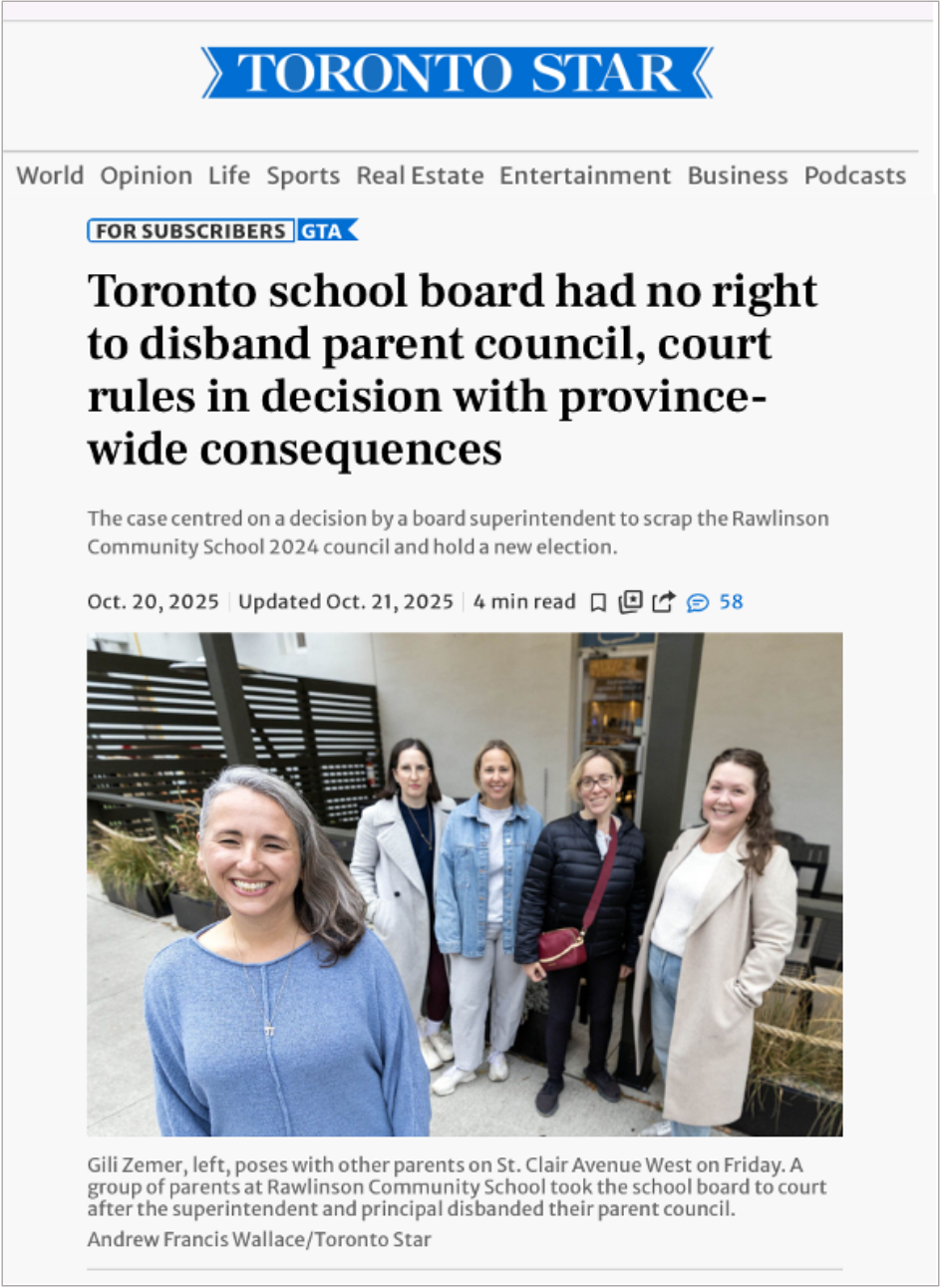 Vindication: The October 2025 Zemer v. Toronto District School Board ruling by Ontario Divisional Court states unequivocally that school councils are not under the control of school boards and can set their own policies and procedures. This decision is directly relevant to Kronas’ struggle with her own school board.
In spite of an unequivocal court ruling, in February 2026 the new chair of the Ancaster High School Council, former secretary Dunmore, claimed the issue of a land acknowledgement was no longer up for debate; based on board policy, it’s now mandatory. When I tried to put the matter back on the agenda, Dunmore refused, stating “the government says this is what we have to do.”
Later that month, I again wrote to Petrazzini asking for a clearer answer on land acknowledgements, given the Zemer ruling. Considering all the hassles and hostility I had faced up to that point, her response now seems stunning. While the board took the position that school council meetings “should begin with a Land Acknowledgement” she admitted that doing so was “not legally mandatory under current by-laws.” Not legally mandatory. I finally had in writing what the school board had refused to admit for so long. There was no rule and never had been. This was vindication. So why didn’t it feel like a victory?
The Broader Struggle
Stories similar to mine have been popping up all across Canada in recent years. In Sechelt, British Columbia, Lara Yates objected to a land acknowledgement prior to a performance at her daughter’s school and was promptly barred from Chatelech Secondary School by Sunshine Coast School District 46. Astoundingly, provincial child protection services were then called to investigate her. The Free Speech Union of Canada challenged Yates’ punishment through an internal appeal but it was ultimately upheld.
In Waterloo Region, Geoffrey Horsman, a biochemistry professor at Wilfrid Laurier University and member of the Kitchener-Waterloo Collegiate and Vocational School’s council, launched a judicial review after the local school board said his council was required to start every meeting with an Indigenous land acknowledgement and then barred its members from even discussing the practice. The board’s legal filings claim the council decided this on its own, although an email the board itself wrote says otherwise.
While these cases and mine all focus on the contentiousness of land acknowledgements, the underlying tension runs much deeper. The foundational issue at play concerns school boards assuming authority that legislatures never gave them. And in furtherance of an ideology that many Canadians strongly disagree with. While the democratic process is meant to resolve such issues, the school boards involved tend to display an alarming tendency towards tyranny. Yates was dealt with swiftly and summarily. Horsman is in the midst of his own legal battle.
In my case, the board initially didn’t need to bare its teeth. Its first choice was to try to convince parents it was in charge by remaining vague about the truth. It was only when I repeatedly pointed out the falsity of its position that the board moved to investigate me twice, and then unjustly suspended me from my elected position as chair.
Again, my dispute was not simply about land acknowledgements. As chair, I had offered council members the opportunity to vote on the matter and was perfectly willing to abide by whatever we decided. But the board didn’t want that to happen. My main objection was the way a public institution sought to make its preference a requirement for all.
A school board imposing an obligation to repeat a land acknowledgement at the start of every meeting is an obvious case of compelled speech, which certainly seems contrary to the free speech guarantees of Canada’s Charter of Rights and Freedoms. I kept pressing this matter long after other councillors grew tired of my crusade because I’d read the law and knew it was on my side. And because I considered the principle at stake to be more important than avoiding conflict at all costs.
Is this what Parental Empowerment is Supposed to Feel Like?
Receiving Petrazzini’s letter was an emotional experience for me. After two years of punishing trench warfare against an unapologetic and arrogant institution, I had finally won the argument. The letter was an admission by the HWDSB that there’s no rule requiring school councils to read an Indigenous land acknowledgement. And this after the board went to great lengths to insist that such a rule existed.
I should have felt elated. Instead the feeling was mostly one of futility. Having exposed the truth, I realized this was probably as much as I could ever hope to achieve. The current chair treated the board’s position as binding even after I put the Zemer ruling in front of her. And to be honest, few other parents showed the stomach for such a fight. On the other hand, I’ve since heard that at least two other HWDSB school councils do not read land acknowledgements, which seems like good news for the independence of councils in general. However, as the last school council meeting of the 2025-2026 year drew near — and with my son about to graduate, which meant this would be my last meeting ever – I decided to skip the final showdown. There was nothing more to be gained.
The significance of my decision soon came into sharper focus. When I emailed chair Dunmore asking for the approved minutes from the meeting I missed, she replied that if I had attended, I would have known there was no quorum, so the November and February minutes were never approved and no May minutes exist. Not only did I choose to miss that meeting – so did most of the other members. Without quorum, the meeting had to be cancelled. The ongoing controversies were thus deferred to the school year that will soon begin, when a new slate of council members will have to tackle them. Or not, if the board gets its way.
I have since come to realize that this is how struggles such as mine are likely to play out everywhere in Canada. Parents come and go. Institutions remain. Dedicated and persistent parents might win an occasional battle against an imperious school board, but only at great personal cost. And often only thanks to the help of organizations such as the JCCF, which are already stretched thin. With their unlimited resources and unshakeable self-righteousness, woke-minded school boards are heavily favoured to win in the end.
Seeing these lopsided battles play out, my concern is that ever-fewer parents will agree to take on the heavy task of holding our school system to account. Conceived as a way to allow parents to get involved, school councils seem fated to succumb to apathy as school boards seek ways to strip their power and neuter their effectiveness – from telling lies to suspending challengers just long enough so that everyone else gets the message. And right now, who is going to stop them? Removing the destructive wokeness embedded in Canada’s school system is going to take a lot more than has been achieved so far.
Despite the long odds, however, I’m not prepared to give up. And I hope others feel the same way.
Catherine Kronas is a Hamilton, Ontario parent and former chair of the Ancaster High School Council. Three terms on council taught her that legislative parental rights mean little without effective limits on institutional power.
Source of main image: Shutterstock.