
Diplomacy and Development

Stronger Alliances with First Nations Could Help Overcome Blockade Disruptions

Gwyn Morgan
March 4, 2020
The sight of Justin Trudeau’s ministers genuflecting before petty aristocrats, anarchists, tire-burners and masked thugs sickened millions of Canadians – and made some of us think about hoarding critical supplies. Aside from the venality and sheer ineffectiveness of the Liberals’ approach, Gwyn Morgan was struck by our enlightened rulers’ bone-headed misunderstanding of diplomacy. Going cap-in-hand to the people who despise you is unlikely to end well. And when there are other options, it’s unforgivable. Morgan suggests instead applying age-old principles of diplomacy – like supporting one’s allies to maximize their influence. He should know, for he has done it himself.
Diplomacy and Development

Stronger Alliances with First Nations Could Help Overcome Blockade Disruptions

Gwyn Morgan
March 4, 2020
The sight of Justin Trudeau’s ministers genuflecting before petty aristocrats, anarchists, tire-burners and masked thugs sickened millions of Canadians – and made some of us think about hoarding critical supplies. Aside from the venality and sheer ineffectiveness of the Liberals’ approach, Gwyn Morgan was struck by our enlightened rulers’ bone-headed misunderstanding of diplomacy. Going cap-in-hand to the people who despise you is unlikely to end well. And when there are other options, it’s unforgivable. Morgan suggests instead applying age-old principles of diplomacy – like supporting one’s allies to maximize their influence. He should know, for he has done it himself.
Share on Facebook
Share on Twitter

The year was 2015. We had gathered in the meeting house of the remote Tl’azt’en First Nation at Tache, 215 km northwest of Prince George. I was there as volunteer Chair of the B.C. Industry Training Authority (ITA), the organization responsible for funding and facilitating trades training in the province. Accompanying me were the ITA’s CEO, Gary Herman, and other board members who shared a passion for our dual mission of helping young people gain rewarding careers in the certified trades, while also providing the skills that individuals and organizations would need to carry out virtually any public or private project throughout the province.

Gwyn Morgan, Gary Herman and Andy Calitz believe passionately in trades training for young First Nations members.

One of the ITA’s board members was Andy Calitz, a South African engineer who had led LNG projects around the world. Now, Andy was the CEO of LNG Canada, a joint venture by international energy companies to develop Canada’s first large export facility for liquefied natural gas. It was Andy’s leadership and determination that would make the $40 billion venture situated at Kitimat – the largest industrial project in Canadian history – a reality.  

The natural gas supply for this massive project would be transported from landlocked northeast B.C. gas fields through the Coastal GasLink Pipeline. The pipeline’s construction would create opportunities for the Tl’azt’en and other First Nations members along its route to learn a trade that could provide them with satisfying and well-paying, potentially lifelong careers, and help provide prosperity for their communities.

Making history: LNG Canada’s export facility in Kitimat (digital rendering), now under construction, is the largest-ever industrial project in Canada.

But we faced a dilemma. Many young people from those remote villages lacked the academic qualifications normally required even to enter trades training. Learning a certified trade such as electrician, welder or heavy equipment mechanic is a four-year process of schooling and work experience. 

After wrestling with our dilemma, the ITA Board decided to create an entirely new certified trade called Construction Craft Worker. Through this program, trainees would receive the foundational knowledge needed to work safely as labourers, from where they could learn the skills needed to move into advanced trades. At the invitation of the Tl’azt’en Chief, Justa Monk, and Councillors, we came to discuss our Construction Craft Worker initiative.

xThe late Tl’azt’en Chief Justa Monk (above) welcomed IAT leaders in the hopes of securing employment for his members.

Chief Justa Monk offered a traditional welcome and I respectfully responded, describing our mission. Then came a memorable feast of bear, beaver, deer, elk and moose, along with fish from the nearby lake. It turned out to be an emotional day for all. The Chief was near tears as he told us that, while they had heard many leaders’ statements from afar aimed at First Nations, we were the first group of leaders to honour his people by travelling to their village. That meant more to the Chief (who has since passed away) and Council than we could have imagined. The many young band members in attendance expressed their hope that working on the pipeline might help them gain the trade qualifications needed to secure employment afterwards. 

Given their remote location, our board knew the Coastal GasLink Pipeline would be their only chance in a generation to achieve that. The arduous process of gaining approval for the LNG project took much longer than expected but finally, five years after our meeting, the gas supply pipeline is under construction. And 20 First Nations along the route have signed agreements that not only offer employment opportunities, but also financial benefits that will help lift their communities out of poverty.

xIllegal rail blockades disrupt industry and kill jobs – including for Indigenous people – across Canada.

Who could have imagined that this long-held dream would turn into a national nightmare due to opposition by unelected “hereditary” Chiefs of just one of those 20 First Nations? And that this single, internal jurisdictional dispute could spawn illegal blockades disrupting railways, roads and international commerce across our entire nation, and even threaten shortages of things all of us need to live, like heating fuel and food? I’m sure most Canadians were as dismayed as I to see ministers of the Crown meekly asking for “permission” to enter an unlawfully occupied site to “dialogue” with a disparate agglomeration of protesters opposed to virtually everything that we value about our country. 

There have been many times over the years when I’ve witnessed people who keep trying to change the behaviour of an impossibly intransigent opponent, rather than going around them to engage supporters. In this case, the way to do that is breathtakingly obvious. There are 20 First Nations who, just like the Tl’azt’en, are counting on the Coastal GasLink to help lift them out of poverty and provide opportunities for their young people to gain employable skills. If I were Prime Minister, my Cabinet ministers would immediately be on their way to each of those 20 First Nations to solicit their help in making sure the pipeline gets built.
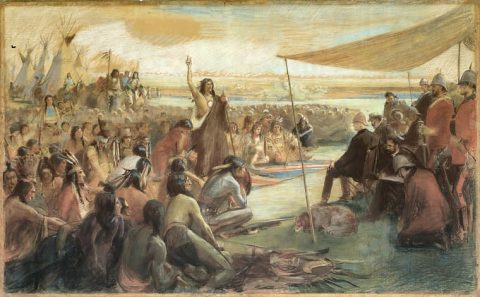
Diplomacy that worked: Siksika Blackfoot Chief Crowfoot making a speech during the Treaty 7 negotiations in the 1870s.

My experience in that Tl’azt’en meeting house shows that ministers from our national government coming to meet First Nations on their own ground would be profoundly impactful in encouraging First Nations leaders who actually care about the future of their people to speak out against those who do not.

Gwyn Morgan is the retired founding CEO of Encana Corp.

Love C2C Journal? Here's how you can help us grow.

More for you

What’s Yours is Ours: Why Canada’s Charter Ignores Property Rights and What That Means for Everything You Own

“The whole meaning of life,” famed comedian George Carlin once observed, “is trying to find a place for all your stuff. That’s what your house is, it’s a place for your stuff with a cover on it.” If so, then Canadians should be very concerned about their stuff. Unlike nearly every other modern nation, Canada lacks constitutional affirmation of the right to own property and as protection against its unjust seizure. With a recent B.C. Supreme Court ruling putting the very notion of home ownership at risk, Peter Shawn Taylor seeks out legal opinions on Canada’s surprisingly lax attitude towards property rights, how it differs from other countries and what that means for everyone’s possessions. If Canadians really want to protect their homes, belongings and personal finances, Taylor concludes, now’s the time to get loud.

The Righteous Response: What Canada Can Learn from America’s Fight Against Antisemitism

Canadians frequently criticize U.S. President Donald Trump’s projection of American power. But in the fight against anti-Semitism, Canada could learn a thing or two from our neighbour to the south. In Part One of this series, Lynne Cohen revealed how Canada’s political and civic leaders have chosen to ignore or even abet the hate crimes and abuse Jews have suffered since October 7, 2023. In this second installment, she shows how the U.S. – from the President on down to local officials and law enforcement – has fought back. Where Canada has been cowering and cowardly, the U.S. has resolved to fight anti-Semitism, protect its Jewish citizens and defend Israel’s right to live freely as a Jewish state.

One Free Miracle: Towards a Theory of Everything

A new year has dawned and, as the light strengthens across the Northern Hemisphere, David Solway reminds us that how we choose to experience our world is at least as important as understanding how it came to be. In the first instalment of this two-part series, the writer illuminated the irreducible paradox at the heart of all theories concerning the universe’s creation, then scrutinized the seemingly unbridgeable gap between quantum physics and the physical world we live in. In Part II he considers an even tougher and, so far, unsolved scientific challenge: gravity. Some of the finest minds in science think it actually is insoluble without some kind of creative intelligence to oversee it. In other words, a miracle. To Solway, the true miracle is the fact of a marvellous world and our freedom to experience and wonder at it.

More from this author

The Price of Foolish Pride: What Germany’s Social and Economic Decline Can Teach Canada

Germany was postwar Europe’s most successful nation – until it was seized by an arrogant leftist ideology that led it down a ruinous path. Its government abandoned safe, zero-emission nuclear power for inefficient wind and solar plus natural gas from Vladmir Putin. It threw open its borders to millions of asylum-seekers with barely a thought to the enormous costs or the difficulties of social integration. Today, at the 11th hour, Germany is at last struggling to turn around its decade of economic decline and social disintegration. In this cautionary tale, Gwyn Morgan sees a profound warning for Canada.

Socialist Shakedown: It’s Finally Time to End Supply Management in Agriculture

U.S. President Donald Trump’s trade policy may be chaotic and punitive, but he’s right about one thing: Canada’s agricultural supply management system has to go. Not because it’s unfair to America, though it is, but because it punishes Canadians. The price-fixing scheme limits consumer choice, requires a huge bureaucracy and prevents farmers from producing more in the face of shortages, forcing them instead to dump excess production. Worst of all, writes Gwyn Morgan, it drives up prices for milk, cheese, chicken, eggs and other essential foods — all for the benefit of a few thousand farmers, largely in Quebec. For Canada’s trade negotiators, argues Morgan, ending this mad racket should be job one.

Climate Climbdown: Sacrificing the Canadian Economy for Net Zero Goals Others Are Abandoning

Climate-obsessed politicians – Justin Trudeau in the vanguard – nearly destroyed the Canadian economy chasing emissions targets that are both unrealistic and pointless. Ottawa and the four biggest provinces have squandered $158 billion to create just 68,000 “clean” jobs. Meanwhile, fossil fuels are supplying a bigger share of Canada’s energy needs than ever. And now, leading U.S. officials and even eco-zealots like Bill Gates are re-evaluating their net-zero ideology. But that hasn’t gotten through to Prime Minister Mark Carney who, warns Gwyn Morgan, intends to inflict further punishment on an ailing country in pursuit of a delusional cause.