Public Policy

We Should Build Back with Private Healthcare

Gwyn Morgan
October 26, 2021
Its many supporters claim Canada’s vaunted universal healthcare system was simply overwhelmed by the sheer number of Covid-19 patients and the relentlessly recurring waves of the pandemic. But if that is the case, how did the U.S. hospital system (with a few local exceptions) easily accommodate and treat a far higher per capita caseload than Canada? Examining key statistics in each country, Gwyn Morgan concludes that something serious is ailing Canada’s healthcare system that Covid-19 did not cause. It can only be cured, Morgan writes, when those who call the shots on healthcare policy overcome their ideological aversion to innovations and ideas that are already used in every other highly developed country around the world.
Public Policy

We Should Build Back with Private Healthcare

Gwyn Morgan
October 26, 2021
Its many supporters claim Canada’s vaunted universal healthcare system was simply overwhelmed by the sheer number of Covid-19 patients and the relentlessly recurring waves of the pandemic. But if that is the case, how did the U.S. hospital system (with a few local exceptions) easily accommodate and treat a far higher per capita caseload than Canada? Examining key statistics in each country, Gwyn Morgan concludes that something serious is ailing Canada’s healthcare system that Covid-19 did not cause. It can only be cured, Morgan writes, when those who call the shots on healthcare policy overcome their ideological aversion to innovations and ideas that are already used in every other highly developed country around the world.
Share on Facebook
Share on Twitter

The coronavirus hit Canada in March 2020. By the time that first wave had subsided in the summer, hundreds of thousands of scheduled surgeries and other procedures had been postponed across the nation. But before that huge backlog could be substantially reduced, a second and then a third wave of the virus struck, increasing the backlog by hundreds of thousands more. Adding to the clinical risk of these surgical delays was the mental health impact of living with aggressive afflictions such as cancer.

Just as hospital wards became available once more to regular surgeries last spring, a fourth wave driven by the delta variant overwhelmed ICUs in Quebec and Ontario before moving west to plunge Saskatchewan and Alberta hospitals into their current crises.

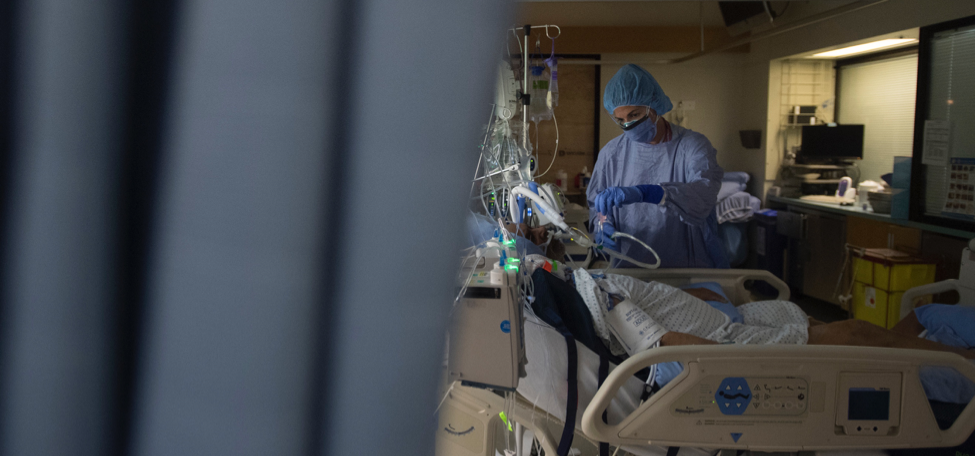
xThis isn’t the patient’s fault: Prior to the Covid-19 pandemic, Canada’s perennially full and lavishly funded healthcare system was consistently assessed as woefully unprepared to handle any crisis, due to long waiting lists, overwhelmed hospital capacity, shortages of medical staff and lack of diagnostic equipment. (Source of bottom left image: The Canadian Press)

The pandemic will eventually subside. While Covid-19 deaths can be tallied, the death toll due to all those delayed surgeries is virtually impossible to determine, the path of each patient’s affliction being different. But given the hundreds of thousands who experienced both physical deterioration and mental stress due to delays in treatments ranging from relatively simple diagnostic procedures all the way to complex surgery and organ transplants, that toll could be as high or even higher than the deaths from Covid-19 itself.

The real tragedy for families who lost loved ones due to Covid-19-triggered treatment delays is that those deaths occurred mostly because our healthcare system was woefully less prepared than those in other developed countries. Canada is the only country that went into the pandemic with zero unused hospital capacity and long waiting lists. A report by the Fraser Institute in 2020 comparing the performance of 28 countries with universal healthcare found that, despite having the second-highest spending per capita on healthcare, Canada ranked dead last in providing timely care and had the longest waiting lists.

Canada also ranked second-last in hospital beds per capita, which helps explains why so many surgical patients were displaced by Covid-19 patients. Our other healthcare resources have also been in relative decline. Out of 28 countries, we ranked 26th for the number of doctors per capita and were also near the bottom in diagnostic equipment such as MRI and CT scanners.

Canadians are prone to thumbing their noses at American healthcare, but our neighbour’s much-disparaged system was vastly better prepared for the Covid-19 crisis. Compared with Canada’s virtually zero spare capacity, hospital bed occupancy in the U.S. was just 64 per cent at the beginning of the pandemic. The U.S. was hard hit by Covid-19 – especially in certain states such as New York. But because that country went into the crisis with ample unused hospital bed capacity and a world-leading 35 ICU beds per thousand population, nearly three times Canada’s meagre level of 12 per thousand, it weathered successive waves of the virus with little displacement of non-Covid-19 patients.

xAmong the 28 most highly developed countries, Canada is the only one that all-but outlaws private healthcare delivery and private medical insurance, and does so for ideological reasons. Pictured, private healthcare in Germany (top) and in the United States (bottom).

How was our healthcare system in province after province allowed to fall into this sad, dangerous state? As the Covid-19 crisis winds down, that’s a question grieving Canadians should demand an answer to. Given that we’re one rung from the top in the Fraser Institute’s 28-country ranking of healthcare spending, the answer isn’t lack of funding. Then what is it?

Among those 28, Canada is the only one that outlaws private sector participation in the delivery of healthcare. Can you imagine if you could only get food from a government farm or a vehicle from just one government manufacturer? Quality? Service? Innovation? Not likely! Gradual deterioration of quality, customer service and supply? Almost certain. And the outcome? Rationing of services, primarily via waiting lists.

Prime ministers, premiers and healthcare administrators have known for years that our sclerotic government-run monopoly system suffers the dual afflictions of unsustainable cost growth and ever-lengthening waiting lists. Unions, academics, much of the news media and other interests opposed to private clinics and hospitals vigorously perpetuate the myth that Canada has the “world’s best health system.” But the 28-country comparison clearly shows the opposite.

xCanada’s Deputy Prime Minister and Minister of Finance Chrystia Freeland’s tweet about Erin O’Toole’s alleged support of privately-operated healthcare delivery was later deemed to be deceptive, intentionally omitting O’Toole’s clarification comment of “inside of universal healthcare”; regardless, Prime Minister Justin Trudeau shamelessly repeated the deception.

Entrenched fear of private-sector participation played a role in the recent federal election campaign when Liberal candidate Chrystia Freeland posted a Twitter video of Erin O’Toole stating he would allow provinces to “experiment with real healthcare reform including private for-profit and non-profit options.” Twitter later flagged Freeland’s post as “manipulated media” because it omitted O’Toole’s words “inside of universal healthcare.”

Liberal Leader Justin Trudeau repeatedly ignored that clarification, saying, “Erin O’Toole confirmed he wants to bring private, for-profit healthcare to Canada…” It was a bitter result that Trudeau’s shameless use of Freeland’s deliberate deception was rewarded, helping the Liberals return to power. And ironic given the Liberals’ campaign focus on the perils of disinformation on the internet.

Canada’s doctors, nurses and other healthcare workers are indeed world-class and highly dedicated. They have continually risked their own health doing everything humanly possible to balance the needs of Covid-19 and non-Covid-19 patients alike, even as they labour under an egregious lack of facilities and inept allocation of funding that will see, for example, the construction of glitzy new facilities but then leave them largely dark and empty for lack of operational funding. Canada’s healthcare professionals and workers deserve our support, consideration and admiration. But once the pandemic is behind us, Canadians should demand that our dangerous and dysfunctional government-monopoly healthcare system be opened to private-sector competition – as in virtually every other country around the world.

Gwyn Morgan is a retired business leader who has been a director of five global corporations.
Love C2C Journal? Here's how you can help us grow.

More for you

What’s Yours is Ours: Why Canada’s Charter Ignores Property Rights and What That Means for Everything You Own

“The whole meaning of life,” famed comedian George Carlin once observed, “is trying to find a place for all your stuff. That’s what your house is, it’s a place for your stuff with a cover on it.” If so, then Canadians should be very concerned about their stuff. Unlike nearly every other modern nation, Canada lacks constitutional affirmation of the right to own property and as protection against its unjust seizure. With a recent B.C. Supreme Court ruling putting the very notion of home ownership at risk, Peter Shawn Taylor seeks out legal opinions on Canada’s surprisingly lax attitude towards property rights, how it differs from other countries and what that means for everyone’s possessions. If Canadians really want to protect their homes, belongings and personal finances, Taylor concludes, now’s the time to get loud.

The Righteous Response: What Canada Can Learn from America’s Fight Against Antisemitism

Canadians frequently criticize U.S. President Donald Trump’s projection of American power. But in the fight against anti-Semitism, Canada could learn a thing or two from our neighbour to the south. In Part One of this series, Lynne Cohen revealed how Canada’s political and civic leaders have chosen to ignore or even abet the hate crimes and abuse Jews have suffered since October 7, 2023. In this second installment, she shows how the U.S. – from the President on down to local officials and law enforcement – has fought back. Where Canada has been cowering and cowardly, the U.S. has resolved to fight anti-Semitism, protect its Jewish citizens and defend Israel’s right to live freely as a Jewish state.

One Free Miracle: Towards a Theory of Everything

A new year has dawned and, as the light strengthens across the Northern Hemisphere, David Solway reminds us that how we choose to experience our world is at least as important as understanding how it came to be. In the first instalment of this two-part series, the writer illuminated the irreducible paradox at the heart of all theories concerning the universe’s creation, then scrutinized the seemingly unbridgeable gap between quantum physics and the physical world we live in. In Part II he considers an even tougher and, so far, unsolved scientific challenge: gravity. Some of the finest minds in science think it actually is insoluble without some kind of creative intelligence to oversee it. In other words, a miracle. To Solway, the true miracle is the fact of a marvellous world and our freedom to experience and wonder at it.

More from this author

The Price of Foolish Pride: What Germany’s Social and Economic Decline Can Teach Canada

Germany was postwar Europe’s most successful nation – until it was seized by an arrogant leftist ideology that led it down a ruinous path. Its government abandoned safe, zero-emission nuclear power for inefficient wind and solar plus natural gas from Vladmir Putin. It threw open its borders to millions of asylum-seekers with barely a thought to the enormous costs or the difficulties of social integration. Today, at the 11th hour, Germany is at last struggling to turn around its decade of economic decline and social disintegration. In this cautionary tale, Gwyn Morgan sees a profound warning for Canada.

Socialist Shakedown: It’s Finally Time to End Supply Management in Agriculture

U.S. President Donald Trump’s trade policy may be chaotic and punitive, but he’s right about one thing: Canada’s agricultural supply management system has to go. Not because it’s unfair to America, though it is, but because it punishes Canadians. The price-fixing scheme limits consumer choice, requires a huge bureaucracy and prevents farmers from producing more in the face of shortages, forcing them instead to dump excess production. Worst of all, writes Gwyn Morgan, it drives up prices for milk, cheese, chicken, eggs and other essential foods — all for the benefit of a few thousand farmers, largely in Quebec. For Canada’s trade negotiators, argues Morgan, ending this mad racket should be job one.

Climate Climbdown: Sacrificing the Canadian Economy for Net Zero Goals Others Are Abandoning

Climate-obsessed politicians – Justin Trudeau in the vanguard – nearly destroyed the Canadian economy chasing emissions targets that are both unrealistic and pointless. Ottawa and the four biggest provinces have squandered $158 billion to create just 68,000 “clean” jobs. Meanwhile, fossil fuels are supplying a bigger share of Canada’s energy needs than ever. And now, leading U.S. officials and even eco-zealots like Bill Gates are re-evaluating their net-zero ideology. But that hasn’t gotten through to Prime Minister Mark Carney who, warns Gwyn Morgan, intends to inflict further punishment on an ailing country in pursuit of a delusional cause.