You can’t beat A+. It is instantly recognizable as the best possible mark anyone can earn, signifying the pinnacle of hard work and subject mastery. Despite the steady erosion in educational standards at schools and universities across Canada, many students and teachers still care deeply about what A+ means, as a grading scandal at Manitoba’s Brandon University reveals.
According to a recent Winnipeg Free Press investigation, Brandon University’s campus has been roiled by allegations that Bernadette Ardelli, formerly the school’s dean of science, changed the grade of a student in an advanced science course from F to A+ over the instructor’s objections. The student, the newspaper alleges, is related to someone known to Ardelli.

A university employee who spoke anonymously told the paper’s investigative reporter Maggie Macintosh that the grade improvement “was mathematically impossible” given that the student had not attended any of the class’s mandatory labs. Even had they earned a perfect score on every other aspect, the maximum possible grade would have been B. A former classmate told Macintosh it was “shocking” to learn of the grade change since, “I assumed [the student had] dropped the class.” In fact, the assigned A+ was a higher mark than this student earned, despite regularly attending labs.
The school’s faculty association launched a grievance over the loss of academic freedom and conflict of interest the incident entailed. But while Ardelli reportedly offered an apology for overriding the instructor’s grade without consultation, the adjusted mark apparently remains in place even after the official investigation. Ardelli has even been promoted to Vice-President of Research and Graduate Studies.
While this tale can be seen as yet another depressing example of the rampant grade inflation and decline of overall standards within the Canadian education system, it also contains the seed of a more hopeful perspective. At least some students and teachers at Brandon University feel strongly enough about the integrity of their school’s letter-based grading system that they’re prepared to speak out (even if anonymously) to defend the concept.
Despite what experts may claim, there is real truth in letter grades. And they deserve a strong defence.
A “Continuum of Learning”
As part of a decades-long ideological shift in Canadian schools towards “student-centred” learning methods, the manner in which students are assessed and graded is changing dramatically. Quantitative assessment techniques that involve assigning letter grades or percentage scores on report cards based on test results and other objective metrics are being replaced with softer and more qualitative approaches that rely on a teacher’s subjective observations of a student’s progress and descriptive written feedback.
This trend is most apparent in the 2023 decision by the B.C. government to abolish letter grades in primary and middle schools and assess all students from kindergarten to Grade 9 on a new Provincial Proficiency Scale. Where once B.C. students received a mark ranging from A to F based on how well they knew their material, now they’re placed in one of four standardized assessment categories: Emerging, Developing, Proficient and Extending.
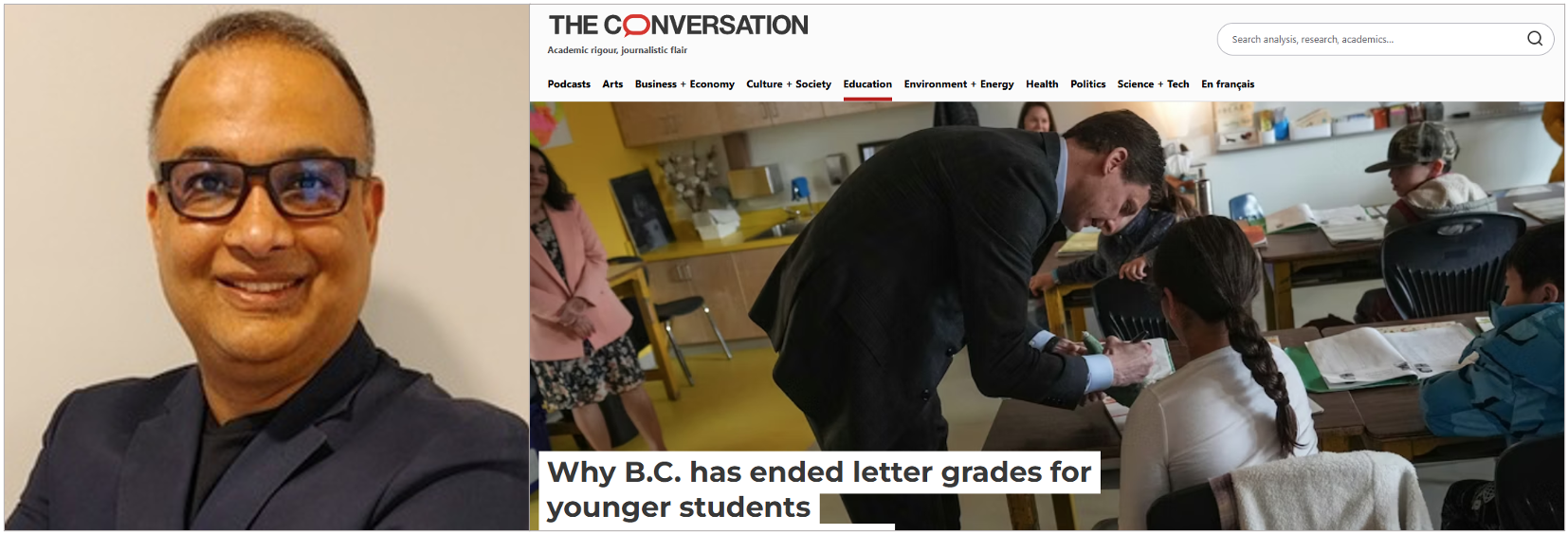
 B.C.’s new proficiency scale, Brar admits, has left many parents worried that the lack of objective marking standards may cause their children to “lose their competitive edge” once they reach university. (Sources of photos: (top) woodleywonderworks, licensed under CC BY 2.0; (bottom) Jeremy Wilburn, licensed under CC BY-NC-ND 2.0)
Not to worry, the education professor declares. The new Provincial Proficiency Scale “doesn’t necessarily ignore competition. Instead, it asks students to be concerned with their competitive relationship with themselves first, before considering it with others.” In other words, it ignores competition altogether.
Confused By Design
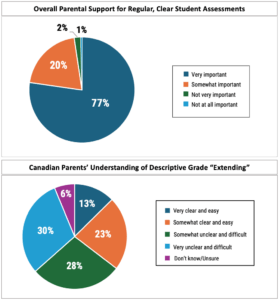
Brar is right about one thing. A lot of parents don’t like the new system. According to a 2023 readers’ poll by the Delta Observer community newspaper conducted when the policy was first rolled out, only 8 percent of parents welcomed the new scale; 84 percent wanted a return to the old letter grades.
A year later, the Fraser Institute released a scientific poll conducted by the polling firm Leger that came to a similar result. The survey asked 1,200 Canadian parents with school-aged children their thoughts on the importance of “regular, clear student assessments”. Ninety-eight percent said clarity was very or somewhat important. A similarly massive plurality of 93 percent of parents said letter grades were “clear and easy to understand” while a majority struggled to define what “Extending” or “Emerging” actually meant. Again, a majority of B.C. parents opposed the move away from letter grades.
A closer look at the definitions for these new terms suggest parents are right to worry about their usefulness. From the provincial booklet “Unpacking the Proficiency Scale”:
Most B.C. parents see this as a giant backward step, concluded Paige MacPherson, the Fraser institute’s associate director of education policy. “A clear majority of Canadian parents with children in K-12 schools find letter grading easier to understand…than the B.C. government’s new descriptive grading,” she writes in her summary of the poll report mentioned above. MacPherson urges any provincial government seduced by the idea of abandoning traditional assessment methods to be “mindful” that “these changes do not make report cards clearer and easier for parents to understand their child’s academic progress.”
An “Emerging” Crisis
The conceptual fog enveloping B.C.’s new proficiency scale is creating genuine, real-world problems, says Joanna DeJong VanHof, education program director at the Ottawa-based think tank Cardus. Despite what supporters claim, VanHof explains in an interview, qualitative assessments tend to measure student performance “relative to their peers” since the grading categories are restricted to a few large and poorly defined buckets. As a result, the traditional focus on what an individual student is actually learning is lost. This neuters the feedback mechanism that report cards are supposed to entail, which can create significant problems.

VanHof imagines a scenario in which a child is labelled as an Emerging learner for many years. Under the old system, that student would likely have earned Ds or Fs, raising red flags that would have sparked interventions at home and school. Now, she says, it may never become obvious to parents that their child is failing. Remember, the official definition of “Emerging” explicitly states that it isn’t a failing grade. The resulting confusion could mean the student doesn’t promptly – or perhaps ever – receive the remedial assistance he or she needs. “Students who actually need help the most could be in a situation where they’re falling through the cracks instead of being noticed earlier,” VanHof warns. Concrete grades, she says, “translate objective standards of learning into meaningful criteria for parents to understand.” Everyone knows this, she adds, because such standards have been around for centuries. Objective marking schemes allegedly date back to 1792, when University of Cambridge tutor William Farish repurposed a nearby shoe factory’s system for determining whether its products were “up to grade” as a way of ranking his students’ progress.
While the stated purpose of removing letter grades is to make the school system more equitable and ensure struggling students are not labelled as failures, another education expert predicts B.C.’s new system will likely have the opposite effect: the greatest costs will be borne by the least fortunate families.
John Hilton-O’Brien is executive director of the Alberta-based Parents for Choice in Education. His organization lobbies for a greater role for parents in the education system and favours traditional assessment standards. Hilton-O’Brien worries that B.C.’s new rules will end up exacerbating inequalities. “Well-resourced parents can hire tutors, they can interpret these opaque competency-based reports, and they can navigate the system,” he observes in an interview. But not all families have access to such resources, or have the spare time to figure out whether “Emerging” is better or worse than “Developing”. Disadvantaged students will thus be at the greatest risk of being left behind under B.C.’s new system.

More broadly, Hilton-O’Brien worries that the new measurement system could estrange all parents from their children’s education by turning schools into the “sole interpreter of student progress.” If parents lack a proper understanding of how their children are doing because report cards no longer contain actionable information, families will be pushed further away from the nexus of decision-making for their children. In essence, Hilton-O’Brien says, the educational bureaucrats who concocted this new system have interposed themselves between teachers and students. The new system will also make life tougher for teachers, VanHof suggests, as they must now interpret and translate the vague categories of “Emerging” and “Extending” when meeting with confused parents.
B.C.’s new proficiency scale may even increase grade inflation, a longstanding problem in Canadian schools. VanHof explains that because the proficiency scale is inherently subjective, standards can vary from class to class depending on the teacher and the mix of students. Given the vagueness of the categories, students may end up being placed in higher proficiency levels than they deserve. Hilton-O’Brien echoes this view. “What letter grades do is introduce an element of accountability to the system itself,” he says. Removing those As and Fs erases “visible records” of underperformance and makes the entire system unaccountable.
 National problem: Similarly to B.C.’s proficiency scale, Ontario’s Growing Success assessment standard introduced a “no-zero” approach that discourages teachers from failing students or docking marks for late work.
The Pushback
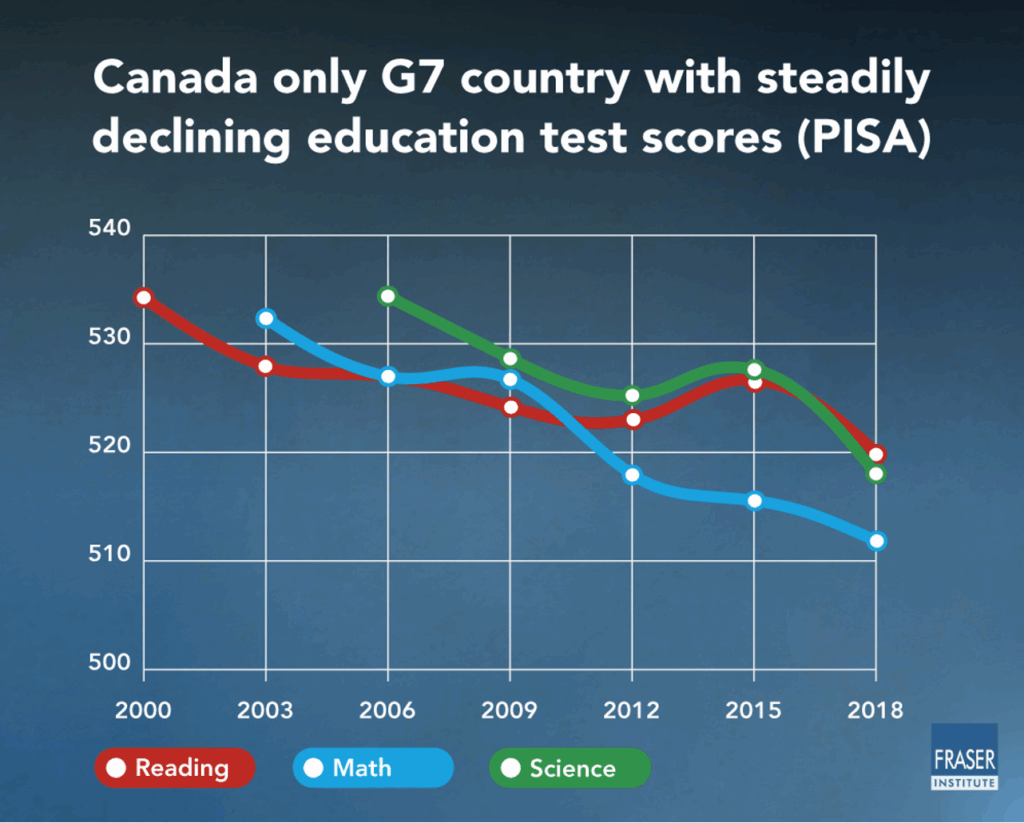
The accumulated evidence suggests this slackening of school standards is weakening the overall quality of Canadian education. Over the past decade, for example, Canadian students’ scores on testing under the Programme for International Student Assessment (PISA) have steadily trended downward. Organized by the OECD, PISA assesses the reading, math and science skills of 15-year-olds in countries around the world. Although Canada often ranks well, its scores have been consistently declining. From 2003 through 2022, Canada’s PISA results in math fell by 35 points, roughly equivalent to a drop of two whole grade levels (for those who still think in grade levels, as opposed to proficiency scales).
Some provinces are paying attention. Alberta is rolling out a multi-year recalibration of its entire school curriculum that puts much greater emphasis on fact-based schooling. Ontario has promised its own “back-to-basics” curriculum reform, set to take effect at the beginning of the next school year, that promises to include direct math instruction in kindergarten. It should be noted, however, that the Fraser Institute has criticized Ontario for failing to fully rid its school curriculum of damaging diversity, equity and inclusion criteria. The province is also acting on a major investigation into provincial reading skills that found Ontario’s previous student-centred approach to literacy instruction left many students unable to read. In response, the province is reforming how reading and writing are taught, chiefly by returning to conventional – and amply proven – “phonics”-based instruction. Positive change does appear possible.
Independent schools provide an additional safety valve for parents confused or frustrated by the ideological obsessions of the public school system. John Wynia is league coordinator of the League of Canadian Reformed School Societies, which represents 20 independent Christian schools in Ontario. Wynia himself taught at Hope Reformed Christian School in Paris, Ontario, where his expectation that students work hard and achieve good grades earned him a reputation, he recalls, as a “tough” teacher. In an interview, he says students have “often thanked” him for his demanding approach after they graduated, “because when they went to university, they were very well-prepared.” And despite Ontario’s aversion to late penalties, Wynia continued to deduct marks for late school work, although he says he granted extensions when requested.
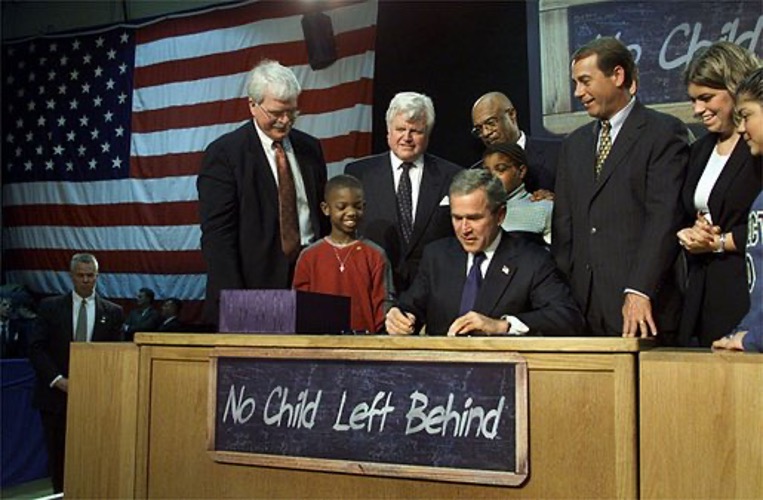 Demand better: The No Child Left Behind Act tackled the “soft bigotry of low expectations” by tracking progress and raising expectations across all schools. Shown, U.S. president George W. Bush signs the bill in Hamilton, Ohio on January 8, 2002. (Source of photo: Paul Morse/White House)