
Energy Security

Quick Read

From the Strait of Hormuz to Cuba, Net Zero is Dying – Mark Carney Needs to Let Go

Gwyn Morgan
April 7, 2026
After decades spent pursuing net-zero dreams at great cost to their economies and social fabric, most of the world’s industrialized nations are waking back up. War with Iran and the threat of tanker blockades have everyone worried about oil and natural gas supplies and clamouring for energy security. Or nearly everyone. Not Mark Carney, though. Canada’s prime minister keeps pushing industrial carbon taxes higher and insists on wasting taxpayers’ money on windmills that make no difference. Gwyn Morgan recalls his own observation of the global warming movement’s original rise, its morphing into the radical “net zero” cult – and its spectacular global disintegration. It is high time, Morgan writes, that Canadians demand Carney also drop his delusions.
Energy Security

Quick Read

From the Strait of Hormuz to Cuba, Net Zero is Dying – Mark Carney Needs to Let Go

Gwyn Morgan
April 7, 2026
After decades spent pursuing net-zero dreams at great cost to their economies and social fabric, most of the world’s industrialized nations are waking back up. War with Iran and the threat of tanker blockades have everyone worried about oil and natural gas supplies and clamouring for energy security. Or nearly everyone. Not Mark Carney, though. Canada’s prime minister keeps pushing industrial carbon taxes higher and insists on wasting taxpayers’ money on windmills that make no difference. Gwyn Morgan recalls his own observation of the global warming movement’s original rise, its morphing into the radical “net zero” cult – and its spectacular global disintegration. It is high time, Morgan writes, that Canadians demand Carney also drop his delusions.
Share on Facebook
Share on Twitter

Delegates to the first World Climate Conference held in 1979 adopted a declaration calling on world governments to “foresee and prevent man-made changes to the climate that might be adverse to the well-being of humanity.” Because the declaration linked rising levels of atmospheric carbon dioxide (CO2) to a purported increase in climate variability, and because much of the increase in atmospheric CO2 appeared to be driven by the production, processing and most of all consumption of fossil fuels, the 1979 statement amounted to an implicit declaration of war against the oil and natural gas industry.

But just as Osama bin Laden’s initial declaration of war against the Western world was ignored for years, until Al Qaeda terrorists’ horrific destruction of the World Trade Center on 9-11, the world’s climate busybodies were widely dismissed as a niche interest – and just as foolishly. For that changed dramatically with the 1992 “Earth Summit” in Rio de Janeiro. Organized by a former Albertan named Maurice Strong (surely one of the strangest characters our nation has ever produced, but that is another story), Rio established the United Nations Framework Convention on Climate Change, centred on a battle cry for the world’s governments to combat “dangerous human interference with the climate system.” With that, the war on oil – and modern industrial society – was out in the open.
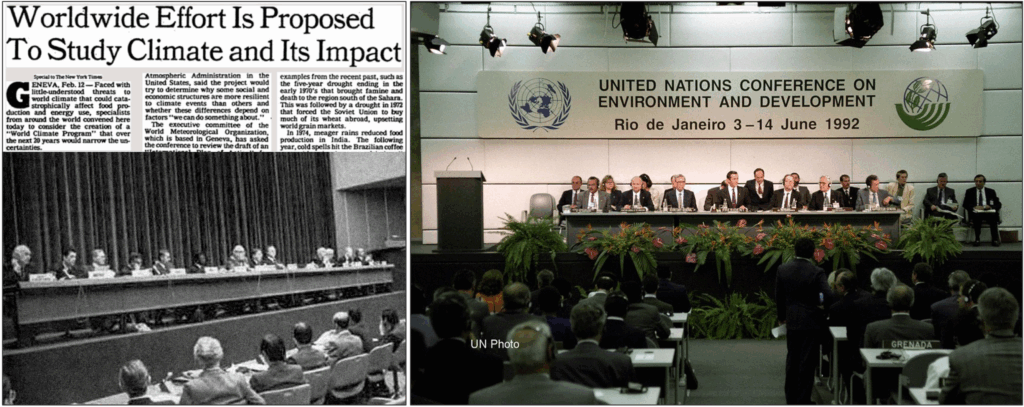
Opening shots in a long war: What began as a widely ignored notion at the inaugural 1979 World Climate Conference (left) had by the 1992 Rio Earth Summit (right) morphed into a formal global mandate for the world’s governments to fight “dangerous human interference with the climate system” – with the oil and natural gas industry sitting in the crosshairs.
xOpening shots in a long war: What began as a widely ignored notion at the inaugural 1979 World Climate Conference (left) had by the 1992 Rio Earth Summit (right) morphed into a formal global mandate for the world’s governments to fight “dangerous human interference with the climate system” – with the oil and natural gas industry sitting in the crosshairs. (Source of right photo: United Nations Photo, licensed under CC BY-NC-ND 2.0)

At the time, I was president of a Calgary-headquartered oil and natural gas exploration and production company that I had co-founded, as well as volunteer-president of our industry’s public communication vehicle, the Independent Petroleum Association of Canada. My industry colleagues were reluctant to take on the global climate elite head-on. But I believed that, rather than trying to make mealy-mouthed concessions to what I recognized was rapidly becoming a movement of zealots, arguing the issue on the facts and the science was vital to the future of our industry, the bedrock of Western Canada’s economy.

My public commentary was, of course, condemned as evidence that I was only out to save my industry. But it wasn’t just my responsibility as an industry leader that called me to challenge the climate movement’s increasingly shrill declarations. It was also my commitment to truth, facts, logic and real science. For starters, I considered the conceptual basis of the man-made global warming hypothesis weak if not self-contradictory. Most obvious among its several critical flaws was that extremely hot temperatures had been occurring long before that first climate conference in Geneva, Switzerland.

The purported global transition to a “net zero” economy – in which a country emits no more greenhouse gases than it sequesters or otherwise mitigates – has run into the hard realities of physics, geopolitics and economics. Fossil fuels continue to supply 84-86 percent of the world’s primary energy. As Western nations pursued “net zero” in part by shutting down reliable nuclear and coal-fired power plants while building expensive yet unreliable/intermittent solar panels and wind turbines, they surrendered energy security to foreign dictators, who control much of the global flow of oil and natural gas. With Iran effectively shutting the critical Strait of Hormuz in March-April 2026, threatening Red Sea shipping routes and firing drones and missiles at energy facilities all over the Middle East, the “net zero” mission is increasingly viewed as an unrealistic fantasy that risks impoverishing citizens through debilitating energy shortages.

For example, in the 1920s European immigrants settled in the verdant, amply watered grasslands of southeastern Alberta, convinced by what they saw before them that they could grow crops without irrigation. Some of those hopeful settlers were my wife’s grandparents. A decade later, the rains stopped and temperatures soared as high as 43° C. Hot, dry winds blew precious topsoil away, spawning choking dust storms. The “Dirty Thirties” had arrived. Starving settlers turned to eating rabbits, gophers, pelicans and anything else edible they could shoot, snare or scrounge. Parents took their kids to school in blinding dust storms, clutching fencelines and breathing through bandanas. And the wind kept blowing through the long, bitterly cold Alberta winters.

Contrary to today’s net-zero zealots’ rhetoric, seven of Canada’s 20 hottest days ever recorded occurred decades prior to that 1979 World Climate Conference – in the 30s and 40s I just described. The other 13 all came in the same four-day heat wave in June 2021. This was before the great global industrialization following the Second World War, with its soaring energy consumption and CO2 emissions. But something that happens today cannot be the cause of something that occurred yesterday. Thus, those temperature spikes of the 20s and 30s simply could not have been caused by greenhouse gas emissions increasing during the 50s, 60s and 70s. Something else was at work; something natural.
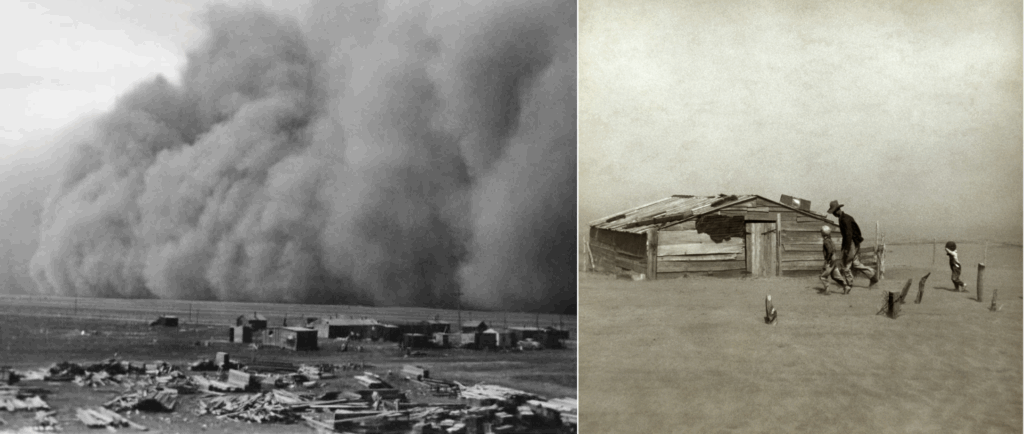
During the “Dirty Thirties” Canada’s Prairies and multiple U.S. states endured some of the most punishing heat ever recorded – decades before post-Second World War industrialization drove CO₂ emissions skyward, and long before “climate change” was even a term. Shown, 1930s dust storms in Alberta (left) and Oklahoma (right).
xDuring the “Dirty Thirties” Canada’s Prairies and multiple U.S. states endured some of the most punishing heat ever recorded – decades before post-Second World War industrialization drove CO2 emissions skyward, and long before “climate change” was even a term. Shown, 1930s dust storms in Alberta (left) and Oklahoma (right). (Sources of photos: (left) Glenbow Archives NA-2496-1; (right) The Canadian Press/FSA-OWI LC-DIG-ppmsc-00241)

So there are not just particular scientific gaps but a glaring conceptual absurdity at the heart of man-made global warming theory. Another Canadian business leader who recognized this was an industry counterpart named James Buckee. A scientist by training, with a PhD in astrophysics, Buckee headed Talisman Energy Inc. in Calgary for many years, and, to the horror of his media handlers, would gladly debate the scientific details of global warming theory. Similar to what I noted above, Buckee would point out to the few journalists willing to listen that the world’s average temperature had risen markedly in the 20s and 30s, as well as back in the 1800s – all before that postwar rise in CO2 emissions. Again, nature at work, not people driving their cars to work.

We were lone voices in the wilderness. Our industry’s overall response was to issue hand-wringing media statements pretending to accept the “settled science” of global warming theory or the “fact” of man-made climate change, and promising to make their companies more environmentally “sustainable”, all while lobbying furiously to delay or water down any government policies designed to roll back CO2 emissions. That game worked for a while but, eventually, the bill came due.
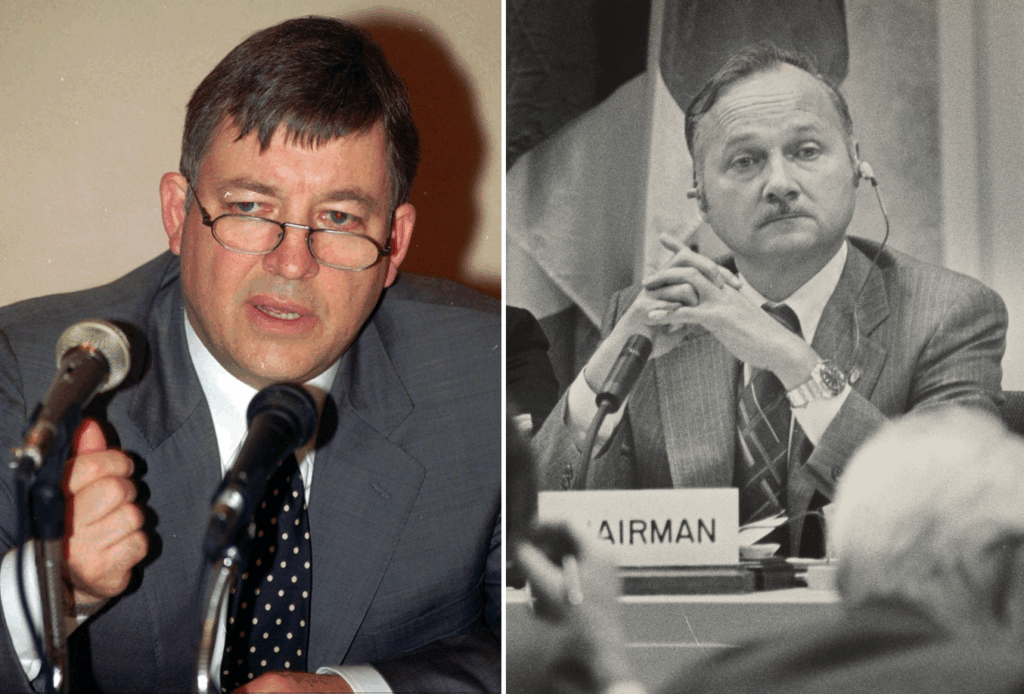
James Buckee (left), astrophysicist and longtime president of Calgary-based oil and gas producer Talisman Energy Inc., was among the few prominent voices bluntly countering global warming theory. Buckee attracted a much smaller following than former Albertan Maurice Strong (right), organizer of the Rio Earth Summit and arguably the world’s principal architect of climate alarmism.
xJames Buckee (left), astrophysicist and longtime president of Calgary-based oil and gas producer Talisman Energy Inc., was among the few prominent voices bluntly countering global warming theory. Buckee attracted a much smaller following than former Albertan Maurice Strong (right), organizer of the Rio Earth Summit and arguably the world’s principal architect of climate alarmism. (Sources of photos: (left) AP Photo/RAOUF; (right) The Canadian Press/files)

Because throughout that time those global climate conferences rolled on, each one larger and more lavish than the one before and each issuing more alarmist rhetoric and more extreme demands. At the 1997 conference in Japan, an impressive total of 192 countries agreed to the “Kyoto Protocol” – but only 37 industrialized countries plus the European Union fell on their swords in agreeing to slash their greenhouse gas emissions to 5 percent below 1990 levels by 2012. The war on fossil fuels was on in earnest, and it was destined to escalate to ridiculous heights. At the 2012 conference in Qatar, the same 37 countries increased their emissions-reduction commitment to 18 percent below 1990 levels by 2020.

The naïveté of those targets is breathtaking. For energy-exporting countries like Canada, neither could be achieved without beggaring the nation’s economy by all-but crushing its most productive, export-earning industry. Meanwhile, countries accounting for over half of global emissions – mainly China, Russia and India – continued their rapid growth without constraint. Nor did virtually any other Asian, Middle Eastern, African or South American nation have any intention of joining the 37. Their emissions were going nowhere but up – even as they demanded vast “reparations” from the “rich” north for allegedly imperilling the Earth’s survival through past greenhouse gas emissions. The climate change movement was now a vast global grift.

Microsoft founder Bill Gates for years was a reliable proponent of climate-change orthodoxy, in 2021 penning a pro-carbon-tax book entitled How to Avoid a Climate Change Disaster. But in 2025, Gates published an essay on his personal blog (gatesnotes.com) that amounted to a significant “climate climbdown”, urging a move away from doomsday rhetoric to focus more on promoting human welfare by fighting poverty and disease. While Gates previously championed aggressive carbon taxes, he now acknowledged that near-term emissions goals often divert resources from more effective ways to improve lives in a warming world. His shift, like those of several other prominent figures including Ted Nordhaus and Lucy Biggers, reflects a growing recognition that “net zero” ideology must be balanced against the immediate needs of the world’s most vulnerable populations, who face greater threats from economic instability than from temperature changes alone.

The 22nd climate conference was held in Morrocco in November 2016, a year after Canadians elected the Justin Trudeau government. In keeping with the new prime minister’s zealous embrace of the cause, environment minister Catherine McKenna led a delegation of some 225 bureaucrats, politicians and activists, one of the largest among the 100 countries assembled. That cost Canadian taxpayers a great deal in emissions-spewing flights.

Imagine our delegation’s shock when, just 24 hours after the conference opened, they heard the soon-to-be 45th U.S. president, Donald Trump, declare that man-made global warming was a “big hoax” promulgated by China and other countries wanting to steal American jobs. With all the major players bowing out, who was left to save the planet from climate Armageddon? Just the EU, Japan and Australia, with a combined emissions share of 15 per cent. And Canada, adding our minuscule 1.6 per cent.
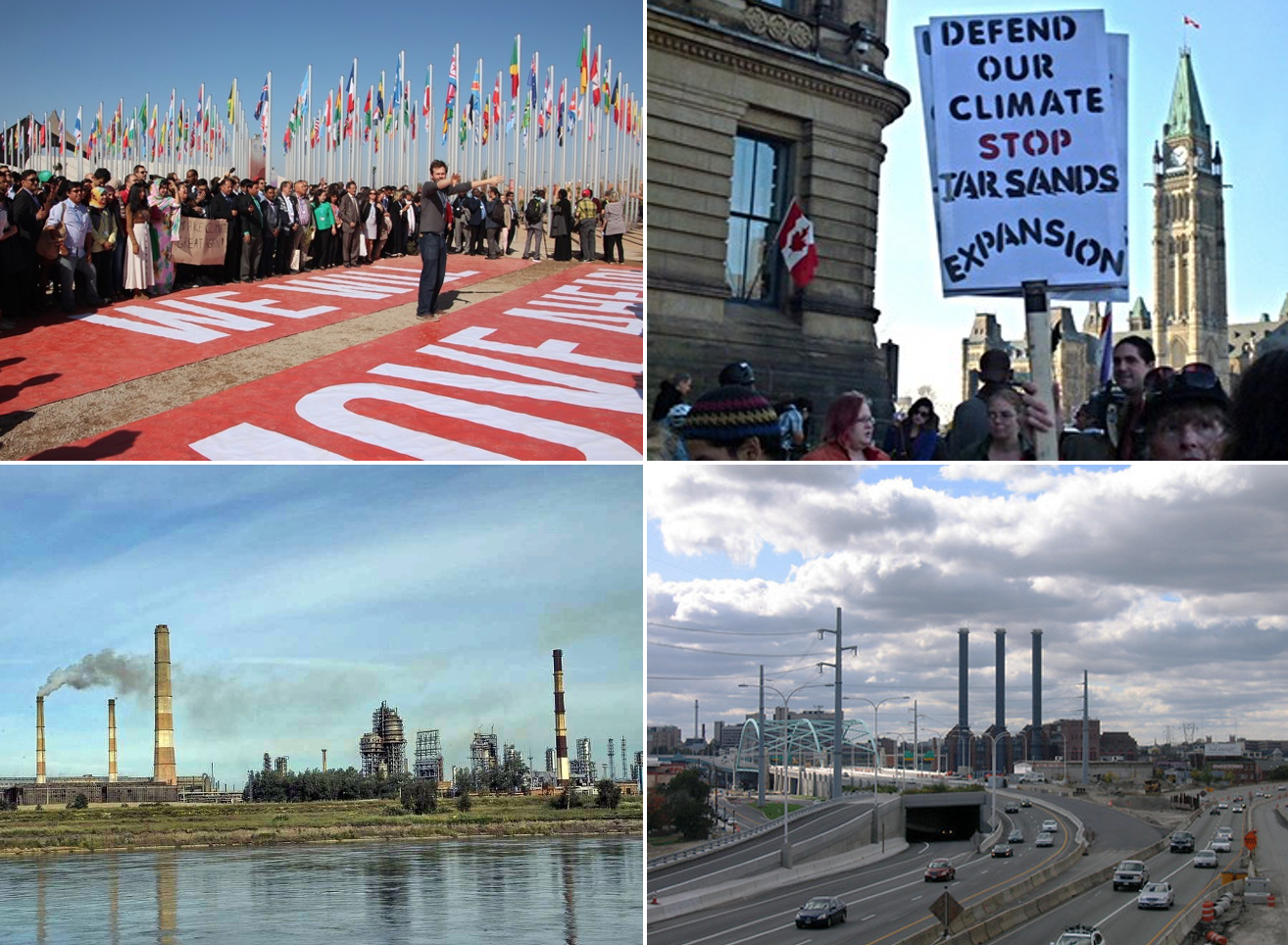
As the war on fossil fuels intensified – with gatherings like Morocco’s 2016 COP22 drawing 196 nations (top left), and relentless anti-oil protests like the 2013 “Stop Tar Sands” protest in Ottawa depicted at top right – Canada under Liberal Prime Minister Justin Trudeau cast itself as the planet’s saviour, even as the world’s largest emitters such as China, Russia (bottom left) and India (bottom right) continued growing unchecked.
xAs the war on fossil fuels intensified – with gatherings like Morocco’s 2016 COP22 drawing 196 nations (top left), and relentless anti-oil protests like the 2013 “Stop Tar Sands” protest in Ottawa depicted at top right – Canada under Liberal Prime Minister Justin Trudeau cast itself as the planet’s saviour, even as the world’s largest emitters such as China, Russia (bottom left) and India (bottom right) continued growing unchecked. (Sources of photos (clockwise starting top left): John Englart (Takver), licensed under CC BY-SA 2.0; Obert Madondo, licensed under CC BY-NC-SA 2.0; Jef Nickerson, licensed under CC BY-SA 2.0; Serb2012, licensed under CC BY-SA 3.0)

But futility didn’t deter the Trudeau government from saddling Canadians with carbon taxes and taxpayer-funded wind and solar power subsidies in pursuit of its newly declared “net-zero-by-2050” Holy Grail. Trudeau’s time in office became a “lost decade” for Canada’s economy, one which Alberta Premier Danielle Smith has estimated included a staggering $500 billion in foregone investment in the energy sector alone.

Today the foundations of the net-zero-emissions religion are crumbling. In 2021, Microsoft founder Bill Gates wrote a pro-carbon-tax book entitled How to Avoid a Climate Change Disaster. Four years later, on the eve of the most recent UN climate conference, Gates issued a breathtaking climate change climbdown on his personal blog that among several surprising admissions noted, “Too many resources are focused on emissions and the environment. More money should go toward improving lives and curbing disease and poverty.” Gates called out the “doomsday view” of climate change, urging world leaders to refocus on issues that “have the greatest impact on human welfare.”

Just last week, a prominent “climate journalist and influencer” named Lucy Biggers published a soul-baring mea culpa repudiating nearly everything she had pushed for the past decade. “Critics will say if we just transitioned to renewables we could get off fossil fuels. But physics begs to differ. Solar and wind production just aren’t as energy-dense or reliable as oil and gas,” Biggers writes. “Despite spending trillions of dollars in an attempt to transition to renewables, oil, coal, and natural gas still produce 86 percent of the energy consumed around the world.”

The Liberal government of Prime Minister Mark Carney is frequently criticized for continuing a “destructive agenda” that includes maintaining an aggressive (though largely hidden) industrial carbon tax in Canada while the country suffers declining productivity and zero economic growth. Carney’s substantive commitment to his predecessor Justin Trudeau’s net zero goals and carbon-pricing schemes continues to weaken not just oil and natural gas producers but every sector of the Canadian economy, while making virtually everything Canadians buy and use more expensive. Carney’s policies are hamstringing Canada’s economy and weakening its international competitiveness, since the world’s largest greenhouse gas emitters – China, India, Russia and the U.S. – are not bound by such policies and are powering their economic growth through unrestricted production and use of fossil fuels.

The U.S.-Israeli attack on Iran’s Mullahcracy has laid bare the absurdity of the net zero/green energy fantasy and refocused the world’s attention on energy security. Countries among the most ideologically committed to net zero are squealing the loudest for Trump to reopen the Strait of Hormuz, the closure of which has sent benchmark oil prices soaring above US$100 per barrel. Apparently the world really does need plentiful and reasonably priced crude oil and natural gas. Some are even calling it a “human right”. The lights recently going out all over Cuba echoes the titanic struggle in the Middle East. Green posterchild Greta “How Dare You” Thunberg, who wants fossil fuels phased out entirely by 2030, is now demanding that Trump allow Cuba to resume importing crude oil so that its Communist dictatorship might lurch through another year. Net zero, when it actually arrives, isn’t as pleasant as promised.
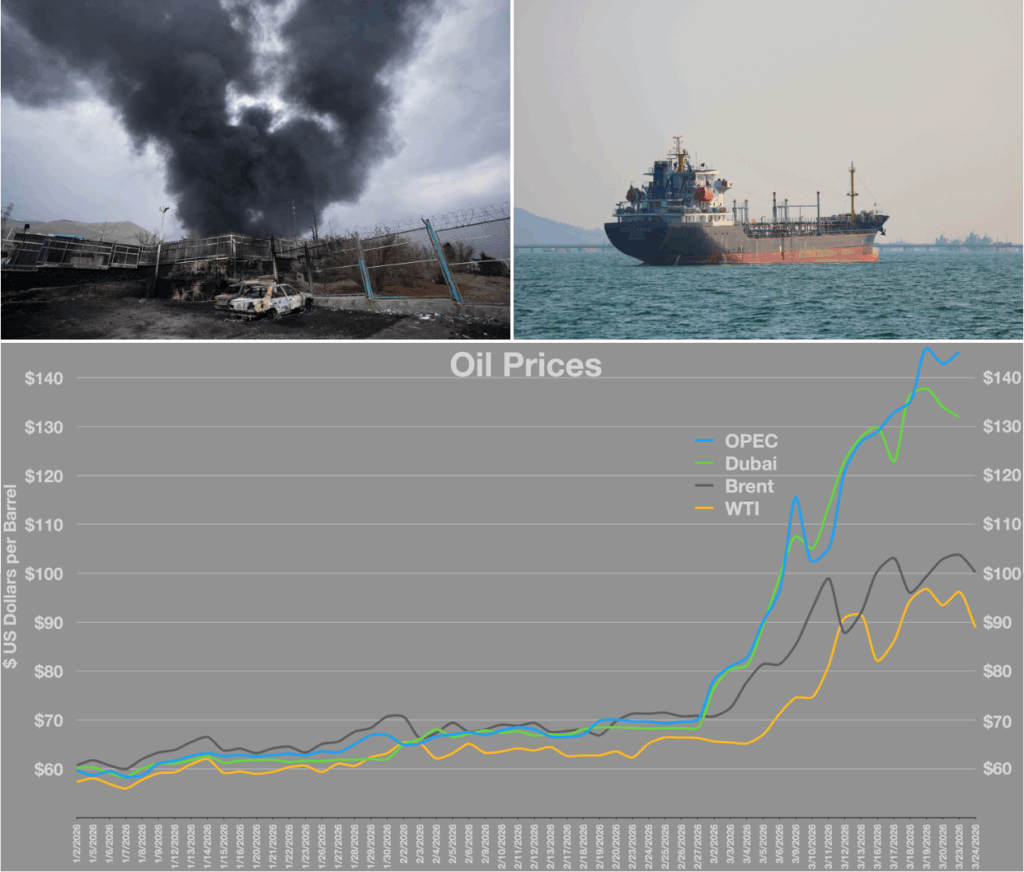
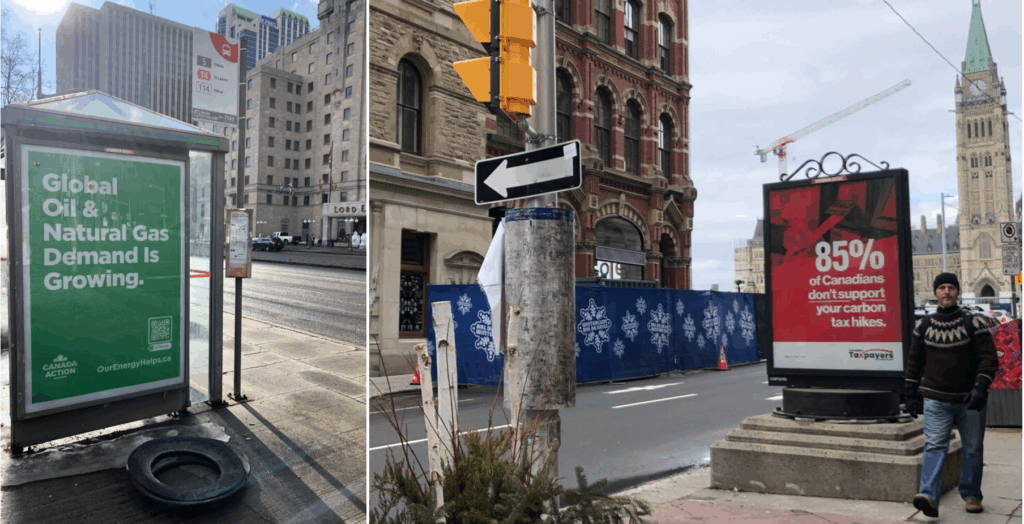
The U.S.-Israeli campaign against Iran’s regime has exposed the fragility of global energy and the limits of the net-zero fantasy, as disruption of the Strait of Hormuz sent oil prices soaring and prompted calls even from net-zero zealots to reopen the vital waterway. At top left, smoke rises from an oil storage facility hit by a U.S. or Israeli strike in Tehran, March 2026; at top right, anchored Chinese tanker unable to transit the Strait of Hormuz, March 2026; at bottom left, a Canada Action ad promoting oil and natural gas; at bottom right, a Canadian Taxpayers Federation ad in Ottawa.
xThe U.S.-Israeli campaign against Iran’s regime has exposed the fragility of global energy and the limits of the net-zero fantasy, as disruption of the Strait of Hormuz sent oil prices soaring and prompted calls even from net-zero zealots to reopen the vital waterway. At top left, smoke rises from an oil storage facility hit by a U.S. or Israeli strike in Tehran, March 2026; at top right, anchored Chinese tanker unable to transit the Strait of Hormuz, March 2026; at bottom left, a Canada Action ad promoting oil and natural gas; at bottom right, a Canadian Taxpayers Federation ad in Ottawa. (Sources of photos: (top left) AP Photo/Vahid Salemi, File; (top right) sawatdinak/Shutterstock; (bottom left and right) Helen Hsu)

As for Canada, we have a newish prime minister who is trying to appear less committed to the net-zero mission. But the conversion of the UN Secretary General’s “Special Envoy on Climate Action and Finance” – one of the international positions the globalist Mark Carney has held – has been less than Biblical. True, one of Carney’s first actions upon taking office was to remove the despised consumer carbon tax. But that was largely a sleight of hand, moving the tax out of public view onto beleaguered businesses already struggling under Trump’s tariffs. Meanwhile Canada’s industrial carbon tax, which raises the price of effectively everything we buy or use, is already steep and scheduled to soar to $170 per tonne of CO2-equivalent emissions less than four years from now.

Net-zero-fatigued Canadians should be asking their prime minister, “Why are you weakening our already struggling economy with industrial carbon taxes and wasting taxpayers’ money subsidizing wind farms when it will make no perceptible difference to the global climate?” Carney owes us all an answer.

Gwyn Morgan is a retired business leader who was a director of five global corporations.

Source of main image: AP Photo/Altaf Qadri.

Love C2C Journal? Here's how you can help us grow.

More for you

Suffer the Little Children: The Liberals’ $10-a-Day Childcare Disaster

Waiting lists stretching years. Plummeting quality. Outraged parents. Providers slowly strangled by red tape. The federal Liberals’ vaunted $10-a-day childcare program has proved an expensive disaster. Five years in, Matthew Lau digs into the many problems and inequities this landmark social policy has delivered. Lau finds B.C., which had a three-year head start on the rest of the country and an enthusiastic NDP government leading the way, in the worst straits of all. With an irretrievably flawed system clearly failing Canadian families, Lau argues that Prime Minister Mark Carney should pivot to a fairer, cheaper and more effective alternative.

Busted Flush: Why Your Next Mayor Should Be an Engineer

You drag yourself out of bed for your morning coffee, but the faucet’s dry. And the toilet won’t flush. It’s going to be a really bad day. Beneath our cities lie massive webs of pipes delivering water and removing sewage. They are crucial to our daily lives. But as Greg Wilson reveals, they have been scandalously overlooked and underfunded across Canada. The City of Calgary, C2C Journal found out, has even skimmed more than $1 billion from its ratepayer-funded water utility to spend on other programs. With a spate of recent failures bringing attention to the condition of our local water services, Wilson argues for a dramatic change in priorities at city hall: drop the social engineering and put real engineers in charge.

We Have Ways of Making You Talk: The Tyranny of Land Acknowledgements and Other Compelled Speech

Indigenous land acknowledgements have become so common that many Canadians no longer give them a second thought – simply accepting a kind of tuneless new national anthem before events of all sorts. And that’s why they’re so dangerous. The enforced conformity and compelled speech they depend on are not just threats to individual freedom, writes George Ramsay, they also create a divisive moral hierarchy based on race. In this originally reported story, Ramsay delves into the dangers posed by Canada’s broader shift to enforced verbal compliance, reveals the inspiring stories of a few brave souls who have dared to challenge this social tyranny and offers practical tips on how the rest of us can fight back too.

More from this author

Future Tense: Why Gen Z is Right to Feel Betrayed

Older generations often roll their eyes when young people seek to blame them for their woes. But if Canada’s Gen Zers feel betrayed by the Boomers, they are right to do so, argues Gwyn Morgan. Years of irresponsible fiscal and regulatory policies have hamstrung the Canadian economy and left younger generations facing a bleak future of stagnant wages, rising taxes and shrinking opportunities. A former business leader who created more than his share of jobs and prosperity during his long corporate career, Morgan casts a worried eye over the next generation – and offers sympathy for the situation they’re inheriting.

The Price of Foolish Pride: What Germany’s Social and Economic Decline Can Teach Canada

Germany was postwar Europe’s most successful nation – until it was seized by an arrogant leftist ideology that led it down a ruinous path. Its government abandoned safe, zero-emission nuclear power for inefficient wind and solar plus natural gas from Vladmir Putin. It threw open its borders to millions of asylum-seekers with barely a thought to the enormous costs or the difficulties of social integration. Today, at the 11th hour, Germany is at last struggling to turn around its decade of economic decline and social disintegration. In this cautionary tale, Gwyn Morgan sees a profound warning for Canada.

Socialist Shakedown: It’s Finally Time to End Supply Management in Agriculture

U.S. President Donald Trump’s trade policy may be chaotic and punitive, but he’s right about one thing: Canada’s agricultural supply management system has to go. Not because it’s unfair to America, though it is, but because it punishes Canadians. The price-fixing scheme limits consumer choice, requires a huge bureaucracy and prevents farmers from producing more in the face of shortages, forcing them instead to dump excess production. Worst of all, writes Gwyn Morgan, it drives up prices for milk, cheese, chicken, eggs and other essential foods — all for the benefit of a few thousand farmers, largely in Quebec. For Canada’s trade negotiators, argues Morgan, ending this mad racket should be job one.