
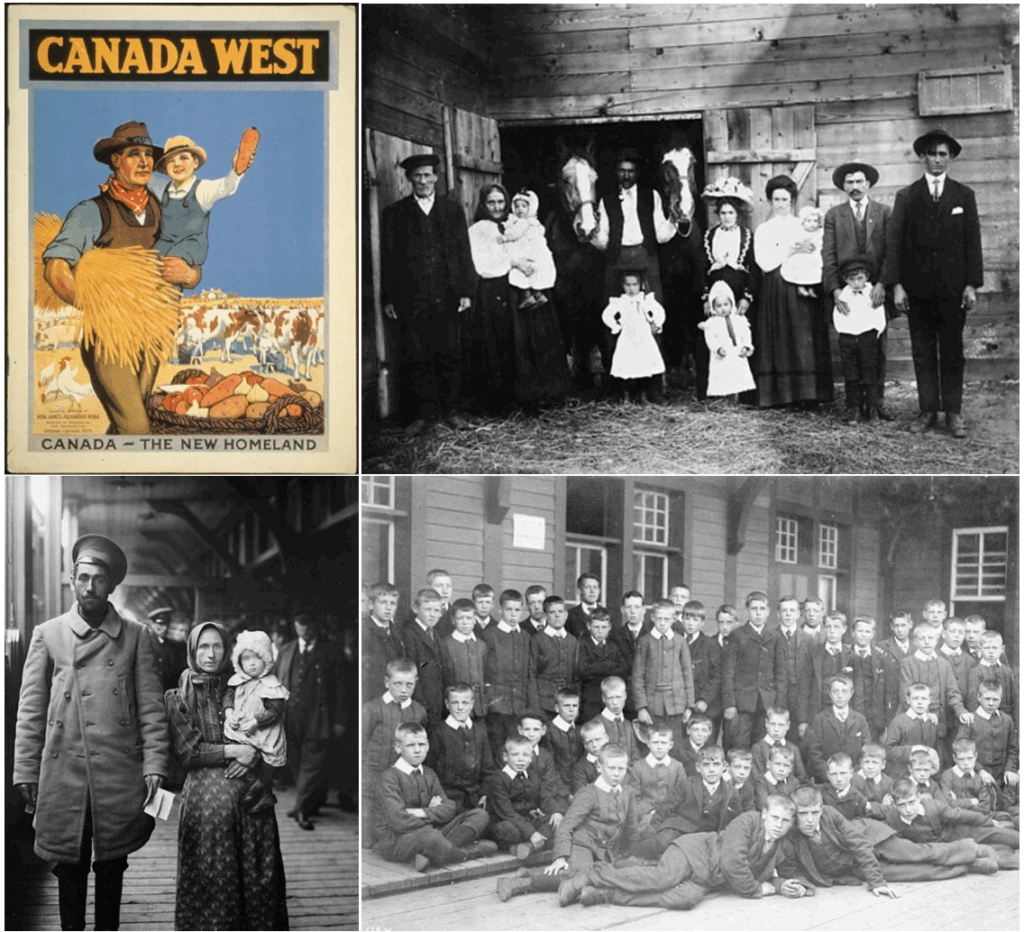
Early in 1951, a refugee in Bavaria tried a second time to emigrate to Canada. Many of the almost 2 million “displaced persons” in that one region of Germany – forming over 20 percent of the local population – were trying to leave. Things had to be better the further you got from war-ravaged Europe. His mistake on the first application had been to write, under “Occupation”, the word “Teacher”. He had been a teacher before the war, but Canada didn’t need teachers. Asking around, it seemed Canada needed labourers, so when my father wrote “labourer” on the second application, he was accepted.
Back then Canada, despite being a “land of immigrants”, used economic criteria to choose whom it took in. It’s a useful reminder given how intense the national debate over immigration has become. Europe’s continuing migration crisis and mass crossings of the U.S. southern border under the Joe Biden Administration have boosted populist politicians, while the longstanding pro-immigration consensus among Canadians has evaporated. Immigration proponents respond by doubling down, accusing almost any opponent of being racist.
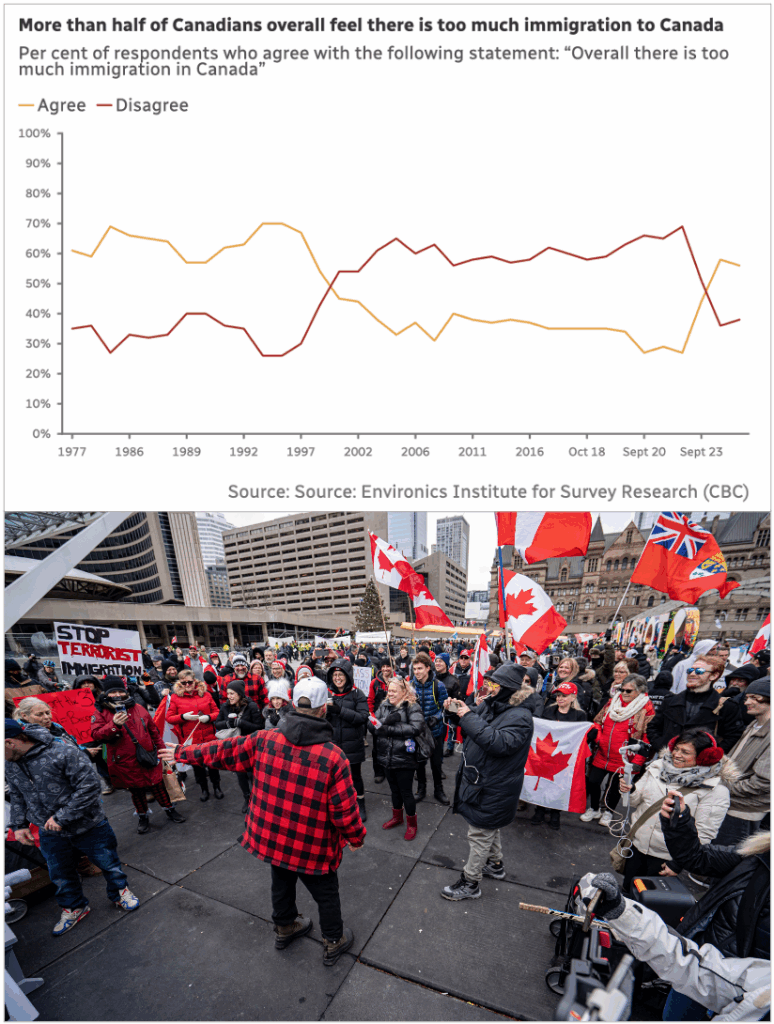
The fight is playing out all over the Western world, with politicians of different stripes juggling public discontent with dissent in their own ranks. The UK’s Labour government faces internal revolt over modest proposals to favour higher-paid newcomers, while Canadians ever-more pointedly criticize the impacts of the Justin Trudeau-fuelled immigration surge. The federal Conservatives have proposed wide-ranging national reforms, while at the provincial level Alberta Premier Danielle Smith is taking questions concerning immigration numbers as well as access to public benefits and job opportunities for non-permanent residents to a provincial referendum on October 19.
Until 2015, Canada actually had a system that worked exceedingly well, what one New York Times contributor described as “Canada’s ruthlessly smart immigration policy.” The reputation lingers; even today, some U.S. commentators on the right remain under the impression that Canada’s immigration system is rigorous, effective and far better than their own. Those of us who had a hand in its management back then can confirm it wasn’t easy or seamless even when it worked well. But it was far better than most. In a breathtakingly short time, however, this “model” system was blown up by the federal Liberals who, as National Post columnist Tristin Hopper put it, took immigration “to cuckoo town.”
The Trudeau government’s shocking mismanagement, if not deliberate dismantling, threatens Canadians’ short-term wellbeing, our future prosperity and our identity – all at once. Bombshell developments occur almost daily, like the March Auditor General’s report revealing massive “non-compliance” (i.e., fraud) and problems with “integrity controls” (i.e., incompetent oversight) in the foreign student visa system. All this has forced a debate over whether immigration is really just about economics and whether Canadians actually have a say about what our country will be.
“Move along, Joe”
A tall, lanky but imposing bricklayer strode through New York’s Ellis Island immigration processing centre in 1902. He wanted to make as much money as possible and send “remittances” back to the old country. What surprised my great-grandfather was that, if you were carrying a mason’s level and a big toolbox, you were simply waved off the ship, typically by a large Irishman saying, “Move along, Joe.” After quick registration in the terminal, you were in. America needed skilled workers.
Canada’s situation was similar during the massive immigration wave before the First World War. Processing, such as it was, amounted to a medical inspection and document review; the sheer number of arrivals was that big. By 1911 foreign-born Canadians numbered almost 2 million – 22 percent of the population. Many newcomers were enticed by land grants out West, as implemented by Clifford Sifton, federal Minister of the Interior in Wilfrid Laurier’s Liberal government, which sought to develop the nation’s sweeping frontier. This was aided by the American West being considered “full” after 1890, leading many Americans, including over 1,500 black people, to come north.
That said, government immigration decisions were dominated by national stereotypes, like the belief that Germans and Slavs were the most skilled at farming on the unforgiving Prairies, or that Brits would best fit socially into Edwardian Canada. There followed a rough pecking order from southern Europeans to “Orientals” and on down. Policies such as the continuous voyage requirement (1908) and Chinese Immigration Act (1923) sought to limit migration from Asia.
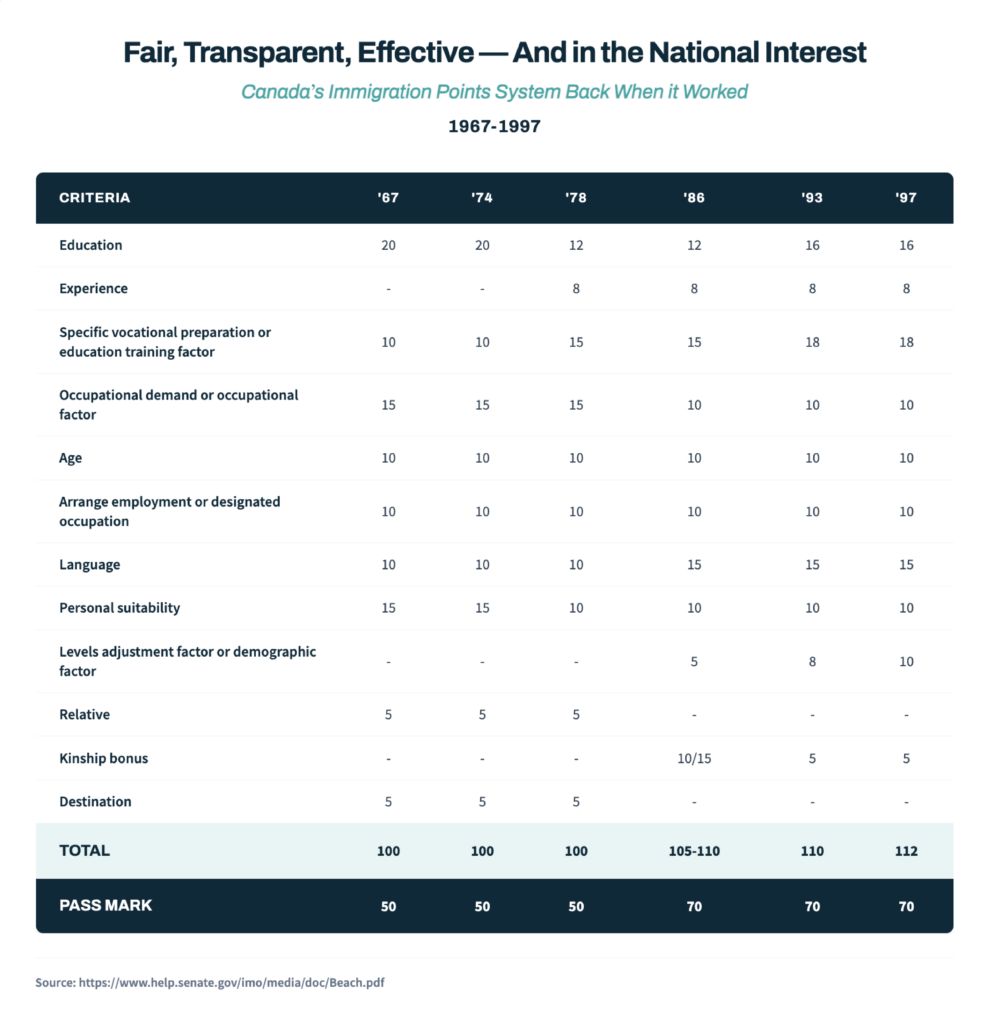
That all changed with the introduction of the “points system” in 1967. An innovation of the Liberal government of Lester Pearson, it translated previously applied general criteria into a specific and transparent tabulation of the applicant’s suitability. The main criteria were vocational/occupational preparation, occupational demand in Canada, age, proficiency in English or French and family already here.
These new criteria were applied to only one of the three main streams of immigrants, the “economic”, which covered skilled workers and their immediate dependants. The other two existing streams – family reunification, in which people already here could “sponsor” relatives to come over, and “humanitarian” candidates – were unaffected. The latter comprised “government-assisted” and privately sponsored refugees. Although the proportions shifted somewhat over the years, since 1980, more than half of Canada’s immigrants have been subject to points-based admissions, about 30 percent have been sponsored relatives and 15 percent have been refugees.
As devised in 1967, the points system provided “an objective way to assess…prospective immigrants while at the same time upgrading the [average] skill level of new arrivals.” Implicit was the recognition that immigration would serve the needs of Canadians and our economy. The criteria, the weighting and the “pass mark” could be adjusted with changing priorities and market demand.
Canada’s system was quickly emulated by Australia in the 1970s, New Zealand in 1991 and the UK in 2008. And as already alluded to, it generated admiration and even envy in the U.S. A 2006 U.S. Senate assessment of our system determined that, while simply increasing the total number of immigrants “lowers the average skill level of arriving immigrant cohorts,” boosting economic-class immigrants does attract people who are more skilled, qualified and able to contribute economically. Emphasizing specific skills was also found to be effective at matching prospective immigrants to Canada’s economic needs.
This fast-tracking not only upended longstanding policy but may actually have violated previous Liberal legislation. The Jean Chretien government’s 2001 Immigration and Refugee Protection Act stipulated that every applicant had to be evaluated by an immigration officer. The constant flow of applications and finite number of staff meant that, five years later, the Conservative government of Stephen Harper inherited a 600,000-application backlog. It took 10 years to whittle that down by about 60 percent, underscoring the time required for basic vetting. Despite their 2020 plan calling for “adding resources” and “streamlining processes,” it’s hard to see how the Liberals could balloon arrival numbers without reducing standards and oversight.
How the Trudeau government really blew things up, though, was by facilitating the explosion of non-permanent residents – temporary foreign workers (TFW), foreign students, etc. By late 2024 this cohort totalled over 3.2 million people – equivalent to everyone in Greater Vancouver – or 7.5 percent of Canada’s population.
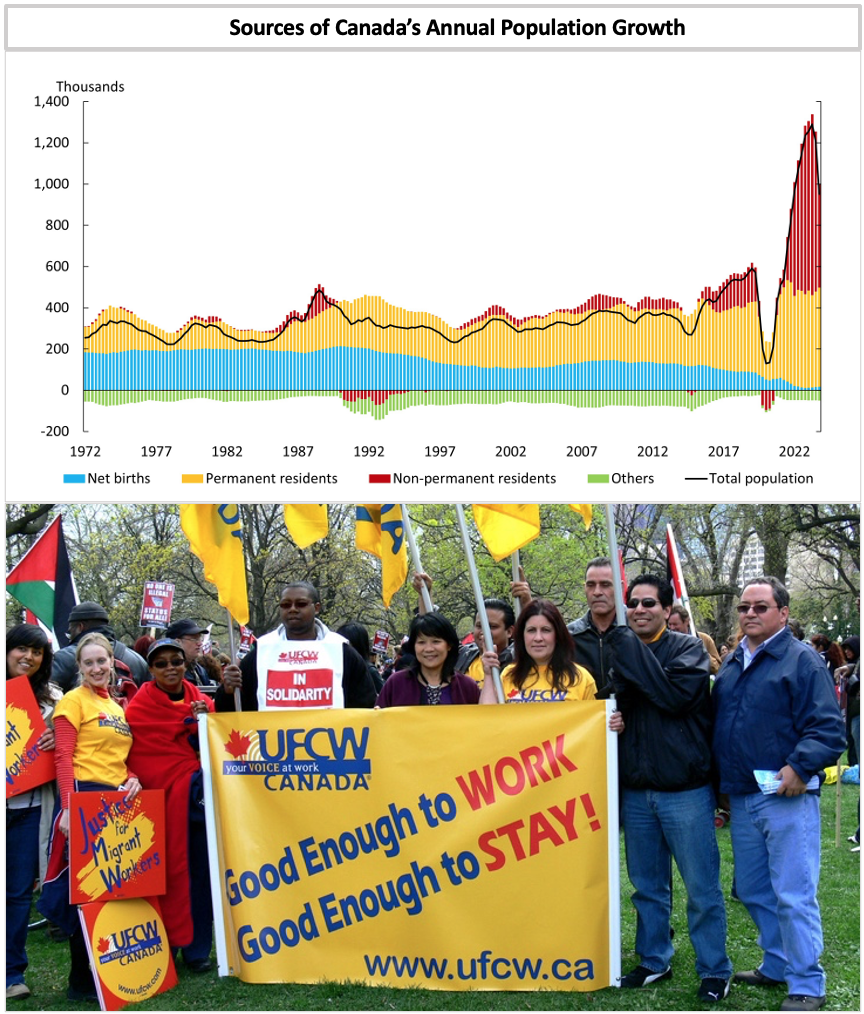
Historically Canada has needed periodic infusions of TFWs in limited numbers, for example in agriculture and tourism. But Trudeau seemed intent on making these a permanent and ever-growing, open-ended feature. Neither temporary nor limited, then. And it showed: youth unemployment zoomed upwards and currently fluctuates around 15-20 percent.
Overall reliance on non-permanent residents has grown dramatically and their areas of employment have spread far beyond the service sector that traditionally sought this class of immigrant. They now extend to professional and technical fields, the health care sector, manufacturing, even finance and real estate. This begs the question: can’t Canadians do these jobs anymore?
Employers seeking TFWs theoretically must prove that no Canadian is available to do the work in question, via what’s called a “Labour Market Impact Assessment”. But our national idiosyncrasies can result in awkward situations. In 2008, for example, owners of a PEI fish-processing plant pleaded with our minister’s office to hire TFWs from Ukraine because “no locals could be found.” Despite unemployment on the island being almost 12 percent, islanders could be exempted from seeking work, and remain on social assistance, for various reasons, including “family obligations”.
International students have become another labour pool and a major source of revenue for universities, their numbers exploding to around 1 million by 2023 – about three times the number in 2015. On average, they now pay over seven times the tuition Canadians do, and universities are cashing in – the University of Toronto deriving over 70 percent of tuition revenue from foreigners. Somnolent federal oversight has allowed upwards of 50,000 foreign students to be here illegally.
Eyebrow-raising aspects of the Liberals’, shall we say, expansive attitude toward immigration include Trudeau’s memorable assertion during the 2015 election, “The Liberal Party believes that terrorists should get to keep their Canadian citizenship.” Similarly, there’s his view that “a Canadian is a Canadian is a Canadian” – including countless people granted citizenship who’ve never even been here.
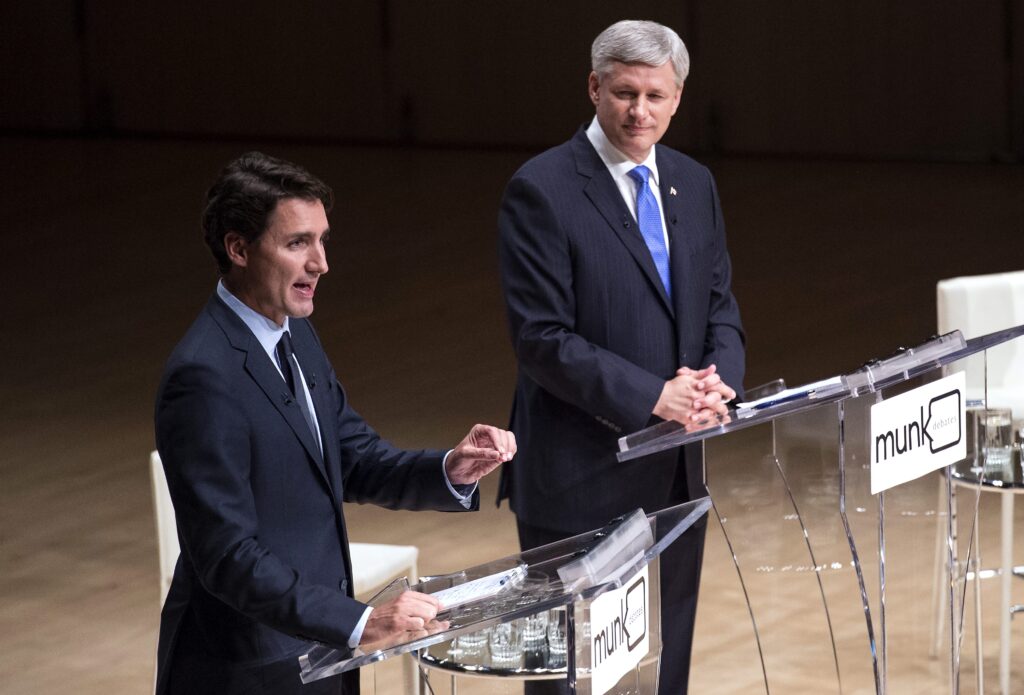
This couldn’t contrast more with the Harper government’s approach. In 2009, longstanding loopholes in the 1947 Citizenship Act were closed, including almost all of the so-called “Lost-Canadian” cases – people who had fallen through the cracks of the old law, a complicated collection that included “war brides” who married Canadian soldiers in the Second World War, and descendants thereof who assumed they were Canadian citizens. Our reforms added much stronger citizenship criteria, emphasizing the individual’s demonstrable attachment to Canada. Consequently, Canadian citizenship was extended only to the foreign-born children of Canadians, excluding grandchildren and on down the line.
In 2023, an Ontario judge overturned this legislation based on, what else, Charter rights. She ruled it unconstitutional to treat someone born of Canadian parents abroad differently from native-born Canucks – i.e., a Canadian is a Canadian is a Canadian. Despite this potentially extending citizenship to generations of foreigners, the Trudeau government chose not to appeal. Now untold numbers, whose forebears emigrated ages ago, or just stopped in Canada for a cup of coffee, are citizens – like the estimated 108,000 “Canadians” apparently residing in the Middle East. It could also include an astounding 10 million Franco-Americans, descendants of long-ago migrants to the New England states who may be only dimly aware of any familial connection to Canada.
Formerly, aspiring citizens had to demonstrate an “attachment to Canada” by actually living here for four years. The Trudeau government reduced this to three and eased language requirements for older applicants, channelling Yann Martel’s vision of Canada as the “greatest hotel on earth”.
Post-national Canada does things a little differently. We currently have as many as 500,000 “undocumented” people, i.e., illegal aliens, living here. Amongst the “documented” are 28,000 failed refugee claimants and others awaiting removal. But unlike Heinrich, they have multiple appeal options before they are, if ever, deported. This includes “ties to Canada” – often themselves derived from excessive, several-year-long delays in hearing claims, enough time to have a child in Canada and get them into pre-school.
The nation’s over 12,000 certified immigration consultants and untold hundreds of Canadian immigration lawyers can help you with the appeals. Courts are often themselves highly solicitous, with judges and even prosecutors frequently going out of their way to lower sentences for serious crimes, or issuing outright acquittals or dismissals, so as not to imperil the defendant’s immigration prospects. This game has gotten too much for some, however, with judges in Quebec and Ontario recently taking the unusual step of publicly reminding prosecutors that their job is to go after criminals, not help them avoid deportation.
There are also currently almost 300,000 unprocessed refugee claimants – the largest number being from India, a rule-of-law democracy not consumed by civil war. Added to those is the annual flow of asylum-seekers, some 172,000 in 2024, compared to just 16,000 in 2015, the Harper government’s last year. Claims doubled in 2017 alone, shortly after Trudeau tweeted his soon-notorious global invitation to all comers. These “irregular arrivals”, plus the 77,000 taken through the annual humanitarian stream, totals almost a quarter-million people.
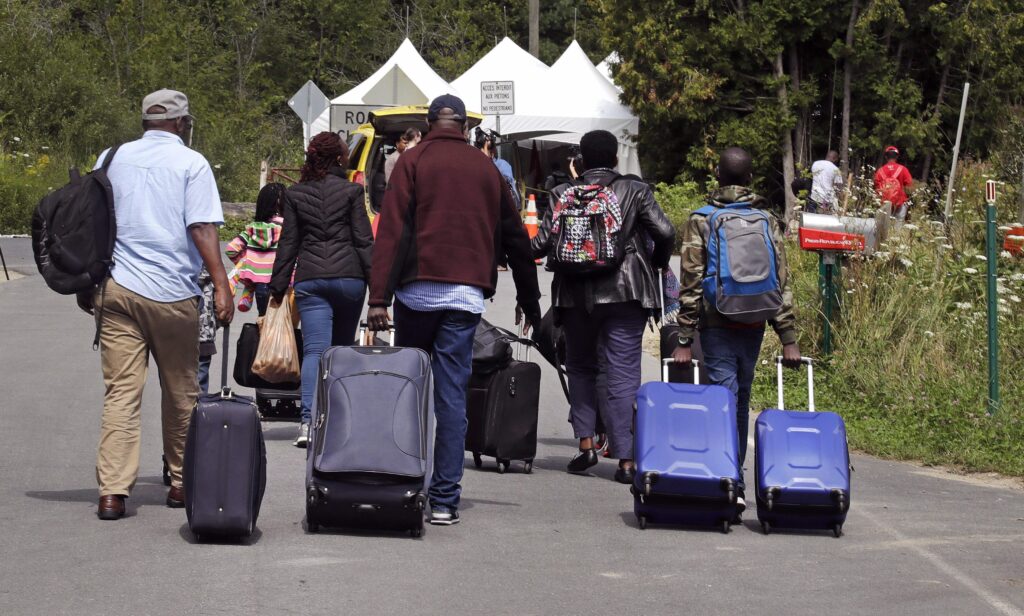
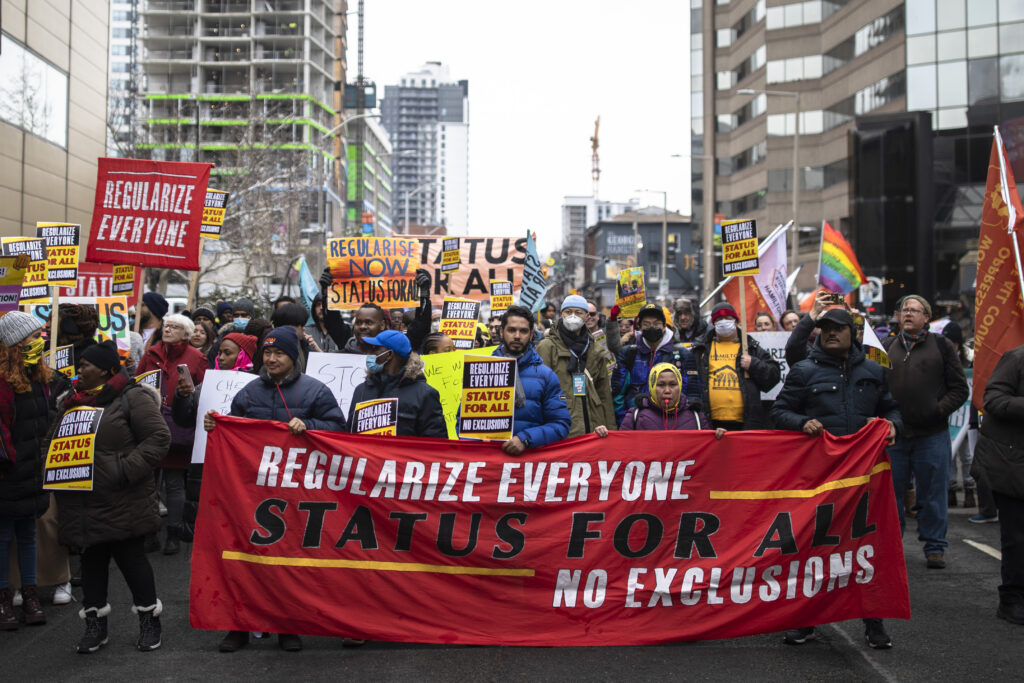


Migration advocates seem to believe that, while there’s a rainbow of cultures with myriad diverse attributes, they are somehow qualitatively equivalent and vary only in degrees of goodness. Diversity is our strength because there’s no downside, at least none we can talk about. Try doing that and you’re subject to Heinrich’s Law. That’s the state of the debate in Canada.
By contrast, some Europeans are diving into Professor Stanley’s pit of xenophobia. The Continent has been positively flooded by migrants, totalling an astounding 87 million by 2020, or 12 percent of Europe’s population. A mathematician at the University of Amsterdam has calculated that non-Western migration to the Netherlands has been costing Dutch taxpayers €17 billion ($27.5 billion) per year since 1995. If the influx continues, the annual tab will soon reach €50 billion ($81 billion). The study found that only immigrants with a bachelor’s degree or higher were even net financial contributors over their lifetime; the rest, the large majority, were a drain.
The reliably liberal Economist magazine has reported some recent analyses of migration’s impact. The UK’s Office for Budget Responsibility (OBR) found that high-wage migrants would be lifetime net fiscal contributors, even if they later claimed a pension and used health-care services until the age of 100. Low-wage migrants, by contrast, would cost British taxpayers over £1.5 million each.
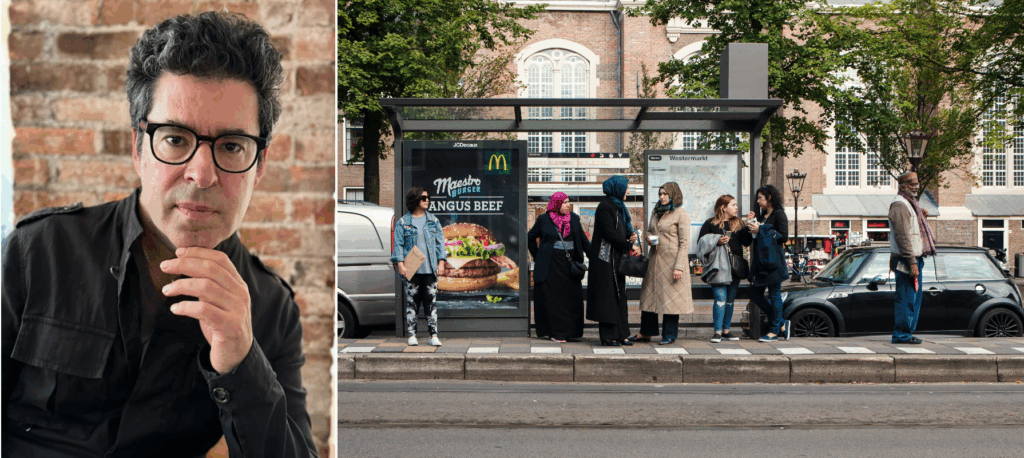
Czech researchers, the article also reported, concluded that every one percent rise in migration to Germany causes a three percent rise in house prices (where’s Andrew Coyne?). And Mette Frederiksen, the centre-left prime minister of historically very pro-immigration Denmark, where immigrants make up 16.3 percent of the population, bluntly declared that open borders make it “impossible to have a sustainable society, especially if you have a welfare society.” U.S. data from 2016 show that each immigrant having less than a high-school education, and each of their descendants, constitutes a net drain of US$163,000 in 2026 dollars, while a postgraduate contributes over US$565,000.
A separate analysis of employment in Denmark over 2010-2024 shows that even second-generation immigrants from non-Western countries lag behind Danes and immigrants from Western countries. The Danish government has consequently beefed up its integration policies, including a mandatory “work obligation” for those receiving social benefits, plus enhanced language requirements and community engagement by newcomers.

Still, most old-line European politicians talk change but don’t change. Not so long ago, they were lining up to repudiate their own migration policies: Germany’s Angela Merkel, “Multicultural [society] has utterly failed” (2010); France’s Nikolas Sarkozy, “The multiculturalism concept is a failure” (2011); the UK’s David Cameron, “State multiculturalism has failed” (2011); France’s Emmanuel Macron, “France will never be a multicultural country” (2019).
Revealingly, though, Macron also believes “white privilege” is real and has said, “There is not a French culture. There is a culture in France, and it is diverse.” One may disdain the French, but no French culture? And while they were all talking, migration continued apace, and integration of newcomers remained a rosy idea. After she trash-talked “Multikulti”, Merkel let in over 1 million asylum-seekers from the Middle East in 2015 alone, with Germany’s total migrant population since swelling to 15.8 million.
The probable results are described by researchers like George Mason University economist Garett Jones, who cites data showing how immigrant outcomes vary dramatically by source country. In Canada, second-generation Argentines, Brazilians and Indians do better than Colombians and Haitians. Statistics Canada shows similar variations in second-generation educational attainment.
Jones’ recent book tracks how immigrants’ values – like savings rates – and their views on trust toward government regulation and personal responsibility persist in their adopted countries. These views extend to as much as 50 percent of the second generation, and even beyond. In Jones’ view, “full assimilation is a myth.” Instead, countries should select for desirable values or, as he boils it down, “If you bring people in from frugal countries, you can make your country more frugal.” His overall advice on immigrant selection: “You better shop wisely.”
These conclusions make intuitive sense and support Canada rebuilding robust, points-based migrant intake using strict criteria. It also implies that Smith and Poilievre are onto something. Smith’s referendum questions seem eminently sensible. Should immigration into Alberta be lowered to a “sustainable” level? Should the province prioritize immigrants who can make a real economic contribution? Should those without permanent residency have free and equal access to all provincially funded programs, or pay something out of their own pockets? Should a temporary resident have the same access to every job opportunity as a citizen? And so on.
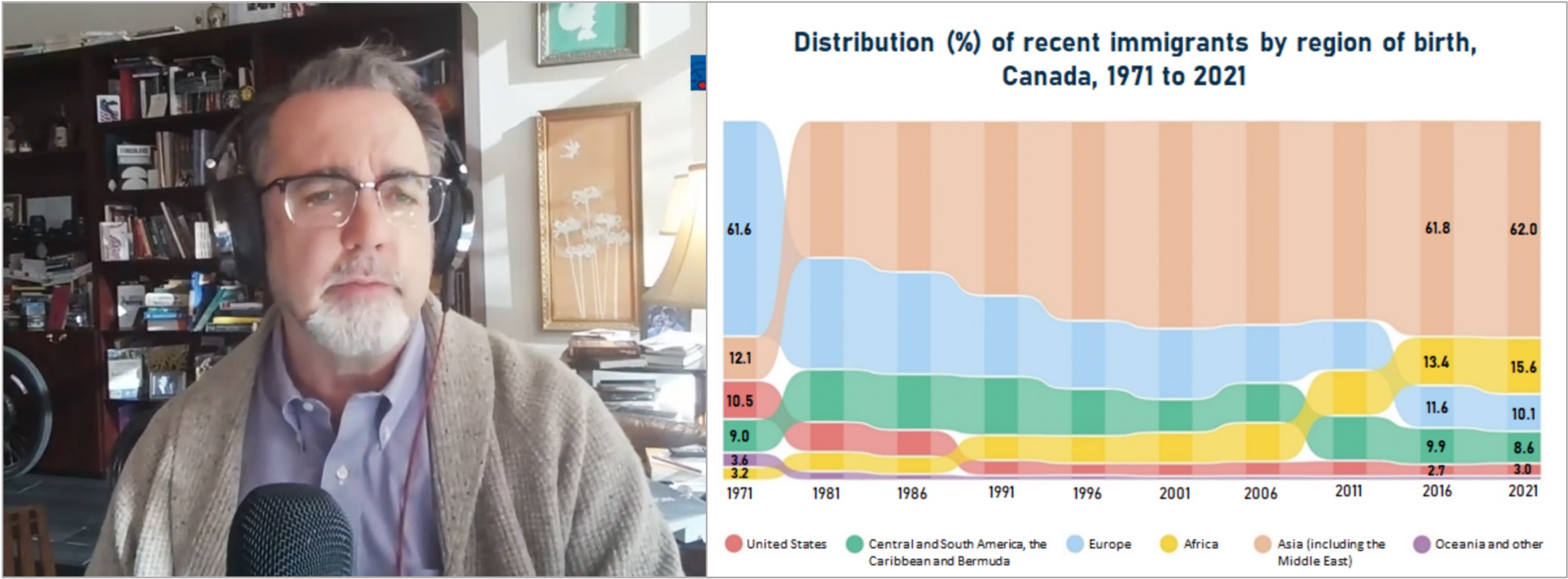
Poilievre similarly wants to slow population growth and tie intake numbers to economic indicators. “We need to have a growth rate that is below the growth in housing, health care and employment,” he says. For reference, prior to 2015 Canada’s annual population growth averaged 1.1 percent while its economy averaged 1.8 percent annual growth, including the downturn after the 2008-2009 financial crisis. In 2023 the population grew by 3.2 percent. The economy? 1.1 percent. The Conservatives have also proposed substantive amendments to tighten the porous asylum system under the Liberals’ border security legislation, Bill C-12, while supporting its passage.
Still the debate, such as it is, falls mostly along predictable lines: mainstream Conservatives preferring imperceptible social change and “progressives” wanting deliberate, dramatic transformation, stuff they can rub in conservatives’ noses. Canadians have barely dipped their toes into the treacherous waters lying beyond the fairly superficial discussions of dollars and cents – such as the relative merits of different source countries. But African-American writer Coleman Hughes believes deeper cultural concerns underlie what are framed as economic arguments. In conversation with author Lionel Shriver, Hughes notes that progressives are inconsistent, promoting “change” but opposing specifics like gentrification of neighbourhoods.

Hughes’ calm, measured analysis touches on the real social strife that has erupted over migration, whether it’s in Minnesota or Europe. The UK, for example, took a flat 250,000 immigrants per year until 1990. That more than doubled by the early 2000s and reached almost 1.5 million in 2023 alone. In 2024, 37,000 asylum-seekers crossed the Channel in “small boats”. Officials fear confronting immigrant-related crime, like the so-called “grooming gangs”, or violence at the ongoing pro-Hamas demonstrations after October 7th, 2023. But those who, like comedian John Cleese, remark that London doesn’t “feel English” anymore are pilloried. Simply noting facts online, like the services and hotel stays provided to migrants, brings fines or imprisonment.
Shriver herself, whose latest novel tackles migration, believes the progressives’ view has more to do with their own moral self-image than with immigrants. They see migrants as “patriots-in-waiting”, despite themselves often hating their own country. Shriver similarly questions the belief that migration is somehow inevitable, that immigrants will “just come, like the rain.”
On the contrary, she says: we can choose.
The Next Canada
Some years ago C2C ran a two-part series headlined “Talk About Immigration While You Still Can”. The premise was that Canada’s pro-immigration consensus was so overwhelming, while the bounds of acceptable discourse were narrowing under an ascendant Trudeau, that it might soon become illegal in Canada to condemn illegal immigration. Indeed, the UN was calling for just such a ban. Things have changed since then. The Overton Window has been pried back open, though squeaking and groaning every inch, and Trudeau late in the game was forced to backpedal on immigration numbers – something implemented by his successor. Public opinion on immigration has shifted dramatically. Canada’s population may even have fallen slightly in 2025.

So we can choose what the future Canada looks like. But how? People are cranky about immigration, but the focus remains almost entirely on economic aspects, and even here there’s no consensus on the seemingly obvious question of whether more people chasing essentially the same number of houses drives up prices.
There are several well-reasoned recent studies that outline how to improve our current immigration. By contrast, the Carney government’s attempt at reform via Bill C-12, the Strengthening Canada’s Immigration System and Borders Act, is too little, too late. As critics point out, while Liberal talking points tout the “new government” taking action, it was the same party and in many cases the same individual politicians who created the mess we’re in now. How could they possibly enact profound reforms?
Overshadowing it all is another touchy subject: birthrates and demographics, something few have wrapped their heads around. Global birthrates are below the minimum population replacement rate of 2.1 live births per woman everywhere but sub-Saharan Africa, and well below that rate in the developed world. The UN projects global population will peak at around 10 billion in 50 years, but others believe this will happen much sooner and at a lower level.
Canada’s birthrate in 2024 was 1.25 and Statistics Canada’s projection that natural population growth will continue into the 2030s must be revised down. Without immigration, our population could halve by 2100.
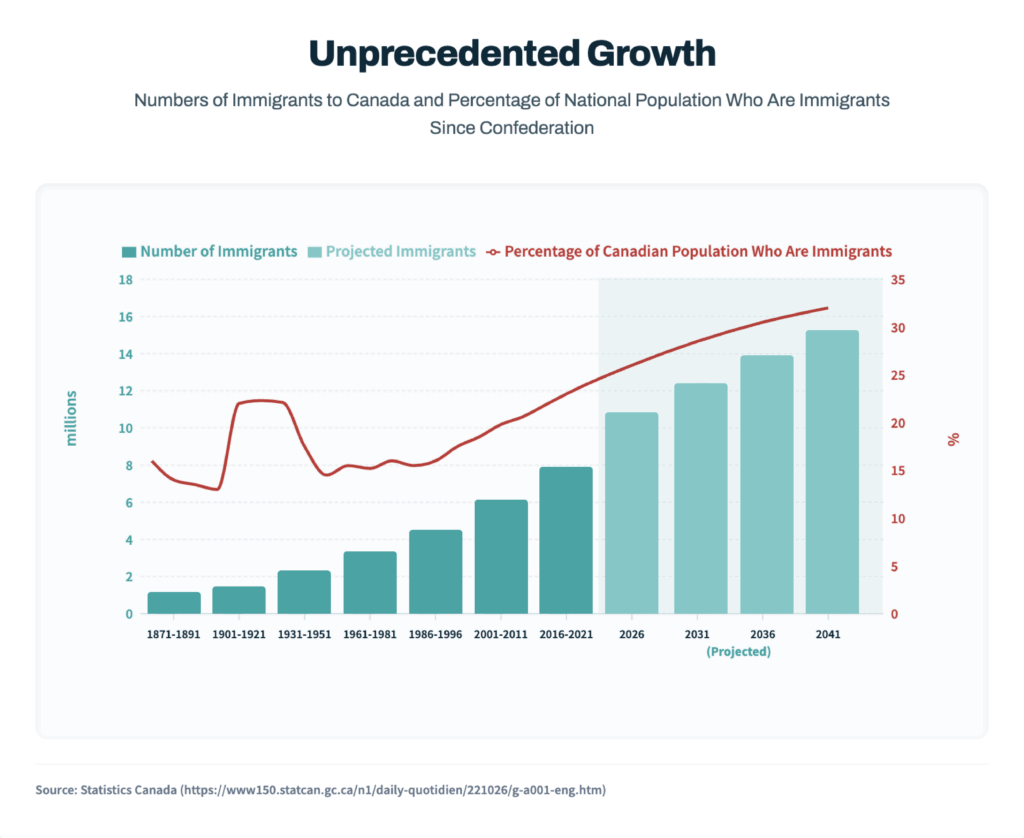
So will we choose to grow and, if so, will it be through immigration or some miraculous return of fecundity? The latter seems unlikely, given that Israel is the only developed country above replacement rate, while vigorous pro-natalist programs like Hungary’s have had only limited success. By contrast, countries like Japan that choose cultural “preservation” (i.e., very low immigration), simply shrink. The attendant costs of an older, smaller population – smaller workforce, lower innovation, productivity and risk-taking, rickety social programs, rampant loneliness, etc. – are presumably nothing that humanoid robots can’t solve.
In 2016, the Conference Board of Canada studied how demographics might affect our future productivity. The board’s scenarios ranged from growing to 53.7 million people – called “status quo” – to zooming as high as 100 million by 2100. Shrinking was not considered, nor was a making-more-babies scenario. The board explicitly analyzed how bringing in younger immigrants could reduce the cost of “expensive social programs by increasing the ratio of employed workers to retirees.” Its assumption seemed to be that Canadians wouldn’t accept lower growth with more expensive, self-sustaining programs.
So a shrinking population appears off the table given our cradle-to-grave expectations and our social programs’ appetite for tax dollars. Except perhaps for Quebec. La Belle Province apparently prefers the Japanese model of “cultural preservation” with lower immigration. But Quebec’s birthrate of 1.3 will mean a declining population and, over time, less political clout. Who will pay for their social services is not mentioned, but one might guess.
Many groups advocate increasing our population, whether to buoy the economy, placate diaspora communities or increase “diversity”. Some are no doubt culpable for the Liberals’ disastrous policies. The “Century Initiative”, a group of self-described “prominent Canadians” (i.e., Laurentian and/or Liberal), grabbed headlines saying Canada should grow to 100 million people by 2100. Proposing growth is fine, but to what end? Attracting the best immigrants just as birthrates in our main source countries also crater will be even more difficult. And the process is self-reinforcing; we’ll need the best to stay competitive in attracting and keeping newcomers.
Remaining attractive also means preserving what draws immigrants now. It means understanding that these conditions didn’t occur by chance, they had something to do with the people and culture that built it. And that a vibrant, innovative economy relies on the rule of law, a high-trust society and social cohesion. These in turn depend on a common culture and shared values which – note to progressives – are a lot more than mere “tolerance” (i.e., indifference). Preserving all that, if only to attract and keep newcomers, will mean, as controversial as it is to some, excluding individuals or groups with entrenched beliefs or cultural practices that undermine it.
In order to compete, we’ll have to be even more “ruthlessly smart”, to hearken back to that long-ago New York Times commentary, which logically should centre upon a rigorous, adaptable points system. A system that rests on the assumption that immigration serves Canadians and our children first and foremost, not primarily the possible future immigrants or their extended families, let alone the utopian abstraction of open borders with unlimited migration. This points system must include overhauling our asylum policies, because no viable nation can allow itself to be swamped by whoever happens to turn up.
This is egalitarianism taken to self-destructive absurdity, the belief that lifting only some – not all – out of destitution is unfair. It glosses over the fact that the past Heinrichs and most of the present ones, while often refugees, are fundamentally economic migrants. They have every right to seek a better life – but we have every right to choose.

Cultural changes will be even more fraught. Agreeing on and preserving whatever pixie dust makes Canada attractive to immigrants now and got us here in the first place is an incendiary topic. Academic ideologues view talk of “common values” as “code words” meant to sustain “unequal social hierarchies.” Preservation of “Canadian heritage” and “Canadian values” is thought to have a “racial subtext.” And if you believe that “white Eurocentric culture in Canada…perpetuates colonial power dynamics,” you might not like points-based immigration. Sadly, threads of such thinking extend right to the Liberal government benches.
My family’s experience was that it’s better to be a refugee than to be dead. And it’s vastly better to be in Canada than to be a refugee. But we got in through Canada’s choice, based on Canada’s needs, not our hopes. Worked then, and would work now.
John Weissenberger is a Calgary-based geologist and former executive at a provincial agency. He was Chief of Staff to the federal Minister of Citizenship and Immigration, 2007-2008.
Source of main image: AP Photo/Eric Gay.