Living for many years on a small Greek island, I eventually came to be known as o xénos mas – our stranger or foreigner. I had acquired many friends and become a member in good standing of the community, learning the language and participating in its rites and customs. I sailed on caïques with fishermen on their trolling expeditions and learned to appreciate the weathered attitude of resilience before the unpredictable. There were moments when I felt we were fish chum, but captain and crew would pray to the Virgin Mary or Panagia – “Most Holy One” – and never wavered. “Mi phobeisthe – do not fear – she will protect us,” one skipper consoled me. But these were rare occasions and most of the time was filled with work and fellowship. I especially loved the singing of chanties and working-class rebekiko refrains during the long periods of sea calm.
I spent time as well in the mountains accompanying shepherds and learning what seemed the deep mysteries of tending flocks. Our conversations over meals or sitting together on a rock smoking delightful Papastratos ovals or Karelia filters were like informal seminars in the worldview of a wise and self-reliant people.
Some of these “mountain men” I will never forget. One was a “natural” chess prodigy for whom the government would occasionally dispatch a helicopter to fly him to prestigious matches and conferences. Another was a science whiz who had followed the debate over the then-theoretical Higgs particle and had lectured me on the physics concept of mass as a form of inertia, like the resistance of a sheep, he pointed out, refusing to be pushed. Yet another was a bagpiper who would carry the bulky traditional tsampouna made of goatskin, reeds, canes and double horns, and who would pipe standard folk tunes during breaks. Still another had a philosophical bent and informed me that the idiomatic expression Einai afto pou einai – “It is what it is” – derived from Eleatic philosopher Parmenides’ to eon – “the thing that is,” usually translated as “whatever is, is.” It represented the unchanging nature of the truly real.

I learned much from these scholars, these captains and herdsmen, including the ways in which the vernacular demotiki Greek they spoke differed from the higher katharevsa of the social and professional hierarchy: the journalists, professoriate, politicians and literary guild. Demotiki means “of the people” and katharevsa derives from kathara – clean, pure, pristine.
The two-tiered Greek language resembled in lexical form the relation between the formal nation of laws, treaties, infrastructure, commerce and industry associated with the mainland and urban metropolis on the one hand, and on the other the insular offshoots dotting the Aegean and Ionian seas with their atmosphere of distance from structured centres, a closeness to the basic elements, and the feeling of a peripheral and insouciant, but authentic, kind of existence that was also porous to the historic culture. These were not “primitive” people but, for the most part, a people deeply imbued with the history and mythology of their nation.
The experience of living on a small Greek island, of having become an islander and absorbing the sense of being part of the environing culture and yet something significantly different, psychologically both sedentary and nomadic, taught me the unique property of what Hellenophile Lawrence Durrell in Reflections on a Marine Venus facetiously, and yet earnestly, called islomania. Durrell describes this as alluding to a “rare but by no means unknown affliction of spirit,” one of confident independence. It is the essence, in my own understanding of this peculiar quality, of what I have come to denote as the apolitical man.
The apolitical man – I use “man” in the traditional sense of encompassing women and men alike – is certainly political in that he is committed to the good order and prosperity of his country. But he or she is also much more than that. His worldview is culture-centred: he is conscious of the distinction between morality and legality, skeptical by nature, a believer in the value of a classical education, and a studious consumer of history and myth, the revelations of the heroic past.

This has great bearing on the pervasive, all-consuming, aggressive if not outright violent and ferally ideological politics of our current times. The political preoccupation has colonized practically all thinking, devolving into something like an obsession. As Harvey Mansfield puts it in The Rise and Fall of Rational Control: The History of Modern Political Philosophy, our social landscape is replete with instruments of state control, from the most trivial to the most coercive, presumably to save us the inconvenience of having to be mindful and think for ourselves. But these are also intrusions into our privacy and exert disparate supervision and power over our life and conduct.
The great challenge of our times is, how might the individual survive such an environment with his psyche intact by somehow carving out a space safe from politics. Even more importantly, how might millions of such individuals stubbornly but quietly reshape what is left of Western societies before it is truly too late.
Colonies of Cultural Redemption
Andrew Breitbart famously told us that politics is downstream of culture, with the implied message that the culture must be changed in order for the politics to follow suit. Breitbart was mainly referencing how the notion is usually broached these days: the “culture” of the workplace, the “culture” of the university, the “culture” of the football locker room, and so on. This is a common bastardization of the original acceptation of culture as the animating spirit of a civilization and the way it diffracts into a given society. But popular culture is always an aspect or manifestation of classical culture even if it compromises or violates or upends the historical and constructive “signal” that allows for the fulness of existence. It is in this latter way that I am using the term.
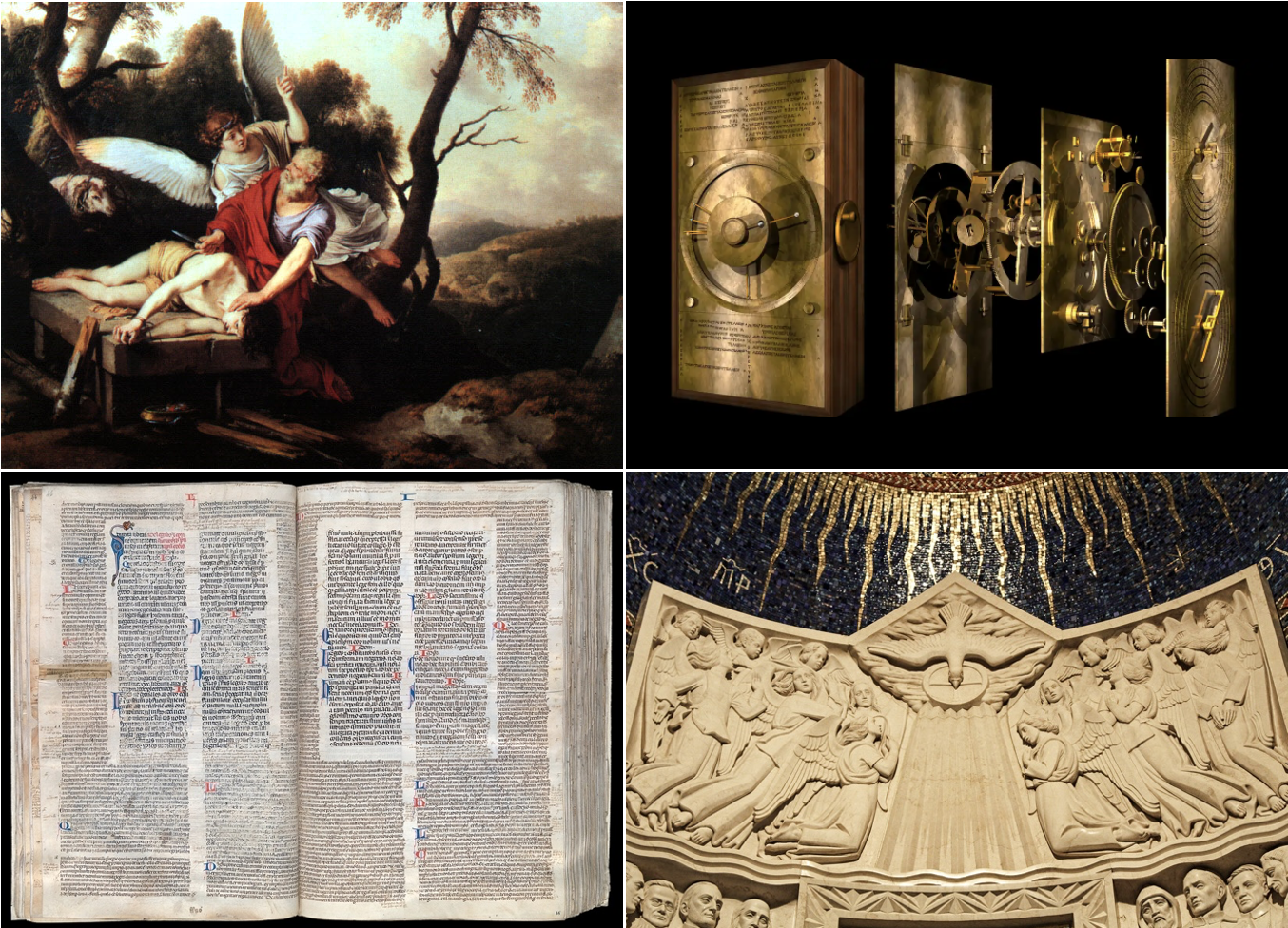 The Judeo-Hellenic-Roman-Christian nexus that formed our Western civilization, the author maintains, is unmatched in the breadth of its accomplishments, and is quietly defended, strengthened and advanced by the apolitical man. Shown (clockwise from top-left): Abraham Sacrificing Isaac, by Laurent de La Hyre, 1650; the Antikythera mechanism, a Greek invention and the world’s oldest computer; relief sculpture depicting the descent of the Holy Spirit, the Basilica of the National Shrine of the Immaculate Conception in Washington, D.C.; a 13th-century excerpt from the Corpus Juris Civilis, cornerstone of Western jurisprudence. (Sources of images: (top right) Antikythera Mechanism Research Project; (bottom right) Lawrence OP, licensed under CC BY-NC-ND 2.0)
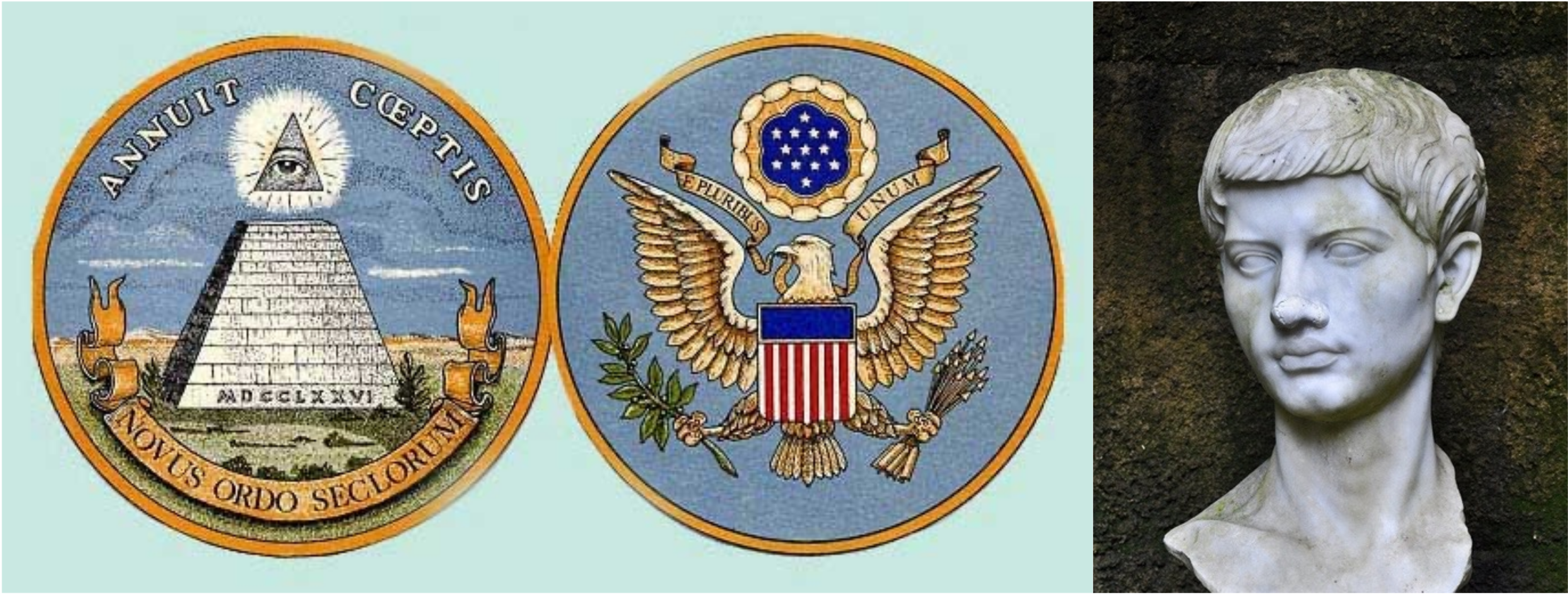 An unquenchable yearning: Novus ordo seclorum – New Order of the Ages – inscribed on the Great Seal of the United States (left), reflects the 1st century BC Roman poet Virgil’s (right) aspiration for an imagined but never realized golden age.
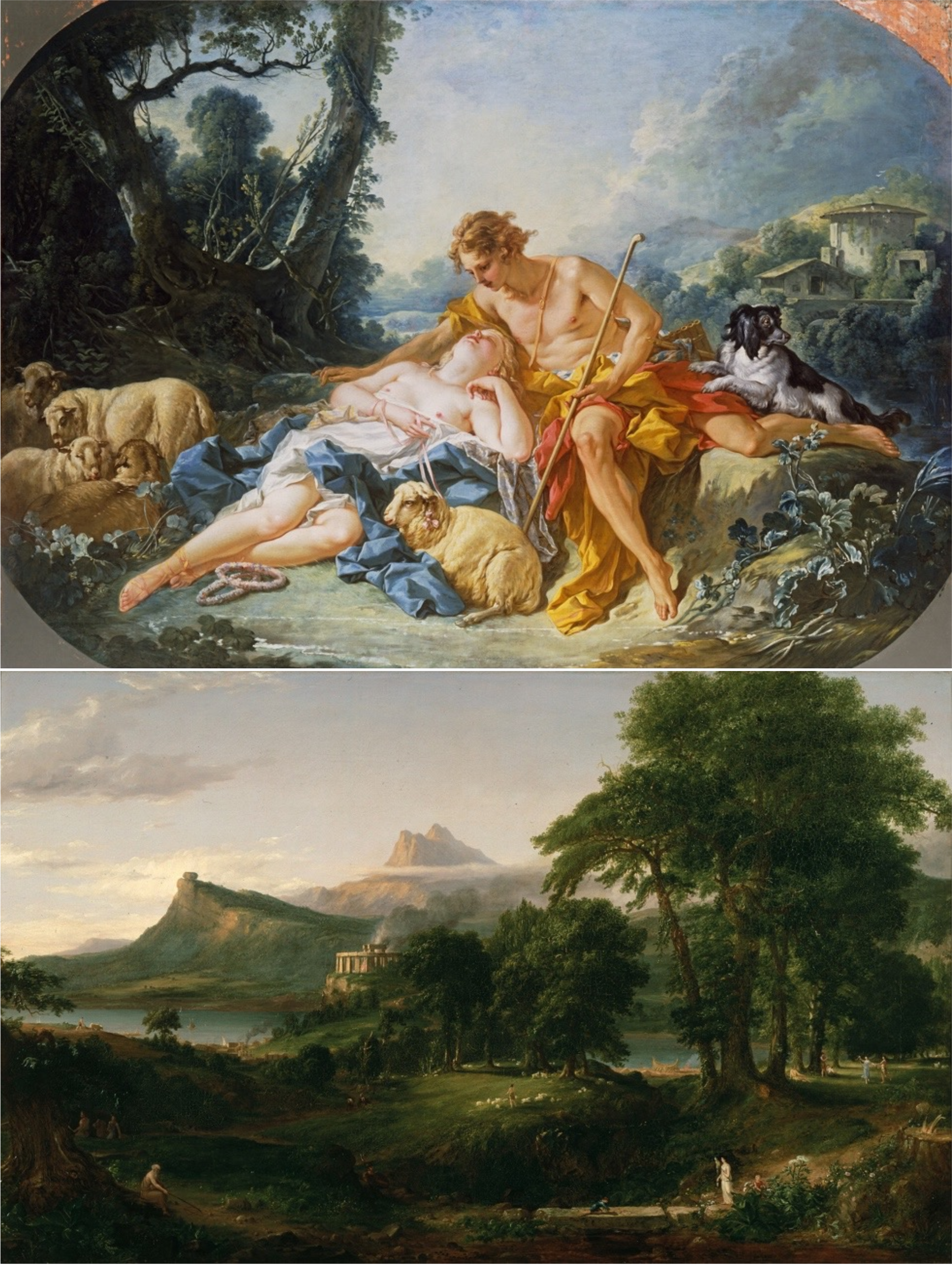 The “better place”: Arcadia, an idyllic, festal paradise of shepherds and nymphs, living in pastoral harmony with nature, though one that classical thinkers always cautioned was not literally achievable. Depicted: (top) Daphnis and Chloe, by Francois Boucher, 1743; (bottom) The Arcadian or Pastoral State, by Thomas Cole, 1834.
 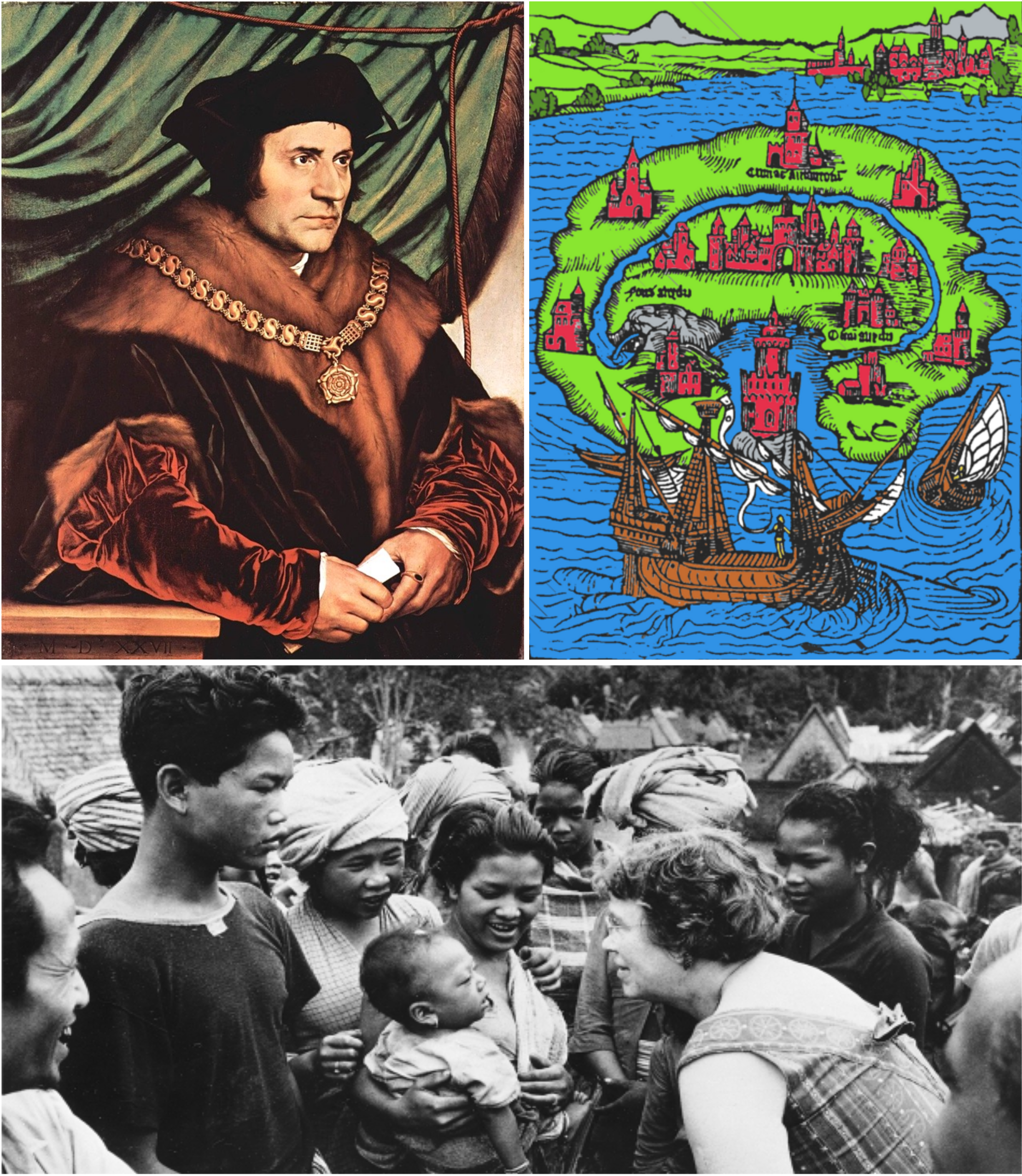 A search for a better society: The utopian fantasy of Sir Thomas More (top left) contributed to a growing notion that tribal peoples remained pure and uncorrupted, offering a simpler, more natural way of life. At top right, coloured woodcut from More’s novel Utopia; at bottom, anthropologist Margaret Mead during fieldwork in American Samoa, 1925-1926. (Source of bottom photo: Tomste1808, licensed under CC BY-SA 4.0)
The attempt to hive off a new society from an established dominion as a smaller variation intact in its own right will almost assuredly lead to ephemerality or calamity. One recalls the famous 17th century English Diggers’ diverse attempts to practice “the levelling of all estates.” Christopher Hill in The World Turned Upside Down follows this “utopian communistic society” before it was broken up by the Council of State. Robert Owens’ New Harmony in Indiana, an effort to inaugurate a “New Moral World, as a prelude to the millennium in which social classes and personal wealth would melt away,” lasted less than three years before disintegrating. Mario Vargas Llosa’s magisterial novel The War of the End of the World tells of the 19th century Brazilian commune of Canudos, a society of the dispossessed, without money, private property or marriage, which was destroyed by the Brazilian government.
Aside from a less turbulent microcosm of social change like Calvin’s 16th century Reformation Geneva, the fate of such real-world communities would suggest they could not flourish indefinitely. These were instances of a presumably apolitical enthusiasm that foundered on the irruption of dubious political motives, the defects and limitations of human nature, and unassimilable realities.
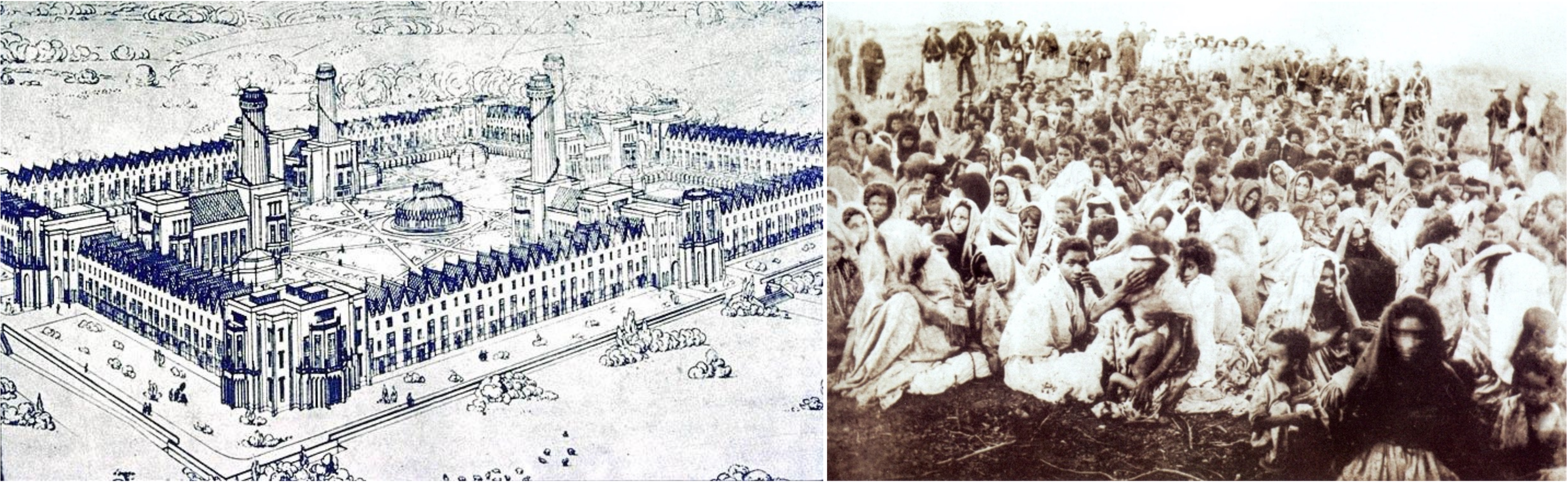
The authentic apolitical drive we are discussing is entirely different, always occurring within the political shell or trellis, being modelled from within the nation or culture, and animated by tradition, imagination, creativity and intellectual energy as part of civilization’s ethos and history. Not replacement, but restitution.
The Two Conceptions of the Apolitical Man
I am using the term and concept of the apolitical in two senses: a) emerging from the whimsical and storybook fable of the classical bucolic with its serious import, including its successors in literature and practice; and b) its deceptive application in the administrative confinement of the functional and reductive political state. The story is both of beneficent aspirations on the one side, which are fundamentally innocuous, and narrow state control and social engineering on the other, which can be both effective and ruinous. The apolitical man has been interpreted as an ambiguous hybrid, and it is important to separate his real from his false natures. It’s a slippery concept to seize.
The movements of political and social re-engineering, particularly from Marx on, have pioneered a new conception of the political state founded with the barest nod to God in the heavens or Nature in the wings, and sometimes not even that. Political thinkers would eventually try to reify the phantasmal and elevate the apolitical man of Theocritus and Virgil into the political man of the modern collective, while retaining a semblance of his attributes. It’s a subtle, Mobius-strip move, a sleight-of-mind and false polarization, but very much what seems to have happened.
It could manifest in one of two ways with only a permeable border between: a repressive sociopolitical system in which individuals are merged into a featureless collective, or a large political unit based on democratic principles but grounded on strong political authority. In The Demon in Democracy, Polish political philosopher Ryszard Legutko, having lived under both communism and liberal democracy, noted the shared objectives between these ostensibly opposing political systems, which believe themselves liberated from the obligations of history and are convinced there is little of value outside their political system. The classical or ancestral past is used only as maquillage to add a touch of fraudulent glamour to the political machine.
Neither of these alternatives has succeeded in capturing the true apolitical man but only his shadow. The two political instances move along a spectrum in which, for one or another reason and in differing degrees, individuals may be despoiled of the opportunity to realize their innate potentials.
These complementary variants of the state – despotic and democratic – were erected on sophisticated and technical theories of statecraft alien to the classics. By the 19th century, after the work of Rousseau, Hegel, Marx, Hobbes, Machiavelli and others, re-imagining the political had taken a completely different tack and bevelled towards the idealized political state as a philosophical and ideological construct assembled and charted in theories of evolutionary history rather than imperatives of the natural order of man and nature, as in the classical fantasy of man’s inherent goodness.
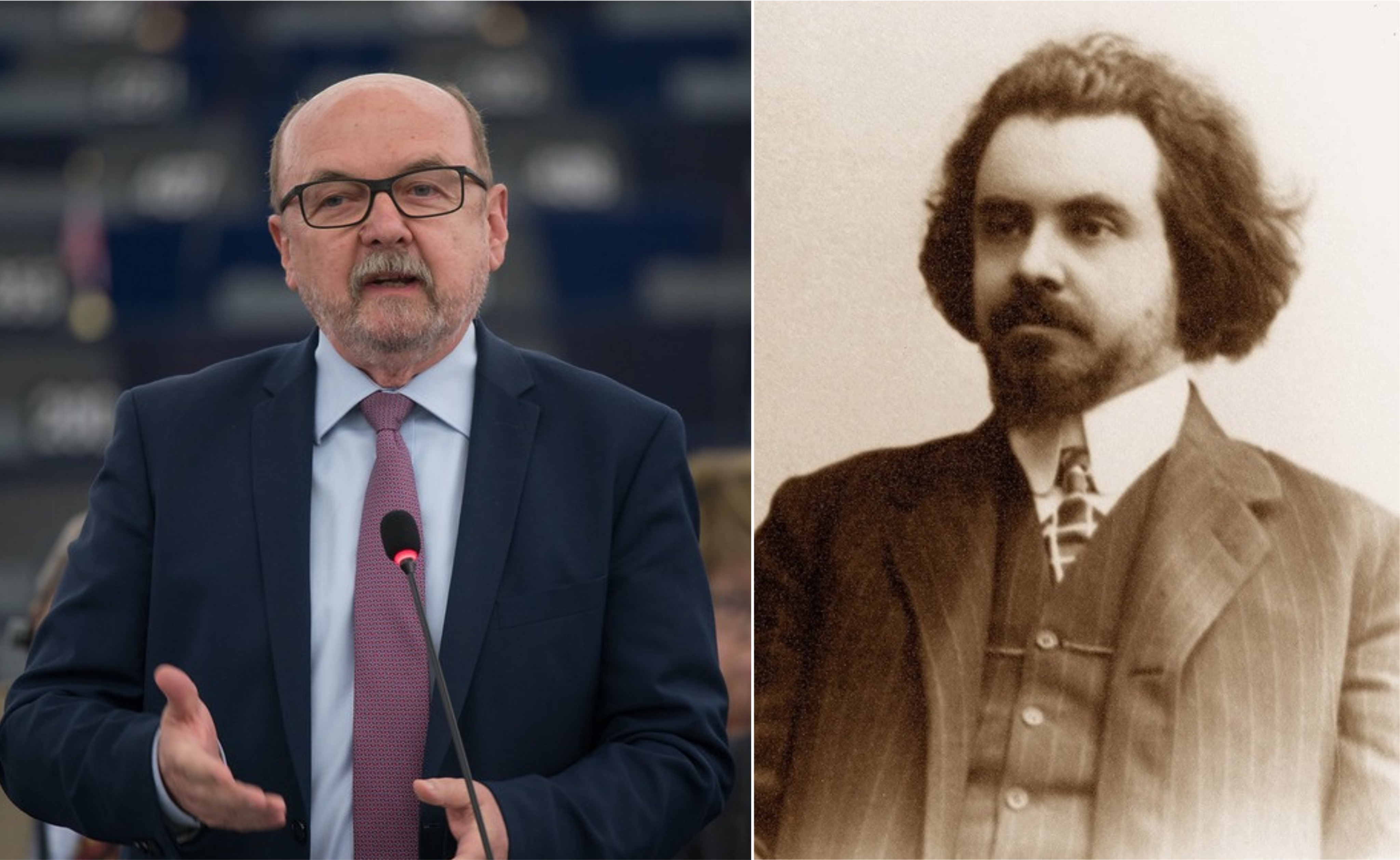
The new state’s intention for the most part – the American founding was an exception – was not to arrive at the noble goals of virtue and justice and productive leisure as in the past, but to build the tenable framework of a manageable political enterprise with a forceful system of legal and economic control over its populace. Its most oppressive version tended in the direction of the demiurgic state, uncreative and mechanical, or as the Russian philosopher Nicolai Berdyaev warned in The Destiny of Man, the state that would sacrifice freedom for the illusion of perfection. In the course of this political trajectory, the “happiness” of the classical apolitical man had been gradually and paradoxically transformed into the ostensible satisfaction of the political man of a new ideological dispensation. This may be elusive to grasp but it is the plinth upon which the demiurgic state is raised.
One can see how the pastoral vision slips effortlessly into the theoretical construct of the authoritarian state. Even Rousseau’s educational bucolic in Emile leaned toward authoritarian government as something morally comparable to the original state of nature. Everything would be predicated on the conviction of the individual’s probity, peacefulness and artlessness while an ethos of administrative constraint and surveillance would effectively prevail in various degrees of severity. The sentiment of being provided for, that is, all that one needed for one’s life furnished in a therapeutic context, would be emphatically stressed by political officials. The concept of the “happy” apolitical man will have been abducted or hacked, transformed into a windowed manikin.
The Liberal democratic or parliamentary state owed its formative stages to the political experiments of antiquity, in particular the classical template of the 6th century BC Athenian democracy, for the concept of “rule of the people”. This vision was almost inevitably distorted by its governing patricians, the ubiquity of this practice defying enumeration. In recent times one recalls former Speaker of the U.S. House of Representatives Nancy Pelosi affirming that socialized healthcare under President Barack Obama and a welfare-Democratic Party-administered society would allow people to quit their jobs, indulge their creative instincts and follow their passions free of “job-lock”.
Currently, New York City’s “Socialist” mayor Zohran Mamdani, touting free supermarkets and municipal transportation – the “warmth of collectivism” – coddles his electorate in the crèche of puerile destitution. Canada’s Avi Lewis, cut from the same tattered cloth, a piliated nabob elected as leader of the NDP, offers the same gumbo of publicly funded grocery stores, green industrial strategies and state ownership of energy – all failed economic manoeuvres producing squalor and privation.
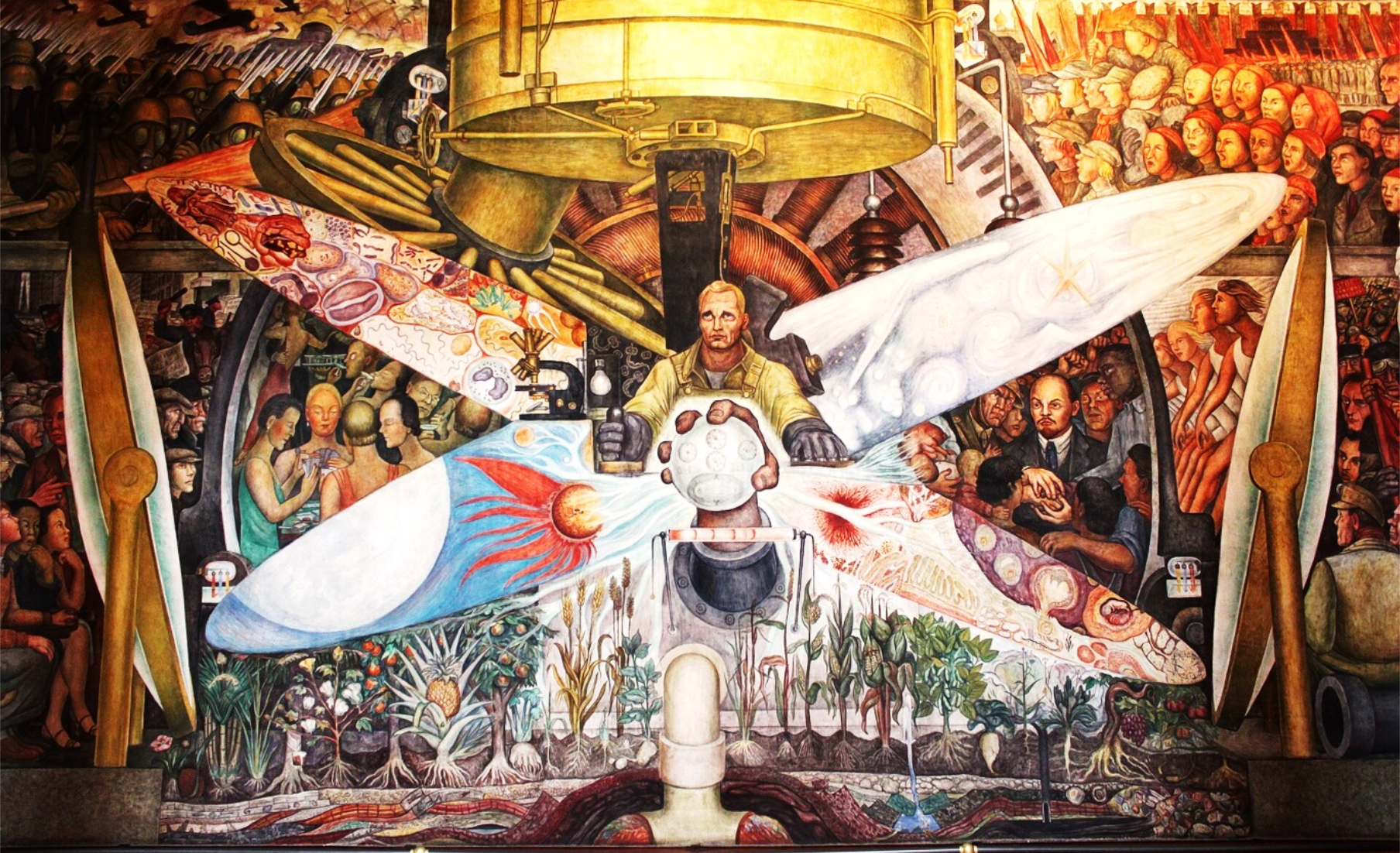 In the overpowering political present, the classical world, the quality of feeling and personal development have all become almost entirely political – and the apolitical man or woman finds themselves absorbed by the state. Shown, fragment of Man at the Crossroads, fresco by Diego Rivera, 1933, depicting the political man between two political forces, capitalism and communism. (Source of photo: AAP86, licensed under CC BY-SA 3.0)
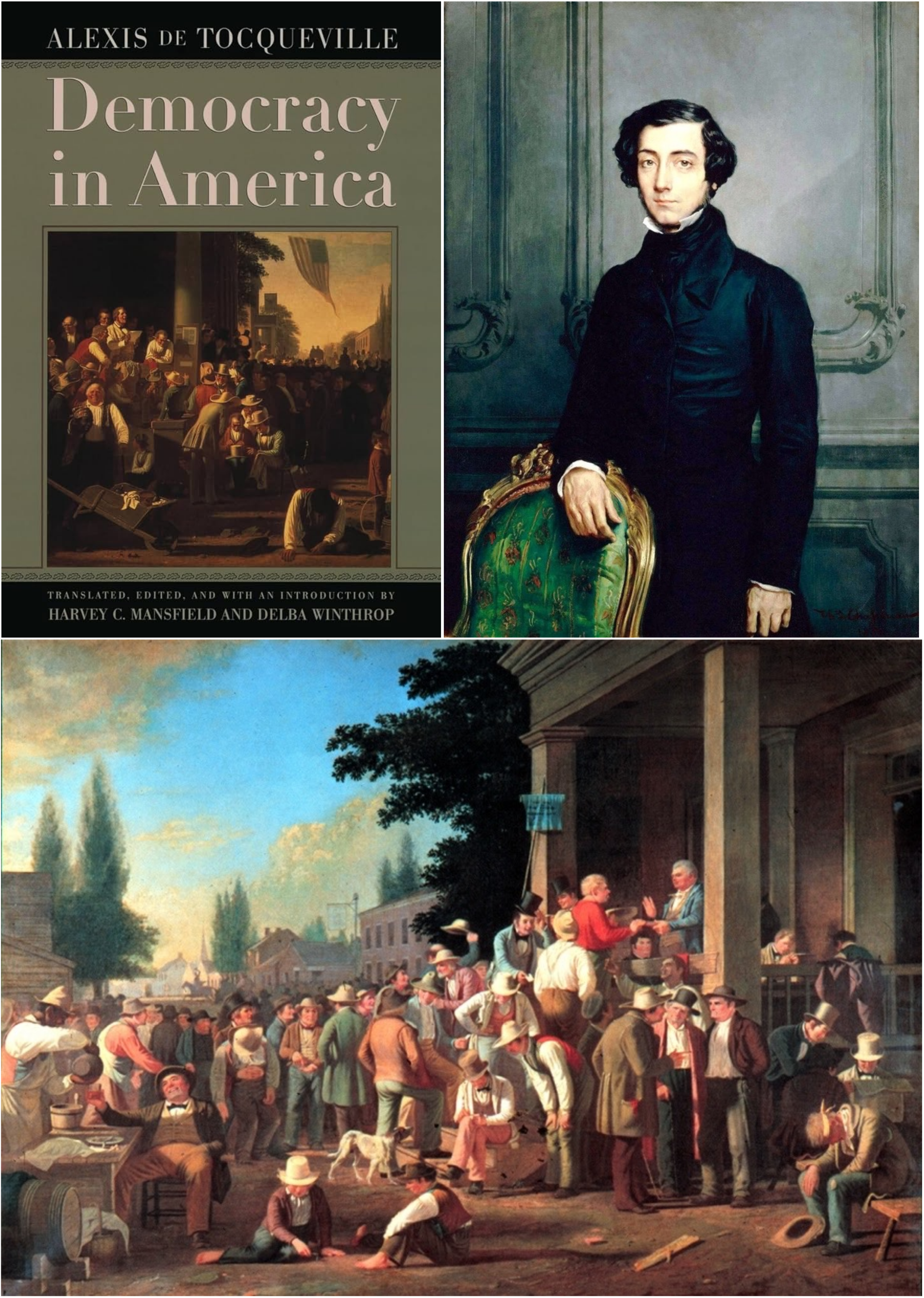 In Democracy in America, early 19th century French political philosopher Alexis de Tocqueville famously predicted a devolution from self-reliance and broad liberty to comprehensive state control through “a net-work of small complicated rules, minute and uniform through which the most original minds” – i.e., apolitical men – “cannot penetrate.” At bottom, County Election, by George Caleb Bingham, 1852.
No wonder there is so little civilized culture to be found in our epoch! Thinking is almost always framed in political terms, ignoring the vast areas of life which were once non-political and sustaining. What I have been designating as the “apolitical” in the positive sense is not a mere pipedream or chimera but an integral part (with a caution against absolute literalness) of the whole human being and the scope of the historical panorama. This is its true nature. It is there to be summoned, if only in fragments, but regaining even a part is preferable to losing the whole.
Play – Integral to the Apolitical Life
The indispensable function of play was brilliantly set forth by Johan Huizinga in Homo Ludens as an essential constituent in everything that generates a superior civilization: art, architecture, law, science, poetry, myth, technology, medicine, warcraft, games and, plainly, politics. The instinct for play – the calibre of the apolitical – precedes both a resident, localized culture and a flourishing civilization.
What Huizinga calls the “play-concept” refers to activities that are in and of its own category and covers a keyboard of performances and exhibitions which “may begin with the primitive play of infants and young animals” but rises to include contests and races, competitions, “dancing and music, pageants, masquerades and tournaments,” and much more. The relation of play to culture involves social manifestations “that are different from ordinary life” and executed within certain fixed limits, according to rules freely accepted and absolutely binding,” whether a chess match, a Superbowl encounter, a Beethoven Symphony, and everything in between. All this is “play”. Ultimately, however, play is a cultural force that gives coherence to the imaginative and purposive “play” of civilization itself.

The ridicule of comedy and farce are clearly instances of the embryonic, rule-based and wide-ranging structure of play – except in our time when the comic has become largely political and unfunny, pinched and reactionary, and even the patent absurdities of wokism do not prompt laughter as they should but are stamped with a political brand. More broadly, the political state progressively sucks the joy out of everything, whether on the grounds of prohibiting freedom of the will and spontaneity or reducing citizens to infantile obedience. Bleak lives matter.
It is time to recognize once again that the world is not all politics and that it is time to bring the imagination back into play, for that is what civilization – at any rate, Western civilization – is all about and is also what the near-exclusive focus on politics in our time has eclipsed. Playlessness, an aspect of political catatonia, would be a victory for the demonic left with its drab and oppressive and humourless displacement of the meaningful and fulfilling.
Finally, as Huizinga writes, civilization cannot exist in the absence of a certain play-element, for civilization presupposes a set of basic rules and mastery of the self, as does sport, for example: “Play must not consist in the darkening or debasing of standards that [have been] set up by reason, faith or humanity. It must not be a false seeming, a masking of political purposes.” [Emphasis in original] Ironically, even politics must be properly understood as a form of play if it is not to be accepted as the Alpha and Omega of life. Even politics must be somewhat apolitical if it is not to dominate thought, conscience and act, and if it is to exemplify a liberating attitude.
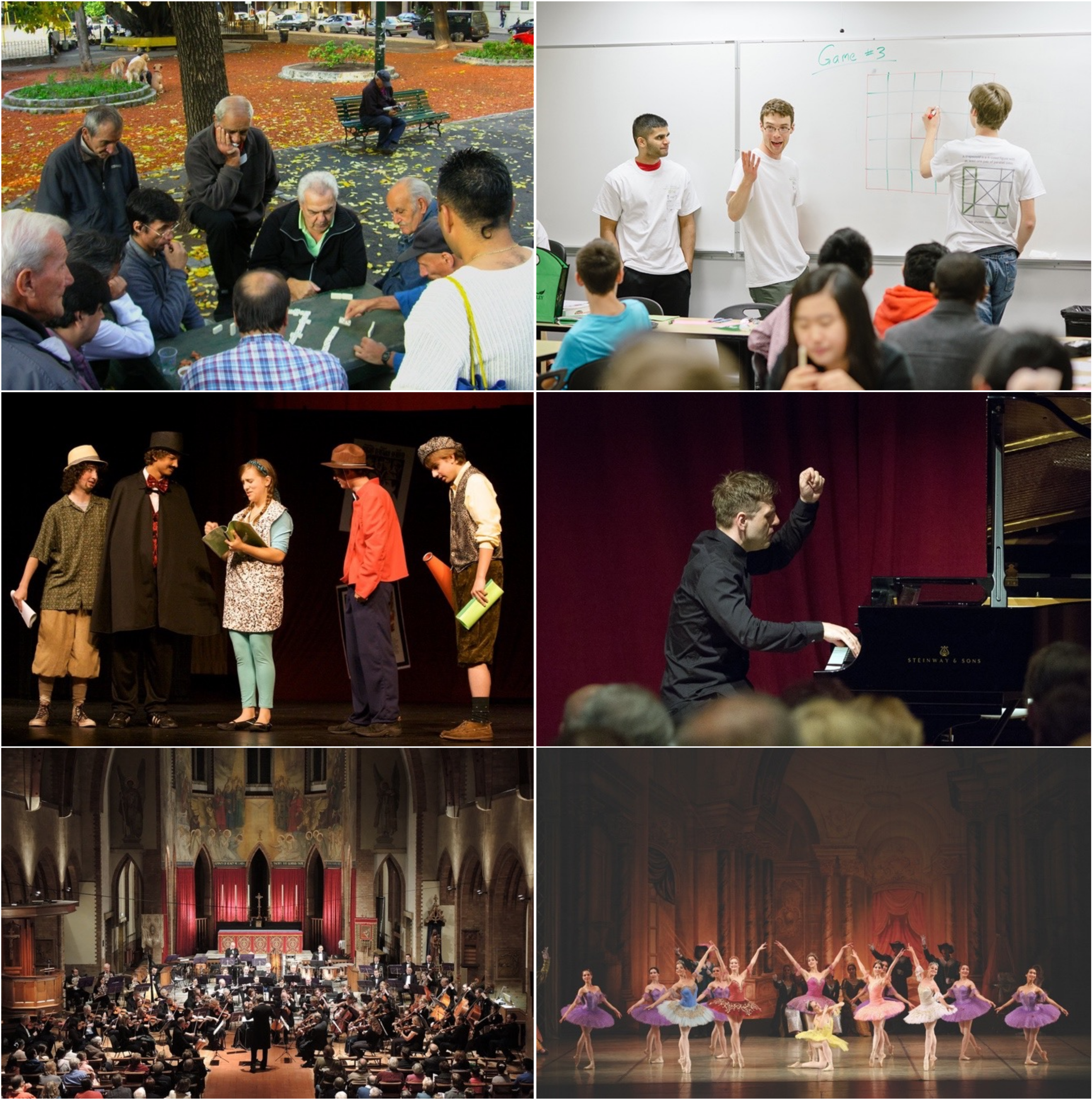
The conservative mind contains and expresses politics, too. But the conservative’s field of study and interest is the entire range of the human adventure in the world, all that anchors it in the complexity of existence, and in the most effective way preserves it. This is all too easily forgotten or neglected. I suspect that men and women of the right have also by and large forgotten that the basis of our civilization is about the expansion of both mind and imagination. Politics, yes, but also science, poetry, art, worship, philosophy, humour, history, language, sport, music – the entire spectrum of human possibility for the good. That is the crux of the issue. Again, this is “play”.
Here it is apt to mention the panoptic oeuvre of Roger Scruton, perhaps the greatest conservative thinker of our time, the age’s Edmund Burke. In Of Human Nature, The Aesthetics of Music, Beauty and How to Be a Conservative Scruton endorses the life-enhancing values of decency and intellectual expansiveness. Fools, Frauds and Firebrands: Thinkers of the New Left should also not be missed. An eloquent warning against the choking limits of the leftist soul, it both mourns and denounces the sort of person whose country is equally a mirage and an ideology, nothing more. Scruton tracks the radical egalitarianism and the staple grievances of identitarians and the dissident agenda of “antinomian” intellectuals and political obsessives.
The apolitical man, the man of Johan Huizinga, Vladimir Nabokov, Thomas Mann, Christopher Lasch, and Giles Scott-Smith, is the civilized man who lives as a political participant of his nation, but who acknowledges the full prism of the developed human personality, a conceptual act which far exceeds the political anatomy of utter state adherence. Scruton, who wrote the wittily titled I Drink Therefore I Am: A Philosopher’s Guide to Wine, did not put Descartes before the horse. Scruton was the apolitical man par excellence, an example of what is possible even in today’s undeniably diminished culture.
Forward to the Past
At this point in our cultural life, we need to go back to our classical past and learn what it has to teach us. “It is impossible to understand Western civilization,” writes Daniel Jupp in A Gift for Treason: The Cultural Marxist Assault On Western Civilization, “without an equal understanding of classical civilization. The literature, sculpture, architecture, poetry, history, politics and economics of ancient Greece and Rome were the bones upon which the flesh of our society was formed, an integral part of our own experience and identity.” The same, of course, is true of Testamentary Scripture.
For those of advanced years it is hard to realize that our neighbours and family, and even our children, all too often belong to another order of social and political existence, what historian David Starkey in Crown and Country, if memory serves, called the “Human Rights Culture” embracing the Marxist/French revolutionary critique in our time. Yet people still congratulate themselves on being “civilized”, living in the architectural husk of antiquity represented, for example, by the classical buildings of Washington, the museum that is Europe today, and even Canada’s Library of Parliament. Millennial parents still drag their Gen Z kids to the Louvre, even if only dimly realizing what they are looking at.
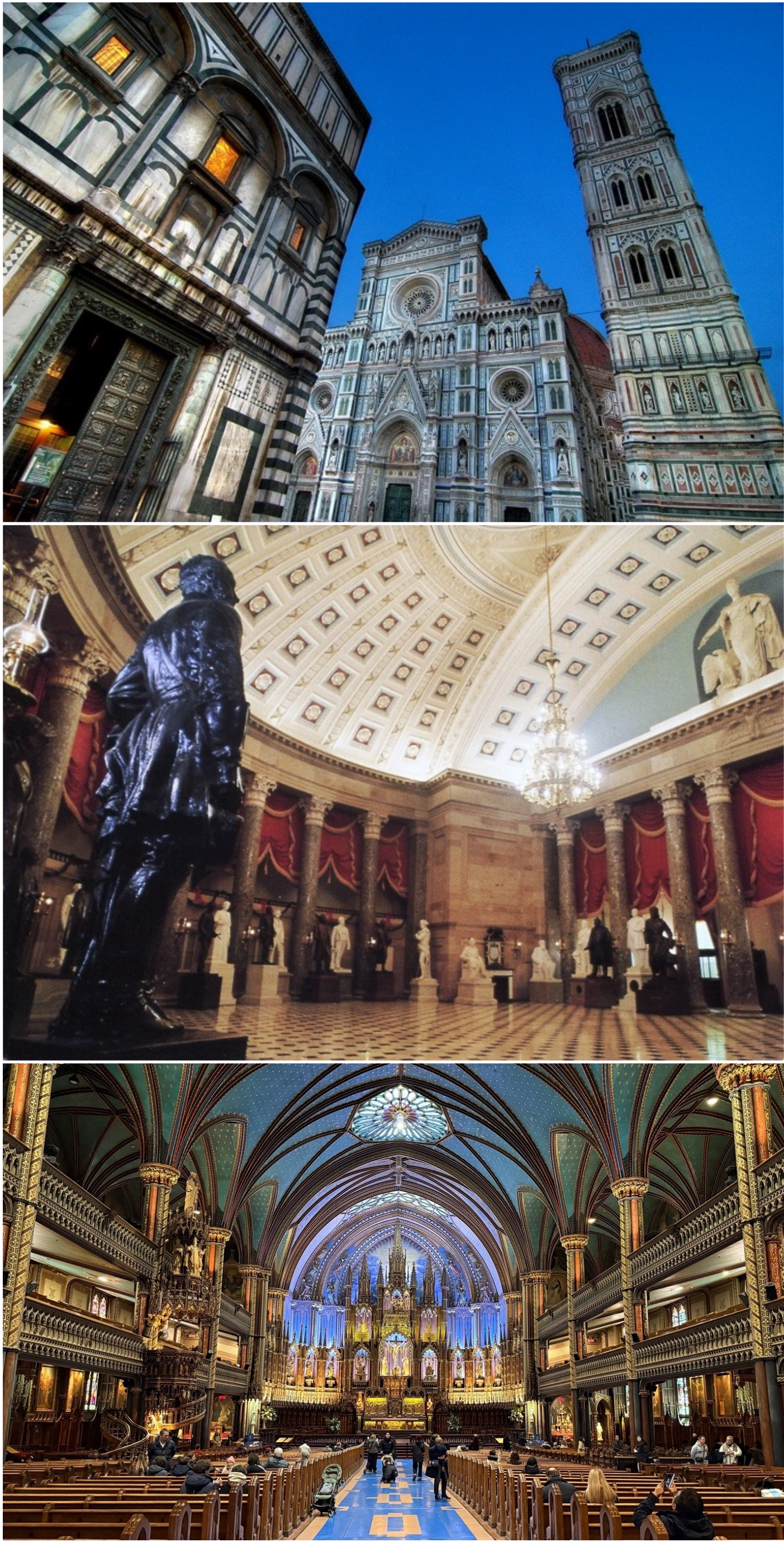
Our governing classes and modern “elites” have no classical learning, have never read Plato or Cicero, the Bible is equally alien to them, and they have likely never heard of Virgil. Our rulers have no conception of the pastoral paradigm in canonic literature or the villatic tradition in political discourse, cannot perceive that the apolitical man as a figure in history with a palpable existence has an important place in any political society. They cannot in consequence truly claim to be civilized.
But that has not prevented progressivist leaders from faking it, from pretending to an ideal of glory and eminence which they have not assimilated or even remotely approximated. The supreme mountebank Barack Hussein Obama placed himself before fake foam Greek columns in accepting the Democratic Presidential Nomination in 2008. The imbecilic Joe Biden delivered his blood-red anti-MAGA speech in front of Philadelphia’s Independence Hall of Georgian architecture, which embodies the symmetry and harmony and proportion of classical Greece and Rome. In Canada, a former substitute drama teacher assumed an essentially hereditary role as prime minister – then spent his time in office tearing down everything in sight and repudiating his own civilization.
The uncivilized man has become almost exclusively political in the reduced sense. His feint at classical values is only an aspect of deceit, of pretending to be what he is not in order to give the impression of learning and knowledge for political advantage and profit. He has adopted the classical yearning for an idealized society and turned it into the fetish of an organized and variously oppressive political state. In so doing, the uncivilized man has replaced the imaginative with the imaginary and rendered the past both superficial and cosmetic, a kayfabe proxy, a false performance. He is propounding what he believes to be a new utopia, a “green” or “sustainable” future, oblivious that a civilization minus its heritage and the record of its evolution is not merely a false eu-topia but really no-place at all, for all intents and purposes, an ou-topia.
The final irony. The apolitical man is someone who has recognized that the best political system is not strictly apolitical in the storybook or abstract sense, as some might think, but plus-political. He has not eliminated politics from his perspective, but has supplemented and enlarged it with the floral and vintage aspects of the greatest civilization the world has ever known, with its patrimony in Greek philosophy, Roman law and praxis, the Jewish moral code and the Christian view of divine immanence, with science, music, art, literature, theology, philosophy, playfulness, economics and exploration in the widest possible acceptation.
The Island Refuge
The apolitical, or plus-political, man, then, remains interested and involved in politics. He is not exclusively political as in the modern worldview, but equally understands that the make-believe world in the blithe and sportive digressions of antiquity are, at best, a kind of market correction of the hard and sullenly real in the mind of man. The attitude is clearly feasible as I experienced it during my lengthy sojourn in Greece. This was no sentimental, back-to-nature indulgence but a realistic and well-rounded proposition. It is in this spirit that the apolitical side of life needs to be brought back, not as fabrication but practical fact, an insular ideal at the core of the mainland.
As Joel Kotkin notes in The Rise of Corporate State Tyranny, corporate state control is in some degree inescapable: “The diffusion of power, so critical to democracy, erodes and autocracy develops naturally.” We have seen this caveat elaborated in Tocqueville and Legutko. Such incorporation not only shrinks the middle and working classes but stifles dissent obstructing the opportunity for cultural resurgence and individual development.
But not all is lost. Kotkin believes some degree of local autonomy may sound an “appeal beyond the political spectrum.” Traditional conservatives concerned with liberty of thought and freedom of speech may offer resistance to state and corporate elites and pursue the recrudescence of cultural vitality. “Given the nature of our society and history, people cannot be controlled from the center,” Kotkin writes, or programmed in the birthing vats of the hive mind.
We hope he is right. Churches (or at least some), independent journals (such as this one), local associations, small enterprises, genuine thinkers (though rare), people with common sense and conscience, still others who feel the need to learn beyond their station, profession, or niche – these comprise what we might call “apolitical forces” that represent the nub of our Judeo-Hellenic-Roman-Christian civilization.
The concept of the apolitical man, and his potential “field” the apolitical state – the state whose sustaining and formative culture ideally remains an integral part of the founding civilization – become an island refuge in a turbulent sea of legislative applications toward political closure in the majority of the world’s nations. The apolitical man has set up his stall in the civilizational dimension.
“Cultural history is after all a stream,” wrote Moses Hadas in New Wine, Old Bottles, foreshadowing Breitbart. It can be “interesting and instructive” as well as “fruitful.” Its basis is “the literary works arriving from antiquity” – what we call the Humanities. This is what provides a society “with patterns and with authority.” This is the endowment of Virgil as it is the defining sensibility of the archipelagian patriarchs I lived among. It is a relief to know they exist in the flesh and not merely as fictional emanations or sentimental projections.
The political man, however, has misconstrued and misrepresented the apolitical man in order to deceitfully accommodate the purposes of state control and management. The political state is thus falsely portrayed as the avatar of imaginative and intellectual freedom, the defender of the civilizational imperative, while it is increasingly the opposite, the leviathan of dirigiste command. The contemporary political man has lost the blessing and benefit of the sublime civilization of the West, the source of the expansion of man’s cognitive and epistemological faculties, that is as close as we will ever get to what we might call aristopia, the superior place, however blemished in practice, however subject to the irruption of religious, political and ideological conflicts and the rise of pagan imperiums in a dark and fallen world.
It is far from clear if we can replevin the marrow of our vast and prodigal civilization and the vibrancy of its promethean culture, but of one thing we can be assured. We cannot sell out our heritage. The apolitical man remains the West’s last best hope.
David Solway’s latest prose book is Profoundly Superficial (New English Review Press, 2025). His translation of Dov Ben Zamir’s collected poetry New Bottles, Old Wine (Little Nightingale Press) was released in spring 2026. Solway has produced two CDs of original songs: Blood Guitar and Other Tales (2014) and Partial to Cain (2019) on which he is accompanied by his pianist wife Janice Fiamengo. A third CD, The Dark, is in planning.
Source of main image: ChatGPT.