When all the world would keep a matter hid,
Since Truth is seldom friend to any crowd,
Men write in fable, as old Æsop did,
Jesting at that which none will name aloud.
And this they needs must do, or it will fall
Unless they please they are not heard at all.
—Rudyard Kipling, “The Fabulists”
In his recent essay “Why I’m Not a Brain-Dead Conservative”, actor and singer-songwriter Clifton Duncan did conservatives a favour by saying the rude thing plainly: the arts matter. They are not decoration. They are not a luxury good for bored liberals. They shape imagination, moral habit, public sympathy and shared myth, permeating society and thus bending civilization itself in one direction or another. Modern-day conservatives, particularly in North America, have too often been useless here, complaining about the state of our arts and cultural institutions while refusing to build them. Duncan puts the cure in one blunt sentence: “The obvious cure for our stagnant culture is investment in a vibrant, viable and competitive cultural infrastructure.” [Emphasis added]
Canada’s arts scene does not lack talent. It lacks form, dissent and above all piety (more on the meaning of that word later). Canada should be the perfect case study. We have institutions, money, festivals, grants, schools, prizes and public broadcasters. What we lack is artistic nerve. Canadian arts culture has not merely been captured by progressive politics. It has been spiritually inverted. The work no longer disciplines the self – the artist’s ego. The self now drives and determines the work.
The Missing Piety
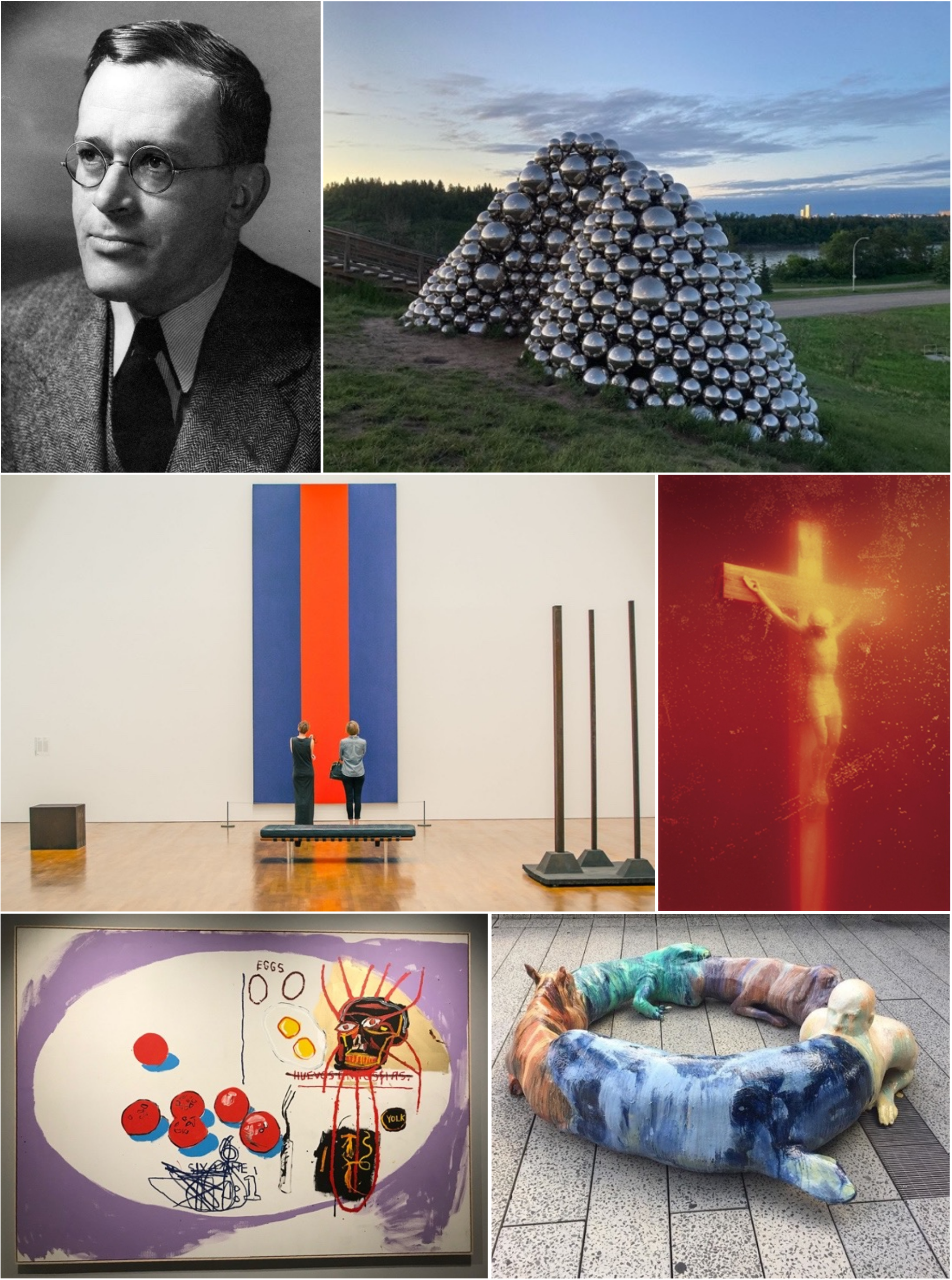
Political philosopher Richard Weaver diagnosed the disease decades ago in “Egotism in Work and Art”, the remarkable fourth chapter of his seminal 1948 book Ideas Have Consequences. Modern man, Weaver argued, makes the separate self – the individual – the sole measure of value. In work this destroys craftsmanship: the worker no longer serves the ideal in the task. In art it destroys form: the artist no longer serves reality, beauty, tradition or the universal. Instead, he or she serves impulse, self, display.
Weaver’s best sentence is also the simplest diagnosis of our current arts culture: the egotist “thinks not of subordinating self to end but of subordinating end to self.” That is the missing piety, used here in the older, larger sense: not mere religious observance but the self-discipline of serving something larger than one’s own self-display, placing the truth over one’s own appetites.
Our world is super-saturated with examples of Weaver’s inversion. These range from ludicrous (yet lavishly-funded) “installations” like piles of glued-together steel balls set beside urban roadways to Andres Serrano’s Immersion (Piss Christ) which, if you’ve never heard of it, depicted a crucifix placed in a container of the artist’s own urine. Part of a series of photos in which Serrano vandalized various classical themes, Piss Christ won a U.S.-government-backed award. Canada had its own, high-church version of such travesties with Barnett Newman’s Voice of Fire, a three-stripe abstraction bought by the National Gallery in 1989 and defended with a mixture of institutional hauteur and taxpayer-funded mysticism.
These examples illustrate the flipside of the work-artist inversion: our arts institutions have infected themselves with the bureaucratic variant of the same disease. True, they don’t actually announce, “The self is the measure.” They do something more effective, selecting and rewarding work that makes identity, lived experience, harm, community standing, positionality or underrepresentation the first credential of artistic legitimacy. The structure is the same. The work comes second. The old artist asked, “Is it true?” The new institution asks, “Whose truth is it?”
The Self Before the Work
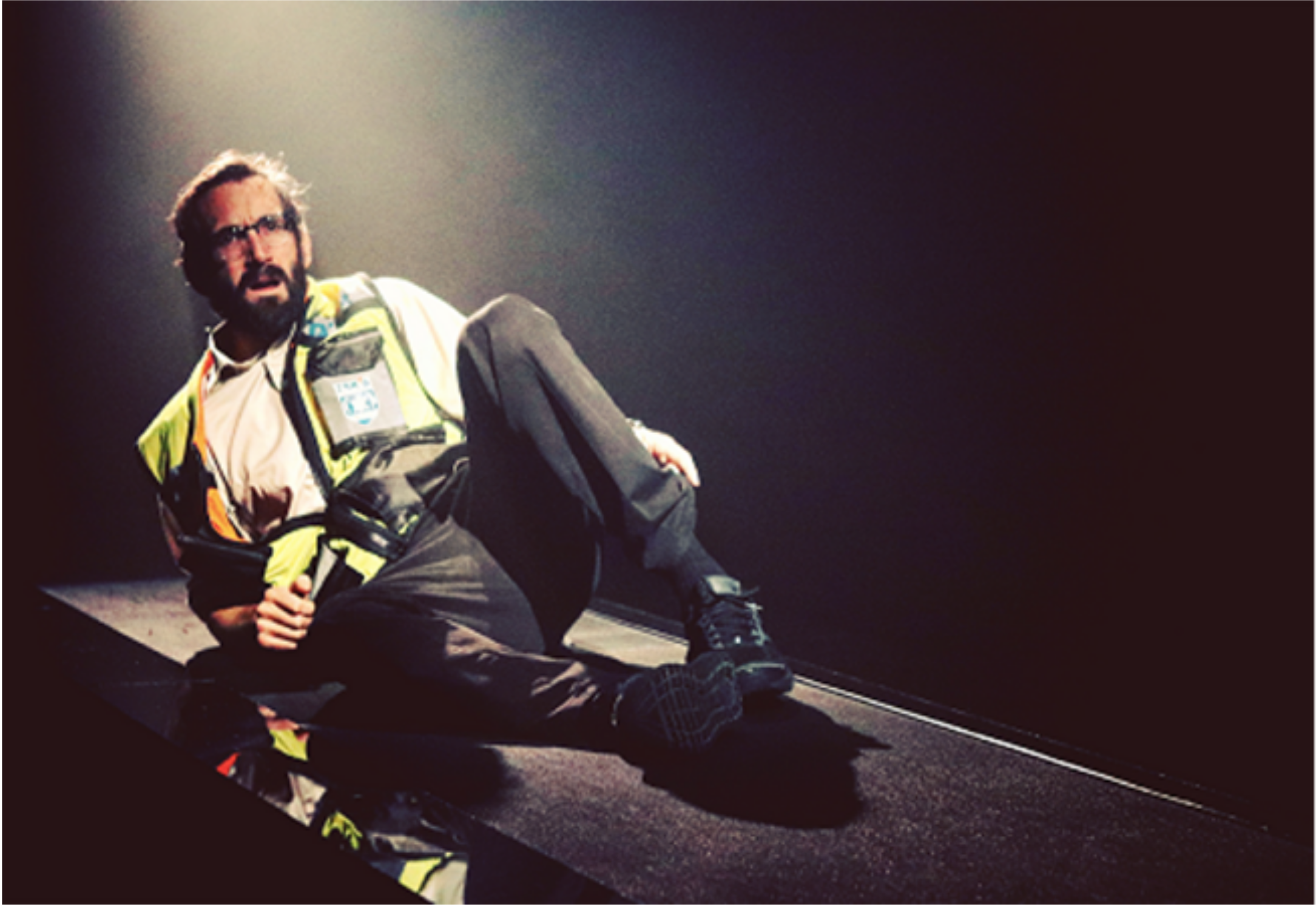
In January 2024, the PuSh Festival in Vancouver cancelled its planned production of Christopher Morris’s The Runner. The play was rooted in deep research and direct observation but, the festival’s board declared, the Canadian Morris had “no religious or cultural ties to the region,” implying his work was illegitimate. PuSh chose instead to “honour the artist whose work reflects their lived experience” by producing Palestinian-Syrian Basel Zaraa’s Dear Laila, whose perspective it described as “grossly underrepresented in Canadian theatre and performance culture.” (C2C covered the event in this excellent essay by Michael Posner.)
In cancelling Christopher Morris’s acclaimed play The Runner (shown), Vancouver’s PuSh Festival and Victoria’s Belfry Theatre signalled that artistic standing today depends less on common humanity and creative imagination than on the artist’s claimed identity and “lived experience”. (Source of photo: Gord Rand by Graham Isador)
Shortly after, Victoria’s Belfry Theatre also cancelled its planned production of Morris’s previously-lauded and repeatedly-performed play, claiming that the aftermath of the October 7, 2023 Hamas atrocity against Israel “is not the time for a play which may further tensions among our community.” PuSh and its defenders argued that the timing of such a production mattered amid the real suffering occurring in Gaza. To both institutions, artistic standing now depends on biographical permission.
Anxiety over suffering is understandable. But if this wasn’t the perfect time for a play that movingly and forcefully asserts the common humanity of all, even under the passions and pressures of war – Morris’s central point – then when would be? And anxiety does not erase the principle. Once “lived experience”, or unproven claims to having it, becomes the trump card, creative imagination is no longer sovereign. Research is not enough. Sympathy is not enough. Dramatic craft is not enough. The artist must present papers.
The theatres did not merely cancel a play. They announced a passport system for creative imagination.
What is the problem with cultural appropriation in Canadian arts, and how does “lived experience” affect creative imagination?
The invented doctrine of “cultural appropriation” has become a moral checkpoint, shutting down the freedom of writers to imagine across cultural lines. The new regime makes “lived experience” the trump card, rendering creative imagination across identity suspicious and potentially exploitative. It demands artists present biographical permission rather than relying on research, sympathy or craft. It destroys the search for truth and diminishes our common humanity by denying that individuals can recognize one another across differing cultural circumstances.
The End of Mimesis
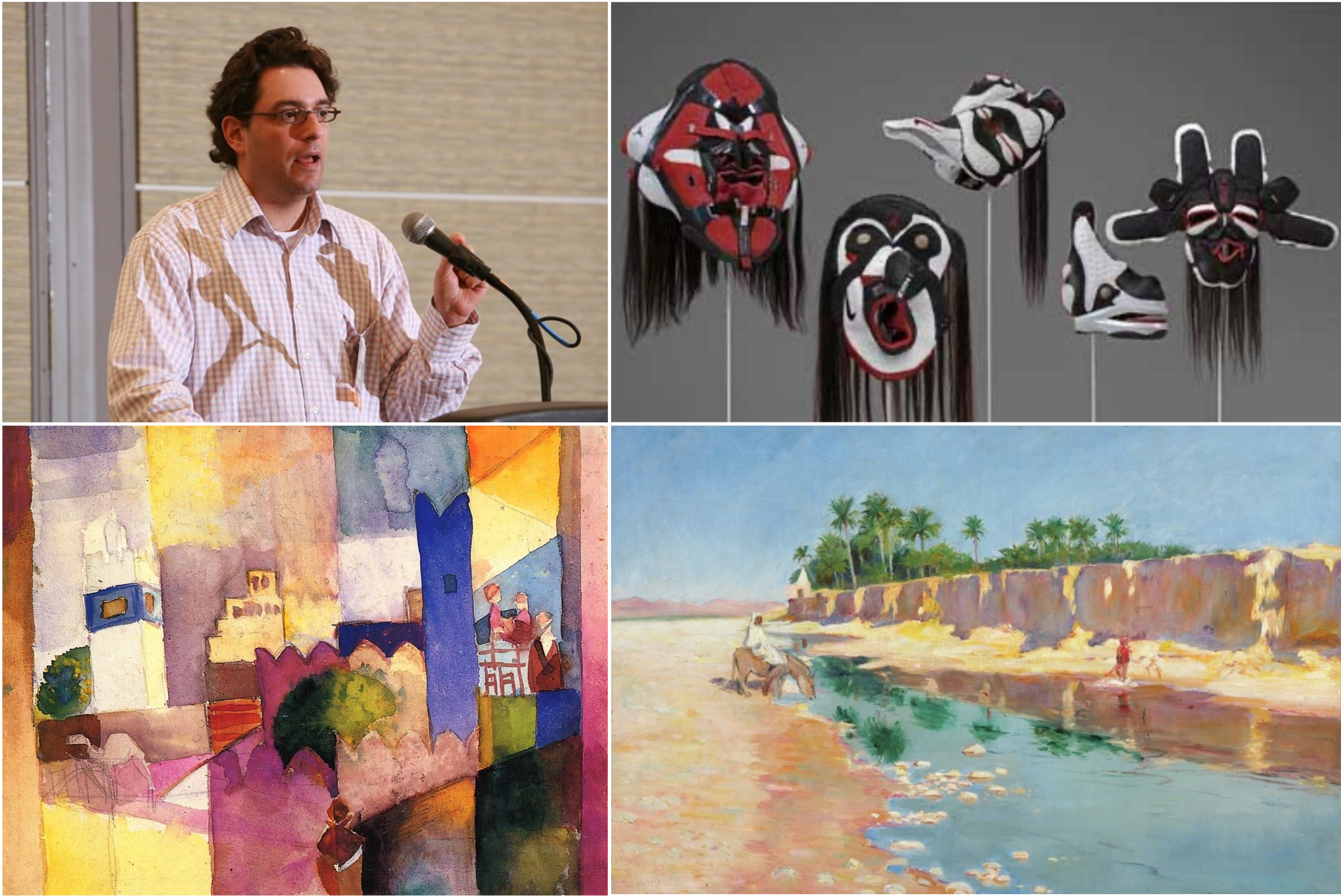
Some years ago the accomplished Canadian Jewish novelist, cultural critic and journalist Hal Niedzviecki penned an editorial in Write – the Writers’ Union of Canada’s magazine – defending the freedom of writers to imagine across cultural lines. “In my opinion, anyone, anywhere, should be encouraged to imagine other peoples, other cultures, other identities,” he wrote, expressing what until not that long ago would have been a declaration of the blindingly obvious. Niedzviecki then goaded writers to go out and try to “Win the Appropriation Prize.”
A writer’s ancient function is to imagine what he is not. That is not a modern writing-workshop slogan. It is the old mimetic wager: that art can represent reality because human beings can recognize one another across circumstance.
This direct skewering of one of the left’s most cherished shibboleths – clumsily stated, perhaps, but spot-on in substance – detonated the room. What should have been a literary argument became an institutional emergency, triggering resignations, apologies, reassignments. Write squirmed and grovelled, scrubbed the piece from its website – now there’s artistic courage – and pressured Niedzviecki to quit. You can still read his editorial here, where it sits as a screenshot atop an extended, sneering attack on him.
A writer’s ancient function is to imagine what he is not. That is not a modern writing-workshop slogan. It is the old mimetic wager: that art can represent reality because human beings can recognize one another across circumstance. (Weaver’s language concerning mimesis is different, but his point runs in the same direction.) It is the very basis of the novel, and it informs writing in nearly all its forms: poetry, narrative history right from Herodotus, cultural and travel prose, anthropology, even textbooks. One has difficulty imagining much of the world’s great art – the Sistine Chapel ceiling, or Michelangelo’s David – being created by artists lacking in it.
The new regime says the opposite: creative imagination across identity is suspicious, perhaps exploitative. The doctrine of “cultural appropriation”, at least in its crudest form, turns a real historical problem into an artistic checkpoint. Yes, cultures have been plundered. Yes, powerful institutions have profited from other people’s stories. But art and literature cannot survive if every act of imaginative crossing is treated as theft in advance. A society that forbids such trespass will soon produce nothing but mawkish diaries and accusatory affidavits. That is not justice. It is the death of art by moral checkpoint.
The Pressure Cascade
Before Canadian arts-and-culture learned to say “harm” it had already learned to say, “Maybe not this season.” In 2012, Toronto’s Tarragon Theatre declined Michael Healey’s satirical play Proud over board-level fears it might be libellous in its proximity to then-Prime Minister Stephen Harper. Healey obtained his own legal opinion that it was protected satire, but no doing. Healey resigned, the institution chose safety. And here, Conservatives, in my opinion, were wrong to hail that decision due to their otherwise-understandable, instinctual desire to defend their leader.
A theatre that cannot defend satire is not prudent. It is misnamed.
The subsequent controversy over production of Robert Lepage’s SLĀV and Kanata illustrates what I call the “pressure cascade”: a public spectacle of protests, open letters, institutional apologies, producer withdrawals and, ultimately, cancellations. The mechanism is now familiar: accusation, media pile-on, reputational triage, evacuation.
What happened was that the renowned Québécois director wrote, directed and produced two concurrent plays without suitable regard for cultural appropriation and minority representation. Here the concerns had some substance. SLĀV had a predominantly white cast (five of seven) singing African-American slave songs, while Kanata’s cast of 34 had zero Indigenous members in a historical play focused on aboriginal suffering.
Histories have too often been mined while their inheritors remain underrepresented. But moral force must not become veto power. Cultures die when the only permitted relationship to painful history is ownership. Art is not theft because it crosses a boundary. It becomes theft when it lies, cheapens or exploits. That judgment requires careful criticism, not institutional panic.
The answer to bad art is better judgment. The Canadian answer increasingly is evacuation.
Why is satire suppressed in Canadian arts, and how does the Canada Council for the Arts contribute to this?
Canadian arts institutions often prioritize safety over artistic integrity, leading to the suppression of satire. Funding bodies like the Canada Council for the Arts, Telefilm Canada and the Canada Media Fund have embedded equity ideology into their operating logic. This system teaches artists to align with specific vocabulary such as equity, harm and authenticity, effectively acting as a sorting machine that discourages diverse thought and daring artistic expression.
Prestige Without Craft: The Disdain for Ordinary Audiences
Norm Foster is not a cancellation case. He is more useful as a test of prestige. The St. Catharines, Ontario-based playwright’s work is accessible, prolific, audience-tested, often very funny and formally competent – middlebrow in the honourable sense. Yet the former radio host, actor and author of more than 75 plays – the most by any Canadian playwright – has faced critical dismissal, limited support from Canada Council for the Arts and scant inclusion in anthologies.
Canadian institutions can forgive obscurity. They struggle to forgive popularity. Real craftsmanship serves the task: structure, timing, clarity, earned feeling. It does not always announce its wound. It does not need to flatter the critic or the grant panel. But staying true to such ancient ideals is severely punished in 21st-century Canada.
The screen sector and funding bodies reveal the architecture. The Canada Council for the Arts, Telefilm Canada, the Canada Media Fund and CBC/Radio-Canada have embedded representation and “equity” – DEI ideology – into their operating logic: funding criteria, commissioning, assessment. This is not a conspiracy-theory. It is how the institutions describe themselves.
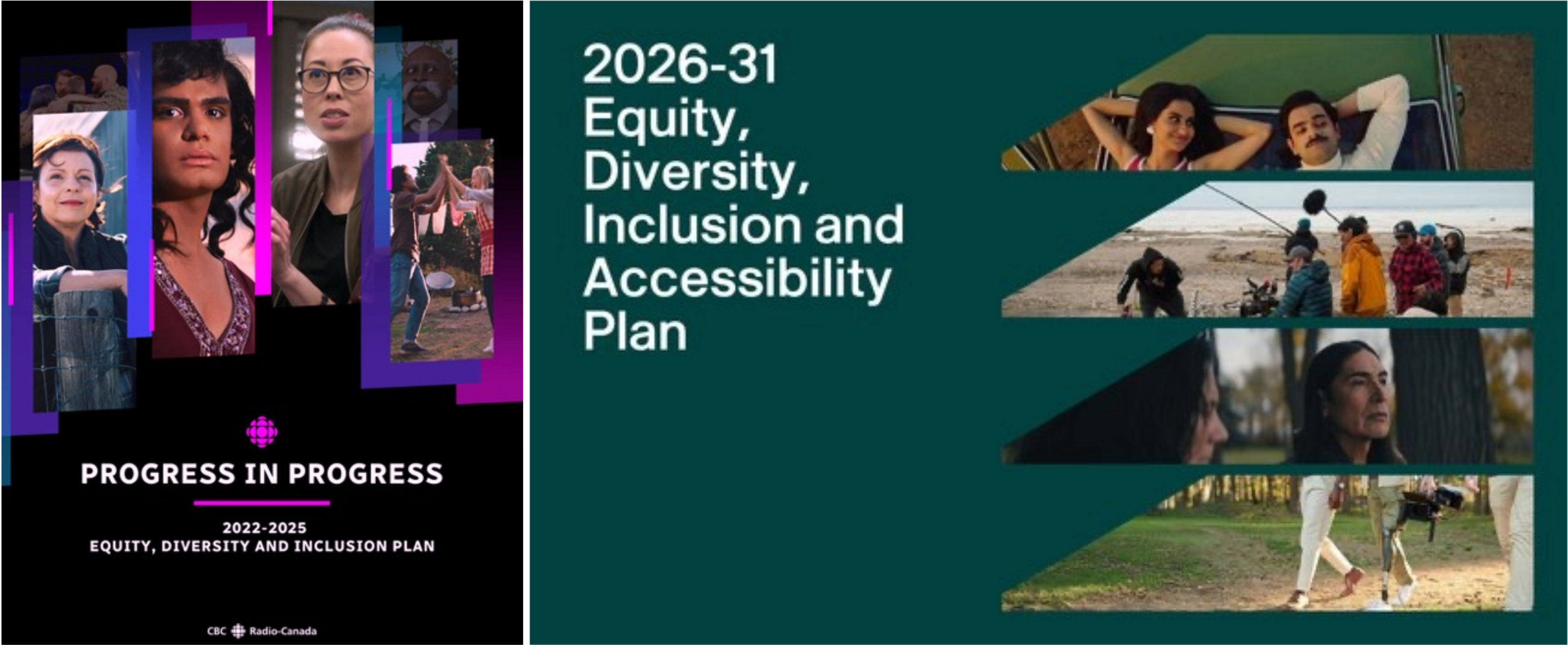
The problem is not that diverse artists receive support. The problem is that the system teaches every artist to become legible to the same language: equity, harm, underrepresentation, positionality, authenticity, lived experience. The vocabulary becomes a sorting machine before the first draft is written. The “only” element of diversity missing is the sole one that should matter: diversity of thought.
The artist no longer asks, “What does the work demand?” He or she asks, “What will the panel understand?”
What Has Been Done to the Classics
The classics endure because they submit the self to permanent things: fate, sin, pride, love, jealousy, courage, betrayal, grace. Modern ideological adaptation often does the reverse. Shakespeare becomes patriarchy studies. Greek tragedy becomes activism in masks. Jane Austen becomes empowerment branding. The canon is not opened. It is processed. They do not adapt the classics. They make the classics sit through decolonization training.
Older art accepted that human beings are contradictory – willful, tragic heroes subject to capricious gods in the Ancient Greek sensibility, fallen creatures amenable to redemption in the Judeo-Christian one. But in all cases, textured, unique, individual. The new art assumes humans are legible by category. That is why so much approved work feels dead. The boss-babe is not a woman; she is a press release. The idiot husband is not a man; he is a ritual sacrifice. The (almost always white) villain is not a soul; he is a permitted target. The victim is not a person; she is a credential.
They have not liberated character. They have abolished it.
Progressives built institutions and made them airless. Conservatives built complaint machines and captured the comments section. Sarcasm is not infrastructure. A Substack post is not a repertory company. A meme is not a school.
Institutions proclaim diversity; too often it is representational variety inside ideological sameness. Faces and biographies change. Conclusions do not. Everyone is welcome, provided everyone arrives at the same moral destination. Real diversity would be stranger: the Catholic novelist, the atheist tragedian, the anti-progressive liberal, the conservative filmmaker, the formalist poet, the working-class satirist, the Indigenous dissenter from land-acknowledgements, the woman who refuses the approved feminist script, the man who writes masculinity without apology.
It would include art that offends the left, embarrasses the right, irritates bureaucrats, and still earns its place because it is alive.
What is mimesis, and why is its decline detrimental to art?
Mimesis is the literary or artistic creator’s ability to reflect or represent reality. It is foundational to art because it allows human beings to recognize one another across different circumstances. The suppression of mimesis in favour of identity-driven criteria by progressivist arts and cultural institutions means that art is no longer driven by the pursuit of reality, beauty, universal themes or the truth. Instead, art is subordinated to serve the artist’s own appetites, impulses and desire for self-display.
The Conservative Failure
Still, Duncan is right. Progressives built institutions and made them airless. Conservatives built complaint machines and captured the comments section. Sarcasm is not infrastructure. A Substack post is not a repertory company. A meme is not a school.
If conservatives want a culture, they must fund one. Stage plays. Publish fiction. Back films. Commission music. Start journals. Endow prizes. Train actors. Risk taste, money and failure – including on artists who may offend them too. A culture made only of agreeable art is not a culture. It is interior decorating.
Culture is not a grant category. It is not produced by panels, metrics or institutional self-esteem. It is produced by disciplined artists serving something higher than themselves: truth, beauty, form, memory, the audience, the dead, the unborn. The permanent things.
Canada, as noted, has talent. It has money. It has schools, festivals, publishers, theatres and broadcasters. What it lacks is piety. What it lacks is form. What it lacks is a serious enough love of art to let art be dangerous again.
T. G. Kelemen is a writer, playwright and poet, and a former private-placement and restructuring dealmaker for owner-managed companies. His forthcoming book, Lawful But Awful, examines Canada’s drift into tutelary despotism under “Big sMother” – the soft rule of forms, experts, permissions, grants and managed dependence.
Source of main image: ChatGPT.