U.S. Semiquincentennial

“We hold these truths”: The U.S. Declaration of Independence at 250

David W. Livingstone
July 2, 2026
As America celebrates its 250th anniversary, it is worth taking a fresh look at the U.S. Declaration of Independence to rediscover how the principles embedded in this foundational document have provided the basis of a free society for a quarter-millennium. More than just a demand for freedom, and no mere list of grievances, David W. Livingstone regards the Declaration as a work of genius that speaks to all of humanity. In the worldview it propounds, human equality comes first, individual rights are intrinsic to that principle, and governments don’t “grant” rights but instead are formed to protect rights that every person already holds. The “truths” that America’s Founders proclaimed to be “self-evident”, Livingstone writes, have endured because they are true – and will continue to shine as a beacon for all.
U.S. Semiquincentennial

“We hold these truths”: The U.S. Declaration of Independence at 250

David W. Livingstone
July 2, 2026
As America celebrates its 250th anniversary, it is worth taking a fresh look at the U.S. Declaration of Independence to rediscover how the principles embedded in this foundational document have provided the basis of a free society for a quarter-millennium. More than just a demand for freedom, and no mere list of grievances, David W. Livingstone regards the Declaration as a work of genius that speaks to all of humanity. In the worldview it propounds, human equality comes first, individual rights are intrinsic to that principle, and governments don’t “grant” rights but instead are formed to protect rights that every person already holds. The “truths” that America’s Founders proclaimed to be “self-evident”, Livingstone writes, have endured because they are true – and will continue to shine as a beacon for all.
Share on Facebook
Share on Twitter

That I should have been invited to celebrate the 250th anniversary of the American Declaration of Independence is perhaps a bit ironic. I happen to have been born on Dominion Day, 1967 – Canada’s centennial. For this great feat I received a letter and commemorative coins from then Prime Minister Pierre Trudeau. To be honest, though, my mother deserves more of the credit for that day. Nonetheless, I came into the world practically stamped with a maple leaf, and I have been a patriotic Canadian ever since. Yet it would be a narrow and cramped patriotism and an excessive love of one’s own that could not perceive the good in others.

I learned to admire the American Founding and the Declaration of Independence while pursuing my doctorate in Politics at the University of Dallas in the late 1990s. Having completed my M.A. in Political Science at the University of Alberta under the brilliant Leon Craig, I arrived in Texas still quite ignorant about American political history. I was fortunate to study with professors Leo Paul de Alvarez, Richard Dougherty, Jack Paynter, Thomas West, John Alvis, Thomas Lindsay and others deeply knowledgeable about how timeless political ideas from the ancient Greeks to the moderns shaped American political thought. What brought me to Dallas was my interest in Western political philosophy. There I learned that the Founders of America were immersed in this tradition and that the United States sprang from a deep engagement with that legacy.

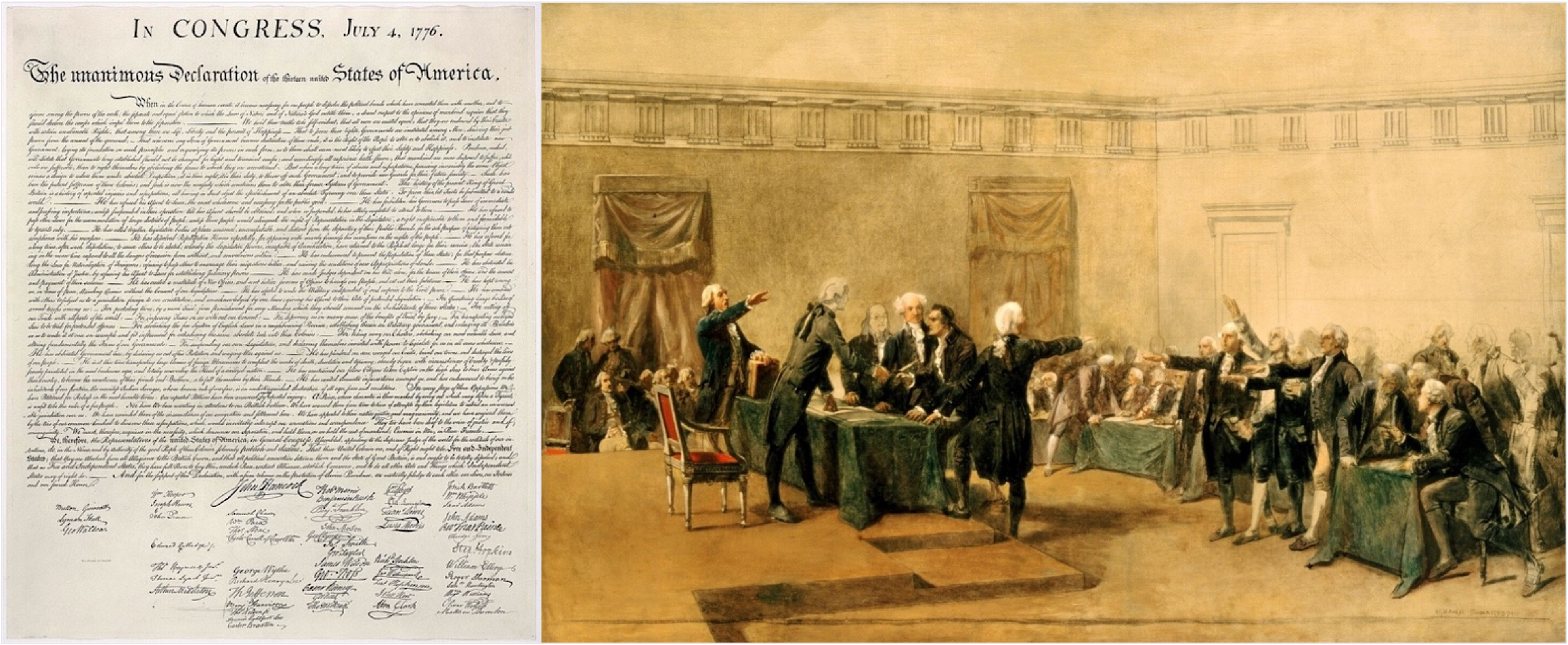
The Founding of the United States of America was an unprecedented event in world history, and remains unparalleled to this day. The message and meaning of its most essential document – the Declaration of Independence – remain as fresh and important as the day its 1,332 words were written out in ink and proclaimed in Philadelphia, Pennsylvania. So it is fitting to remind readers of the Declaration’s critical passage:

“When in the Course of human events, it becomes necessary for one people to dissolve the political bands which have connected them with another, and to assume among the powers of the earth, the separate and equal station to which the Laws of Nature and of Nature’s God entitle them, a decent respect to the opinions of mankind requires that they should declare the causes which impel them to the separation.

We hold these truths to be self-evident, that all men are created equal, that they are endowed by their Creator with certain unalienable Rights, that among these are Life, Liberty and the pursuit of Happiness. — That to secure these rights, Governments are instituted among Men, deriving their just powers from the consent of the governed, — That whenever any Form of Government becomes destructive of these ends, it is the Right of the People to alter or to abolish it, and to institute new Government, laying its foundation on such principles and organizing its powers in such form, as to them shall seem most likely to effect their Safety and Happiness…”

The Declaration of Independence is a child of the Enlightenment – that singular explosion of inquisitiveness, inventiveness and political development in the 17th and 18th centuries that became known as the Age of Reason – but it draws upon pre-Enlightenment traditions, too. Thomas Jefferson, the Declaration’s primary author, claimed inspiration by John Locke, Algernon Sydney, the Baron de Montesquieu and Aristotle, among others, covering over 2,000 years of Western intellectual development. The foundational thoughts underlying the Declaration didn’t spring from nowhere, and were anything but the passing whims of a few disgruntled Colonists.

The Founding of the United States through its defining document, the Declaration of Independence (left), was unprecedented in world history, drawing extensively on Enlightenment as well as earlier philosophical traditions, making it as consequential 250 years later as the day it was adopted on July 4, 1776. Depicted at right, Signing of the Declaration of Independence, by Charles Édouard Armand-Dumaresq, 1873. The Founding of the United States through its defining document, the Declaration of Independence (left), was unprecedented in world history, drawing extensively on Enlightenment as well as earlier philosophical traditions, making it as consequential 250 years later as the day it was adopted on July 4, 1776. Depicted at right, Signing of the Declaration of Independence, by Charles Édouard Armand-Dumaresq, 1873.
Yet for decades the “progressive” left has attacked the Declaration’s central claim, that there are certain “truths” which are “self-evident.” Nothing can be permanently true, they retort. Everything changes with the “arc of history”. More recently the Declaration is being questioned by the post-liberal conservatives who also find it too immersed in Enlightenment thinking, to the point, they argue, of undermining pre-modern foundations of moral virtue and civic commitment based on natural law. This has become an important school of thought whose leading advocates include University of Notre Dame political scientist Patrick Deneen, Harvard Law School professor Adrian Vermeule, Vice President J. D. Vance and author Rod Dreher.

In my view, the progressives’ rejection of the truth of the Declaration threatens liberty, while the post-liberal conservatives do not sufficiently credit the Founders – Jefferson, Benjamin Franklin, George Washington, John Adams, James Madison, Alexander Hamilton, John Hancock and others – for thinking about virtue and the proper ends of government. Neither side has convinced me they have a superior alternative to the principles that have so far provided the basis of a free society for 250 years.

Americans celebrate the Declaration of Independence on July 4. But the Second Continental Congress – the de facto government composed of representatives from Great Britain’s 13 American colonies – officially declared independence two days earlier, on July 2, 1776. The Continental Congress went beyond merely asserting the colonies’ will. It set forth, for all the world to consider, the reasons justifying the American Revolution, the unilateral transformation of colonies into states. And those reasons centred not on tribal identity, territorial gain, vengeance or dynastic disputes, but on an idea.

The idea in a nutshell is the idea of natural rights. In the Declaration’s words, “that all men are created equal, that they are endowed by their Creator with certain unalienable Rights, that among these are Life, Liberty and the pursuit of Happiness.” As the great scholar of the American Founding, Harry Jaffa, wrote in a 1987 essay, “No one before the American Founding had ever before proclaimed the principles of freedom – the principle of freedom for all mankind – as the principles of a particular people.”

In fact, the Declaration isn’t solely, or even primarily, addressed to King George III of England or to the British Parliament. It appeals to all humanity. As it states, a “decent respect to the opinions of mankind requires that they should declare the causes which impel them to the separation.” And the surrounding justification does not rely on a variant of “might makes right” but points to a deeper source of justice: the “Laws of Nature and of Nature’s God.” The Declaration elaborates the natural rights derived from these sources, discerned using man’s native powers of reason.

Nor are these principles put forward as mere human invention or social construct. The Declaration refers to the self-evident truth that “all men” – which we present-day readers should read as encompassing all humans – are created equal and that they are endowed by their Creator with inalienable rights. To understand the Declaration, the U.S. Constitution and America itself, it is critical to understand the order of things here: human equality comes first, and individual rights are intrinsic to that. Both are timeless and exist independently of government. The state – the ruler, the government – comes after. Its role? To “secure these rights, Governments are instituted among Men, deriving their just powers from the consent of the governed.” Properly understood, natural rights determine which regimes are legitimate and which are not. This is revolutionary, indeed.

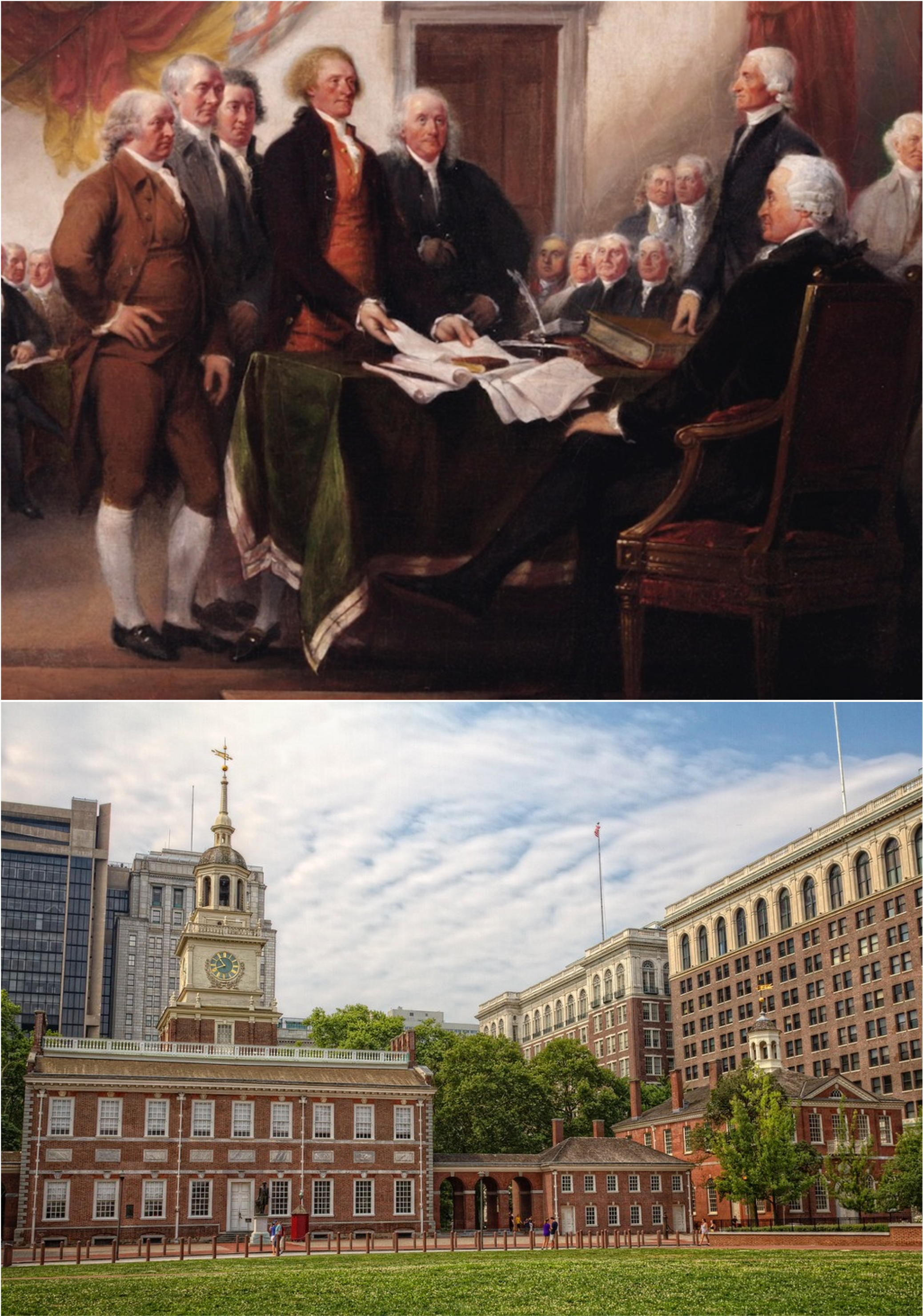
A revolution in ideas: Gathering in Philadelphia in pursuit of happiness and self-governance, delegates from Great Britain’s 13 American colonies founded a new nation on the revolutionary propositions that all humans are created equal by “Nature’s God” and governments exist to secure people’s natural and unalienable rights. At top, the Committee of Five: (left to right) John Adams of Massachusetts, Roger Sherman of Connecticut, Robert R. Livingston of New York, Thomas Jefferson of Virginia and Benjamin Franklin of Pennsylvania, detail from The Declaration of Independence, July 4, 1776, by John Trumbull, 1818. At bottom, Independence Hall, Philadelphia.A revolution in ideas: Gathering in Philadelphia, delegates from Great Britain’s 13 American colonies founded a new nation on the revolutionary propositions that all humans are created equal by “Nature’s God” and governments exist to secure people’s natural and unalienable rights. At top, the Committee of Five: (left to right) John Adams of Massachusetts, Roger Sherman of Connecticut, Robert R. Livingston of New York, Thomas Jefferson of Virginia and Benjamin Franklin of Pennsylvania, detail from The Declaration of Independence, July 4, 1776, by John Trumbull, 1818. At bottom, Independence Hall, Philadelphia. (Source of bottom photo: IceNineJon, licensed under CC BY-NC-ND 2.0)
Because the Declaration contains a list of indictments against King George III and the British Parliament, critics of the U.S. Founding have tried to dismiss it as little more than a “list of grievances”, a selfish if not outright petulant demand letter. But the so-called grievances actually begin to outline the structure of the future Constitution necessary to secure the rights of every individual. For example, if the King of England has corrupted judges by making them dependent upon his will, then the American solution will be to make judges independent (Article II, sec 2). If the right to trial by jury has been repeatedly violated, then such right will be secured in the new nation’s Constitution (Article III, sec 2). If the King has exercised a pocket veto to frustrate the legislature, then the President of the new republic shall have only a qualified veto, one that can be overridden by the Congress (Article I, sec.7).

These are substantive claims about just government derived from the fact of natural rights, as Jaffa wrote in the aforementioned article. The Declaration binds the Americans to a vision of legitimate government. It just as determinately excludes many alternative forms of government. Among its core principles is that legitimate government is based upon the consent of the people. If everyone is equal, then no one person is so superior to the rest of us that he or she can simply rule without our consent. But does consent open the door to moral relativism? Does it mean to say that Americans have a right to consent to anything they want, even to things that are not good?

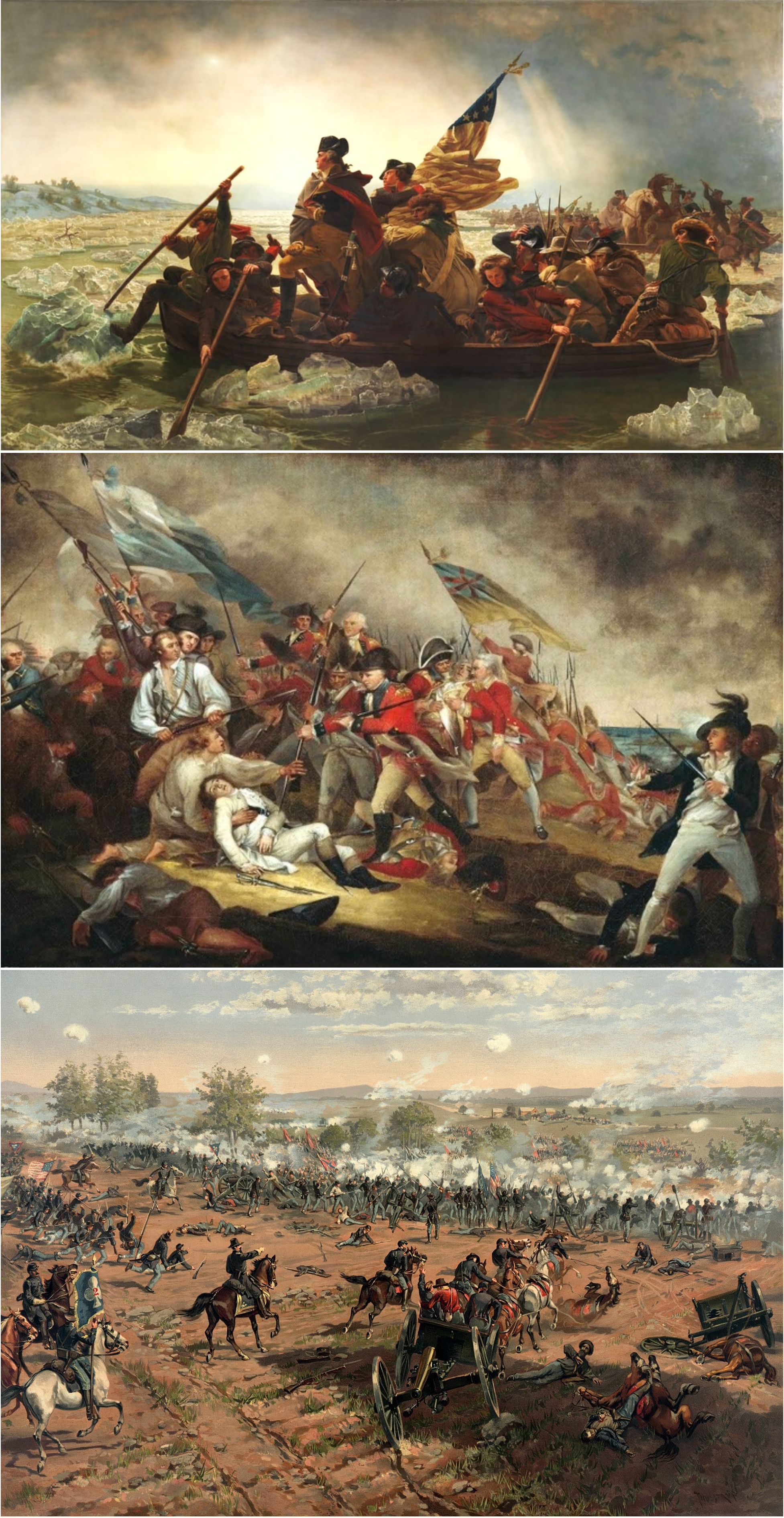
Contrary to critics’ claims, the Declaration’s “self-evident” “truths” were far more than a “list of grievances”; they articulated a vision of just government grounded in natural rights – principles the American colonists deemed worthy of defending at great cost during the Revolutionary War (1775-1783) and Civil War (1861-1865). Depicted: (top) Washington Crossing the Delaware with the Continental Army on the night of December 25-26, 1776, by Emanuel Leutze; (middle) The Death of General Warren at the Battle of Bunker’s Hill, June 17, 1775, by John Trumbull; (bottom) Battle at Gettysburg, July 1863, by Thure de Thulstrup.Contrary to critics’ claims, the Declaration’s “self-evident” “truths” were far more than a “list of grievances”; they articulated a vision of just government grounded in natural rights – principles the American colonists deemed worthy of defending at great cost during the Revolutionary War (1775-1783) and Civil War (1861-1865). Depicted: (top) Washington Crossing the Delaware, with the Continental Army on the night of December 25-26, 1776, by Emanuel Leutze; (middle) The Death of General Warren at the Battle of Bunker’s Hill, June 17, 1775, by John Trumbull; (bottom) Battle at Gettysburg, July 1863, by Thure de Thulstrup.
It’s true, as Deneen and other contemporary, post-liberal conservatives argue, that consent becomes more central to politics after the Enlightenment. Deneen claims that liberal thought since Thomas Hobbes in the mid-1600s has entailed that, “Legitimacy is conferred by consent.” There is a partial truth to that; no government that cannot obtain the consent of those it governs should be considered legitimate. But is the converse true: that anything the governed consent to is legitimate? No, the Declaration’s logic does not permit Americans to consent to just anything. Therefore, it is not quite right to say, as Deneen does, that classical liberalism “is the defender of ‘Right,’ not of any particular conception of the ‘Good.’” Classical liberalism is not as neutral on the “good” as it is sometimes claimed.

For example, Stephen Douglas, the prominent pre-Civil War Democratic Senator from Illinois, famously debated Abraham Lincoln in 1858. Douglas took the position that Americans who resided in territories seeking statehood could vote on their own state constitutions. If the majority consented to creating a pro-slavery state, then so be it. In Douglas’ view, that was popular sovereignty, “which guaranties to each state and territory the right to do as it pleases on all things, local and domestic.” Douglas declared his “indifference” regarding whether the newly formed states voted slavery up or down.

Lincoln, the longtime country lawyer who was just rising to national prominence, forcefully responded to Douglas’ “indifference.” Significantly, Lincoln based his counter-argument not on a particular law or act of Congress, nor on the authority of a famous thinker or leader from history – but on the Declaration of Independence. He labelled it, ringingly, “the father of all moral principle,” and a buttress against any pro-slavery arguments.

Douglas’ popular sovereignty argument, if reflected in law and policy, Lincoln asserted before a raucous audience in Chicago, would fatally undermine America’s moral foundation. For it would imply that majority consent could magically turn the “vast moral evil” of slavery, as Lincoln referred to it, into something legitimate. To permit this view of popular sovereignty to stand unopposed would undermine the natural rights of all Americans.

During those seven debates, Lincoln also argued that consent can never turn illegitimate government into legitimate government:

“This declared indifference [by Douglas], but, as I must think, covert real zeal for the spread of slavery, I cannot but hate. I hate it because of the monstrous injustice of slavery itself. I hate it because it deprives our republican example of its just influence in the world…and especially because it forces so many really good men amongst ourselves into an open war with the very fundamental principles of civil liberty – criticizing the Declaration of Independence, and insisting that there is no right principle of action but self-interest.”

It says something quite remarkable that the man who would soon become America’s arguably greatest President, grappling to contain forces threatening to tear his country apart 80 years after the Revolution, would draw his greatest inspiration, authority and rhetoric from the Declaration of Independence. “All honor to Jefferson,” Lincoln declared in a letter in 1859, “the man who, in the concrete pressure of a struggle for national independence by a single people, had the coolness, forecast, and capacity to introduce into a merely revolutionary document, an abstract truth, applicable to all men and all times, and so to embalm it there, that to-day, and in all coming days, it shall be a rebuke and a stumbling-block to the very harbingers of re-appearing tyranny and oppression.”

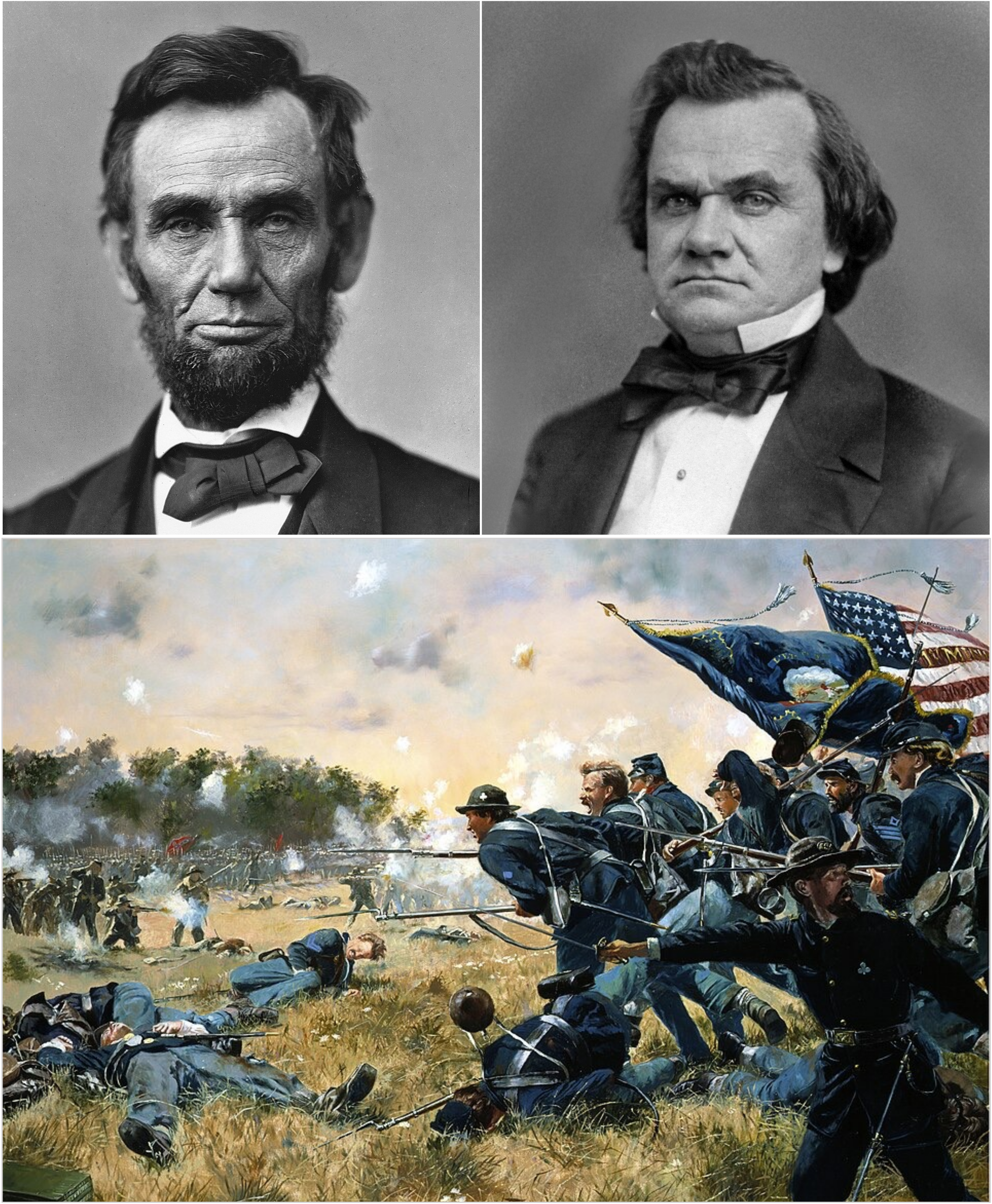
In the increasingly contentious years preceding the Civil War, country lawyer Abraham Lincoln (top left) opposed prominent Senator Stephen Douglas’ (top right) doctrine of popular sovereignty. The future President, later proclaimed the Great Emancipator, argued that even if a majority consented to “the monstrous injustice of slavery,” such a government would remain illegitimate because it violated the Declaration’s core principle of natural rights. Hundreds of thousands of Americans would soon heed Lincoln’s call and give their lives so that the Declaration’s ideas were not extinguished. Depicted at bottom, The First Minnesota, by Don Troiani.In the increasingly contentious years preceding the Civil War, country lawyer Abraham Lincoln (top left) opposed prominent Senator Stephen Douglas’ (top right) doctrine of popular sovereignty. The future President, later proclaimed the Great Emancipator, argued that even if a majority consented to “the monstrous injustice of slavery,” such a government would remain illegitimate because it violated the Declaration’s core principle. Hundreds of thousands of Americans would soon heed Lincoln’s call and give their lives so that the Declaration’s ideas were not extinguished. Depicted at bottom, The First Minnesota, by Don Troiani. (Source of top right photo: Julian Vannerson, licensed under CC BY-SA 4.0)
The second paragraph of the Declaration to which I have mostly been alluding contains its most inspiring, oft-quoted and hotly debated section: “We hold these truths to be self-evident, that all men are created equal, that they are endowed by their Creator with certain unalienable Rights, that among these are Life, Liberty and the pursuit of Happiness.” As mentioned, Jefferson said that John Locke inspired him. Locke indeed was one of the most frequently cited authors by American statesmen in the decades preceding 1776. His arguments appear in preambles of several state constitutions drafted during the Revolution. A glance at Locke’s thinking can help tease out what the Declaration means about natural rights in asserting the self-evident truth that all men are created equal.

Locke’s extended argument in his Two Treatises on Government was meant to justify what came to be known as England’s “Glorious Revolution” of 1688, which deposed King James II. But what principle would suffice to make the new sovereign’s rule legitimate? Locke let the cat out of the bag in the Second Treatise’s Preface. Locke’s argument intended “to make good [the king’s] title, in the consent of the people, which being the only one of all lawful governments, he has more fully and clearly, than any prince in Christendom.” Lockean principles subsequently informed England’s 1689 Bill of Rights, which remains a vital part of the British Constitution (and influenced Canadian law).

In setting forth his argument, Locke first had to clear away the position adopted by those who, like Robert Filmer earlier in the 1600s, argued that monarchs held power by virtue of Divine Right. Since their authority came from God, kings had no need to seek their subjects’ consent. People are born into subjection to their monarch. In section 6 of the First Treatise, Locke reduced Filmer’s entire argument to a single phrase: “‘Men are not naturally free.’” Locke began his own argument from the opposite proposition, writing in S. 95 of the Second Treatise that, “MEN being, as has been said, by nature, all free, equal, and independent, no one can be put out of this estate, and subjected to the political power of another, without his own consent.” [Emphasis added]

Freedom is thus seen – and in my opinion actually is – an expression of our nature as rational beings. Provided we conduct ourselves in accordance with reason, we are owed recognition of our inherent right to order our private affairs as we wish. This right entails a corresponding moral duty: we must also respect the right of others. But again, this right is natural; it is not invented by any organization, it is not conferred by any government, it is not granted by any other human. Our natural right to freedom is supported by a corresponding right to acquire private property. This right too precedes the existence of government.

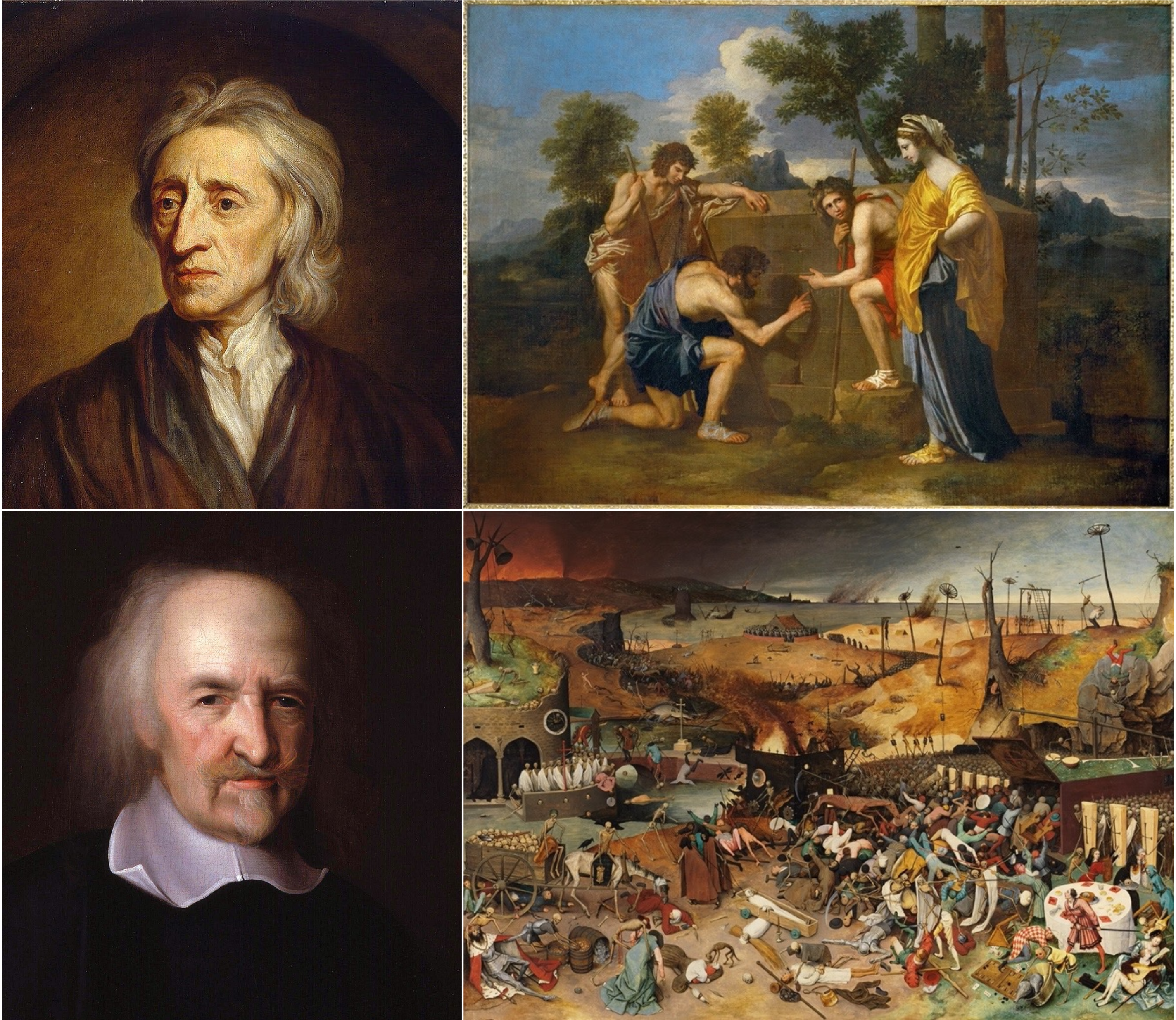
The roots of freedom or of totalitarianism? John Locke’s (top left) political philosophy of natural rights, which helped inspire both England’s 1689 Bill of Rights and the U.S. Declaration of Independence, held that men are “by nature, all free, equal, and independent,” while his predecessor, Thomas Hobbes (bottom left), contended that nature is a state of pure savagery and that justice and rights stem not from any pre-existing natural laws but entirely from the sovereign’s limitless authority. Depicted: (top right) Et in Arcadia Ego (Even in Arcadia, There Am I), by Nicolas Poussin, 1638; (bottom right) The Triumph of Death, by Pieter Bruegel the Elder, 1562.The roots of freedom or of totalitarianism? John Locke’s (top left) political philosophy, which helped inspire both England’s 1689 Bill of Rights and the U.S. Declaration of Independence, held that men are “by nature, all free, equal, and independent,” while his predecessor, Thomas Hobbes (bottom left), contended that nature is a state of pure savagery and that justice and rights stem not from any pre-existing natural laws but entirely from the sovereign’s limitless authority. Depicted: (top right) Et in Arcadia Ego (Even in Arcadia, There Am I), by Nicolas Poussin, 1638; (bottom right) The Triumph of Death, by Pieter Bruegel the Elder, 1562.
This claim distinguishes Locke from his predecessor, Hobbes. For Hobbes, as he wrote in his seminal Leviathan, there is no “mine and thine” in the state of nature. Everyone has a legitimate right to everything, even to other people’s bodies! “[N]othing can be Unjust” in the state of nature. “The notions of Right and Wrong, Justice and Injustice have there no place.” In Hobbes’ telling, the state of nature is awful. This has enormous implications for the nature and role of government. Because there is nothing that is “just” by nature, justice becomes simply whatever the sovereign we erect decides, and there is no limit imposed by nature on the sovereign’s authority.

In Locke’s argument, by contrast, in the state of nature we already have a natural right to private property. The state of nature is simply what Locke means by a condition in which there is no government, no court of law, and no police. It is not just some Edenic place we left behind, nor is it a utopia. This condition in turn provides a natural and legitimate basis for distinguishing what is rightly fully mine and thine. It also constrains the legitimate authority of government.  If another person cannot legitimately take my property without my consent – and if my rights precede and come from outside any government – then neither can the government.

For Marxists and progressives, this is when the jig is up; private property is the problem. “All these assertions about freedom are just smoke and mirrors to cover up crass materialism and exploitation!” goes their argument. As Karl Marx asserted in the Communist Manifesto, “Modern bourgeois private property is the final and most complete expression of the system of producing and appropriating products, that is based on class antagonisms, on the exploitation of the many by the few.”

Locke didn’t frame it that way. As he saw it, property is an extension of our freedom, arising from mixing our labour with nature. In the state of nature, we obviously need to nourish, clothe and house ourselves. That requires work and, in Locke’s view, the fruits of that work belong to the person who does it. If you pick some apples, you have a greater right to them than do I. One’s labour, Locked argued, “added something to them more than nature, the common mother of all, had done; and so they became his private right.”

What is this “more”? And what can this tell us about the Declaration?

I argue that the “more” we add to nature refers to an immaterial part of you mixed with nature – your ideas, your creativity, perhaps your hopes and dreams. Property is not just physical “stuff.” If a thief steals your apple, he doesn’t just take the physical object in your hand. He steals your labour – that little bit “more” that differentiated that apple from all the rest. He could have picked an apple for himself, but he took your apple instead, and with it went a part of you. This, I think, is also why we can feel violated and angry when someone takes our property without our consent.

To be free is to have the right to pursue one’s hopes and dreams, to mix one’s labour with the fruits of the Earth, to derive the resulting benefit – and to defend it. As Locke wrote in S. 87 of his Second Treatise, a person naturally seeks “to preserve his property, that is, his life, liberty and estate, against the injuries and attempts of other men.” And the very best means to protect “life and liberty” is to protect the rights of property. This, in turn, becomes a fundamental purpose of legitimate government.

It wasn’t just Locke or Jefferson who thought this way; it was central in the thinking of the Founding generation. Several state constitutions written before the Declaration refer directly to a natural right to property. In Federalist 10, written after the Revolution to explain the proposed Constitution to delegates, James Madison explained that, “The rights of property originate from the diversity in the faculties of men. Therefore, the protection of these faculties is the first object of government.”

It is in Madison’s formulation we more easily see that the argument isn’t fundamentally about “stuff”, or even “keeping stuff”, but about every individual’s freedom to utilize and benefit from their own faculties – his or her talents, ideas and hopes. Property is derived from the exercise of these faculties, but it is the faculties that are of supreme value, and it is these that must be protected, because they are foundational to the exercise of the individual’s freedom.

In a brief essay entitled simply “On Property”, Madison wrote about property’s “larger and juster meaning” and its connection to the pursuit of happiness (which features so prominently in the Declaration). “A man has property in his opinions and the free communication of them,” Madison explained. “He has a property of peculiar value in his religious opinions…He has a property very dear to him in the safety and liberty of his person. He has an equal property in the free use of his faculties and free choice of the objects on which to employ them.” What conservative would not agree that to be protected in one’s right to form one’s own opinions, to communicate them, and to decide how one wants to use one’s God-given talents and faculties in this world are basic conditions for happiness and dignity?

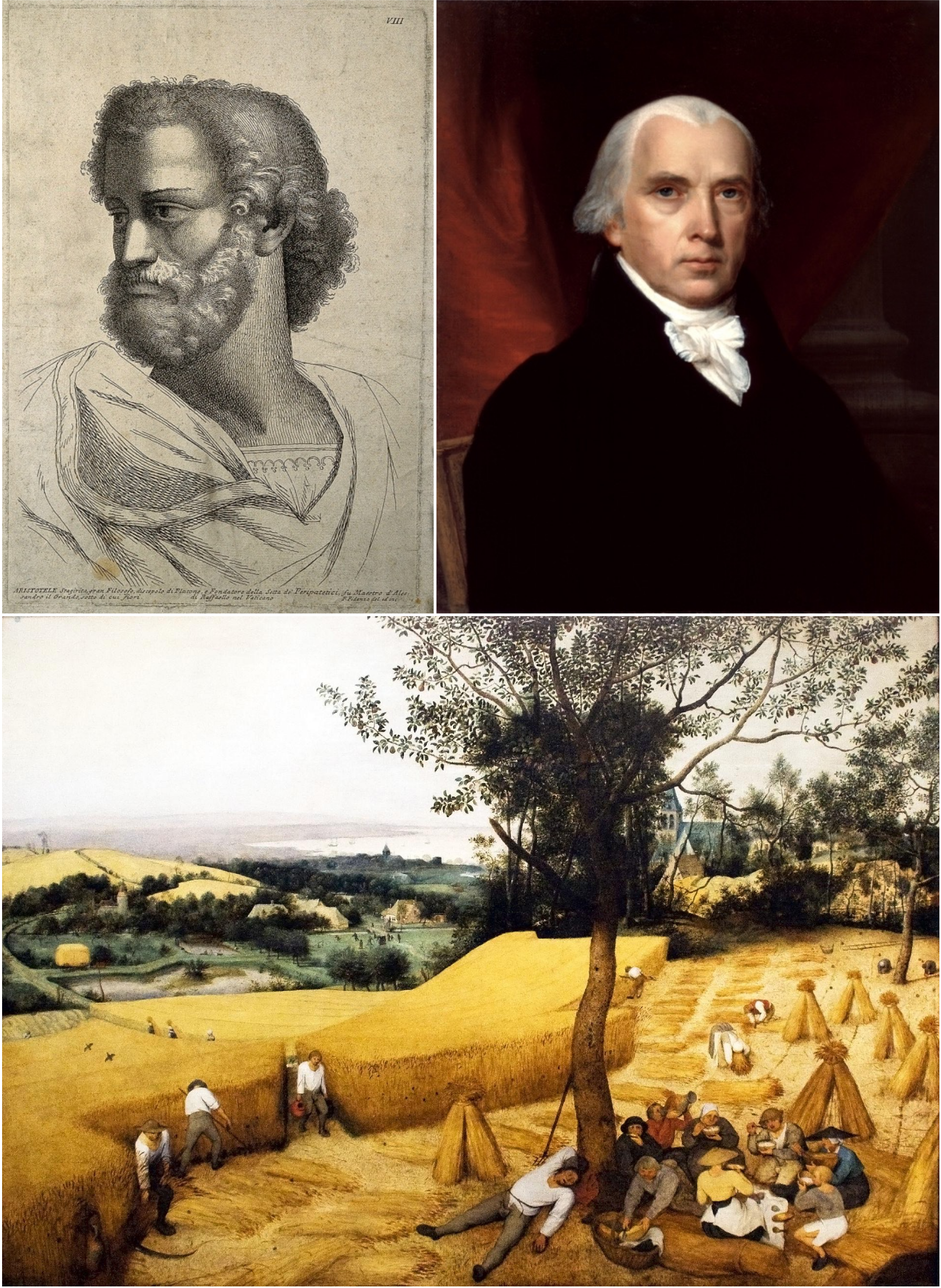
Building on Aristotle’s (top left) concept of eudaimonia – human flourishing made possible by the free exercise of one’s faculties, such as talents and hopes – and the classical liberalism it helped inspire, U.S. Founder James Madison (top right) argued that because property originates from those very faculties, and is critical to the exercise of human freedom, it must be considered of supreme value and vigilantly protected by government. Depicted at bottom, The Harvesters, by Pieter Bruegel the Elder, 1565.Building on Aristotle’s (top left) concept of eudaimonia – human flourishing made possible by the free exercise of one’s faculties, such as talents and hopes – U.S. Founder James Madison (top right) argued that because property originates from those very faculties, and is critical to the exercise of human freedom, it must be considered of supreme value and vigilantly protected by government. Depicted at bottom, The Harvesters, by Pieter Bruegel the Elder, 1565. (Source of top left image: Welcome Collection, licensed under CC BY 4.0)
It’s also important to realize the Declaration not only proclaims every individual’s equality and rights, but places moral responsibility squarely on the shoulders of each individual. “To be morally accountable,” wrote my then-future professor Alvis in a 1988 essay entitled Crisis in the Understanding of Liberty (not available online), “is in the essential sense to be free; an agent cannot be accountable if he is simply the resultant of his interests, the pawn of sub-rational desires or of class conditioning…” The natural right of the Declaration is thereby opposed to the post-modern idea that people are the products of ethnic, racial or gender categories and therefore must think and act in accordance with those groups’ claimed characteristics.

So the bold claim of the Declaration is that “all men are created equal.” But did the Founders really think natural rights extended to everyone, even to slaves? After all, Jefferson was a slave owner. Except for the most fundamental question of whether natural law and natural rights even exist – a true first principle – this is the most hotly debated question regarding the Declaration. In terms of popular awareness, the slavery issue dwarfs the former debate.

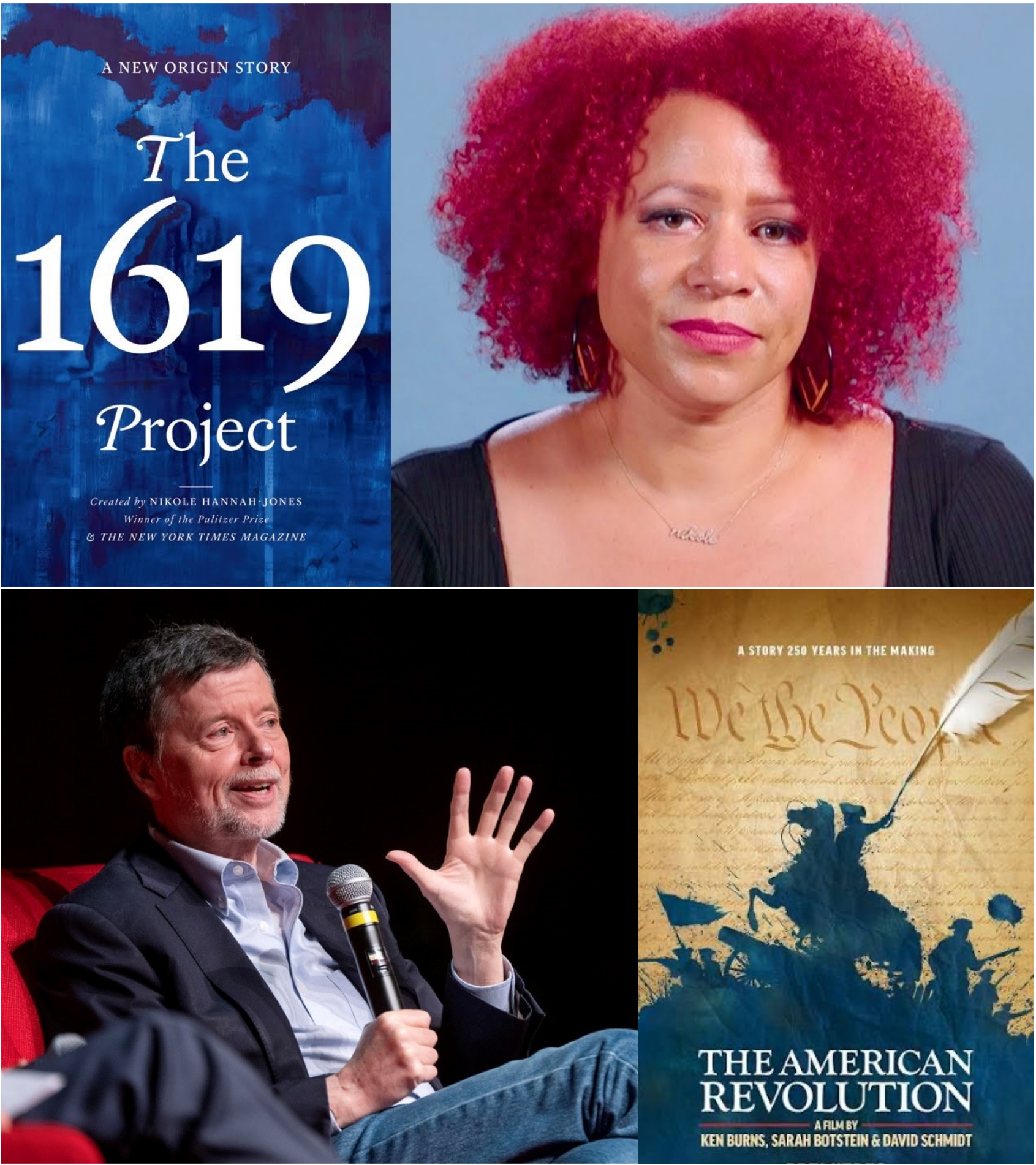
A powerful academic, media and political-activist movement has arisen dedicated to convincing Americans, and non-Americans who pay attention, that the answer is a firm “no”. This is central to their program to invalidate the Declaration, the Founding, the Constitution and the very idea of America as a good and exceptional country. “The 1619 Project” by Nikole Hannah-Jones and The New York Times Magazine is probably the most famous, or notorious, example. It seeks to upend American historiography by claiming that America’s true “founding” was the day the first enslaved Africans were brought ashore at Hampton, Virginia. But even it is just one thread in a tapestry of revisionism.

Documentary filmmaker Ken Burns, fresh from his production of the six-part The American Revolution, recently wrote in Rolling Stone that, “Everyone then knew, of course, that when the Founding Fathers wrote, ‘We hold these truths to be self-evident, that all men are created equal,’ they meant all white men of property.” Only later, Burns claims, did the concept become “broader”. Such breezy contempt for the Founders is sadly common.

But it’s irresponsible. To believe the inarguably brilliant Jefferson couldn’t see the obvious implications of his own argument is preposterous. To assert it anyway merely helps today’s elites feel better about themselves. In seeing clearly what escaped Jefferson, Burns must be a genius! But not only does such mythmaking substitute ignorance for truth, it establishes a narrative in the public mind that undermines respect for the Founding, paving the way for its rejection and replacement with progressive ideology. And that is the point.

Of course Jefferson knew that equality necessarily included non-whites. He made that point explicit in his first draft of the Declaration, only to have the key paragraph removed by others on the drafting committee. The rationale for doing so is the stuff of another essay, but for our purposes it is crucial to know that elsewhere, Jefferson referred to slavery as “cruel war against human nature itself, violating its most sacred rights of life & liberty.” He published the excerpt years later so everyone would know what he intended and what others rejected.

The left’s great smear campaign against classical liberalism: Works such as The 1619 Project by Nikole Hannah-Jones (top right) and the recent documentary The American Revolution by Ken Burns (bottom left) seek to invalidate the Declaration’s validity and the Founders’ authority by claiming that the U.S. was founded upon and for the purpose of slavery and that the claim that “all men are created equal” was intended to apply only to “white men of property.”The left’s great smear campaign: Works such as The 1619 Project by Nikole Hannah-Jones (top right) and the recent documentary The American Revolution by Ken Burns (bottom left) seek to invalidate the Declaration’s validity and the Founders’ authority by claiming that the U.S. was founded upon and for the purpose of slavery and that the claim that “all men are created equal” was intended to apply only to “white men of property.”
Alexander Stephens would also dispute Burns’ contention that “everyone knew” equality was only for white men. Stephens ought to know: in 1861 he was Vice President of the Confederate States of America – the rebelling slave states. “The prevailing ideas” of Jefferson and the U.S. Constitution’s other framers, Stephens wrote in an infamous speech, “were that the enslavement of the African was in violation of the laws of nature; that it was wrong in principle, socially, morally, and politically. It was an evil they knew not well how to deal with,” though they were confident “it would be evanescent and pass away.” In other words, the prevailing view was the opposite of what Burns now ascribes to America’s Founders.

The Declaration does not, however, prescribe or promise the equality of outcomes. The self-evident truth that all are created equal does not mean that every individual is equally talented, equally intelligent or equally eligible to play in the NFL. No wonder the Declaration is toxic to the left. It stands in ringing and philosophically-rooted opposition to today’s identity politics which insist that each individual must positively affirm every other person’s way of life or gender or risk being accused of a hate-crime, and that government exists to ensure sameness of results for members of disadvantaged groups.

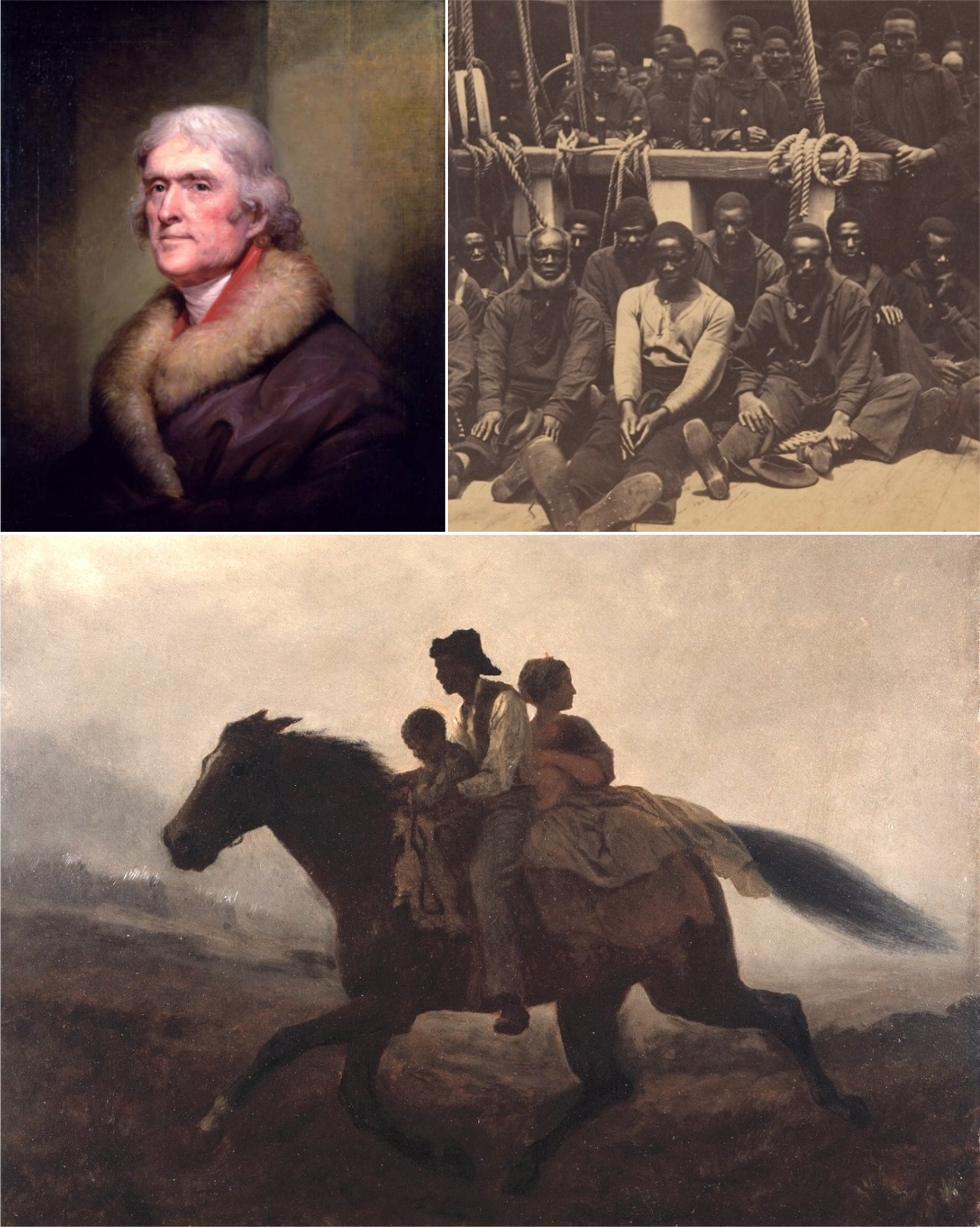
All means all: Principal Declaration author and future President Thomas Jefferson (top left), a champion of the pursuit of happiness, condemned slavery as a “cruel war against human nature itself” and fundamentally incompatible with the natural and sacred equality of all people. At top right, freedmen leaving South Carolina on the USS Vermont, 1862. At bottom, A Ride for Liberty – The Fugitive Slaves, by Eastman Johnson, 1862.All means all: Principal Declaration author and future President Thomas Jefferson (top left) condemned slavery as a “cruel war against human nature itself” and fundamentally incompatible with the natural and sacred equality of all people. At top right, freedmen leaving South Carolina on the USS Vermont, 1862. At bottom, A Ride for Liberty – The Fugitive Slaves, by Eastman Johnson, 1862.

The Founders most often spoke about equality in more fundamental moral and political terms. To them, equality primarily meant that no individual can claim to be so superior to another that they can legitimately rule them without their consent. As Jefferson expressed the thought in a letter just 10 days before his death on July 4, 1826, the Declaration’s 50th anniversary: “The mass of mankind has not been born with saddles on their backs, nor a favored few booted and spurred, ready to ride them legitimately, by the grace of god.” Equality as rightly understood creates an environment in which everyone’s rights are protected, leaving them free to deploy their talents in different ways and with different degrees of effort and diligence, with inevitably unequal results. Some will earn and/or accumulate more than others, and some will draw honours that others don’t.

What the Declaration strove to do – for the first time in humanity’s journey – was to establish a political regime rid of conventional inequalities – illegitimate inequalities between individuals created by law or custom. In European feudal society as in an Asian caste system, there is almost no hope of social mobility. Political and economic inequalities are baked in that do not track with natural talent. And seemingly indestructible Medieval laws kept the artificial inequalities of feudalism intact for centuries. It is why the Americans explicitly rejected such laws in crafting their national Constitution.
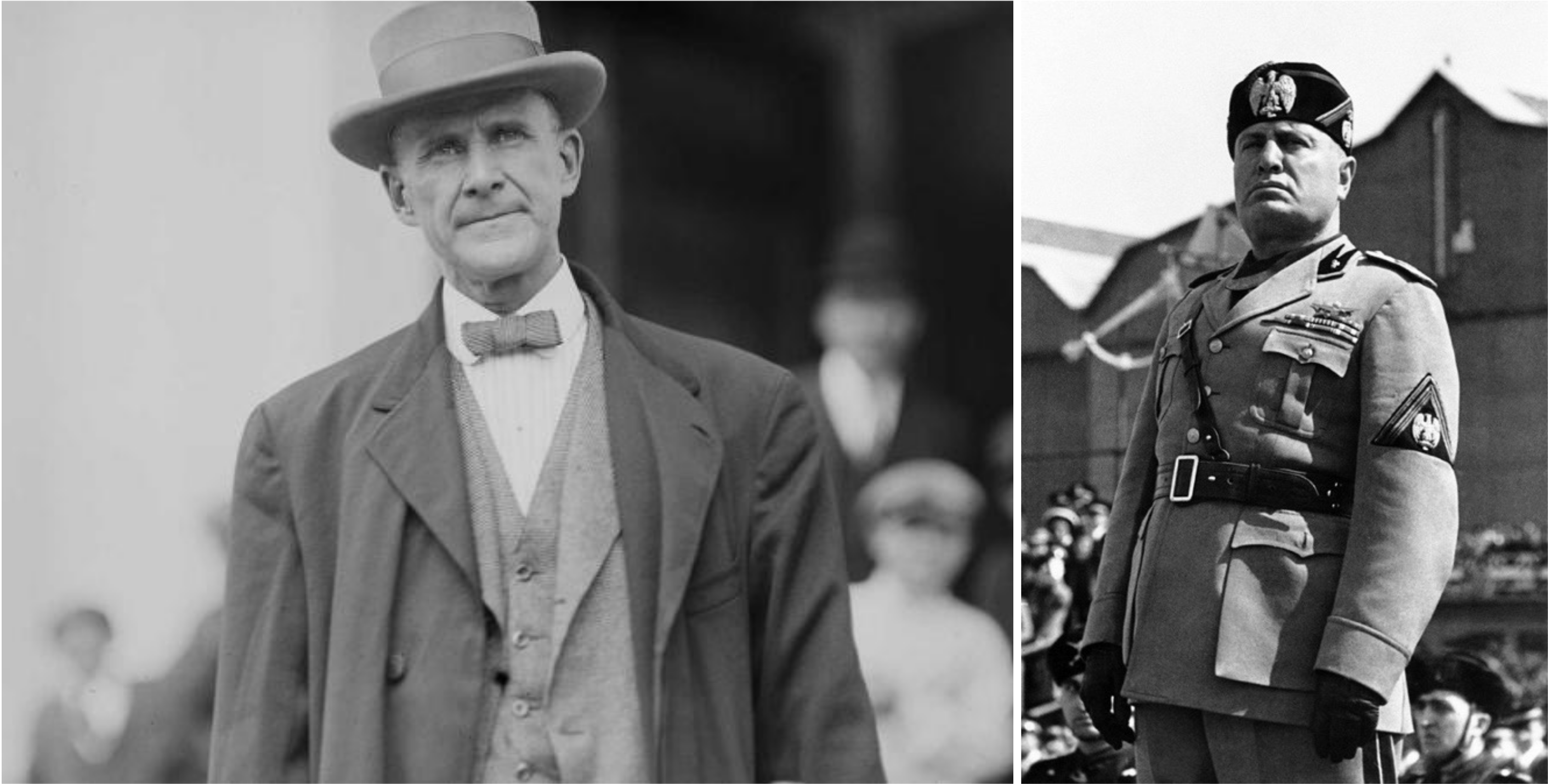
A century after the Declaration’s adoption, John Dewey (left) and other progressive thinkers rejected the Founders’ doctrine of natural rights as unhistoric, asserting instead that rights must be defined and managed by the state. Such a view leads logically to totalitarianism, with tyrants such as Italian fascist dictator Benito Mussolini (right) declaring the state “all-embracing” and the individual as entirely subordinate.
xA century after the Declaration’s adoption, John Dewey (left) and other progressive thinkers rejected the Founders’ doctrine of natural rights as unhistoric, asserting instead that rights must be defined and managed by the state. Such a view leads logically to totalitarianism, with tyrants such as Italian fascist dictator Benito Mussolini (right) declaring the state “all-embracing” and the individual as entirely subordinate. (Source of left photo: Harris & Ewing photograph, 1912/Library of Congress)

The Declaration entered history as a revolutionary solution to an old set of problems – but based on a mix of brand-new, established and ancient ideas. More than a century later, leading American “progressives” like John Dewey and Richard Rorty argued there was no natural basis for our rights at all. They accused the Founders of being unhistoric (a mortal insult coming from progressives, who regard history as something like a living force that “progresses” in the direction they want). Instead, the Founders foolishly believed that truth does not change over time. As Dewey accusingly wrote: “Natural rights and natural liberties exist only in the kingdom of mythological social zoology.”

In the progressive mind, freedom is not our natural endowment; it is a gift of the state. Rejecting the truth of the Declaration enables expanding not only the status but the role of the state. Liberated from the Founders’ misconceptions, we can now look to the state to manage the inequalities that arise in the course of human affairs. If one person lacks talent, the state must lift them up. If another is too talented, the state must place a thumb on the scales and hold them back because they were born with “privilege.” But believing that society or government should swoop in every time someone is “frustrated” or wants to satisfy “new desires,” as Dewey also wrote, is to expand the scope of government infinitely. For, as Aristotle pointed out, human desires are limitless.

According to the Declaration, remember, the state exists to secure the rights of individuals, who have meaning and spiritual value prior to and independent of the state. For progressives like Dewey (as well for fascists, but that too is another essay), the individual is a product of the state and owes what dignity they have to the state. The natural limits to the state’s “legitimate” powers insisted upon by Locke in the Second Treatise, echoed in the Declaration and written into the U.S. Constitution are erased and the state becomes “totalitarian”, at least in principle and, increasingly, in action and effect.

Paradoxically – and disturbingly – post-liberal conservatives sometimes collapse the Enlightenment thinking of the Declaration into the progressive view of Dewey’s liberalism that arises in the 19th century. Or they suggest the Declaration’s classical liberal principles actually gave birth to the progressive view of the state. I worry that such an approach neglects to consider the extent to which progressives like Dewey explicitly rejected the natural rights teaching of the Declaration by denying that anything can be transhistorical and eternally true. The post-liberal conservatives risk encouraging us to take our eye off the true culprit not only in the main intellectual challenge to the Declaration and its principles, but to the entire West’s overall decline: historicism (that “arc of history”). And historicism, warned the great political scientist Leo Strauss in his 1953 Natural Right and History, “culminated in nihilism.”
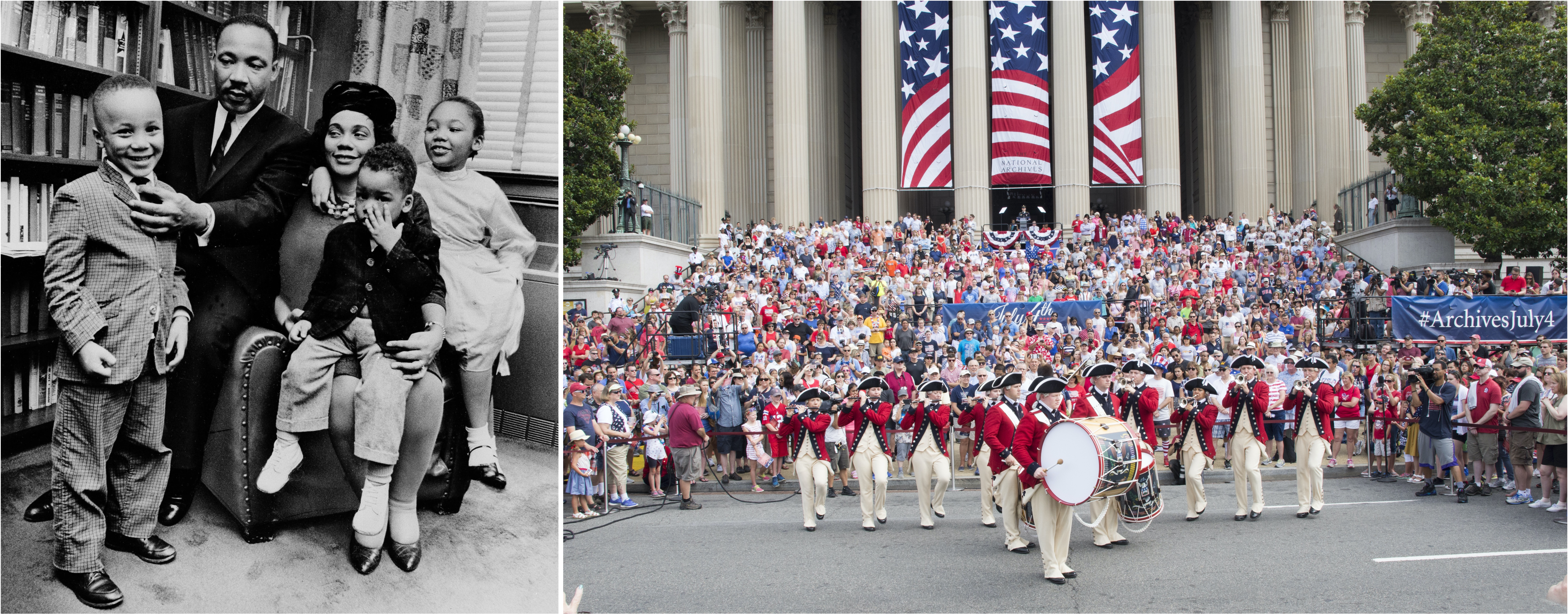
“A promise to all men”: The timeless principles of the Declaration of Independence – that every human possesses unalienable rights, that governments exist to secure them, and that governments must have the consent of the governed – remain as worthy of protection and celebration today as they were 250 years ago. At left, American civil rights activist Rev. Martin Luther King, Jr. (shown with his wife, Coretta Scott King, and three of his four children) who became world-famous for his 1963 “I Have a Dream” speech that unapologetically drew upon the Declaration. At right, Americans celebrate Independence Day – and the freedoms that remain its enduring legacy.
x“A promise to all men”: The timeless principles of the Declaration of Independence – that every human possesses unalienable rights, that governments exist to secure them, and that governments must have the consent of the governed – remain as worthy of protection and celebration today as they were 250 years ago. At left, American civil rights activist Rev. Martin Luther King, Jr. (shown with his wife, Coretta Scott King, and three of his four children) who became world-famous for his 1963 “I Have a Dream” speech that unapologetically drew upon the Declaration. At right, Americans celebrate Independence Day – and the freedoms that remain its enduring legacy. (Sources of photos: (left) AP Photo; (right) TJ Brown/Shutterstock)

And here we return to the Declaration’s contemporary – timeless – relevance. The great American civil rights campaigner Rev. Martin Luther King, Jr. reminded us, as Lincoln had before him, that the rights perceived and announced by the Founding in 1776 are as true now as they were then – because they are always true. Like Lincoln, King entreated America to live up to the truth contained in the Declaration. Unlike smug progressives or their 21st-century radical-left heirs, King did not argue that the Founding’s principles were flawed.

Quite the opposite. In his eternal “I Have a Dream” speech, King unapologetically referred to “the magnificent words of the Constitution and the Declaration of Independence…to which every American was to fall heir. This note was a promise that all men – yes, Black men as well as white men – would be guaranteed the unalienable rights of life, liberty and the pursuit of happiness.” Those unalienable rights were as valid in 1776 as they were in 1963 and as they are today.

In my estimation, that is the great legacy of the Declaration that deserves to be celebrated in this year and in every year hereafter.

David Livingstone, PhD, is Honorary Research Associate in Vancouver Island University’s Political Studies Department and Senior Fellow with the Aristotle Foundation for Public Policy.

Source of main image: AP Photo/John McDonnell.

Love C2C Journal? Here's how you can help us grow.

More for you

Beyond the Tantrum: Canadian Self-Determination Demands More Than Anti-Americanism

With another Canada Day having passed, it’s a good time to reflect on the patriotic fervour sweeping the country. In P.M. Szpunar’s estimation, much of it is nothing to be proud of. From performative “Buy Canadian” campaigns to booing U.S. children on visiting sports teams, too many Canadians have responded to American swagger with self-righteous sneering, assuring themselves their country is wiser, kinder and more civilized. This even as the southward flow of Canadian money, talent and innovation accelerates. Self-indulgent anti-Americanism is not just lazy and immature, argues Szpunar, it’s counter-productive, distracting Canadians from the real work of addressing our own weaknesses and rebuilding our strengths. A serious country should want better.

The Hands-On Future: Skilled Trades, Data Centres and Canada’s Big AI Opportunity

Whether Canadians fear or favour artificial intelligence, they can’t stop it. AI’s transformative power in making so many things faster and easier will doubtless cause pain, says veteran Canadian business leader Gwyn Morgan, but it will also provide generational opportunities Canada must seize. The Prairie region, especially, has the abundant land and energy needed to build the massive AI data centres that will power the future. Some workers are at risk, Morgan concedes, but AI will create opportunities as well, particularly in the skilled trades. AI might just transform our labour force into one where more workers do real things for real people.

The Day After: How Ottawa’s Clarity Act Could Destroy the Federation It Was Meant to Protect

With Alberta headed for a vote on having a vote on independence, many Canadians may think the threat of separation has evaporated. Or that it’s a long way off. Or that, in any case, Ottawa’s Clarity Act will shut it down and protect the federation. But in the concluding instalment of their series (read Part I here and Part II here), George Koch and Jim Mason explode that delusion. The Act is more likely to increase the “Yes” vote which, they predict, will trigger more political wrangling, more bad faith and bitterness, possible civil unrest and even the province’s annexation by the U.S. The consequences, in other words, are dire no matter which side you’re on.

More from this author

C2CJournal Livingstone Macdonald

Canada’s Timeless Political Ideals

By any measure, Canada is a success story. According to the recent United Nations World Happiness Report, we are ranked the world’s 7th happiest country (out of 156 listed). Yet more and more Canadians have lost their connection with where this all came from. Confederation was crafted by men conversant with the great traditions of Western political thought. What happens to our contemporary political culture, wonders David Livingstone, when we neglect these works and the permanent ideals they express? We need to remember, Livingstone argues, that our constitutional form of government is founded on enduring principles and should not be viewed as ongoing construction project.

Book Review: Tolerism: The Ideology Revealed

By Howard Rotberg, Mantua Books, 231 pp, $25 Howard Rotberg’s new book, reviewed by David W. Livingstone— Page 50 Rotberg sets out to show that tolerance has been “raised to the be-all and end-all of human existence” and to point out the problems that excessive tolerance brings in its wake: “It disarms our best minds and our future leaders from protecting the important values and freedoms for which our forefathers have fought, and even died.”