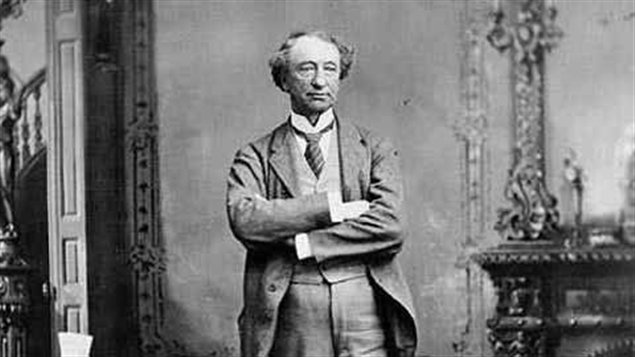
In his recent tribute to John A. Macdonald marking the 200th anniversary of the birth of our founding Prime Minister, his 21st successor Stephen Harper celebrated Macdonald’s vision for Canada, making the point that, though the “Old Chieftain” was a pragmatic politician, “he was also a man of principle who fully grasped the great thinkers of the classical western political tradition.” This isn’t what I recall being taught in high school or even in university. I got the “pragmatic” part, but somehow the point that Macdonald and the other Canadian fathers of Confederation were conversant with the great tradition of political thought got missed.
As far as I remember, I was never assigned to study speeches by any of the fathers of Confederation in school. Students of American political history are expected to read at least some of the Federalist papers, the 85 essays by James Madison, Alexander Hamilton and John Jay written to persuade delegates to the New York ratifying convention to support the proposed U.S. Constitution. A quick Amazon search can net a wide variety of works written by the likes of Thomas Jefferson, John Adams, and George Washington. It’s much harder to find anything written by Macdonald, Cartier, Brown or Tupper. For a Canadian to dig up speeches by an ardent advocate of Confederation like Thomas D’Arcy McGee requires patience and access to a university library. Many of these primary works are simply not part of our contemporary political culture, and so we are unfamiliar with what they contain.
It’s true, unlike the U.S., Canada wasn’t born out of revolution. We didn’t require a Declaration of Independence to proclaim the principles of our new government to the world. But Confederation represented a substantial change to the forms of government in the colonies. It required a new constitution, an alteration to the regime. And it wasn’t unopposed. The plan needed defending and the case had to be made. And those who made it quite naturally drew upon their knowledge of the principles of self-government.
Harper’s point is borne out by these speeches defending (and opposing) Confederation. David Christie, speaking in the Legislature of the province of Canada in 1865, said, “life, liberty and the pursuit of happiness are among the unalienable rights of man.” It’s a clear reference both to the U.S. Declaration of Independence and also to the Two Treatises of Government, by John Locke. The principle that consent is the basis of legitimate government also comes from Locke, and, Christie argued, “it is the secret strength of the British Constitution, and without a full and free recognition of it no government can be strong and permanent.”
The constitutional government they were creating was intended to embody these principles. D’Arcy McGee proclaimed, “The two great things that men aim at in their government are liberty and permanency.” He thought that Canadians had done a pretty good job of securing the first through the adoption of British-inspired institutions. “There is not on the face of the earth a freer people than the inhabitants of this colony,” he boasted. Canada, he insisted, was a place where merit and hard work could be rewarded and where the entrenched oligarchic privileges that persisted in Great Britain would pose no barriers. “This is a new land – a land of young pretensions because it is new; because classes and systems have not had that time to grow here naturally.” And in a nod to Aristotle’s Politics, he concluded, “We have no aristocracy but of virtue and talent, which is the best aristocracy, and is the old and true meaning of the term.” The trick was now to make this a lasting possession for future generations.
George Brown, meanwhile, applauded his fellow parliamentarians–French and English–for their willingness to deliberate in the legislature together about fundamental questions of justice. While south of the border a civil war raged, two peoples in the north with distinct languages and cultures created a new nation peacefully. “Where, sir, in the page of history, shall we find a parallel to this?”
Not only do we sell ourselves short by not remembering this history, we also generate a strange cynicism. Persuaded somehow that no enduring principles of right were entrenched in our regime we are encouraged to regard our Constitution as an ongoing construction project where everything can be remade in light of ever-evolving standards of decency. To borrow from the late American progressive, Richard Rorty, the liberty and rights that the fathers of confederation thought were real and worth protecting are seen as nothing more than “handy bits of rhetoric.” But this means that no principles of good government can ever be regarded as fixed or true. If ideas about justice are merely subjective opinions, then there’s really no point debating them. All we are really doing is swapping power claims.
Ironically, once this attitude is fostered it provides further incentive to neglect our own history. It’s a vicious circle: if there are no enduring principles, there’s no point looking to the past for something that doesn’t exist. And so we can dispense with the primary documents in our political history.
More cynically still, having apparently discarded the notion that there are permanent standards of better or worse, we are nevertheless encouraged to feel superior to those who came before us. As Travis D. Smith of Montreal’s Concordia University has put it so well, “Neglecting the past is a surefire way to exacerbate the conviction that the present is exceptionally enlightened and morally sophisticated.” This in turn encourages us to view our regime not in light of permanent and rationally accessible principles of justice but instead as an empty vessel waiting to be filled up with the hopes and aspirations of the current generation without reference to the past. Of course, that being the case, the future will certainly feel no compunction to adhere to today’s declared standards of justice and decency, since, by the same logic, our current principles are just as groundless and impermanent as any others.
Harper’s argument that Sir John A. Macdonald and the other fathers of Confederation held a different view of things, and that their perspective arose out their own study of the political thought of the past, might strike many of us as strange. It is still an unfamiliar account of our political past. But if it inspires a few of us to go back and read the primary documents for ourselves, we might begin to break out of the conformity and cynicism arising from the neglect that past. To paraphrase Harper, if we continue to misrepresent Canada’s founding as little more than unprincipled deal-making, “it is the country itself we sell short.”
~
David W. Livingstone teaches Liberal Studies at Vancouver Island University where he is also the Chair of Political Studies. He is currently editing a book on civic education, liberal education and the Canadian regime to be published by McGill-Queen’s University Press in spring 2015.