Editor’s Introduction by George Koch:
When Nasdaq stock exchange officials in New York City at 9:50 am EDT on June 12 released the shares of Space Exploration Technologies Corp. of Starbase, Texas – known universally simply as SpaceX – it became the largest initial public offering (IPO) in business history. Valued at a staggering US$85.7 billion including over-allotments, it dwarfed the previous record of US$19 billion set in 2019 by the state-owned oil producerSaudi Aramco. Within hours SpaceX attained a market capitalization of US$2.1 trillion, becoming one of the seven most valuable companies on Earth – “and beyond”, one could say with only slight facetiousness – and making its eccentric-genius CEO and main shareholder Elon Musk the world’s first trillionaire. And that happened despite SpaceX’s unorthodox federal filing that reported financial losses and offered jaw-dropping speculative financial targets along with questionable if not misleading marketing information.

Just over three weeks later and about 350 km distant, operators began shooting the first batches of what would total 850,000 fireworks into the night sky above Washington, D.C., entertaining over 100,000 Americans gathered at the famous Mall on July 4th to celebrate their country’s 250th anniversary. The brash extravaganza was billed as – of course – the largest single-day expenditure of fireworks in history. People convinced of – or perhaps hoping for – America’s terminal decline would do well to note both events, which are linked in more ways than one.
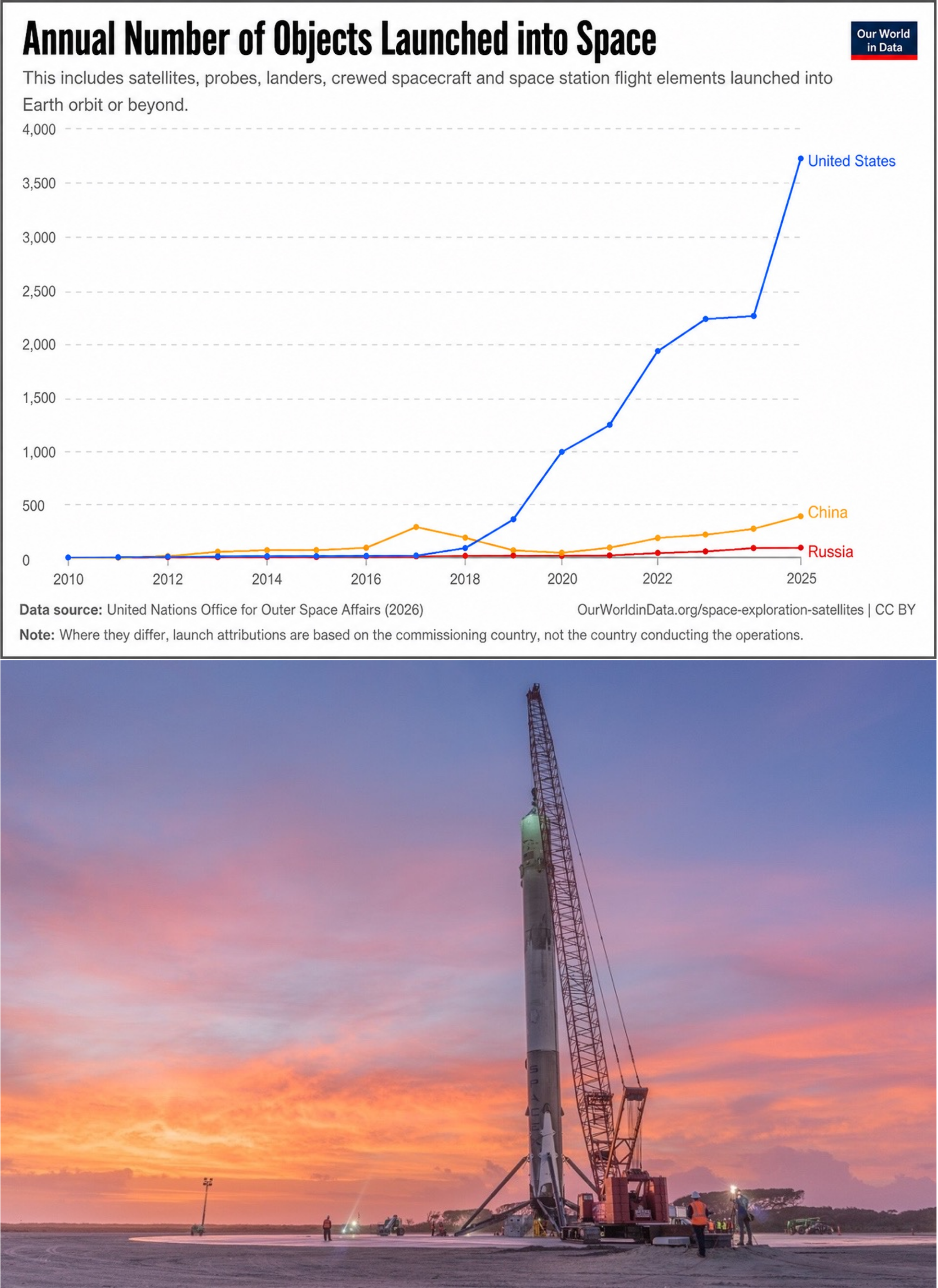
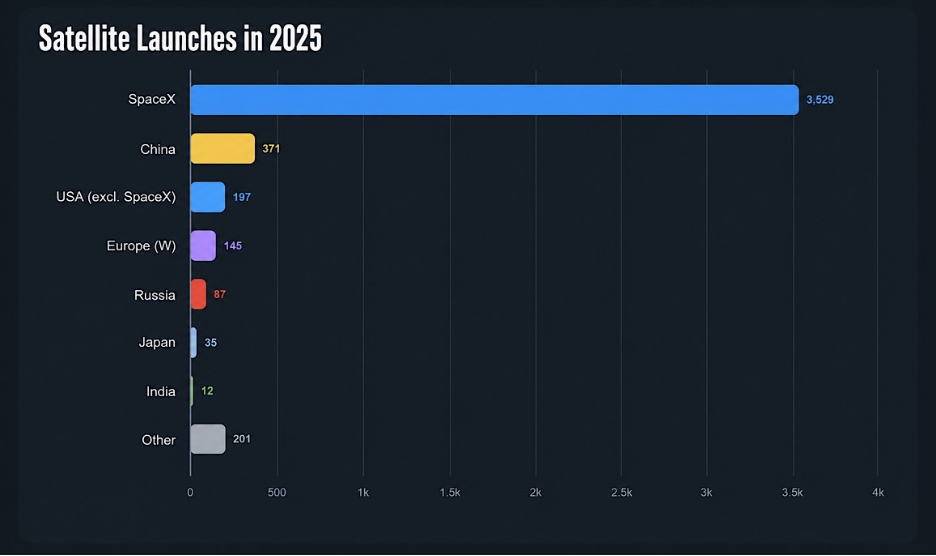
Aside from signalling that rockets are cool, fun and increasingly plentiful, they offer symbolic and concrete evidence that America is anything but done. Despite its many shortcomings and deep social and political divisions, the U.S.A. is soaring once more: dominating financial markets, driving technological innovation, unveiling medical advances, deploying unprecedented military might, racking up economic growth and creating millions of new jobs. Like no other country, America continues to encourage and reward risk-taking, idea-generation and gifted oddballs who swing for the fences and reach for the stars. Musk is arguably Exhibit Number One. His creation by itself currently accounts for about 85 percent of the objects placed into orbit by all the world’s space programs.
The following article by Gleb Lisikh is not primarily about what SpaceX owns and sells now as the combined owner of the world’s most active rocket and satellite-launching operation, plus the social media platform X and artificial intelligence developer xAI (Musk’s Tesla electric car producer is a separate company). It is about what SpaceX has accomplished for the exploration and commercialization of space – and is aspiring to further accomplish. Lisikh’s essay is for all those who can’t handle or just don’t want to be bothered with all the mind-boggling financial complexities of the investment contraptions, but simply want to know why anybody sane would place an economic value on, or invest in, exploring emptiness.
In fact, the opportunities in space are as endless as the space itself. The nearest portions of that infinite vastness are being measurably drawn within humanity’s grasp. Private and government space agencies around the world are announcing new milestones, achievements or goals almost by the week. Increasingly the questions revolve less around exploration per se than around stuffing that endless emptiness with useful things, and turning the process of doing so into a new, rapidly-growing – and profitable – industry. The implications are profound – not just for Americans, but Canadians and all humanity.
The material results are already becoming evident. Musk’s companies are central in a revival of U.S. engineering and manufacturing might and a reorientation of the tech sector from coding apps and gadgets to designing and making things that work both on the ground and in unforgiving outer space. Exciting and lucrative careers at the leading edge beckon for a generation of young Americans – and anyone else with the talent to come and join in. With a Canadian mother, Musk himself isn’t even American, after all. Yet barely a month ago, the SpaceX IPO made instant millionaires of 4,400 company employees. As Europe falls farther behind, as Canada teeters on the edge of outright decline and can’t decide what it wants to be, SpaceX and the country that hosts it stand as living testimony that humanity’s age-old spirit of adventure lives, that plenty of people still gaze up at the sky and yearn to reach for the stars.
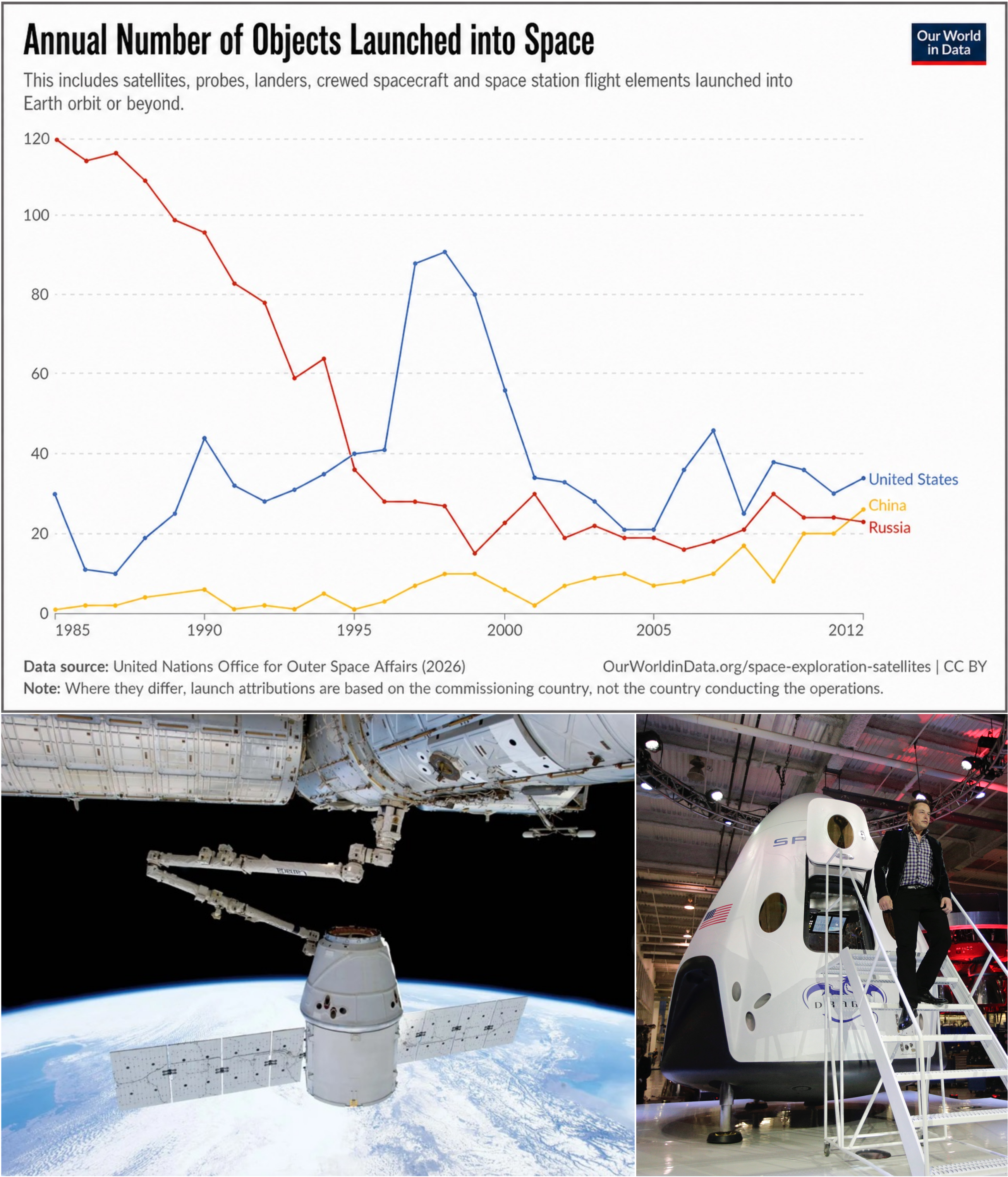
SpaceX has unequivocally revolutionized space travel by making it affordable for commercialization, as well as reliable and replicable and, in doing so, taking nearly all of that business effectively away from the U.S. government and its tottering space agency, NASA. With thousands of Starlink satellites now circling the globe and multiple private-sector space companies vying for a share of the burgeoning defence, scientific and commercial business, we need to start by recalling that, when Elon Musk came along, space exploration by anyone was a stagnant if not slowly dying enterprise. The total number of objects placed into orbit worldwide had fallen from typically 160 in the 1970s-1990s to barely 60 in the 2010s. By last year, as the graphs lower down show, that figure had zoomed above 4,000 – and SpaceX alone delivered more than 3,500 of them.
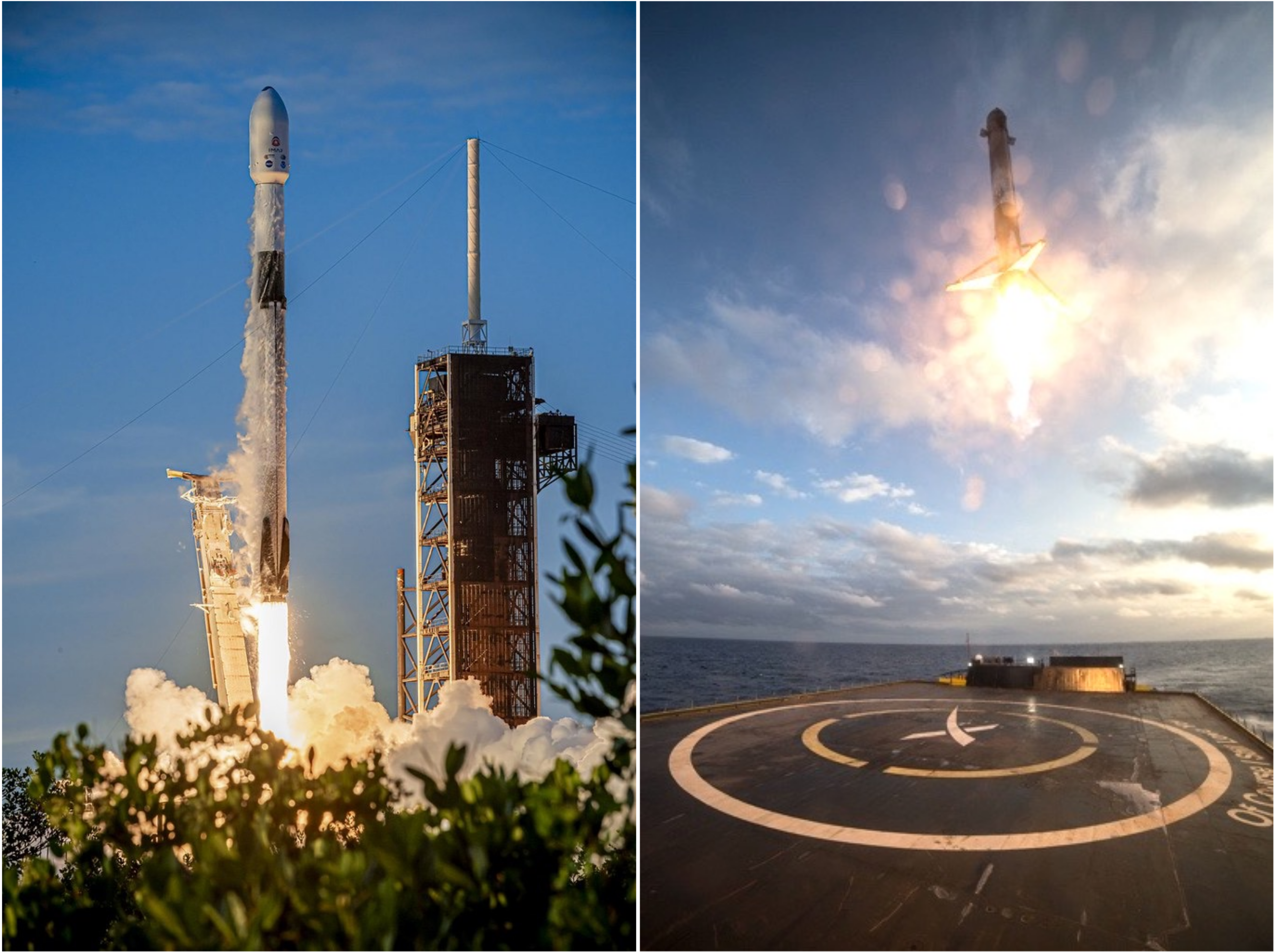
Since the most difficult and expensive part of space travel is getting things up into orbit, whoever has the best rockets that do that heavy lifting owns space exploration, because they ultimately decide what goes up and when. And SpaceX came to almost monopolize that business by offering something that no government space agency had yet achieved: an effective, efficient and affordable workhorse – Falcon 9 – that since 2018 has logged a 99.5 percent success rate.
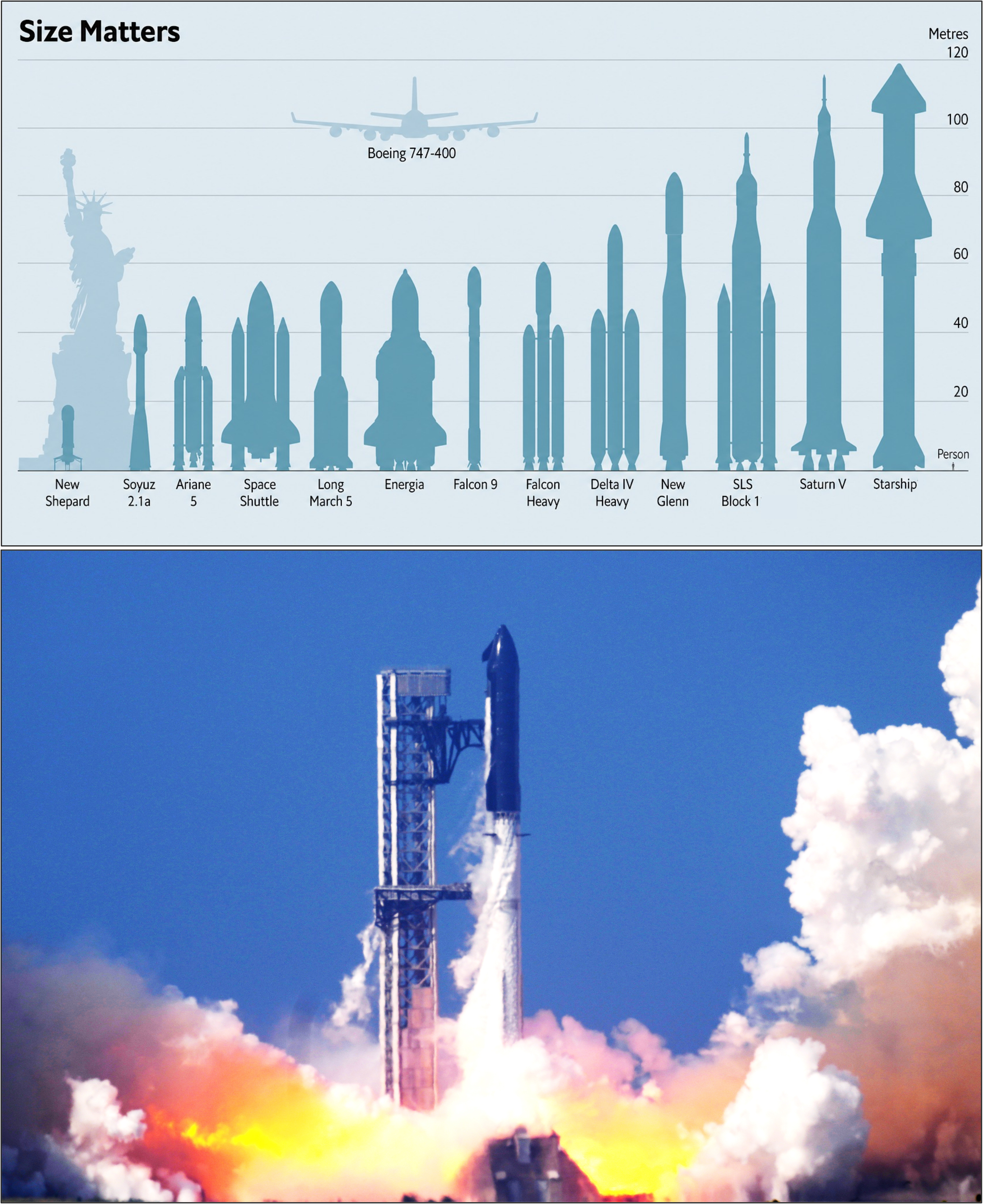
The revolution is ongoing, however, as SpaceX proceeds with the development and testing of its largest and most promising rocket – Starship. It is the biggest flying machine ever built by humans and the most critical element upon which the whole SpaceX empire hinges, including its behemoth market valuation. The most anticipated and, as it turned out, mostly successful test of the significantly modified Starship V3 took place on May 22. That launch missed the IPO filing date but not the IPO itself, the vehicle’s viability as a categorically larger transport mode offering physical backing to futuristic promises from Musk and other space nerds about asteroid mining, moon bases, orbiting AI data centres and much more.
Before we jump into those sci-fi-sounding promises, let’s have a look at what’s enabling them and why even well-informed and typically careful investors look up to SpaceX despite many features that in any other company or its leader would trigger bursts of hysterical laughter.
The Main Element
Contrary to some claims, size definitely matters and many discussions focus on a given rocket’s payload – how much it can place into the low Earth orbit (LEO) of 160-2,000 km that represents the most requested and frequently visited distance above the planet’s surface. SpaceX’s Falcon Heavy rocket, the largest operational rocket on Earth at the time of writing, can take up to 64 metric tonnes to LEO. Starship is designed to lift twice as much, 100-150 tonnes, and consists in full of the Super Heavy rocket aka “booster” or “first stage”, topped by an interchangeable crew/cargo capsule integrated with “second-stage” propulsion, which confusingly is also called Starship. (For comparison, NASA’s problem-plagued Space Shuttle was long billed as a “space truck” capable of routinely placing 30 tonnes into LEO, but never managed more than 23 tonnes.)
The far more important metric, however, is an economic one: how much does it cost to deliver something to the desired orbit? This is commonly measured in $/kg of useful payload to LEO. (All following figures are stated in US dollars.) This cost has represented the main barrier to any commercially viable activity in space. But it’s changing and changing fast – thanks overwhelmingly to SpaceX.
The accompanying chart is designed to illuminate the evolution of that cost, in part by expressing it in kilograms of gold to avoid undue arguments about what a dollar was worth “back then”, how different currencies compared, etc. It’s a complex subject and the highly approximate numbers quote the minimum cost to LEO in а given period, naming the cheapest rather than necessarily the most-used vehicle at the time. Besides the rocket itself, the actual cost depends on the nature of the load, the orbit and other launch circumstances. The chart’s purpose is thus not to “prove” particular launch economics but to demonstrate the scale and the source of changes to the cost over time. The tragically fated Space Shuttle – two of which exploded in flight, killing 14 astronauts – is included for interest, since it dominated space news for years.
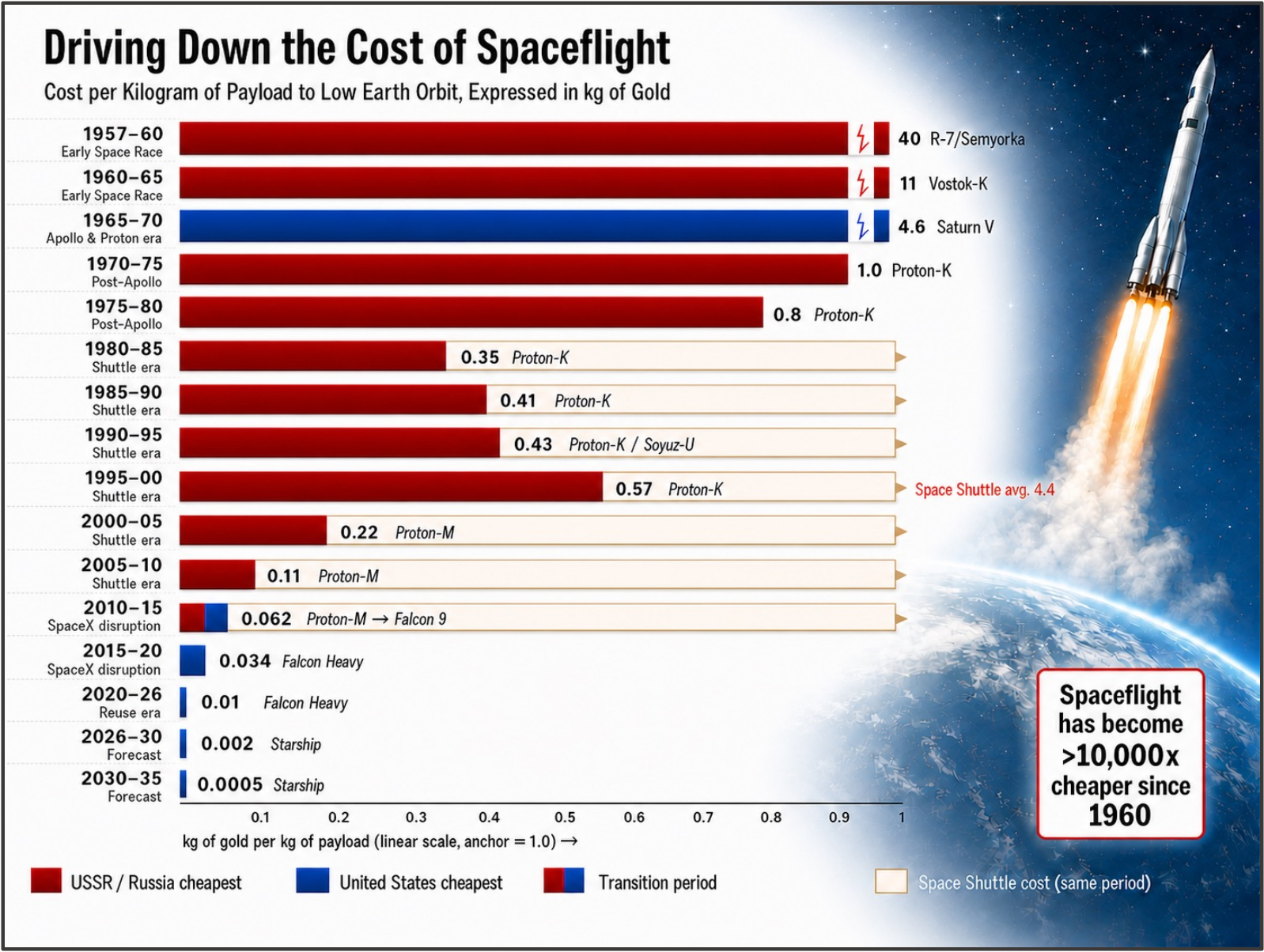
Skipping through the experimental and understandably expensive period of the “Early Space Race”, when military ballistic missiles were repurposed for the first sub-orbital and orbital flights, the following “Apollo era” space race brought the launch costs down by about 10 times. Even with that reduction in costs, as of the 1970s the cost of merely moving a kilogram of cargo into orbit was still approximately equal to that cargo’s weight in gold.
It is thus not coincidental that after the U.S.’s big Apollo-centred push to the moon, the USSR completely dominated worldwide launches for over two decades. This is a clear manifestation of how economically unsustainable space exploration was and how it could only be maintained through state funding and, in this case, a command economy whose government was doing it mainly for military and national-prestige reasons. U.S. President John F. Kennedy’s famous rallying cry, “We go to the Moon not because it’s easy but because it’s hard,” was no longer winning the hearts and mind of Americans over the money they could keep in their pockets.
Through the 1980s and 1990 – the time I stayed much closer to the subject than I am now – the cost pretty much settled and was axiomatically assumed to be about 1 kg of gold per 1 kg to LEO (mind again that the cost chart shows minimums – not averages), an easy price-tag to remember and another reason to use gold as the unit of measure.
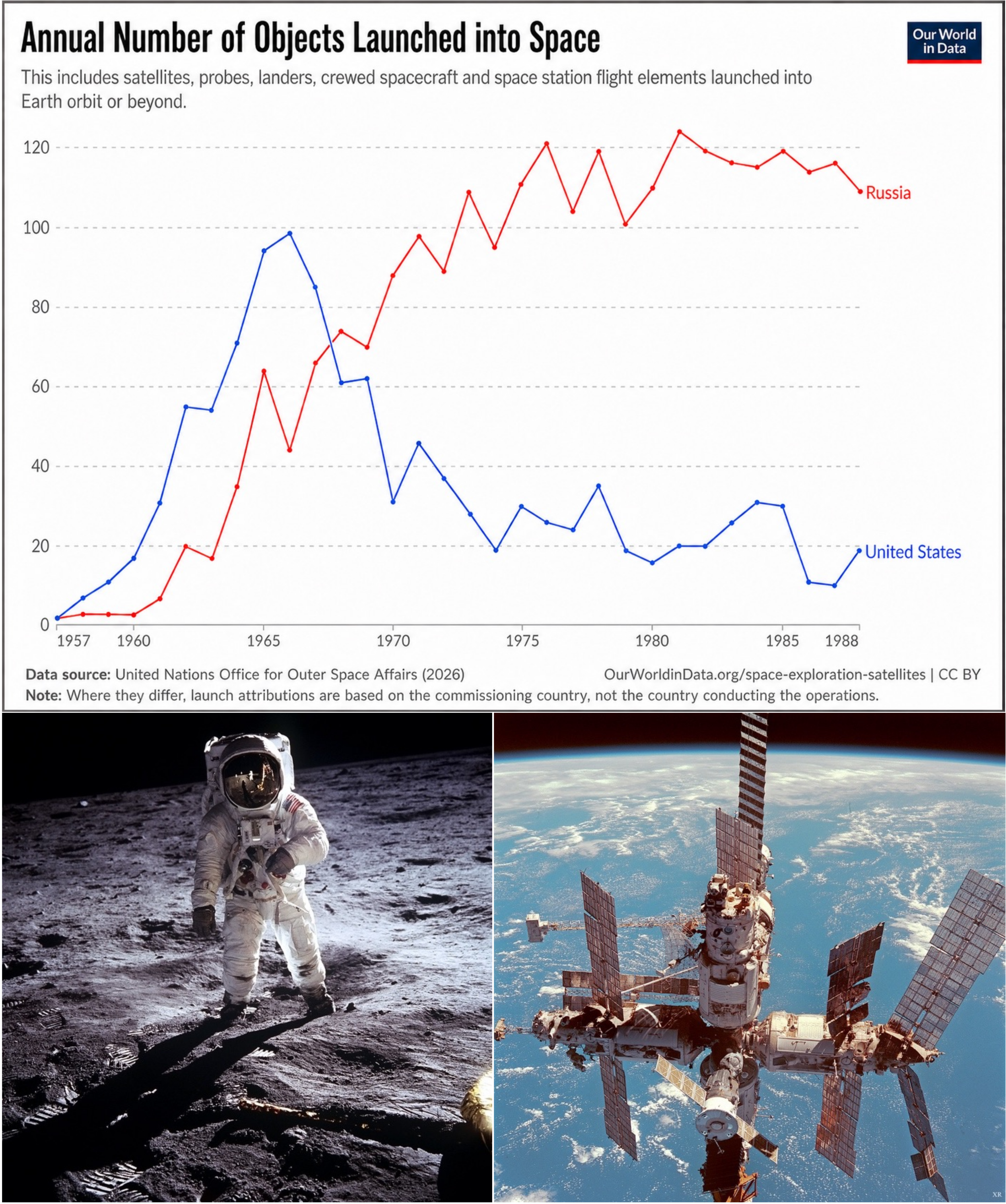
Leaving politics and government subsidies aside, it is important to note that while cheaper rockets drive their more frequent use, the more frequent use in its turn drives down the costs of those launches through economies of scale. In space exploration, these economies include overhead spread over more flights, cheaper manufacturing with cumulative volume (Wright’s Law), better supplier terms and, most importantly, less conservative or overbuilt design achieved through reliability data. It’s a virtuous cycle which is very difficult to beat for a new entrant. It was the edge and trend Russia still had with Soyuz and Proton rockets even after the Soviet Union’s dissolution, when the Russian economy switched to selling hydrocarbons and abandoned rocket science among other things.
Reusable launch systems offer, conceptually at least, a way to transform a gradual downward cost trend into a step-change. The systems themselves are likely to be more expensive than a one-shot expendable rocket, but the attraction of spreading manufacturing costs over dozens or even hundreds of launches is irresistible. The world’s first partially reusable system, the Space Shuttle (1972-2011), did not help, but was a catastrophe in any currency. Shuttle payloads cost more than 4 kg of gold per kg to LEO – worse than the Saturn V of the 60s.
The Shuttle did make great contributions to space exploration, making 37 flights to build the International Space Station (ISS) and dozens more to service it and ferry crews, and performing dramatic in-orbit repairs/upgrades to the Hubble Telescope. But the failure of this first reusable system to demonstrate any economic benefits, let alone airline-like cadence and reliability, became a major source of skepticism toward reusable rockets in general. The Soviet version, Buran, only flew one uncrewed test mission, was grounded and at least never killed anybody.
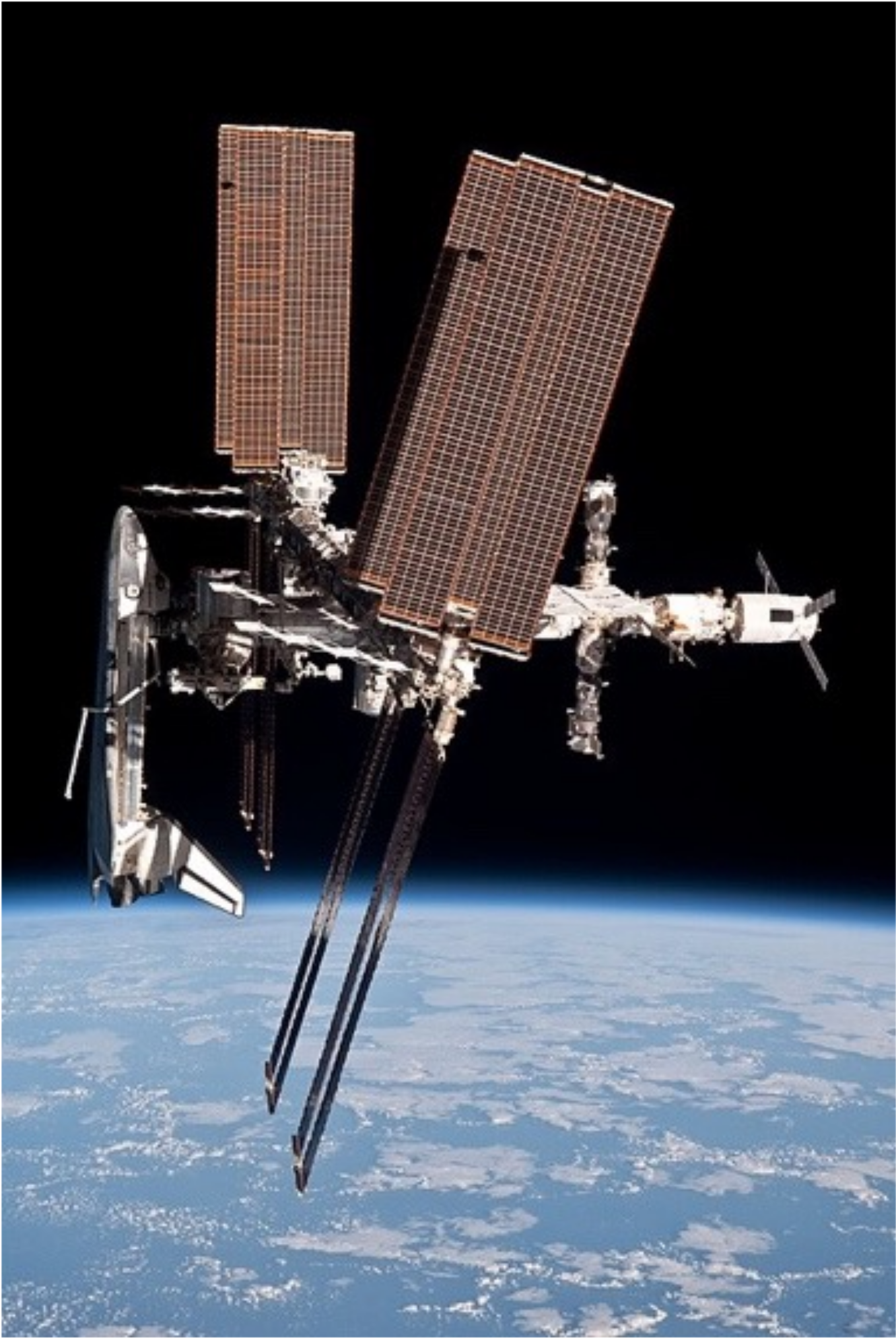
The Space Shuttle program was shut down in 2011, leaving the U.S. out of the means to even get to the ISS, fully dependent on the Russian rocket fleet and engines, while also facing a new competitor: China. It was doing the opposite of Russia by investing in science and education, laying out its strategic space program, Project 921, and becoming a major space player during that relatively quiet period when Russia was in economic distress and the U.S. was struggling with the Space Shuttle’s unhealthy reusability and death rate.
It took Musk’s audacity to read on Shuttle’s tombstone not “Don’t ever try this again!” but “Learn and do better!” In May 2012 SpaceX’s uncrewed Dragon capsule, carried by Falcon 9, became the first commercial spacecraft to dock with the ISS, marking a uniquely American revival to its space flight capabilities and demonstrating that NASA could buy services rather than own and operate hardware. In September 2014 SpaceX won a $2.6 billion commercial crew contract to develop and operate Crew Dragon for astronaut transport to the ISS. There have so far been 50 Dragon flights to the ISS. By contrast, Boeing received $4.2 billion for the same task and still cannot reliably fly astronauts.
In December 2015 SpaceX again made history by executing the first-ever successful vertical landing of an orbital rocket’s first stage. In that flight the Falcon 9 rocket launched 11 Orbcomm satellites from Cape Canaveral and, shortly after, the 156-foot-long booster returned to Earth, touching down perfectly at the landing zone pretty much ready to be refuelled and fly again. This marked a stark contrast with the Shuttle’s reusability, which required fishing the booster from the sea followed by heavy refurbishment, discarding many damaged and corroded parts, and expensive reinstallation of the solid propellant “motors”. This process took months, thus preventing any economic re-launch cadence.
That successful 2015 booster landing was followed by a decade of “sharpening the saw”, a process that eventually cut the costs to LEO by roughly five times, down to 11 grams of gold per kilogram of payload, or $1,500 for the newer Falcon Heavy rocket. A number commonly cited is that SpaceX cut the costs to orbit by 50-100 times, but that is when compared to the Shuttle rather than the cheapest contemporary alternative. Still, both results are hugely impressive. The much lower cost also importantly came with high reliability and extremely high launch cadence.
From that year on the U.S.-owned orbital launches literally skyrocketed. SpaceX also ended America’s dependency on the Russian rocket engine RD-180, which had been used to power other “American” rockets and lasted 20 years until about 2020. Starship is designed to be a fully reusable rocket system, which is expected to cut costs to LEO by another five times right off the bat, down to 2 grams of gold or about $300 per kg. Although schedules have been slipping somewhat, Starship’s full reusability is supposed to be demonstrated this year, followed by orbital refuelling and an uncrewed trip to the moon as early as next year.
The biggest reason Soyuz and Proton were cheap for their time may simply be that they flew a lot. Over its history, the R-7/Soyuz family of rockets has accumulated well over 1,900 launches, making it by far the most-flown orbital launch vehicle family ever. In a sense, SpaceX is pursuing the same fundamental ideas as Soyuz – standardization and high cadence – but critically combining it with efficient reusability.
If Starship can be re-flown with turnaround times and costs comparable to commercial aircraft, then costs could fall below $100 per kg for the mature Starship. But SpaceX’s long-term target is $10! There is a hard stop to this number somewhere of course, but even at $100 (less than a gram of gold and no more than the current cost to courier a valuable item by air on Earth) the launch cost is effectively a rounding error in most space business models. Even a more conservative scenario of $200-$500/kg to LEO would be transformative.
Decoupling the Fi from the Sci
The cost per kilogram to LEO is a gating function for entire industries. When launch cost crosses a particular threshold, a new category of economic activity transitions from speculative fantasy to viable business case. The categories below are organized in roughly descending order of cost thresholds, each section capturing what becomes possible as the price to LEO descends toward SpaceX’s declared long-term target of $10/kg.
Such categorization is a convenience, not a precise taxonomy. Many applications depend on variables beyond launch cost alone, of course, so the categories should be read as signposts rather than engineering specifications.
Category 1: Economic Today – The Falcon Era – $1,500-$3,000/kg to LEO
In many respects, this category represents the transition from what used to be reserved for governments and scientific institutions to a commercial environment. These activities are already commercially viable under current launch economics and do not require Starship to succeed, although they would benefit greatly from even cheaper transportation.
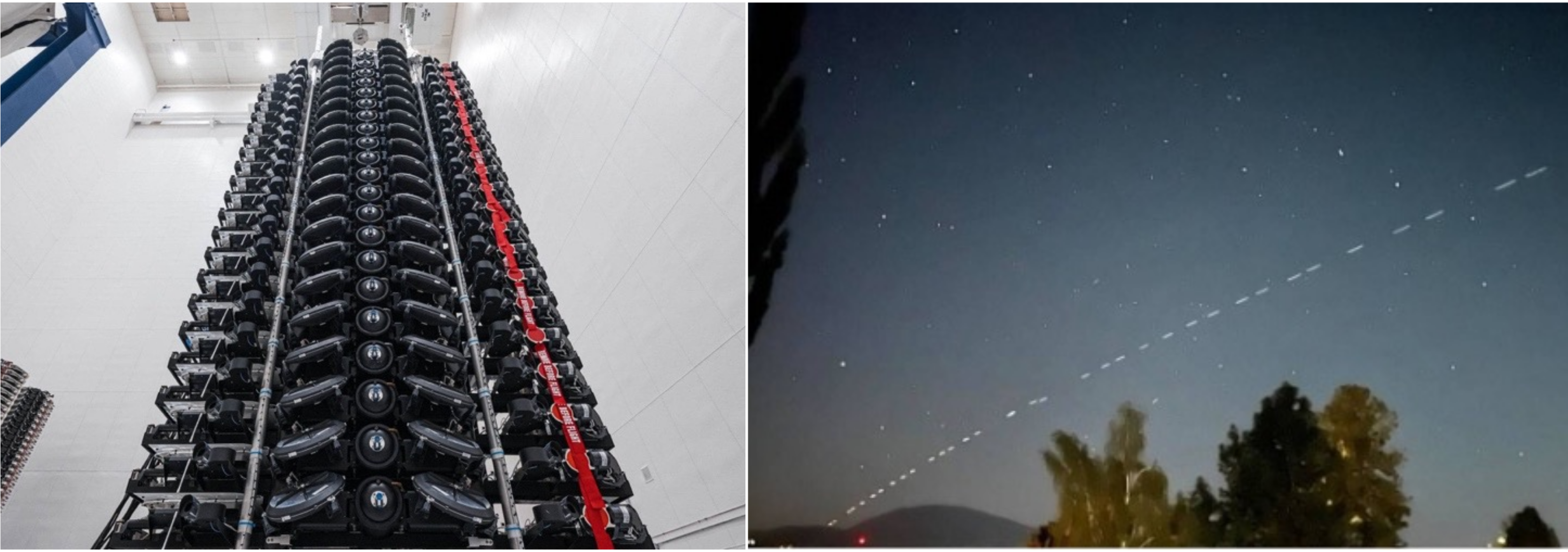
The clear Category 1 case is Starlink. Recall the decades when the entire world placed barely 100-200 objects into orbit per year. SpaceX’s Starlink so far numbers ten-thousand-seven-hundred satellites providing worldwide broadband to more than 12 million subscribers and generating over $11 billion in annual revenue. Similar systems are being pursued by Amazon with its Project Kuiper (rebranded to “LEO”), China with its Guowang constellation and numerous Earth-observation providers. What lower launch costs change in Category 1 is not the existence of the business but its scale. Larger satellites, denser constellations, faster replacement cycles and more ambitious payloads become practical. For example, Starlink V3, designed among other things to deliver satellite internet directly to handheld devices, in practical terms can only be deployed by Starship.
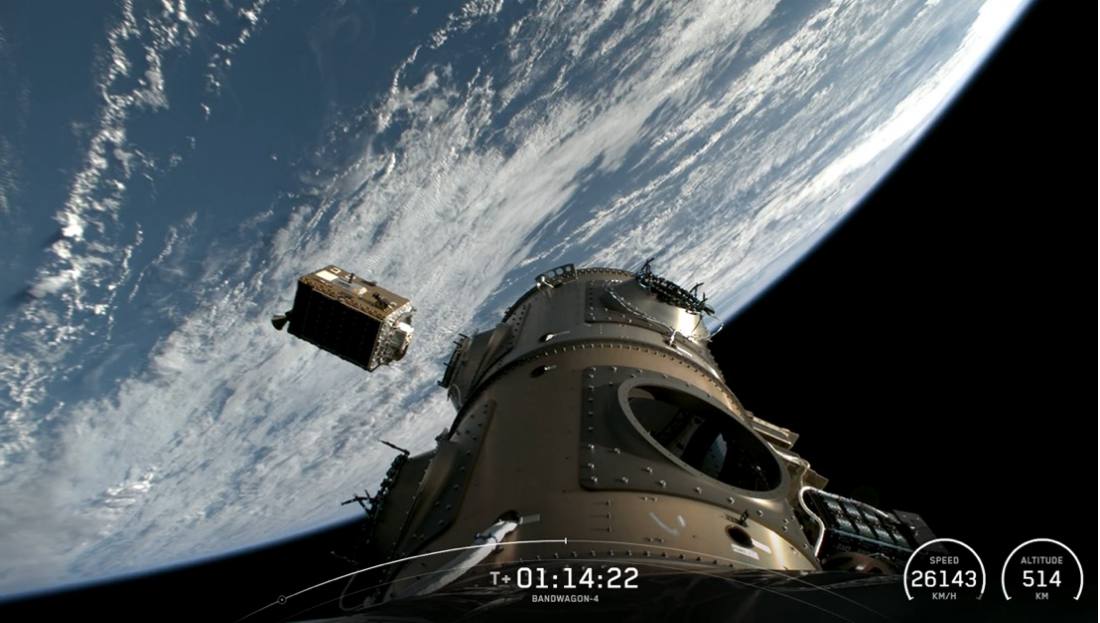
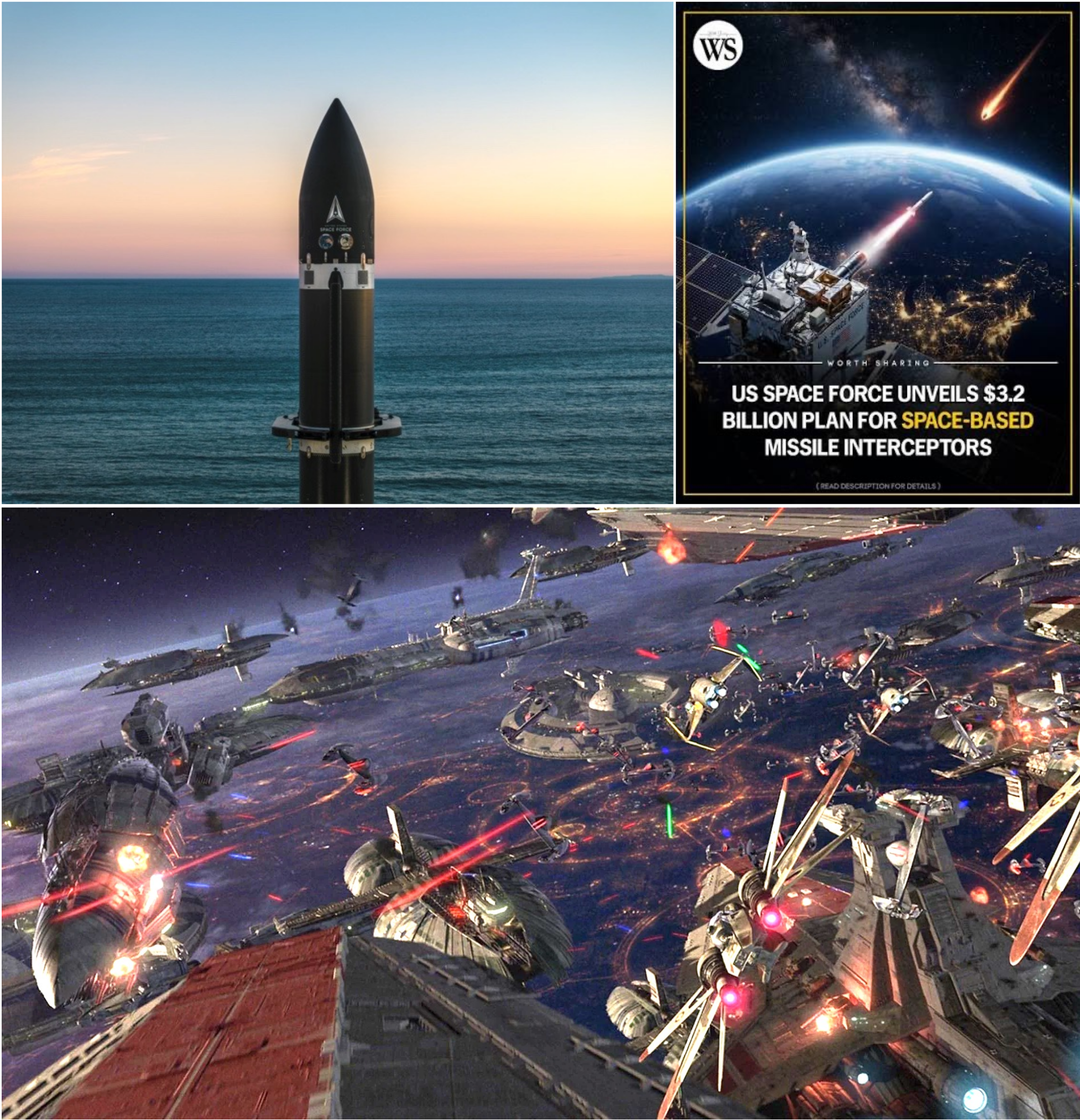 Star Wars comes closer: A recent demonstration launched in part aboard SpaceX competitor Rocket Lab’s Electron rocket (top left) tested the U.S. Space Force’s ability to almost instantly intercept, shadow and photograph an “enemy” satellite. Depicted at bottom: the Battle of Coruscant from 2005’s Star Wars: Episode III – Revenge of the Sith. (Sources: (top left photo) USSF SSC; (bottom screenshot) Fandom)
If this quick overview does not give you Star Wars vibes, have a look at this cosmic chase. It’s part of a tactically responsive military space concept designed to speed access to orbit down to a cycle time of mere hours when replacing damaged critical satellites or shooting down enemy ones (the euphemisms in the transcript used to avoid words like “destroy”, “shoot” or “enemy” alone are hilarious). We won’t return to this theme as its future is classified.
Category 1/2: Becoming Economic – Falcon to Starship
Data centres in space are a big and widely debated topic whose economics straddle categories 1 and 2. The idea of running orbital infrastructure for compute (a term signifying virtualized access to CPU/GPU or RAM capacity) may sound futuristic, but early proof-of-concept missions are already operating.
Washington-based startup Starcloud launched its first satellite in November 2025 aboard a SpaceX Falcon 9, carrying the first NVIDIA H100 graphics processing unit (GPU) ever placed in orbit and delivering roughly 100 times more compute capability than any previous space-based hardware. Within weeks, Starcloud-1 had trained the NanoGPT language model and run inference on Google’s Gemma large language model, becoming the first spacecraft to do either. Starcloud-2, carrying multiple H100s and NVIDIA’s next-generation Blackwell B200 GPU, is scheduled for October 2026.
The same month, Google announced Project Suncatcher, a constellation of solar-powered satellites carrying Google TPU AI chips, connected by free-space optical links. Prototype satellites, in partnership with Planet Labs, are scheduled for early 2027. China has also started moving more aggressively at the constellation scale, beginning in May 2025 launching 12 out of 12,800 planned satellites for the so-called Three-Body Computing Constellation, connected by laser links.
As for SpaceX, its filing on January 30 seeks Federal Communications Commission (FCC) approval for a constellation of unprecedented scale: up to 1 million satellites orbiting in sun-synchronous inclinations to maximize solar power generation. After that extraordinary request, Musk only waited for a weekend and Groundhog day to announce the merger of SpaceX with xAI, the maker of Grok, owner of X and an already-prolific compute provider.
The appeal of building IT infrastructure in space is compelling. The environment offers continuous solar energy unattenuated by atmosphere, no need for water as waste heat can be radiated into the big void, no terrestrial land constraints, no political opposition or NIMBYism, a simpler regulatory process and direct integration with satellite networks.
The economics of doing it this way are not obvious, not yet, anyway. This simple and hardly objectionable “Economics of Orbital vs Terrestrial Data Centers” calculator finds a 3X cost gap between on-the-ground and in-orbit data centres, making these a seemingly dubious business proposition. The calculator does allow the observer to gauge the relative importance of the various cost components. And when one adds in the trends affecting each option, which the calculator is missing, the go-forward business case changes dramatically.
The economic case for orbital compute is not primarily driven by launch cost (one reason I gave it its own category). Instead, it is driven by the cost and scarcity of terrestrial power and cooling. AI-optimized data centre construction on Earth already exceeds $20 per watt of IT load capacity, electricity costs are rising steeply in many markets, water requirements for cooling are drawing regulatory scrutiny, and public opposition is increasing, as this recent C2C article discussed. Extrapolate those trends five years and terrestrial data-centre accounting easily rises to equal the orbital. And that’s without assuming favourable cost trends in satellite manufacturing and launch costs, nor the benefits of more reliable computer-chip operation in space (yet to become SpaceX’s business).
“On strict near-term unit economics, this might still be a mediocre use of capital,” writes Andrew McCalip, creator of the above-cited calculator. “But the knock-on effects are why this keeps pulling at people. If you can industrialize power and operations in orbit at meaningful scale, you’re not just running GPUs. You’re building a new kind of infrastructure that makes it easier for humans to keep spreading out. Compute is just one of the first excuses to pay for the scaffolding. Even if this is a mediocre trade on strict near-term unit economics, the second-order effects could be enormous.”
But McCalip soon sets aside practicality altogether and urges people to cast their eyes skyward and reach for the heavens, not for dollars and cents but because it reflects humanity’s age-old quest:
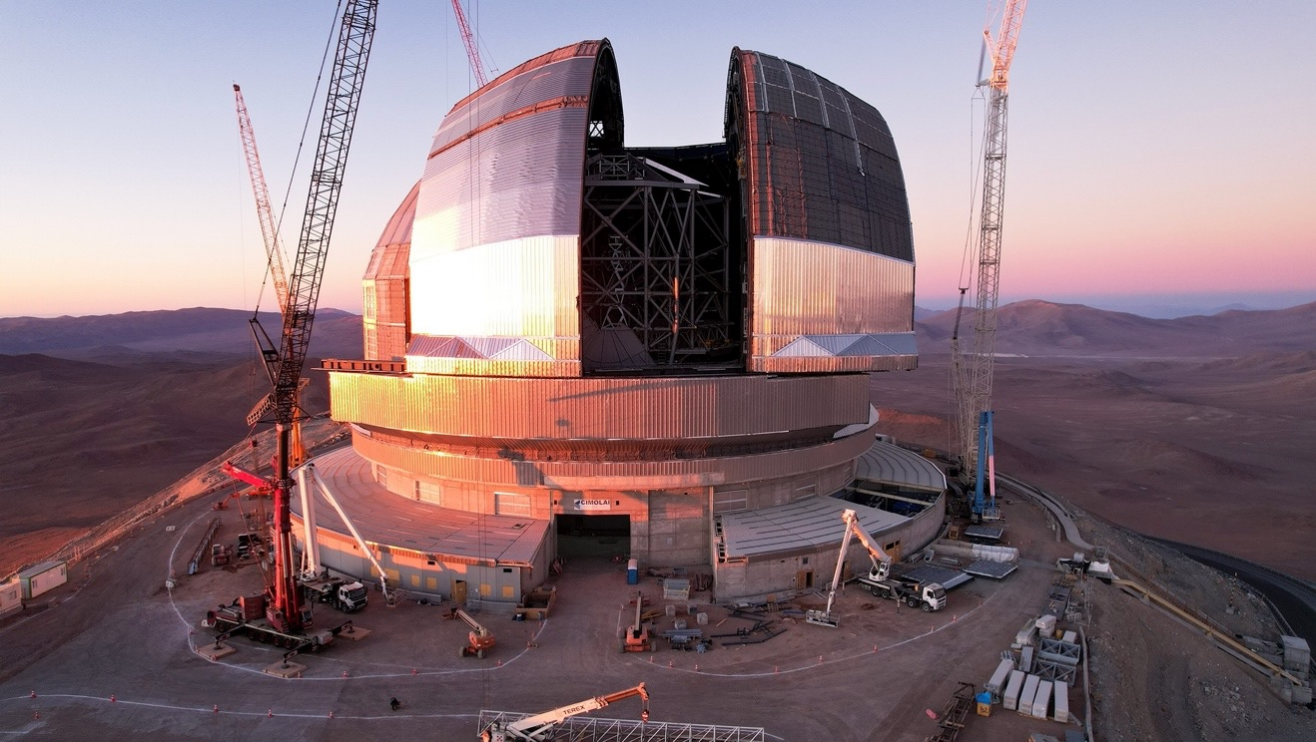
Large observatories – Every major space telescope to date has been constrained by launch mass and fairing volume. Bigger and cheaper transport facilitates larger mirrors, simpler deployment mechanisms and lower engineering risk. Astronomers should stop complaining how Starlink is polluting the night sky and “killing” Earth-based astronomy, and start looking forward to the new and vastly better successors to the Kepler, COBE, Hubble and WMAP/Planck orbital telescopes, which already revolutionized astronomy and our understanding of the universe.
Category 3: New Industries in Orbit – Improved Starship and others – $100-300/kg to LEO
At this level entirely new industries begin to emerge rather than simply improving existing projects.
Microgravity manufacturing – Companies such as Varda Space Industries and Redwire are already conducting commercial manufacturing experiments in orbit. Microgravity allows production of high-purity optical fibres, specialized pharmaceuticals and other advanced materials. SpaceX is testing Starfall, an uncrewed capsule designed to perform R&D in microgravity as well as provide point-to-point cargo delivery. That did not make a big splash in the news, but recent FAA documents reveal some details.
Space-based solar power – A solar array in sun-synchronous LEO or much higher geostationary orbit receives sunlight without atmospheric attenuation and transmits that energy to Earth via microwave or laser. The effectiveness is estimated at five to eight times that of ground-based solar. The obstacle has always been the mass of the required infrastructure, but the technology is no longer theoretical.
This year, JAXA’s OHISAMA satellite – roughly the size of a washing machine – is scheduled to transmit electricity from LEO via microwave to a ground station in Suwa, Japan – the first-ever orbital-to-surface wireless power transmission with conversion to electrical power. Meanwhile the European Space Agency’s SOLARIS program is advancing toward a full development decision by its member states. The UK, European and Chinese programs all project commercial gigawatt-scale capacity in the 2040s-2050s, contingent upon launch costs falling into the $100-$500/kg range.
Category 4: Airliner-like Operations – Future Launch Systems
This category depends less on cost per kg and more on operational maturity. The requirement is not merely cost but cadence, turnaround and reliability approaching those of commercial aviation.
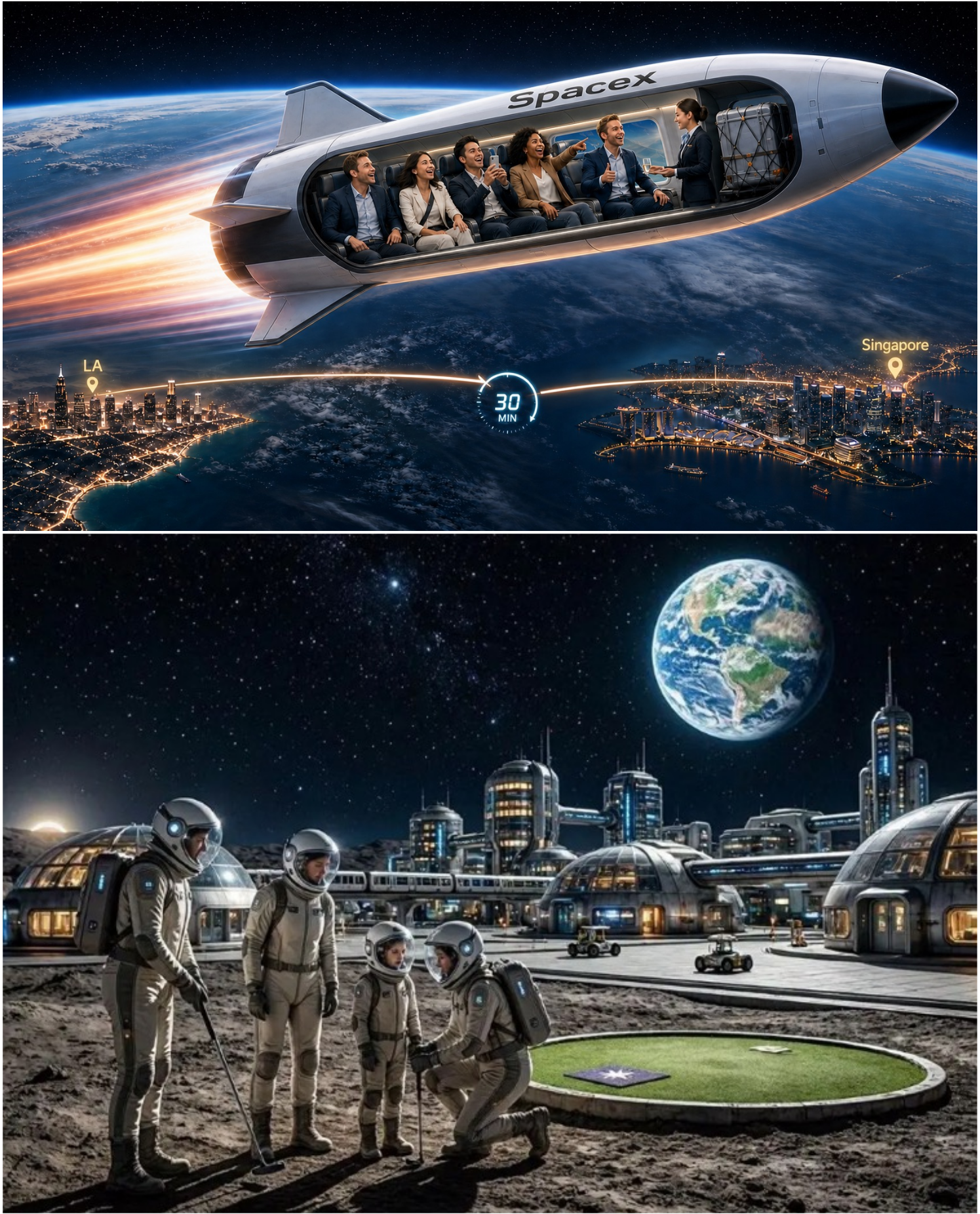
Point-to-point Earth transport – SpaceX has repeatedly proposed transporting passengers and cargo between major cities via suborbital trajectories. The appeal is obvious: journeys like London-Sydney or Los Angeles-Singapore currently measuring 10+ hours could be reduced to 30 minutes. Judging from my own experience, the biggest obstacle to this venture would be not the wallets but the stomach strength of the passengers.
Rapid military logistics or rescue operations – These follow the same economic logic as above. Instead of moving cargo across oceans over days or weeks, high-priority equipment and personnel could be delivered anywhere on Earth within hours if not minutes. Governments are already funding this possibility.
Space tourism – This is already an operating niche but here we are talking about its becoming accessible to an ordinary Joe and Karen who used to vacation in Cuba but can change their minds and try golfing on the Moon instead.
Category 5: Permanent Off-World Industry – Future Launch Systems
Once transportation becomes inexpensive and routine, attention shifts from moving hardware up to building self-sustaining industrial ecosystems outside Earth in addition to or on top of the big space stations.
The Moon – This is the natural first step. SpaceX’s filing identifies both lunar manufacturing and lunar energy production as future markets. The objective is not simply exploration but local production of fuel, power and construction materials. Every kg produced on the Moon is a kg that no longer needs to be sourced on and hauled from Earth through its thick atmosphere and gravity.
Mars – The Red Planet represents the same principle at a larger scale. Transportation remains important, but eventually life support, energy generation, resource extraction and manufacturing become the dominant challenges. It is an interesting fact that among other reasons SpaceX chose liquid methane and liquid oxygen (Methalox) for its Starship (Raptor engine) propellant is because its chemistry can be manufactured on Mars from atmosphere (mostly CO2) and water, thus making a self-sustaining two-way transport loop possible, bypassing “the tyranny of the rocket equation.”
Category 6: Civilization-Scale Expansion
These projects’ feasibility depends on a self-reinforcing cycle of industrial growth in space.
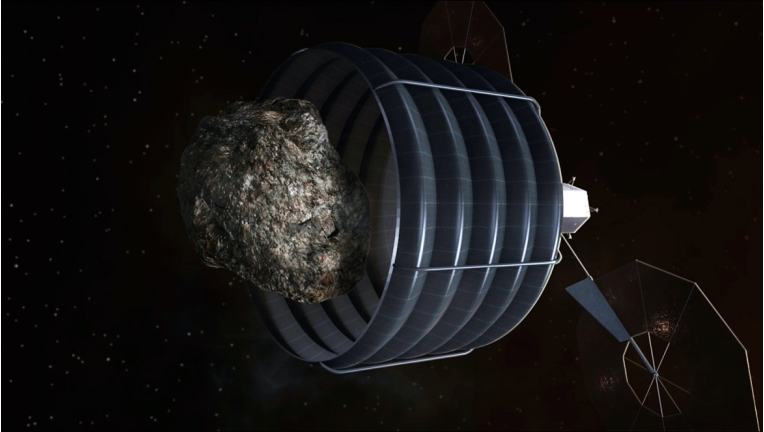
Asteroid mining – This is the most frequently cited example and appears explicitly in SpaceX’s future-market discussion. The attraction is obvious: near-Earth asteroids are long known from spectral analysis, more recently confirmed by space probes, to contain quantities of essential metals that would be extraordinarily difficult to obtain from Earth. Asteroid mining becomes meaningful once there exists a large industrial economy capable of consuming those resources in space.
Large space habitats – These have the same logic as above. O’Neill cylinders and fully space-based industrial civilization concepts require millions of tonnes of material in orbit and cannot be unlocked by a single technological breakthrough.
Initiating such a feedback loop – not any individual rocket – is the true long-term significance of SpaceX’s Starship. The vehicle itself is merely the first step. The larger question is whether dramatically cheaper access to space can trigger the same kind of compounding economic growth that railroads, shipping containers or the internet produced on Earth.
Who Wants to Be a Quadrillionaire?
The Cold War-era space “arms race” between the Soviet and Western blocs was not challenging the economy of the space projects but the pocketbooks of the citizens. Thanks to Elon Musk, this is changing fast. Musk saw an opportunity, an unoccupied technical and business space which after 25 years, prodigious effort and numerous setbacks has made him the world’s first trillionaire. But others are waking up to the call of participating in the new industry with the enticing promise of its burgeoning development exceeding in scale the GDP not just of the proverbial small Third World country but of middle-sized developed nations. Who doesn’t want to be a trillionaire?
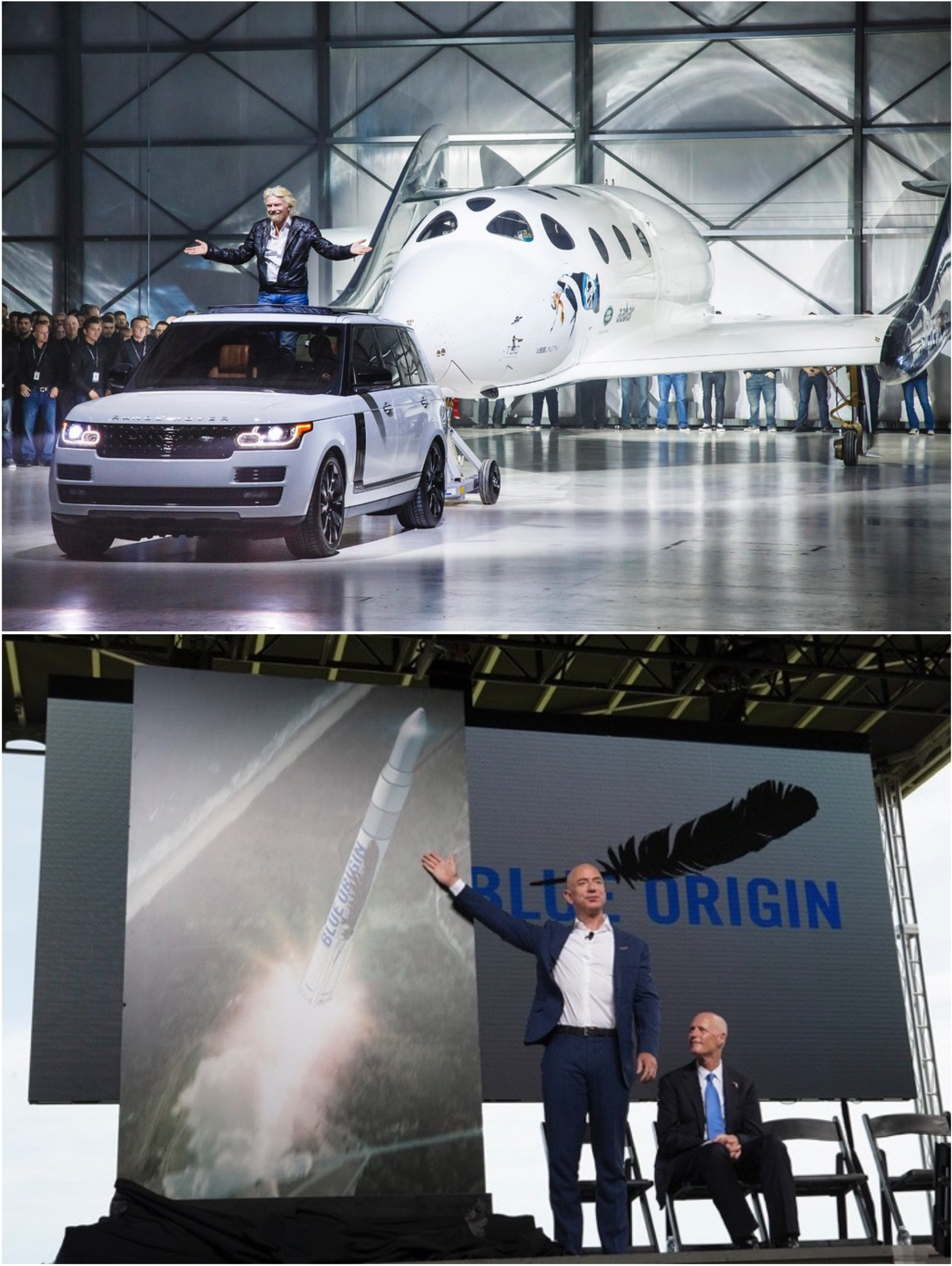
In 2007, when SpaceX was just a startup trying to prove that a private company could build an orbital rocket, Musk declared, “We don’t have any serious competition.” There wasn’t – not even in anybody’s head. It took nearly 15 years for Richard Branson and Jeff Bezos to succeed in their respective first Virgin Galactic and Blue Origin flights, and the media exploded with “Billionaire space race!” headlines. But the race was only in the keyboards of the hypesters, for the Falcon family of rockets was already long commercially operational.
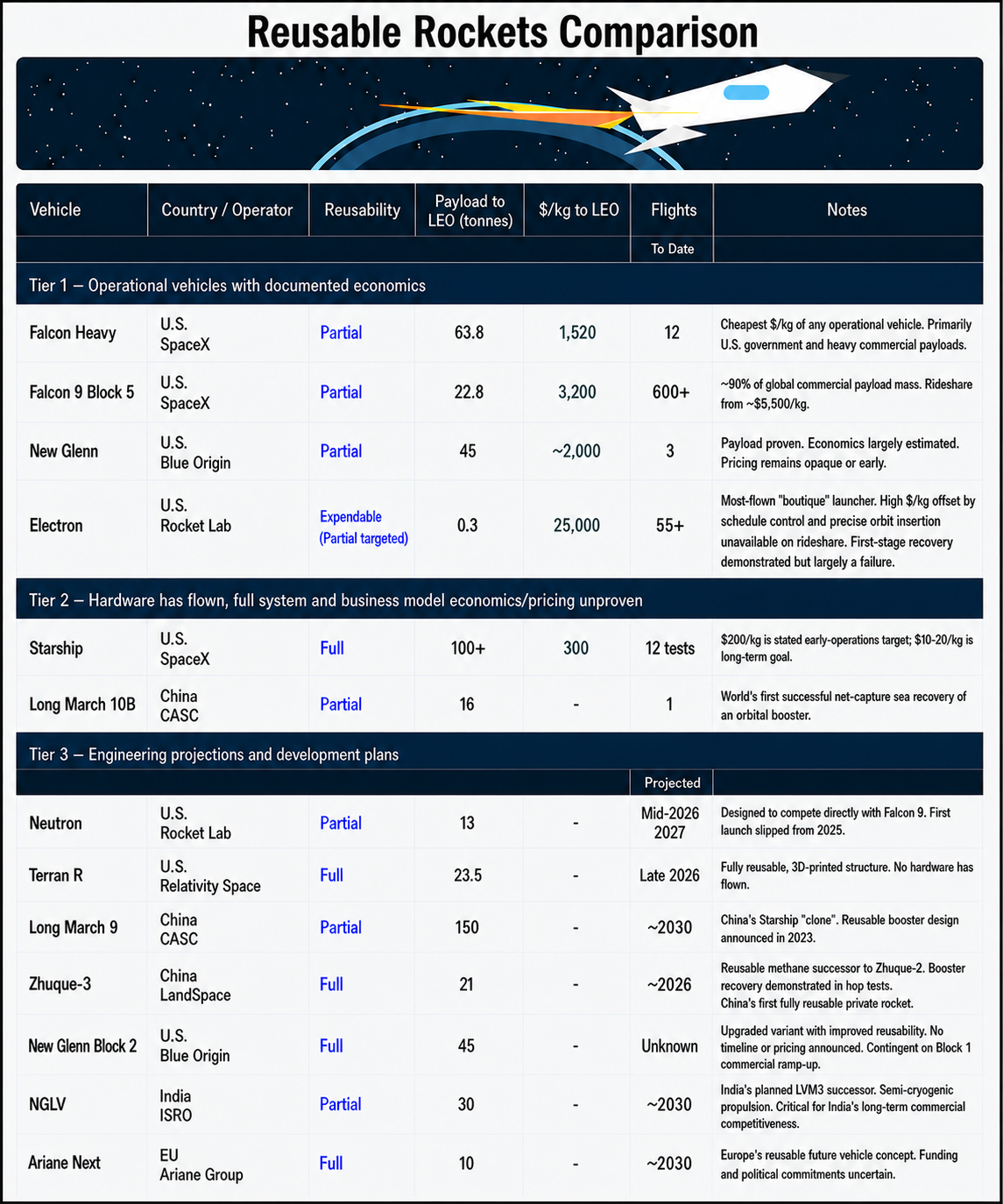
Still, it’s tough to be a pioneer. Those who follow in your footsteps have an advantage. The gap is closing – and that’s a good thing! Yet even now SpaceX still has no serious competition. There are lots of expendable rockets still in active use and even new ones in early stages of deployment or testing for too many applications to mention here, especially by China. Yet all of the engineering projections and development plans are based on full or partial reusability. SpaceX is the only company that has a fully reusable rocket that is already extensively tested. For everybody else it’s only on paper, which suggests 5-10 years’ lag.
The U.S. government regards meaningful competition as so important that NASA last month selected Relativity Space to design, build and operate its Aeolus Mars orbiter in 2028, expressing confidence in the company’s capabilities and claims to full reusability. The California-based startup stands out for its 3D-printing approach to manufacturing reusable rockets. But it has no ready-to-fly hardware (Terran R) and 2028 may prove overly optimistic.
The closest SpaceX rival, Jeff Bezos’s significantly smaller New Glenn rocket, is in early operational stages and its economics are unproven. On May 28, the rocket exploded during a pre-launch static fire test at Cape Canaveral, causing major damage to the launch pad, “setting back” Bezos’s Blue Origin project by a year and possibly affecting NASA’s Artemis lunar program. Unfortunate as they are, such accidents are an inevitable part of “rocket science”. Making a rocket fly consistently and reliably takes time and involves a lot of trial-and-error; rushing it blows things up.
Another runner-up is also in the U.S.: Neutron by Rocket Labs, a direct competitor to Falcon 9. China is already full in and in the longer term should be a formidable competitor. That just gained hard evidence as on July 10, China recovered a Long March 10B first-stage booster on the rocket’s maiden flight, using a novel sea-based net/cable capture system, making China the second nation with demonstrated orbital-class booster reuse. The EU, India and Japan are trying too but all are 10-20 years behind SpaceX, as the table below indicates.
Sadly, Russia is off the radar. Russia delivered the overwhelming majority of space exploration innovations and accomplishments for more than 50 years. These include the lesser-known LHP technology for transporting heat, critical for heat dissipation for those coming orbital data centres. Yet today Russia still relies on its old fleet of expendable rockets – Soyoz, Proton and Angara. Russia’s reusability plans consist overwhelmingly of announcements of the plans for the partially reusable methane-fueled “Amur” booster, targeting a physical first-stage demonstrator by 2027-2028, and the fully reusable “Korona” vehicle, for which the development work is only expected to begin this year (2026). Realistically, this hardware development remains roughly 20 years behind SpaceX’s 2015 milestone of recovering an orbital-class Falcon 9 booster. I believe that for the next 10-20 years Russia can only hope to manufacture propellant for others.
 “Project Hail Elon”
Elon Musk’s wild aspirations and perseverance in “making humans multiplanetary species” render SpaceX’s success one of the iconic “American Dream” stories of the past 400 years. The idea of economically reusable rockets was dismissed for decades by nearly all the experts as a fantasy and economic absurdity, mocked as a pointless billion‑dollar boondoggle. The consensus inherited from the grim Space Shuttle experiences can be summed up roughly as, “Even if you recover it, you’ve flown it through launch, hypersonic re-entry and rocket-powered landing. Refurbishment will eat all the savings.”
The consensus persisted like a bad hangover, to the point of attempts to discredit anyone who disagreed. Yet as of mid‑2026 Falcon 9 had logged over 400 first‑stage landings. Its reuse is routine, with some individual boosters having flown 20+ missions. This has, as we’ve discussed, cut launch costs dramatically and enabled a launch cadence of 100+ per year. The “impossible” goal is now SpaceX’s operational backbone.
The “absurd” Starlink vision for thousands of small satellites was ridiculed as a reckless and hopeless space‑junk nightmare. Starlink’s initial filing was roughly two orders of magnitude larger than familiar constellations like GPS with around 30 satellites, Iridium at 66 and Globalstar with about 50. The criticism could be summed up as: “Nobody is going to build and operate a constellation this large.”
To date, Starlink has had over 12,000 small, inexpensive and individually expendable satellites launched, providing high‑speed internet to millions of subscribers and contributing about 70 percent of SpaceX’s current revenue – a number willfully ignored by those who repeat “Elon lives off of government subsidies” like a mantra. In fact – and serious business analysis have recognized this – Musk figured out how to fund the dramatic acceleration of his rocket venture by creating his own paying customer, Starlink. Already by far the largest operating satellite constellation ever built, the system is on track toward its FCC‑approved 12,000‑satellite initial constellation, with a further application for up to 42,000. But with the old criticism falling mute, a new one has emerged: internet access for the world has proved too successful, annoying Earth-based astronomers.

And the critics never seem to learn. Now they mock the million-satellite target for the orbital data centre system, which is “just” another two orders of magnitude above Starlink. Lampooned as megalomaniacal delusion, an “orbital vanity project” technically, and financially and legally preposterous by pretty much the same outlets as before, the orbiting data centres of course are not guaranteed to follow the same success pattern as Musk’s previous projects. Still, the tone is changing from “this is just a scam” to “there will come a time when Elon trips.”
Wishing someone to fail out of envy or ill-founded premonitions is unhealthy. Of course, such a prominent figure inevitably attracts scandalous speculation concerning character and intentions. There are plenty of questions surrounding Musk. The perfectly explicable but poorly explained sharp pivot from Mars to Moon. The xAI-SpaceX merger, contextualized by intriguing assumptions in an S-1 filing (look it up – it reads like Asimov’s Foundation merged with Enron’s financial audits). The deep ties to the U.S. defence establishment.
But none of this diminishes in the slightest SpaceX’s stupendous accomplishments and aspirations, which in my opinion should inspire wonderment, awe and hope for humanity, and instill confidence in future successes and their righteous ends through however winding a course.
I personally look forward to witnessing the aforementioned future unfolding before my eyes – and wish well to those who take part in making it happen.
Gleb Lisikh is a researcher and IT management professional, and a father of three children, who lives in Vaughan, Ontario and grew up in various parts of the Soviet Union.