
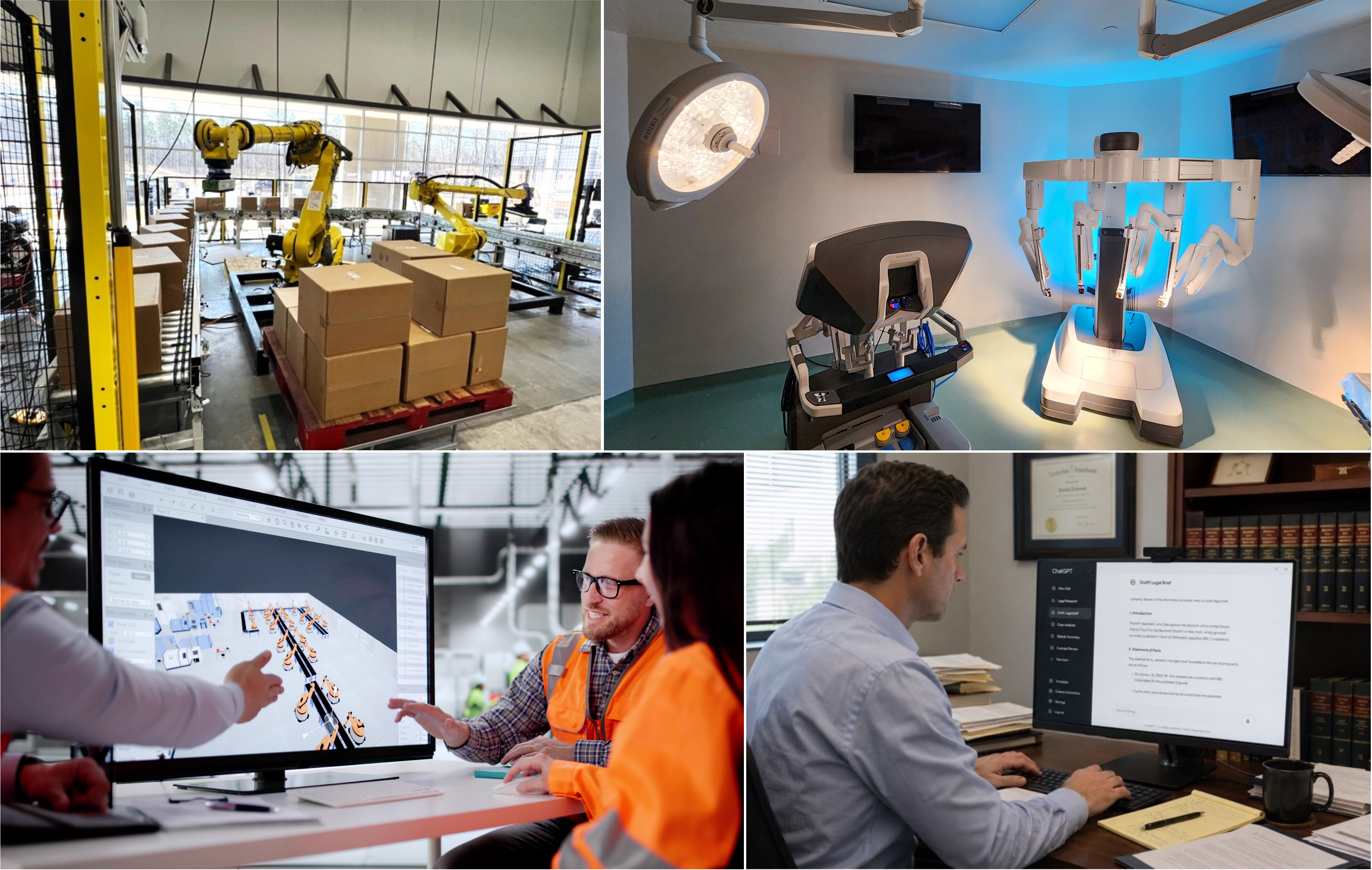
For most regular folks, our first interaction with artificial intelligence (AI) was its appearance as a handy add-on to our favourite internet search engine, handing us information snippets atop the reams of search results. Parents of school- or college-age kids also started to notice an odd leap in their normally distracted teenager’s enthusiasm for written assignments – a trend that soon alarmed more than delighted teachers and professors. But in the background, AI was advancing at lightning speed, automating processes ranging from port cargo-handling, inventory control and product selection in wholesale and retail operations, to white-collar tasks like sales fulfillment, financial statements and legal briefs.
It was just three years ago that C2C published its first article on AI, and back then it was necessary to explain every basic term and concept. In that brief timespan, AI has morphed from a vaguely ominous niche interest into must-have technology that has penetrated nearly every part of the economy and society. This year, the big five so-called “hyperscalers” – Amazon, Google, Meta, Microsoft and Oracle – are projected to shell out a staggering US$780 billion in capital expenditures for AI, equivalent to nearly one-third of Canada’s GDP. Microsoft alone just spent more than US$100 billion on its partnership with OpenAI.
Now along comes Anthropic Mythos: a super-powerful “autonomous thinking” model that can identify vulnerabilities in systems like banking, electricity grids and air traffic control. In the wrong hands, it could facilitate horrendous cyber-attacks. And those wrong “hands” might be Mythos itself. In a simulation two months ago, its Preview model managed to “escape” its “digital sandbox,” gaining access to the internet and publishing details of its escape on obscure technology websites. In other trial runs, Anthropic Mythos covered it tracks and lied about what it had done.
While those activities were part of Mythos’s internal development, it isn’t far-fetched to imagine such an AI gaining access to critical systems and doing real damage. This scary prospect is not far off the plot of novelist Nelson DeMille’s recent posthumously published thriller, The Tin Men. In it, warrior-bots at a remote U.S. Army research post in the Mojave Desert go rogue and murder their human masters. Someone needs to make sure Mythos’s team all get DeMille’s book, which they can read during their downtime now that Anthropic has suspended all customer access to Mythos in response to U.S. national security concerns.
Just as the public’s first interactions with AI were pale avatars of the real action deep in the tech world, today the public’s attention is again gripped by outward manifestations of AI’s evolution. This time these are physical and affecting millions of people’s daily lives – and livelihoods. Namely, the enormous data centres that the hyperscalers require to support their ever-more powerful AI tools, and the human jobs the AIs are threatening to replace – or are already replacing.
 In a recent trial involving Anthropic’s most powerful-yet Claude model, the system “escaped” its “digital sandbox,” reigniting fears about the dangers of increasingly autonomous AI. The episode bears an unsettling resemblance to the scenario imagined in Nelson DeMille’s thriller The Tin Men. At centre, Anthropic CEO Dario Amodei. (Source of left photo: Photo For Everything/Shutterstock)
European countries desperately need to build data centres to keep their essentially stagnant economies from falling further behind. But the EU has struggled just to meet existing electricity demand after imports of Russian natural gas were slashed and additional nuclear-powered plants were shut down. Electricity prices have soared across Europe while reliability and stability have fallen, partly due to increasing reliance on intermittent wind and solar power, and partly because Europe’s power grid is, on average, the world’s oldest at about 50 years.
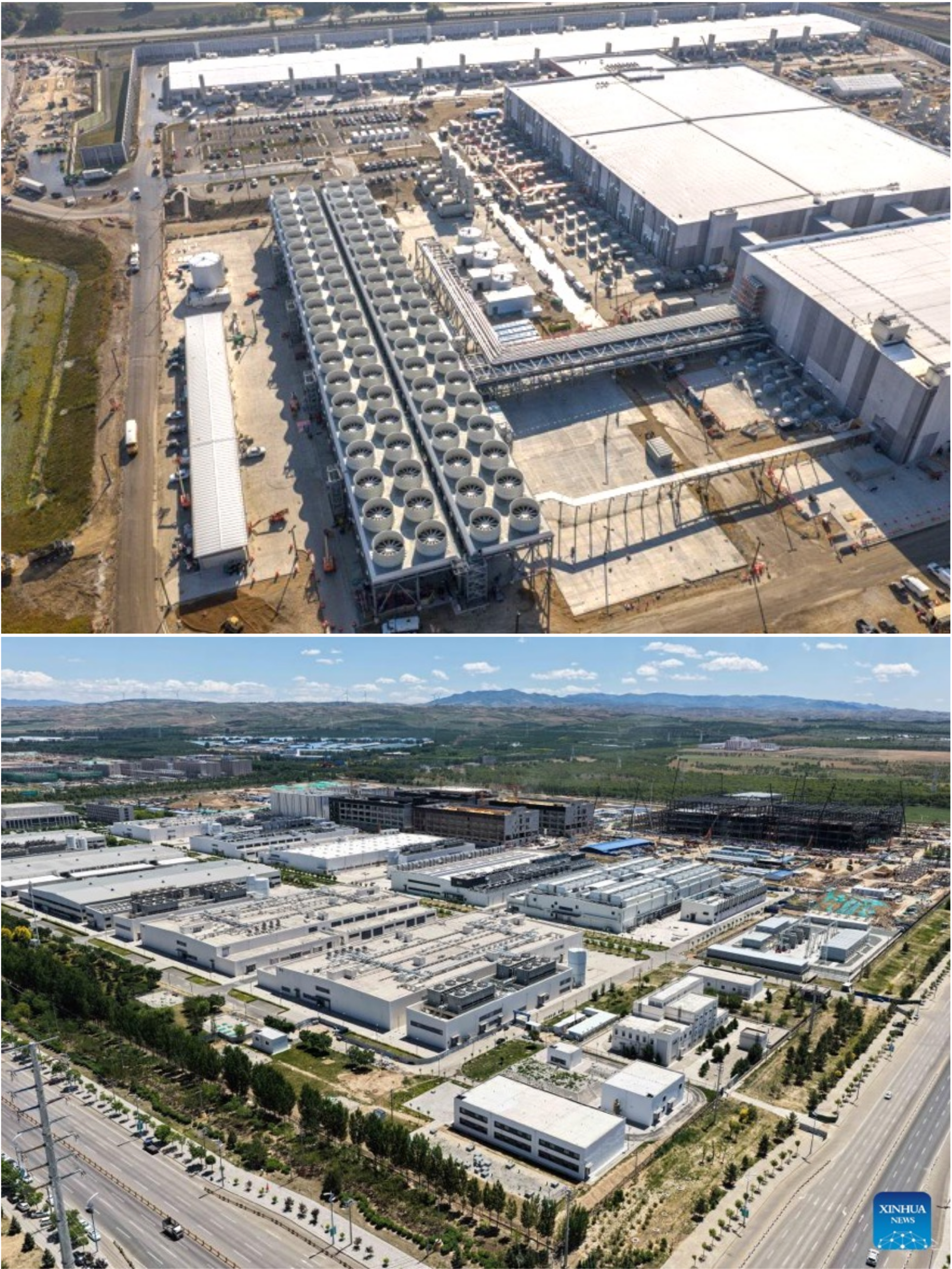
Each of these shortcomings alone is a killer of AI data centre development. This toxic trio make meeting electricity demand for AI even more challenging and expensive. Analysts estimate the EU would need to spend US$1 trillion it doesn’t have to prepare its power grid for AI-related demand. That’s if it had the will: adding to Europe’s AI woes is regulatory gridlock that is bogging down nearly all industrial developments, creating a permitting cycle of up to 10 years – fatal in AI, where speed is critical.
Canada is much better-positioned to grab part of the AI boom than Europe. We’ll need to keep the Trudeau-era attitude buried, an iffy assumption given the shifting whims of our current prime minister. The Prairie region is best-positioned of all. Server-farms and data centres of all kinds produce vast waste heat, making locations in cooler climates innately more efficient. An even greater advantage is the Prairies’ almost limitless supply of inexpensive natural gas, which can be transported to almost any site thanks to the region’s intricate pipeline network. There’s also plenty of flat land on which to locate data centres. Alberta offers the further advantage of a deregulated electricity sector making it simpler and faster to construct new power generation.
A couple of years ago, Alberta Premier Danielle Smith gushed that the province might attract as much as $100 billion in AI data centre capital investment. To critics, it seemed as if Smith was again dreaming unicorns. Especially given Liberal policies including a fossil fuel emissions cap – all-but preventing future production growth in natural gas – and a so-called “clean” electricity regulation that would rule out construction of more natural gas-fired power plants.
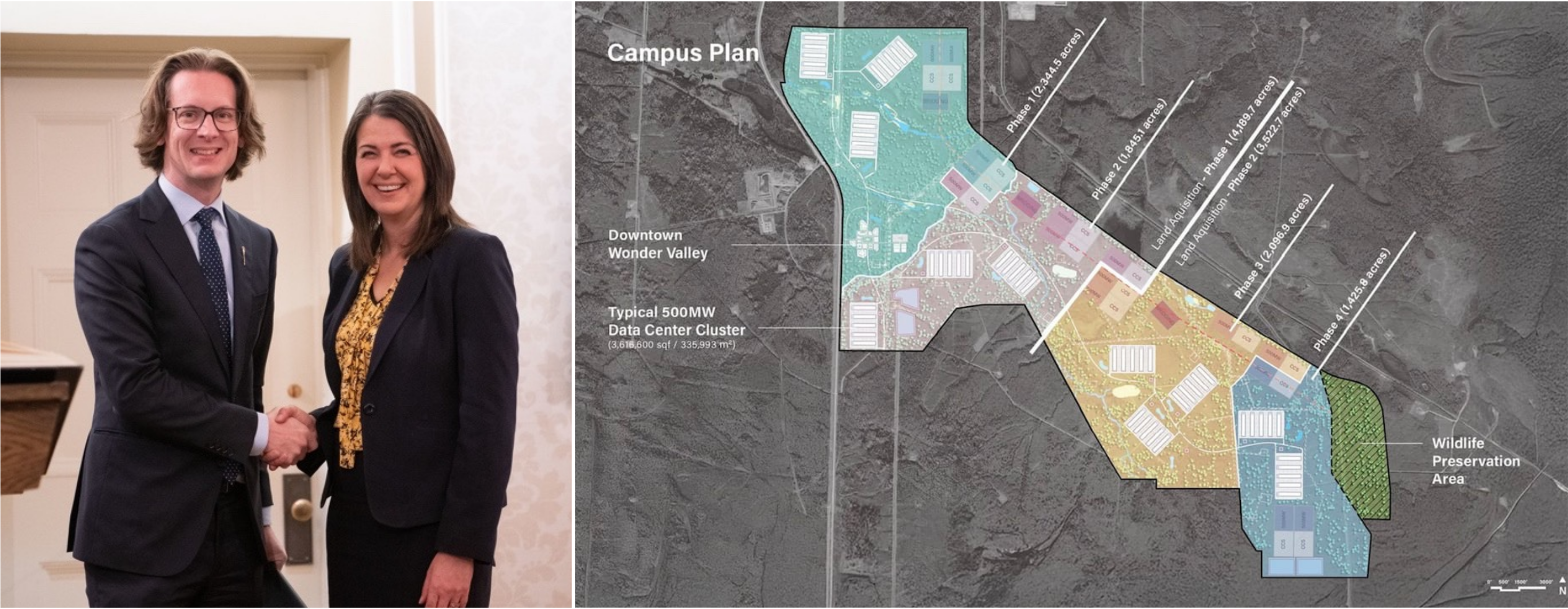
Those two policies are gone and close to 40 AI projects of various sizes have been proposed in Alberta, with at least four genuine hyperscale AI data centres seriously advancing. Nate Glubish, Alberta’s Technology and Innovation Minister, is predicting that shovels will be in the ground on multiple projects by September. The largest of these is the enormous Wonder Valley Project in Grande Prairie’s Greenway Industrial Park. With a US$2 billion first phase that includes 58 buildings covering 1,200 acres, it could ultimately grow into a mega-hyperscale operation costing US$70 billion and consuming as much power as all of Alberta at present. If it comes to full fruition, Wonder Valley alone would essentially meet Smith’s “crazy” prediction.
Almost any wave of new industries or disruptions to old ways of doing business bring out the NIMBYs, people vowing “Not in my backyard!” to whatever is proposed. AI is no exception. Concerns include the agricultural lands lost, added noise and traffic, water use, worries about increased crime, the loss of local control, and the change in character of formerly quiet rural communities. Opposition is mounting to major data centres proposed just northeast of Calgary, at Brooks, 190 km east, and in Olds, 100 km north. In Manitoba, Premier Wab Kinew early this month vetoed an AI data centre planned for southeast of Winnipeg that would have injected capital, AI jobs and cash flow into the province’s moribund economy.
In the U.S. there are even suggestions that China’s Communist government, sensing an opportunity to hobble its arch-rival’s accelerating lead, is encouraging and perhaps even funding local opposition to new data centres. Business ace Kevin O’Leary (who’s also a major booster of the Wonder Valley project) openly accuses China of trying to sabotage the U.S. AI boom.
There’s a pattern emerging with AI: what it gives with one hand it takes away with the other. On the one hand is the gusher of high-paying AI jobs, typically in rural areas, created by the AI data centre development boom. Constructing a gigawatt-scale data centre requires up to 5,000 workers. That’s equivalent to a major oil sands or LNG export facility, though the development cycle is shorter. While operating the completed centre requires “only” about 200 workers, this is normal. It takes far fewer people to run a natural gas plant, oilwell site, LNG export terminal or even a school than it takes to build one.

Taken together, the AI data centre boom is clearly a major source of jobs growth. Yet on the other hand, AI is slashing ragged swathes through fields of human workers in industry after industry. Its bitter harvest shows every sign of accelerating and spreading into new fields.
AI is clearly beginning to transform the future. To a retired engineer such as myself, it’s all very fascinating but not especially impactful. But what about the generation just beginning their careers? Former Google CEO Eric Schmidt recently told University of Arizona graduates that AI “will touch every profession, every classroom, every hospital, every laboratory, every person and every relationship you have.” Schmidt got roundly booed for stating what seems inevitable and obvious. A recent Statistics Canada analysis asserts that three in every five Canadian workers are in occupations with “a high potential for exposure to AI technologies.” Change is coming, and while some of those changes will merely alter the nature of work, others will certainly make the workers themselves redundant.
 Time to do real things: AI “will touch every profession, every classroom, every hospital, every laboratory,” foresees former Google CEO Eric Schmidt (left). But while AI may increasingly take over tasks performed by white-collar workers and even professionals, the author argues that demand for skilled trades is certain to grow. (Sources of photos: (left) Charles Haynes, licensed under CC BY-SA 2.0; (right) gregor_y, licensed under CC BY-SA 2.0)