The World Trade Organization marked its 20th anniversary last year and hardly anybody noticed. The WTO’s promise of globalized free flowing goods and services has mostly gone unrealized as governments around the world, including Canada, have increasingly focused on creating bilateral or regional economic and political alliances. They may call them free trade agreements, but most are designed to protect insiders from outsiders. Recent political developments in both the United States and the United Kingdom suggest the global trend towards greater nationalism and protectionism, and away from multilateral institutions, is getting worse. This has serious, long-term, negative implications for global cooperation and economic growth, especially for trade-dependent countries like Canada, which ought to be leading an international campaign for the revival of the WTO.
The movement away from a general goal of lowered tariffs and barriers in a global framework, through the WTO and its predecessor General Agreement on Trade and Tariffs, and towards bilateral and limited multilateral trade agreements, is undermining the whole concept of free trade. The complicated nature of these deals, which often include many conditions and clauses that have little to do with actual trade barriers, divorces the meaning of free trade from its intellectual foundations. This has led some commentators to question whether recent initiatives such as the Trans-Pacific Partnership should even be termed “trade agreements”, and allowed protectionists to argue that sovereignty and democracy are being undermined by these multi-faceted arrangements.
These sentiments played a role in the recent British referendum decision to leave the European Union. Many voters concluded that political and regulatory harmonization and a wide open border were not what Britain signed up for when it joined the then-European Economic Community in 1973. At the time, the UK was struggling with high inflation and low productivity growth while the continental economy was thriving. The hope was that the rising European economic tide would lift the listing British boat, and it did, for a time. But EEC membership would remain a contentious issue for years, with the Labour Party explicitly backing exit until 1987. Most Brits wanted to keep their distance by retaining a separate currency, and as long as membership was only about common markets and economic benefits, they were willing to go along.
The aspects of European integration which were more political in nature were always more contentious. Former Prime Minister Margaret Thatcher was a booster of the common market, in accordance with her general adherence to the principles of free trade, but she famously railed against the UK’s contribution to the EU’s common budget. She even negotiated a partial “rebate” in 1984. Thatcher’s successor John Major negotiated an opt-out of the EU’s so-called “Social Chapter”, which provided for transnational workplace and social welfare rights that were seen as greater than those in Britain. Under Tony Blair, the UK later would sign on to the Social Chapter, and bring British human rights law in line with the European Court of Human Rights. This was a milestone in the shift of British Euroscepticism from left to right as the former welcomed European institutions taking on a role of sociopolitical norm setting, while the latter was chiefly interested in increasing market freedom.
Forget the TPP, revive the WTO
Just as the EU was pitched to Britons as more than a trade alliance, the Obama administration has tried to win support for the TPP by portraying it as a counterweight to Chinese power in the Pacific Rim. Waning public support for the deal, exacerbated by unrelenting attacks from presidential candidates Donald Trump and (former fan) Hillary Clinton, is further evidence that complicating trade treaties with other policy objectives is risky.
Former WTO general secretary Pascal Lamy complained five years ago that the proliferation of bilateral agreements amounted to “throwing away ten years of solid multilateral work” on globalized trade rules. Indeed, the more bilateral agreements get signed, and the more the world becomes polarized into trading blocs, which increasingly have other geopolitical implications, the less effort and political risk governments will be willing to expend on global level negotiations. Notwithstanding the passing of the relatively small (though not insignificant) Bali Package of tariff reductions and other measures by WTO members in December of 2013, this has been the general story of trade in the 21st century.
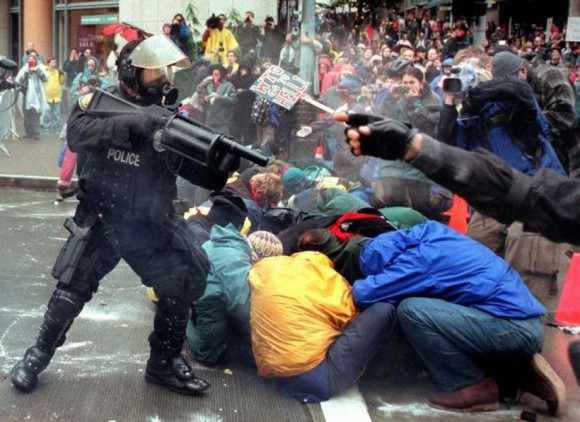
Why the shift away from the WTO and toward these smaller trading blocs? There are number of reasons, not the least of which were the mass demonstrations that accompanied WTO meetings from the Battle of Seattle onwards. The rising economic power of nations like China, India and (until recently) Brazil has also shaken up the global order, creating new trade relationships within and without the developing world. These emerging economies sometimes argue, not unfairly, that the WTO and its rules are dominated by US and European interests who tilted the playing field unfairly towards themselves.
Developing nations created new trading blocs like South America’s Mercosur and the ASEAN-China Free Trade Area which further lessened their dependence on the WTO. As well, a wider decline in US power, perceived or actual, is driving both the movement towards alternative trade arrangements in the Global South and the use of agreements such as the TPP as de facto defense pacts on the part of the US.
The elephant in the room, though, is that most developed countries are hypocrites about free trade. They preach it to developing countries as economic gospel, but run for the exits when it threatens their own interests, and deny that protectionism contributed to their development. In the entire history of the WTO, only one developing country has ever taken a developed country to a trade resolution tribunal and won. Two years ago, after a 12 year battle, Brazil won a dispute against the US over cotton subsidies. A truly free and truly fair system of global trade with clear and consistent rules for all parties, would see more of this sort of thing occur. Nations and industries would sometimes gain and sometimes lose from these rules, but they would apply equally to all and over the long haul the Ricardian benefits of open trade so often bandied about would actually emerge.
The problem with Harper-Trudeau trade policy
Under the former Conservative government of Prime Minister Stephen Harper, Ottawa pursued several new bilateral or regional trade agreements, but did little or nothing to advance stalled WTO negotiations. Similarly, despite their signaled intentions to ratify the TPP, the Liberals have not touched the big prize of globe trade either. In his 2,000-word mandate letter to International Trade Minister Chrystia Freeland, Prime Minister Justin Trudeau did not mention the WTO even once.
This is a shame because a multilateral regime of trade would benefit Canada in a number of ways. For one thing, it would lessen our dependence on the United States as an export market and make us less vulnerable to sudden political or economic changes there. The “Buy America” laws passed under the Obama administration make a mockery of the supposed level playing field of NAFTA. So did the presidential veto of the Keystone XL pipeline. Difficulties in accessing US and European markets with a variety of goods have only increased over the past few years and show few signs of improving, making multilateral trade ever more urgent. Growing consumer markets in developing countries will continue to remain inaccessible to Canadian goods and resources if the drift towards bilateralism continues.
For another, with the increasing use of trade agreements as end-run geopolitical alliances, Canada’s traditional, more neutral, political position as a catalyst for trade may be under threat. In the case of the TPP, its pitch as an anti-Chinese counterweight makes sense from an American security perspective, but it is less clearly a good deal from a Canadian economic view. Canada’s participation in the TPP as currently constructed risks creating a barrier to Chinese market access which would endanger future growth in many Canadian sectors. Of course, this is not to say that we should deliberately antagonize the United States or ally with China in some theoretical trade war. Rather, by actively supporting and pushing for multilateralism in trade, Canada’s leaders would be able to both retain US access and expand into developing markets without pitting these goals against each other.
If we want to advance a system of fair competition in trade between nations which will benefit all involved, we need to do it through a global, multilateral mechanism which all, or at least a vast majority of, nations are party to. We need to reach an agreement which doesn’t let nations play selective games with barriers, preaching their removal to weaker powers whilst constantly throwing them up to defend their own favoured industries and interests. We furthermore need to stop conflating and packaging trade agreements with other forms of multilateral institution-building such as the European Union, which have tended towards bureaucratic overreach and a lack of national accountability.
Canada’s Trudeau Liberal government has taken great pains to position itself as the antithesis of its Conservative predecessor on a wide range of policy fronts, including foreign affairs. They have proclaimed that “Canada’s back” as a champion of international cooperation, and they have been publicly critical of renascent nationalism, particularly in the platform of US presidential candidate Donald Trump. The Liberals could and should prove they are serious about all of this by taking a lead role in getting the WTO’s Doha round of negotiations back on track, which could not only give a much-needed boost to Canada’s sluggish economy, but also lead to an estimated $300 billion in global economic benefits.
~
Carter Vance is an MA candidate in Political Economy at Carleton University in Ottawa.