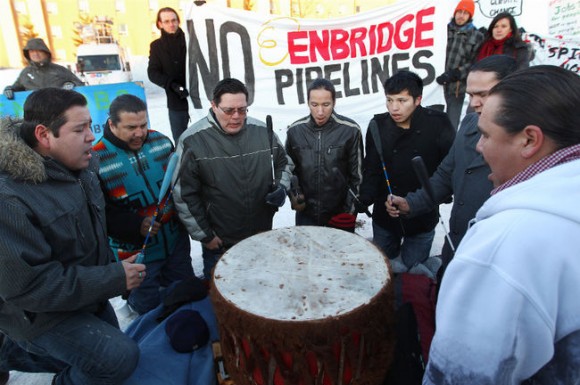
This June the Federal Court of Appeal quashed the former Conservative government’s approval of the proposed Northern Gateway pipeline, citing a “lack of consultation” with Aboriginal communities. The successful plaintiffs were the Gitga’at First Nation and Coastal First Nations, acting on behalf of nine Haida communities along British Columbia’s northern and central coast. The decision came despite years of public consultations by Enbridge, and months of public hearings by a Joint Review Panel of the National Energy Board and the Canadian Environmental Assessment Agency, amounting to what Enbridge reasonably describes as “the most thoroughly and effectively scrutinized oil pipeline project ever.” Moreover, 31 First Nations and Metis groups representing aboriginal landholders elsewhere along the 1,200-kilometre route from northern Alberta to the port of Kitimat, B.C. signed equity participation agreements for a share of the $8 billion project, which would generate thousands of jobs and billions in tax revenues while adding an estimated $300 billion to Canada’s GDP over 30 years.
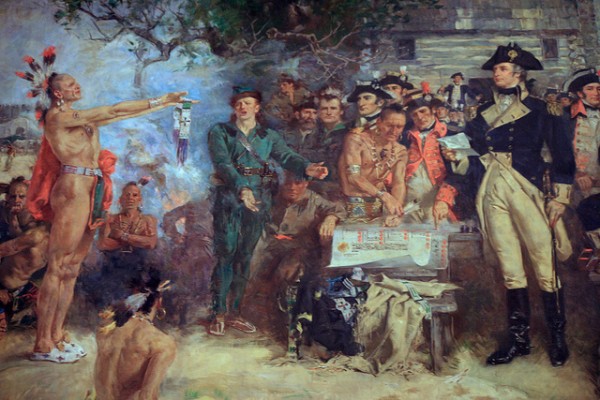
To understand how it came to be that a handful of aboriginal litigants can persuade the courts to wreak such massive damage on the national economy, a look back in history to the eve of the American Revolution is instructive, to an agreement between the United Kingdom of Great Britain and the Iroquois Confederacy of North America called the Treaty of Fort Stanwix. Negotiated at a British garrison nearly 250 years ago in what’s now upstate New York, the stakes were very similar – land tenure and group rights – minus the lawyers, environmentalists and a court.
It was 1768, a decade after the British and their Iroquois allies defeated the French on the Plains of Abraham and won control of Canada. The Confederacy was composed of six formidable Aboriginal groups – known to this day as the Six Nations – whose influence spanned present-day Ontario in the Great Lakes region, the Ohio River Valley, and what’s now Virginia, Kentucky, Pennsylvania and New York State. That fall some 3,000 representatives of the Confederacy from both sides of the future Canada-United States border travelled to Fort Stanwix to renegotiate the boundaries between aboriginal and colonial territories that had first been laid out in the Royal Proclamation of 1763.
The Royal Proclamation formally spelled out the rights of the Indigenous people of North America in much more detail than the “peace and friendship” treaties that preceded it, particularly in relation to territorial and political sovereignty. It is the landmark document that still informs Canada’s legal and Constitutional obligation to First Nations. In addition to carving Rupert’s Land and Quebec out of the original 13 American colonies, the Proclamation defined the border between Aboriginal and non-Aboriginal territory running north-south, slicing through the eastern Continental Divide from New England to Florida: land eastward to the Atlantic Ocean would belong to non-Aboriginals, land westward to the Mississippi River would belong to Aboriginals.
“The implications of this policy were that First Nations, for the most part, would not be integrated with the European population, as immigration would be directed to the south and the east where First Nations had already ceded their lands,” writes historian John Borrows in his essay Wampum at Niagara: The Royal Proclamation, Canadian Legal History, and Self-Government. The Proclamation restricted the ceding or selling of land exclusively to direct transactions between Aboriginal peoples and British authorities. But some First Nations ignored this proviso and dealt directly with land speculators instead of agents of the Crown, which created uncertainty about land title.
Thus encouraged, speculators had been pushing into Iroquois territory for years. That provoked violence between Indians and settlers, and feckless British authorities were unable or unwilling to enforce the terms of the Proclamation. The Stanwix Treaty was supposed to fix all this, and its singular contribution to the history of treaty-making in North America is that it marked the first time a big cash payment was part of the deal. The Stanwix Treaty cost the treasury of King George III more than £10,000 ($2.5 million Cdn today), by far the biggest indigenous payment ever at the time. Stanwix also moved the demarcation between Aboriginal and non-Aboriginal territory westward, from the Continental Divide to the Ohio River; a major real estate concession by the Iroquois. Nevertheless the treaty did not hold up very well or very long – in less than a decade the American Revolution would effectively void it in much of the territory it covered – but in Canada it established a benchmark for negotiating treaties and resolving conflicts over land and resources that persists to this day.
Now as then, some First Nations and Metis groups make individual deals for compensation and contracting privileges with corporations like Enbridge, just as their ancestors did with the land speculators of yore. Others turn to the courts, which have become the de facto treaty makers of our time. There has been progress over the last couple of centuries in the sense that violent disputes over territory and rights occur much less frequently today, but in many other respects there has been no progress at all: treaties and land claims agreements remain in a permanent state of flux, subject to interminable negotiations leading to impermanent settlements involving large payoffs.
In 1768, Aboriginal people understood the reality of immigration to their territory and sought better guarantees through treaties like Stanwix that the British would safeguard their land from interlopers and speculators. By this time, Aboriginal and non-Aboriginal people in eastern North America had been living side-by-side for more than 100 years, sometimes warring over turf or as part of colonial alliances, and at other periods co-habiting in relative pastoral peace. The Six Nations Mohawks, for example, were early adopters of European social and economic practices including leasing land to newcomers and adopting the Christian faith.
A statue of Mohawk warrior Joseph Brant features prominently at Ottawa’s Valiants Memorial, as a founding father of what would eventually become Canada. Brant and the other Iroquois who agreed with the terms of Stanwix and sided with the British during the American Revolution ended up as refugees along with Loyalists who fled to what would become Upper and Lower Canada. The Revolution, like the later War of 1812, brought the old and new Canadians closer together than they have ever been, before or since.
The subsequent colonization of western North America was famously violent and bloody south of the 49th parallel, much less so north of it. But it is a tribute to the colonists and the colonized alike in Canada that, despite their vast cultural differences and the inherent competition between them for land and resources, there wasn’t more sustained violence between them. Nevertheless, the long, slow process of cultural integration has been severely hampered by the explicit racial segregation institutionalized in the reserve systems in both the U.S. and Canada, and it was further encumbered by the mid-20th century rise of identity politics rooted in grievance and entitlement narratives.
In today’s conflicts over resource development and pipelines, these modern divisions are exacerbated by environmentalists who leverage dissenting voices in the Aboriginal community to suit their purposes, and by romantics in the media, academe and progressive political parties who have internalized the myth that Aboriginal people could and should go back to living and governing themselves in some pre-industrial Eden.
In the end, that conflict will be resolved within the aboriginal community. Some see the chain of legal commitments from the Royal Proclamation through the Stanwix Treaty and all the way up to Section 35 of Canada’s 1982 Constitutional amendments as their pathway to sovereignty and some fantastical existence outside our globalized post-industrial society. Others see the same commitments as their ticket to a big piece of the action in Canadian resource development, and a comfortable niche in the mainstream of modern life. Both views were on display in the legal wrangling over Northern Gateway.
“This is a victory for Gitga’at,” said 90-year-old Gitga’at elder and matriarch Helen Clifton after the Federal Appeal Court ruling. “We did this as a whole community and we are still free in our territory. We are rich as a people with cedar, sea, air and water. There is no money to pay for what we have.”
Conversely, a few weeks before the ruling, representatives of the 31 First Nations and Metis organizations who support the project expressed an entirely different view. “We are owners of the project and are participating in Northern Gateway as equals,” they declared in a statement. “This ownership ensures environmental stewardship, shared control, and negotiated business and employment benefits. Collectively, our communities stand to benefit from more than $2 billion directly from this Project.”
Thanks to their coastal cousins, however, they will not realize that benefit any time soon, and perhaps never.