Canada’s Economic Crisis

Quick Read

Continental Grift: Why the Liberal Government’s Fixation with Europe Is a Sham

October 20, 2026
Market diversification is a sensible enough strategy for Canada, but Mark Carney’s fixation on closer ties with Europe is anything but. For one thing, argues business veteran Gwyn Morgan, we’ve already got comprehensive free trade deals with virtually all of Europe. Cozying up further to a dysfunctional, declining EU is pure folly. Far better for the Carney government to focus on Canada’s own self-inflicted economic problems – inflation, taxes, public debt, the disastrous drought in foreign investment. Oh, and the ongoing lack of free trade within our own borders. No need for overseas adventures, notes Morgan; there’s plenty of work to be done at home.
Share on Facebook
Share on Twitter

The breakdown of free-trade negotiations between the U.S. and Canada has motivated Prime Minister Mark Carney to seek expanded trade and stronger political ties with Europe. Perhaps the move merely rationalizes his deep-seated hankering for Europe: Carney long held citizenship in not one but two European countries, is married to an Englishwoman and has spent much of his career in the UK.

“What we are looking [at] – and will begin discussions for – is a unique alliance between Canada and the European Union,” Carney disclosed in a media scrum after word leaked in mid-September that something was up. He explained more in a speech to the European Parliament in Strasbourg, France a few days later: “We are pursuing resilience so that no one can control our open markets, impair our sovereignty, threaten our territorial integrity, or undermine our freedoms, our democracies, our rule of law.”

Whatever his true reasons, and whatever might ultimately result, Carney’s move raises two fundamental questions.

First, what is the point? Canada already has a free trade agreement with the European Union (EU): the Comprehensive Economic and Trade Agreement (CETA). Though hardly the stuff of Canadian kitchen-table conversations, CETA is a powerful piece of diplomacy. Signed in 2016, it covers nearly all trade in goods, plus many services, and even eases trans-Atlantic labour mobility for businesses and professionals. Since it took effect, two-way trade has nearly doubled to an estimated $195 billion last year, with a reported 99 percent of goods crossing borders tariff-free (except for some figurative and literal sacred cows like Canada’s supply-managed dairy, egg and poultry products).
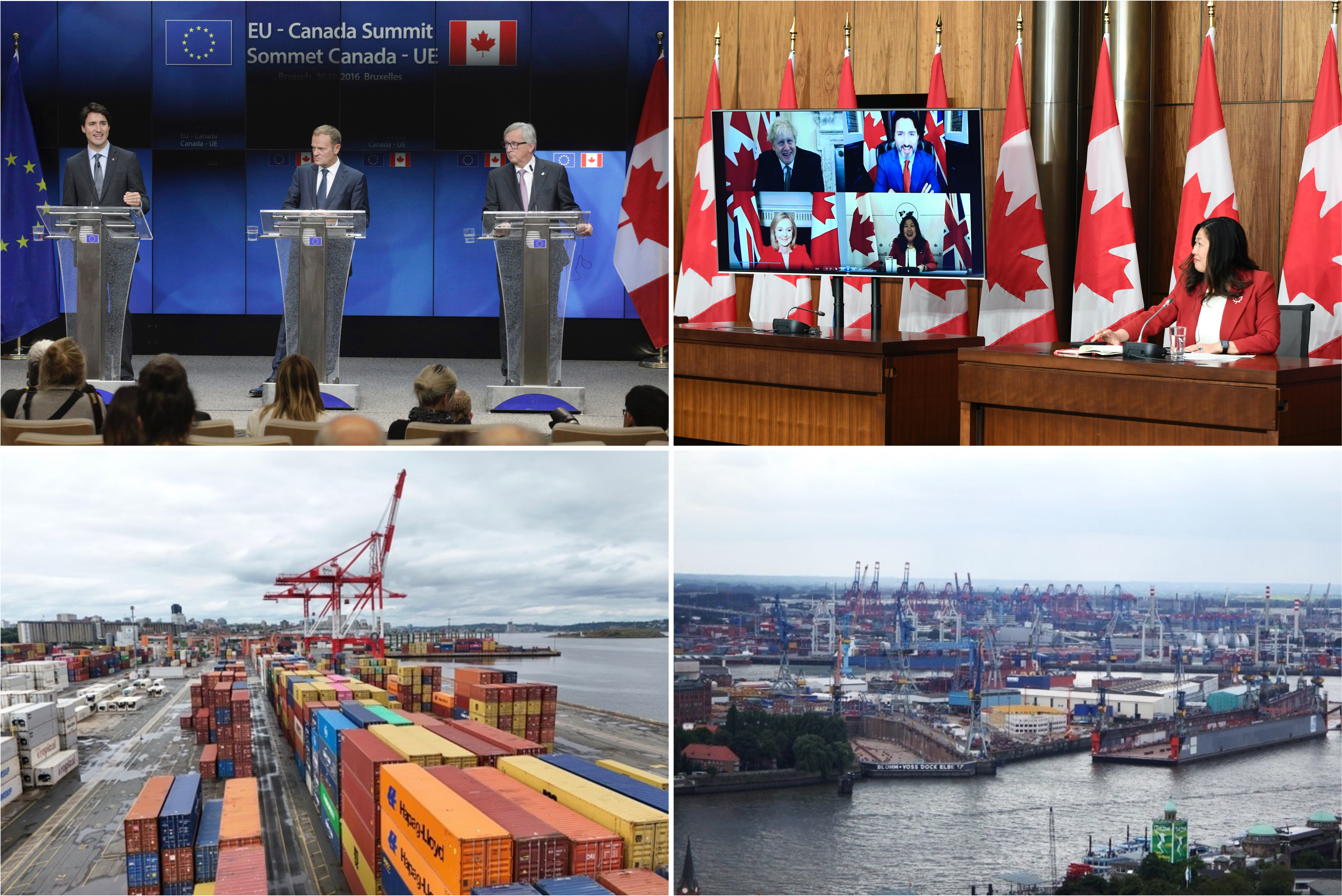
The Comprehensive Economic and Trade Agreement (CETA), the Canada-UK Trade Continuity Agreement (TCA) and the Canada-European Free Trade Association Free Trade Agreement have helped drive Canada-Europe trade to nearly $300 billion per year. Shown: (top left) the 2016 EU-Canada summit at which CETA was signed; (top right) a 2020 news conference on the TCA; (bottom) two engines of Canada-Europe trade, the Port of Halifax (left) and the Port of Hamburg, Germany (right).
xThe Comprehensive Economic and Trade Agreement (CETA), the Canada-UK Trade Continuity Agreement (TCA) and the Canada-European Free Trade Association Free Trade Agreement have helped drive Canada-Europe trade to nearly $300 billion per year. Shown: (top left) the 2016 EU-Canada summit at which CETA was signed; (top right) a 2020 news conference on the TCA; (bottom) two engines of Canada-Europe trade, the Port of Halifax (left) and the Port of Hamburg, Germany (right). (Sources of photos (clockwise from top left): AP Photo/Olivier Matthys; The Canadian Press/Justin Tang; majabl, licensed under CC BY-NC-SA 2.0; Quintin Soloviev, licensed under CC BY 4.0)

Canada also has the Trade Continuity Agreement (TCA) with Great Britain. It was drawn up when the UK left the EU in 2021 and replicates the CETA almost word-for-word. Two-way trade currently totals an estimated $61 billion. The foremost trade irritant has been – you guessed it – Canada’s bad-faith management of provisions intended to crack open our supply-managed agricultural cartels to tariff-free UK goods.

Lastly, there’s an agreement with the European Free Trade Association, comprising the non-EU countries of Iceland, Liechtenstein, Norway and Switzerland. Considerably more limited in scope, this goods-only agreement nonetheless provides preferential tariff rates on an array of items. Two-way trade with these countries totals about $17.5 billion per year.

So given that Canada already has major deals with virtually all of Europe, covering close to $300 billion in annual trade, what does “turning to Europe” mean exactly? If it means becoming an EU “associate” member, as President of the European Commission Ursula von der Leyen announced and Carney later confirmed, it is critical that Canadians understand EU membership involves much more than trade.

The EU is no mere economic bloc, but a political confederation in which the European Parliament – and, even more, the über-powerful organization of permanent bureaucrats and appointed functionaries known as the European Commission – has powers superior to the governments of member countries. The Commission’s relentless micromanagement governs everything from the design of traffic roundabouts in remote Balkan villages to – infamously – the exact curvature required for a banana to qualify for tariff-free importation, to literal life-and-death issues like the settlement of unvetted “migrants” from war-torn countries.

This relationship substantially erodes if not erases the sovereignty of member nations. It is what drove Britain to exit the EU via its “Brexit” vote in 2016. Several other nations are threatening to do so as well, and many others are in constant battle with the Eurocrats in Brussels. And Carney wants to join? If so, there is great danger ahead for Canada, especially for the natural resource-producing provinces, as Gina Pappano revealed last week in C2C.

Do we really want to join? Prime Minister Mark Carney and European Commission President Ursula von der Leyen (at left, shaking hands at the European Parliament in Strasbourg, September 2026) are considering an “associate” EU membership for Canada. Depending on how it is implemented, the proposed arrangement could be ceremonial and meaningless – or could begin to erode and eventually erase Canada’s national sovereignty. At right, the European Parliament in session.Do we really want to join? Prime Minister Mark Carney and European Commission President Ursula von der Leyen (at left, shaking hands at the European Parliament in Strasbourg, September 2026) are considering an “associate” EU membership for Canada. Depending on how it is implemented, the proposed arrangement could be ceremonial and meaningless – or could begin to erode and eventually erase Canada’s national sovereignty. At right, the European Parliament in session. (Sources of photos: (left) AP Photo/Pascal Bastien; (right) European Parliament)

The second fundamental question is why Canada would want closer relations with Europe at all. It is, in the words of former European Central Bank President Mario Draghi, “A society facing a slow agony of decline.” If the slide continues, warns Draghi, “The continent will progressively lose the ability to fund the core functions of a modern state.” Given this dire description from one of the EU’s most experienced officials – the embodiment of a trusted insider – it’s understandable that von der Leyen would grasp at any straw to paint an image of a strong, dynamic, growing bloc. Rescuing Canada from the greedy clutches of Donald Trump and bringing it into Europe’s warm embrace would be a great coup for her.

But what’s in it for us? Canada signing on with the dysfunctional, collapsing EU would be like boarding an ocean liner that’s already sinking. Or as an acquaintance puts it less delicately, when you mix ice cream and dog excrement, the result isn’t a pleasing mocha-like melange, but something that tastes decidedly more like the one than the other.

“Slow agony of decline”: The EU – facing economic stagnation, deindustrialization, a continuing immigration crisis and incipient anarchy – offers Canada no lifeline, argues the author. Shown: (top) far-left and migrant-led “student” riots in Paris, October 2026; (bottom) anti-EU demonstration in Paris, May 2026.
x“Slow agony of decline”: The EU – facing economic stagnation, deindustrialization, a continuing immigration crisis and incipient anarchy – offers Canada no lifeline, argues the author. Shown: (top) far-left and migrant-led “student” riots in Paris, October 2026; (bottom) anti-EU demonstration in Paris, May 2026. (Sources of photos: (top) FreCha, licensed under CC BY-SA 4.0; (bottom) Pierre Laborde/Shutterstock)

The metrics demonstrating Europe’s decline are too numerous to list here, let alone explore in detail. I’ve written elsewhere about Germany’s self-inflicted wounds in the areas of energy, industry and immigration (see here, here and here), which are a useful proxy for what is happening across the continent. On top of that, we now have the worsening anarchy in France, the so-called “student” riots – mostly led by hard-left agitators and migrant radicals – that have all but paralyzed the French government.

Carney has done a lackadaisical sales job for his EU membership scheme but, as usual, the mesmerized “Elbows-Up” boomers who prop up his popularity appear totally on board. Not so the president of the country whose trade with Canada dwarfs Europe’s. “If they do that and if I think it’s a hostile act, I will put very serious tariffs or stop trading with Europe on many things,” warned Trump after von der Leyen’s announcement. However much one may despise the man, a sitting U.S. president putting Canada and Europe on notice this way reveals how the geopolitical risks and potential economic costs of Carney’s self-indulgence are huge, while the benefits are meagre and undefined.

One irony here is that becoming a mere associate EU member would be largely ceremonial – at least for the moment – and would likely have little to do with trade which, as explained, is already covered by detailed treaties and has been growing nicely on its own. Canadian officials no doubt explained all that to their American counterparts, but it’s difficult to change Trump’s mind about almost anything. Of course, those officials and Carney have withheld that key bit of information from Canadians.

Given the impasse we’re now in, couldn’t one of Carney’s innumerable officials urge their globe-trotting boss to suspend his symbolic gestures and diplomatic theatrics and buckle down to some nuts-and-bolts work at home? Though it’s probably a vain hope, there’s no end of things to do.

For example, while we have all those great trade agreements with the Europeans, plus another one covering much of the Asia-Pacific, we still don’t have free trade within Canada itself! But after issuing bold promises soon after becoming prime minister about breaking down inter-provincial trade barriers, Carney soon found out that Quebec would have none of it, so he seems to have abandoned this file entirely.
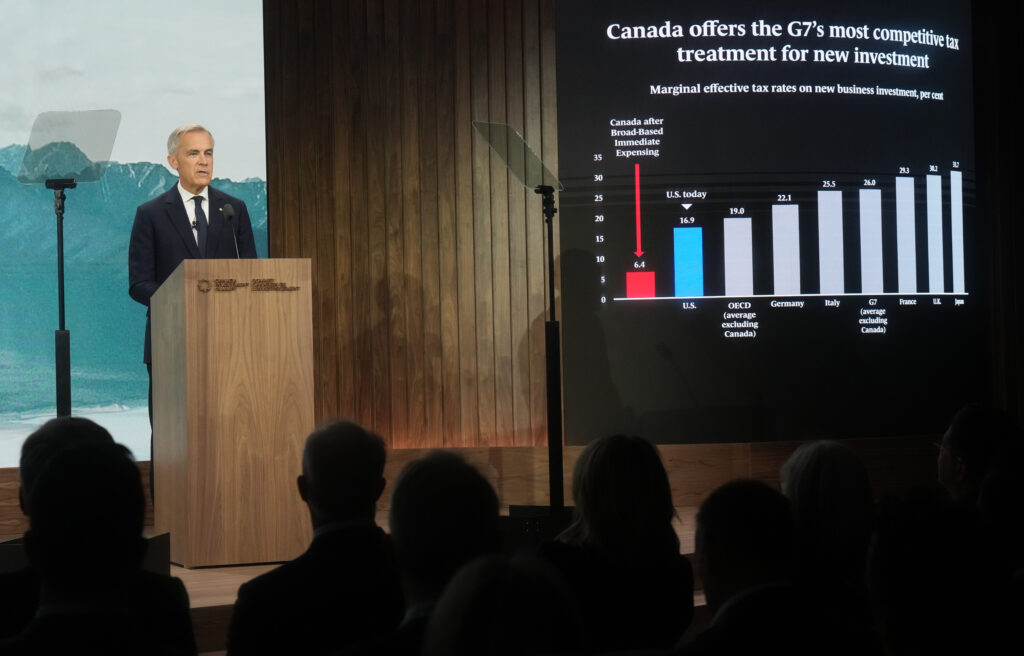
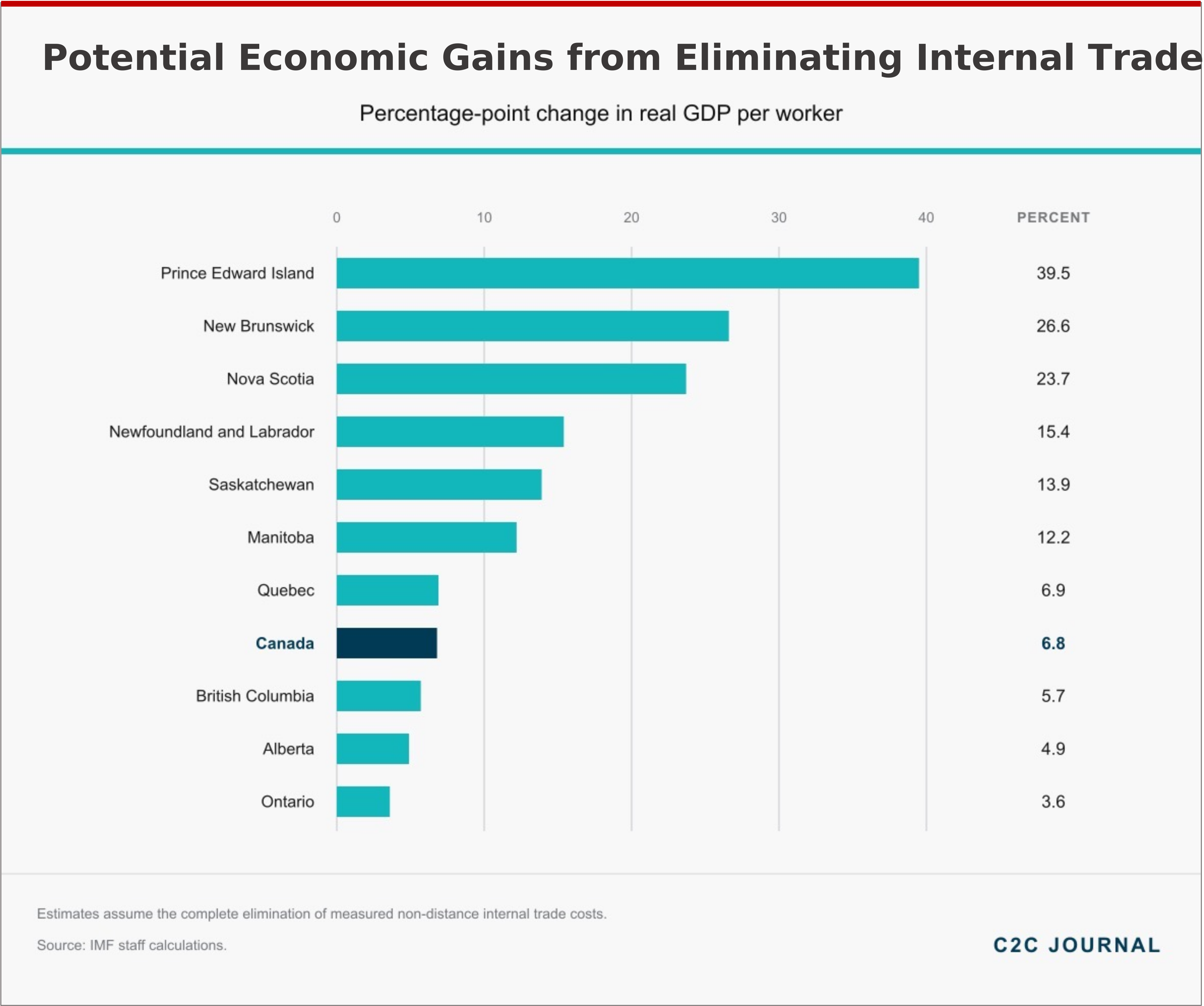
Ditch the theatrics, please: Carney’s $600-billion “deal book” of not-yet-approved projects is intended to attract foreign investment, while his promise to break down inter-provincial trade barriers – which could deliver substantial economic improvements across Canada – has evidently stalled. At top, Carney addresses the Investment Summit in Toronto, September 2026. (Source of photo: The Canadian Press/Nathan Denette)

Cheered on by Canada’s increasingly government-funded news media, Carney has made much of his government’s campaign to attract foreign investment. At the recent Canada Investment Summit in Toronto, international investors were given a “deal book” describing 167 projects worth a combined $600 billion ostensibly all available for investment. Summit attendees ranged from local money managers such as the $300-billion Ontario Teachers’ Pension Plan to APG Groep N.V. of the Netherlands, which manages $1.1 trillion in pension assets. Some delegates said Ottawa’s new regulatory structure for project approval compares favourably against more difficult procedures elsewhere.

All that is certainly positive. Still, numerous items in that “deal book” are listed as being in the “pre-feasibility” stage, i.e., years away from regulatory approval, perhaps situated at remote sites stranded far from needed infrastructure. How many of these will actually prove “investable” rather than being ultimately abandoned like so many other great ideas during Canada’s “Lost Decade”?

The urgency of attracting investment capital to Canada cannot be overstated. Before the election of the Justin Trudeau government in 2015, the amount of money that Canadian individuals, companies and institutions had invested abroad was about equal to incoming investment. That itself represented a worrying shift from the past, when Canada normally was a net recipient of investment capital. But since 2015, a cumulative $828 billion more has left the country than has entered. In short: Canadians seeking reasonable investment returns couldn’t find them at home and so sought them abroad, while foreign entities increasingly spurned Canada’s low returns and shied away from its escalating risks.

Correcting that disastrous imbalance is vital to halting the slow-motion collapse of the Canadian dollar and reversing our industrial decline, so that Canada can position itself to survive no matter what Trump or his successor does next. But this will take far more than statements of intent, colourful “deal books” and new federal offices with grandiose names; can Carney rise to such a challenge?

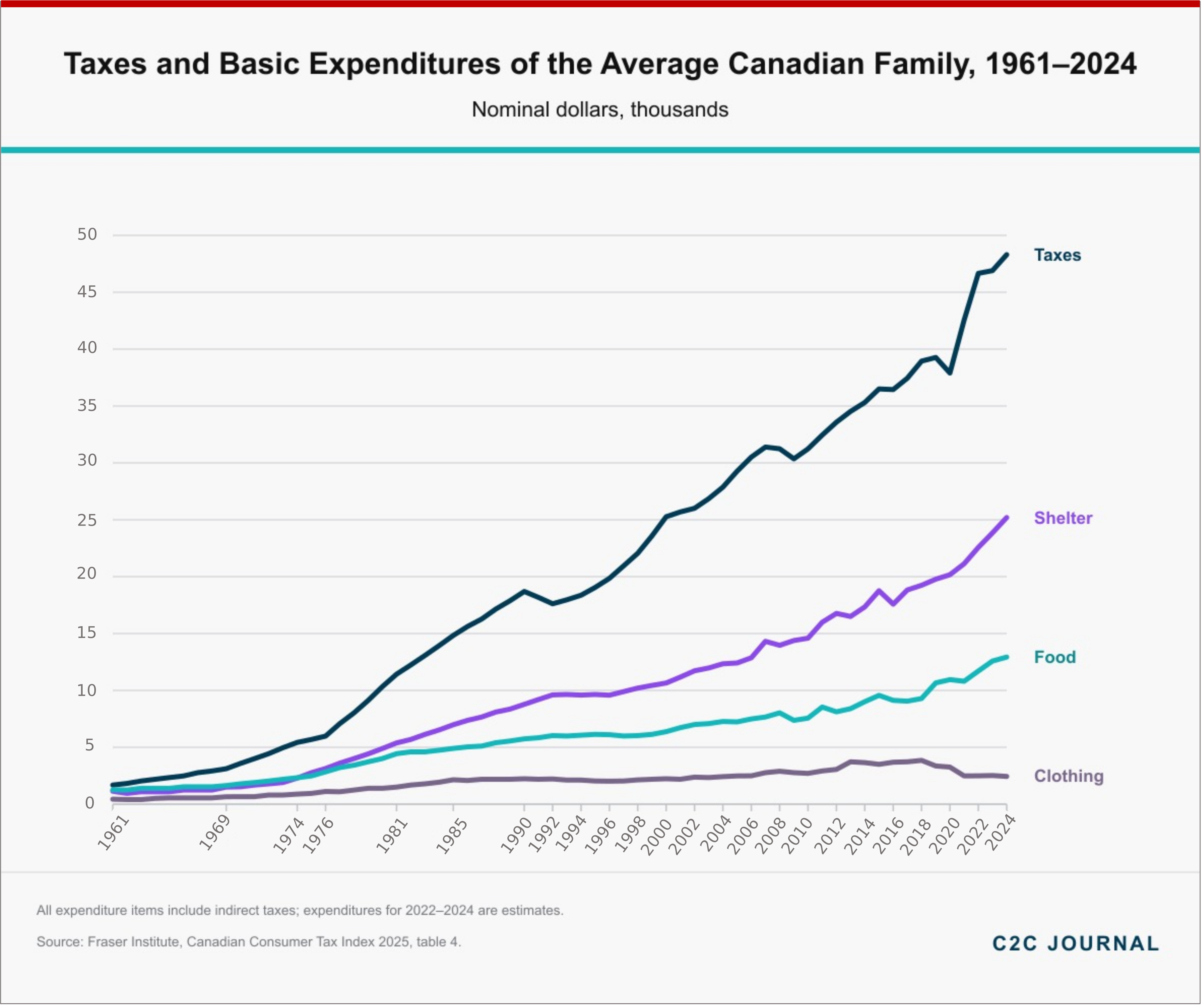
Success starts at home: Canada’s domestic struggles range from a $65.3-billion fiscal 2027 federal budget deficit and declining productivity to growing unemployment and a tax burden consuming 42.3 per cent of the average family’s income. Reversing this decline will take far more than courting European VIPs, says the author.

Canada’s domestic picture is even worse than the disarray on our trade and investment files. A partial list includes: the $65.3 billion fiscal 2027 federal budget deficit, our $3.4 trillion and climbing gross public debt, crushing taxation – with the average Canadian family paying 42.3 percent of its income in taxes, compared with 35.5 percent for housing, food and clothing combined – evaporating jobs and rising unemployment, sagging productivity and sliding incomes. Indeed, the most recent Fraser Institute report reveals that most Canadian provinces now rank alongside the poorest U.S. states. Such an array of challenges merits the full attention of any prime minister.

Making matters worse is an immigration policy adding large numbers of unskilled people requiring taxpayer-funded support. Rejecting the points system that had proved effective in selecting the immigrants that Canada needed ever since another Liberal, Lester Pearson, introduced it in Canada’s Centennial Year, Trudeau’s approach saw a flood of people without needed skills or social compatibility pour into the country. The same approach has proved increasingly disastrous in Europe, which is in an immigration crisis. And now, after an all-too-brief interruption in the incoming flood, Carney is already musing about raising intake levels once again to resume Canada’s population growth.

“If success is measured by whether Canada is becoming more prosperous, whether immigration is sustainable and whether Canadians remain free to speak their minds, this government is failing,” warns Pierre Gilbert, a Senior Fellow at the Winnipeg-based Frontier Centre for Public Policy.

The Carney Liberal government would like us to believe that our problems are caused by Donald Trump. The reality is that Canada was in self-inflicted decline well before Trump became U.S. President. And our prime minister’s fondness for continuously palling around with European political grandees and global billionaires hasn’t managed to turn that dire situation around.

Gwyn Morgan is a retired business leader who has been a director of five global corporations.

Source of main image: ChatGPT.

Love C2C Journal? Here's how you can help us grow.

More for you

Absent Minded: Ontario Tackles the School Attendance Crisis

Canadian schools have a problem – kids aren’t showing up. In Ontario, nearly 60 percent of high school students aren’t meeting the provincial standard for attendance. And Canada leads the world in absenteeism among children of university-educated parents. Yet when Ontario’s education minister announced he was getting tough on truancy, he was hammered from all sides, including “progressive” academics, conservative education reformers, sports parents and, of course, always-angry teachers’ unions. Christina Park looks into the causes of absenteeism and compares Ontario’s reforms to what various other countries are also trying to do about it. As Park explains, nothing can be fixed in Canada’s chaotic school systems until students start showing up for class.

New Man, Same Old Plan: Mark Carney’s Net-Zero Ambitions Remain an Existential Threat to Canada’s Economy

To many Canadians, Mark Carney’s apparent transition from climate-change zealot to build-baby-build capitalist has been a surprising though welcome change. But is it real? Recent evidence suggests the prime minister has not abandoned his longstanding fixation with growth-killing net-zero commitments. Exhibit A is his government’s sustainable investment guidelines. Also known as the “green taxonomy”, this little-known effort seeks to label every development project in the country according to its perceived environmental impact, with the goal of directing where banks and investors are allowed to put their money – and punishing industries deemed unworthy. If not abandoned or watered-down soon, warns industry expert Gina Pappano, the green taxonomy will crush economic growth and cripple the current resurgence in Canada’s vital natural resources sector.

From Refuge to Hunting Ground: Why Some Migrant Men Come Here to Rape, and What to Do About It

Among the many true things that cannot be said out loud in our era of wokist orthodoxy is that some recent immigrants might be fundamentally different from other Canadians. It’s a taboo that must end if Canada is to avoid repeating the vast wave of sex crimes sweeping across much of Europe. In the concluding instalment of her searing two-part series, Margret Kopala examines the underlying factors behind the horrifying propensity of some recent male migrants to brutalize and sexually assault women in their new country. While many politicians have chosen to turn a blind eye to the problem, Kopala reveals how a popular pushback is finally forcing some Western governments to secure their borders and protect their people. (Read Part I here.)

More from this author

Canada’s Economic Web of Woe

In these “Elbows Up” times, when so many Canadians act so eager to tout Canada’s resilience and potential, veteran business leader Gwyn Morgan points to a troubling list of economic woes that tell a different story. Canada is indeed among the world leaders – in food costs, taxation, government debt, the regulatory burden on business and the crippling shortage of affordable housing. Meanwhile, the private sector is neglected and trade talks prioritize political goals. All that, and a government that lacks the ability or courage to take effective action. It is a veritable web of woe – one in which each strand worsens the other.

The Hands-On Future: Skilled Trades, Data Centres and Canada’s Big AI Opportunity

Whether Canadians fear or favour artificial intelligence, they can’t stop it. AI’s transformative power in making so many things faster and easier will doubtless cause pain, says veteran Canadian business leader Gwyn Morgan, but it will also provide generational opportunities Canada must seize. The Prairie region, especially, has the abundant land and energy needed to build the massive AI data centres that will power the future. Some workers are at risk, Morgan concedes, but AI will create opportunities as well, particularly in the skilled trades. AI might just transform our labour force into one where more workers do real things for real people.

From the Strait of Hormuz to Cuba, Net Zero is Dying – Mark Carney Needs to Let Go

After decades spent pursuing net-zero dreams at great cost to their economies and social fabric, most of the world’s industrialized nations are waking back up. War with Iran and the threat of tanker blockades have everyone worried about oil and natural gas supplies and clamouring for energy security. Or nearly everyone. Not Mark Carney, though. Canada’s prime minister keeps pushing industrial carbon taxes higher and insists on wasting taxpayers’ money on windmills that make no difference. Gwyn Morgan recalls his own observation of the global warming movement’s original rise, its morphing into the radical “net zero” cult – and its spectacular global disintegration. It is high time, Morgan writes, that Canadians demand Carney also drop his delusions.