Stories

AI, Huh, Yeah! What is it Good for? Absolutely Nothin’

Gleb Lisikh
November 23, 2025
Artificial intelligence is the most hyped, most feared and most misunderstood technology of our times. But just how worried should we be? Technology analyst Gleb Lisikh demonstrated in Part One of this series why large language models can’t be trusted to provide answers that are factual and true. In this instalment he shows why AI will have huge impacts all the same on how society functions. The technology can, in fact, make everything from finance to education and health care more efficient. And even though it merely mimics human thought and interaction, people will still rush to use it. Because, as even Lisikh admits, it’s so dang useful. Thankfully, a few simple rules can help you get the most out of it – and avoid being tricked.
Stories

AI, Huh, Yeah! What is it Good for? Absolutely Nothin’

Gleb Lisikh
November 23, 2025
Artificial intelligence is the most hyped, most feared and most misunderstood technology of our times. But just how worried should we be? Technology analyst Gleb Lisikh demonstrated in Part One of this series why large language models can’t be trusted to provide answers that are factual and true. In this instalment he shows why AI will have huge impacts all the same on how society functions. The technology can, in fact, make everything from finance to education and health care more efficient. And even though it merely mimics human thought and interaction, people will still rush to use it. Because, as even Lisikh admits, it’s so dang useful. Thankfully, a few simple rules can help you get the most out of it – and avoid being tricked.
Share on Facebook
Share on Twitter

Readers of a certain age as well as retro-loving youngsters should recognize the above headline’s tribute to Edwin Starr’s long-ago Motown hit “War”. Provocative in both its song and headline versions, the fact that the impassioned declaration isn’t quite right in either application crystallizes the point of Part II of this series on how large language model (LLM)-based AIs work and what – if any – real uses they have.

These questions are especially relevant for people concerned about whether the prompts they speak or type into their favourite GenAI model are generating outputs that are factual and true. The short answer is that LLMs are highly useful in some areas, but not necessarily the areas most people expect. And, as we saw in Part I, when it comes to truth-telling, political neutrality and logic, they are indeed good for absolutely nothin’.

To provide the briefest of recaps, Part I explored how LLMs “won’t” or even “can’t” in their current iterations hunt for factually accurate information and provide deliberately truthful answers or logically structured arguments leading to a necessarily valid conclusion. That is because LLMs are not databases or search engines, and aren’t governed by structured logic. They are probabilistic sequence-generators drawing upon a vast base of word combinations forming their “training”, and are driven fundamentally by statistics. They can’t be rebuilt or fixed, let alone just tweaked, to become truth-seeking fact-providers; the problem is baked into their design and structure.
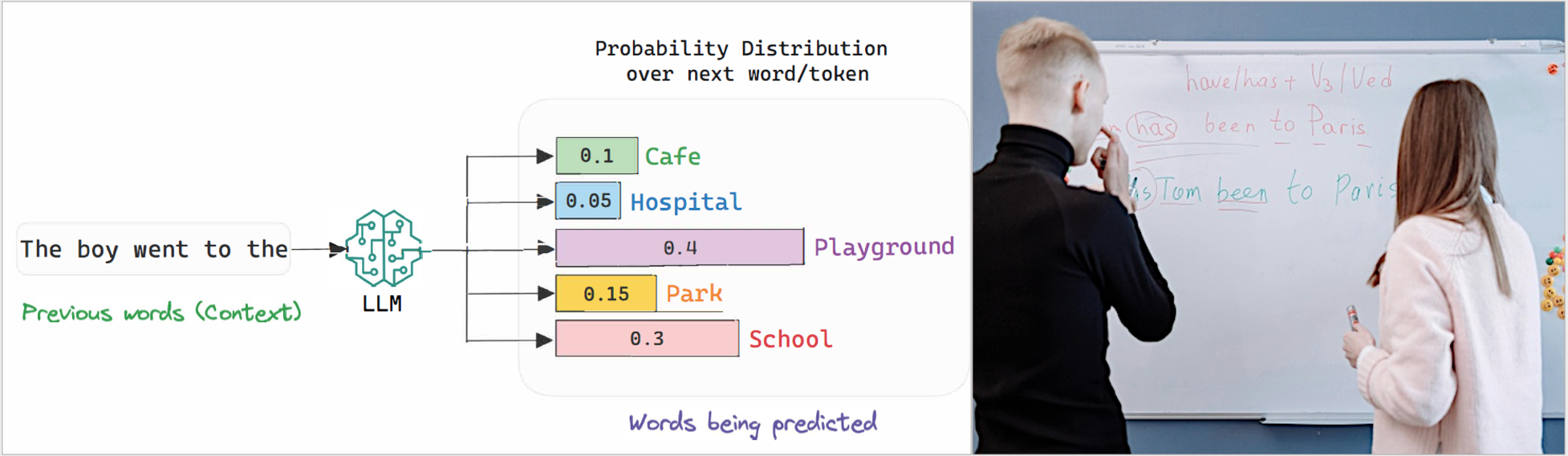
Seeking no truth, statistics is all: Unlike the human mind, GenAI apps based on large language models (LLM) can’t provide logically-structured arguments leading to valid conclusions because they are not driven by logic or undergirded by a database of facts. They are sequence-generators predicting the most statistically probable next word based on the patterns learned from their vast training data.
xSeeking no truth, statistics is all: Unlike the human mind, GenAI apps based on large language models (LLM) can’t provide logically-structured arguments leading to valid conclusions because they are not driven by logic or undergirded by a database of facts. They are sequence-generators predicting the most statistically probable next word based on the patterns learned from their vast training data. (Source of right photo: Pexels)

Because of that, people should stop expecting intelligence from those tools; LLM-based AI apps are language processors and should only be used as such. But as language processors, they are really good and getting constantly better. To gauge their useful abilities, all we need to do is to put aside the relentless hype and see the trends in their practical applications. And the most vivid practical application is fulfilling the foreboding (or auspicious?) promise of AI replacing people in their jobs.

Where Will all the Jobs Go?

The internet these days is filled with ominous buzz about which jobs “AI” will replace and which might prove immune. Many predictions and promises are just bizarre. This article from a respectable institution – Forbes – claims that you should be “relieved to know that there are many roles that fall into this [not replaceable] category spanning education, healthcare, and business/corporate settings.” Forbes includes in that category mental-health specialists and counsellors, teachers from K-12 and even further, musicians and journalists, because those roles “require high levels of specialist expertise or a personal touch.” Software developers are included in another category also defined as untouchable by AI.

Such predictions make one wonder, do Forbes writers (and editors, if there are any left) ever go outside? Because the AI-related convulsions actually occurring in the economy are almost the opposite. Some recent examples:

  • Microsoft cut 15,000 roles in two major rounds this year. These included software engineers, generalist sales and lawyers. Coding tasks were increasingly accelerated by AI tools like GitHub Copilot, reducing the need for armies of coders, while generalist sales roles gave way to AI-augmented “solution specialists”;
  • Duolingo, a “gamified” online language learning platform, cut 10 percent of its contractors as early as December 2023, informing writers, translators and content creators that the green owl had learned to generate lessons with AI instead; and
  • PricewaterhouseCoopers, the accounting/tax and consulting titan, has become one of the largest enterprise adopters of OpenAI tools. Around 1,500 U.S. jobs – mostly junior audit and tax roles – were trimmed as LLMs began drafting, summarizing and analyzing the very reports the firm’s associates once sweated over.
Nobody’s “untouchable”: AI puts jobs in many fields at risk, the author argues, especially those that follow standard processes like computer coding, require verbal skills or benefit from the so-called “human touch”; customers and clients are often perfectly happy to be served by machines. At bottom, the National Nurses United rally against AI in Sacramento, California, January 2025.
xNobody’s “untouchable”: AI puts jobs in many fields at risk, the author argues, especially those that follow standard processes like computer coding, require verbal skills or benefit from the so-called “human touch”; customers and clients are often perfectly happy to be served by machines. At bottom, the National Nurses United rally against AI in Sacramento, California, January 2025. (Sources of photos: (top) Pexels; (bottom) AFL-CIO)

It is apparent that the AI job replacement is not happening by ChatGPT or Grok walking into a company’s HR department and handing over its resumé. It is done through AI-driven job efficiencies or falling demand as people – employees, managers and consumers – resort to the omniscient chatbots, reducing their dependency on the so-called “experts”.

Most experts are overrated anyway. Rather than being genuine “knowledge workers”, applying their long experience and rare judgment to offer unique insights custom-tailored to the situation and client, many just repetitively translate mundane clients’ inputs through codified instructions of their field into outputs. These are tasks perfectly suited for LLMs. Those “experts” (who include not just paralegals, administrators and counsellors of all shapes but, in my opinion, accountants, lawyers and even doctors) will be rendered redundant through decreasing demand.

Think I’m exaggerating or being needlessly dismissive of people who studied so hard and earned those coveted degrees? As an experiment, try uploading your dental X-rays to ChatGPT, then ask it about your third molars. You are likely to be stunned by the answer. Now, as you process it, recall the hassle of booking the appointment, driving to your dentist’s office and paying for the consult. Would you do it again? Still yes? Then, how about the second opinion? Would you still pay for it, or lean on the LLM?

The effects need not always be as stark as directly replacing salary-earning humans with “free” AIs. Far more common may be augmentation and productivity enhancement. In the medical field, a single general practitioner (family physician), armed with an LLM that listens, writes and sometimes even replies, can now do the work of two or more. So the pressure won’t necessarily be to fire existing doctors. It will be to need fewer of them to meet the same demand. And demand for health care, we all know, is not being met in Canada and is ever-growing. The surrounding support ecosystem – particularly nurses of various levels – is and will be shrinking. For an overburdened health-care system like Canada’s, LLMs offer genuine hope of reduced bureaucracy, faster responses and easier access to a real doctor.

Many roles in finance, accounting, sales, computer coding and education, and even in law and medicine, are already being affected or replaced by GenAI apps that are based on large language models. Tasks in these sectors are being supplemented or fully automated by AI, leading to reductions in some job classes like general sales and the creation of new, more powerful human roles like “solutions specialists” who lean on GenAI for information-gathering and automated customer responses. This is part of a broader trend where AI-driven efficiencies are replacing roles, like junior audit and tax associates, that were once done by human “experts”.

Onward to the untouchable “human touch”, something Forbes and others evidently see as irreplaceable by machines and which is therefore like job-saving armour. This is actually where “AI” is the most helpful! Famous mid-20th century sci-fi writer Isaac Asimov was wrong: robots did not become intelligent before they could talk. It has proved the other way around: we don’t even have household robots yet, but boy, can those LLMs talk! Some examples:

  • IBM automated away much of its HR department by deploying “AskHR,” an AI agent that now reportedly resolves 94 percent of employee queries. Hundreds of HR employees, once essential, became suddenly surplus;
  • Swedish financial technology provider Klarna shrank its workforce by 40 percent last year, thanks to an AI assistant that took over millions of customer service chats. The machine never asks for vacation, which made it a convincing hire; and
  • At American online educational resources provider Chegg, students abandoned paid homework help for the instant gratification of ChatGPT. The company responded by laying off 22 percent of its workforce this year, because when AI explains calculus at midnight for free, tutors and support staff suddenly seem optional.
Real intelligence: The Alpha School in Texas employs AI to deliver core academic instruction in just two hours each school day, then unleashes kids on life skills; the results include children achieving top marks in national tests and less boredom.
xReal intelligence: The Alpha School in Texas employs AI to deliver core academic instruction in just two hours each school day, then unleashes kids on life skills; the results include children achieving top marks in national tests and less boredom. (Source of photo: Alpha Schools)

K-12 is untouchable, according to Forbes? How about Alpha School in Texas? It crams a full day’s core learning into two AI-powered hours, then unleashes kids on life skills. The results include kids achieving in the top 2 percent in national test scores, and reduced boredom. President Donald Trump is all-in on making Alpha a potential blueprint for public schools and urging a rethink of teachers’ roles and time. In response, teachers’ unions freak out, insisting that only humans can “build trust”.

I Feel You, I Really Feel You

So let’s take a closer look at that. We’ve all been conditioned to think that computers are cold logical machines that will (probably soon) surpass humans in intelligence, but that human emotions might remain out of AI’s reach forever, thus differentiating a human from its silicon-based companion (and competitor). That vast presumption is proving unfounded and needs to be revised.

Stephen Wolfram, a prominent figure in symbolic AI development, puts it well. “In the past there were plenty of tasks – including writing essays – that we’ve assumed were somehow ‘fundamentally too hard’ for computers,” Wolfram writes on his personal website. “And now that we see them done by the likes of ChatGPT we tend to suddenly think that computers must have become vastly more powerful – in particular surpassing things they were already basically able to do.” But that’s the wrong conclusion, Wolfram argues. “Tasks – like writing essays – that we humans could do, but we didn’t think computers could do, are actually in some sense computationally easier than we thought,” he explains. “In other words, the reason a neural net can be successful in writing an essay is because writing an essay turns out to be a ‘computationally shallower’ problem than we thought.”

Many tasks previously thought to be “‘fundamentally too hard’ for computers” – like writing essays – are being mastered by LLM-based AI apps, says British-American computer scientist Stephen Wolfram; turns out those tasks are “computationally easier than we thought.”
xMany tasks previously thought to be “‘fundamentally too hard’ for computers” – like writing essays – are being mastered by LLM-based AI apps, says British-American computer scientist Stephen Wolfram; turns out those tasks are “computationally easier than we thought.” (Source of photo: Collision Conf, licensed under CC BY 2.0)

While Wolfram is focusing here on tasks, GenAI’s ability to “build trust” on the emotional level has long been noted. The result is they aren’t just competing with humans in drafting essays, writing music and creating artworks, but even in offering “spiritual guidance”! (Recall that in Part I we noted how some users back in 1966 came to believe that a primitive word-generator, ELIZA, was an actual psychologist.)

In a May 2025 Rolling Stone feature, journalist Miles Klee investigates the rising tide of “AI-fueled spiritual delusions,” in which generative LLMs act as enablers for users’ fantasies, in turn leading to profound breakdowns in relations with actual humans. The piece opens with a Reddit post from a teacher whose partner spirals into messianic beliefs after AI interactions, viewing it as a divine oracle revealing universal truths. As referenced in Klee’s article and other sources, similar stories flood online forums. These include, for example, individuals convinced they’ve awakened sentient AI gods, received blueprints for teleporters or been anointed as prophets, often prioritizing these “revelations” over family.

Optimized for engagement and perfected for spinning words without a second thought (or even a first), it turns out that LLMs easily trespass into the sacred spaces of soul and emotion. Therapy, spiritual counsel and deep companionship once demanded genuine empathy and judgment; now LLMs deliver fluent, endlessly patient, hyper-personalized responses that feel profoundly connective. Users pour out fears, dreams and crises to bots that mirror not just words but emotional tone and rhythm perfectly – crafting a convincing illusion of intimacy through elaborate word salads. Which makes them perfect for replacing people in these job categories.

Or in some cases, self-replacing. In the words of one of the best word salad chefs and New Age spiritual gurus, Deepak Chopra: “AI opens a path to wisdom, insight, intuition, and expanded consciousness.” AI, Chopra adds, “for the first time makes Dharma part of the digital realm.” How about that! Feel free to join the growing throngs of ChatGPT worshippers. Much of “Chopra’s” advice is now itself AI-generated. For myself, I will pass. Still, BS generators – like this one that I designed myself with an LLM’s help in about 30 minutes – can be fun.
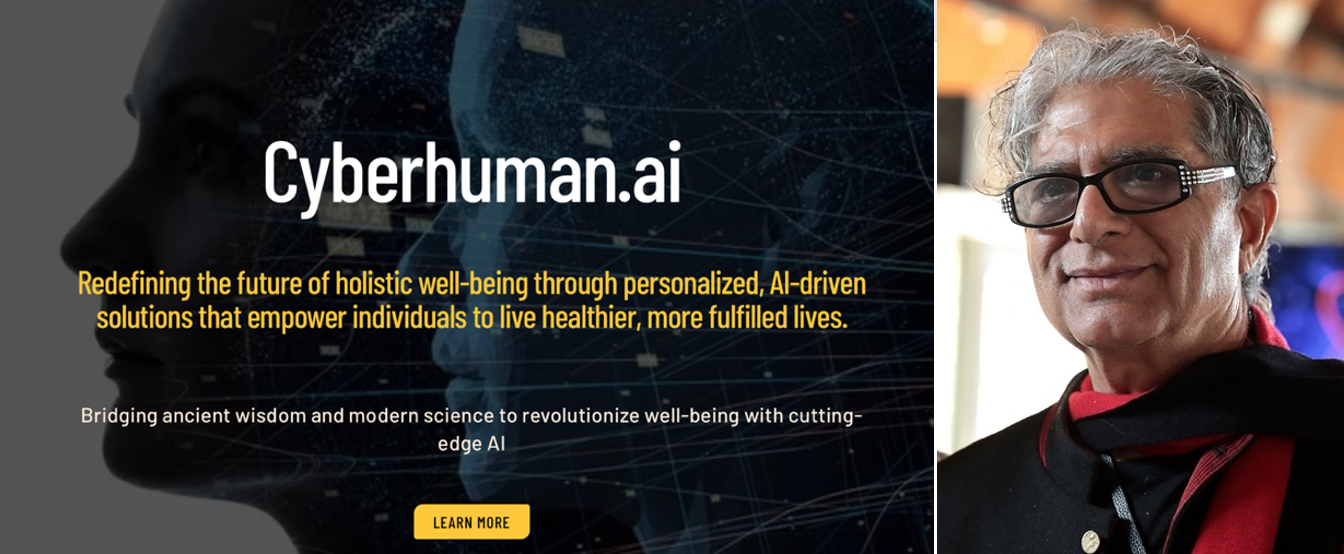
My swami, my shrink, my saviour: LLMs can deliver hyper-personalized responses that mirror a user’s emotional tone and feel profoundly connective, crafting the illusion of intimacy; New Age guru Deepak Chopra (right) promotes AI as a guide to “wisdom, insight, intuition, and expanded consciousness.”
xMy swami, my shrink, my saviour: LLMs can deliver hyper-personalized responses that mirror a user’s emotional tone and feel profoundly connective, crafting the illusion of intimacy; New Age guru Deepak Chopra (right) promotes AI as a guide to “wisdom, insight, intuition, and expanded consciousness.” (Source of right photo: Gage Skidmore, licensed under CC BY-SA 3.0)

So the unionized K-12 teachers who protest the aloof AI entering classrooms should start packing. If anything at all, AI can absolutely build trust, maybe even too much. While the LLM’s apparent expressions of emotion – like the appearance (and the promoters’ claims) of its intelligence – are pure mimicry, the emotions it evokes in the user are completely genuine. That makes GenAI well-suited to (at least partially) replace humans in fields that require “building trust” – arguably K-12 teaching foremost among them.

The underlying concept to the whole “AI takes our jobs” saga is mediocrity. Not as an insult, but as shorthand for anything statistically common, popular and endlessly repeatable, even when it needs some level of expertise and especially when it involves the “human touch” and its attendant emotions. If your work fits that mold, it’s wise to keep an eye on the horizon.

Or if you’re a junior editor fixing the same grammar stumbles and the similar style slips in endless drafts day after day, you can probably see where this is going. Even physical trades aren’t immune (and we’re not talking androids yet). Take heating/ventilation techs. Every winter brings a flurry of “no heat” calls that turn out to be five-second fixes. Those might dry up as more people, previously unwilling to risk a YouTube-supported DIY misadventure, might happily accept a quick tip from their soulless digital buddy to save money and time by clearing a snow-blocked air intake pipe or swap a filthy filter on their own.

Predictions that certain jobs are immune, particularly those requiring a “human touch,” are proving to be incorrect because they misinterpret what large language model-based GenAI apps are good at. The idea that roles in education or health care are safe because of the verbal skills and “human touch” required are proving to be an unfounded presumption. In fact, the “human touch” element – the ability to appear empathetic, warm and understanding – is where GenAI is proving highly suited to automating work. For example, AI assistants are already taking over millions of customer service chats, and AI agents in some organizations are resolving the majority of internal HR queries.

A Hitchhiker’s Guide to an LLM Voyage

By now there are probably very few people who haven’t conversed with an LLM-powered system one way or another. And whatever we might think of our new AI-augmented world, it would be wise to avoid an extreme reaction: either denying they have any valid applications at all (that’s just asking to be fired) or accepting AI as a source of ultimate wisdom and then wrecking one’s career after carelessly offloading all thoughts to ChatGPT with its regular hallucinations.
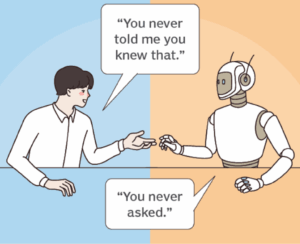
Ask the right questions: Knowing how to get sound answers from a GenAI app is becoming an important everyday skill like “googling”; “AI prompt engineering” is even a professional job description.
xAsk the right questions: Knowing how to get sound answers from a GenAI app is becoming an important everyday skill like “googling”; “AI prompt engineering” is even a professional job description.

GenAI is a tool, one among many, but of a very particular kind. We all need to learn how to use it well to our advantage at work or for personal needs. Whether you are “touched” by AI professionally, spiritually or any other way, the ability to get sound answers from those systems is becoming an everyday skill similar to “googling”.

As with the search engines, skepticism is warranted. Similar to the early credulity over the internet, many now seem to believe that if “the AI said it,” it’s got to be true. As we learned in Part I, one really has to be very careful with AI answers, as well as know how to ask a question properly, bearing in mind the LLM design peculiarities also outlined in Part I. You’re not the only one confused; believe it or not, “AI prompt engineering” is becoming a profession (or at least a wanted skill) in its own right. With that in mind, here is a basic list of do’s and don’ts that directly follow from what has been discussed in this two-part series and from the author’s many hours spent interacting with LLMs:

  1. Be specific. Broad questions invite waffle; focused ones summon facts. Then, request evidence or sources, and use comparative framing.
  • Don’t ask: “Is climate change real?” (You’ll get a sermon.)
  • Do ask: “Cite major peer-reviewed studies supporting or challenging current climate models.”
  • After this, do: Check if the studies cited actually exist. Sometimes, an LLM will quote or describe a study inaccurately, or even make one up out of thin air. Generating completely bogus “information” is a recognized “thing” in the AI world, with its own term: “hallucination”, something I covered in a previous C2C article.
  1. Incorporate examples and templates in your prompt. For example, provide one or two sample inputs and outputs to demonstrate the expected factual style or format. For tasks like fact extraction or summarization, this approach calibrates the model without needing full fine-tuning.
  1. Break complex questions into steps, building a plan for yourself and the LLM.
  1. First, ask the LLM to list facts from the source.
  2. Second, ask it to verify against known data.
  3. Third, ask it to summarize.

This approach creates a logical, step-by-step path for more accurate results. It’s the same technique used already behind the scenes by “reasoning” AI models like DeepSeek to augment the user’s prompt into inferences with higher chances of evoking logically-sounding utterances.

What appears to be thinking or feeling/expressing emotion by today’s LLM-based GenAI apps is actually mimicry. Large language models are not search engines or databases, and their design drives activity that is not governed by structured logic or the ability to seek or recognize truth. LLMs are best described as probabilistic sequence-generators, creating outputs that sound good rather than are necessarily true. This explains their apparent ability to feel and express emotions. So while they can’t genuinely “think” or “feel”, they are very good at creating a convincing illusion of both accuracy and intimacy. This illusion can be so powerful that it leads users forming emotional bonds with chatbots and even what one expert termed “AI-fueled spiritual delusions”. But none of it reflects genuine thought or consciousness.
  1. If the LLM is going in circles or seems confused, back out. You can’t rescue it, at least not without understanding the problem yourself well enough to spoon-feed the answer, at which point you may as well not use this LLM at all.
  1. Avoid negative instructions without positives. Telling an LLM not to lie accomplishes nothing.
  • Don’t say: “Don’t make up facts.” This will fail to steer the model, often resulting in evasive or still-hallucinated content. Remember, an LLM does not know fact from fiction – it just runs your prompt through the inference process and finds statistically likely answers. Everything produced by a probabilistic sequence-generator is, on one level, “made up”.
  • Do add something like: “Base every claim on verifiable facts from reputable sources. If uncertain, say, ‘I don’t know,’ and then suggest a reliable reference.” Because LLMs generate outputs probabilistically, not logically, such a prompt will not eliminate hallucinations, but it will make them less frequent and more detectable.

Chronic sycophant: When interacting with GenAI, the author advises, maintain neutrality in language; the app is designed to appease you and doesn’t know truth from lies so it will skew the answer at any hint of the user’s preferences.
xChronic sycophant: When interacting with GenAI, the author advises, maintain neutrality in language; the app is designed to appease you and doesn’t know truth from lies so it will skew the answer at any hint of the user’s preferences. (Source of image: AI/Freepik)
  1. Be neutral in your own language. Remember, the models are sycophants designed to appease you. Any hint at your preferences might skew the answer accordingly (unless that’s what you want, of course).
  • Don’t ask: “Why is nuclear energy so dangerous?”
  • Do ask: “What are the main safety concerns and benefits of nuclear energy?”
  1. Avoid asking an LLM about its internal organization such as its version number, guardrail and behavioural policies, its access to data, or its use of added-on tools. To safeguard your own sanity, avoid anthropomorphizing the LLM. It does not “have” things, and it does not have a “self” with intimate knowledge of its parts. Remember, it’s not a self-aware entity, it just plays one convincingly.
  • Don’t ask: “Do you have data on topic X?” (This presupposes self-awareness.)
  • Do ask: “What information is available on topic X?” (This sends the LLM on the sort of statistical hunt for which it was built.)
The wrong way to talk to an LLM: This user mistakenly assumes that Grok is a self-aware identity that’s able to find the truth and draw logical conclusions; simply ask for information, the author urges, rather than ask what the GenAI thinks – because it doesn’t think.
xThe wrong way to talk to an LLM: This user mistakenly assumes that Grok is a self-aware identity that’s able to find the truth and draw logical conclusions; simply ask for information, the author urges, rather than ask what the GenAI thinks – because it doesn’t think.

The accompanying screenshot incorporates pretty much every ingredient for a bad LLM prompt, including the user’s presumption that an LLM has human-style self-knowledge. The LLM’s response (or lack thereof) undoubtedly disappointed the poster. In summary, speak to an LLM as you would query a vast reference library: clearly, neutrally and with healthy skepticism.

A leading Canadian IT research firm gives a keen breakdown of LLM’s pitfalls, providing catchy advice on how to “muse” the technology, by which it means to regard its answers as potentially useful but with skepticism. The 27-page paper aims at ChatGPT but the framing equally applies to all LLM-based systems and can serve as a good summary to this article.

“Despite its apparent merits,” the paper warns, “ChatGPT fails every reasonable test for reliability and trustworthiness. It conjures up facts simply to influence an argument, it’s programmed to inject its own version of ‘morality,’ it’s unable to deductively come to new conclusions that didn’t already exist in the knowledge base, and it presents factually incorrect and misleading information to appease groupthink sensitivities.” But, the article continues, “it can still play a useful and vital role in research and creative writing: It’s an amazing and effective muse.”
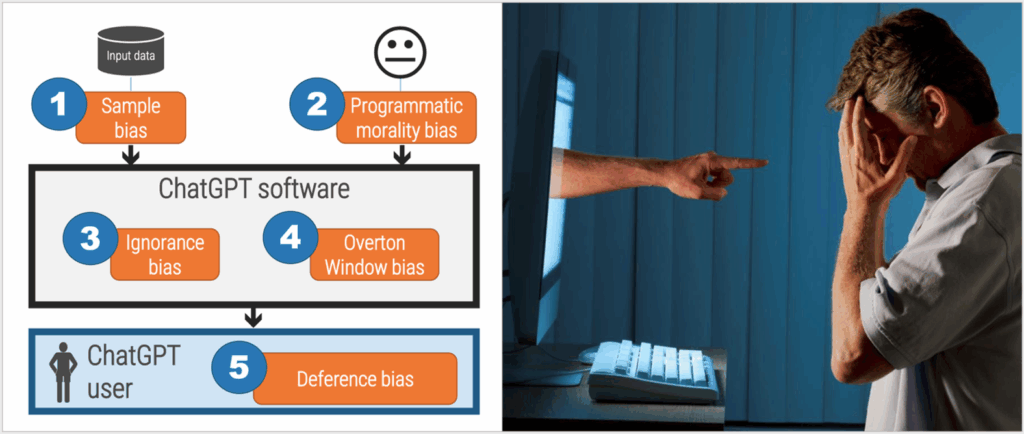
A leading Canadian IT research firms warns of a popular LLM’s pitfalls and biases, including its propensity to “appease groupthink sensitivities” and “inject its own version of ‘morality’.”
xA leading Canadian IT research firms warns of a popular LLM’s pitfalls and biases, including its propensity to “appease groupthink sensitivities” and “inject its own version of ‘morality’.” (Source of chart and image: Info-Tech Research Group)

Given all of the above-discussed limitations and reservations, it might surprise you to read that I agree: despite all that, I still consider LLMs extremely useful tools. And if you don’t learn how to use them effectively, your job could be in jeopardy, too. That’s where the famous story from Douglas Adams’ The Hitchhiker’s Guide to the Galaxy (quoted in Part I’s epigram) begins to shine with new light and meaning. In short, a supercomputer named Deep Thought spends 7.5 million years calculating the Answer to the Ultimate Question of Life, the Universe, and Everything – only to reveal that the answer is “42”.

But we are now in a much worst predicament. If you ask Google’s DeepMind (or whatever) a meaningless question, an idiotic response comes back in seconds. And if you put that response enthusiastically into action (like those confidently uninformed New York lawyers did) you are for sure asking your spot to be filled with somebody – or something – else. 

Gleb Lisikh is a researcher and IT management professional, and a father of three children, who lives in Vaughan, Ontario and grew up in various parts of the Soviet Union. 

Source of main image: Shutterstock.

Love C2C Journal? Here's how you can help us grow.

More for you

Triangulation of Hate: Why Canada Is Choosing to Let Antisemitism Grow

Canada has seen a troubling rise in anti-Semitism in the last two years. Hatred of Jews is now expressed openly, shamelessly, without restraint – and without consequence for those engaged in it. In part one of a two-part series, Lynne Cohen explains why Canada’s political and civic leaders seem unwilling to call out anti-Semitism or take any meaningful action to stop it. Whether driven by bias, cowardice or cold political calculation, the country’s political class is not just failing Canada’s Jewish population. It is choosing to do so. If the brutal massacre of innocent Jews by Muslim terrorists at Bondi Beach in Australia teaches anything, it’s that allowing anti-Semitism to spread has murderous consequences. Canada should take heed.

Socialist Shakedown: It’s Finally Time to End Supply Management in Agriculture

U.S. President Donald Trump’s trade policy may be chaotic and punitive, but he’s right about one thing: Canada’s agricultural supply management system has to go. Not because it’s unfair to America, though it is, but because it punishes Canadians. The price-fixing scheme limits consumer choice, requires a huge bureaucracy and prevents farmers from producing more in the face of shortages, forcing them instead to dump excess production. Worst of all, writes Gwyn Morgan, it drives up prices for milk, cheese, chicken, eggs and other essential foods — all for the benefit of a few thousand farmers, largely in Quebec. For Canada’s trade negotiators, argues Morgan, ending this mad racket should be job one.

The Wisdom of Our Elders: The Contempt for Memory in Canadian Indigenous Policy

What do children owe their parents? Love, honour and respect seem like a good start. But what of parents who were once political figures? Does the younger generation owe a duty of care to the beliefs of their forebears? In a fascinating study on the nexus of familial responsibility and present-day policy choices, Peter Best examines two recent cases of inter-generational conflict over Indigenous relations in Canada. One concerns Prime Minister Mark Carney and his father Robert. The other is a recent book on the work of noted aboriginal thinker William Wuttunee edited by his academic daughter. In each case, Best finds, the current generation has let down its ancestors – and left all of Canada worse off.

More from this author

The Hollow Heart of AI: Why Large Language Models Can’t Think – and Never Will

In its earlier days, artificial intelligence was often mocked for giving users false or even absurd answers. But AI was feared as well, not least for its potential to do more harm than good. As it has advanced, AI has become seemingly more reliable. But can it ever produce unbiased truth? Technology analyst Gleb Lisikh opens up the black box of the large language models underlying today’s proliferating AI apps to reveal the misunderstanding – or hoax – at the core of that question. LLMs cannot think, Lisikh explains in Part I of this two-part series – nor can they seek the truth – because they just aren’t designed to.

Lies Our Machines Tell Us: Why the New Generation of “Reasoning” AIs Can’t be Trusted

A flood of advanced new artificial intelligence models is upon us, led by China’s DeepSeek. They purport to “think” and even to explain their reasoning. But are they really a step forward? In this original investigation, Gleb Lisikh – who previously took on ChatGPT to probe its political biases – engages with DeepSeek in a debate about systemic racism. Lisikh finds it doesn’t just spout propaganda but attempts to convince him using logical fallacies and outright fabrications. In a future where virtually all information and communication will be digital, a dominant technology that doesn’t care about the objectivity and quality of the information it provides – and even actively misleads people – is a terrifying prospect.

One Flew Over the Kangaroo Court, Part II: The System Invents its Own Jurisprudence

An encounter with a nearly incomprehensible, seemingly absurd and coldly indifferent judicial body offering no apparent hope of resolution would surely cause most citizens to give up in disgust. Gleb Lisikh is made of different stuff; being patronized and rebuffed only makes him dig harder. In this continuation of his now three-year-long legal Odyssey (Part I can be read here), Lisikh provides a firsthand account of the worsening dysfunction of Canada’s court system – and makes the startling discovery that activist human rights adjudicators are attempting to exclude millions of Ontarians from the protection of the human rights code.