Free to think: Recognizing that the search for truth demands open and often difficult debate, ancient Jewish thinkers many centuries before the Western Enlightenment pursued questions ranging from human nature, Jewish customs and law, to mathematics and astronomy. Shown: (top) A Talmudic Dispute, by Carl Schleicher; (bottom left) Sabbath, by Jankel Adler; (bottom right) 13th-century illustration of Ibn Ezra, renowned 12th-century Spanish-Jewish scholar, conducting astronomical calculations.
 Seeking solutions in government measures: B’nai Brith Canada, the Centre for Israel and Jewish Affairs and other Jewish groups are backing the Mark Carney government’s Bill C-9, the Combatting Hate Act, which amends the Criminal Code to prohibit hate-motivated propaganda, further restrict speech and increase penalties for hate-related offences. At right, Rally Against Hate at the University of Toronto, May 2024. (Source of right photo: Shawn Goldberg/Shutterstock)
Are the positions of these organizations genuinely “Jewish”, and do they represent the real views of Canada’s Jewish community? In my opinion, not by a long shot. Why then are so many Jews lined up behind the groups supporting anti-hate laws? It is complicated. Perhaps it can best be understood as a lingering reaction to the Holocaust. The Nazi oppression, enslavement and industrialized murder of 6 million Jews inflicted a collective trauma from which the community has not fully recovered. The associated victimhood mindset has, among other effects, nurtured a determination to promote hate-speech laws, anti-Semitism education and tight restrictions on demonstrations. As understandable as the impulse may be, this public policy position is anti-Jewish and, I’m convinced, will prove counter-productive for Jews and damaging to Canada.
What Is Free Speech? What Isn’t it?
Among the saddest fates in Judaism is how easily many Jews “can be mollified,” says Ezra Levant, founder and CEO of Rebel News, in a Zoom interview with C2C. He says this can happen even to senior figures, such as those running CIJA or B’nai Brith Canada, “by showing them some shiny beads: ‘Here, look, look at this, C-9.’” Acceptance is then seen as evidence of the Jewish desire to combat anti-Semitism alongside a natural ally, progressives. Both groups believe that shaping people’s attitudes is a legitimate function of government, and that the most effective way of doing so is through legislation and regulation. But is this true, or even possible, with respect to free speech?
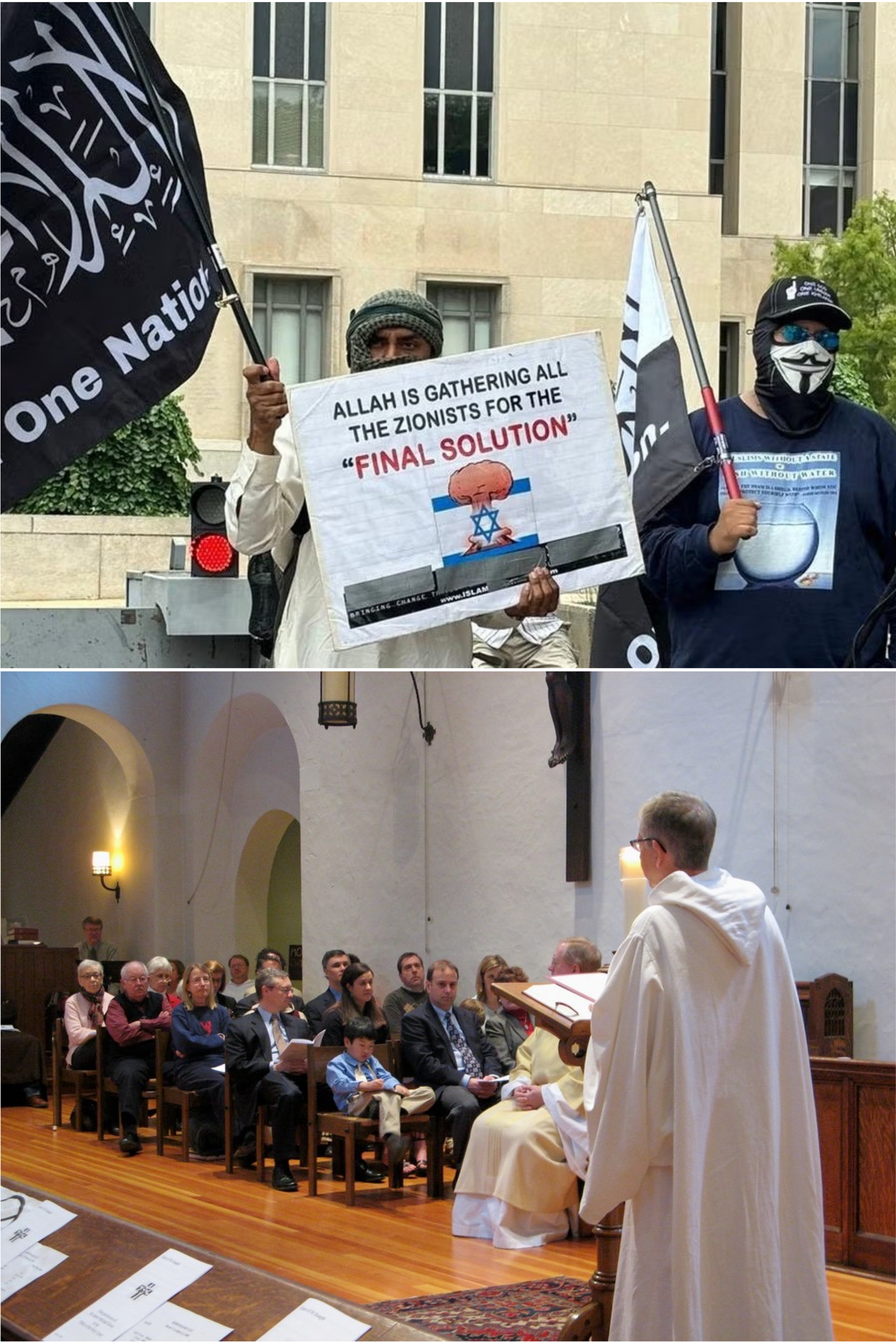
It’s a complicated issue, for sure. We need to try to clarify what “free speech” means, or at least what it doesn’t. Is it binary: I’m either for free speech or against it? Not really, because virtually everyone is going to say they are for it but, when pressed, admit it needs limits. Free speech should not include incitement to violence, and incitement is indeed already a criminal offence in Canada. But where do you draw the line? Is speech fine except when you dance through the streets praising Hamas or dressed as a neo-Nazi? Is it acceptable as long as you don’t insult Jews or Muslims or homosexuals? What about speech that takes the form of repeated name-calling and taunting from a mob on the street in front of your home? Most want to stop that kind of sticks-and-stones behaviour. But many do not. Drawing a precise line is an exercise in futility; just about everyone who thinks seriously about free speech will pick a different one.
The issue is not whether the opinions articulated are pleasant or awful. It’s whether any government can be trusted with restricting unkind expressions. Even now, anti-hate laws in Canada are being invoked to suppress legitimate criticism of controversial policies. Consider the practice of allowing men in women’s change rooms out of respect for their “gender expression” or “self-identification”. Good-faith opposition to the practice has already led to severe punishment. With the passage of the Combatting Hate Act, how long before clergy preaching Christian sexual morality from the pulpit are charged with promoting hate?
This is a main fear of those who oppose expanding the web of anti-hate laws and policies. Free speech can be messy and truly belligerent, even scary, but the cure being promoted by the anti-hate lobby is worse than the disease.
Hate-Speech Laws: One Failure Begets Another
Section 319(2) of the Criminal Code prohibits the wilful promotion of hatred against an identifiable group; passed in 1970, it was later upheld as constitutional by the Supreme Court of Canada. The list of prosecutions under the law is not long, however, even when including civil appeals of human rights tribunal decisions. This recent listing (click on the Excel file) indicates there’s been a total of only 17 charges leading to nine convictions, one guilty plea and one acquittal. In addition, several new charges were laid earlier this month in the wake of an anti-Semitic protest in Toronto.
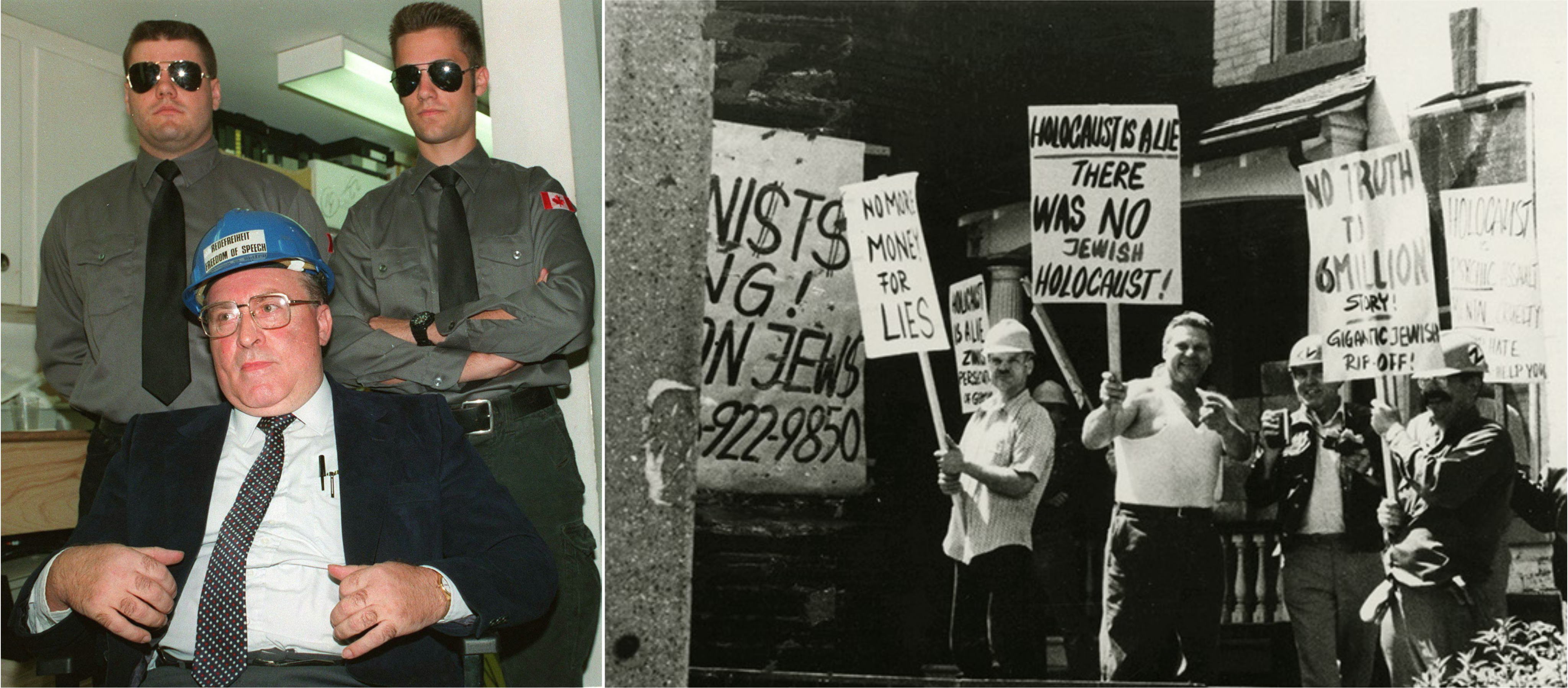
The famous case of neo-Nazi Ernst Zundel, who went through two trials and multiple appeals after publishing a pamphlet entitled Did Six Million Really Die? was prosecuted under a different Criminal Code section that prohibits willfully publishing false news which can cause injury. The Supreme Court of Canada eventually struck down this law, finding it violated Zundel’s free-speech rights. It is okay to lie.
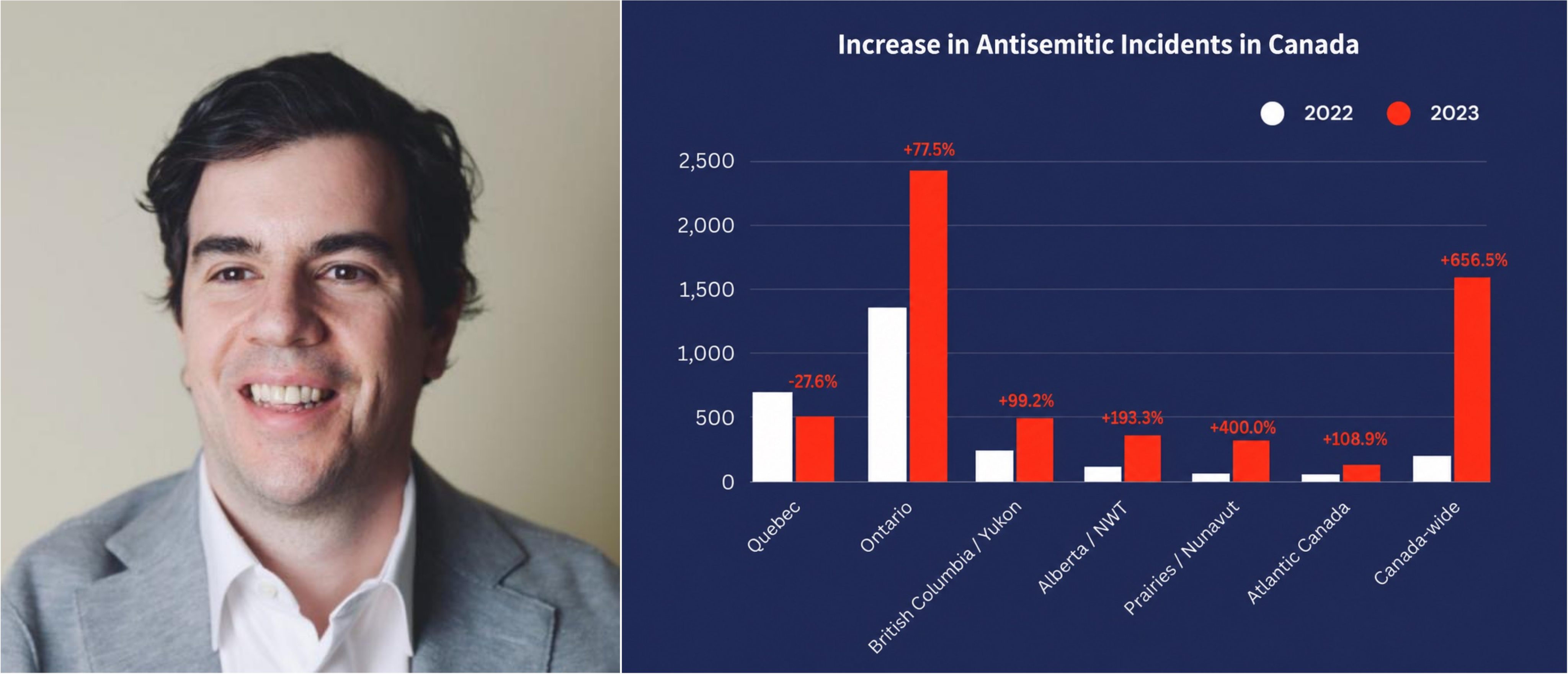
Canada’s legal record, asserts Kenneth Grad, an assistant professor of law at the University of Manitoba with a strong interest in hate-speech legislation and anti-Semitism, suggests there’s little evidence hate-speech laws have served their stated purpose. The original criminalization was a response to neo-Nazism, yet did not prevent record levels of Jewish hatred which, in turn, prompted the 2022 criminalization of “wilful antisemitism”.
Nor did that expansion prevent the surge of anti-Semitism that followed the October 7, 2023 Hamas massacre of over 1,200 Jews in Israel – which was nonetheless invoked to support both Bill C-9 and the Online Harms Act/Safe Social Media Act. Commentator Joseph Ben-Ami describes all these efforts as a “colossal failure”. As Grad concludes, “Hate speech prosecutions work in theory, but not in practice.” He argues they fail to protect vulnerable communities, do not serve the stated objectives of criminal justice and may impede the search for truth.
And yet, notes Grad, “There is a worldwide trend in favour of increased use of the criminal law to combat hate speech.” In just the last two years Australia, South Africa, Scotland, Sweden, Ireland and Nigeria have proposed or enacted such laws. Though couched as targeted strikes against “hate” speech, Grad explains, most have turned into broader-based attacks on free speech.
Developments in Europe support Grad’s assertion. There is scant empirical evidence that the expanding web of hate-speech measures by the EU and member states has made Europeans safer or more tolerant. Often it has done the opposite, chilling legitimate dissent, empowering the state to police opinion and, increasingly, targeting the very minorities such laws were meant to protect. That might make a person wonder whether the goal of defending minorities against hatred is being used as cover for something much less noble.
Canada Doubles Down
Even in this dubious company, Canada’s retreat from its historically healthy respect if not reverence for free speech stands out. Several recent examples illustrate the trend. In February Anil Kishen, Dean of the University of Toronto’s dentistry school, was suspended for using two anti-Semitic images during a class lecture. He admitted making the mistake, claimed it was unintentional, added that this was not an excuse and apologized. Yet as of this writing, Kishen remains on administrative leave pending the outcome of a university investigation.
Also early this year, the B.C. Human Rights Tribunal fined former school trustee Barry Neufeld a staggering $750,000 for hurting the feelings of fellow trustees and staff who identify as 2SLGBTQ+. As the CBC put it, Neufeld “poisoned” the offices “with a public campaign against classroom resources on sexual orientation and gender.” Others might say – and some have said – that Neufeld was standing up for the interests of parents and the safety of pupils in attempting to protect children against being sexualized at an inappropriately young age. This is, in other words, precisely the sort of topic that should be debated vigorously – and freely. Neufeld is seeking to have the Tribunal’s decision overturned.
And just this month, it emerged that Edmonton police were openly encouraging people to report their fellow citizens for social media discourse that by any legal measure is not close to hate speech, let alone incitement. The samples police posted to social media as reportable “offences” include strongly-worded expressions of policy preferences – including important public topics that Albertans will be voting on in the province’s October referendums. The police’s chilling behaviour aped the recurring conduct of police in the UK. Thankfully, it earned a sharp rebuke from Alberta Premier Danielle Smith, who reminded the cops, “In Alberta we believe in free speech. Full stop.”

Do heavy-handed law-enforcement actions, snitch lines, quasi-judicial prosecutions and draconian punishments fit the “crime” in any of these examples? Clearly not. Are combating anti-Semitism and other bigotry or “hate” being used as excuses to muzzle free speech? It certainly seems so.
The fundamental question is, should any kind of hate speech except the incitement to violence or terrorism be illegal? Based on ancient Jewish law, no. Based on Charter-era Canadian law, at least where Zundel was concerned, the answer should also be no. Yet the latest round of federal legislation suggests the Carney government is determined to make the prosecution of so-called hate speech much easier – mainly by casting an ever-wider net.
Canada’s slide away from free speech – and Jewish organizations’ role in greasing the skids – has not gone unnoted abroad. Jacob Mchangama is executive director of The Future of Free Speech, a professor at Tennessee’s Vanderbilt University and co-author with Jeff Kosseff of the recently published book The Future of Free Speech: Reversing the Global Decline of Democracy’s Most Essential Freedom. In a recent Globe and Mail column, the two authors assert there’s little question Canada’s government is exploiting the October 7 terrorist attack to push the Online Harms Act and its successor.
“I understand why Jewish organizations are alarmed by rising antisemitism and want to see action,” Mchangama says in an email interview with C2C. “I also understand why it is tempting to advocate for laws restricting hate speech as a visible and symbolic way to demonstrate that Canadian society is committed to fighting antisemitism and that such speech will entail consequences.” He warns, however, that this is “a self-defeating and counterproductive strategy likely to cause more democratic harm than good. Democracy depends on robust protection of free expression, which is particularly important for minority groups.” If they read Mchangama’s words, Canada’s Jewish groups would do well to remind themselves that, except in Israel, Jews are always a minority.
Europe, despite harshly implementing a web of criminal hate-speech laws, appears to have learned virtually nothing regarding their ineffectiveness. “The failure of hate-speech laws to reduce racism and hatred has not deterred European institutions from adopting further repressive measures,” the two authors state in the Globe article.
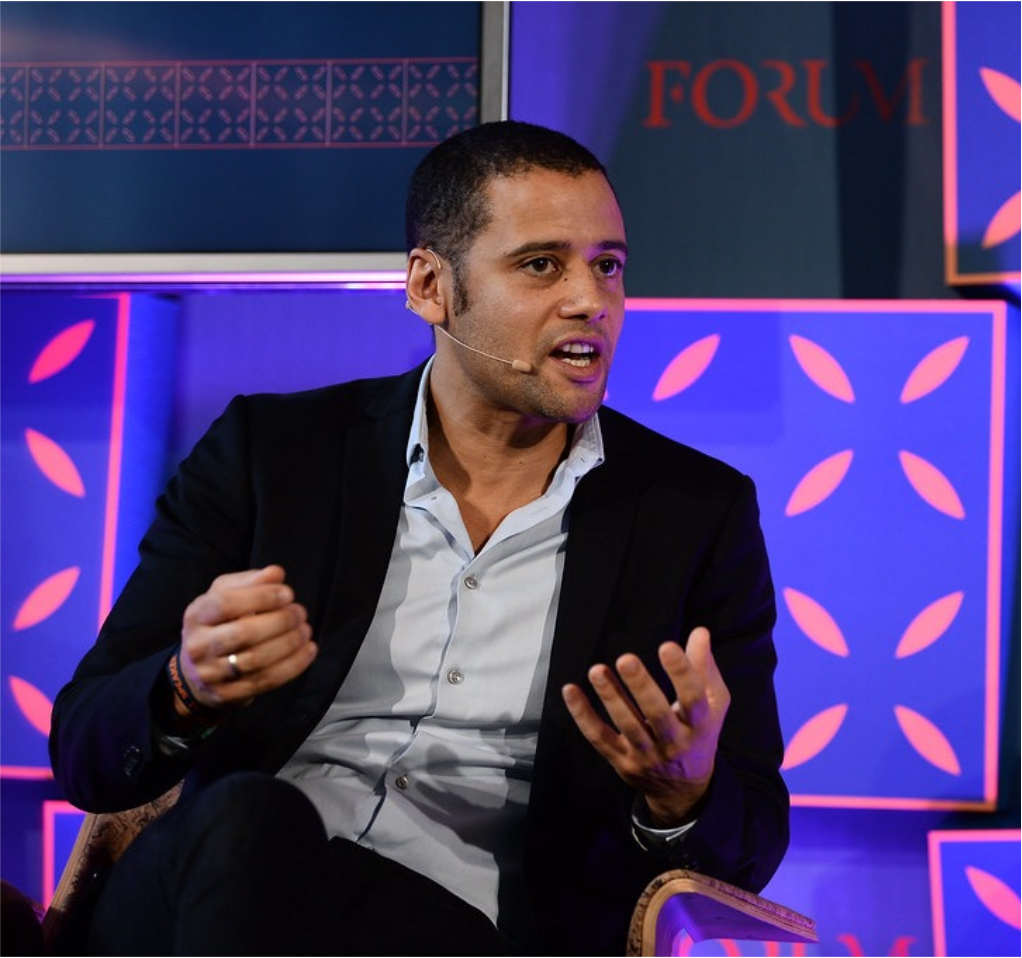
Why has Canada not learned from Europe’s mistakes? “This is a good question,” Mchangama says in the interview. Part of the problem, he believes, lies in the fact that “a lot of people and organizations view tolerance and approval of hate speech as the same thing, even though they’re very different concepts. Jewish groups can and should combat antisemitism, even if hate speech was not criminalized.” [Emphasis added] Echoing a Talmudic principle, Mchangama notes that, “It is free speech that enables counter speech.” Words that Canada should live by.
A Law Better-named the Censoring Canadians Act
Levant goes farther than Mchangama, arguing that not merely the Combatting Hate Act’s likely consequences but its very goal is ridiculous. “You can’t combat hate through legislation,” he points out. “Hate is a human emotion. You can’t ban hate. You can’t ban feelings.”
But you can try. Among other things, the new Act: creates a new offence of wilfully promoting hatred against an identifiable group by exhibiting certain symbols, for example, a swastika, in a public space; enables open-ended creation of further hate crime offences under the Criminal Code or any other Act of Parliament, based on undefined factors; and creates an offence of intimidation to stop a person, or an identifiable group, from entering houses of worship or other places for certain reasons.
“The provisions prohibiting interference with access to houses of worship and religious services are popular among Jews who are regularly harassed by gangs outside synagogues,” notes Ben-Ami, a former policy aide to former Conservative Prime Minister Stephen Harper. “But such harassment is already illegal under Section 176 of the Criminal Code.”
If the newly criminalized acts are already crimes, what is going on? “What’s missing,” says Ben-Ami, “is the will and, dare I say it, the courage to enforce those laws effectively.” Merely expanding the government’s power will do nothing to change that. But it will dramatically expand the scope for selective law enforcement and prosecutions, also known as “two-tiered justice” of the sort that has become infamous in the UK, earning its recently-unseated Labour Prime Minister, Keir Starmer, the derisive nickname “Two-Tier Keir”.
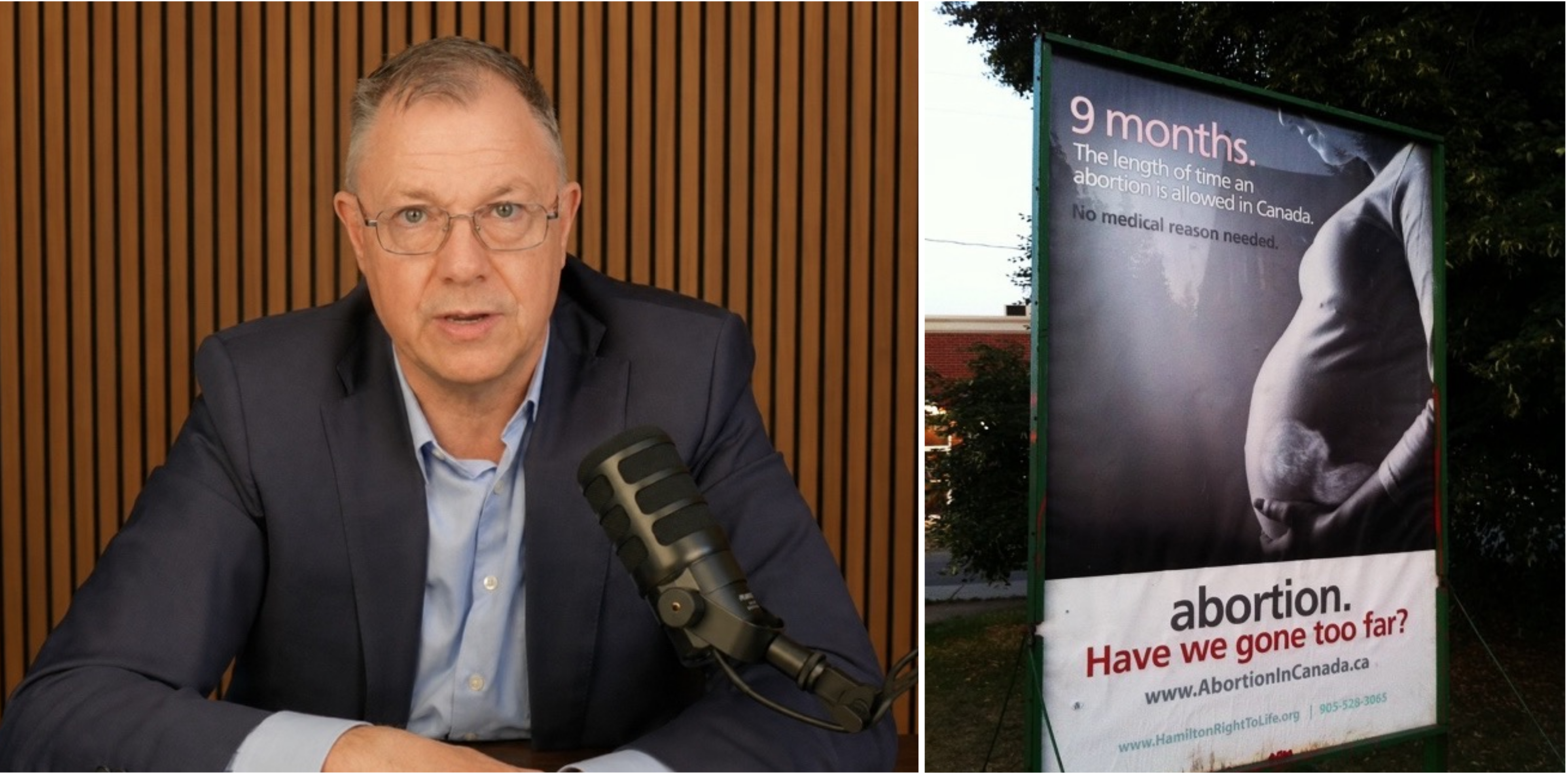
John Carpay, President of the Justice Centre for Constitutional Freedoms, in a telephone interview, predicts the new law will increase the number of Canadians “facing criminal prosecutions for hate crimes, for what people say about immigration on Facebook or what they say about Aboriginal policies or transgenderism or abortion, any of these issues.” Would the issues include statements about Muslims? “Yes,” replies Carpay, whose team takes on many court cases related to free speech, “because restrictions on speech are always political and [focus on] the sacred cows of the day. If you give the government power to censor speech, the government is going to exercise that power politically.” Notably, Carpay predicted all of this months before the Edmonton police proved his point with their self-generated case study in abusive law enforcement.
Still, Levant predicts the Combatting Hate Act will prove “fool’s gold.” First of all, “In the internet age, you can’t really censor things.” Censor something and excitement soon surrounds it, attention spreads, it goes viral, and “you make it blossom.” And “all of a sudden, it’s deemed to be important and dangerous as opposed to dull and boring.” This “forbidden fruit” effect is a real thing studied by academics; formal research into so-called trigger warnings found that flagging “harmful” or otherwise controversial content made people more likely to check it out.
Second, continues Levant, censoring anti-Semitic speech appears to prove one of the vile claims advanced by anti-Semites, “which is Jews control media.” Third, and perhaps most pernicious, “If you do get censorship put into law, that’s most likely going to be used against you. And I say that from personal experience.” As C2C has chronicled here. And as Canada’s Jewish organizations ought to be considering, but apparently aren’t.
Reasons to Oppose Canada’s New Anti-hate Laws
There are many reasons why Jews and Jewish organizations should oppose the Combatting Hate Act, the Online Harms Act/Safe Social Media Act and other measures that expand Canada’s criminalization of hate speech. Here are a few:

That’s not to say there isn’t plenty of hate to go around – as well as outright lawbreaking. “The weekly downtown Toronto pro-Hamas protestors are doing more than protesting,” argues Levant. “They trespass. They utter threats. They commit assault. They organize traffic violations. They sometimes walk through the community screaming at Jewish families, harassing them. There are real crimes: mischief, vandalism, assault, uttered threats. There are real laws on the books…today.” They simply aren’t being enforced.
Officials could also be using existing immigration laws to protect Jews. “They can, if they have to, deport 700 [Iranian] Islamic Revolutionary Guard Corps agents from Canada,” Levant explains. “Immigration laws can also be used for deporting international students or temporary foreign workers who are here as our guests to study or to work, but who are violating their visas and going to these terror marches. In some cases, refugees shouldn’t be in Canada at all. They’re fake.” Again, Canada won’t enforce the laws it does have.
Why Jews Tend to Support Free-speech Crackdowns
As mentioned, Jews remain collectively traumatized by the Holocaust. Prior to the genocide, anti-Semitism and violence were tough facts of life in European Jewish communities. But trying to stop anti-Semitism per se was never a serious consideration, as most Jews knew it was permanent. While they of course beseeched their rulers for help, they concluded that they simply had to learn to live with it, as they had already for over 3,000 years.
In the mid-1800s serious political discussions arose to restore Jewish sovereignty in their ancient homeland, where there had been a continuous Jewish community for 3,000 years but, since Roman times, no independent government to protect it. Once Israel was established, it was thought, Jews the world over would move there, where they would no longer be a minority subject to the whims of a hostile population or government. That homeland – the State of Israel – was established on May 14, 1948. Jew-hatred remained rampant in the surrounding nations but, following the revelation of Nazi Germany’s atrocities, overt anti-Semitism became taboo in the West.
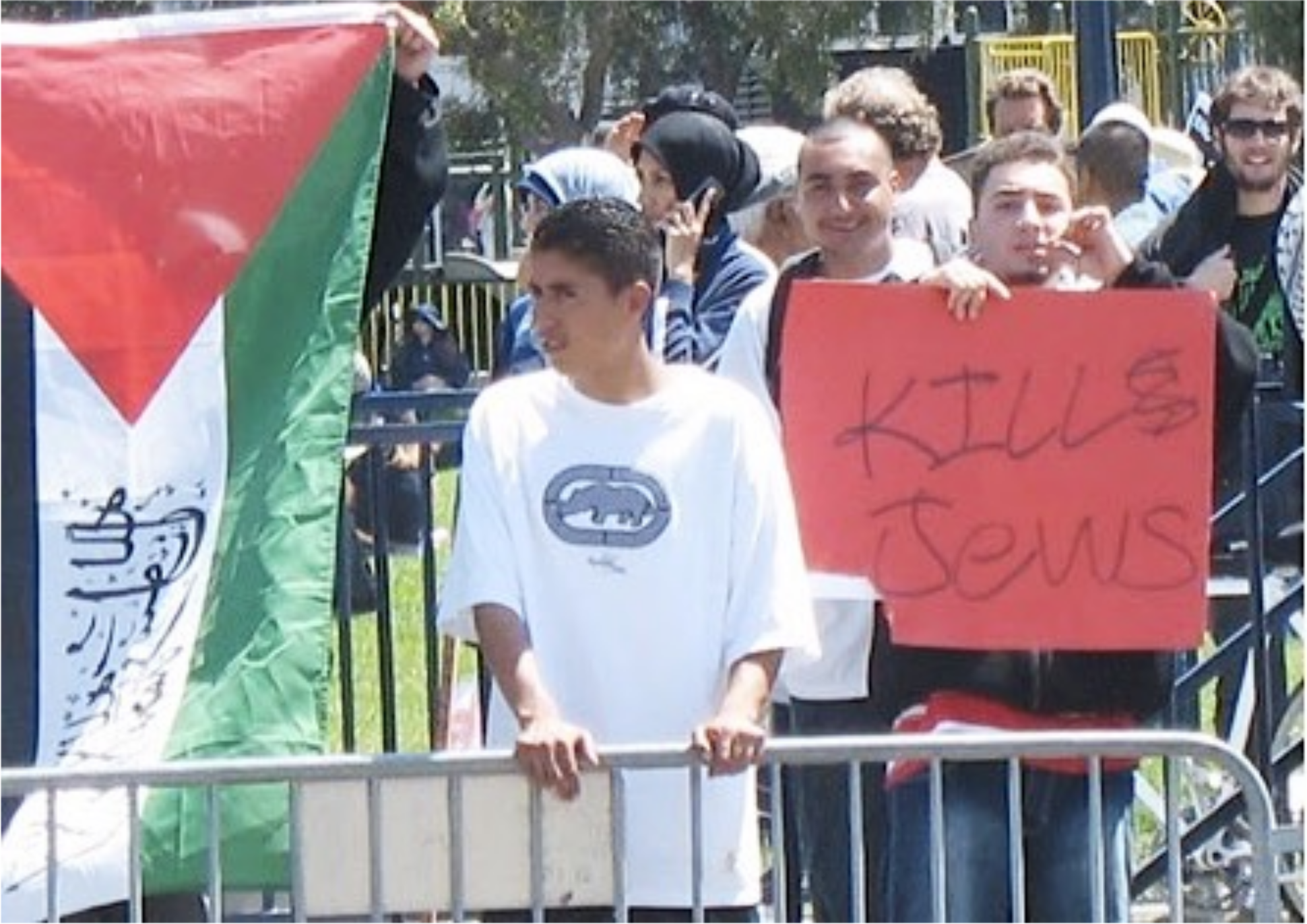
That is perhaps why today more than half the world’s Jews – about 8.5 million – still live outside Israel and the majority want to stay where they are. More than 7 million of these are in the U.S., where they are protected by government better than Jews anywhere else in the world outside Germany and Israel, as detailed in this two-part series. Diaspora Jews, including the 400,000 in Canada, understandably want to feel safe and accepted by the overwhelming number of non-Jews around them.
North American Jews lived nearly 80 years – until October 7 – without serious anti-Semitism being thrown in their faces. As the years passed, however, new generations emerged with little or no direct knowledge of the Holocaust. For them, Nazi Germany and the Second World War were just chapters in a history textbook, the Holocaust a footnote.
Gradually beginning in the 1970s, and then suddenly after October 7, the old anti-Semitic slurs and libels resurfaced, triggering a deep-seated fear among Jews that without action – including strong anti-hate laws and punishments – history might repeat itself. Hopefully not another Holocaust, but definitely a return of institutional bigotry and anti-Jewish riots and vandalism. The natural reaction with entrenched victimhood – particularly among secular Jews – is to default to a progressive mindset: we need to change attitudes, to win over our opponents.
Canadian Jews in the postwar period focused on education, hoping that teaching students about the horrors of Russian pogroms and the Nazis’ “Final Solution” would mould a generation that rejected anti-Semitism. And it seemed to work for a time. Pro-Jewish cultural elements helped as well, whether it was the lovely singing of Barbra Streisand or the deeply moving, tragi-comic shtetl in Fiddler on the Roof.
 The horrors of Nazi Germany’s Holocaust pushed anti-Semitism down to all-time lows through the West; it began to re-emerge in the 2000s, however, and exploded following the October 7, 2023 Hamas massacre of over 1,200 Jews. Shown: (top left) Nazi officer beside a placard reading, “Germans, defend yourselves, do not buy from Jews,” outside Jewish-owned department store in Berlin, April 1933; (top middle) anti-Semitic graffiti on Jewish-owned store in Norway, circa 1941-45; (top right) Jewish prisoners at Wöbbelin concentration camp, May 1945; (bottom left) anti-Israel protester at pre-match gathering before World Cup soccer game in Toronto, June 2026; (bottom middle) anti-Israel graffiti at Gail’s Bakery in London, UK, February 2026; (bottom right) anti-Semitic threat mailed to Friendship Circle Las Vegas, May 2025. (Sources of photos: (top left) National Archives via pingnews.com; (top middle) U.S. Holocaust Memorial Museum; (top right) National Archives; (bottom left) Christopher Penler/Shutterstock; (bottom middle) Combat Antisemitism Movement)
As the Jewish community lobbied for the incorporation of formal Holocaust Studies into school curricula, though, other communities began to demand that their history of victimization be included as well. The results included watered-down modules in social studies with titles like “Man’s Inhumanity to Man”, wherein the unique character of the Holocaust was lost. Worse, rather than reducing anti-Semitism, the often-acrimonious surrounding arguments prompted accusations that Jews considered their history, and themselves, to be special, a level above the rest.
What’s Up with Canada’s Jewish Organizations?
The lingering victimhood mindset appears to have fostered the determination of secular Jewish organizations to promote hate-speech laws, anti-Semitism education and tight restrictions on protests – despite the recurring failure of this decades-old approach. To take one of many data points, within a week of the start of the war against Iran’s regime anti-Semitic incidents rose by 34 percent worldwide. One reason is that, no matter how much anti-anti-Semitism materials you crank out, Canadians can watch and listen to Jew-haters online all-day long; American podcaster Tucker Carlson’s impact and audience grow almost daily. As one New York Times writer observed recently, “In New York State, 1 in 5 millennials and Gen Zs believe the Jews caused the Holocaust.”
“It’s tough to be for free speech if you’re Jewish because there’s so much anti-Semitism,” Levant acknowledges in the aforementioned interview. “It is human nature to try and stop it. If you can’t persuade someone to stop, then you try to compel them to stop through some rule or censorship. But freedom of speech is the kind of thing that if you want it for yourself, you have to give it to your opponents. And that is the hardest thing in the world to do.”
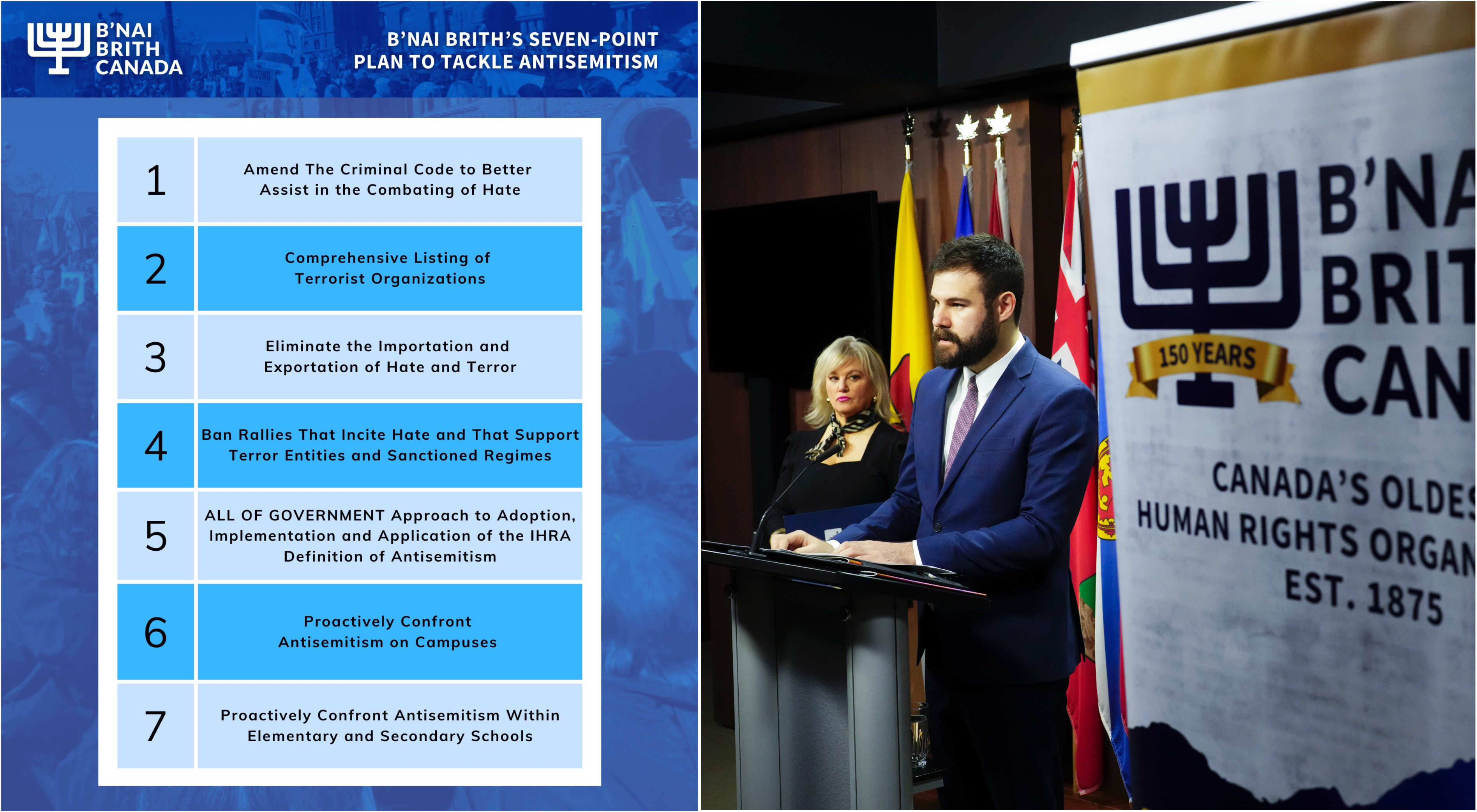
Far too hard, indeed, for Canada’s largest secular Jewish organizations. Perhaps sensing they’re losing the information war, they’re placing their fate ever-more in the hands of government. “We continue to call on Parliamentarians to build consensus and move forward with urgency,” leaders of five Jewish groups jointly stated in a CIJA press release last December. “Our organizations welcomed [Bill C-9’s] intention to contribute to a safer Canada and supported in principle the legislation’s attempt to achieve that outcome.” Their principal beef, as indicated in the press release, was that the Combatting Hate Act didn’t go far enough.
The belief that government policies and levying of criminal charges can significantly reduce anti-Semitism in Canada is now a pillar of the large Canadian Jewish groups. The sheer number of letters and press releases and reports and documents these groups publish attests to that. B’nai Brith Canada – though its mandate includes important charitable work such as alleviating poverty and providing homes for the aged – appears devoted to influencing government to shut down free speech and tighten hate-speech laws. CIJA (a follow-on to the defunct Canadian Jewish Congress) likewise subscribes to the government-must-help-us cause. Earlier this year I was receiving a total of about ten urgent emails a week from both groups.
 Conservative MP Roman Baber (left) calls out Prime Minister Mark Carney for pushing the Combatting Hate Act legislation while “rewarding the brutality of Hamas” by recognizing a Palestinian state (shown at right at a UN meeting, September 2025). (Sources of photos: (left) The Canadian Press/Adrian Wyld; (right) AP Photo/Yuki Iwamura)
Conservative MP Roman Baber, a Jew who fought hard against the Combatting Hate Act throughout its gestation, agrees. “I’m disgusted by this Liberal government, how it pretends that the Jewish community, once Bill C-9 passes, [will benefit from it],” the MP for York Centre said after recent House of Commons committee hearings. “Nonsense…When the Prime Minister recognized the Palestinian state, he rewarded the brutality of Hamas and he did so on the eve of [the Jewish holiday of] Rosh Hashanah.”
Final Thoughts
As a Jew, it is difficult for me to admit that the two loudest and largest Jewish groups in Canada have fallen lockstep behind the government’s retreat into anti-free speech policies. As shown above, there’s little evidence Canada’s existing hate-speech laws have served their intended purposes. The 1970 criminalization of hate speech in response to neo-Nazism did not prevent a subsequent surge of anti-Jewish sentiments that then motivated the 2022 criminalization of “wilful antisemitism”. It in turn did nothing to prevent the shocking explosion of Jew-hatred following October 7 – a failure that did not stop politicians and lobbyists from misusing the atrocity to bolster the case for the Combatting Hate Act and Online Harms Act.

To many, it seems anarchy is slowly taking over. So it’s no wonder Jews are looking to the government for safety. But it won’t work. It never has. Dare I say, quietly and humbly, it’s almost like the Jewish organizations are desperate to appear like they are doing something to conquer anti-Semitism so Jews will continue to donate so they can continue to appear like they are doing something to defeat the scourge. These organizations claim to be looking out for Jewish interests across the country but, except where they help the poor and the elderly, they are not doing what they claim. It is harsh criticism, but as shown, it is hard to describe the anti-Semitism industry any other way.
What to do? Bret Stephens, a Jewish opinion writer for The New York Times who coined the term “October 8thJew” to describe those greatly altered by the horrific event, is calling openly for the dismantling of America’s mainstream secular Jewish organizations, whose response to rising anti-Semitism is broadly similar to Canada’s. “History’s most demented hatred,” Stephens concludes, simply cannot be eradicated. Accordingly, members of the Jewish community need to refocus: “Raise proud Jews, not scared Jews.” As for speech? Keep it completely free – consistent with ancient Jewish law and practice. Amen to all of that.
Lynne Cohen is a non-practising lawyer and journalist. She has written seven books, five of them published, including the ghost-written Holocaust memoir The Life of Moshele Der Zinger: How My Singing Saved My Life.
Source of main image: Shutterstock/AI.