When I talk to fellow Canadians about education it is rarely an optimistic conversation. Our public schools and post-secondary institutions suffer from many ailments. There are perennial complaints about funding, classroom sizes and tuition fees. There are other concerns: what is being taught, how and why. Many Canadians worry about curriculum, ideology and declining standards.
Consider a few things we have witnessed over the last decade. Teachers’ unions circulating materials meant to undermine our armed forces and discourage recruitment. School boards spending time and money on an intrusive census asking students who had yet to enter high school about their sexual identities and how they conceal their anatomy. A human rights commission lambasting an education system for abandoning evidence-based techniques, finding that a whole province “is systematically failing students with reading disabilities and many other students.” The steady decline of Canada’s educational performance as measured by the respected Programme for International Student Assessment.
The list goes on. From a teacher sporting enormous prosthetic breasts in class to textbooks claiming that math is subjective and racist, something is amiss. Post-secondary institutions are equally afflicted. We can find a graduate student being subjected to a disciplinary procedure because faculty fabricated a student complaint, worries about neutrality and partisanship, and the resignation of faculty who can no longer stomach their workplace.
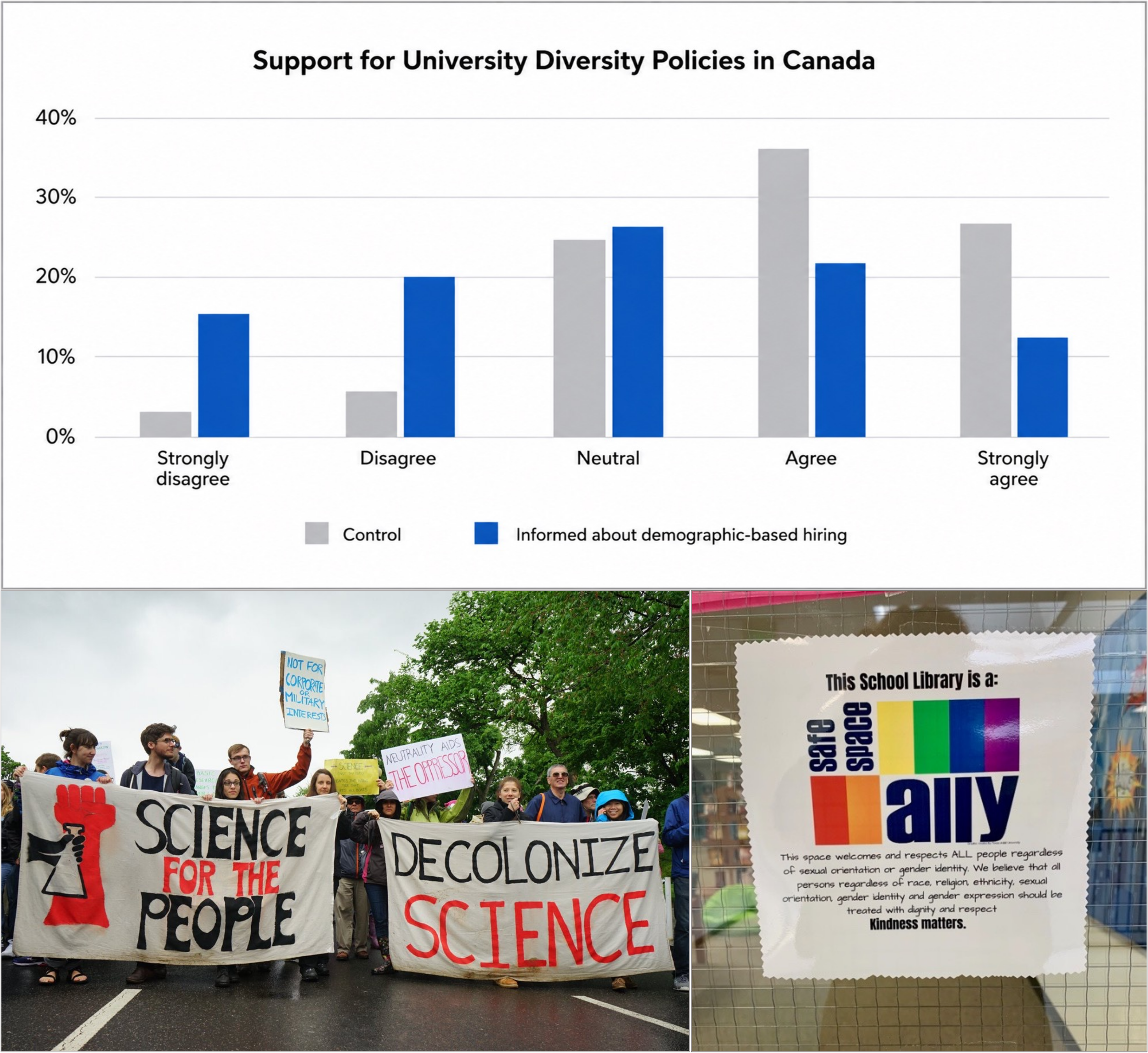
The bad news gives credence to the belief that education in Canada, infested with ideology from the earliest years of primary school to the advanced seminars of graduate school, has ceased to fulfil its former mission of teaching students how to think rather than what to think. The more Canadians learn about how higher education operates these days, the less they like it. In a 2025 report probing attitudes towards the use of DEI criteria in faculty hiring, researchers Brad Epperly and Geoffrey Sigalet found that “[a]s Canadians learn more details about how demographic-based hiring practices are used in the university sector, their support declines.”
It can be challenging to keep one’s head and think dispassionately when faced with what looks like an endless list of scandals and failures. Yet, it is foolish to hastily draw conclusions. As we shall see, education is not an ideological and political monolith. Teachers and professors do not all agree or hold the same views. Nor is it the case that all of the false beliefs and bad practices made their way into our classrooms in the same way. Canadian education is ailing. But no good treatment ever follows from a bad diagnosis.
Through the Looking Glass: The Trigger Warning
One way to explain what is happening is to begin with a case study. We will examine how the “trigger warning” – an unscientific, deeply ideological and unhelpful practice – spread across North America. By focusing on this area in detail, we should be able to gain better insight into how things actually go wrong in our schools.
From modest beginnings as a self-help measure in online discussions nearly 30 years ago, trigger warnings grew into a shibboleth and political symbol. To use trigger warnings or publicly promote them became a way of signalling one’s “progressive” credentials. By the mid-2010s, progressives were making their case in flagship publications to win over the public. Kate Manne, professor of philosophy at Cornell University, defended them in The New York Times. In The Guardian, Onni Gust, a historian at the University of Nottingham, rebutted critics who opposed such coddling of students. The UK’s leading progressive paper also had activist and comedian Lindy West reassure readers that trigger warnings were not a contraction of free speech, but an expansion of it! Today, various race and gender studies and education academics continue to crank out papers promoting their merit.
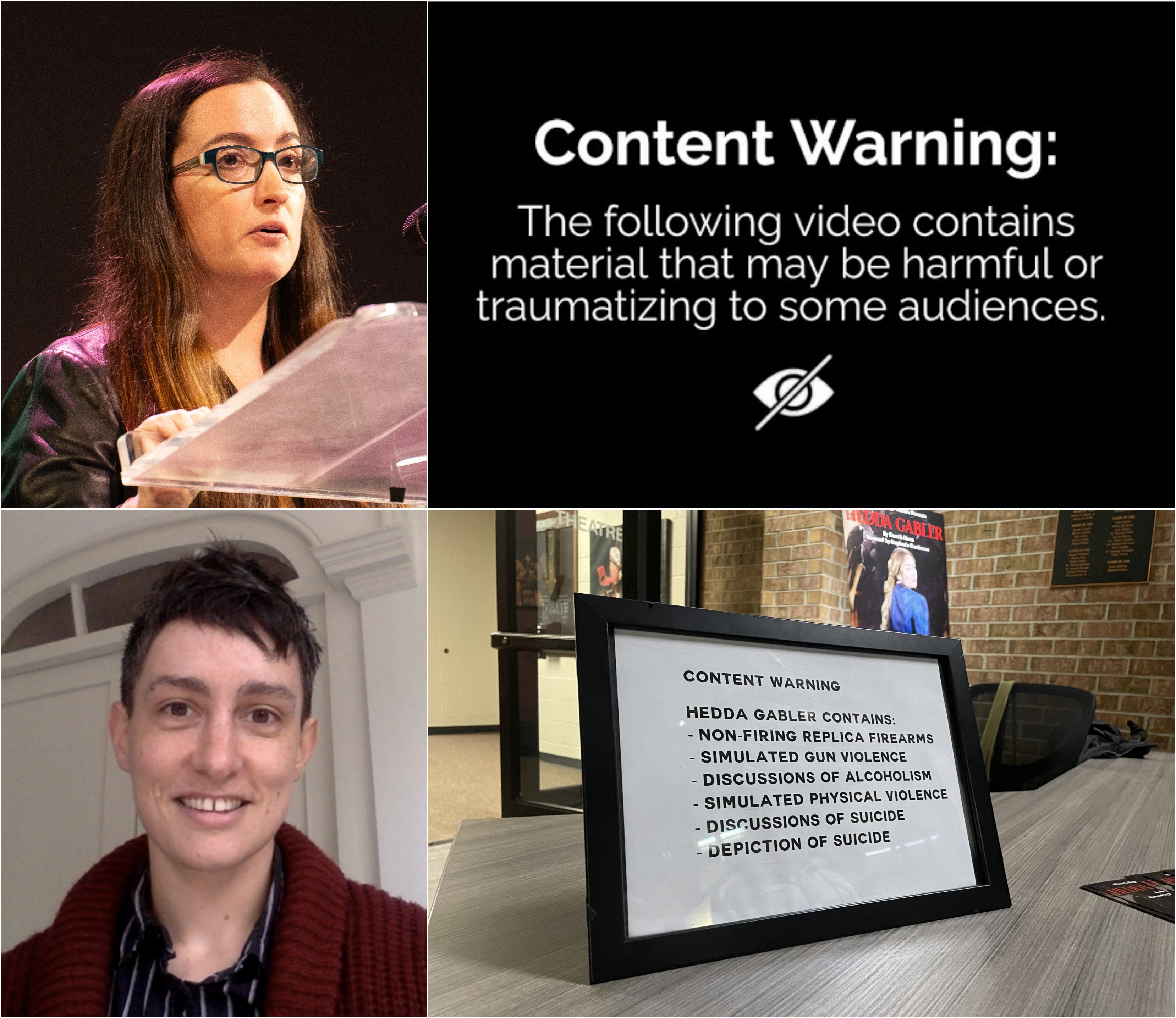
What is a trigger warning? The ideal trigger warning is captured by three claims. First, it is addressed to people whom we consider particularly vulnerable. The very reason they are called “trigger” warnings is that they were invented to help those suffering from post-traumatic stress disorder (PTSD) avoid being “triggered” – i.e., to experience an intense and distressing reaction from being reminded of a traumatic experience. Trigger warnings are – or purported to be – addressed to the psychologically vulnerable, making the term fraught with significance and looming consequences.
Second, the presence of a trigger warning is meant to alert the vulnerable of an upcoming threat. Note that they are alternatively called “content warnings” because the underlying presumption is that the impending content – be it text, audio, pictures or video – represents a particular threat to the wellbeing of the psychologically vulnerable.
And third, a trigger warning is supposed to benefit the vulnerable. The idea is that the traumatized are better off with a trigger warning than without one. Concretely, warnings such as “TW: the following discusses sexual assault” and “Content warning: this film contains depictions of domestic violence” are trigger warnings. By contrast, statements like “Warning: sharks may be present” and “This material is radioactive” are not trigger warnings because they identify objective threats that are actually harmful to us all rather than things that might be harmful to those suffering from a particular psychological vulnerability.
It is easy enough to understand the desire to help those who are vulnerable or weaker than ourselves. Those with PTSD go through their days with a heavier burden than the rest of us. On the other hand, it is far from obvious why and how trigger warnings actually help. What about them makes them helpful? And so, we need to assess the arguments in favour of trigger warnings. What do their proponents say, and do their claims hold up to critical scrutiny?

Three arguments are commonly presented: the avoidance argument, the coping argument and the learning argument. We need to be careful, however. In truth, the avoidance argument is more of a caricature than anything else. It holds that trigger warnings are valuable because they allow the psychologically vulnerable to opt out of difficult conversations or experiences before they begin. The problem is that it is far easier to find critics objecting that trigger warnings will promote avoidance of difficult material than to find anyone defending trigger warnings for this reason. And in fairness, proponents like the above-mentioned Gust deny this is their purpose at all.
Instead, proponents tend to stake their claim on one or both of the following arguments. First, they claim that trigger warnings reduce harm. When traumatized persons encounter a trigger warning, they become aware of a likely threat to their psychological wellbeing. Once informed, they can effectively counteract it by using coping techniques to lessen the psychological costs of engaging with the distressing material. In short, trigger warnings help the previously traumatized prepare, cope and thereby reduce the negative impact.
The second argument builds upon the first. If the traumatized are adequately warned about upcoming content, and if they use their coping techniques to mitigate the effects of the distressing material, then trigger warnings are doing double-duty. By enabling effective coping, the trigger warnings help the vulnerable student or other content consumer continue to engage as much as possible with the material. Put succinctly, trigger warnings ultimately deliver learning outcomes.
These are both instrumental arguments. The basic idea is that it is good or rational to use trigger warnings because they help us achieve something valuable: reducing psychological harm and improving learning. On the face of it, it is easy to see why trigger warnings can seem so attractive to many in education.
Reality, however, does not conform to these high-minded aspirations. There are two basic problems with these instrumental justifications. First, they do not help as their defenders claim. Second, the weight of evidence indicates that their use is mildly harmful to those they are meant to protect. We know these unfortunate facts because we have a growing body of research on the topic, including a meta-analysis on the effects of trigger warnings.
While meta-analyses are becoming better known, a quick refresher: a meta-analysis is a systematic analysis of the available findings to date on a given topic or question, combining the results of multiple quantitative studies. When used correctly, a meta-analysis produces more thorough and accurate results, avoids “cherry-picking” hoped-for data or relying on incomplete analyses, and helps the researcher address conflicting findings.
In their 2023 A Meta-Analysis of the Efficacy of Trigger Warnings, Content Warnings, and Content Notes, Victoria Bridgland, a lecturer at Flinders University in Adelaide, Australia, and co-authors reviewed 12 peer-reviewed articles covering 24 individual studies. Their findings are eye-opening. First, there is no evidence that trigger warnings help the psychologically vulnerable cope: “11 of the 12 articles conclude that warnings were ineffective at their proposed goals.” The sole exception ambiguously concludes that warnings “introduce difficult-to-weigh trade-offs.” Interestingly, other researchers have produced findings supportive of the meta-analysis. In short, when the results of multiple studies were pooled and analyzed, there was simply no clear evidence that trigger warnings help the vulnerable manage their psychological state.
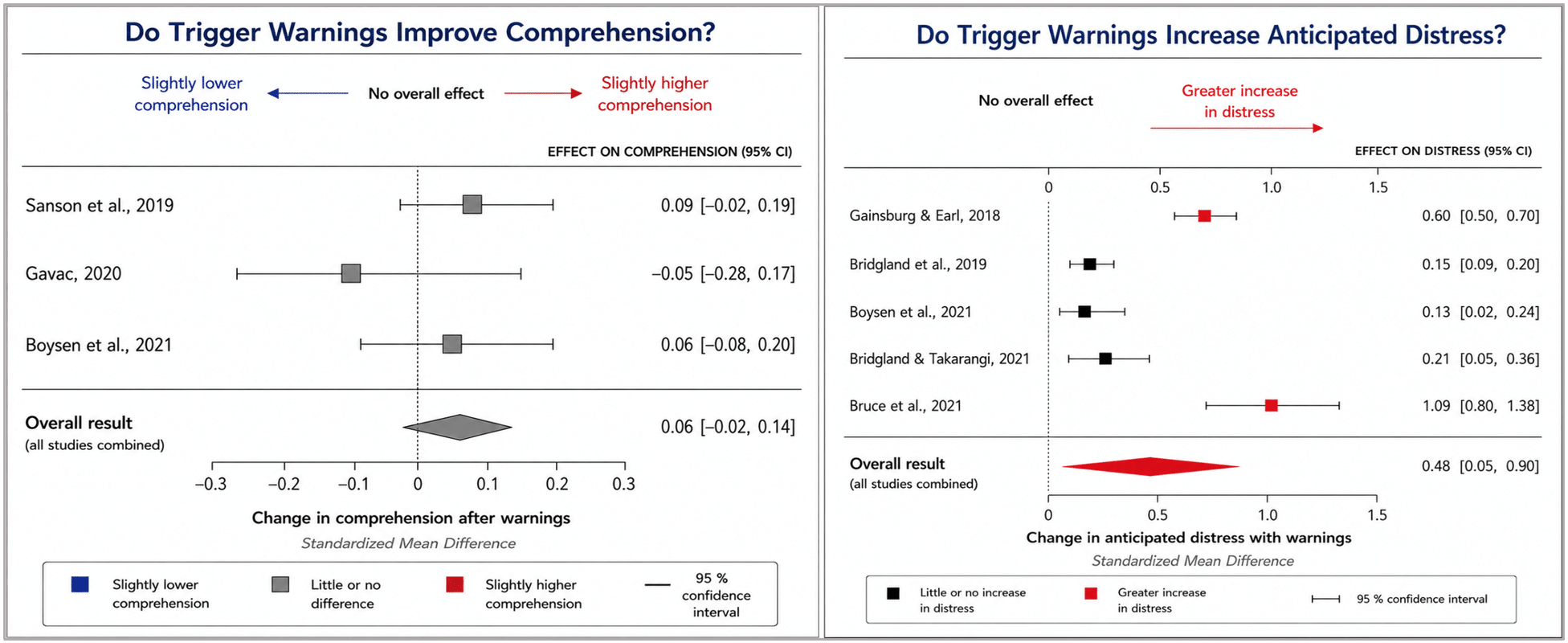
The meta-analysis’ second important finding is that there is no evidence trigger warnings contribute to better learning outcomes. Four of the articles evaluated contain studies assessing the impact of trigger warnings on comprehension. Here too, the results are clear: trigger warnings “had a trivial or null effect.” Third, Bridgland and her colleagues found, trigger warnings do not promote avoidance of “triggering” content. In fact, they appear to generate a “forbidden fruit” effect: a warning tends to prompt more engagement with the ostensibly risky content.
The only obvious effect the meta-analysis did find was negative. Trigger warnings raise the “anticipatory” anxiety of the psychologically vulnerable, making those they are supposed to protect temporarily more anxious. “Overall, we found that trigger warnings had no meaningful effect on response affect, avoidance, or educational outcomes (i.e., comprehension),” the study states. “However, trigger warnings reliably increased anticipatory distress before viewing material.” [Emphasis added]
In summary, the best science we have has concluded that trigger warnings do not help anyone cope, learn or avoid potentially risky content – but they do make some people pre-emptively uncomfortable. Recall that trigger-warning proponents claim they are good tools to reduce harm and improve learning. Instead, they actually produce mildly more psychological distress among the (allegedly) psychologically vulnerable and no discernible good educational effect. This is terribly damning.

We should note another cost of trigger warnings: they poison our interactions with art. As a 2025 study also co-authored by Bridgland found, “[They] substantially increased all negative emotions (and decreased all positive emotions) in response to art,” with the result that they “decreased aesthetic appreciation.” That trigger-warnings lessen our experience of what should be an accessible good and a source of personal enrichment is not particularly surprising. Nor is it anything to celebrate.
The fact that the findings of various research teams working at different times and places all point in the same direction gives us strong confidence that trigger warnings do not work. The evidence is not mixed; the findings are not split down the middle. A systematic review shows that they do no good, produce mild harm and have additional negative consequences.
Yet this scientific consensus is also disconcerting. Why did educated professionals from primary school teachers to university professors adopt junk-science as a widespread pedagogical practice?
No Science – Not Even Fake Science!
Trigger warnings emerged sometime in the late 1990s among online communities discussing trauma; they were created by amateurs as a measure of self-help. Their big moment came in 2014 when the student senate of the University of California Santa Barbara (UCSB) passed a motion urging instructors to use trigger warnings.
It took roughly two decades for trigger warnings to go from amateur self-help in chatrooms to an official student demand in the prestigious and influential University of California system. Within just two more years, half of American college instructors reported having used trigger warnings. The practice had also made its way to Canada by this time, as C2C’s Brock Schnurr recounts in this essay about Queen’s University.
A crucial reminder: when the UCSB’s student representatives officially called for the routine employment of trigger warnings, there existed no credible evidence that they even worked. Their demand thus was not evidence-based. The earliest paper cited in the above meta-analysis came out in 2018 – four years after these California students appointed themselves mental health experts.
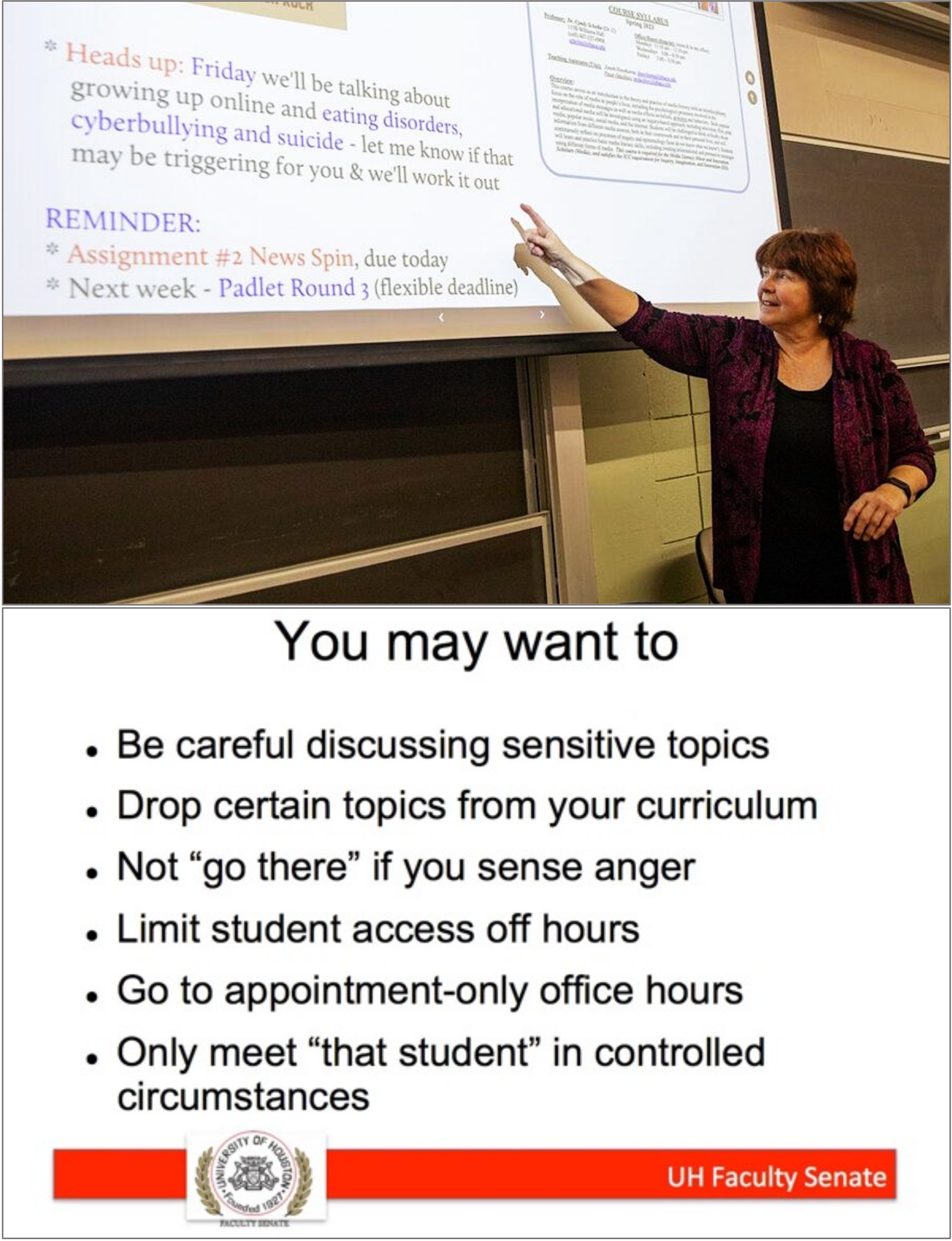
Trigger warnings instead spread through activism and assertion. Their defenders did not appeal to any empirical evidence or anything resembling a systematic review of the evidence. Mostly they advanced emotional arguments appealing to people’s desire to “help” the vulnerable. At best, they could include some anecdotes, many of which were self-reports. Self-reporting is notoriously unreliable, and does not comprise credible evidence, let alone a case for official action. Make no mistake: for any technique or treatment, no matter how odd or unproven, someone will report that it worked.
What is shocking is that teachers and professors went along. They are university-educated professionals, ostensibly trained in critical thinking and research methods. We employ them to teach others how to analyze and assess arguments, conduct research, reason logically and exercise sound judgment. Therefore, when someone claims that some new practice or technique has wonderful effects or alleviates suffering or brings about more equality in the world, we can and should expect educators to know how to apply appropriate skepticism, ask probing questions and think for themselves.
No government, national or sub-national, mandated the use of trigger warnings. Nor can we find many universities actually imposing their use. Nor did trigger warnings spread because of some early research that reported favourable results that were later disproven. This is an interesting contrast with contemporary scepticism towards vaccines. When UK gastrointestinal surgeon Andrew Wakefield published an explosive paper purporting to find a link between the measles-mumps-rubella (MMR) vaccine and autism, those who were taken in were not entirely at fault.
Wakefield’s fraudulent research and unsupported findings were published in a highly selective medical journal, The Lancet. This is precisely the kind of institutional stamp of approval that amateurs and professionals alike tend to trust. None of us can possess expertise on everything. Consequently, all of us must regularly identify the relevant experts and defer to their judgment. Those fooled by the Wakefield article were simply deceived. Fortunately, Wakefield was exposed, delicensed and disgraced in the UK, though he continues as an anti-vaccine activist in the U.S.
With trigger warnings, unfortunately, there has been no Andrew Wakefield, no retracted paper, no discredited science. There never was any research to support this pedagogical practice to begin with – not even fraudulent research! Whatever one wants to call trigger warnings as a practise, they are not evidence-based.
The Conformists
Once we rule out what cannot explain the spread of trigger warnings and we look at some of the available evidence – like a student senate pressuring its institution’s entire faculty – we come to the best remaining explanation: conformism. Let us unpack what conformism is and how it works.
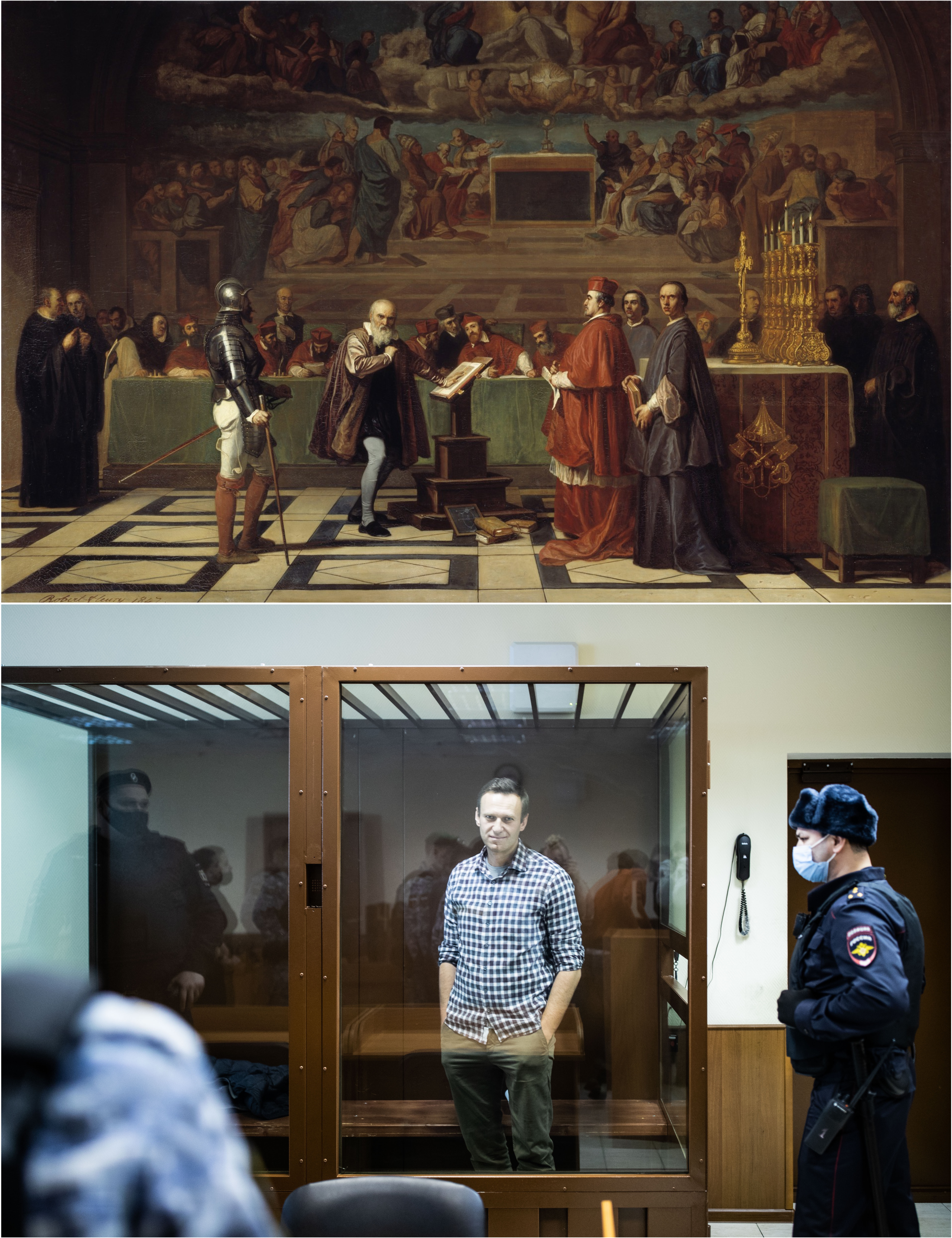
There are two kinds of conformism: strategic and non-strategic. The former is what we think about when we are being judgmental. We know that people go along to get along, that people say and deny things, that they emote and act, all to avoid exclusion and punishment. People constantly conform because the cost of non-conformism can range from discomfort to death. Being mocked in high school or excluded from work parties is one thing, but Socrates, Galileo and Alexei Navalny paid a far higher price for refusing to conform.
Strategic conformism is ubiquitous, from the banal keeping of the peace at home or work, to biting one’s tongue when everything is on the line. Such conformism can appear prudent or pusillanimous, depending on what is at stake. Long before Donald Trump was elected, many Americans masked their views on immigration. In fact, we know that left-leaning Americans (termed “liberals” in the U.S.) are quite likely to lie to avoid social costs. According to one study published in 2010, “26 percent of liberals claim to support cutting off immigration in response to a direct question, 71 percent of liberals support immigration restrictionism as measured by the list experiment, a difference of 45 percentage points.” Strategic conformism is common, and left-leaning individuals seem more likely to engage in it.
Non-strategic conformism, by contrast, is not motivated by fear. It is not the tool of the timid, the shy or the social climber. Rather, non-strategic conformism is an essential part of our social lives. As I’ve discussed, none of us can become experts on anything and everything. There needs to be a division of intellectual labour. Given this inalterable fact, we all need to defer to the judgment of others. We do what others do, we believe what they believe, because deference and trust are essential to our social lives.
The spread of trigger warnings is explained by both strategic and non-strategic conformism. There is no denying there are activists in public education and post-secondary institutions. There is scant evidence, however, that they represent let alone form the majority. Most educators have little time and energy to engage in ideological polemics or proselytizing. Try to consider what the average teacher in public education might look like. They are likely to be more left-leaning than the average citizen. They are passionate about some field or topic that they wish to share, and genuinely believe that education is a way to a better world.

It is also the case, however, that the average teacher consistently has to deal with administrators and parents in addition to their pupils. Discipline issues can and do derail an ordinary lesson. Rumours and commentary that might once have been mere gossip are amplified through social media. Extracurricular duties can be both incredibly rewarding and draining. And teachers, like the rest of us, must deal with disruptive technology such as generative AI.
While teachers are neither literal nor figurative “soldiers” of education, a passage by George Orwell on what the average soldier experiences is worth meditating on. Reflecting on his service during the Spanish Civil War, Orwell paints a realistic picture: “A soldier anywhere near the front line is usually too hungry, or frightened, or cold, or, above all, too tired to bother about the political origins of the war.” Neither Nationalist nor Republican troops, Orwell found, were all fanatics whose political views followed nicely and neatly from some great creed. It’s quite likely that in wars generally, most soldiers know or understand little about the justice of their war, and think little about it. Their concerns and fears are too pressing, too immediate, too normal for them to get lost in abstract debates about right and wrong, good and evil, progress or reaction.
I believe this prosaic portrait applies also to many professions that we too easily caricature. The average teacher is too focused on children struggling, on entitled or confrontational parents, on meddlesome administrators, on some upcoming holiday or fieldtrip that cuts into their class time, too tired from grading and staying up late to prepare some underfunded event, to wake up each day and fight for “social justice”.
Consider for a moment how pedagogical days go. Students are given the day off as teachers engage in “professional development”. Between profiteers who are peddling so-called training based on little theory or evidence, and academics peddling bad research, teachers are set up to fail. They are given a talk by an expert, but they are not given much time to reflect. Unlike at academic conferences, the tone and expectations are not propitious to sustained criticism.
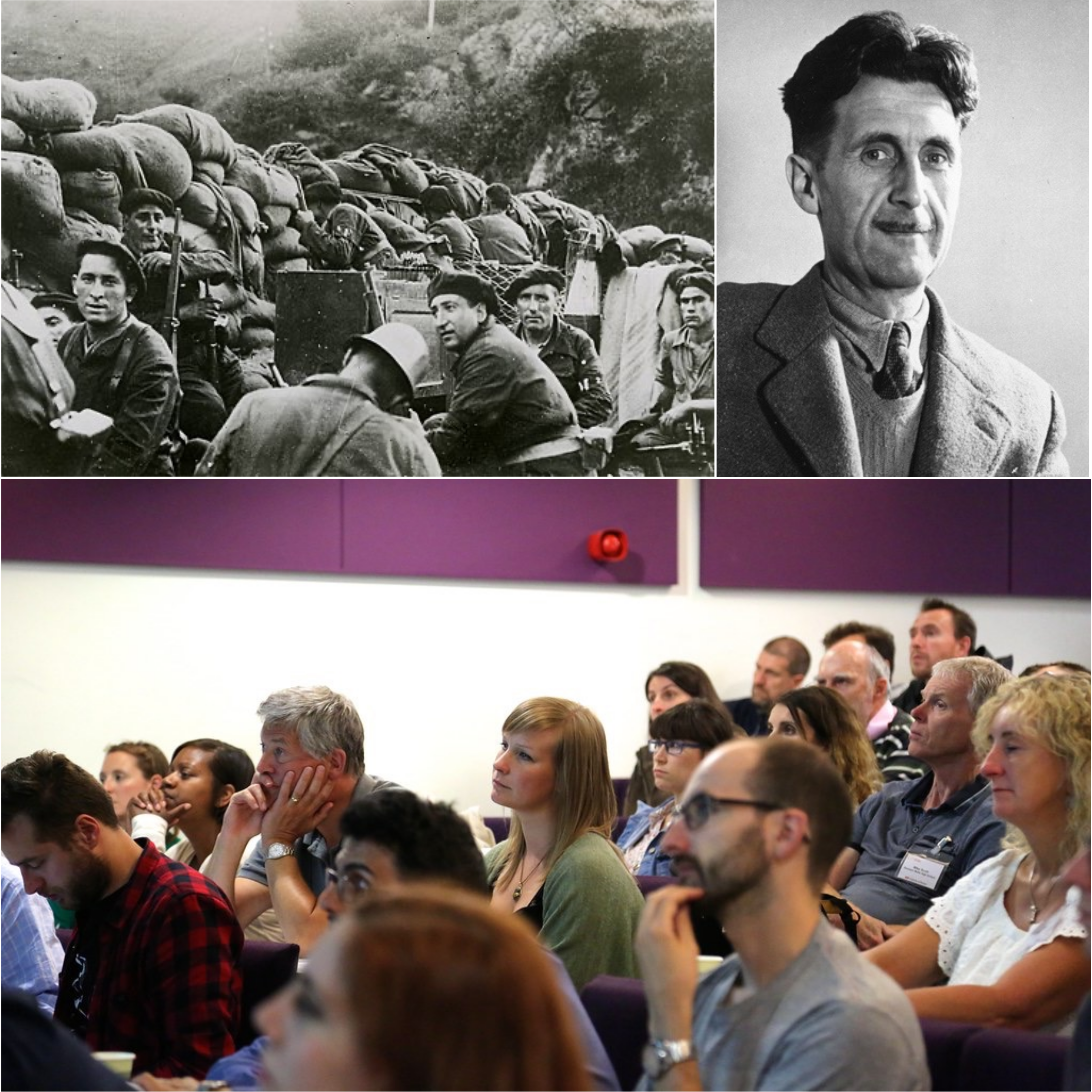
Imagine being a mathematics teacher with an undergraduate degree from a local university. Today some speaker is summarizing the views defended by Jo Boaler, a professor of mathematics education at Stanford University. Further imagine that you are being told that this far more accomplished scholar thinks that your old-fashioned way of teaching math is harmful and oppressive. The aforementioned Boaler, it turns out, also happens to be one of the architects of teaching reforms that seem to be spectacularly failing.
But does anyone seriously believe that this typical teacher has the time, energy and motivation to read the fundamental research, identify its flaws, wade into a controversy and then challenge the keynote presentation? And so, year after year, teachers all across the country are subject to what is essentially misinformation and indoctrination. Again, and again, and again.
The Charlatans
Trigger warnings are actually the tip of the iceberg. Remember, this article is employing them as a case study into the wider problem; they are by no means the whole problem, or even the worst aspect of the problem. Consider the theory of “learning styles”. According to its adherents, we do not all learn the same way. Thus, education based on a one-size-fits-all model of learning is deeply flawed. Yet there never was any strong evidence or well-conducted research to support such a claim. People express preferences for learning in certain ways, but the evidence (see here and here) is unambiguous: there are no educational gains from teaching people according to their so-called learning style. The most charitable thing we can say is that do-gooders confused preferences with outcomes and then went about spreading misinformation.
This is not all. There has been long and ongoing disagreement about how to teach students how to read. The dispute is between the historically dominant sounding-out-loud method of phonics instruction and its newer rival, whole-word or whole-language instruction. The problem is that the empirical evidence is incompatible with a debate. The findings are not equally stacked. Overwhelmingly, the evidence (see here and here) favours the phonics approach to reading. And yet whole language has been widely used in Canadian schools for several decades.
![Bad ideas die hard: North American education – Canadian education very much included – is awash in debunked yet persistent false beliefs and ineffective practices, such as “learning styles” and Howard Gardner’s (middle) “multiple intelligences theory” – which a scientific evaluation concluded is “a neuromyth that should not be taught to teachers…[nor] used in the classroom.”](https://c2cjournal.ca/wp-content/uploads/2026/08/Inset10.svg "critical-thinking_canadian-education_trigger-warnings_image-10")
Or perhaps you have heard about “multiple intelligences theory” by Howard Gardner, a professor specializing in developmental psychology at Harvard University. For years, Gardner advanced and popularized the idea that we have multiple, independent brain-based forms of intelligence rather than a single general – and measurable – ability. In the traditional view, a person’s intelligence quotient (IQ) score provides a reliable picture of cognitive ability. According to multiple intelligences theory, there is no general ability.
Instead, there are eight kinds of intelligence. While you might have a low or middling IQ on one metric, like logical-mathematical or linguistic intelligence, you might score highly on musical or interpersonal “intelligence”. (The trendy “emotional intelligence” we’ve all heard about is not a Gardner invention.) This “theory” is unserious. First, there is no empirical support for its grandiose claims. Second, the claims are incompatible with well-established findings about the brain. As Lynn Waterhouse, director of child behaviour theory at the College of New Jersey, convincingly argues in her 2023 paper Why multiple intelligences theory is a neuromyth, the Gardner proposition “is a neuromyth that should not be taught to teachers, and MI teaching strategies should not be used in the classroom.”
Who are these charlatans? Why do they do what they do? We need to recall that charlatans do not operate alone. Most educators are trying to help. Many believe, or want to believe, that a warning at the beginning of a novel can improve the mental health of potential readers who might be upset or even harmed by its contents. While this can seem laughable – and going by the experience of nearly anyone over 50, who was exposed unfiltered to nearly everything that our language has to offer and came out the richer for it, it is laughable – there is no shortage of teachers and professors, however serious their credentials, who believe laughable things.
Orwell put it best when he wrote that, “One has to belong to the intelligentsia to believe things like that: no ordinary man could be such a fool.” The teachers and professors who accept and implement the charlatans’ ideas are typically not themselves charlatans, but they are objective allies. They spread misinformation, they repeat false claims, they may even pressure or shun doubters to encourage the dissemination of bad ideas and ineffective practices. But they truly mean well.

The charlatans are those who believe they are right and superior to their critics and yet, paradoxically, they quickly dismiss empirical evidence when it disproves their pet theories. Often, they know the research they have done or are relying upon is unfit for purpose: the arguments are weak, the data is unreliable or falsified, and so on. What matters most to them is not a particular finding or study, but contributing to a grand narrative.
In this particular case, the Ariadne’s Thread of all of these failures is that traditional education is oppressive. If and when disparities arise, when some students underperform or lack interest, it is inevitably the sign of some yet-to-be-unmasked oppression. Trigger warnings are needed because we are insufficiently attentive and sensitive to the psychological distress of the traumatized. New learning styles are needed because the standard model is not inclusive enough, elevating one “learning style” and failing to accommodate diversity. Multiple intelligences theory can help overcome the old hierarchical view that systematically denigrates certain groups and fails to recognize their atypical forms of intelligence.
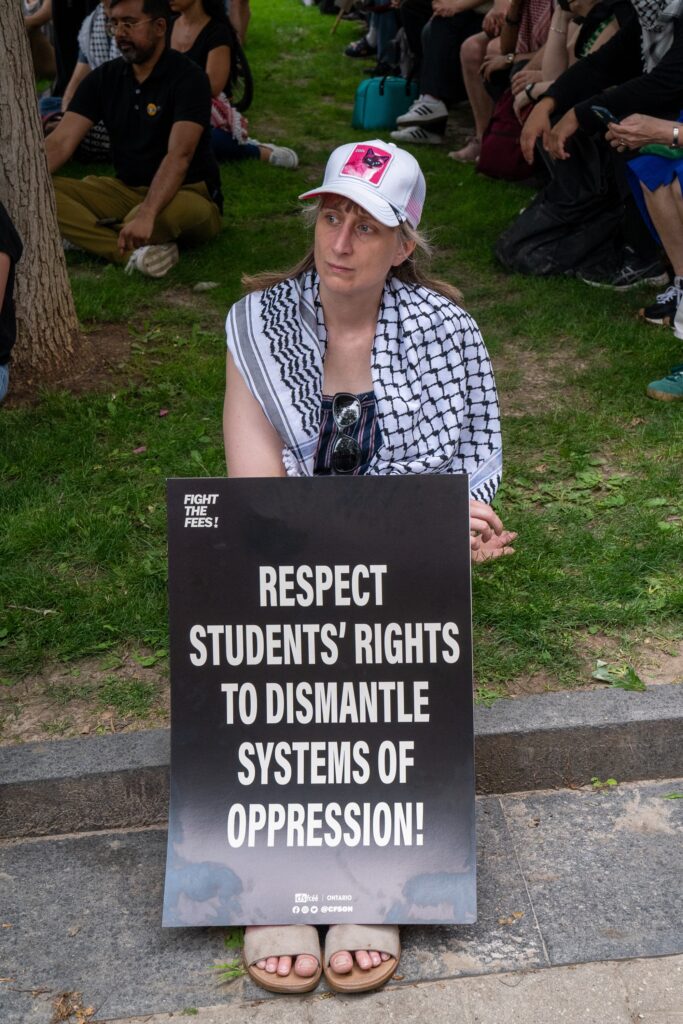
The pattern can be replicated in other situations again and again because the unshakeable belief is that our traditional education system (what is left of it today) is deeply oppressive and unjust. This is explained by the fact that our society is deeply oppressive and unjust. In each case, the bad ideas and ineffective practices applied are presented as cures to oppression and injustice, helping shield them from criticism. Don’t you care about the oppressed? Whose side are you on, anyway? And if such mild defensiveness doesn’t suffice, proponents can simply escalate to threats of cancellation.
Let us return to the charlatans. Even when a study is debunked or a paper retracted – even when an entire theory is unsupported by evidence – they will not revise their views or admit an error. They do not care because the message, the grand narrative, is much more important than any data point, study, group of studies or even field of scholarship.
But it is not only that there is a kind of religious fervour animating this group. Their crusade is also self-serving. The default view in the academy, particularly in schools of education, is that Western nations are exclusionary and oppressive societies. Thus, bad research and weak arguments, ineffective or useless innovations, pass more easily precisely so long as they signal a commitment to the grand narrative. Rigorous, traditional scholarship that challenges this narrative signals that you are part of the problem.
Not only are the charlatans unwilling to entertain the idea that they are wrong, their professional advancement requires that they act this way. This is why Sokal-style hoaxes in real form keep happening, 30 years after the American physicist tried to draw attention to increasing fraud and junk science by submitting and having published an entirely bogus study in a cultural studies journal. And so, certain “experts” have become rent-seekers without responsibility.

Pity the Poor Teacher
There is much to lament about education in Canada, but we must not fall prey to easy accusations and quick fixes. Teachers and professors are not all ideologues. Most of them, probably the vast majority, are well-meaning and poorly-informed. Nor is it the case that their conformism is always blameworthy. True, teachers and professors could be less trusting of their activist colleagues. They could ask sharper questions. Still, deference and trust must be the norm. I believe all of us should defer to our oncologists, for example. It is equally wise to do as others do if you are trying to figure out what behaviour and mannerisms are polite and appropriate in a new social situation.
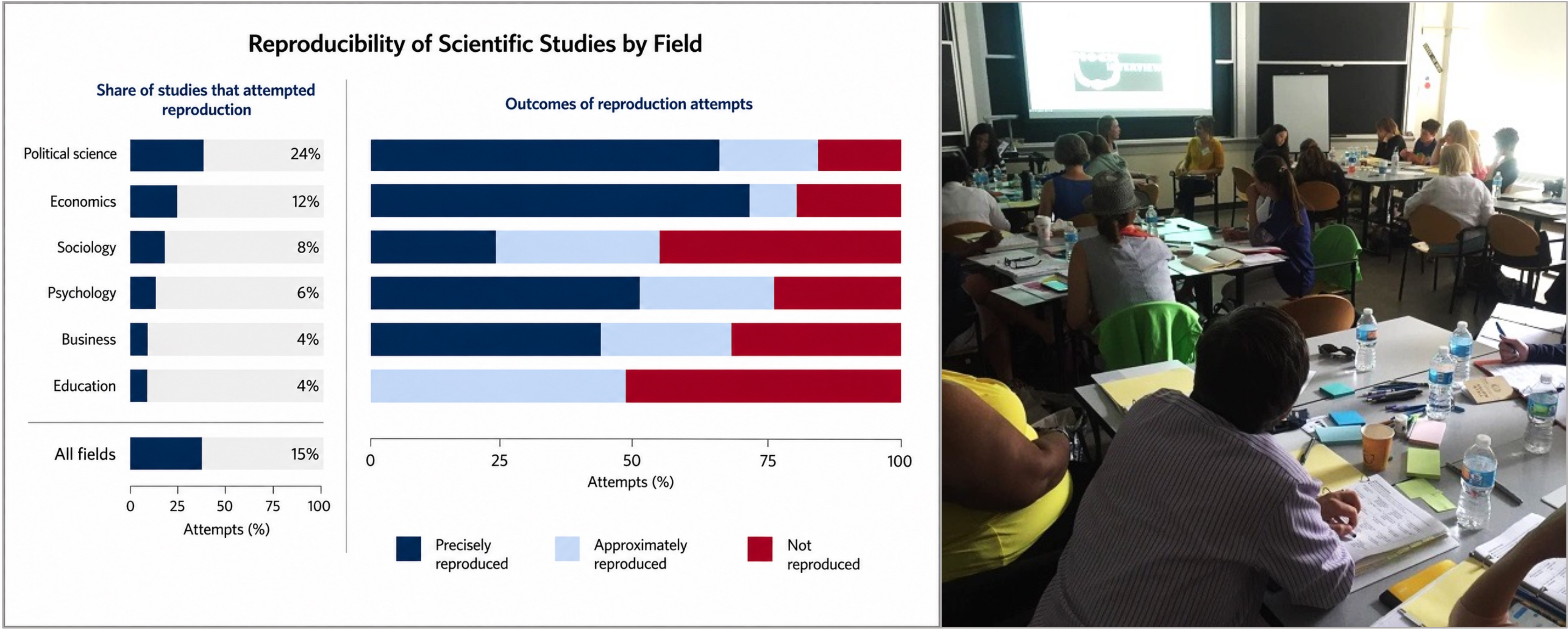 Take skepticism instead: With education ranking as the least reproducible scientific field, teachers have good reason to question what educational charlatans and the self-appointed “experts” are prescribing, advises the author. (Sources: (graphic) Nature, modified with ChatGPT; (photo) schmidjon, licensed under CC BY-NC-SA 2.0)