Post-Covid Economy

Canada Needs its Oil and Natural Gas Industry More than Ever

Gwyn Morgan
May 7, 2020
You don’t see news media reporting that Germany has declared Audi and BMW to be obsolete companies from yesteryear. Nor that Switzerland has come to regard its banking sector and watchmakers as sunset industries. There’s been no announcement that South Korea is shuttering Samsung. Nor that the Greeks are tearing over hill and dale torching their olive and orange groves. Everywhere you look, countries are leaning on their proven economic strengths to power their post-Covid comeback. So why is Canada’s federal government, seemingly alone in the world, intent on euthanizing this nation’s number-one source of export earnings and inter-regional tax transfers – the oil and natural gas sector? Gwyn Morgan moves briskly through the recent madness and declares that this is one instance of ideological folly the country simply can’t afford.
Post-Covid Economy

Canada Needs its Oil and Natural Gas Industry More than Ever

Gwyn Morgan
May 7, 2020
You don’t see news media reporting that Germany has declared Audi and BMW to be obsolete companies from yesteryear. Nor that Switzerland has come to regard its banking sector and watchmakers as sunset industries. There’s been no announcement that South Korea is shuttering Samsung. Nor that the Greeks are tearing over hill and dale torching their olive and orange groves. Everywhere you look, countries are leaning on their proven economic strengths to power their post-Covid comeback. So why is Canada’s federal government, seemingly alone in the world, intent on euthanizing this nation’s number-one source of export earnings and inter-regional tax transfers – the oil and natural gas sector? Gwyn Morgan moves briskly through the recent madness and declares that this is one instance of ideological folly the country simply can’t afford.
Share on Facebook
Share on Twitter

Albertans are living in year five of a nightmare that just keeps getting worse. That nightmare started in 2015 when our newly elected Prime Minster appointed Gerald Butts, head of the Canadian arm of the anti-fossil-fuel World Wildlife Fund, as his Principal Secretary and key advisor. A year later, Justin Trudeau cancelled the previously approved Northern Gateway Pipeline that was to run from central Alberta to the B.C. port of Prince Rupert. Then in early 2017, Trudeau made his infamous visit to Alberta where he advocated the “phase out of the oilsands”. Later that same year came the demise of the Energy East Pipeline that needed to transit Quebec on its route from the Prairies to the New Brunswick port of Saint John when, after the regulatory hearing and consultation process had been completed, Trudeau acceded to Quebec’s objections by inserting new, deliberately impossible conditions.

xOrphaned industry: The Liberal government seems only too happy to accede to the anti-energy agenda of groups like these.

With no access to tidewater and global markets, Canadian crude oil exporters were left hostage to American oil refiners, driving down the pricing received by our producers in a phenomenon known as a “captive market discount”. At times, this foregone revenue totalled as high as $2 billion per month. Had the cancelled pipelines been built, those lost tens of billions of dollars, net of government royalties and taxes, would have put the industry in a vastly stronger position. Instead, most companies were already on the edge of a financial precipice when the Covid-19 crisis slashed world oil demand by an unprecedented amount. Their only hope was government aid. But this prospect was vehemently opposed by the anti-fossil-fuel groups, most of whom make their living off the public purse.

On March 25, a collection of 108 groups comprising public service unions, environmentalists including the Sierra Club  and Greenpeace along with civil disobedience advocates Extinction Rebellion, Climate Justice and Climate Strike, sent a letter to the Prime Minister, stating: “Giving billions of dollars to failing oil and gas companies…only prolongs reliance on fossil fuels”. Then came another letter from 265 Canadian university professors arguing the industry should be left to die, with the public assistance funds instead going to green energy development. (Speaking of green energy, Planet of the Humans, a powerful new documentary produced by erstwhile environmentalists’ hero Michael Moore, is a myth-buster that’s shaking the green energy establishment to its roots.)

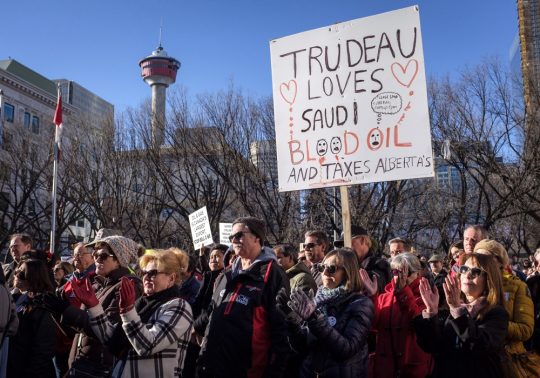
Those letter-writers may have gotten their way. On April 17, Trudeau announced “assistance” to the energy sector that focused on the final cleanup and abandonment of no-longer-producing (or “orphaned”) oil and natural gas wells. An important program, to be sure, but hardly central to saving the oil and natural gas industry from the twin-devastation of collapsing world oil markets and a deep economic recession. It was largely optics, in other words; our “woke” prime minister was trying to have it both ways. And indeed, three days before, Alberta oil prices had gone below zero, pushing many companies off the precipice.

But when help came, it was both modest and selective. The Business Development Bank of Canada announced $15 million to $60 million in one-year loans at “full commercial interest rates” for qualifying small and medium-sized companies. While providing a temporary reprieve for some, it’s hard to think of a more modest measure for an industry employing half-a-million people facing existential crisis. By comparison, in the 2009 Ontario auto industry crisis, the federal government injected $20 billion (in 2020 dollars), without repayment requirements, to save just 22,000 jobs. 

Some people get it: Alberta Energy Minister Sonya Savage last year promoting the energy sector’s national benefits (above) and Pro-energy-industry demonstrators in Brandon, Manitoba (below).

This is not just an Alberta and Saskatchewan problem. The oil and natural gas industry has long been the very engine of Canada’s economy. From 2014-2018, it contributed over $100 billion to our annual GDP, including tens of billions of dollars in direct payments to governments, plus income taxes paid by the industry’s employees. The industry’s average capital spending of $40 billion per year included sourcing manufactured equipment across the country, spreading jobs and wealth from coast to coast. Moreover, Alberta has long been the largest net contributor to federal revenues. A recent Fraser Institute study found that from 2014 to 2018 Alberta’s net contribution to Ottawa was $94 billion, $36 billion more than Ontario, a province with a population three times as large.

Even in 2019, despite relatively weak commodity prices further lowered by captive-market discounts, oil and natural gas and its derivatives made up five of Canada’s top-ten net (exports minus imports) exports, at US$115 billion. And here is a dramatic illustration of Canada’s dependency on our bountiful resource endowment. Of Canada’s top-ten net exports, seven were natural resources and the other three agricultural. Vehicles aren’t among the top-ten net exports because we import more than we export.

xPrice-war pals of convenience: Saudi Arabia’s Crown Prince Mohammed Bin Salman and Russian strongman Vladimir Putin.

Korea’s economy has already bounced back from Covid-19 because it’s a manufacturing powerhouse. Countries need to play to their strengths. The last thing they should do in a crisis – or ever, for that matter – is trash the industry or industries that form the basis of their prosperity. For Canada, the answer couldn’t be clearer. Our recovery will depend on government policies that actively encourage, rather than impede, resource investment.

Over the past few years, production growth from U.S. oil shales and Canadian oil sands has substantially reduced the Saudi Arabian and Russian shares of global oil markets. To say this has caused consternation in those two oil-dependent countries would be a severe understatement. Russia, especially, is almost obsessed with undermining the Americans’ energy advantage. The Covid-19-driven collapse in crude oil demand handed Soviet strongman Vladimir Putin and Saudi Crown Prince Mohammed Bin Salman a perfect opportunity to achieve their longstanding goal of crippling the U.S. and Canadian industries by driving down prices. 

xPetro-currency: The Canadian dollar’s correlation to crude oil.

If the current situation persists, it would be a significant blow to the U.S., but America’s world-leading industrial diversification would carry it through. Low energy prices are helpful to that country’s immense manufacturing, transportation and consumer sectors, offsetting the damage to industries that benefit from higher energy prices.

By contrast, resource-dependent Canada would lose its most economically important industry. (The fact that our currency fluctuates along with crude oil and natural gas prices rather than, say, indexes of manufacturing industry health, illustrates how the world sees us – even if our Prime Minister, the Liberals and Canada’s other left-wing parties don’t.) And the country’s most important resource-producing province would move from Canada’s biggest net economic contributor to the most impoverished. Newfoundland, already in desperate financial straits, would be devastated, Saskatchewan would be severely damaged, and B.C. would feel the effects as well. 

xEnergy fortress North America? Alberta Premier Jason Kenney meets in Washington in February with U.S. Secretary of Energy Dan Brouillette.

The Covid-19 experience also teaches us the folly of depending on other countries for critical supplies. Energy is the most important of those. The Energy East pipeline cancellation has left Quebec and the Atlantic provinces dependent on oil now supplied mainly by guess who…Saudi Arabia. With a dose of political will and a modicum of vision the project could be fast-tracked, however, as it mostly involves converting an existing natural gas pipeline to crude oil service.

Nor are North American policymakers completely helpless on the pricing front. As long as North America produced far less crude oil than it consumed, we had no direct or short-term ability to influence global energy prices. That has all changed thanks to the dramatic increase in U.S. and Canadian oil production over the past decade. Canada should immediately engage the U.S. administration to set a viable minimum North American benchmark oil price and phase-in a ban on offshore imports. There is no time to lose. Every day that goes by sees the industry most important to restoring the health of our government finances weaken further. And any hope that Albertans have of waking from their tragic, more than five-year-long nightmare further diminishes.                               

Gwyn Morgan is the retired founding CEO of Encana Corp.
Love C2C Journal? Here's how you can help us grow.

More for you

The Other Right to Choose: Reversing the Trudeau Immigration Fiasco

Canada’s immigration system was once the envy of the world. Based on the notion that those who get into the country are those who determine its future, the system chose people best able to contribute. Then the Trudeau Liberals blew it up, opening the gates to just about anyone – including literal terrorists – wreaking economic havoc and breaking Canadians’ faith in the value of citizenship. John Weissenberger, who served as chief of staff to the federal immigration minister in Stephen Harper’s Conservative government, has watched it happen with growing dismay, and argues for a return to sanity – centred on the sensible “points” system that served Canada so well for decades.

Suffer the Little Children: The Liberals’ $10-a-Day Childcare Disaster

Waiting lists stretching years. Plummeting quality. Outraged parents. Providers slowly strangled by red tape. The federal Liberals’ vaunted $10-a-day childcare program has proved an expensive disaster. Five years in, Matthew Lau digs into the many problems and inequities this landmark social policy has delivered. Lau finds B.C., which had a three-year head start on the rest of the country and an enthusiastic NDP government leading the way, in the worst straits of all. With an irretrievably flawed system clearly failing Canadian families, Lau argues that Prime Minister Mark Carney should pivot to a fairer, cheaper and more effective alternative.

From the Strait of Hormuz to Cuba, Net Zero is Dying – Mark Carney Needs to Let Go

After decades spent pursuing net-zero dreams at great cost to their economies and social fabric, most of the world’s industrialized nations are waking back up. War with Iran and the threat of tanker blockades have everyone worried about oil and natural gas supplies and clamouring for energy security. Or nearly everyone. Not Mark Carney, though. Canada’s prime minister keeps pushing industrial carbon taxes higher and insists on wasting taxpayers’ money on windmills that make no difference. Gwyn Morgan recalls his own observation of the global warming movement’s original rise, its morphing into the radical “net zero” cult – and its spectacular global disintegration. It is high time, Morgan writes, that Canadians demand Carney also drop his delusions.

More from this author

From the Strait of Hormuz to Cuba, Net Zero is Dying – Mark Carney Needs to Let Go

After decades spent pursuing net-zero dreams at great cost to their economies and social fabric, most of the world’s industrialized nations are waking back up. War with Iran and the threat of tanker blockades have everyone worried about oil and natural gas supplies and clamouring for energy security. Or nearly everyone. Not Mark Carney, though. Canada’s prime minister keeps pushing industrial carbon taxes higher and insists on wasting taxpayers’ money on windmills that make no difference. Gwyn Morgan recalls his own observation of the global warming movement’s original rise, its morphing into the radical “net zero” cult – and its spectacular global disintegration. It is high time, Morgan writes, that Canadians demand Carney also drop his delusions.

Future Tense: Why Gen Z is Right to Feel Betrayed

Older generations often roll their eyes when young people seek to blame them for their woes. But if Canada’s Gen Zers feel betrayed by the Boomers, they are right to do so, argues Gwyn Morgan. Years of irresponsible fiscal and regulatory policies have hamstrung the Canadian economy and left younger generations facing a bleak future of stagnant wages, rising taxes and shrinking opportunities. A former business leader who created more than his share of jobs and prosperity during his long corporate career, Morgan casts a worried eye over the next generation – and offers sympathy for the situation they’re inheriting.

The Price of Foolish Pride: What Germany’s Social and Economic Decline Can Teach Canada

Germany was postwar Europe’s most successful nation – until it was seized by an arrogant leftist ideology that led it down a ruinous path. Its government abandoned safe, zero-emission nuclear power for inefficient wind and solar plus natural gas from Vladmir Putin. It threw open its borders to millions of asylum-seekers with barely a thought to the enormous costs or the difficulties of social integration. Today, at the 11th hour, Germany is at last struggling to turn around its decade of economic decline and social disintegration. In this cautionary tale, Gwyn Morgan sees a profound warning for Canada.