History will probably record that multiple vaccine breakthroughs ended the Covid-19 pandemic. But it will also show that ill-considered responses by our federal and provincial governments caused enormous wreckage and left highly damaging long-term legacies. These are what I call the Covid Follies.
Destruction of the Canadian Aviation Industry
Canada’s airlines have been burning through their dwindling cash since the first-wave lockdowns. A major impediment to attracting passengers has been the two-week quarantine requirement upon return, which turns a two-week vacation to a month off the job, unacceptable to most employers and unaffordable to most workers. The airline industry has long been calling for rapid testing-on-arrival to cut quarantine periods. Many other countries have implemented this approach, including Finland where arriving passengers get rapid testing followed by a second test a few days later. If both tests are negative, the person can snap out of quarantine. A similar and, as C2C recently noted, successful pilot program is being offered at Calgary International Airport.

Instead of having this program expanded across the country, what airlines got was the sudden federal requirement (announced on New Year’s Eve) that passengers get tested before they board their returning flight, followed by a two-week quarantine. Without public debate, the Trudeau government implemented an outrageous policy that could keep Canadian citizens from returning to their own country (even if temporarily). Adding to this flyer-repelling measure, if their flight originates where certified pre-flight testing is unavailable, passengers must spend the two-week period locked up in some federal facility rather than at home.

Airlines had hoped that winter’s arrival would bring rising bookings from Canadians wanting to escape from our country’s usual deep freeze. Instead came expansions and extensions of the first-wave edicts that Canadians avoid “non-essential travel”. When some thousands of brave souls ventured abroad anyway, it set off a media and political firestorm labelling those sun-seeking travellers as careless rule-breaking pariahs.
The aviation industry now faces a doomsday situation: pre-return flight testing, a bellicose 14-day quarantine process, and plunging customer numbers, all made even worse by the maintenance of edicts (repeated and amplified by news and social media) against “non-essential” travel. All Canadian airlines are suffering but to take just the latest example, last week WestJet announced the cancellation of numerous flights and routes as well as work reductions equivalent to shedding 1,000 full-time employees (on top of the 6,900 terminated last spring).

WestJet CEO Ed Sims bluntly blamed the “incoherent” federal airline policies for the most recent damage and, in particular, the December 31 announcement, which triggered a flurry of cancellations and slowed new bookings to a crawl. As WestJet noted in its official statement, “Since March, we have safely operated more than 30,000 flights and carried more than 1.3 million guests with no reported cases of transmission onboard our aircraft.”
Is destroying further jobs and sending a made-in-Canada success story like WestJet back to a level of traffic not seen since 2001 how we “Build Back Better”? It makes reading the self-satisfied government signage like “Covid-19 – We Got This” (as the City of Calgary displays overhead one of its freeways) downright sickening.
As usual, it is taxpayers who will be on the hook for these senseless government actions. The Trudeau government was already planning a multi-billion-dollar bailout of the airline industry. Why not let the airlines participate in bailing themselves out, so to speak – by selling plenty of tickets and flying to many nice places? Instead, the ill-conceived new measures have further hindered the airlines’ ability to generate passenger revenue, so the bailout will need to be even larger, taking our country yet another step towards financial oblivion.
Bankrupting Small Business while Big-Box Booms

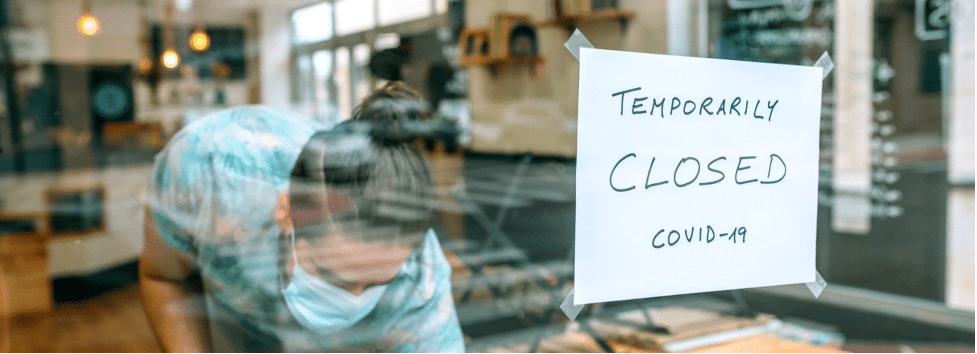
Here come those fearsome words “non-essential” again. Covid-19 had already forced many small business owners to shut down. Those remaining were depending on Christmas sales to help them survive, and had prepared carefully to keep shoppers safe from the virus. Then, just weeks before the holidays, big government teamed up with big-box stores to strike a fatal blow against untold thousands of additional small businesses.
Quebec, Ontario and Manitoba banned “non-essential” shopping, while Alberta closed several categories of small business and limited traffic in the rest to 15 percent of normal capacity, all-but unmanageable for many small retail outlets. Big-box outfits such as Walmart and Costco, however, whose sales of essentials like groceries are vastly exceeded by a plethora of potential Christmas gifts and other nice-to-haves, were allowed to remain open.
With the giant store chains as their remaining choice, anxious shoppers formed long lineups before rushing frantically to find coveted items ahead of others, a Covid-19-spreading nightmare. Meanwhile, many small shop owners who had spent much of their lives building their businesses lost everything. As the inestimable columnist Rex Murphy recently wrote in the National Post, “A small shop selling knickknacks is too risky, but a big box is perfectly fine.”
Wasteful Income Support Programs
Seemingly every morning from March 12 to June 30, Prime Minister Trudeau made a new Covid-19 support program announcement that, collectively, totalled some $170 billion in spending commitments (essentially all of it borrowed money). These were by far the biggest and fastest expenditure commitments in Canadian history. The “announce it now – fix it later” approach was understandable at a time when much of the economy had been shut-down virtually overnight. But the flaws in the programs were not fixed even after they became clear.

One of the most serious of these is that a lot of the money went to those who didn’t need it. A study by the Fraser Institute found that of four programs totalling $82 billion, over $22 billion worth of spending made the recipients better off than before the pandemic. An even more serious flaw is that the Canada Emergency Response Benefit (CERB) actually paid people not to work, leaving businesses struggling to find workers needed to re-ignite the economy. This could have been prevented by providing a sliding-scale incentive to return to work.
Other disturbing statistics have emerged. One is that the average household income of Canadians actually went up during the pandemic, suggesting the additional government spending was more than needed. So reportedly did the average rate of saving. This suggests that Canadians were not spending their money, perhaps because so many things were restricted or forbidden, or because people were scared to go out and live their lives. A high rate of saving is usually laudable, but not at a time when every available measure to restart the economy needs to be cranked up – including consumer spending.
Fighting Back Against the Follies
After nearly a year of pandemic and frequently erratic government behaviour, it’s probably tempting to feel resigned and helpless. But you are not. Here’s what you can do to fight back. Take that winter vacation if you can. That will help to keep tens of thousands of airline and airport workers employed. If you aren’t in a position to travel, respect the decision of those who want to go. Shop local, and soon! Voice your opinion about those who avoid returning to work in favour of collecting government support payments, and if you know someone like that personally, try to persuade them to reconsider.

Inform yourself carefully about genuine conditions and rules, including what is actually forbidden versus what is blown out of proportion by government officials and the news and social media (such as myths about which provincial borders are sealed and which countries prohibit tourism). Follow sensible public health guidelines, for sure, but keep your brain switched on to detect hard-to-define terms such as “non-essential” that may have harmful unintended consequences to your own wellbeing and that of the workers and companies Canada needs to thrive.
Gwyn Morgan is the retired founding CEO of EnCana Corp., formerly Canada’s largest producer of natural gas