If history repeats itself, first as tragedy, then as farce, what to make of modern Greece?
We are five long years into Greece’s economic crisis and we have yet to figure out if the Greek parrot is dead, or merely resting.
By opting to extend (the Greek bailout) and pretend (it will get paid back) for a third time, European leaders have once again ducked the difficult questions of Eurozone reform to play another game of pin the tail on the Greek donkey.
If insanity is doing the same thing over and over again and expecting a different result, Europe is ready for the asylum.
The urge for creditors to kick the current Greek government is understandable. Greeks have hardly been well-served by any government in the past 30 years, but Alexis Tsipras’ ragtag collection of communists and revolutionaries have injected rank amateurism into the debate at a time when statesmanship was at a premium.
The result is a status quo that satisfies no one, and offers no prospect for resolution.
Greece’s creditors don’t like the latest bailout proposal; the IMF doesn’t like it much either; and Tsipras accepted the intrusive settlement only after having campaigned against a better deal, before passing the harsher version, despite not agreeing with it.
Hands up everyone who thinks this bailout will solve the problem. And does anyone really think Tsipras will keep his end of whatever deal is ultimately agreed?
Tsipras has only himself to blame for earning the enmity of the Eurozone. He was elected on a fantasist anti-austerity platform and then continually bluffed his creditors when everyone in the room could see his crap cards. His ridiculous last-minute referendum succeeded only in bleeding his banks dry and further strengthening his opponent’s hand.
And by thumbing his nose at the people with their hands around his nation’s throat, Tsipras invited his creditors to squeeze. The Eurozone hawks, led by Germany, have duly complied and it is ordinary Greeks who are being strangled by Tsipras’ folly.
As the Germans and Greeks trade barbs through the press, the core issues remain unaddressed: Greece’s unsustainable debts and the Eurozone’s unworkable monetary union.
Neither side is willing to accept the truth: Greeks are never going to clear their debts, and Greece is never going to grow without root and branch reform of its utterly corrupt and clientelist public service.
This wasn’t the story Europeans or Greeks were peddled when they expanded the single currency. No, the European Union and the Euro were supposed to make the world safe for bureaucracy.
What happened?
First, the Eurozone decided to form a monetary union without a supporting banking union, or deeper political and economic integration. This has left policy makers dangerously ill-equipped to stamp out fires in the single currency.
Second, in its rush to expand, the Eurozone admitted members it knew had no business ditching their drachmas. With a helpful assist from the balance sheet fixers at Goldman Sachs, Greece fudged just enough of a lie to become a member of the club.
They were aided and abetted by German and French exporters and banks – among others – who were eager to sell into new Euro markets. No one has profited more from the Eurozone expansion than the German manufacturer, and no one is more exposed than German and French bankers.
Third, the nations who joined and took their responsibilities to a united Europe seriously have not been rewarded for their efforts. Instead, they’ve been served a bill for Greece’s failures.
The former Soviet bloc entrants to the Eurozone have, at considerable cost and effort, re-modelled their economies to be fit for European purpose. Meanwhile, formerly profligate Western European countries like Spain and Ireland have taken harsh measures to return to balance.
Understandably, these reformed countries think Greeks should buck up and get on with it.
This will mean – gasp – paying and collecting taxes, reducing ludicrous pensions, bludgeoning a bloated bureaucracy, and selling off public assets. It will be stern stuff but the alternative – life outside the Euro – would surely be worse for the Greeks.
Meanwhile, the EU hawks have been so busy building firewalls around Greece that they’ve missed some large fissures forming in the European foundation.
Angela Merkel and Francois Hollande are bitterly divided on Greece; the great Franco-German alliance that has underpinned the modern European project is now under the most severe strain since the end of the Second World War.
The latest bailout talks have also managed to knit Eurosceptics of the British left and right together in the run up to the United Kingdom’s scheduled EU referendum. A European Union without Britain would be significantly weakened, perhaps fatally.
Which brings us to Vladimir Putin, who is watching a few million poor Greeks inflict more damage on his enemies than his Little Green Men could ever do. There is undoubtedly much cackling in the Kremlin as Putin watches Europe’s cack-handed response to the crisis. The Russian leader also stands ready to assist his communist protégé in Athens should the rescue fail.
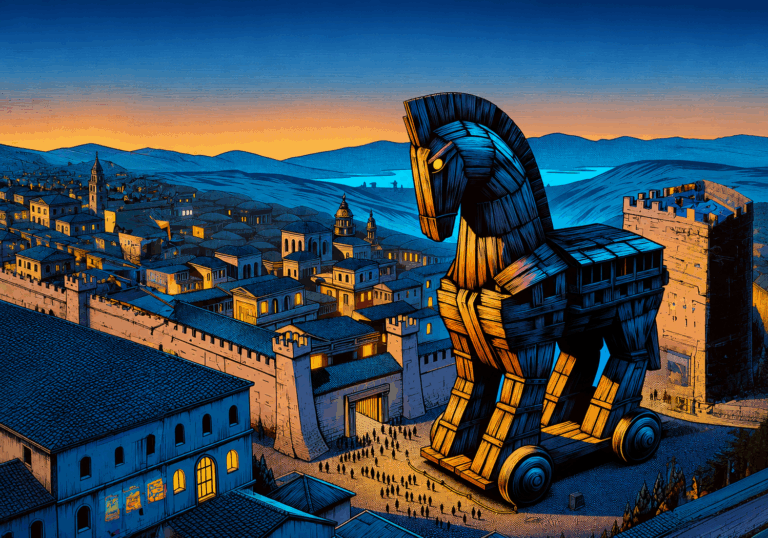
It is as if the Greeks forgot their history when they welcomed the Trojan Horse of the Euro into their country in 2001. But from the EU perspective, it is Greece’s entry into the Eurozone that serves as a painful reminder of what happened to Troy, and the inevitable fate of all empires.
~
Andrew MacDougall is Senior Executive Consultant at MSLGROUP London (UK) and a former Director of Communications for Prime Minister Stephen Harper.