The 2015 election campaign officially kicked off August 2 but it effectively began May 3, 2011, the day after Stephen Harper’s Conservative party won its first majority government. In the years since Canadians have been subjected to pre-election advertising in many forms. The so-called permanent campaign, long established in the United States, is now well rooted in Canada. It involves the parties and their proxies, armies of creative content producers, hundreds of millions of dollars (including your tax dollars), and unrelenting bombardment of voters via conventional and social media.
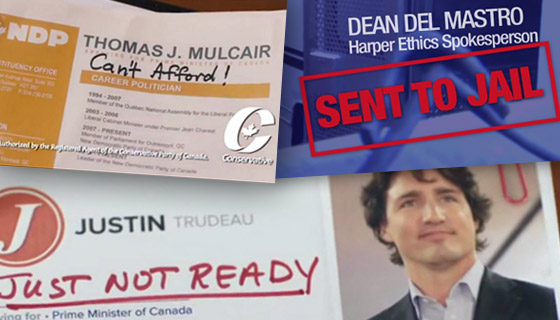
This “air war” escalated dramatically earlier this year and especially since the writ drop. But if you think you are already sick of hearing that Justin Trudeau is “just not ready”, that “you’ve had enough” of Stephen Harper, or that Thomas Mulcair is “risky, dangerous and unaffordable,” you should turn off your television and radio and disable your modem. Because the real advertising Blitzkrieg has just begun.
However, if you want to find out more about what the parties are up to on television and in cyberspace, read on. This article for the Fall 2015 election edition of C2C Journal includes hyperlinks to the best and worst of this year’s campaign attack and advocacy ads. Many are as consciously or unconsciously cheesy, menacing and funny as classic spaghetti westerns, so in homage to Sergio Leone and Clint Eastwood’s greatest cinematographic work, we present the ads produced by each of the parties in accordance with their style and substance – the Good, the Bad, and the Ugly.
The Liberal Party of Canada
The Good: So far the Liberals have mostly abstained from negative advertising unless you count half-hearted YouTube stuff like this ad. Staying positive is consistent with Trudeau’s sunshine brand of politics. Being the target of negative campaigning puts him on the defensive anyway, so sticking to his simple message of “Real Change” and playing up his undeniable telegenic assets is a reasonable strategy. Most of the advertising by the Liberals has been earnest online policy explanations featuring Trudeau as the centerpiece. A few ads like this one are defensive, but still upbeat. The recent “Harder To Get Ahead” ad, featuring Trudeau walking the wrong way up an escalator, is a perfect example of politely gambling on a positive approach. Taking the high road is admirable, except the human memory tends to retain nasty over nice.
The Bad: A positive campaign isn’t necessarily an ineffective campaign, but for the 2015 Liberals it is. Learning techniques from U.S. Democrats in regards to identifying and engaging supporters has helped the Grits rebuild their membership and finances. And a year ago it seemed their leader was on the same “hope and change” trajectory as Barack Obama in 2008. But a combination of brutal Conservative attack ads, strong Parliamentary performance by Thomas Mulcair, and Trudeau’s ever-growing list of bozoisms, knocked the Liberals back into third place.
“Aargh! When an opponent says, you’re not ready, you don’t say: “No, I’m not.” You say, “You’re corrupt.” – Tweet by former Liberal strategist Warren Kinsella.
Kinsella is referring to the Liberal rebuttal to this Conservative “Just Not Ready” blockbuster. Trudeau addressing the charges laid against him, while repeating the smear, was a horrible idea. As veteran election strategist Stephen Carter said on his podcast The Strategist, “Even if they had just gone with the ‘We’re Ready’ messaging…’We’re ready for the election call tomorrow! We are READY for the election call tomorrow! We are ready for the election to start today! We are ready, we are ready, we are ready. Let me tell you how many times we’re gonna be ready. The entire team is ready.’ But instead they repeated the entire charge.”
In other words, never play inside your opponent’s frame.
The Ugly: Trudeau’s edict last year that the Liberal party would only accept candidates who publicly swear to uphold pro-choice dogma sent the social conservative crowd into a tizzy. Not being very adept at social media or rich enough to buy TV ads, they fought back this spring the old-fashioned way, with pamphlets featuring Trudeau alongside ghastly pictures of dismembered fetuses delivered to a million households. This combined effort by Campaign Life Coalition and the Canadian Centre for Bio-Ethical Reform amounted to the single biggest anti-abortion campaign in Canadian history. A July Ipsos-Reid poll found that 70 percent of respondents disagreed with Trudeau’s ban on pro-life Liberal candidates, but other polls suggest half the population supports unrestricted abortion on demand. And all the major parties are pro-choice in varying degrees. So it’s doubtful the campaign will have much impact other than making pamphlet recipients nauseous.
The New Democratic Party of Canada
The Good: While Trudeau performs self-aggrandizing ads in the boxing ring, the NDP are putting on the brass knuckles. As former PMO staffers were testifying at the Duffy trial they were running this ad, showcasing the brutal list of baggage that the Conservative Party has accumulated over the last decade. It climaxes with former Harper parliamentary secretary and convicted election expense cheater Dean Del Mastro waddling in leg irons. Canadian marketing guru Tony Chapman contends such ads aren’t very effective because most voters think politicians are corrupt anyway. Perhaps this ad ripping Harper’s economic performance will resonate more loudly.
If imitation is the sincerest form of flattery then the NDP must secretly admire the Tories because the style and structure of their attack ads – featuring collages of unflattering images, negative headlines and quote fragments, and snarky voiceovers – is more than a little reminiscent of previous generations of Conservative ads aimed at Paul Martin, Stephane Dion, and Michael Ignatieff. So far, though, they have not gone as far at the Tories did in 2008 when they created a mobile phone ring tone with Dion’s plaintive cry, “Do you think it’s easy to make priorities?”
The Bad: The NDP are hoping ads like this will rally the base, generate campaign volunteers and donations, and get out the vote. This is fine, but it doesn’t engage people beyond those who are already likely to vote NDP. Current polls peg NDP support at roughly the same levels Jack Layton achieved in 2011, and because it is concentrated in B.C. and Quebec, it is not efficiently distributed to optimize their seat count. To win the election they need to grow their vote and that won’t happen by preaching to the converted.
One of Mulcair’s biggest challenges is that he is a new leader and unknown to many voters, as Ezra Levant’s online Rebel Media made light of in this recent video. Name and face recognition counts, especially for party leaders, and compared to Stephen Harper, who is as widely known as he is widely loathed, and camera magnet Justin Trudeau, Mulcair is the invisible man. The NDP is trying to change that with this cuddly ad, but to many he is still just that guy with the beard, and Canadians haven’t voted for a bearded prime minister since Alexander Mackenzie in 1874.
The Ugly: For a lot of Canadians the first nationally televised debate on August 8th was their first really good look at the NDP leader. Early on in his career he was labelled as a guy with a temper. One Conservative MP who faced off against him a few times in inter-caucus hockey games claims he was “always the dirtiest player on the ice.” After he won the NDP leadership, the Tories worked hard to brand him “Angry Tom.” He has worked equally hard to rebut the image, but some who witnessed his debate performance saw a man trying very hard not to explode. Internet memes highlighting this impression soon surfaced, and although internet memes are a dime a dozen during elections and most disappear without a trace, one suspects the character assassins in the Conservative war room may unleash something Angry and Ugly on YouTube or television before the campaign ends.
The Conservative Party of Canada
The Good: It is widely acknowledged that the Conservative Party has developed the most sophisticated and effective political advertising in Canadian history. Pre-writ advertising has been their speciality ever since they deconstructed Stephane Dion as “Not a Leader” with a “Tax on Everything”. Justin Trudeau has endured the same treatment, first with the “In Over His Head” commercials and more recently with the collection of “Just Not Ready” ads. Tom Mulcair also gets some attention from the same group of “Just Not Ready” actors in this “Can’t Afford” spot.
Since the Conservatives have heavily out-fundraised their competition since 2011, they can saturate the airwaves with their ads. While the other parties send their videos around the social media ghettos of Facebook and YouTube, the Conservatives are spreading their message to people watching Blue Jays games and The Bachelor marathons. These people are known as “normal voters” and they are needed to win elections.
The Bad: Taxpayer-funded federal government advertising, especially the ubiquitous Economic Action Plan advertising of the last few years, has been widely criticized as de facto partisan propaganda. The Conservative government has spent roughly $750 million on this type of advertising since 2006, including right up to the August 2 writ drop.
Their Liberal predecessors in Ottawa spent nearly a billion dollars on government advertising from 1998-2006, and much of it was just as self-serving as the Tory campaigns. The practice is an insult to voters and taxpayers of all stripes, and it corrodes the ethical standards of everyone who’s party to it. It so corrupted the Chretien Liberals that they awarded multi-million advertising contracts for bogus national unity promotions in Quebec in return for kickbacks to their party. One hopes the Conservatives are not so far gone.
The Ugly: Senate page Brigette DePape held up her “Stop Harper” sign during the throne speech a month after the 2011 election. It made her moderately famous, and seemed to energize left-wing protest groups to mobilize against the much-feared and despised Conservative majority government. Among other things, that energy has been directed into anti-Tory advertising. With funding from public sector unions, umbrella labour organizations like Unifor, and international environmental lobbies, Canadian groups like Leadnow and Engage Canada have taken to television and the Internet to attack the Harper Conservatives. One of the main reasons Harper kicked off the election early was to impose campaign spending limits on such third party advertisers.
“Being famous on Twitter is like being rich in Monopoly” – Chris Rock
As a result third party campaigners are now largely relegated to social media playgrounds. But even there they can generate “earned media” exposure with interesting stories that are picked up and amplified by the mainstream media. One such story about a federal public servant who wrote, performed and posted on YouTube a song calling for Harper’s defeat went near viral after he was sanctioned for making such a public, partisan attack on his employer.
Conclusion: The advertising arsenals of all the parties likely contain Good, Bad, and Ugly ads we haven’t seen yet. If one party becomes the frontrunner you will know it because their advertising will be mostly positive and their opponents’ mostly negative. With polls suggesting the shaky economy is by far the most pressing election issue for most Canadians, you can expect ads promising economic Nirvana and warning of economic Armageddon. Take all of them with a grain of salt.
~
Jeff Hodgson is a freelance writer specializing in politics and public policy. His columns are published monthly at the website Poletical.