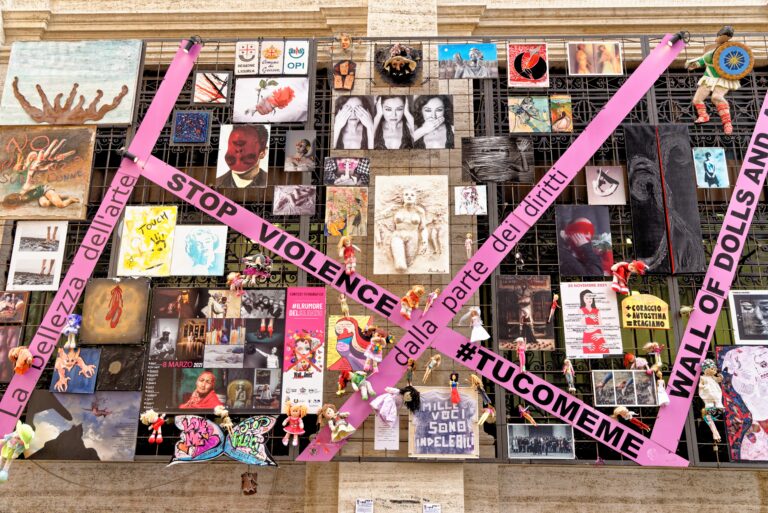
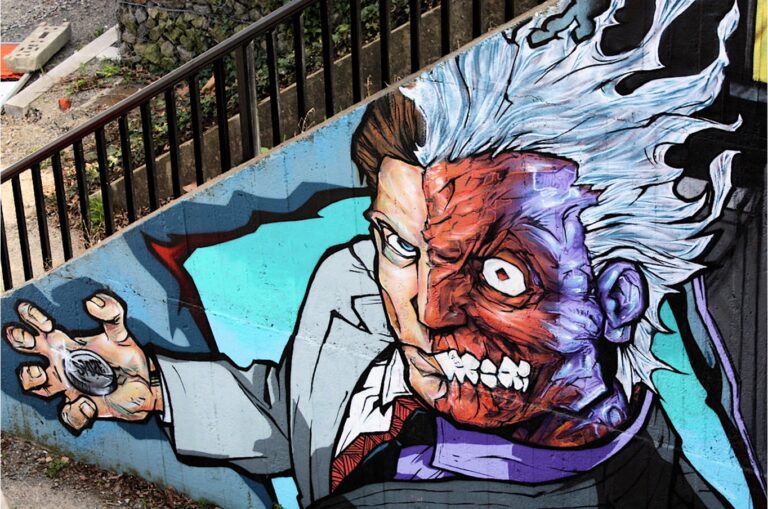
Canada’s official entry at this year’s prestigious Venice Biennale art exhibition features a wall built with massive sacks of gold ore from an abandoned Canadian mining project in Sardinia – a symbol of Canada’s sinister “global resource empire.” “Not only do imperial colonial powers redefine territories,” says the artwork’s manifesto, “they also breed new empires, replaying their cycles of dissemination and domination over and over again.” In case anyone missed the point, the opening ceremony featured a member of the Athabasca-Chipewyan First Nation from northern Alberta oilsands country reading a poem denouncing the Indian Act. Canada’s ambassador to Italy was directed to get down on his hands and knees to watch a short film through a peephole on the ground and get a taste of being subjugated to Canadian mining interests. Some beaver pelts were added for good measure. “It’s not a pavilion, it’s a counter-pavilion,” said the artist, “it’s not an exhibition, it’s not an installation, it’s an intervention (italics mine).”
Many conservatives would shrug at this. To them, it’s just more evidence the contemporary art world is hopelessly mired in political correctness. It’s not even worth a reaction – unless it involves art so offensive or expensive it might be used to criticize public art funding.
But others wonder: “Where are the conservative artists?” If politics emanates from culture, the argument goes, then conservatives should be creating their own content. The art world isn’t an ideological monolith, the exclusive domain of the left. Rather, it’s a part of the rich experience offered by a free, democratic and prosperous society. Conservatives should never turn their backs on art – including abstract and other non-traditional art. And no matter how incensed they are by left wing propaganda masquerading as art, they should resist the temptation to compete using right-wing agitprop. Art should always be art first, and ideology second.

Bad conservative art is still bad art
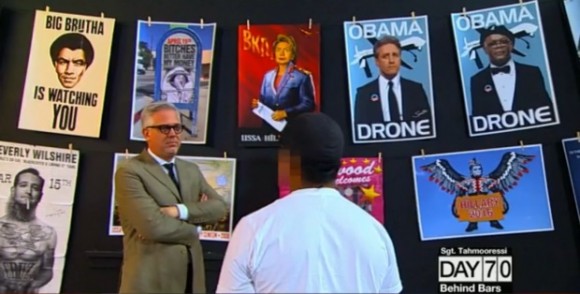
As with all aspects of life, Ayn Rand had strong opinions about art. Though she was a big fan of modernist architecture, Rand believed art should be realistic and uphold objective standards of beauty. She even envisioned an art movement called “Romantic Realism,” where artists would, like Rand, create “scenes, melodies, and stories to present the essentially heroic character of man.” Ironically, her vision was not much different than Soviet-style “Socialist Realist” art, except it celebrated rugged individualism and free markets instead of collective farms. Though Rand’s dream didn’t come true, her ideas live on in more than a few American artists who have attempted to created conservative-themed art. The results are not promising:


Sentimental, heavy-handed art rarely makes for good art, although it can still be popular, commercially successful, and culturally influential. The self-published first novel The Shack, for example, a rather prosaic tale of “evil and redemption” by Canadian writer William P. Young, has sold millions and is set to be made into a movie. But even within Christian circles, there is debate over whether it is shlock or art or even heresy.
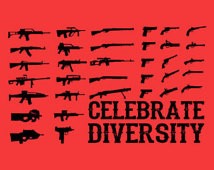
This is not to say that conservative pop art is totally without merit. Though right-wing graphic artists are rare (which means less competition for people like me!) the explosion of computer design tools has allowed for the long tail of conservative talent to manifest itself. The movement has had some success in creating effective graphics – especially satirical images that remix symbols from popular culture:


Art is more diverse than you think
It may be that conservative-themed art fails because so much of it is produced in reaction to left-wing art. Out of anger or a misperception that conservatives must fight fire with fire in order to compete for space on gallery walls and prizes in juried competitions, they wind up doing work that is imitative and derivative of that which they despise. “Contemporary art is obsessed with the politics of identity,” writes Sohrab Ahmari of the Wall Street Journal. “Visit any contemporary gallery, museum or theatre, and chances are the art on offer will be principally concerned with race, gender, sexuality, power and privilege.” But that doesn’t mean conservative artists should spend all their time and creativity rebutting it. Besides, the idea that left-wing propaganda covers the walls of most contemporary art galleries is an exaggeration.
Consider, for example, the works from the current Annual Graduate Exhibit at the Ontario College of Art and Design (OCAD). These are young, downtown Toronto art students – the belly of the urban liberal beast, right?
Among the 83 illustration students, only 21 presented artworks that would meet Ahmari’s definition – the most commonly recurring themes being environmentalism and animal rights, as well as economic injustice and female identity. However, the other three-quarters of the students’ work cover a wide range of topics: some optimistic (Fail Better “visually explores the idea that failure can become a catalyst for creativity and innovation.”), some absurd (What’s In A Nickname “is a hypothetical campaign promoting cities based on their nicknames.”), and some critical (The Unchivalrous City “depicts the way people behave towards one another in the modern metropolis by comparing their actions to medieval warfare”). Any fair-minded conservative should agree the OCAD grads represent a wide variety of styles and perspectives – whether they like the works or not.

Abstraction is not the enemy
Conservatives also need to reconsider their conviction that the classical approach to art is superior to other forms. In Charles Murray’s 2003 book Human Accomplishment, the tale of rapid human advancement comes with a caveat: “It is hard to make a case that the literature, art, and music of today come close to the work of earlier ages,” Murray writes, “let alone signify progress.”
That’s the view that prevailed among Canadian conservatives in 1990, when the Reform Party had a field day berating the Mulroney Progressive Conservative government and the National Gallery of Canada for spending $1.8 million on a painting entitled “Voice of Fire” – which essentially consisted of three vertical lines. Little did the Reformers know that Barnett Newman’s 1967 piece had played a small role in fighting the Cold War against the Soviet Union.
During the post-war era, abstract paintings took on an increasingly minimalist look, as western artists continued to move away from representation and broke down painting to its essential features: color, lines, texture etc. At the same time, Soviet art stringently enforced a traditional style that espoused communist themes. The contrast was not lost on the CIA, which secretly funded several modern art exhibitions in Europe, part of the war of ideas aimed at promoting American values abroad – including artistic freedom.
The cold-war rivalry was still raging when Expo came to Montreal in the summer of 1967. While both the Soviet and American pavilions showcased their respective countries’ space programs, the look and feel was radically different. The Soviets filled their glass rectangle with exhibits that vaunted their economic achievements, while the Americans featured enlarged photographs of Hollywood stars, mechanical rides, and colorful modern art – including Voice of Fire – inside a geodesic dome. In the words of architect Jonathan Massey, the U.S. pavilion “invited visitors to identify with an internationally ascendant American culture.”


Aside from recognizing the ideological significance of non-traditional art, I hope conservatives can also give it a chance on a personal level. My views echo those of conservative cultural critic David Gelernter:
But for myself, the best abstract painting is so powerful and beautiful it commands attention. And my problems with “true conservative art” don’t end there. I have no principled objection, either, to the [art] Establishment’s infatuation with “installations” as opposed to painting. An installation can be profound and sublime – look at the tense-and-perfect poise, the endless whispering depth of the best Zen gardens; the breathtaking silence of Luis Barragan’s Mexican courtyards. Nor can I object in principle to the fad for untraditional media… What are renegades like me doing in the conservative movement?
Conservatives are perfectly entitled to criticize publicly funded left-wing art like the Venice Biennale exhibit. But they should keep in mind that artists are essentially individuals making interesting connections in visual form – a form of “creative destruction.” Though one may question the career choices of OCAD students, I encourage conservatives to appreciate their work as the product of a free and prosperous society.
~
Olivier Ballou is the Director of Graphic Design at the American Enterprise Institute. Prior to this, he was Director of Communications at the Manning Centre. He is the creator of the pro-oilsands art installation “For the Love of Crude” and the short documentary “Flanagan.”