
In March 2021, the Justin Trudeau government committed Canadian taxpayers to spending $30 billion over the next five years to provide parents with $10-a-day childcare. Proponents claimed this huge expense would dramatically reduce the stress and financial burdens on hard-pressed Canadian families while improving the lives of their young children and encouraging more mothers to get into the workforce. With that initial funding period having come to an end, it’s time for a report card on Ottawa’s plan to bring low-cost daycare to the masses.
Mom and Dad better sit down. The news isn’t good.
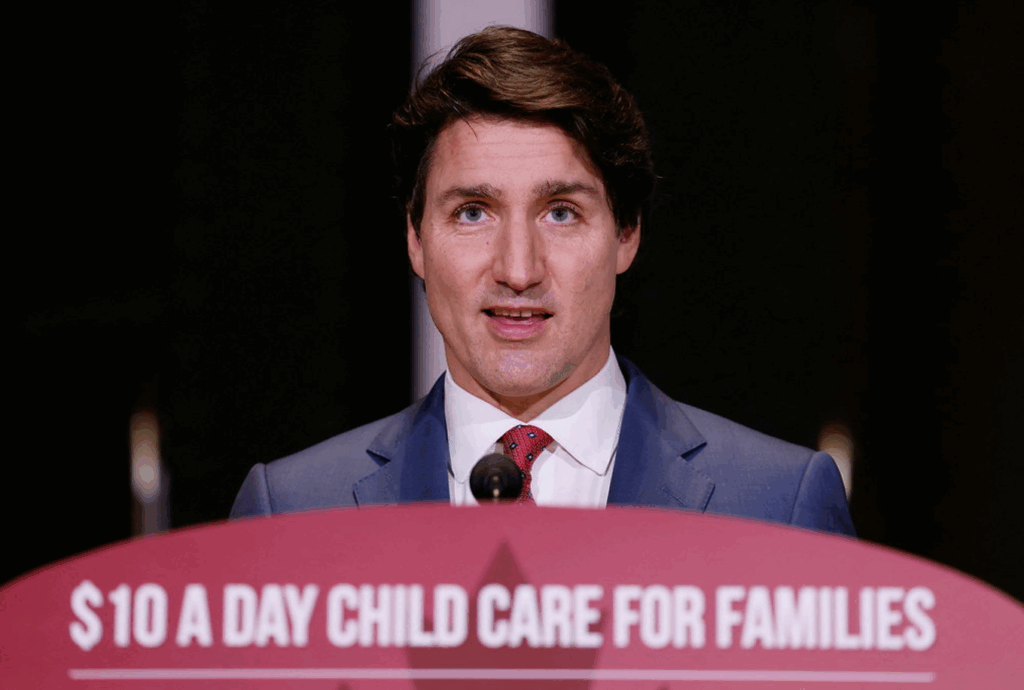
From coast to coast to coast, parents have expressed extreme frustration with how difficult it is to find a subsidized daycare spot for their kids. Waitlists once measured in weeks or months now stretch to years. In some places, officials admit children will likely be in public school by the time a place opens up for them. Adding inequity to this frustration, parents denied a subsidized spot face the prospect of spending $50 to $60 per day for market-based childcare while their lucky neighbours may be enjoying the same service at a fraction of the cost thanks to generous but hard-to-access government subsidies.
Meanwhile, daycare operators say they can’t pivot to meet the pent-up demand because of bureaucratic restrictions that limit their flexibility and discriminate against private-sector initiative. Evidence further suggests that the quality of care offered to children in subsidized care is suffering, as childcare centres trim their budgets to meet new government requirements.
In short, after five years things are getting worse, not better. More parental stress, longer waitlists, greater inequity, unhappy operators and an apparent decline in care standards. And many of these issues seem most acute in British Columbia.
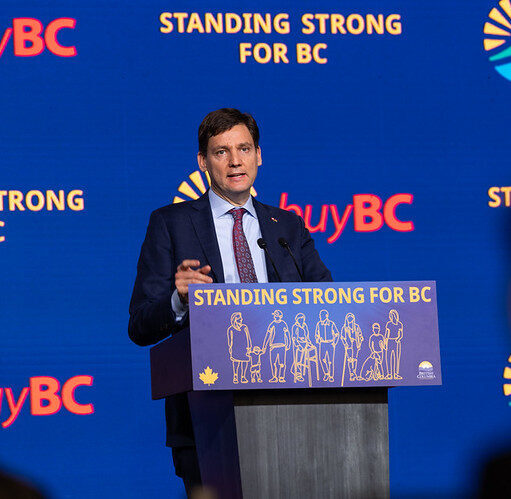
Outside Quebec, which runs its own system, B.C. ought to be the best-situated province when it comes to delivering on Trudeau’s vision of heavily subsidized, not-for-profit, government-controlled daycare. That’s because B.C. had a big head start on everyone else. In 2017 the NDP won the provincial election on the strength of an explicit promise for province-wide $10-per-day daycare. A year later that policy, called ChildCare BC, was officially launched. It would be three more years before Ottawa got around to creating its own national version of this B.C. innovation.
Last month, however, B.C. premier David Eby’s NDP government announced it was halting further expansion of ChildCare BC – which runs parallel to the federal program – in order to implement a “stabilization period”. With expenses skyrocketing and parents complaining about the unfairness of a system that works more like a lottery than a coherent social policy, the Eby government has hit pause on its signature innovation.
What does B.C.’s experience mean for the rest of the country as it struggles to implement Ottawa’s vision of the same heavily-subsidized childcare? To repurpose that famous line from Frank Sinatra’s signature song New York, New York, if $10-a-day daycare can’t make it there, it can’t make it anywhere.
The Stats: Canada Can’t
The problems facing Trudeau’s $10-per-day childcare promise are evident both in government statistics and on-the-ground tales of parental woe.
For hard numbers, Statistics Canada offers a wealth of survey data on how Canadian families are managing childcare. We know that in 2025, for example, 58 percent of children aged 0-5 years were in some form of non-parental childcare arrangement. This represents a slight uptick from 56 percent in 2023 but is noticeably lower than before Trudeau launched his Canada-Wide Early Learning and Child Care (CWELCC) program. In 2019, childcare participation was at 60 percent. The recent rise is actually due to an increase in childcare arrangements other than formal care, such as by a relative. In other words, there were fewer children in daycare and childcare centres because grandma and grandpa were picking up the slack. Hardly a policy innovation to brag about.

The biggest problem with Ottawa’s heavily subsidized childcare concept is that, as the price drops, demand inevitably rises. And demand is rising far faster than the supply of government-supported daycare spots. The original goal of CWELCC was to create 250,000 new childcare spaces at an average price of $10 per day by March 2026. Five years in, neither goal has been reached. The latest figures from Ottawa reveal only 122,788 new spaces have been opened. And average prices vary widely. In some smaller jurisdictions, including Prince Edward Island, Manitoba, Saskatchewan, Northwest Territories and Yukon, the $10 daily average fee has been reached, or almost. Elsewhere, however, average rates for children aged 0-5 climb as high as $28 in B.C. and $27 in Ontario.
Cross-Country Checkup
The survey figures are backed by ample anecdotal evidence. No part of the country seems safe from childcare shortages. Numerous news reports in the past year have highlighted the plight of Newfoundland and Labrador daycare operators keen to increase the supply of childcare spaces but who’ve been stymied by the regulations and bureaucracy baked into CWELCC.

Even provinces that have succeeded in lowering fees are failing on access. In December 2023, PEI’s Liberal government crowed in a press release that it would “achieve $10-a-day regulated childcare two years ahead of [the] national target.” Yet the very next month, daycare owner Wendy Foote sat before a legislative committee and said she was often forced to turn away “sobbing parents” as there were no spaces available at her facility. “I hear horror stories every day working in centres; people calling and begging for spaces,” Marianne Ellis, senior program manager with childcare operator Chances, told the same committee. “Honestly, there [are] people that have been on [a wait list since]…before they were even pregnant, and they still don’t have a space by the time the child is a year old.” By late last year there were 1,400 children on the tiny province’s waitlist.
Waitlists have also exploded across Ontario. In Waterloo Region more than 14,000 children are on one, including 9,500 who need a space within the next three months. And the regional municipality has identified 13 neighbourhoods where “access to affordable licensed childcare is very low or almost non-existent.” Ottawa city council reports the number of waitlisted children aged 0-5 ballooned by more than 300 percent from 2019 to 2025. Last year Sault Ste. Marie said it had 1,900 licensed childcare spaces – but more than twice as many kids on waitlists. In Orillia, some facilities have temporarily closed their waitlists because they’re so long that any kids added to it will likely be in public school before a spot opens up.
Childcare access has similarly deteriorated in Manitoba, another province that boasts of meeting its CWELCC fee goal. A poll last year showed the average waitlist for Manitoba families was 17 months, even after excluding families who never got a childcare space at all. The same poll showed that 52 percent of families had to delay a parent’s return to work because childcare was unavailable, up from 41 percent in 2016, before the federal Liberals launched their national childcare program.
The problem isn’t just skyrocketing demand; incompetence seems to play a role as well. According to a recent CBC report, a $5.5 million provincially-funded daycare facility in a rural municipality north of Winnipeg was completed in 2024 but has yet to open its doors because of a dispute over who owns the land. The facility is supposed to provide 74 daycare spaces – and already has a waitlist of 600 kids.
Declining Quality
Declining care quality is another problem. The goal of charging parents $10 per day for a service with a market value of $50 to $60 in most major cities requires significant government intervention. Along with the subsidies provided to childcare centres to lower their fees comes a web of bureaucratic controls. In some provinces, childcare has essentially become a government-controlled enterprise in which individual operators no longer control their finances or day-to-day operations. The alternative – foregoing government subsidies – is a difficult choice for many childcare centres, as parents now expect to pay fees dramatically below market rates.
Childcare centres participating in the government system have responded to this financial and managerial squeeze in various ways. Many are trimming their expenses by reducing staff numbers, providing fewer toys and games, eliminating field trips, ending flexible pickup hours, cutting out snacks and lowering staff salaries and benefits, thus reducing many of the things that contribute to high-quality care.

Anya Kerr, who runs childcare centres in Alberta and Ontario, explained in an industry group news release that “the unique needs and expenses of centres in remote areas cannot be met” under the existing system. As Kerr put it, “We’ve already had to make cuts to our quality programs, services for families, and nutrition costs, which goes against our founding philosophy. With the proposed changes, we will have to lay off staff who are needed to support inclusion of special needs children and make further cuts to our programs.” She added that many parents have offered to support these additional programs through private donations. But CWELCC is designed to prevent parents from paying more. “If none of the key goals of the system are being met, it is a failure for all Canadian families,” Kerr concluded.
According to the Association of Canadian Early Learning Programs (ACE), an Alberta-based childcare operator group that represents 1,700 operators, including Kerr, with 163,000 daycare spaces, “Funding can fall short by as much as $900 per child per month when quality programming, adequate staffing, inclusion supports, and fair educator compensation are factored into operating costs.” ACE, which has repeatedly drawn attention to the negative impact of government control on childcare quality, said in a statement last year that CWELCC has had “devastating consequences for accessibility, quality, and parental choice.”
In Alberta, daycare operator Sarah Hunter told Maclean’s she feels “handcuffed by the constraints” of her agreement with the government. She described working 13-hour days, foregoing any salary since she opened her daycare three years ago, and being forced to turn away children with special needs because she could not afford the additional staffing expense. “Sacrifices loom large,” Hunter said, “whether that involves cutting food, art, or music programs, or mass layoffs of educators – which means fewer and fewer people caring for more and more kids.”
Pointing Fingers
As the evidence of CWELCC’s many flaws and failures piles up, even vocal proponents of non-profit, government-controlled childcare are admitting the federal rollout has been problematic. This admission generally follows one of two themes. The first is that the country is experiencing a minor bump on an otherwise virtuous path. An op-ed by members of the pro-daycare organization Prosperity Project, for example, claims “the $10-a-day program isn’t perfect, but…with a few tweaks it could help even more families in the coming years.” Similarly, a study by the left-wing Atkinson Centre for Society and Child Development admits that, “Low fees are driving demand which can not be reasonably met, leading to compromises with quality,” but figures this can be remedied with yet more government funding and control.

The second theme is most often heard in Ottawa. There the preferred message is that the problem lies with the provinces, and in particular Conservative-led provinces. In 2024, for example, Trudeau said, “There are provincial governments unfortunately that follow the federal Conservatives’ lead on this and are looking to not deliver childcare or even cut child-care services.” These remarks came at an event at a Vancouver daycare where Trudeau used the moment to praise NDP-run B.C. for its forward-thinking approach. More recently, Prime Minister Mark Carney declared that the future financing of this very expensive program rests on the shoulders of the provinces rather than his federal government.
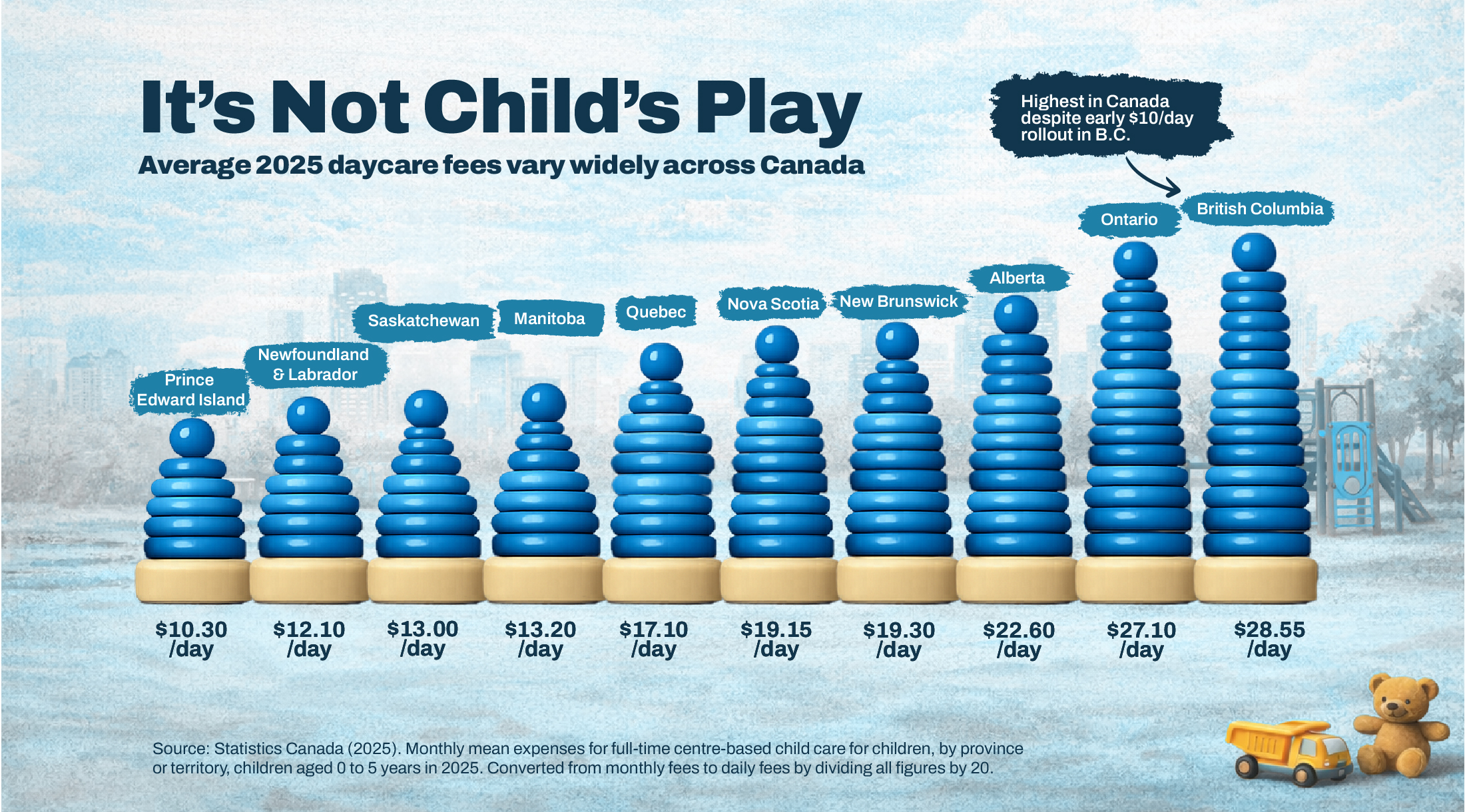 Worst in Canada: Despite a three-year head start in rolling out $10-a-day childcare, B.C. still has the country’s highest average fees. (Source of chart: C2C Journal)
The OFM is “fundamentally flawed,” Worms says. To limit the program’s overall cost, government funding comes with strict controls that prevent childcare centres from paying staff more than what appears on a government-created wage grid – even if existing staff had higher salaries prior to the new system. This means some childcare centres have been forced to reduce the wages of long-tenured staff or let them go in order to hire cheaper, less experienced replacements. Such a situation “doesn’t say a lot for quality for children,” Worms says. She adds that parents with children who have special needs have also been let down, as special needs funding has been “obliterated” in the drive to get fees down to $10 per day.

Echoing concerns raised by ACE and daycare operators in other provinces, Worms explains that government payments don’t accurately reflect her actual costs, particularly for toddlers. It’s a one-size-fits-all model imposed by politicians who “don’t have any understanding of operations,” she says. In her experience, the provincial government has zero interest in listening to entrepreneurs who have operated successful childcare centres for years. An industry that was once relentlessly innovative is now being strangled into submission by bureaucracy.
Daycare operators are “essentially government employees at this point, without any of the benefits at all,” adds Worms. “Everyone’s just hoping to survive.” This sort of result is hardly a surprise when government intrudes into the marketplace. Public control is fundamentally incompatible with entrepreneurial activity.
Those Who Need it Least Benefit the Most
The bigger surprise in B.C. is how inequitable childcare has become while under public control by an NDP government. Remember, the concept of cheap childcare was sold to Canadians as the means to help families most in need and at the same time encourage more mothers to enter the workforce. In practice, B.C.’s daycare mostly helps families at the top of the heap and mothers who were already working.
A survey conducted for the Coalition of Childcare Advocates of British Columbia reveals that among families with a child in daycare, 25 percent of households with annual income under $50,000 waited over two years for a subsidized space, compared to 15 percent of those from households with annual income over $100,000. Asked if they were at any time unable to return to work due to a lack of childcare, 71 percent of parents with household income under $50,000 said yes, compared to 60 percent of those with an income over $100,000. And only 16 percent of families earning less than $50,000 said they knew someone who had actually accessed $10-a-day daycare; that figure was almost twice as high – 29 percent – for those earning over $100,000. The clear disparity between families on different rungs of the income ladder is disturbing.
A separate survey of parents and caregivers of children under the age of five in two inner-city Vancouver neighbourhoods similarly revealed how poor families have the poorest access to subsidized childcare. Most of those surveyed had annual income under $50,000 and their most common form of childcare was basic parental care. Their modest taxes are helping to pay for $10-per-day childcare that they can’t use. And as recounted in an earlier C2C Journal article, in 2024, UBC researchers had to abandon plans to study the effects of $10-per-day childcare on low-income single mothers after they could only find 13 such families actually receiving the benefit. The vast majority of the spaces were in the hands of middle- and upper-income families, well motivated to get their share of government goodies.
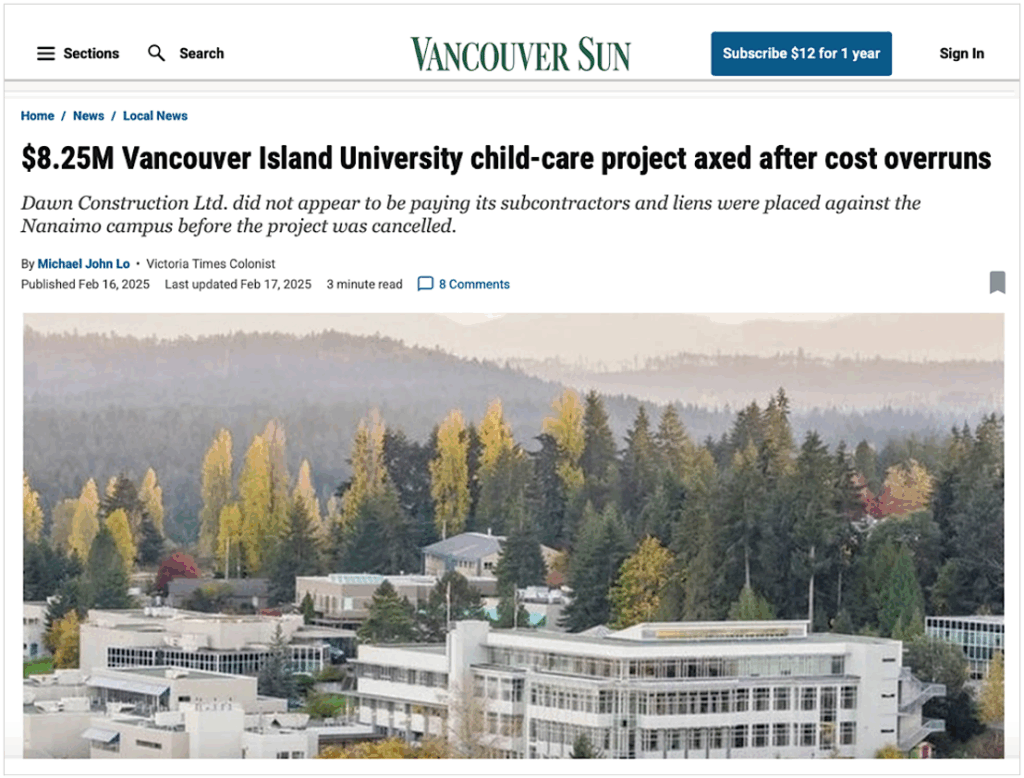 Costly incompetence: With governments making themselves central in the once-entrepreneurial childcare business, boondoggles have become commonplace. Shown, a 2025 article from the Vancouver Sun revealing how a multi-million-dollar daycare project at Vancouver Island University was botched.
A Failed Policy that Failed First in B.C.
When $10-per-day daycare was introduced in 2021, proponents argued it would free new mothers from the drudgery of parenting and spur their entry, or re-entry, into the workforce. Some even claimed heavily subsidized daycare would actually “pay for itself” as additional federal and provincial tax revenue from these mothers’ extra income would cover the subsidies’ total cost. Five years later, it is possible to test those claims.
The C.D. Howe institute recently put the federal CWELCC program through a rigorous cost-benefit analysis. Its conclusion: rather than paying for itself, the pricey program has generated a net loss of $16 billion. (Because the cost-benefit analysis is based on 2025 data, the overall cost is estimated at $25 billion.) The reason for this staggering loss is tied to the essential unfairness on display in B.C.: the families making the greatest use of heavily-subsidized daycare are not the families who really need it.

As the C.D. Howe report reveals, the bulk of CWELCC benefits are going to “households already using regulated childcare, particularly high-income families, [who] were simply able to substitute government-subsidized care for the market-priced care they were already paying for.” Rather than lifting up low-income families, the report concludes Ottawa’s childcare program is simply providing “a financial windfall” to well-off families who were previously using market-rate childcare.
As for the promise of more mothers in the workforce, “Maternal workforce participation has increased only modestly,” the report finds. Child development outcomes are similarly characterized as exhibiting “minimal to no additional gains.” In short, low-income, single-earner families who could most use subsidized daycare can’t get it. Why? Because richer folk have taken the bulk of the spaces. The end result is no increase in working mothers and no gains in child development for at-risk kids.
Meanwhile, childcare providers and entrepreneurs who have spent years and risked their own savings to provide this important service to families have essentially had their businesses expropriated by government, which does not have the necessary knowledge or ability to run childcare competently.
Fine-tuning the CWELCC boondoggle is unlikely to help. The best solution to this expensive failure is to blow up Ottawa’s entire childcare policy and start over. Rather than continue with an extremely expensive universal model, the C.D. Howe report suggests governments prioritize measures that help “low-income, less-educated, or single-parent households with preschool-aged children.” And this is best accomplished, it says, with “an income-tested, refundable tax credit similar to the Quebec model to increase flexibility and support families using non-subsidized care.”

A version of the Quebec tax credit model, it bears mentioning, was included in the Conservative Party’s childcare platform during the September 2021 federal election under former leader Erin O’Toole. This was the election in which Trudeau successfully defended his universal, $10-per-day childcare promise he’d rolled out earlier that year. The Conservative plan would have offered much greater support for families at the low end of the income spectrum, while improving parental choice everywhere. And it would have been significantly cheaper.
As the experience in B.C. reveals – and as the rest of the country will soon discover – Trudeau’s vision of heavily-subsidized, universal, government-controlled, non-profit childcare is failing. It’s time to try something better.
Matthew Lau is a Toronto-based writer who specializes in business, politics and economics. He is a frequent contributor to the National Post, Fraser Institute and other publications and think-tanks.
Source of main image: AI/ChatGPT.