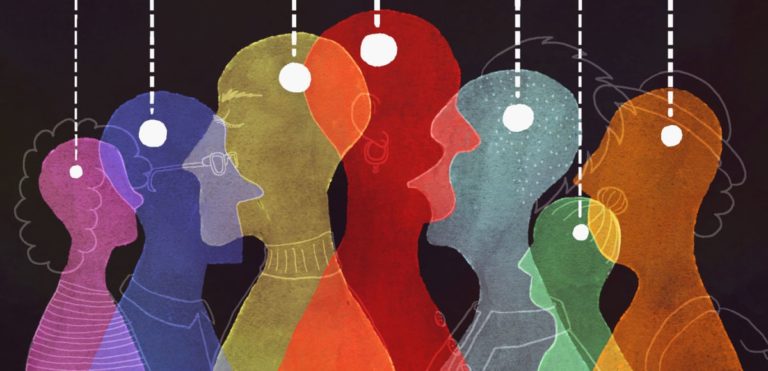
“Who are those hooded hordes swarming,
Over endless plains…”
-T.S. Eliot, The Waste Land

In his epic account of the evolution of civilization, the historian Will Durant observed that the Greek city-state of Sparta was ruthlessly single-minded in its pursuit of militaristic supremacy—and this included a virtual ban on foreigners. “Foreigners were rarely welcomed,” he writes. “Usually they were made to understand that their visits must be brief; if they stayed too long they were escorted to the frontier by the police.”
For Sparta, a functioning and healthy society was defined by an extreme unity; the more alike citizens were—the better. So eugenics was practiced; those that survived were inculcated from youth that they could learn nothing from other nations; Spartans themselves were forbidden to travel abroad without government permission. In addition, boys were taken from their families at age seven and raised by the state. Schooling was basic (to prevent independent thought) and military training brutal. It included sleeping outside in winter and summer and taking baths rarely lest the “water and unguents made the body soft,” writes Durant.
More generally, while differences in wealth existed in Sparta, they were hidden and citizens were expected to dress and behave alike; equality at almost all costs—unity—was expected. It was how the Spartans defined their civilization.
In contrast, Athens promoted more extensive education, art, philosophy, commerce, and cultivated inequality of all sorts; Athenians celebrated luxury and luxuriousness, including in food and drink—much to the chagrin of Spartans who considered Athenians flabby and weak.
While ancient Athens was hardly a modern, liberal cosmopolitan New York City—Athens too had restrictions on foreigners and citizenship was narrowly defined to exclude slaves and women, Athens was, in the ancient world, diverse in comparison to Sparta.
The ancient contrast between Sparta and Athens is relevant yet today. Much of the West (the Americas and Europe) defaults to diversity in practice and in law; so too some East Asian city-states such as Hong Kong and Singapore and some African nations such as South Africa. Japan (where I once lived) is a middling case. It is far from the isolationist, enforced unity seen in its most closed period, from the early 17th century and until the Meiji restoration in the 19th century. Today, while Japan is still ethnic-based in citizenship requirements, it is increasingly open in sentiment and in some policies. India’s population is diverse though it seems to struggle in part because of some chauvinism of both the ethnic and male variety.
In clear contrast to the West, North Korea is a modern version of Sparta; Saudi Arabia is only slightly less self-isolated but still leans heavily to monochromatic unity, perhaps akin to another historical theocracy, Calvin’s Geneva.
The Sparta-Athens, North Korea-New York City contrasts are stark. But even where the unity-diversity contrast is less obvious, a proper understanding here matters to internal disputes in any country on issues such as immigration, integration and citizenship: When is unity desirable and when is diversity optimal, given that both are necessary for a viable, functioning nation-state?
Canada, America, Great Britain, France and Australia all welcome newcomers from all corners of the world. That is smart for reasons of state (diverse peoples within a country help governments better understand how those in other countries think). It also matters to trade and commerce (entrepreneurialism is helped by a diversity of thinkers and that implies a literal diversity of peoples and their experiences). It also matters to tolerance: rubbing shoulders with people different in some manner at least allows one to reconsider an existing prejudice.
Diversity is desirable for that and other reasons. But like a rubber band, it is a mistake to pretend that diversity can be stretched beyond reasonable limits. Citizens must at least agree on some basics.
In the West in varying but growing degrees since the Enlightenment, and now in some additional parts of the world, that meant a growing respect and role for women over the centuries; the belief that domestic social, economic and ultimately political disputes are settled by reason and the rule of law; it includes agreement that peacefully changing rulers according to the preference of citizens and not some (previous) institutionalized control by the church (or mosque, as the case may be) reigns supreme. It also includes protections for diverse thought, expression and practices. The sensible self-protecting caveat here is that the functional unity of the nation-state cannot be allowed to be undermined. And some practices cannot be tolerated: Female circumcision, for example.
All this matters to practical decisions that governments make on immigration and citizenship—much in the news recently; it matters how judges will rule on those same political decisions if and when specific instances of revoked citizenship come before the courts. It matters to the wider societal discourse about what type of civilization is desirable and worth retaining in the West, or what types should be created elsewhere.
No one should read into this a hidden call for a ban on immigration from specific nations. That would miss the point and get it backwards: When evaluating immigration policy, or whether a dual citizen should be stripped of their Canadian citizenship, and on multiple other matters that might touch on the unity of Canada, the useful question to ask is this: can this specific person contribute to the necessary unity of Canada or will they attempt to rip us apart?
The main motivations of young immigrants to Canada in the 1970s from places like Pakistan likely included a desire for greater personal security and freedom, a more tolerant, diverse society, and better economic opportunities.
Today, someone from Karachi who has spent a bit too much time near the Khyber Pass, whose travel history included trips to Yemen, Syria and Iraq for uncertain purposes, might be motivated to come to Canada for very different reasons. Thus, it is entirely reasonable for immigration policy and processes to consider such travel histories. That is not the same as recommending a ban based on the country of origin, where unwarranted generalizations are made instead of decisions on specific cases.
After all, pace the 1970s example, plenty of people leave repressive regimes precisely because they are repressive, and here I think of a young lady I met last year in Toronto. While devout in her Islamic faith, she preferred her mother and Canada to her father and her birth country of Saudi Arabia.
Diversity, properly defined, with the recognition of its rubber-band limits, is a useful default preference; but unity, properly understood and enunciated for all, is a precondition for the kind of flourishing diversity most of us desire.
~
Mark Milke is an author, columnist and member of C2C Journal’s editorial board.