Stories

Democracy in America

Paul Bunner
June 1, 2016
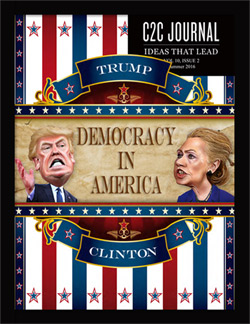
The 2016 U.S. presidential campaign is an unrivalled spectacle of political entertainment that is by turns fascinating, repulsive, and worrying. As the primaries wind down and the main event begins, C2C Journal launches its Summer Edition on the theme of Democracy in America. The title, borrowed from the famous 1835 book by French political philosopher Alexis de Tocqueville, heralds the overarching theme of ten essays we will publish over the course of June, starting with Trevor Shelley’s examination of Tocqueville’s remarkably prescient hopes and fears for the country that became the world’s strongest defender of democracy but is now making a mockery of it.
Stories

Democracy in America

Paul Bunner
June 1, 2016
The 2016 U.S. presidential campaign is an unrivalled spectacle of political entertainment that is by turns fascinating, repulsive, and worrying. As the primaries wind down and the main event begins, C2C Journal launches its Summer Edition on the theme of Democracy in America. The title, borrowed from the famous 1835 book by French political philosopher Alexis de Tocqueville, heralds the overarching theme of ten essays we will publish over the course of June, starting with Trevor Shelley’s examination of Tocqueville’s remarkably prescient hopes and fears for the country that became the world’s strongest defender of democracy but is now making a mockery of it.
Share on Facebook
Share on Twitter

Supporters of Hillary Clinton and Donald Trump are predicting nothing less than the fall of the American empire if their opponent wins the U.S. presidency this November. The Clintonites warn that a Trump victory will result in a global economic meltdown precipitated by trade and currency wars, a Russian takeover of eastern and central Europe following the collapse of NATO, a confrontation between China and nuclear-armed South Korea and Japan in the Pacific, an explosion of home-grown Islamist terrorism in response to Trump’s ban on Muslim immigration, and an acute shortage of illegal Mexican immigrant nannies and pool boys.

The Trumpians believe a Clinton presidency would be a “catastrophe” for American economic, political and military power. They also think it will lead to a ban on the phrases “Islamist terrorism” and “separate bathrooms”, repeal of the Second Amendment, a tsunami of affirmative action for everyone who is non-male, non-white and non-heterosexual, and a special room in the West Wing where Old Bill gets an unlimited supply of interns and cigars to help him orchestrate the ruin of the U.S. economy.

Many Canadians watching nervously from the north are fearing disaster no matter who wins the presidency. This is the thematic thread that runs through most of the articles in the Summer 2016 edition of C2C Journal.

We titled it Democracy in America to honour the 1835 book of the same name by Alexis de Tocqueville and to highlight the irony that what is happening in the 2016 presidential year bears almost no resemblance to what most of us – including Tocqueville – would recognize as a healthy, functioning democracy.

What it looks like instead is the mother of all reality TV shows, featuring an actual reality TV show host and real estate developer of dubious competence and integrity who won the Republican nomination by calling all his competitors stupid, ugly, impotent liars. His opponent is a career political opportunist who is dragging around so much baggage – including an FBI investigation – that she can’t even finish off her only competition for the nomination, a fossilized socialist rehashing economic balderdash they don’t even believe in Beijing or Havana anymore.

However awful it is as democracy, it is also great entertainment. Like train wrecks and epic fail videos, we can’t look away. Trump, even more than our own Prime Minister Justin Trudeau, has so mastered the medium that it doesn’t matter how glib or factually unsupportable the message is, we are drawn to it like moths to flames. So you might as well resign yourself to a summer of Fox News, Politico, C2C Journal, and non-stop coverage of the battle between Hillary and The Donald for the soul of America.

Our exploration of this fateful contest begins with Trevor Shelley’s reflections on Tocqueville’s remarkably prescient hopes and fears for American democracy. Next up is John Robson, who understands why voters are mad as hell at the unholy choices before them, but suggests they should be even madder at themselves for the selfish, ignorant, hedonistic vote-sellers they have become.

Peter Shawn Taylor examines the parallels between the possible if not probable implosion of the Republican Party and what happened to Canada’s conservative movement when it cracked up nearly three decades ago. Luigi Bradizza drills deeply into the ruins of democracy in America, where a failed education system has rendered millions unemployable and incapable of fulfilling the basic responsibilities of citizenship. Jason Unrau provides some gonzo comic relief to this grim epitaph for U.S. exceptionalism by trying to persuade you that Donald Trump is, in fact, the apogee of American democracy and the pure and perfect expression of her exceptionalism.

There is more, including Patrick Keeney on the prescient work of cultural critic Neil Postman, who foretold 31 years ago what would happen when politics and popular culture became indistinguishable and Kim Kardashian’s latest cosmetic surgical enhancement became more important to most people than the latest atrocity by ISIS. Kelly Jane Torrance, a Canadian editor at the Weekly Standard, explores the parallels between the presidential races of 1968 and 2016, Tim Anderson previews what’s in store for Canada after Clinton becomes the most powerful woman on earth since Queen Victoria, J.J. McCullough investigates the ominous “alt right” movement of angry young white males, a key Trump constituency that may be the harbinger of a dangerous new radical movement in American democracy.

If this all sounds too gloomy, take heart. The Dark Ages only lasted 500 years after the fall of the Roman Empire.

~

Paul Bunner is the editor of C2C Journal.
Love C2C Journal? Here's how you can help us grow.

More for you

The Hands-On Future: Skilled Trades, Data Centres and Canada’s Big AI Opportunity

Whether Canadians fear or favour artificial intelligence, they can’t stop it. AI’s transformative power in making so many things faster and easier will doubtless cause pain, says veteran Canadian business leader Gwyn Morgan, but it will also provide generational opportunities Canada must seize. The Prairie region, especially, has the abundant land and energy needed to build the massive AI data centres that will power the future. Some workers are at risk, Morgan concedes, but AI will create opportunities as well, particularly in the skilled trades. AI might just transform our labour force into one where more workers do real things for real people.

The Day After: How Ottawa’s Clarity Act Could Destroy the Federation It Was Meant to Protect

With Alberta headed for a vote on having a vote on independence, many Canadians may think the threat of separation has evaporated. Or that it’s a long way off. Or that, in any case, Ottawa’s Clarity Act will shut it down and protect the federation. But in the concluding instalment of their series (read Part I here and Part II here), George Koch and Jim Mason explode that delusion. The Act is more likely to increase the “Yes” vote which, they predict, will trigger more political wrangling, more bad faith and bitterness, possible civil unrest and even the province’s annexation by the U.S. The consequences, in other words, are dire no matter which side you’re on.

Too Clever by Half: Why Ottawa’s Clarity Act Helps Neither Side in Alberta’s Separation Debate

The House of Commons once had an effective law in front of it that laid out clear steps to assure that any provincial referendum on independence would be democratic and any negotiations after a “Yes” vote would be fair. But it wasn’t the current Clarity Act – it was a bill put forward by the Opposition Reform Party in 1996, and the Liberal government chose to ignore it. Instead, it passed its own legislation designed to crush support for any subsequent secession movement. In Part II of their series on what the Clarity Act means to today’s debate over Alberta’s future, George Koch and Jim Mason delve into the Act’s origin story and explain why it’s so blatantly stacked in favour of Ottawa – and how that could inflame separatist sentiment and undermine the federalist cause.

More from this author

Good News From C2C Journal

C2C Journal is pleased to announce that thanks to the loyal and generous support of our readers, contributors and donors, the Journal is immediately increasing volume and frequency of original stories and essays, expanding staff, unveiling a redesigned website, and launching a sustained social media marketing push on multi-media platforms. Editor Paul Bunner has the details.

One step forward, two steps back for freedom

When he wasn’t kayaking on or swimming in the North Saskatchewan River near his home in Edmonton, C2C Journal editor Paul Bunner spent some of his summer fighting two battles for little freedoms in his local community. He won one and lost one. Although he’s a veteran political activist at the federal and provincial level, Bunner contends that the lifeblood of democracy must be nurtured at the foundations of society if it is to flourish at the top.

The Last Front Page

The rapidly shrinking newspaper business raises all kinds of questions. What will we wrap fish guts in? How will we light backyard fires? And where will we get reasonably accurate and important stories about what’s going on in our community, our country, and the world? The internet? Where global editor-bots decide what’s news? Where politicians can lie with impunity? Where fake news outsells real news? The short answer is yes. The longer and more encouraging answer is in the Spring edition of C2C Journal, which launches today with editor Paul Bunner’s lead editorial and career newspaperman Paul Stanway’s lament for the ink-stained wretches of yesterday’s news.