American political satirist Hunter S. Thompson covered the 1972 U.S. presidential election in a series of articles for Rolling Stone magazine that were eventually compiled in a book titled Fear and Loathing on the Campaign Trail ’72. Thompson’s “gonzo” journalistic treatment of the Democratic primaries and George McGovern’s disastrous campaign against Republican nominee Richard Nixon was both hilarious and insightful. He contended that McGovern’s single biggest mistake was making U.S. withdrawal from Vietnam his main campaign focus and using overheated pacifist rhetoric to defend his position.
Fast forward 44 years to this year’s presidential campaign. If Thompson were still around (and had not drunk and drugged himself into an early grave), what would he make of Donald J. Trump? At least as polarizing a figure as McGovern, armed with much less rhetorical restraint, Trump seems the embodiment of Thompson’s famous quote: “When the going gets weird, the weird turn professional.”
The absolute focus on “making America great again”, and the hammer-and-tong bashing of anyone who stands in his way, has been Trump’s ground game from day one. He seems completely unscripted and authentic – no ordinary politician would say the things he does – and people love him for it. His stadium rallies across the U.S. are filled to overflowing by adoring “Trumpkins”, while outside his equally passionate enemies beat up his supporters and trash police cars. No matter how racist, sexist, untrue or just plain weird his daily pronouncements are judged by an incredulous media, he won’t be deterred, is unapologetic, doubles down and somehow lives to fight another day.
The apogee of American democracy
Why is a reality television star, best-selling author, real estate mogul and former beauty pageant proprietor a legitimate contender for the presidency? Because Trump represents the American Dream, in technicolor. He is populism on steroids, Willie Loman with cojones, the consummate political outsider, and in the land of the exceptional it’s this most unexceptional, almost hackneyed persona that is resonating.
Dismissed in the early going as a joke candidate in the same league as the ‘The Rent is Too High’ YouTube sensation Jimmy McMillan, Trump went on to defeat all the Grand Old Party comers, a field of 16 that included well-organized and financed political professionals Jeb Bush, Ted Cruz, John Kasich and Marco Rubio. Since few of his policy positions were recognizably Republican or rooted in anything resembling mainstream conservative philosophy, the party establishment and most of its intellectuals wanted nothing to do with him – until polls began suggesting he might be competitive with the presumptive Democratic nominee Hillary Clinton. Then the party grandees, eventually including powerful House Leader Paul Ryan, slowly and reluctantly started to come onside.
Trump seemed not to care if he got these lukewarm endorsements or not. The primary source of his support is widespread public antipathy towards the political “establishment” in all its manifestations. This includes, according to Trump, the media, the wealthy, the highly educated, Democratic and Republican politicians, and “the lawyers, the lobbyists, [and] Hillary…” who don’t like him or all the “beautiful people” who support him.
Beautiful or not, some 13 million Americans voted for him in the primaries, and polls suggest many millions more favour him for the presidency. It’s not clear whether Trumpism is the product of a sophisticated political machine or one man’s gut political instincts or some combination of the two, but it is clear that it’s a riotous mash-up of capitalism, democracy, and entertainment that has generated the biggest stockpile of earned media the world has ever seen. And the more that earned media is negative, the better Trump seems to do in the polls.

The Donald is hardly the first American politician to transform celebrity fame into political fortune, but unlike Arnold Schwarzenegger, Jesse Ventura, Sonny Bono, or Clint Eastwood – he’s the first to do it by torqueing up his performance instead of toning it down. He has authored an epic narrative pitting a rookie political Horatio Alger against the almighty former first lady, senator, and Secretary of State Clinton. It’s Seabiscuit vs. War Admiral, Balboa vs Creed, Skywalker vs Vader for 21st century American politics. The looming contest is so American, the apples are spilling from the pie.
Adhering to the all-American wager of putting your money where your mouth is, Trump’s primary campaign was almost entirely self-funded. His stadium rallies generate $25 a head and produce hundreds of thousands of newly registered voters. In keeping with his mission to Make America Great Again, by democracy’s yardstick he’s made it better already.
True lies
Trump has also reclaimed some public space for America’s most cherished principle – free expression, enshrined in the First Amendment – by saying things his competition wouldn’t dare, but what his growing legions of supporters have been thinking all along. Whether it’s clamping down on illegal immigration, linking Islamic terrorism to Islam, or the tremendous loss of American jobs to cheap foreign labour and the toll it’s taken on the U.S. economy, Trump is speaking at least half-truths to power and hitting a primal sweet spot in voters’ minds. His idea to build a wall at the Mexican border to staunch the flow of illegals illustrates his genius for growing a kernel of truth into a beanstalk of ambition. He’s really just proposing to finish the job started at Tijuana where a wall already exists, and replacing border patrols and fences elsewhere in Texas and New Mexico with something more substantial.
Perhaps the most exceptional aspect of Trump presidential gambit is that he doesn’t need the hassle of politics or its spoils. He is certainly not doing it for the $400,000 a year presidential salary, and so far all attempts to brand him as an evil, power-mad Hitlerian megalomaniac have failed. No matter how vehemently they disagree with his policy proposals or despise his seemingly uncontrollable rudeness and vulgarity, most Trump-haters concede that his motive for running seems fairly altruistic: a proud if misguided American patriot who genuinely wants to restore U.S. economic and military power and prestige.
If anyone looks like a power-mad schemer, it’s Clinton. Thwarted in her lust for the presidency eight years ago by Barack Obama, 2016 is her last shot at the Oval Office. Plus 1600 Pennsylvania Avenue is the coolest crib she’s ever known whereas if Trump wins, he will be downsizing from his Spanish revival Mar-a-lago mansion in Florida, or his Louise XIV-inspired, gold-embossed super condo in Manhattan.
For the wealthy and those who aspire to wealth, owning a membership at the local golf and country club is a sort of status symbol, like fancy houses and cars. The Donald has 17 memberships at golf courses he owns outright: a dozen in America, a pair in Dubai, another pair in Scotland and one in Ireland. When he decides to play a round at his Emerald Isle links, he can hop on his private 757 jet in New York and be teeing off there in a few hours. As an awestruck female contestant on Trump’s reality TV show The Apprentice once gushed, “He’s the mack-daddy.” Rap slang for pimp, the United States of America may soon become the first country in the world to elect a mack-daddy as president.
But a preponderance of female voters are leery of that idea, according to the polls. Many see the thrice-married Trump as a misogynist, an impression he exacerbated by saying women who get abortions should be jailed and by suggesting Fox News host Megyn Kelly was hormonally unhinged when she asked him some tough questions. So far, those two incidents mark the only times Trump has backtracked and apologized for comments made on the campaign trail. It suggests that his alleged weakness with female voters is real, and that the candidate and his handlers know it. Indeed, the Trump campaign has tried to neutralize his negatives with women by vigorously accusing Hillary of collaborating in attempts to cover up her husband’s numerous infidelities.
The Trump counter-revolution
Still, the politically incorrect alpha male is an indelible part of Trump’s brand. There are even reports of young males, inspired by The Donald, giving up drugs, booze and indolence so as to imitate his abstemiousness, entrepreneurialism, and familial devotion. Insofar as “making American great again” implies a return to an earlier political, economic and cultural time, it’s part of a consistent message aimed at voters who are unhappy with some aspects of the modernist, progressive status quo.
Inevitably this counter-revolutionary beacon has attracted a few bugs including long time Klu Klux Klan leader David Duke and the noisy, belligerent, beer-fueled Bikers for Trump. He has a few slightly less embarrassing celebrity endorsements: Indiana Hoosiers coach Bobby Knight and golf legend Jack Nicklaus are among the notables. Then there’s the mixed blessings from reality TV B-listers like the hairy Christians in the Duck Dynasty clan and Jesse James of West Coast Choppers. Here is James’ ode to Trump, typos and all, from a January 17 Facebook post:
He is respectful to the little guy (which shows he worked hard to get where he is) and he is also tough as nails when he needs to be. The people he will appoint to key top positions will be top shelf, and you can bank if they don’t perform? They will get the boot. Lastly the best quality I observed about Donald Trump is being a dad. This is by far his strongest quality. Ivanka is an super smart, driven woman. The shakes your hand firm and looks you in the eye when she talks to you. Donald Jr. Also has the same smarts and drive, but is also a pretty regular guy that has a “almost” restored 69′ Camaro and loves to long range shoot (don’t let anyone know I told you that). The poise in these two shows a lot in their parents. I think we are lucky to have his kids as part of the deal.
Even Hunter S. Thompson would have been hard pressed to imagine or explain the appeal of Trumpism, but a much earlier chronicler of American democracy might have predicted it. Nearly two centuries ago Alexis de Tocqueville reported in his famous two-volume work Democracy in America that individualism, free markets, hard work and making money were key to American greatness because they allowed people to transcend the rigid class hierarchies that prevailed in Europe. Granted Trump won the lottery twice – by being born in America and into wealthy family – but by any objective measure of success in business, television, writing and now politics, Trump is very much a winner, earning his fame, fortune, and status as an avatar of modern American exceptionalism. Perhaps African-American rapper-turned-actor Ice Cube said it best: “Donald Trump is what Americans aspire to be – rich, powerful, do what you want to do, say what you want to say.”
Ironically, Tocqueville’s idea that America was exceptional among nations because of its liberty, democracy, equality and abundant natural resources was acknowledged by Marxists in the American Communist Party. They saw the United States as immune to determinist economics because of these qualities, and it is said that Josef Stalin purged these useful idiots from his American political proxy for pointing out the obvious.
Like the Tea Party movement he has effectively taken over and expanded, Trump is essentially calling for a revival of American exceptionalism. In his simplistic world view, communism or something much like it has burrowed into the economic and political foundations of the U.S., leaving it weak, impotent and vulnerable. When he mocked Senator John McCain for being a POW “loser” in Vietnam, he was implicitly arguing that the rot dates back as far as the 1960s. And Trump’s promise to take care of wounded veterans, particularly those of America’s foundering conflicts this century in Iraq and Afghanistan, has attracted more veterans to his fold than turned them away.
Although the late libertarian essayist Christopher Hitchens described the United States as sui generis, in that its founding document explicitly separates church and state, it remains the most Christian of western developed nations. The godless Trump is an unlikely champion for the religious right but they instinctively trust him more than Clinton thanks to her militant secularism and his clumsy outreach on abortion and vow to defend them from secular crusades like the war on Christmas: “You’re going to see Merry Christmas in department stores, believe me.”
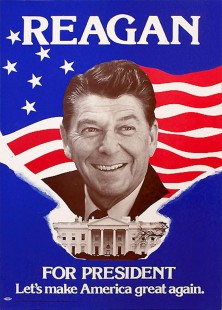
Ronald Reagan, another Hollywood B-lister who endured similar ‘mission impossible’ criticism and character assassination during his run for president, ended up a two-termer who won the Cold War. He too ran on a promise to “make America great again”, and there are echoes of his ‘peace through strength’ motto in Trump’s vow that “our military will be so strong, nobody will mess with us”. Is Trump the next Reagan, an underestimated simple-minded chump who will beat the odds and become the next president because his message scores a direct bulls-eye on voters’ nostalgia, fear and yearning for American exceptionalism? We’ll see. In the meantime somewhere Hunter S. Thompson is fumbling for a smoke in his grave and muttering “Jesus! Where will it end? How low do you have to stoop in this country to be President?”
~
Jason Unrau is an Ottawa writer and admirer of Thompson, Tocqueville and Trump.