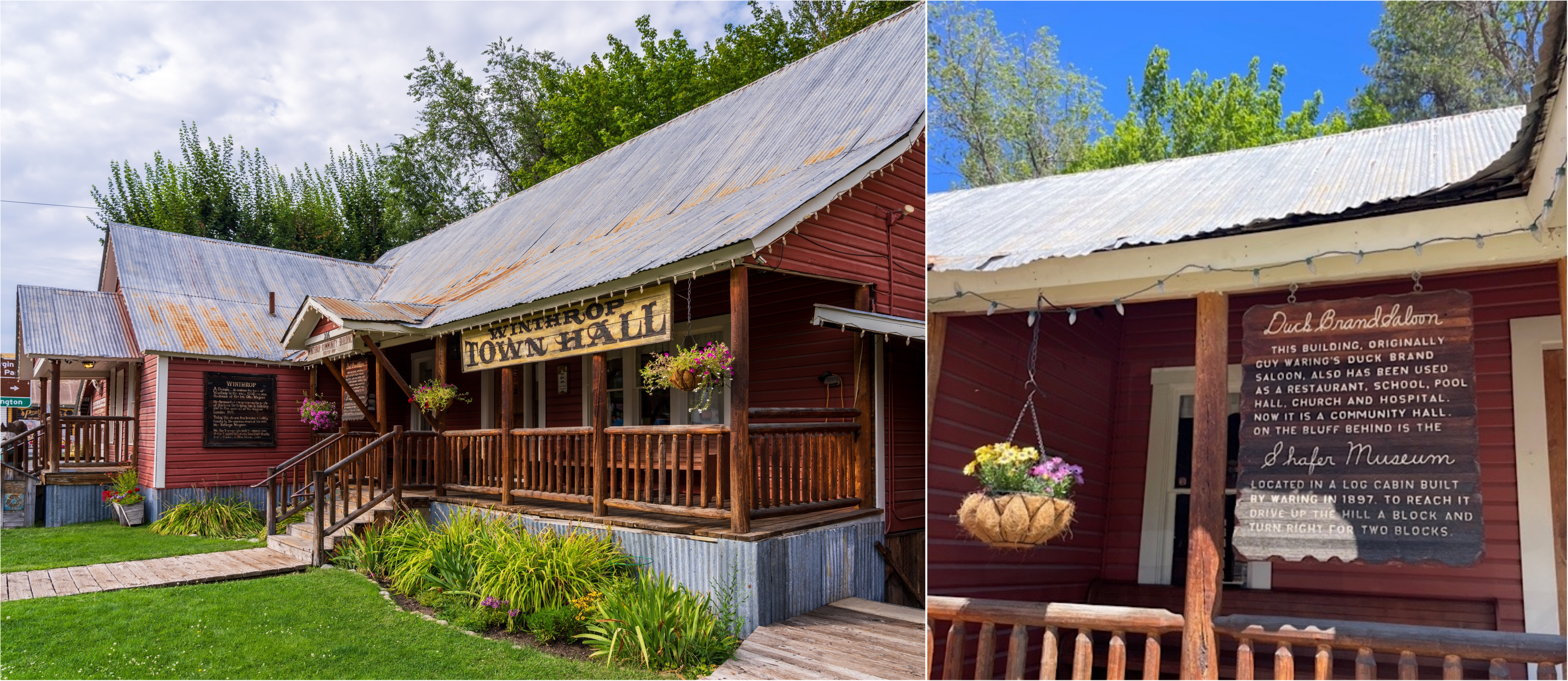
Nestled on the shoulders of the Cascade Mountains in the Methow Valley lies picturesque Winthrop, Washington. With its Old West-style false-fronted buildings, wooden boardwalks and hand-painted signs, this former gold-mining town draws legions of tourists from across Canada and the U.S. eager to step back in time. Beyond its visual delights, however, Winthrop is also a useful source of insight into the true nature of “sustainable” design. You just have to look a bit closer.
One of Winthrop’s oldest and most versatile buildings is the Duck Brand Saloon. As the sign out front explains, the Duck Brand began life in 1891 as a unique frontier drinking establishment owned by a teetotaller famous for his refusal to serve drunks. Later it became a restaurant, school, pool hall, church and hospital. Currently it serves as Winthrop’s town hall and community centre. Over its 135 years, this simple wooden structure has met the evolving needs of Winthrop’s residents. It is hard to imagine a more practical and enduring example of true sustainability. The Duck Brand Saloon has done it all. And with locally sourced wood.
Today, of course, sustainability is on everyone’s lips. But instead of being hailed as the happy result of necessity colliding with imagination, sustainability is now something that must be baked into every new building at the point of conception. Sustainability is no longer an organic process but an official requirement. “Green” building standards, either imposed or recommended by all levels of government, cover an ever-growing range of demands regarding energy use, carbon dioxide emissions, public transportation, local habitat, social justice and naked political diktat.
In addition to federal and provincial requirements, many municipalities now consider adherence to their local green building codes more important than residents’ own standards of living, given that such rules inevitably raise housing costs. In some cases, requirements have been toughened in the midst of Canada’s national housing affordability crisis. In Vancouver, for example, a 2022 green building standard banned inexpensive natural gas for home heating and mandated an implausible net-zero requirement on all new construction projects commencing in 2030. (The ban on natural gas heating was later paused; the net-zero commitment remains.)
Canada’s green building fixation thus appears to have intensified into something like a religious fervour – casting aside practical secular concerns in favour of aspirational, moralistic goals. At its most exalted level, followers profess belief in a mysterious “points” system that claims to celebrate virtue and rewards the faithful with baubles of bronze, silver, gold and platinum. The pursuit of these trinkets has blinded adherents to what were once the most basic elements of good building design: matters of cost, time, practicality and purpose. Throughout Canada, the entire public-sector construction community of architects, developers, builders and politicians has prostrated itself before the holy altar of LEED. It is a false god.
Down a Garden Path
The Leadership in Energy and Environmental Design certification system – LEED – was created in the late 1990s by the U.S. Green Building Council (USGBC), a wildly successful non-profit agency. Under LEED, points are awarded to building projects by LEED-certified analysts across a variety of metrics covering energy and water efficiency, construction materials used and overall environmental impact. The system is meant to encourage architects and developers to embrace the latest technologies and practices in order to make their buildings as efficient as possible. Based on points earned, buildings can score LEED Basic, Silver, Gold or Platinum plaques. In March 2000 the Phillip Merrill Environmental Center in Annapolis, Maryland earned the first-ever LEED plaque, with a Platinum designation.
The concept soon crossed the Canadian border and in 2003 the municipal operations centre in White Rock, B.C. became the first new building in Canada to meet LEED’s standards, earning 44 out of a possible 69 points. Among its LEED-friendly features were waterless urinals, a system that stored rainwater for car washes, a gravel parking lot (which improves drainage) and a garden full of native plants.
Since then, LEED certification has become the sine qua non of the Canadian construction industry, most prominently in the public sector. In Canada the LEED program is managed by the Canada Green Building Council, which boasts of certifying nearly 7,000 buildings since 2003. A LEED plaque at a building’s main entrance has become a highly-sought status symbol, its presence signifying an edifice of true virtue and foresight, with that glory reflecting warmly on the builders, owners, tenants – as well as the politicians who cut the ribbons and take the credit.
As the success of LEED has grown, the stakes have broadened from simply encouraging lower energy use. The total number of points available now stands at 110, with additional categories covering a range of not only environmental but nakedly ideological objectives. The newest version, ratified for use in Canada but not yet implemented, allocates points across three main groupings: decarbonization, ecology and inclusivity.
This new structure is clearly meant to mirror activist efforts to promote environmental, social and governance (ESG) priorities for corporate behaviour. Among LEED’s recent additions, two points are available for encouraging electric car use. Pushing residents towards public transportation is worth another four points. A focus on “social health and equity” can add five more points. As the categories and calculations proliferate, the connections between LEED status, energy efficiency and the underlying purpose of the building become ever-harder to discern. The political aims, though, seem clear enough.
It is also important to note that LEED status is bequeathed prior to construction. It is a projection based on modelling efforts rather than a statement of actual results. This raises obvious concerns that participating in LEED may be more performative than practical. A 2008 study commissioned by the USGBC found that nearly half of all LEED-certified buildings used more energy than their certification results promised, with 21 percent delivering results below even the non-LEED code baseline. The authors also discerned a pattern among the poor performers: the greater the bluster, the worse the results. “Projects with more aggressive energy performance goals seem to generate overly optimistic predictions of actual energy use,” the report concluded.
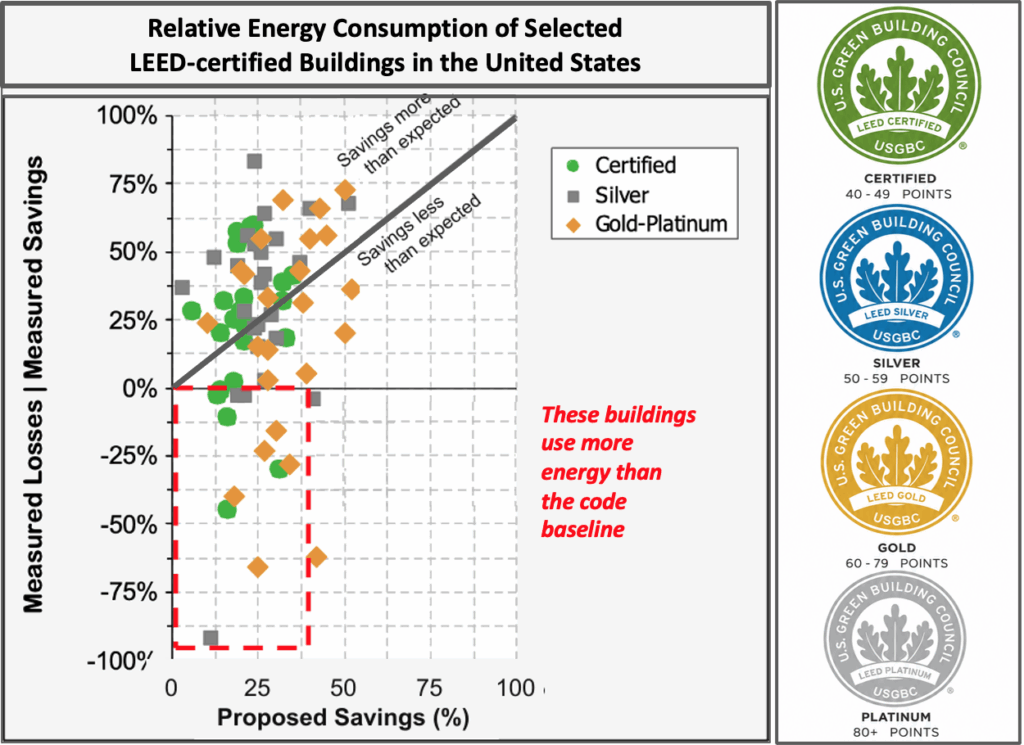
A 2009 study by the National Research Council of Canada that reviewed the same USGBC dataset came to an even more disturbing conclusion: LEED status was often irrelevant to observed building performance. From the Canadian report, “28-35% of LEED buildings used more energy than their conventional counterparts. Further, the measured energy performance of LEED buildings had little correlation with [the] certification level of the building, or the number of energy credits achieved by the building at design time.” [Emphasis added]
A separate 2020 report commissioned by B.C. Housing and the University of Victoria examined the performance of 10 LEED Gold-certified social housing projects in the province. Only two met or exceeded their modelled results. “The other eight consumed between 22.1% and 281.7% more energy than models predicted,” the report alarmingly states. Ample research points to a massive disconnect between the promise of LEED scores and real-world outcomes. A few case studies can shine a light on the varied reasons behind this worrisome – and at times outrageous – gap.
 Top heavy: Green roofs have become a popular LEED feature, earning a project up to six LEED points; but as the 2011 collapse of the green roof at Illinois-based Aquascape Gardens demonstrates, this amenity entails serious risks. (Source of photo: Stacey Wescott/Chicago Tribune)
Despite the lessons offered by the Aquascape experience – particularly given Canada’s ample supply of freeze-and-thaw winter weather – the lure of LEED points can be so intoxicating that architects and public officials will simply look the other way. Case in point is the John M. Harper Library in Waterloo, Ontario. When it opened in late 2011 with a ceremony attended by numerous municipal, provincial and federal politicians, its verdant green roof and LEED Silver status were the talk of the town. The following year it won the Ontario Library Association’s New Library Building Award.
Amid all the acclaim over its “environmentally-best practices”, however, no one seems to have asked if a green roof was the right choice for a book-filled library. Today, the award-winning John M. Harper Library regularly affixes brightly-coloured tarps to the ceilings above its bookshelves. These tarps direct water leaking from its green roof into hoses that empty into buckets placed on the floor whenever there’s a leak – which occurs regularly during winter months. According to the minutes of a 2025 meeting of the Waterloo Public Library Board, the facility has had “a substantial problem” with its green roof.
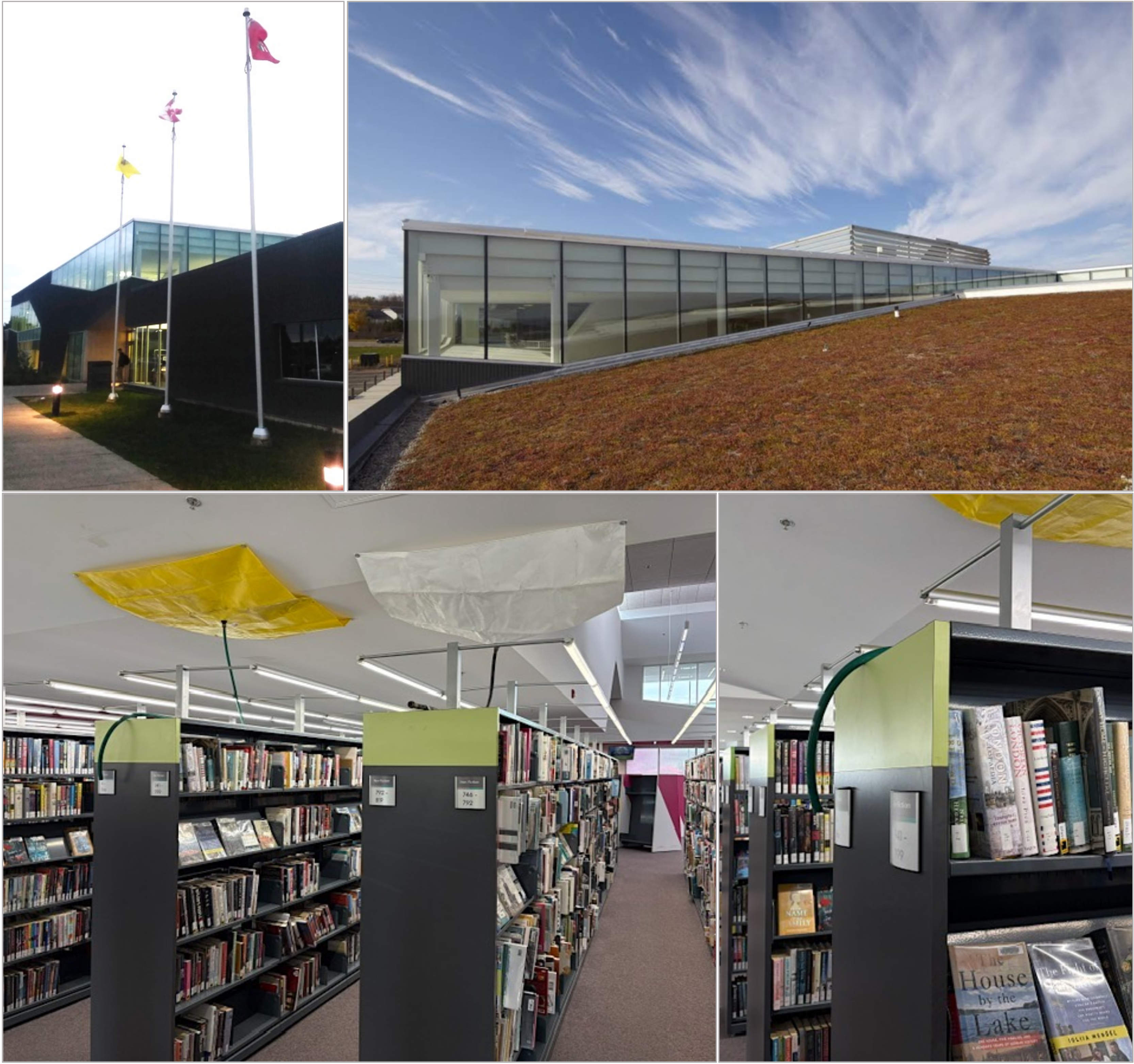
And while the tarps, hoses and buckets offered a temporary – though very old-school – fix, “The larger problems around ice damming, drainage and challenges with the green roof at Harper are unresolved,” according to the meeting’s minutes. In contrast to the foofaraw surrounding its grand opening in 2011, today no one in Waterloo seems willing to discuss the library’s innovative roof – or its performance issues. The embarrassment is simply suppressed. An email to the CEO of Waterloo’s library system was redirected to city staff, who never responded to C2C Journal’s repeated enquiries.
Waterloo’s roof crisis is not an isolated problem. A comprehensive 2020 study by the U.S. Inspector General’s office of green roofs installed on 48 U.S. federal buildings found that green roofs cost at least US$10 per square foot more than a traditional roof and have 30 percent higher maintenance costs. A major reason for this higher upkeep, the report explains, is that building staff typically lack the gardening skills necessary to keep their living canopies alive; one-third of all rooftop plants die within the first year, leaving the green roof a disappointing brown. According to the report, habitual lack of maintenance on the green roof at the landmark Sam Nunn Federal Center in Atlanta, Georgia resulted in a mass rooftop vegetation die-off, generating what the authors wryly called “a long term four season weed seed bank” atop the building. No doubt the neighbours were thrilled.
It is important to note that ongoing maintenance problems are not exclusively linked to LEED’s fixation with green roofs. The inability of building staff to properly maintain a variety of cutting-edge building technologies located indoors was similarly identified as a root cause for the performance problems in the B.C. public housing report mentioned earlier.
Dropping Acid in the Boys’ Room
Waterless urinals are another popular LEED points-booster. When it comes to water usage, no-flow washrooms earn a building more points than low-flow or traditional washroom facilities. But sometimes using a bit of water is better for the environment than using none at all.
Bill Gauley is the creator of the Maximum Performance (MaP) toilet-testing protocol, the North American standard for toilet efficiency. From his headquarters in the bucolic community of Acton, Ontario, an hour’s drive northwest of Toronto, Gauley subjects every model of toilet and urinal sold in Canada and the U.S. to a series of tests meant to confirm they perform as promised. An engineer by trade, Gauley got his start in his niche testing business after being asked to investigate a rash of complaints about low-flow toilets in Toronto’s public housing apartments. The water-use problems, he discovered, mostly stemmed from the toilets working so poorly that residents had to flush them twice. That insight led him to develop MaP. His goal, Gauley says in an interview, is to ensure plumbing decisions are made on the basis of reliable scientific evidence rather than simply “doing things because they sound like a good idea.”

Waterless urinals certainly sound like a good idea. Since urine is a liquid, it seems logical that it can be flushed away without any added water. In practice, however, it’s a bit more complicated. At the request of a U.S. university that was having problems with its waterless urinals, in 2006 Gauley took a road trip to investigate the academy’s washrooms. It was no holiday. “When the plumber pulled the urinals off the walls, the smell was pretty much unbearable,” he recalls. “It was just a terrible, awful smell.”
The issue, Gauley soon discovered, was a massive accumulation of struvite in the pipes. Struvite is a naturally occurring compound created by the accretion of minerals found in urine. In the human body, it can form kidney stones. In indoor plumbing, it turns into a horrible-smelling gray paste that plugs pipes and repels washroom users. While kidney stones can be treated medically, the only effective solution to struvite – beyond removing an affected urinal and physically scraping it out – is to pour hydrochloric acid down the drain. According to Gauley, this is exactly what many frustrated building owners do. Some, he says, rig up systems to slowly drip acid down their drains to prevent struvite from forming; others pour buckets of acid down the drain as needed – often at night when no one is looking. LEED is silent on how many points are earned by adding acid to municipal wastewater systems.
The Gamification of LEED
In constantly striving to reach the highest possible LEED certification, designers, developers and governments habitually overlook traditional, practical matters like cost, timelines, performance and the comfort of the building’s future users in order to gain a prestigious plaque. This is why, despite their many obvious flaws and unintended consequences, impractical green roofs and waterless urinals have become regular features of public buildings. Even worse, such misplaced priorities inevitably push up a project’s total cost. LEED has essentially become a game in which the goal is to score the most points regardless of cost. Taxpayers or tenants, as the case may be, are the unacknowledged losers.
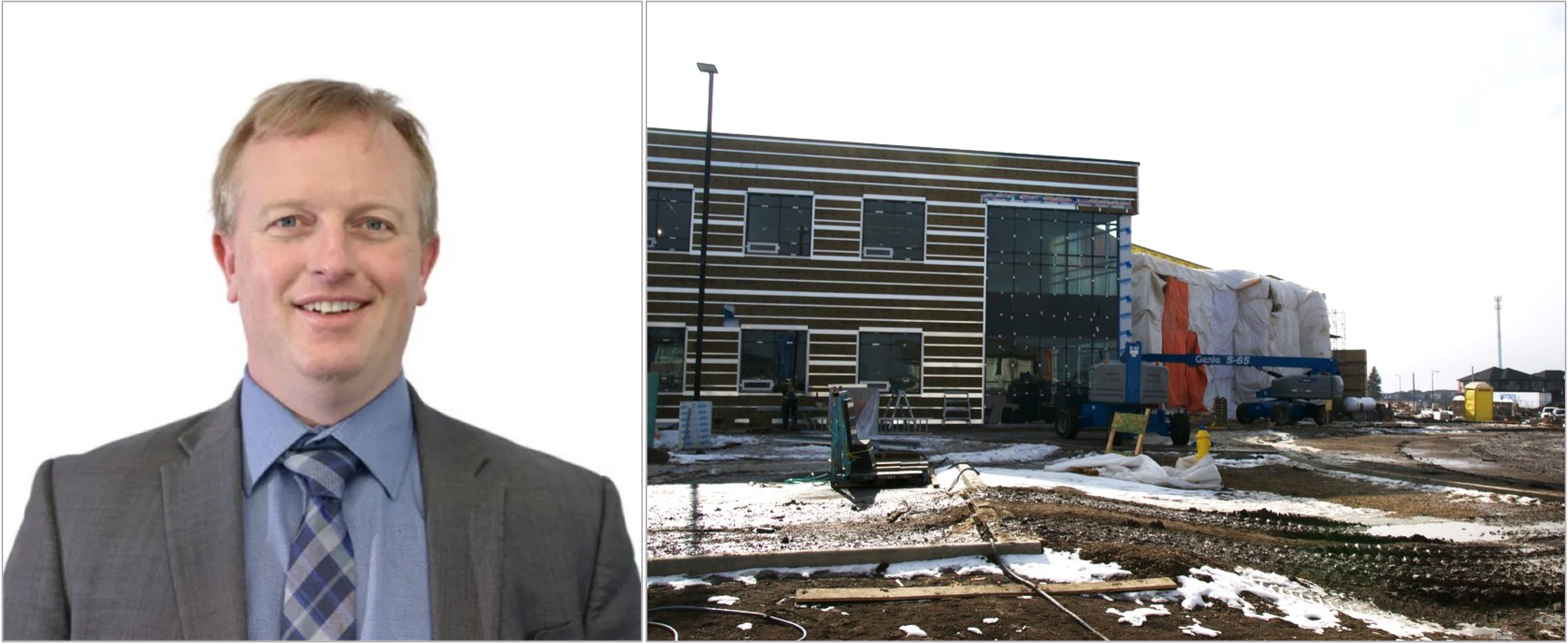
In 2018, the Victoria suburb of Saanich announced it was time to replace its aging and cramped Fire Station #2. According to the city’s Facilities Master Plan, every new municipal building must achieve a minimum LEED Gold, with aspiration towards LEED Platinum, the highest possible designation. This led to the decision to build Saanich’s new firehall out of wood – what is called mass timber construction – along with a host of other LEED-boosting innovations. A year later the budget was set at $26 million – already on the higher side as such facilities go – with the firehall to open in 2023.
 A pricey plaque: The cost of replacing Saanich, B.C.’s aging Fire Station #2 (top) soared by 70 percent due to city council’s insistence on LEED Gold or Platinum certification, which demanded costly mass timber construction. At bottom, a planning sketch of the still-unopened new station. (Sources of photos: (top) Darren Stone/Times Colonist; (bottom) hcma architecture + design)
In a statement provided to C2C Journal, Long cited the extra costs and longer building times as key factors. “By removing the LEED certification requirements for new construction projects, we are reducing red tape and focusing on delivering infrastructure faster and in a more cost-effective way,” he stated. In the absence of LEED, Long figures Albertans will save an average of two percent on every new building the province constructs. With Alberta currently planning an additional 140 schools at an average cost of $40 million each, that’s the equivalent of two free schools. And if avoiding LEED helps such projects avoid going off the rails like the Saanich firehall, the ultimate savings could be vastly higher than projected.
The minister adds that the province will continue to follow the National Energy Code of Canada, which entails standardized requirements for measurable energy efficiency, durability and life-cycle costs. In this way, Alberta has decided to put its faith in practical standards that deliver on intended results. “We remain committed to energy efficiency and building quality infrastructure rather than checking boxes for a certification intended for milder climates,” Long concludes.
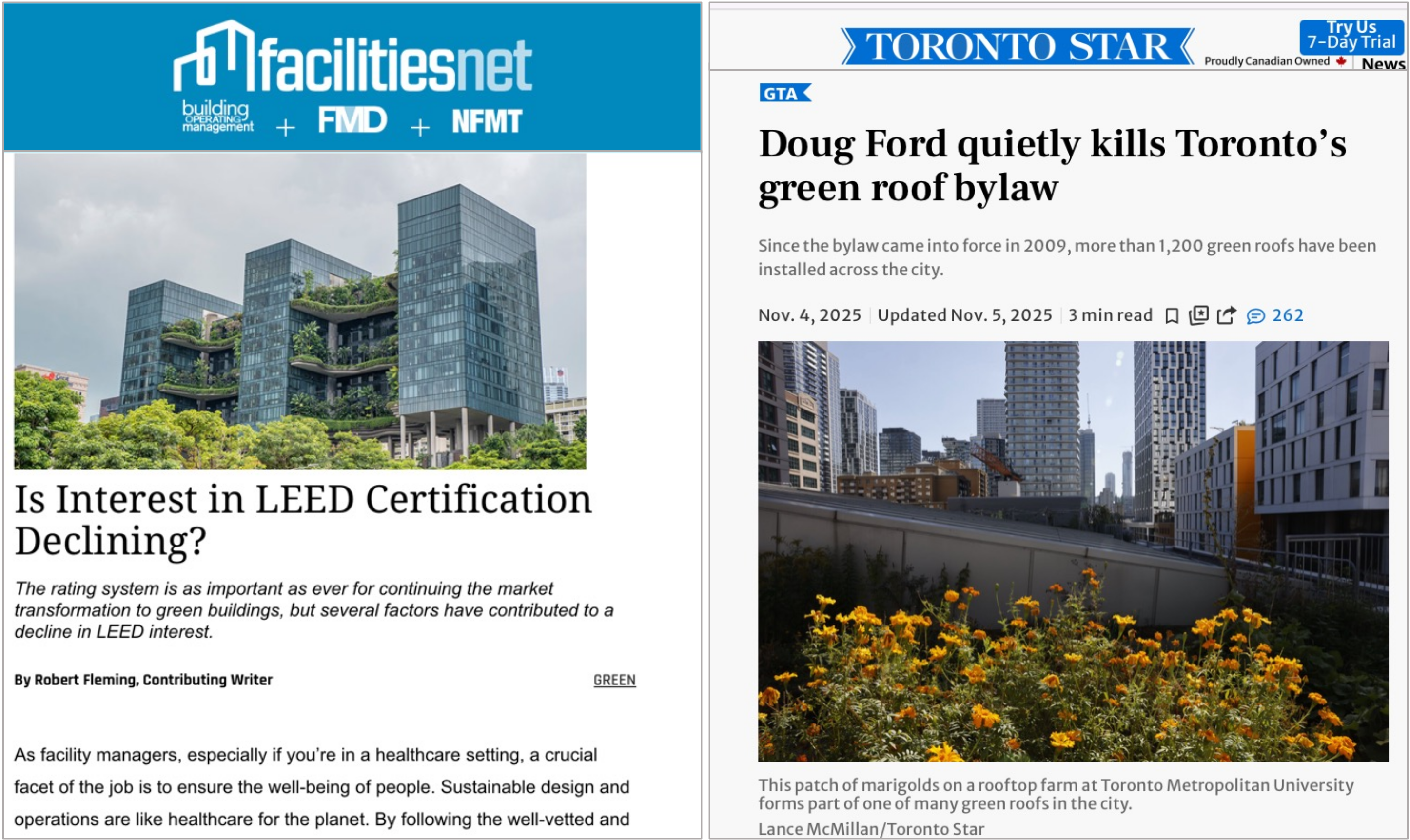
Alberta is not alone. Late last year Ontario Premier Doug Ford used his authority over municipal governments to strike down Toronto’s problematic green roof bylaw. In place since 2010, this policy made Toronto the province’s only city to require green roofs on certain commercial, residential and industrial buildings. It was widely cited as a key factor behind the skyrocketing costs of local housing and other construction projects.
A group of developers had earlier sued the city, arguing it lacked the constitutional authority to impose such a requirement. Ford’s action renders that lawsuit unnecessary. “By making green roofs voluntary, builders and taxpayers have the flexibility of choice, while reducing unnecessary costs and keeping Ontario workers on the job,” a provincial spokesperson told the Toronto Star. Undaunted, Toronto said it would continue to install green roofs on its own municipal buildings.
Elsewhere, LEED proponents are beginning to fret that the tide has turned. “Is Interest in LEED Certification Declining?” asks a 2024 headline in the U.S. building trade publication Facilities.net. The author, who calls LEED “an amazing system,” laments the rise of “LEED-lite,” in which developers pick and choose whatever options for energy conservation might be suitable for their particular project without obsessing over the total number of LEED points earned. Doing so also avoids the expense of having project plans scrutinized by LEED-certified specialists, which can add up to US7¢ per square foot to a building’s cost. LEED-lite thus entails making design and construction decisions based on practical calculations of costs and benefits, rather than in the blind pursuit of a shiny plaque.
The 200-Year Goal
Given the industry-wide fixation with green building standards, it was once rare to find anyone in the design or construction business willing to criticize the cult of LEED. One who tried to raise awareness during its early days was mechanical systems designer Henry Gifford. In 2010 Gifford, a New York-based designer of energy-efficient buildings, fronted a $100 million class action lawsuit against the USGBC alleging deceptive business practices.

“The USGBC has falsely led consumers to believe that LEED buildings are more energy efficient,” his lawsuit stated. “The Plaintiffs claim that the USGBC’s own data proves that LEED buildings are actually not more energy efficient. The Plaintiffs also assert that the USGBC never actually verifies that buildings are designed and constructed to save energy.” The case was dismissed prior to trial because the judge ruled Gifford was not in direct competition with LEED and therefore could not prove personal damages. Gifford’s core argument about the grift behind LEED certification was never tested in court.
Other architects and designers have more recently begun to raise concerns about the value of LEED, often by harkening back to a more enduring definition of sustainability. Galen Page is the founder of Page & Beard Architects, based near Seattle, Washington. His firm is widely known for its environmentally-conscious designs for homes and mid-sized public structures such as firehalls and municipal utility buildings. Page actually lives in Winthrop, site of the famously resilient Duck Brand Saloon.
With his hometown as evidence, Page says his overriding concern when working on government contracts is that “public buildings should last 200 years.” While current green building standards such as LEED focus on incorporating the very latest, often-finicky technology, he says what should really matter is longevity. Beyond a life expectancy measured in centuries, that means incorporating flexibility and ease of maintenance into the design of public buildings – two factors where LEED standards are noticeably deficient.
As an example of his approach, Page says he eschews green roofs in all his designs. The best roof, he observes, is a simple and durable sloped metal design enabling water and snow to run off quickly and efficiently. It makes no sense to place a massive load of soil and plants on top of a building, particularly when the roots of those plants are actively seeking to destroy any water barrier below.

Relying on timeless design principles does not mean ignoring current evidence or best practices, Page points out. When he compared the standard LEED checklist with applicable state building codes, Page found that “three quarters of the [LEED requirements] are already in our basic specifications and meet most energy code standards. It is the last 25 percent that adds a big chunk of money and goes beyond code.” Page thus comes to the same conclusion as Alberta Minister Long: that it’s possible to incorporate the latest energy and building knowledge without falling under the spell of expensive LEED flourishes.
Page essentially operates on a LEED-lite basis, offering his clients the option of adding the expensive extras LEED certification requires while pointing out the additional cost each entails. Rather than focusing on that LEED plaque as an end in itself, his firm promotes overall practicality and functionality. And he figures the cost advantages go far beyond the two percent savings cited by Alberta.
“LEED is going to cost the client 10 to 20 percent higher,” Page says flatly, based on his own deep experience. Besides the per-square-foot certification fees, Page points to other LEED expenses in documenting, verifying and monitoring certification. “Everybody gets frustrated with how much process there is,” he says. “It costs $250,000 on a fairly small project to just monitor and document the LEED process.”
And the costs can continue even after a building opens. As with the U.S. Inspector General’s report on green roofs, Page has found that many of the complicated energy and mechanical systems installed on LEED buildings fail to perform as expected because maintenance staff simply don’t understand all the nuances of the fancy new technology. This can force building owners into hiring yet more expensive consultants “to manage a building that is overly complex just to save a few thousand dollars [on energy costs] and be more sustainable,” he says, stressing the irony of the final word.
In some significant ways, the current concept of LEED-lite echoes the “Practical Sustainability” movement that heavily influenced architectural design at the beginning of the 20th century. Among the first examples of this concept were early skyscrapers and modern-era tenements in New York City and other major urban centres in North America. The movement’s key aspects included floor plans shaped like Hs or Ls and windows that opened. The goals were to maximize natural light, ventilation and living space for the occupants.
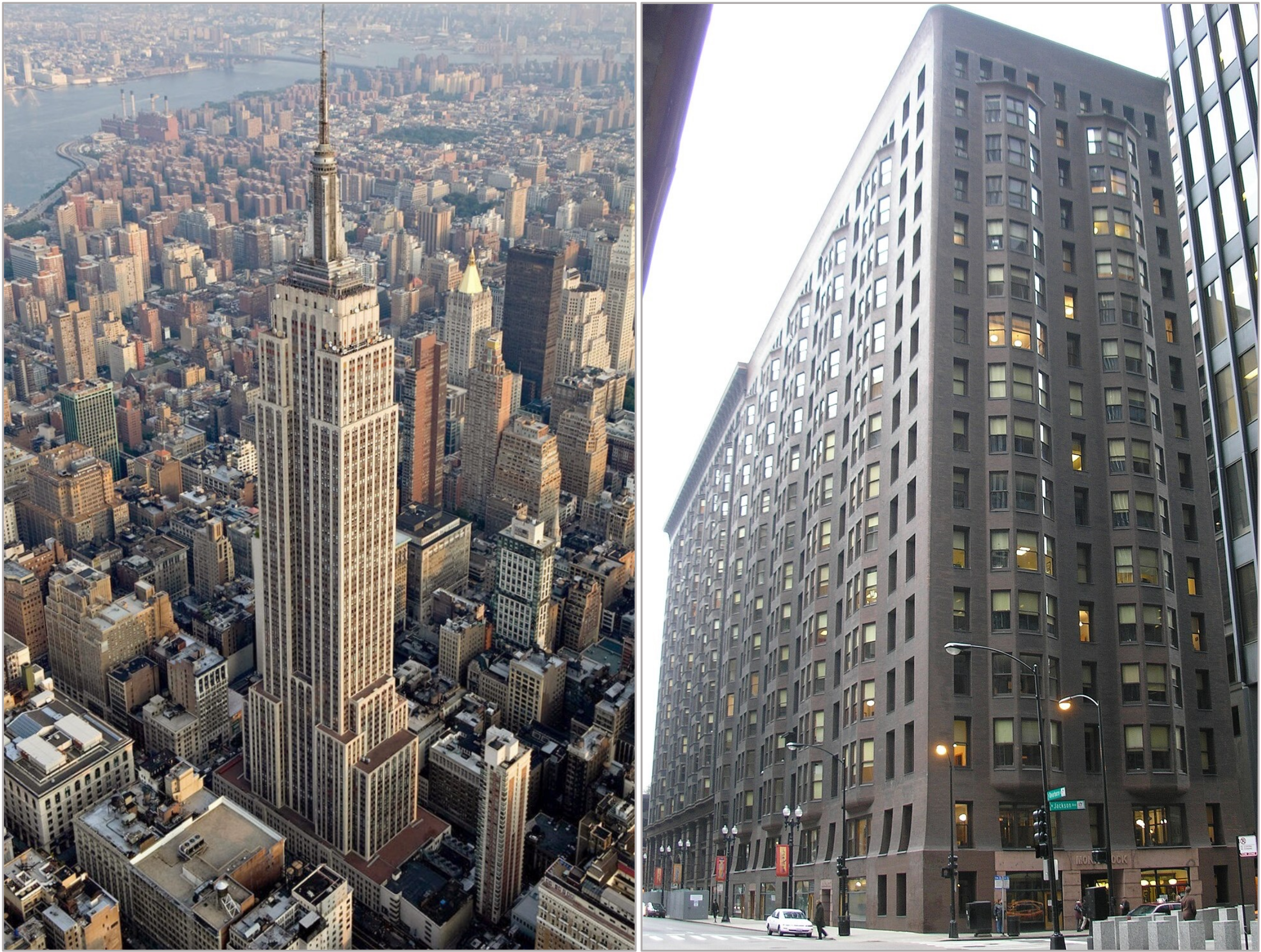
Buildings crafted with practical sustainability in mind were generally made of steel clad in thick stone or masonry. Among the most-famous examples are New York’s Empire State Building and Chicago’s Monadnock Building. These buildings were remarkably quick to build, yet remain architectural gems a century or more after their construction. And their public purposes have evolved many times to meet the needs of a changing society, just as the Duck Brand Saloon did in its own era.
Today, the pursuit of maximum possible efficiency requires most new buildings to be glass boxes with sealed windows, high-efficiency HVAC systems to maintain air flow, and energy-efficient, eye-straining LED lights. Good luck repurposing any of that. For anyone who might want to lament what we’ve lost in the shift from practical sustainability to 21st-century green building standards, there’s a shiny gold plaque at the main entrance for all to enjoy.
Greg Wilson is a professional engineer, writer and commentator obsessed with how we build, break and belong to the world around us. His musings can be found @Libertastalks on YouTube and @Libertaswrites on X and Substack.
Source of main image: Tada Images/Shutterstock.