Are recreation centres the new churches? The local church used to be the community hub for religious activities and children’s groups – Brownies, Girl Guides, Cubs and Scouts – as well as a diversity of adult meetings. However, as our world has become more urban, more ethnically and religiously diverse and less church-oriented, recreation centres have taken over as the multicultural, multi-generational community meeting place.
The decline in religion’s importance in the lives of Canadians is illustrated by census figures from 1971 to 2011 that show that Canadians who identified themselves as having “no religion” increased from 1 per cent to 23 per cent. In the 2011 Hemorrhaging Faith report commissioned by the Evangelical Fellowship of Canada and the Young Adult Ministry, one key finding was that 66 per cent of young adults (18 to 34 year olds) who attended church as children no longer do so. There is also ample evidence that churches across the country struggle to find a sustainable congregation.
The rise of recreation is counter to the increasing level of obesity in our society. However, one can note that while some people are more inclined to be couch potatoes, others strive to be fit – and neither is likely to be found in church on a Sunday morning.
As never before, singles, couples and families love to work out together at their favourite recreation centre – often several times a week. I do not think my mother has ever set foot in a gym or worked out in her life. Also, I do not recall any of my parents’ friends running marathons or training for Ironman competitions. Today, you feel like a wimp if you are not at the gym three or four times a week to work on your six-pack or get those sought-after buns of steel. Boomers regularly try to stay young and thus work out rather than go to church and hope for a better life in heaven. The modern closet overflows with several pairs of running shoes – one for each activity – and lots of spandex to provide the tuck and hold needed for a slim and trim look. Long gone is the space in the closet for Sunday best clothes.
The new spiritual leaders: Jane Fonda and her workout heirs
Fifty years ago, it was the priest, minister, rabbi or other religious leader who preached to us on how best to live a more fulfilling life. Today, it is more likely your personal fitness coach, dietitian or yoga instructor who advises you and encourages you on how to live a better life. The American College of Sports Medicine’s Worldwide Survey of Fitness Trends for 2012 noted an “exponential” growth of recreation and fitness educational programs at post-secondary schools worldwide. The GoodLife chain of gyms grew 307 per cent between 2004 and 2010 and opened a 45,000-square-foot flagship gym in downtown Toronto. With 300 outlets across Canada, it is the fifth-largest fitness chain in the world.
Even churches have adapted to the fitness trend. John Van Sloten, pastor at the New Hope Church, a Christian Reformed Church established in 1996 in one of Calgary’s thriving inner-city communities, and author of The Day Metallica Came to Church (so you know he is an out-of-the-box preacher) is known for his ability to position God and spirituality within a contemporary context. Van Sloten believes God and spirituality are in everything we do. “The church and steeple are not important,” he says.
When asked about the connection or competition between recreation and religion, Van Sloten asserts, “God is part of all human activities. God can appear at any time. It could be on the 4th hole on a Sunday morning when you hit that 300-yard drive down the middle of the fairway and marvel how in heaven did that happen. That’s a spiritual experience whether we know it or not.” Thus, even today’s religious leaders have bent their message to the reality of recreation.
The recreation centre as the new cathedral
The rise of recreation is obvious in other ways. When developers design a master plan for a new community, the key amenities they must include are a recreation centre, parks, tot lots and pathways. They know the most frequently asked question from potential buyers is not “Where is the church?” The frequently asked questions are “Do I back onto a park or a pathway? How far is it to the playground? What recreational facilities are planned?”
In Canada, proximity to an outdoor hockey rink is no longer good enough. There has to be at least a double arena with heated seating for the fans (ideally with a lounge so they can have an “adult beverage” while they watch). There must also be an NHL-quality sound system to allow for blaring music whenever there is a lull in play and to announce who scored the goal. For most parents and kids, this is as close to the NHL dream as they will get.
Up until the late 20th century, churches were the dominant building in suburban communities across North America. Today, the $100-million-plus recreation cathedrals foster a community’s sense of place and are the new gathering spot for people of all ages and backgrounds. These New Age cathedrals include not only hockey rinks but also one or more of the following: swimming/wave pool, gym, weight room, racquet court, library, painting/pottery room, dance/yoga studio and now spinning class areas. In addition, let us not forget the outside amenities such as playing fields, tennis courts, playgrounds, skate parks and water parks. For anyone interested in recreation, today’s recreational cathedrals are heaven on Earth.
For example, Edmonton’s Commonwealth Community Recreation Centre recently celebrated its first anniversary, with an annual attendance of almost 500,000 people, far higher than the initial projection of 325,000 annual attendees. Deanna Kayne, from the new centre, told Global TV this past March, “We have a social living room. … There’s a great multicultural spread in our patronage and it just continues to grow.”
Calgary is fast-tracking the development of four new recreational cathedrals – Great Plains, Quarry Park, Seton and Rocky Ridge – to serve new communities on the edge of the city. The total cost – an estimated $480-million.
The construction of massive recreation centres is nationwide. From Martensville, Saskatchewan, (population 7,000) to the new $21-million Queens Place Recreation Centre in Queens County, Nova Scotia, to Iqaluit in the North and a $38-million Westmount Recreation Centre in Montreal, the modern temples come with ice rinks, pools, fitness centres and the occasional green roof. In what might count as a recreation theology summit, in January 2013, the Western Nova Scotia Recreation Summit was titled Recreation Rising, a sign that recreation is taken as seriously as papal conclaves were in the 15th century.
Recreation and urban revitalization
Positively, recreational facilities play a major role in the revitalization of city centres. In the latter half of the 20th century, most North American downtowns saw a decline in the number of people who lived there. But urban living has since seen a resurgence that, at least in some instances, can be credited to new recreational facilities.
One such example in Calgary is the Eau Claire YMCA, whose construction was instrumental in the building of more than 10 condo towers in the immediate area. It is interesting to note that at the same time, the Eau Claire Market opened with its cinemas, restaurants, shops and a small market, yet it struggled and failed. Could it be that recreation is more influential than shopping and entertainment in urban revitalization?
In Winnipeg, the development of the Forks as a both a summer and winter recreation area for skating, cycling, running and walking has resulted in significant new condo construction along the Red River. Similarly, in Ottawa, some of the most desirable communities are along the Rideau Canal with its many recreational opportunities.
In Vancouver, the new Coal Harbour and Yaletown urban villages are near the water where there are plenty of outdoor parks, beaches and, of course, the Sea Wall for walking, cycling and running.
The return of painted pagans – on Sunday morning
Sunday mornings (or Saturdays for others) are no longer reserved for church and a day of rest. For many, it is a time to play golf, go for a run, a bike ride, a walk, a workout or participate in some other recreational pursuit. The Sunday clothes of the past – dress and bonnet for women, tie and jacket for men – are replaced by spandex for all. Or, if we do dress up, it is in the jersey of our favourite pro sports team, which we view live or on a big-screen TV. Some even paint their faces and bodies as if it is a pagan celebration. The Super Bowl or Masters Sunday is now as big a day of worship as Easter Sunday once was for Christians.
Even today’s YMCA and YWCA, once part of the thriving link between Christianity and recreation, have dropped their religious programming in favour of becoming major recreation centres.
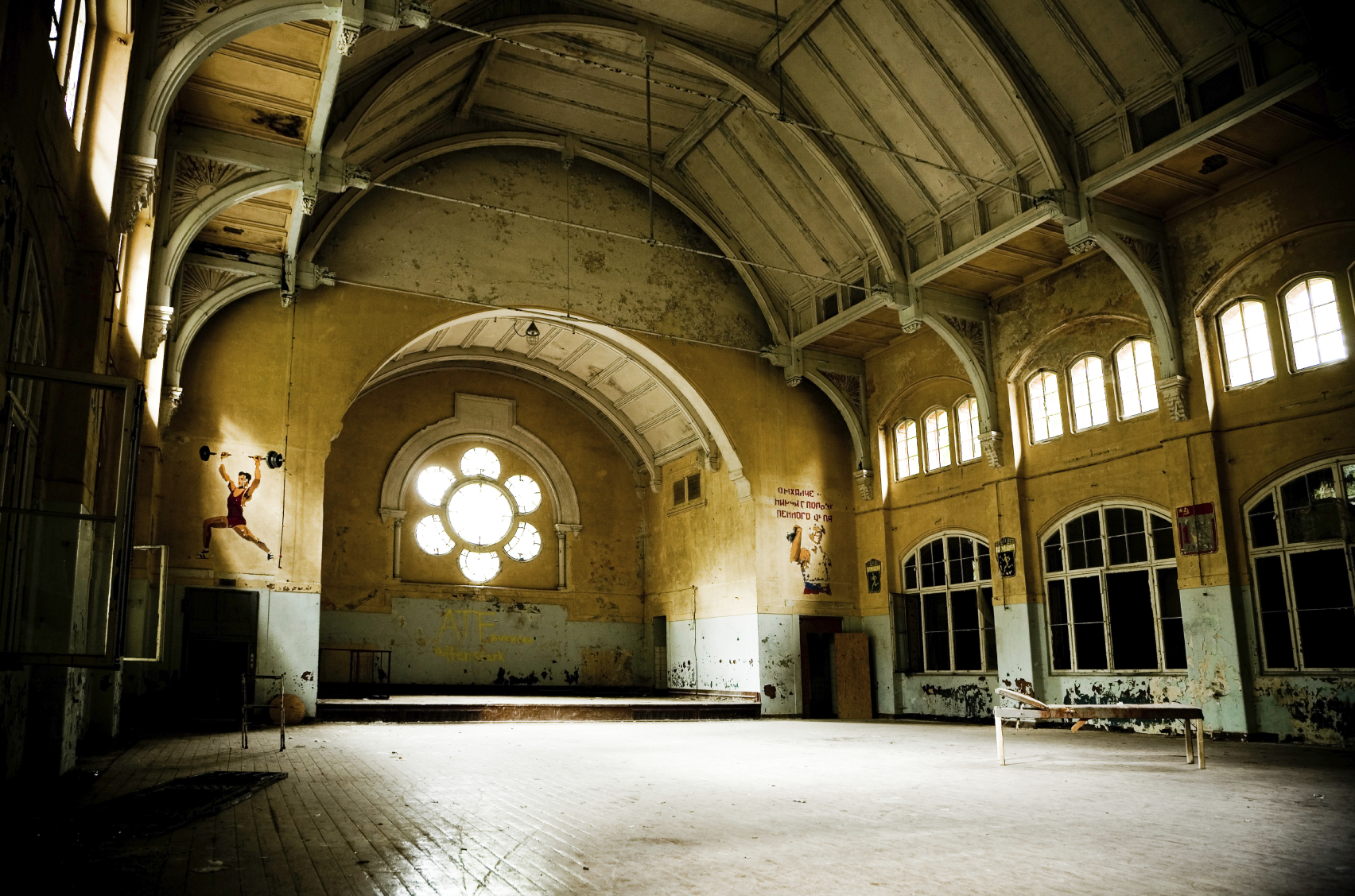
And, in an ironic twist, in the community I live in, a 1960s recreation centre’s gym is used by a church for its Sunday service. The church is called New Hope! Could it be that the only hope for a religious renaissance might be to find synergies with the new recreation culture?
~
Richard White is a Calgary-based freelance writer. Follow him on twitter @everydaytourist or read his blog at www.everydaytourist.ca.
Richard is an experienced everyday tourist. Over the past 30 years, his “day job” has taken him from scientist to director/curator of a public art gallery to executive director of downtown business association to director of 3D animation studio to consultant. All the while – when travelling for work or pleasure – he honed his flaneuring skills.
For the past 10 years, he’s written on topics ranging from public art, parks, pathways, plazas and urban revitalization in Canadian cities to Dubai’s architecture and Frankfurt’s “green beach.”
Richard has served on numerous boards/committees.