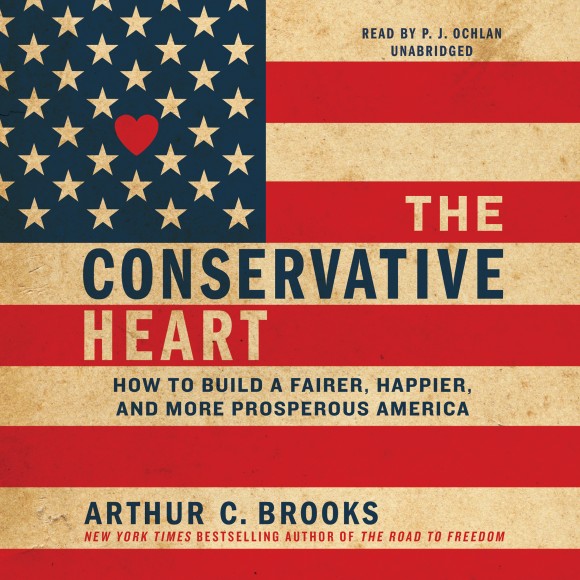
 The Conservative Heart
How to Build a Fairer, Happier, and More Prosperous America
By Arthur C. Brooks
Broadside Books, 2015
246 pp., $34.99
Review by Trevor Shelley
You gotta have heart Miles and miles and miles of heart Oh, it’s fine to be a genius of course But keep that old horse before the cart First you’ve gotta have heart
– From the song Heart, in the 1955 Broadway musical Damn Yankees
Hard-headed Conservatives groan when progressives invoke the heart, as when Justin Trudeau spoke about “grow[ing] the economy…from the heart outwards.” Whatever Trudeau actually meant, mentioning the heart was altogether calculated. As an organ metaphorically associated with various sentiments it is more suited to rhetorical appeals than, say, invitations to think through proposed policies and complicated arguments based on facts or statistics. As Jim Prentice rather heartlessly observed, “math is hard.”
Of all the emotions politicians use to try to win votes, compassion is one of the most powerful. Fear and anger work too, but if the Conservatives lose the 2015 election, it may be said that in two of the defining issues of the campaign – the niqab flap and the refugee crisis – compassion trumped fear and anger. The desire for change has been the overarching narrative, but it has been framed as a choice between the callousness of the conservatives and the compassion of the progressives.
Twas ever thus. Conservatives are stereotypically heartless, yet pragmatic, whereas progressives are universally compassionate, if imprudent. This perception of conservatives, however, is as inaccurate as it is entrenched, according to Arthur C. Brooks, a former leftist who had a change of heart before eventually becoming president of the conservative American Enterprise Institute. In his new book, The Conservative Heart: How To Build A Fairer, Happier, And More Prosperous America, Brooks argues conservative principles are responsible for curtailing global poverty and increasing general human happiness, and it is up to conservatives to make such facts known – to properly and persuasively reveal the truths of the conservative heart.
Brooks makes clear he is not rehashing the “compassionate conservatism” of the late 20th century American right, most associated with President George H.W. Bush. Such an approach, according to Brooks, made the “major error” of grafting compassion onto conservatism, as though it were something external or alien to the conservative disposition. For Brooks, conservatism must communicate its innate compassionate core. As he defines it, the creed “flows from the optimistic belief that every person is valuable and capable of earned success.”
In Brooks’ estimation, the greatest conservative contribution to mankind lies in the alleviation of global poverty, which has fallen 80 percent since 1970. He attributes “five incredible innovations” as the cause of “the greatest antipoverty achievement in world history”: globalization, free trade, property rights, the rule of law, and entrepreneurship. These capitalist ideals have made the world richer, healthier, freer and happier, but their conservative authors got little credit for it. “The defenders of free enterprise have done a terrible job of telling people how much good the system has done around the world,” writes Brooks. “Capitalism has saved a couple of billion people and we have treated this miracle like a state secret.”
Polls consistently and overwhelmingly find that most Americans (and Canadians) believe conservatives care less than progressives about the poor and downtrodden. Yet the record shows, according to Brooks, that the economic fortunes of America’s poor and unemployed have actually worsened under Democrats, including during the reign of their current uber-progressive president Barack Obama. Brooks calls it “the height of irony…that inequality actually increased over the course of the Obama administration.” The failure of his massively expensive efforts to reduce poverty, which Obama has framed as a modern extension of the War on Poverty launched by his Democratic predecessor Lyndon Johnson in 1964, should be seen as “the greatest moral scandal of our time.”
Thus, Brooks sets out to educate conservatives about how to regain the moral high ground on social justice issues, not least the fight against poverty. Conservative obsessing about economics – debt and deficits, taxation and spending, fiscal responsibility and GDP – has persuaded many voters that conservatives care only about money. Brooks contends that progressives are in fact more materialistic, in that they believe government spending can solve every social ill. “The obsession with redistribution for its own sake comes skillfully wrapped in the moral language of fairness and compassion,” Brooks writes. “This is materialism tarted up to look like moralism.”
Brooks suggests conservatives could refute their critics and strengthen their cause by celebrating the freedom and responsibility of individuals to “thrive by lifting themselves up out of poverty, building their lives, supporting their families, and understand their true purpose.” This “up by the bootstraps” message has been invigorating conservative rhetoric for ages, but in the mouths of ersatz conservative blowhards like Donald Trump it sounds like blame for everyone who fails to achieve these goals. Moreover, it ignores the fact that in an advanced post-industrial welfare state, there is a large, intergenerational constituency that knows nothing other than reliance on big government for material satisfaction.
Few conservatives would disagree with Brooks’ desire to limit the size and scope of government for the sake of human freedom and fulfillment, and it may well be that true compassion occupies a bigger piece of the conservative heart than the progressive one. But his sunny prescriptions for conservative political success give short shrift to human weakness and corruption, the willingness of voters to be bought with other people’s money, and the power of sentimentalism in politics. The message of “hope and change” that lifted Obama to power in 2008 could do the same for Trudeau in Canada next week, ending nearly a decade of conservatism that was highly aspirational but also, ultimately, unsentimental. Such is the way of the political pendulum, at least in part due to the complexities of the human heart. As the great French moralist and fine student of the human heart known as Duc de La Rochefoucauld observed, “In the human heart new passions are forever being born, such that the defeat of one forever begets the rise of yet another.”
~
Trevor Shelley is an Albertan who recently completed a PhD in political theory at Louisiana State University.