Stories

The hashtag that changed the world – for a day

Don Hutchinson
January 22, 2015
The outpouring of support for freedom of expression in the aftermath of the Charlie Hebdo massacre in Paris was worldwide – and an inch deep. Days later, a Canadian court upheld a university’s bid to silence a campus pro-life group. Meanwhile, freedom of religious belief and expression are under attack by law societies across Canada that are trying to prevent graduates from a Christian university from entering the legal profession. The fact that they are using legal sanctions rather than Kalashnikovs to do so is no comfort to the cause of genuine intellectual freedom, writes Don Hutchinson…
Stories

The hashtag that changed the world – for a day

Don Hutchinson
January 22, 2015
The outpouring of support for freedom of expression in the aftermath of the Charlie Hebdo massacre in Paris was worldwide – and an inch deep. Days later, a Canadian court upheld a university’s bid to silence a campus pro-life group. Meanwhile, freedom of religious belief and expression are under attack by law societies across Canada that are trying to prevent graduates from a Christian university from entering the legal profession. The fact that they are using legal sanctions rather than Kalashnikovs to do so is no comfort to the cause of genuine intellectual freedom, writes Don Hutchinson…
Share on Facebook
Share on Twitter

C2CJournal Je suis Charlie Hutchinson piece

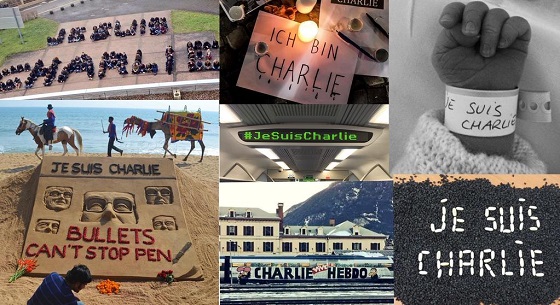
Did you “#jesuischarlie”? Maybe you even secured one of the seven million copies of the commemorative edition of Charlie Hebdo. For many, the hashtag was a demonstration of their commitment to freedom of expression. Others used it to express anger that satire, no matter how willfully offensive, could generate such a murderous response.

Dozens of world leaders marched arm-in-arm on the streets of Paris, the presidents of Israel and the Palestinian Authority among them. At home, untold thousands joined them by hashtagging jesuischarlie. For a moment, at least, it seemed the whole world was rallying behind free speech, tolerance and peace.

Alas, just days after #jesuischarlie headlines had dominated mainstream and social media, the Chief Justice of British Columbia ruled that universities are private precincts where the administration can determine which opinions will be permitted on campus. According to the judge, university administrations are not subject to freedom of expression protections contained in the Canadian Charter of Rights and Freedoms. He also declined to offer the free speech protections of the Common Law. If left unchallenged, the ruling allows the University of Victoria to silence the campus pro-life club, whose members had sparked the legal action merely by asking the question, “Should abortion remain unrestricted in Canada?”

The spirit of #jesuischarlie is equally absent from the Canadian legal establishment’s treatment of law graduates from B.C.’s Trinity Western University. Trinity Western, you may recall, is the Christian school that has run afoul of professional associations for refusing to sanction same-sex marriage. This had left its education graduates ineligible for accreditation by the teaching profession in B.C. until the Supreme Court of Canada pronounced, in a 2001 decision, that professional associations can’t discriminate against graduates on the basis of their religious education or beliefs. As long as they meet the educational requirements of the profession, they must be accepted by the association.

The Supreme Court of Canada visited the issue of same-sex marriage in a 2004 constitutional reference case and concluded that there are and will be different opinions on the issue that must be respected. Furthermore, the Court said religiously informed opinion is protected under our Constitution. And Parliament echoed the Court’s language on diversity of positions being constitutionally and legally protected when it changed the definition of marriage to “two persons” in 2005.

None of that has spared Trinity Western from further attacks on its religious freedom, this time aimed at its law school. Last year lawyers in B.C., via referendum, and law societies in B.C., Ontario and Nova Scotia, voted to deny TWU law grads the opportunity to practice in their provinces. Again, the issue was the university’s stand on same-sex marriage. The Law Society of New Brunswick narrowly voted against the same prohibition two days after the Charlie Hebdo massacre in Paris. But Trinity Western will still be in court this year fighting the other challenges to its religious freedom.

However it turns out, the secular tide is running hard against religion across the western world. This is hardly new, although the violent Islamist expression of religious belief has given it new impetus. France has long prohibited religious input into public policy development. Quebec is wrestling ominously with issues of accommodating religion in public life. So is the rest of Canada, as Trinity Western’s travails demonstrate. But the Supreme Court has set some important ground rules for the debate. Its 2004 Chamberlain decision held that religiously informed opinion is not to be disqualified from public debates that inform and shape public policy. In 2011, in Whatcott, the Court noted that sacred texts and the opinions based on them are welcome to the debates in the public square, with the same limit drawn for them as for other free speech. If the expression is defamatory or promotes hatred and violence against an identifiable group then it might be criminal hate speech instead of free speech; but those are the exceptions, not the rule. There is no right not to be offended.

To impose unwarranted restrictions on public debate about abortion, or same-sex marriage, or the accommodation of religious beliefs in public policy is to ignore Canada’s constitution, federal and provincial human rights laws, and decades of decisions from the nation’s highest court. To advocate for such restrictions, while hashtagging for Charlie, reveals gross hypocrisy and ignorance or disrespect for the law and the elemental principles of freedom.

I do not support engaging in intentionally provocative and hurtful offense directed at others. But I am a committed defender of freedom of expression, whether it’s attacked with Kalashnikovs or legal sanctions. #jesuisCanadien.

~

Don Hutchinson is an Ottawa lawyer.
Love C2C Journal? Here's how you can help us grow.

More for you

Sign on the Dotted Line: How B.C.’s Latest Indigenous Outrage Threatens Freedom of Contract Across Canada

As if the mayhem created by the 2025 Cowichan decision regarding property rights wasn’t enough, the B.C. court system has now declared its readiness to undermine legal contracts as well. As Peter Best reveals, a January 2026 decision to allow a contentious Indigenous lawsuit to proceed threatens to upend centuries of contract law. At issue is a small B.C. First Nation’s claim it has an aboriginal title right to export propane on an industrial scale, one that should overrule a signed, legal contract between the port of Prince Rupert and a billion-dollar energy project that itself is providing major aboriginal benefits. Acceding to such an outrageous demand, Best warns, will plunge relations between natives and the rest of Canada further into chaos and mistrust.

The Other Right to Choose: Reversing the Trudeau Immigration Fiasco

Canada’s immigration system was once the envy of the world. Based on the notion that those who get into the country are those who determine its future, the system chose people best able to contribute. Then the Trudeau Liberals blew it up, opening the gates to just about anyone – including literal terrorists – wreaking economic havoc and breaking Canadians’ faith in the value of citizenship. John Weissenberger, who served as chief of staff to the federal immigration minister in Stephen Harper’s Conservative government, has watched it happen with growing dismay, and argues for a return to sanity – centred on the sensible “points” system that served Canada so well for decades.

Suffer the Little Children: The Liberals’ $10-a-Day Childcare Disaster

Waiting lists stretching years. Plummeting quality. Outraged parents. Providers slowly strangled by red tape. The federal Liberals’ vaunted $10-a-day childcare program has proved an expensive disaster. Five years in, Matthew Lau digs into the many problems and inequities this landmark social policy has delivered. Lau finds B.C., which had a three-year head start on the rest of the country and an enthusiastic NDP government leading the way, in the worst straits of all. With an irretrievably flawed system clearly failing Canadian families, Lau argues that Prime Minister Mark Carney should pivot to a fairer, cheaper and more effective alternative.

More from this author

Our Ethically-Challenged PM

Justin Trudeau’s decision last week to publicly purge two Liberal MPs for alleged sexual misconduct, without asking or naming the complainants or giving his MPs any measure of due process, was not his first foray outside elementary principles of law. A few months ago he invented a constitutional right to abortion and banned anyone who does not subscribe to this myth from running as a candidate for the Liberal Party of Canada. Is he a legal naif or tinpot autocrat? Don Hutchinson weighs the evidence…

Justin Trudeau’s invention of a Charter right to abortion must have his father rolling in his grave

Almost 50 years after then-Justice Minister Pierre Trudeau liberalized Canada’s abortion law, his eldest son and latest successor as leader of the Liberal Party has plunged the country back into this gut-wrenching debate. Trouble is, Justin Trudeau’s illiberal position rests on bogus interpretations of the Charter, the Supreme Court and his father on abortion. Can he rebuild the Liberal party by stifling debate and misrepresenting history? Don Hutchinson is doubtful…