Stories

An expensive Quebec separatist says adieu

Mark Milke
January 25, 2012
An expensive Quebec separatist says adieu. C2C Journal’s Mark Milke argues it’s long overdue….
Stories

An expensive Quebec separatist says adieu

Mark Milke
January 25, 2012
An expensive Quebec separatist says adieu. C2C Journal’s Mark Milke argues it’s long overdue….
Share on Facebook
Share on Twitter

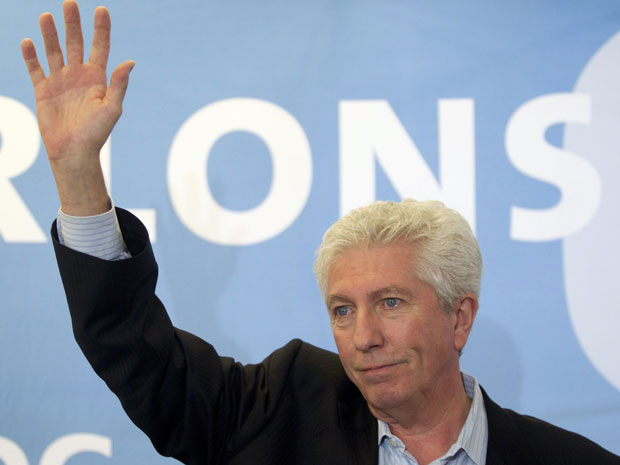
Former Bloc Québécois leader Gilles Duceppe has said goodbye to politics.  After Montreal’s La Presse reported how the Bloc Québécois broke parliamentary rules by paying its party’s general manager out of House of Commons funds for seven years, Duceppe said he would devote himself full-time to “defending my integrity and re-establishing my reputation.” The allegations made it “impossible to envision a return to active politics,” said Duceppe. That means he won’t run for the leadership of Quebec’s Parti Québécois, a Crown that everyone knew he wanted and thought he deserved instead of the current party boss, Pauline Marois.

If Duceppe does actually leave Canadian politics for good, so much the better. Separatists have been costly for Canada and Duceppe was a too-effective advocate for that cause. He even obtained—only in Canada—the official opposition post in Parliament between 1993 and 1997.

Of related note to his time in federal politics, Duceppe’s personal federal pension for his years of “service” in Ottawa is $140,765 annually according to the Canadian Taxpayers Federation. That’s expensive but of more importance, symbolic of the fiscal damage wrought upon the country’s fabric.

The cost to Quebec of separatist chatter has been decades of lost investment, migration of talent out of the province, and public policy within the province that focused on linguistic battles as opposed to fixing Quebec Inc. The cost to Canada has been instability when we could least afford it: think of the 1995 referendum that took place just as Canada was recovering from the sluggish early 1990s.

One doubts this will happen, but perhaps Duceppe will have a quiet retirement in Florida where his hard-left policies (he was a Marxist until his thirties and never broke from that mindset) and his break-up-Canada troublemaking might finally fade into Florida sunsets.
Love C2C Journal? Here's how you can help us grow.

More for you

The Other Right to Choose: Reversing the Trudeau Immigration Fiasco

Canada’s immigration system was once the envy of the world. Based on the notion that those who get into the country are those who determine its future, the system chose people best able to contribute. Then the Trudeau Liberals blew it up, opening the gates to just about anyone – including literal terrorists – wreaking economic havoc and breaking Canadians’ faith in the value of citizenship. John Weissenberger, who served as chief of staff to the federal immigration minister in Stephen Harper’s Conservative government, has watched it happen with growing dismay, and argues for a return to sanity – centred on the sensible “points” system that served Canada so well for decades.

Suffer the Little Children: The Liberals’ $10-a-Day Childcare Disaster

Waiting lists stretching years. Plummeting quality. Outraged parents. Providers slowly strangled by red tape. The federal Liberals’ vaunted $10-a-day childcare program has proved an expensive disaster. Five years in, Matthew Lau digs into the many problems and inequities this landmark social policy has delivered. Lau finds B.C., which had a three-year head start on the rest of the country and an enthusiastic NDP government leading the way, in the worst straits of all. With an irretrievably flawed system clearly failing Canadian families, Lau argues that Prime Minister Mark Carney should pivot to a fairer, cheaper and more effective alternative.

From the Strait of Hormuz to Cuba, Net Zero is Dying – Mark Carney Needs to Let Go

After decades spent pursuing net-zero dreams at great cost to their economies and social fabric, most of the world’s industrialized nations are waking back up. War with Iran and the threat of tanker blockades have everyone worried about oil and natural gas supplies and clamouring for energy security. Or nearly everyone. Not Mark Carney, though. Canada’s prime minister keeps pushing industrial carbon taxes higher and insists on wasting taxpayers’ money on windmills that make no difference. Gwyn Morgan recalls his own observation of the global warming movement’s original rise, its morphing into the radical “net zero” cult – and its spectacular global disintegration. It is high time, Morgan writes, that Canadians demand Carney also drop his delusions.

More from this author

Not So Beautiful Minds: Conspiracy Theories from JFK to Oliver Stone and Donald Trump

Shocking events that plunge a country into chaos or destroy a beloved leader are hard for anyone to process. The evil done is so towering it bends the human psyche to accept that the evildoer is utterly banal, a loner walking in ordinary shoes. The cause simply must befit the outcome; thus can a conspiracy theory be hatched. At other times, the cold hope of political or financial gain or simple mischief might be the source. There certainly is no shortage of conspiracy theories. Mark Milke revisits one of history’s most famous political assassinations and the conspiracy theories it spawned to illuminate the ongoing danger this toxic tendency poses to us all.

Picture of Thomas Hobbes frontispiece of Leviathan. A renowned pieceof political work on liberty

Future of Conservatism Series, Part VII: Memo to Politicians: We’re Not Your Pet Projects

Canadian conservatives have most of the summer to ruminate on what they want their federal party to become – as embodied by their soon-to-be elected leader, anyway. Acceptability, likability and winnability will be key criteria. Above all, however, should be crafting and advancing a compelling policy alternative to today’s managerial liberalism, which has been inflated by the pandemic almost beyond recognition. Mark Milke offers a forceful rebuttal against the Conservative “alternative” comprising little more than a massaged form of top-down management.

Leaders_debate_2019_canada_diversity_bias_free_speech_liberal_conservative

So Much for Diversity: The Monochromatic Moderators of Monday’s Debate

Canada is a big, diverse country by virtually any measure, from our no-longer-so-sparse population to our epic geography to the ethnic makeup of our people. Diverse in every way, it seems, except in our elites’ aggressively progressive official-think. Consistent with this is the otherwise bizarre decision to have Monday’s federal leaders’ debate hosted by five decidedly similar female journalists. Mark Milke briefly profiles the five and, more important, advances a positive alternative: five distinguished women diverse in background, hometown and, above all, thought.