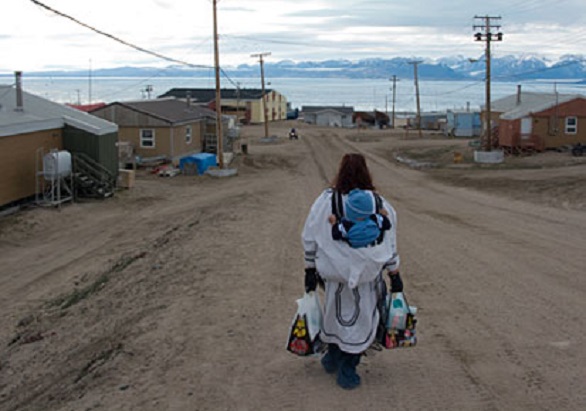
 Fifteen years have passed since of the founding of Nunavut, the vast northern territory that occupies one-fifth of Canada’s land mass. This February, the Iqaluit-based Northern Institute will host a conference in Ottawa examining whether the “Nunavut Project” has been a success.
An intuitive answer might be no. Nunavut’s problems are well documented. Suicides hit a record in 2013. More than half of all Inuit students drop out of high school before completion. Last summer’s “dumpcano” fiasco highlighted the ineffectiveness of the territorial government. And violent crime, alcoholism, and poverty remain widespread. Socio-economic conditions haven’t improved much since the territory was born April 1, 1999, and by some measures have gotten worse. The incidence of crimes like assault, drug use, and impaired driving, for example, have almost doubled.
The picture seems bleak, but Nunavut’s also a demographically young territory – around 60 percent of its 32,000 residents are under 25 – and it possesses tremendous economic potential. However, before this potential produces real benefits for the Nunavummiut, Nunavut needs to resolve its pressing social problems, which disproportionately affect the territory’s majority Inuit population
A solution often proposed to these issues – and which will likely be discussed at the Ottawa conference – is devolution. The argument goes that with greater autonomy, including more local control over resource development and revenue, the territorial government will be better able to take advantage of the territory’s strengths. But devolution is not, in itself, the solution. Nunavut’s root problem is an Inuit identity crisis that pits traditional Inuit culture against modernity. If Nunavut is to move forward and reclaim the dream of ’99, this tension needs to be resolved, and doing so will require an introspective public discussion on what it means to be Inuit in the modern world. This is precisely the discussion the Northern Institute should aim for at the Ottawa conference if that event is to generate real solutions for Canada’s newest territory.
A dialectical relationship between tradition and modernity is the core of Nunavut’s existence. As early as 1976, Inuit Tapirit Kanatami (ITK – formerly Inuit Tapirisat, the organization which spearheaded Inuit land claims) identified the goal of protecting traditional Inuit culture as the underlying purpose of a new Arctic territory. That same year, ITK’s former chairman John Amagoalik outlined Inuit objectives on CBC’s Front Page Challenge: “The original intent [of land claims] was very simply the survival of our people as a unique race within Canada. We want to save our language, our heritage, our philosophy, our whole way of life.”
Save it from what? Ostensibly from traditionalism’s opposite: modernism.
In the aboriginal context, modernity generally means white culture, as it was the arrival of the qallunaat (whites) that brought modernity to the Arctic. As Amagoalik explained on CBC: “What [the Inuit] want is to protect whatever is left of what we had before. Before Columbus, before Martin Frobisher, before those people came.”
It is little wonder that many Inuit have a negative outlook on modernity and view it as a threat to their traditional culture, given that the most obvious aspects of modernity in Nunavut today are its vices, among them welfare dependency, alcohol, drugs, and obesity. To the extent that such factors contribute to Nunavut having the lowest life expectancy and highest infant mortality rates in Canada, it’s reasonable for the Inuit to suspect that modernity is actually killing them. As such, it’s also no surprise that many Inuit share the instinct to combat these particular issues by combating modernity itself. And it seems possible. After all, if the modernity that exists in Nunavut today is a variation of white culture, then it must be possible to simply substitute it with traditional Inuit culture.
But modernity is not white culture.
In fact, it’s not a cultural phenomenon at all. Modernization is the societal equivalent of physiological evolution. Every society throughout history has had to modernize as the world has changed. It is a natural process that occurs either through innovation within a society or through interaction with other societies to learn new technologies. Prehistoric humans moved from sticks to flint. Mesopotamians developed agriculture. The British built the steam engine. All of these developments changed these societies for better and worse. There is nothing inherently bad about modernization; it just is.
The impulse to keep things “the same” is impossible to uphold in practice for the Inuit or anyone else. Senilicide, invalidicide, and infanticide once existed in traditional Inuit society because of the feast and famine cycle inherent to a subsistence lifestyle. Yet most would agree that although these practices represent a certain way of life, they are not integral to Inuit culture. Shedding them has not meant a loss of culture. It’s meant a change of culture, yes, but that’s not the same thing.
These are extreme examples, but other, more common, aspects of the traditional way of life have also changed over time. The very fact that the Inuit have created a modern political entity – a territory – with a government and a bureaucracy is proof of modernity. It incorporates elements of traditional Inuit political organization, but in most respects it’s a modern construct. Plus, the Inuit are no longer semi-nomadic, but community based. Few rely primarily on traditional industries like hunting, and even hunters now use rifles instead of spears and generally travel on skidoos instead of dogsleds. They may be engaging in the cultural practice of hunting, but no longer in the traditional ways.
The traditional Inuit way of life has by and large already succumbed to modernity. But this does not mean that Inuit culture has been lost. In many ways, notably art, compatibility with the harsh Arctic environment and, ironically, mechanical aptitude, Inuit culture remains strong. Yet the best way to capitalize on this cultural strength and translate it into societal strength is not by trying to revive the traditional way of life. It is, counterintuitively, through further modernization. By encouraging further adaptation to the modern world through greater emphasis on education, greater exposure to life beyond Nunavut, and greater endorsement of the opportunities the “outside” may hold for youth, visionary Inuit leaders will help strengthen Nunavut’s society for the long term.
Consider the Inuit who have left Nunavut to pursue education or careers elsewhere; often they are fiercely proud of being Inuit, perhaps more so than if they had stayed home. And often they themselves uphold elements of traditional culture, such as food, clothing, music, or language, despite living relatively modern lives. And many who leave ultimately do decide to return, perhaps with greater determination to contribute to the territory and certainly equipped to do so. Such Inuit are proof that not only can modernity not be stopped, it shouldn’t be. It is the key to overcoming the very problems it creates.
With or without devolution, the territory and its people should abandon their efforts to artificially keep alive a traditional way of life that no longer exists. Henceforth the territory should embrace modernity, which will strengthen Inuit society, and in turn strengthen and protect Inuit culture. In short, a more modern Nunavut is the path to a society in which the Inuit do not merely survive, but thrive.
Yule Schmidt is a Whitehorse writer.