There was some minor rumbling in Conservative circles in the fall of 2013 suggesting that Stephen Harper should consider making way for a new Conservative leader before the 2015 federal election. It was quickly squashed as Justin Trudeau’s gaffes started piling up, the economy seemed to perk up, and Harper’s government started polishing up some shiny pre-election baubles like income splitting for families and higher TFSA contribution limits. It seemed the stars were aligning for another Conservative victory under Harper’s leadership.
At the outset of this year’s extraordinarily long campaign, the Conservatives still seemed well-positioned for another win. The party was flush with money, the policy hopper was full of targeted benefits for a broad spectrum of voters, a campaign built around leadership, the economy and security seemed the right mix at the right time, and Harper himself had never looked so confident, calm and even cheerful on the hustings.
Yet seven weeks later, it all came to nought.
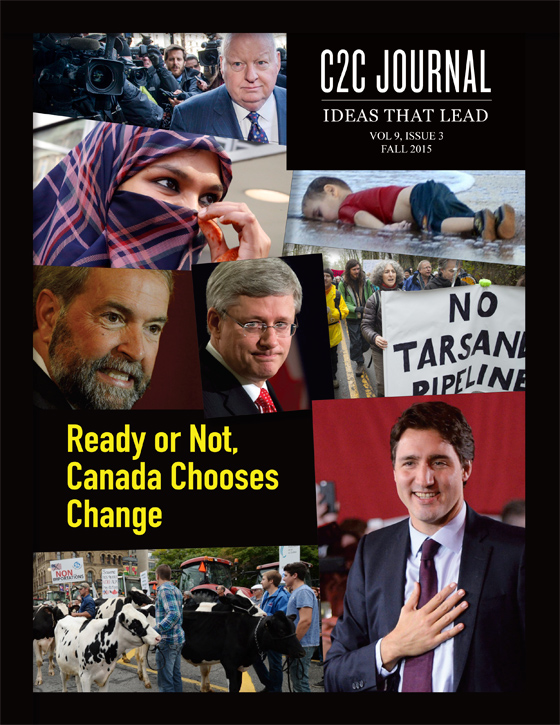
The fall edition of C2C Journal is a compendium of what happened in this turbulent campaign, and why. Most of the pieces were written as the campaign unfolded, beginning with a stage-setter by long time Sun Media editor Paul Stanway that examined the positioning narratives the parties developed over the last year or so and their success – or failure – in getting their messages out in the first month of the campaign.
Swirling around those tightly scripted narratives and improbably costed promises were all the stories the parties can’t control – the Duffy trial, Syrian refugee crisis, candidate bozo eruptions, the niqab flap, and global financial market gyrations. Usually these are the true tests of campaigns, with victory often going to the nimblest. In Campaign ’15, however, most of these eruptions faded as quickly as they arose, influencing the central themes of leadership and change only at the margins.
C2C’s election edition also provided a detailed look at the competition for ethnic votes and an assessment of the Air War, the television advertising and social media bombardment that wallpapered the electoral landscape. And we examined the importance of messy, oppositional ideology in modern politics and campaigns, contrasting it especially with Trudeau’s utopian promise of non-partisan technocracy.
In the latter stages of the campaign we provided detailed analyses of the pre-vote electoral environment in each of Canada’s six regions. Writers based in each region tracked polls, monitored swing ridings and tried to separate reality from spin in conversations with campaign insiders. These pieces collectively chart the evolution of the campaign, highlighting its many twists and turns.
Finally, we wrapped the Fall 2015 edition of C2C Journal with a campaign post-mortem by Colby Cosh. Political historians will be trying to sort out what happened for years, but they would do well to study Colby’s first pass at this history-making election. Among his insights is an analysis of how the Conservatives’ congenital hostility towards the “Media Party” exacerbated the anybody-but-Harper phenomenon and allowed Trudeau to sail through the campaign on a sunny message of hope and change, with little sustained scrutiny or criticism of his vague policies or often shallow, incoherent statements during the debates and scrums.
Many will say that Trudeau won big because he greatly exceeded the low expectations that he, and Conservative party attack ads, had set for him. But from his vow to grow the economy from “the heart outwards” at the start of the campaign to his “sunny ways” victory speech on election night, there was little discernible improvement in his policy depth, maturity, or credibility as a leader.
What happened instead was a relentless focus on Harper’s leadership. Ironically, this was exactly what Conservative election planners had scripted. The economy, security and leadership were the three pillars of their campaign. Ministers, MPs and candidates were all sidelined to keep the spotlight on Harper. The bet was that Harper would win a mano-a-mano showdown with Trudeau by convincing about 10 percent of the two-thirds of Canadians who wanted change that the devil they knew was better than the lightweight heir to the loathsome Trudeau legacy.
As things began to go sideways in the last half of the campaign, the Tory war room doubled down on security with hints of a barbaric cultural practices snitch line and a ban on the niqab in the public service. By the time Harper was coerced into campaigning alongside the notorious Ford brothers, way too many voters had concluded that he was, in fact, the devil.
It is truly a shame the Harper era ended on this surreal note. He ought to be remembered for lowering taxes, shrinking government, putting families back on the political agenda, the eclipse of Quebec nationalism, reviving pride in Canada’s military and history, expanding international trade, and dismantling numerous nanny state artifacts like the gun registry and the wheat board.
In the long run, depending who writes it, history should judge him thus. In the short run, though, his party faces a steep climb back against an impressive Liberal majority, which might have been avoided with a less leadership-focused national campaign and less furniture burning at the end.
~
Paul Bunner is the editor of C2C Journal and a veteran of numerous federal, provincial and municipal elections as a journalist or campaign worker.